International Journal of Emerging Technology and Advanced Engineering
Website: www.ijetae.com (ISSN 2250-2459, Volume 2, Issue 4, April 2012)625
Comparison of different MIMO system using Space Time
Coding in Rayleigh channel
Avinash RameshchandraTrivedi
1, Prof. S.B.Parmar
2, Prof. S.B.Bhatt
31-2 Electronics & Communication Department at Shantilal shah engineering college, Bhavnagar 3
Electronics & Communication Department at B.H.Gardividyapith, Rajkot
1[email protected] 2[email protected]
Abstract—Wireless communication systems growing day by day. It is necessary to develop such a system that gives low BER (Bit Error Rate) and higher system capacity without extra use of bandwidth. MIMO (multiple input Multiple Output) system offers low BER and high system capacity within given bandwidth and power budget. We simulate Space Time Coding (STC) MIMO technique and compare that results with traditional SISO systems. Space Time Code (STC) gives higher performance of BER by code information in both space and time. In this paper we give method to implement STC MIMO system. First we implement STC with BPSK modulation. We simulate STC MIMO systems by increasing number of receiving antennas and compare all results. When we implement STC, choice of modulation scheme is very important issue. We simulate M-ary PSK and ary QAM STC MIMO systems. We compare results of M-ary PSK, M-M-ary QAM and uncoded SISO systems. This paper guides to select proper modulation method as per requirement of BER, data rates and SNR of system.
Keywords— BER (Bit Error Rate), MIMO systems, STC (Space Time Coding), SNR(Signal To Noise Ratio).
I. INTRODUCTION
According to Shannon‘s formula ―Channel Capacity = Bandwidth x log2 (1+SNR)‖ in order to increase channel capacity either the bandwidth or the SNR need to be increased. Until the arrival of multiple-antenna systems, this is the only solutions to increase channel capacity.
Modern multiple-antenna systems can be designed to take advantage of multipath, rather than treat it as something to be avoided, as is the case for traditional single antenna systems. When wireless communication systems are used with multiple-antenna systems it is possible to achieve increased throughput and better error rate performance by taking advantage of the multipath effect.
Multiple Input, Multiple Output (MIMO) [1] technology offers a significant increase in capacity and performance within a given bandwidth and power budget. MIMO systems provide spatial diversity, which can be created without using the additional bandwidth that time and frequency diversity both require. We can also create multiple parallel channels for carrying unique data streams, which is spatial multiplexing. MIMO communication systems increase the system reliability (decrease the bit or packet error rate), Increase the achievable data rate and hence system capacity, Increase the coverage area, decrease the required transmit power.
Space-Time Coding [2] is a MIMO technique that is designed for use with multiple transmitter antennas. This technique introduces temporal and spatial correlation into signals transmitted from different antennas. The intention is to provide diversity at the receiver and coding gain over an uncoded system without sacrificing the bandwidth. The other MIMO technique is spatial multiplexing in which different data streams are transmitted from multiple antennas. These two MIMO techniques have their own advantages and disadvantages, proper technique should be selected as per system requirement. In this paper we will discuss about Space Time Coding (STC) which provides low Bit Error Rate (BER) and high data rates. MIMO systems aim to achieve capacities increasing linearly with a number N, which is the number of antennas on the transmitter side and on the receiver side.
International Journal of Emerging Technology and Advanced Engineering
Website: www.ijetae.com (ISSN 2250-2459, Volume 2, Issue 4, April 2012)626
II. MIMO FUNDAMENTALS
The performance improvement that results from the use of diversity in wireless communications is well known and often exploited. On channels affected by Rayleigh fading, the BER is known to decrease proportionally to SNR-d, where SNR designates the signal-to-noise ratio and designates the system diversity obtained by transmitting the same symbol through d independently faded channels. Diversity is traditionally achieved by repeating the transmitted symbols in time, in frequency or using multiple antennas at the receiver. In the latter case, the diversity gain is compounded to the array gain, consisting of an increase in average receive SNR due to the coherent combination of received signals, which results in a reduction of the average noise power even in the absence of fading. If, in addition to multiple receive antennas, one includes multiple transmit antennas, a MIMO system is obtained.
A communication system, where N signals are transmitted from N transmitters simultaneously is considered. For each time slot t, signals Ct,n n = 1, 2, . . . , N are transmitted simultaneously from N transmit antennas. The signals are the inputs of a input multiple-output (MIMO) channel with M multiple-outputs. Each transmitted signal goes through the wireless channel to arrive at each of the M receivers. In a wireless communication system with M receive antennas; each output of the channel is a linear superposition of the faded versions of the inputs perturbed by noise. Each pair of transmit and receive antennas provides a signal path from the transmitter to the receiver. The coefficient is the path gain from transmit antenna n to receive antenna m. Fig.1 depicts a baseband discrete-time model for a flat fading MIMO channel. Based on this model, the signal rt,m which is received at time t at antenna
m, is given by
, , , ,
t m n m t n t m
N
r
h
c
n
(1).
Where
n
t m, is the noise sample of receive antenna m attime t.
III. SPACE TIME CODING
It is Space-Time code in that it sends information on two transmit antennas (space) over two consecutive transmissions in time. Therefore it is said to transmit information in space and time.
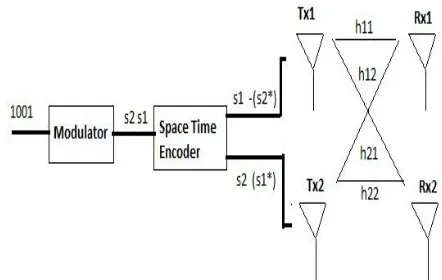
[image:2.612.329.550.252.392.2]This technique captures diversity gains by sending a single data stream in two parts out of two antennas, interleaved with transformed/conjugated versions of the same information, so that the receiver has higher probability of successfully extracting the desired signal. Consider a STC MIMO system, consisting of 2 Transmit and 2 Receive antennas as depicted in Figure below:
Fig 1 Space Time Coding with Two transmit and Two receive antenna
The receiver sees a combination of the transmissions from the two transmit antennas and needs to recover the actual transmitted signals. MIMO systems achieve this by using coding schemes that define which signal should be transmitted and when order to make it possible to recover the original signal. These coding schemes are called ‗Space-Time‘ codes because they define a code across both space (antenna separation) and time (symbols). Space-Time Block Code, so called because the code operates over a block of data. Block codes require less processing power to decode than convolution codes. X is the output of the encoder and S1 and S2 are the input symbols into the encoder [8].
International Journal of Emerging Technology and Advanced Engineering
Website: www.ijetae.com (ISSN 2250-2459, Volume 2, Issue 4, April 2012)627
11 11 1 12 2 11
r
h s
h s
n
(2.A)12 11 2
*
12 1*
12r
h s
h s
n
(2.B)For the first receive antenna, and
21 21 1 22 2 21
r
h s
h s
n
(3.A)22 21 2
*
22 1*
22r
h s
h s
n
(3.B)For the second receive antenna [7].
In these expressions, hji designates the channel response
from Tx i to Rx j, with i, j = 1, 2, and nji designates the
noise on the corresponding channel. This MIMO scheme does not give any spatial multiplexing gain, but it has 4th-order diversity, which can be fully recovered by a simple receiver. [8]. In systems with high SNR performance, the improvement in the error rate achieved as a result of using Space-Time codes could be traded for higher capacity by using a higher order modulation than would otherwise be the case, resulting in marginal increases in throughput.
IV. SIMULATION
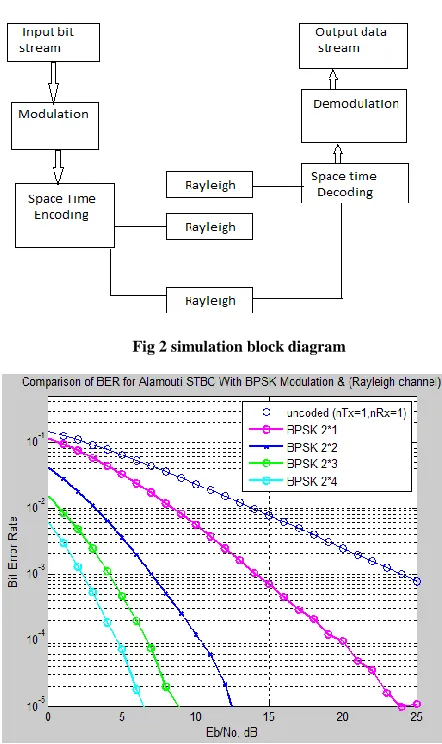
Figure 2 represents the simulation model of Space Time Coding for N transmitter and M receiver antennas. First of all input stream of random binary data is generated. Then input bit stream is converted to symbols by modulation. In this different modulation techniques like PSK and QAM are applied. The generated symbols are encoded using Space time coding, then given to N transmitter antennas. Signals are received by M receiver, hence creates N x M paths between transmitters and receivers. Each path represented by path gains.
WGN White Gaussian Noise) is added to each channel. The received signals are decoded by hard decision decoding technique. Output data stream is compared with input data steam to calculate numbers of Bit errors. The total number of bit errors divided by the total number of bits sent gives the Bit Error Rate (BER) for a particular value of SNR. The simulation is implemented using MATLAB. In this simulation process number of bits per symbols can be increased by applying higher order modulation schemes. The simplest modulation is BPSK (binary phase shift keying) where only one bit per symbol is used. First we simulate the model with 2 Tx and 1 Rx and BPSK modulation.
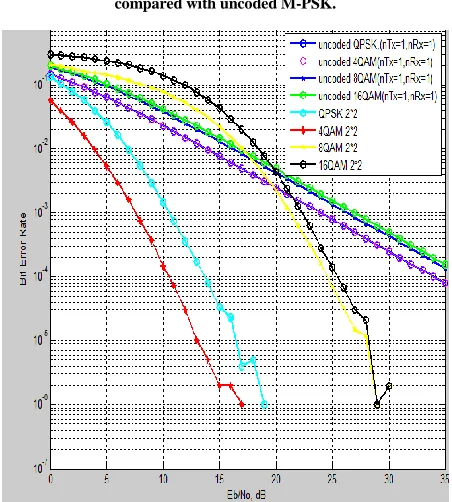
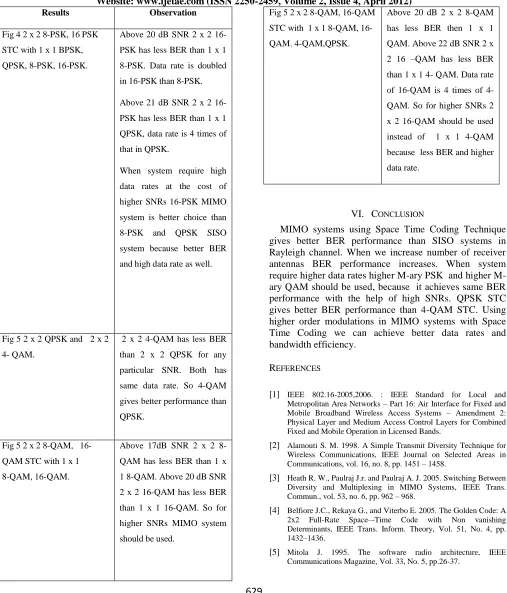
[image:3.612.320.541.316.688.2]With same modulation we increase receive antennas. We simulate BPSK model with 2 Tx and 2 Rx. Then we increase diversity order by increasing receive antennas to 3 and 4. For comparison we simulate all this together and the result is as follows: Further we can simulate higher modulation of PSK like 4-PSK,8-PSK,16- PSK with 2 x 2 STC and compare them with uncoded. The result of this comparison is shown in fig 4. Then we simulate other modulation which is QAM with 2 x 2 STC. We simulate all order of QAM like 4-QAM, 8-QAM, 16-QAM. We compare QAM with QPSK when diversity order is same this comparison is shown in Fig 5.We will later compare BERs at particular SNR for all modulation schemes. when 2 x2 STC is used We will also check BERs for BPSK modulation when 2 x 2, 2 x 3, 2 x 4 STC applied.
Fig 2 simulation block diagram
International Journal of Emerging Technology and Advanced Engineering
Website: www.ijetae.com (ISSN 2250-2459, Volume 2, Issue 4, April 2012)628
V. COMPARISON
Results Observation
Fig 3 uncoded 1 x 1 and 2 x 1 STC with BPSK.
2 x1 MIMO system has better BER performance than 1 x 1 SISO systems.
Fig 3 2 x 1 STC and 2 x 2 STC with BPSK.
[image:4.612.71.552.89.676.2]2 x 2 MIMO system has better BER than 2 x 1 MIMO system for same modulation scheme.
Fig 3 2 x 2, 2 x 3 and 2 x 4 STC with BPSK.
2 x 3 STC has less BER than 2 x 2 STC, 2 x 4 STC has less BER than 2 x 3 STC for BPSK. So if diversity order of MIMO system increases BER of system will decrease for same modulation scheme used.
Fig 4 2 x 2 BPSK, QPSK STC with 1 x 1 BPSK, QPSK
2 x 2 BPSK QPSK STC has less BER than 1 x 1 BPSK QPSK. 2 x 2 QPSK can reduce BER same as 2 x 2 BPSK at cost of higher SNR while data rate is doubled in 2 x 2 QPSK. Fig 4 2 x 2 8-PSK, 16-PSK
STC with
1 x 1 8-PSK, 16-PSK.
2 x 2 8-PSK has less BER than 1 x 1 8-PSK above 9 dB SNR.2 x 2 16-PSK has less BER than 1 x 1 16-PSK above 17 dB SNR. For higher SNRs 2 x 2 8-PSK and 2 x 2 16-8-PSK has better choice than SISO systems for the same.
[image:4.612.323.542.124.374.2]Fig 4 F BER Vs SNR graph for 2 x 2 STC with M-PSK compared with uncoded M-PSK.
[image:4.612.327.553.399.650.2]International Journal of Emerging Technology and Advanced Engineering
Website: www.ijetae.com (ISSN 2250-2459, Volume 2, Issue 4, April 2012)629
[image:5.612.52.559.136.729.2]Results Observation
Fig 4 2 x 2 8-PSK, 16 PSK STC with 1 x 1 BPSK, QPSK, 8-PSK, 16-PSK.
Above 20 dB SNR 2 x 2 16-PSK has less BER than 1 x 1 8-PSK. Data rate is doubled in 16-PSK than 8-PSK. Above 21 dB SNR 2 x 2 16-PSK has less BER than 1 x 1 QPSK, data rate is 4 times of that in QPSK.
When system require high data rates at the cost of higher SNRs 16-PSK MIMO system is better choice than 8-PSK and QPSK SISO system because better BER and high data rate as well.
Fig 5 2 x 2 QPSK and 2 x 2 4- QAM.
2 x 2 4-QAM has less BER than 2 x 2 QPSK for any particular SNR. Both has same data rate. So 4-QAM gives better performance than QPSK.
Fig 5 2 x 2 8-QAM, 16-QAM STC with 1 x 1 8-QAM, 16-QAM.
Above 17dB SNR 2 x 2 8-QAM has less BER than 1 x 1 8-QAM. Above 20 dB SNR 2 x 2 16-QAM has less BER than 1 x 1 16-QAM. So for higher SNRs MIMO system should be used.
Fig 5 2 x 2 8-QAM, 16-QAM STC with 1 x 1 8-QAM, 16-QAM. 4-QAM,QPSK.
Above 20 dB 2 x 2 8-QAM has less BER then 1 x 1 QAM. Above 22 dB SNR 2 x 2 16 –QAM has less BER than 1 x 1 4- QAM. Data rate of 16-QAM is 4 times of 4-QAM. So for higher SNRs 2 x 2 16-QAM should be used instead of 1 x 1 4-QAM because less BER and higher data rate.
VI. CONCLUSION
MIMO systems using Space Time Coding Technique gives better BER performance than SISO systems in Rayleigh channel. When we increase number of receiver antennas BER performance increases. When system require higher data rates higher ary PSK and higher M-ary QAM should be used, because it achieves same BER performance with the help of high SNRs. QPSK STC gives better BER performance than 4-QAM STC. Using higher order modulations in MIMO systems with Space Time Coding we can achieve better data rates and bandwidth efficiency.
REFERENCES
[1] IEEE 802.16-2005,2006. : IEEE Standard for Local and Metropolitan Area Networks – Part 16: Air Interface for Fixed and Mobile Broadband Wireless Access Systems – Amendment 2: Physical Layer and Medium Access Control Layers for Combined Fixed and Mobile Operation in Licensed Bands.
[2] Alamouti S. M. 1998. A Simple Transmit Diversity Technique for Wireless Communications, IEEE Journal on Selected Areas in Communications, vol. 16, no. 8, pp. 1451 – 1458.
[3] Heath R. W., Paulraj J.r. and Paulraj A. J. 2005. Switching Between Diversity and Multiplexing in MIMO Systems, IEEE Trans. Commun., vol. 53, no. 6, pp. 962 – 968.
[4] Belfiore J.C., Rekaya G., and Viterbo E. 2005. The Golden Code: A
2x2 Full-Rate Space–-Time Code with Non vanishing
Determinants, IEEE Trans. Inform. Theory, Vol. 51, No. 4, pp. 1432–1436.
International Journal of Emerging Technology and Advanced Engineering
Website: www.ijetae.com (ISSN 2250-2459, Volume 2, Issue 4, April 2012)630
[6] Tuttlebee Walter H. W.1999 Software-defined radio: Facets of aDeveloping Technology, IEEE Personal Communication Magazine, Vol. 6, No. 2, pp. 38-44.
[7] Hamid Jafarkhani, 2005. Space Time Coding- Theory and Practise, Cambridge University Press.