Journal of Chemical and Pharmaceutical Research, 2014, 6(6):79-85
Research Article
CODEN(USA) : JCPRC5
ISSN : 0975-7384
Bi(OTf)
3as a powerful and efficient catalyst for the synthesis of
highly functionalized piperidines
Louisa Chouguiat, Raouf Boulcina and Abdelmadjid Debache*
Laboratoire de Synthèse de Molécules d'intérêts Biologiques, Université Constantine 1, Constantine, Algérie
_____________________________________________________________________________________________
ABSTRACT
A simple, and efficient multicomponent synthesis of a highly functionalized piperidines has been developed based on a low-cost and environmentally benign Bi(OTf)3 catalyst via a one-pot condensation of aromatic aldehydes, β
-ketoesters and aromatic amines.
Keywords: Bi(OTf)3, Functionalized piperidines, One-pot synthesis, Multicomponent reaction.
_____________________________________________________________________________________________
INTRODUCTION
Pyridine and its partially or totally unsaturated derivatives, namely, the tetrahydropyridines, dihydropyridines and piperidines, are ubiquitous structural motifs found in natural products and in compounds of interest for the pharmaceutical, agrochemical, and other chemical industries.
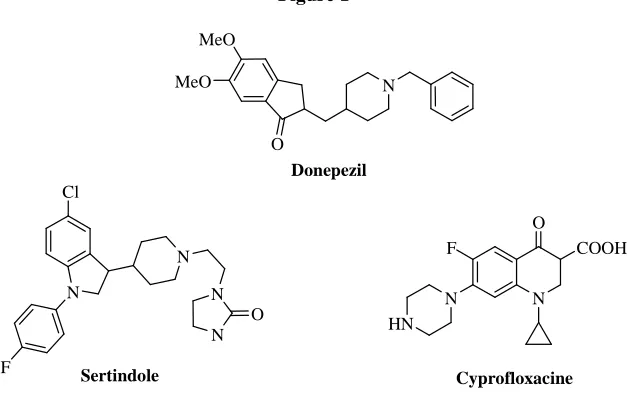
[image:1.595.149.464.523.720.2]Functionalized tetrahydropyridines and piperidines are common substructures found in biologically active natural products and synthetic pharmaceuticals [1].
Figure 1
MeO
MeO
O
N
Donepezil
F
N Cl
N
N
N O
Sertindole
N
COOH O
N HN
F
Cyprofloxacine
______________________________________________________________________________
[3d,e] for the treatment of Schizophrenia (Fig. 1). Some bearing piperidine frameworks (also convertible to the corresponding piperidines) are important in antiparasitic, antiviral, anticancer, antimicrobial, and antimalarial research as well as other fields [4].
For the important reasons mentioned above and due to the bioactivity of many piperidine-containing compounds [5], and although the availability of many traditional procedures for the synthesis of these heterocyclic compounds, the development of efficient and versatile methods for the enantioselective synthesis of these six-membered nitrogen heterocycles continues to be a relevant synthetic goal with the pyridines [6], and piperidines [7], having received much attention in this regard, and to be an important objective in organic chemistry [8].
Nowadays, one-pot multicomponent reactions have received special attention over their multistep variants for reasons of atome economy, energy efficiency, and general environmental friendliness [9].Although, three reports have been made on the one-pot multicomponent synthesis of functionalized piperidines (FP) in high diastereoselectivity, based on InCl3 [10a], Me2S+BrBr- [10b], and TFA-proline [4], ZrOCl2.8H2O [11], Bi(NO3)3.5H2O [12], I2 [13], VCl3 [14], PEG-embedded KBr3 [15], picric acid [16], Oxalic acid dehydrate [17], TBATB [18], [PBBS] or [TBBDA] [19], Acidic ionic liquids [20], Cerium(IV) triflate [21], and BF3-SiO2 [22] from the reaction of aromatic aldehydes, amines, and acetoacetic ester, these methods have limitations in terms of product diversity and yields.
During the last two decades, rare earth metal triflates mediated organic reactions have gained much attention in organic synthesis due to its low toxicity, commercial availability, moisture stability, and recyclability [23].
We herein report an efficient one-pot synthesis of highly substituted and functionalized piperidine derivatives using Bi(OTf)3 as new versatile and efficient catalyst (Scheme 1).
Scheme 1
2
1
R
1CHO
OR
2O
O
R
3NH
2Bi(OTf)
3(10 mol %)
EtOH, Reflux
N
OR
2O
NH
R
1R
1R
3R
33
4
EXPERIMENTAL SECTION
General procedure for the synthesis of highly functionalized piperidines 4.
A mixture of aniline (2 mmol), ethyl acetoacetate or methyl acetoacetate (1 mmol), and Bi(OTf)3 (10 mol %) in 4 ml of ethanol were stirred at 80 °C for 20 min, then aromatic aldehyde (2 mmol) was added and stirring was continued up to completion of the reaction as indicated by TLC. After completion of the reaction, a thick precipitate was obtained. The solid was filtered and washed with cold ethanol-water, and the crude product was purified by crystallization from ethyl acetate-ethanol mixture to yield the highly pure piperidine derivatives. The physical data (M.p., IR, and NMR) of known compounds were found to be identical with those reported in the literature.
Spectroscopic data for:
Ethyl 1,2,6-triphenyl-4-(phenylamino)-1,2,5,6-tetrahydropyridine-3-carboxylate (4a) White crystals, mp 171-173 °C. IR (KBr) ν (cm-1): 3244 (N-H), 1651 (C=O), 1589 (C=C). 1H NMR (250 MHz, CDCl3) δ ppm (J, Hz): 1.53 (3H, t, J=7.0 Hz, CH3CH2), 2,88 (1H, dd, J=15.0, 2.2 Hz, H-5), 2.94 (1H, dd, J=15.0, 2.2 Hz, H-5'), 4.32- 4.5 (2H, m, CH3CH2), 5.2 (1H, s, H-6), 6.33 (1H, s, H-2), 6.54-7.40 (20H, m, Ar-H), 10.37 (1H, s, NH).
13
C NMR (62.5 MHz, CDCl3) δ ppm: 15.2; 34.0 (C-5); 55.4 (C-2); 58.6 (C-6); 60.1; 98.5 (C-3); 113.3; 116.5; 126.1; 126.2; 126,7; 127.0; 127.6; 128.7; 129.1; 129.3; 129.4; 138.2; 143.1; 144.4; 147.3; 156.5 (C-4); 168.7 (C=O).
CDCl3) δ ppm (J, Hz): 1.49 (3H, t, J=7.1 Hz, CH3CH2), 2,78 (1H, dd, J=12.4, 2.8 Hz, H-5), 2.88 (1H, dd, J=9.9, 5.3 Hz, H-5'), 4.32- 4.53 (2H, m, CH3CH2), 5.06 (1H, s, H-6), 6.41 (1H, s, H-2), 6.44 (2H, dd, J=6.1, 1.3 Hz, Ar-H), 6.50 (1H, d, J= 8.2 Hz, Ar-H), 6.51 (1H, t, J= 7.2 Hz, Ar-H), 7.08-7.29 (10H, m, Ar-H), 10.34 (s, 1H, NH). 13C NMR (62.5 MHz, CDCl3) δ ppm: 14.7; 33.6 (C-5); 54.6 (C-2); 57.3 (C-6); 59.8; 97.6; 112.8; 116.6; 125.6; 125.9; 127.7; 128.0; 128.3; 128.7; 129.0; 129.1; 132.0; 132.7; 137.5; 140.8; 142.3; 146.4; 155.7 (C-4); 167.9 (C=O).
Ethyl 2,6-bis(4-bromophenyl)-1-phenyl-4-(phenylamino)-1,2,5,6-tetrahydropyridine-3-carboxylate (4c) White crystals, mp 238-240 °C. IR (KBr) ν cm-1: 3232 (N-H), 1651 (C=O), 1597 (C=C). 1H NMR (250 MHz, CDCl3) δ ppm (J, Hz): 1.49 (3H, t, J=7.1 Hz, CH3CH2), 2.77 (1H, dd, J=15.2, 2.7 Hz, 5), 2.86 (1H, dd, J=15.2, 5.3 Hz, H-5'), 4.34- 4.49 (2H, m, CH3CH2), 5.11 (1H, s, H-6); 6.38 (1H, s, H-2), 6.44 (2H, dd, J=7.7, 2.0 Hz; Ar-H), 6.49 (2H, d, J=8.18 Hz, Ar-H), 6.68 (1H, t, J=7.2 Hz, CH3CH2), 7.02-7.25 (9H, m, Ar-H), 7.41 (2H, d, J=2,5 Hz, Ar-H), 7.44 (1H, d, J=2.6 Hz, Ar-H), 10.32 (1H s, NH). 13C NMR (62.5 MHz, CDCl3) δ ppm: 15.3; 34.1 (C-5); 55.2 (C-2); 57.9 (C-6); 60.3; 98.1; 113.4; 117.2; 120.2; 120.7; 121.4; 126.1; 126.4; 128.6; 128.9; 129.5; 131.8; 132.2; 138.0; 141.9; 143.4; 146.9; 156.3 (C-4); 168.4 (C=O).
Ethyl 2,6-bis(4-nitrophenyl)-1-phenyl-4-(phenylamino)-1,2,5,6-tetrahydropyridine-3-carboxylate (4d) Yellow crystals, mp 246-248 °C. IR (KBr) ν (cm-1): 3244 (N-H), 1597 (C=O), 1255 (C=C). 1H NMR (250 MHz, CDCl3) δ ppm (J, Hz): 1.52 (3H, t, J=7.1 Hz, CH3CH2), 2.91 (2H, m, H-5, H-5'), 4.36-4.56 (2H, m, CH3CH2), 5.30 (1H, s large, H-6), 6.41-6.45 (5H, m, Ar-H), 6.73 (1H, t, J=7.3 Hz, Ar-H), 7.06 (1H, s, Ar-H), 7.10-7.19 (3H, m, Ar-H), 7.55 (4H, m, Ar-H), 8.18 (4H, t, J=8.2 Hz, Ar-H), 10.36 (1H, s, NH). 13C NMR (62.5 MHz, CDCl3) δ ppm: 15.0; 38.0 (C-5); 55.3 (C-2); 57.5 (C-6); 60.4; 97. 0; 113.0; 117.8; 123.9; 124.1; 125.6; 126.5; 127.4; 127.5; 129.3; 129.5; 137.3; 145.9; 146.9; 147.4; 149.9; 151.8; 155.4 (C-4); 167.7 (C=O).
Ethyl 1-phenyl-4-(phenylamino)-2,6-di-p-tolyl-1,2,5,6-tetrahydropyridine-3-carboxylate (4e) White crystals, mp 234-235°C. IR (KBr) ν (cm-1): 3232 (N-H), 1651(C=O), 1597 (C=O). 1H NMR (250 MHz, CDCl3) δ ppm (J, Hz): 1.52 (3H, t, J=7.1 Hz, CH3CH2), 2.39 (6H, s, 2CH3), 2,82 (1H, dd, J=12.6, 2.5 Hz, H-5), 2.93 (1H, dd, J=9.6, 5.4 Hz, H-5'), 4.34- 4.55 (2H, m, CH3CH2), 5.18 (1H, s large, H-6), 6.35 (2H, d, J=8.2 Hz, H), 6.48 (1H, s, Ar-H), 6.59 (2H, d, J=8.4 Hz, Ar-Ar-H), 6.65 (1H, t, J=7.2 Hz, Ar-Ar-H), 7.09-7.30 (11H, m, Ar-Ar-H), 7.27 (2H, d, J= 8.0 Hz, Ar-H), 10.36 (1H, s, NH). 13C NMR (62.5 MHz, CDCl3) δ ppm: 15.2; 21.5; 21.6; 34.1 (C-5); 55.2 (C-2); 58.4 (C-6); 60.1; 98.7; 113.3; 116.4; 126.0; 126.2; 126.7; 126,9; 129.2; 129.3; 129.4; 129.7; 136.2; 137.0; 138.4; 140.1; 144.4; 147.5; 156.5 (C-4); 168.7 (C=O).
Methyl 2,6-bis(4-phenyl)-1-phenyl-4-(phenylamino)-1,2,5,6-tetrahydropyridine-3-carboxylate (4f) White crystals, mp 182-184 °C. IR (KBr) ν (cm-1): 3242 (N-H), 2945, 1650 (C=O), 1598 (C=C). 1H NMR (250 MHz, CDCl3) δ ppm (J, Hz): 2.75 (1H, dd, J= 15.2, 2.7 Hz, H-5), 2.82 (1H, dd, J= 15.2, 5.3 Hz, H-5'), 3.94 (3H, s, COCH3), 5.22 (1H, s, H-6), 6.35 (1H, s, H-2), 6.52-7.42 (00 H, m, Ar-H), 10.2 (1H, s, NH). 13C NMR (62.5 MHz, CDCl3) δ ppm: 34.2 (C-5); 51.7; 55.2 (C-2); 57.8 (C-6); 98.0; 113.4; 117.2; 126.2; 126.5; 128.2; 128.5; 128.9; 129.3; 129.5; 129.6; 132.6; 133.4; 138.1; 141.4; 142.8; 146.9; 156.5 (C-4); 168.8 (C=O).
Methyl 2,6-bis(4-chlorophenyl)-1-phenyl-4-(phenylamino)-1,2,5,6-tetrahydropyridine-3-carboxylate (4g) White crystals, mp 200-202 °C. IR (KBr) ν (cm-1): 3240 (N-H), 2947, 1655 (C=O), 1593 (C=C), 744 (C-Cl). 1H NMR (250 MHz, CDCl3) δ ppm, (J, Hz): 2.79 (1H, dd, J= 15.2, 2.7 Hz, H-5), 2.88 (1H, dd, J= 15.2, 5.3 Hz, H-5'), 3.97 (3H, s, COCH3), 5.15 (1H, s, H-6), 6.41 (1H, s, Ar-H), 6.44 (2H, dd, J= 7.6, 2.1 Hz, Ar-H), 6.55 (2H, d, J= 8.1 Hz, Ar-H), 7.09 (2H, d, J= 1.4 Hz, Ar-H), 7.12-7.30 (10 H, m, Ar-H), 10.3 (1H, s, NH). 13C NMR (62.5 MHz, CDCl3) δ ppm: 34.2 (C-5); 51.7; 55.2 (C-2); 57.8 (C-6); 98.0; 113.4; 117.2; 126.2; 126.5; 128.2; 128.5; 128.9; 129.3; 129.5; 129.6; 132.6; 133.4; 138.1; 141.4; 142.8; 146.9; 156.5 (C-4); 168.8 (C=O).
Methyl 2,6-bis(4-bromophenyl)-1-phenyl-4-(phenylamino)-1,2,5,6-tetrahydropyridine-3-carboxylate (4h) White crystals, mp 228-230 °C. IR (KBr) ν (cm-1): 3240 (N-H), 1655 (C=O), 1593 (C=C), 744 (C-Cl). 1H NMR (250 MHz, CDCl3) δ ppm (J, Hz): 2.76 (1H, d, J=15.2 Hz, H-5), 2.86 (1H, dd, J=15.1, 5.1 Hz, H-5'), 3.95 (3H, s, COCH3), 5.11 (1H, s, H-6), 6.41-6.49 (4H, m, Ar-H), 6.68 (3H, t, J=7.0 Hz, Ar-H), 7.02 (2H, d, J=8.0 Hz, Ar-H), 7.10 (2H, d, J=7.8 Hz, Ar-H), 7.14-7.22 (5H, m, Ar-H), 7.42 (4H, d, J=7.7 Hz, Ar-H), 10.28 (1H, s, NH). 13C NMR (62.5 MHz, CDCl3) δ ppm: 34.3(C-5); 51.9; 55.4 (C-2); 58.1 (C-6); 98.0; 113.5; 117.4; 120.9; 121.6; 126.4; 126.8; 128.8; 129.1; 129.7; 132.0; 132.4; 138.2; 142.1; 143.5; 147.0; 156.7 (C-4); 169.0 (C=O).
______________________________________________________________________________
(62.5 MHz, CDCl3) δ ppm: 15.3; 31.5; 34.1 (C-5); 55.9 (C-2); 58.1 (C-6); 60.5; 98.1; 114.4; 114.5; 115.8; 116.2; 120.9; 121.7; 128.4; 128.5; 128.7; 131.9; 132.4; 134.1; 141.9; 143.1; 156.3 (C-4); 168.5 (C=O).
RESULTS AND DISCUSSION
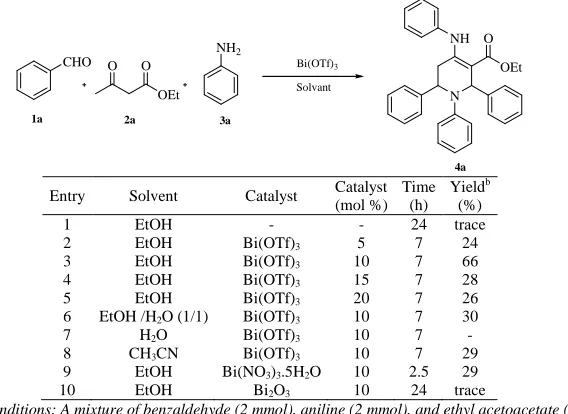
[image:4.595.171.455.290.497.2]The reaction of 2 equivalents of benzaldehyde 1a with 1 equivalent of ethyl acetoacetate 2a and 2 equivalents of aniline 3a was initially carried in ethanol, without the use of catalyst. The reaction was very slow, and the yield was disappointing because it was significantly low compared to that reported in the previous papers (Entry 1, Table 1). In order to improve the yield, we chose Bismuth triflate as catalyst. The results summarized in Table 1 show that the previous condensation proceeded efficiently in the presence of 5 mol % of Bi(OTf)3, but resulting in a very modest yield of the desired product (entry 2). Then, we used different catalyst's amounts to promote the condensation. We found that the product 4a was formed in near a quantitative yield when 10 mol% of the catalyst were used (Entry 3). When we increased the amount of the catalyst to 15 or 20 mol%, the reactions afforded bad results (Entries 4 and 5). By optimizing further the reaction conditions, it was found that the reaction in 50 % aqueous ethanol or by using acetonitrile as solvents, allowed the condensation to be performed however the corresponding tetrahydropyridine was obtained in lower yield (Entries 6 and 8). However, the same reaction carried out in water don't work at all (Entry 7).
Table 1. Optimization of reaction conditions for the synthesis of highly substituted tetrahydropyridinesa
CHO
OEt
O O
NH2
Solvant
N OEt O NH
Bi(OTf)3
1a 2a 3a
4a
Entry Solvent Catalyst Catalyst (mol %)
Time (h)
Yieldb (%)
1 EtOH - - 24 trace
2 EtOH Bi(OTf)3 5 7 24
3 EtOH Bi(OTf)3 10 7 66
4 EtOH Bi(OTf)3 15 7 28
5 EtOH Bi(OTf)3 20 7 26
6 EtOH /H2O (1/1) Bi(OTf)3 10 7 30
7 H2O Bi(OTf)3 10 7 -
8 CH3CN Bi(OTf)3 10 7 29
9 EtOH Bi(NO3)3.5H2O 10 2.5 29
10 EtOH Bi2O3 10 24 trace
a Reaction conditions: A mixture of benzaldehyde (2 mmol), aniline (2 mmol), and ethyl acetoacetate (1 mmol). b Isolated yields.
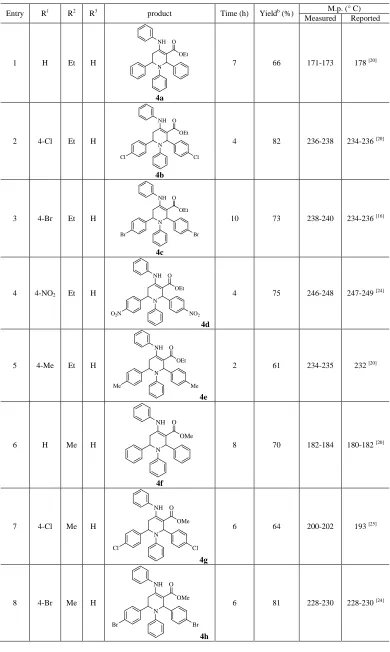
Given the successful development of this new procedure, we were prompted to study the generality of this Bi(OTf)3 -mediated tetrahydopyridine synthesis with various substrates. Table 2 lists several of the prepared products. To explore the scope of this methodology, reactions were performed with various aromatic aldehydes with aniline and ethyl acetoacetate under the same reaction conditions (Table 2, entries 1-5). A variety of electron-rich or electron poor aldehydes with various substitution patterns smoothly underwent the transformation to give the corresponding products in good yields. However, 3-iodobenzaldehyde and 2-nitroaniline did not give the desired products because of the steric hindrance caused by the large iodo and nitro groups respectively. Also, 4-methoxybenzaldehyde remained unaffected under the reaction conditions probably due to the strong electron donating effect of the OMe group, which reduces the electrophilicity of the aldehyde group.
Table 2. Bi(OTf)3-Catalyzed synthesis of tetrahydropyridines under optimized reaction conditionsa Entry R1 R2 R3 product Time (h) Yieldb (%) M.p. (° C)
Measured Reported
1 H Et H
N OEt O NH
4a
7 66 171-173 178 [20]
2 4-Cl Et H N
OEt O NH
Cl Cl
4b
4 82 236-238 234-236 [20]
3 4-Br Et H N
OEt O NH
Br Br
4c
10 73 238-240 234-236 [16]
4 4-NO2 Et H
N OEt O NH
NO2
O2N
4d
4 75 246-248 247-249 [24]
5 4-Me Et H
N OEt O NH
Me Me
4e
2 61 234-235 232 [20]
6 H Me H
N OMe O NH
4f
8 70 182-184 180-182 [20]
7 4-Cl Me H
N OMe O NH
Cl Cl
4g
6 64 200-202 193 [25]
8 4-Br Me H
N OMe O NH
Br Br
4h
[image:5.595.111.501.87.739.2]______________________________________________________________________________
9 4-Br Et 4-F N
OEt O NH Br Br F F 4i
10 63 220-222 218 [22]
a Reaction conditions: A mixture of aromatic aldehydes (2 mmol), anilines (2 mmol), and ethyl/methyl acetoacetate (1 mmol) in the presence of
bismuth triflate (10 mol%) as catalyst.
b Isolated yields.
To find the generality and scope of this MCR, other amines were also examined. Anilines bearing electron-withdrawing groups such as NO2 did not give any product, nevertheless, p-fluroaniline led to the desired piperidine in moderate yield (entry 8) although a prolonged reaction time (10 hours) was required. The low reactivity of anilines containing electron-withdrawing groups can be attributed to their relatively weak nucleophilicity and therefore decreased activity in the Mannich steps of the reaction.
Most of the reactions afforded the corresponding THPs in good to excellent yields irrespective of the position of the substituents present in aldehyde or amine. Work-up was simple and for all the substrates, the following procedure was adopted. Once the reaction was deemed complete (no further conversion in TLC), the precipitated product was collected by filtration. In all cases, simple washing with cold ethanol and crystallization from ethyl acetate/ethanol delivered the desired product in very pure form.
Finally, we proposed in scheme 2, a plausible mechanism in which benzaldehyde 1 was reacted with enamine 5, which was formed initially from condensation of aniline with β-ketoester and the resulting probable Knovenagel product 6 or 7 was then refluxed with pure imine 8 (obtained from the reaction of aniline and aldehyde ), and eventually generating 4.
A second possible mechanism is initiated by the nucleophilic attack by enamine 5 will take place preferentially on the imine 6 to give Mannich type product 9. Then the intermediate 9 reacts with aldehyde to give 10 after dehydration. Further, there will be a spontaneous tendency in the presence of the catalyst for tautomerization to give the intramolecular hydrogen bonded species 11. However, the tautomer 11 immediately undergoes intramolecular Mannich-type reaction to form intermediate 12 which give by tautomerization the final piperidine derivative 4.
Scheme 2 OR2 O O N OR2 NH O
- H2O
Inter-molecular Mannich condensation 3 2 6 1 R1 CHO R1 CHO 7 5 12 11 R3 NH2 N OR2 O N R1 R1 R3 R3 N OR2 O N R1 R1 R3 R3 OR2 O N R1 R3 R3 R3 R1 3 R3 NH2 1 OR2 O N R1 R3 Bi 8 4 N OR2 O NH R1 R1 R3 R3
- H2O R1 CHO 9 10 N OR2 O N R1 R1 R3 R3 HN OR2 O N R1 R3 R3 Bi(OTf)3 +
5 + 8
H
REFERENCES
[1]a) JP Michael, in The Alkaloids, GA Cordell (Ed.), Academic Press: San Diego, 2001, Vol. 55. b) PM Dewick, in
Medicinal Natural Products, John Wiley and Sons: Chichester, 1997, Chapter 6. c) AR Pinder, Nat. Prod. Rep.
1992, 9, 491-504.
[2]J Breman; A Egan; G Keusch, Am. J. Trop. Med. Hyg. 2001, 64, iv.
[3]a) JP Yevich; FD Yocca, Curr. Med. Chem. 1997, 4, 295-312. b) S Targum; J Zborowski; M Henry; P Schmitz; T Sebree; B Wallin, Eur. Neuropsychopharmacol. 1995, 5, 348-349. c) PS Watson; B Jiang; B. A Scott, Org. Lett. 2000, 2, 3679-3681. d) C Walsh, Nature, 2000, 406, 775-781. e) R.G Ridley, Nature, 2002, 415, 686-693.
[4]M Misra; SK Pandey; VP Pandey; J Pandey; R Tripathi; RP Tripathi, Bioorg. Med. Chem. 2009, 17, 625-633. [5]a) Naturally occurring alkaloids: JP Michael, Nat. Prod. Rep. 2004, 21, 625-649. b) D O’Hagan, Nat. Prod. Rep. 2000, 17, 435-446. c) O Plunkett; M Sainsbury, in Rodd’s Chemistry of Carbon Compounds, M Sainsbury, Ed.; Elsevier: Amsterdam; 1998; Vol. 4, pp 365-421. d) W Maison, in Highlights in Bioorganic Chemistry, C Schmuck; H Wennemers (Eds.), Wiley-VCH: New York, 2004, pp. 18-29.
[6]a) GD Henry, Tetrahedron 2004, 60, 6043-6061. b) D Spitzner, in Science of Synthesis, D Black (Ed.), Thieme, Stuttgart, 2005, pp. 11-284. c) D Craig; G. D Henry, Tetrahedron Lett. 2005, 46, 2559-2562. d) MC Bagley; C Glover; EA Merritt, Synlett 2007, 2459-2482.
[7]a) S Laschat; T Dickner, Synthesis 2000, 1781-1813. (b) RW Bates; S-E Kanicha, Tetrahedron 2002, 58, 5957-5978. c) PM Weintraub; JS Sabol; JM Kane; DR Borcherding, Tetrahedron 2003, 59, 2953-2989. d) F-X Felpin; J Lebreton, Eur. J. Org. Chem. 2003, 3693-3712. e) C Escolano; M Amat; J Bosch, Chem. Eur. J. 2006, 12, 8198-8207. f) C De Risi; G Fanton; GP Pollini; C Trapella; F Valente; V Zanirato, Tetrahedron Asymmetry 2008, 19, 131-155.
[8]a) MGP Buffat, Tetrahedron 2004, 60, 1701-1729. b) F-X Felpin; J Lebreton, Curr. Org. Synth. 2004, 1, 83-109. c) S Laschat; T Dickner, Synthesis 2000, 1781-1813. d) M Rubiralta; E Giralt; A Diez, in Piperidine: Structure,
preparation, reactivity, and synthetic applications of piperidine and its derivatives. Elsevier: New York, 1991.
[9] a) A Dömling, Chem. Rev. 2006, 106, 17-89. b) DJ Ramón; M Yus, Angew. Chem., Int. Ed. 2005, 44, 1602-1634. c) A Dömling; I Ugi, Angew. Chem., Int. Ed. 2000, 39, 3168-3210. d) J Zhu, Eur. J. Org. Chem. 2003, 1133-1144. e) RW Armstrong; AP Combs; PA Tempest; SD Brown; TA Keating, Acc. Chem. Res. 1996, 29, 123-131. f) CJ Chapman; CG Frost, Synthesis 2007, 1-21.
[10]PA Clarke; AV Zaytzev; AC Whitwood, Tetrahedron Lett. 2007, 48, 5209-5212. [11]S Mishra; R Ghosh, Tetrahedron Lett. 2011, 52, 2857-2861.
[12]G Brahmachari; S Das, Tetrahedron Lett. 2012, 53, 1479-1484.
[13]AT Khan; MM Khan; KKR Bannuru, Tetrahedron 2010, 66, 7762-7772. [14]S Pal; LH Choudhury; T Parvin, Mol. Divers. 2012, 16, 129-143. [15]S Verma; SL Jain; B Sain, Beistein J. Org. Chem. 2011, 7, 1334-1341.
[16]C Mukhopadhyay; S Rana; RJ Butcher; AM Schmiedekamp, Tetrahedron Lett. 2011, 52, 5835-5840.
[17]SS Sajadikhah; MT Maghsoodlou; N Hazeri; SM Habibi-Khorassani; AC Willis, Chin. Chem. Lett. 2012, 23, 569-572.
[18]AT Khan; M Lal; MM Khan, Tetrahedron Lett. 2010, 51, 4419-4424. [19]G-V Ramin; Sh Hajar, C. R. Chimie 2013, 16, 1047-1054.
[20]HR Shaterian; K Azizi,. J. Mol. Liquids 2013, 180, 187-191.
[21]S Khaksar; SM Vahdat; M Alipour, C. R. Chimie 2013, 16, 1024-1028. [22]R Ramachandran; S Jayanthi; YT Jeong, Tetrahedron Lett. 2012, 68, 363-369.
[23]a) S Kobayashi; M Sugiura; H Kitagawa; WW-L Lam, Chem. Rev. 2002, 102, 2227-2302. b) S Genovese; F Epifano; MC Marcotullio; C Pelucchini; M Curini, Tetrahedron Lett. 2011, 52, 3474-3477, and references cited herein. c) T Ollevier; E Nadeau; A-A Guay-Bégin, Tetrahedron Lett. 2006, 47, 8351-8354.