6HDUFKIRU+LJJVERVRQVEH\RQGWKH6WDQGDUG0RGHO
5DLQHU0DQNHODRQEHKDOIRIWKH&06&ROODERUDWLRQ
1'HXWVFKHV(OHNWURQHQ6\QFKURWURQ'(6<
1RWNHVWU'+DPEXUJ*HUPDQ\
Abstract.WhiletheexistenceofaHiggsbosonwithamassnear125GeVhasbeen
clearlyestablished,thedetailedstructureoftheentireHiggssectorisyetunclear. Be-yondthestandardmodelinterpretation,variousscenariosforextendedHiggssectorsare
beingconsidered.Suchoptionsincludetheminimalandnext-to-minimal supersymmet-ricextensions(MSSMandNMSSM)ofthestandardmodel,moregenericTwo-Higgs
Doubletmodels(2HDM),aswellastrulyexoticHiggsbosonsdecayinge.g.intototally
invisiblefinalstates.ThisarticlepresentsrecentresultsfromtheCMSexperiment.
1 Introduction
The discovery of a Higgs boson at a mass near 125 GeV has been a milestone for Elementary Particle Physics [1, 2]. One of the most relevant questions after this discovery concerns the structure of the Higgs sector. Up to now, the measured properties of the observed state are in accord with the expec-tations of the standard model (SM). Nevertheless, the observed particle could well be only the first member of an extended Higgs sector. Detailed analysis of the Higgs couplings as they are measured from the various decay channels indicate that there is still plenty of room for non-SM decays of the H(125) boson [3]. The most promising approach is the direct search for additional Higgs bosons, or for decays that are forbidden in the SM.
2 Higgs Models Beyond the Standard Model
Supersymmetry presents an elegant solution to the quadratic divergences in the Higgs mass radiative corrections, since the super-partners of the classical particles cancel the corresponding loop contribu-tions. In order to achieve this cancellation, supersymmetry naturally requires additional Higgs bosons. The minimal sypersymmetric standard model (MSSM) features two complex Higgs doublets, leading to five physical Higgs boson states, three of them neutral (h, H, A), commonly denoted asφ, and two of them charged (H±). At tree level, the MSSM is governed by two parameters, mAand tanβ, where
the latter is the ratio between the vacuum expectation values of the two Higgs doublets.
The next-to minimal sypersymmetric standard model (NMSSM) is characterized by two complex Higgs doublets plus an additional singlet field. This results in seven physical Higgs states: h1, h2, h3,
a1, a2and h±.
ae-mail: [email protected] C
The two-Higgs doublet models (2HDM) can be seen as an effective theory, which extends the SM by adding a second complex Higgs doublet. Flavor conservation can be imposed by enforcing symmetries. This leads to four types of 2HDM – Type I, Type II, Lepton-specific and Flipped – which differ in the way the Higgs doublets couple to the fermions. The structure of the MSSM corresponds to a Type II 2HDM, with a similar set of Higgs bosons. In less restricted 2HDM, also flavor-changing Yukawa couplings are possible.
Other models are inspired by warped extra dimensions (WED), as the Randall-Sundrum model. Such models may predict new heavy particles that can decay into pairs of H(125) Higgs bosons. Examples are the radion, which is a particle with zero spin, and the first Kaluza-Klein excitation of the graviton, which has spin two.
3 Search for Neutral MSSM Higgs Bosons in the
ττ
Channel
The decayφ→ττrepresents a good compromise between a relatively large expected branching frac-tion, and manageable backgrounds. Both leptonic (τe,τμ) and hadronicτdecays (τhad) are considered,
and five of the six possible combinations –τeτμ,τeτhad,τμτhad,τhadτhadandτμτμ– are used in this
analysis. The main production modes considered are gluon-gluon fusion, characterized by absence of any b-tagged jet, and b-associated production, where at least one b-tagged jet is required.
The main backgrounds and the way they are estimated in this analysis can only be addressed in broad strokes. Contributions from decays of the Z boson into theττfinal state are estimated using an embedding method. In this technique Z→μμdecays are extracted from real data, and the muon products are replaced by simulatedτdecays. The Z→μμbackground itself, which is most relevant for theτeτμandτμτμchannels, is suppressed by using the distance of closest approach of the two
muon tracks. All distributions are found to be well described by the background hypothesis.
[GeV] φ m
100 200 300 400 1000
[pb]
)
ττ
→φ
(
B
⋅
)
φ
(gg
σ
95% CL
limit on
-3
10
-2
10
-1
10 1 10
2
10
3
10
φ gg
Observed
Expected for SM H(125 GeV) Expected
σ 1 ±
Expected σ 2 ±
(8 TeV)
-1
19.7 fb τ
τ → φ CMS
[GeV] φ m
100 200 300 400 1000
[pb]
)
ττ
→φ
(
B
⋅
)
φ
(bb
σ
95% CL
limit on
-3
10
-2
10
-1
10 1 10
2
10
3
10
φ bb
Observed
Expected for SM H(125 GeV) Expected
σ 1 ±
Expected σ 2 ±
(8 TeV)
-1
19.7 fb τ
τ → φ CMS
Figure 1.Upper limits onσ· B(φ→ττ) at 95% CL for gluon fusion (left) and b-quark associated neutral Higgs boson production (right) for a single narrow resonance (right) [4].
limits agree well, where the latter take the contribution of a SM Higgs boson at 125 GeV into account. The combination of the 7 and 8 TeV datasets allows extension of the Higgs mass range up to 1 TeV.
[GeV]
A
m
200 400 600 800 1000
β
tan
10 20 30 40 50 60
scenario
max h
MSSM m
(MSSM,SM)<0.05:
S
CL Observed Expected
Expected σ 1 ±
Expected σ 2 ±
3 GeV ± 125 ≠
h,H MSSM
m
(7 TeV)
-1
(8 TeV) + 4.9 fb
-1
19.7 fb τ
τ → h,H,A CMS
[GeV]
A
m
200 400 600 800 1000
β
tan
10 20 30 40 50 60
scenario
mod+ h
MSSM m
(MSSM,SM)<0.05:
S
CL Observed Expected
Expected σ 1 ±
Expected σ 2 ±
3 GeV ± 125 ≠
h,H MSSM
m
(7 TeV)
-1
(8 TeV) + 4.9 fb
-1
19.7 fb τ
τ → h,H,A CMS
Figure 2.Expected and observed exclusion at 95% CL limits in the mA−tanβparameter space for the MSSM
mmax
h and m
mod+
h benchmark scenarios [4].
The results are interpreted in the context of the MSSM. The full MSSM Higgs mass spectrum is taken into account. A test statistic comparing the likelihoods of the MSSM and SM hypotheses is computed for each MSSM parameter point, and a point is taken as excluded if the confidence level of the MSSM hypothesis is less than 5%. The resulting constraints in the space of the MSSM parameters mAand tanβare shown in Figure 2. The left plot shows the exclusion limits in the traditional mmaxh
scenario. In this scenario, which was defined before the discovery of the boson at 125 GeV, the radiative correction parameters were tuned such that the mass of the lightest MSSM Higgs boson, h, became as large as possible. As a result, only a narrow band mostly at moderate values of tanβseems possible with themhmass still compatible with the measurement at 125 GeV.
However, this band does not take any uncertainties of the MSSM parameters beyond the tree level into account. Recently, new benchmark scenarios have been created [5] which are better adjusted to the measured mass of the Higgs boson at 125 GeV. The right plot in Figure 2 shows the exclusion limits in the mmod+
h scenario. The 125 GeV mass constraint only results in a lower constraint on tanβ,
and the upper limits only come from the direct search.
4 Charged Higgs Bosons
Observation of a charged Higgs boson would be immediate evidence for physics beyond the SM. If the mass of the H±is below the top mass, it can be produced in top decays. In the MSSM with tanβ <1, the dominant decay mode is H+→c¯s. If the second top quark in a t¯t event decays semi-leptonically, the event topology is similar to that of the t¯t lepton-plus-jets channel, and the signal should appear as a second peak besides the W+in the di-jet invariant mass distribution.
(GeV) jj M 0 20 40 60 80 100 120 140 160 180 200
Events
500 1000 1500 2000
2500 Observed
Diboson
-l
+
l
→ γ
Z/ SingleTOP
ν
l
→
W
t t Total Unc.
s c
→ +
H
= 120 GeV +
H
M b) = 0.2
+
H
→
Br(t
-1 = 8 TeV, 19.7 fb s
CMS Preliminary,
(GeV)
jj
M 0 20 40 60 80 100 120 140 160 180 200
Bkg
Data-Bkg
-0.5 -0.4 -0.3 -0.2 -0.1 0 0.1 0.2 0.3 0.4 0.5
(GeV)
+
H
m
90 100 110 120 130 140 150 160
)
±
bH
→
95% CL
limit on BR(t
0 0.02 0.04 0.06 0.08 0.1 0.12 0.14
Observed
Expected
σ 1 ± Expected limit
σ 2 ± Expected limit
s c → + b, H ± H → t
) = 1 s c → + BR(H
+ jets final state μ
-1 = 8 TeV, 19.7 fb s
CMS Preliminary,
Figure 3.Left: Di-jet mass distributions after all selections. The dotted line represents the total expected event yield in the presence of a charged Higgs boson [6]. Right: Exclusion limit ofB(t→H+b) at 95% confidence level asumingB(H+→c¯s)=100%.
to suppress QCD and Z+jet backgrounds. A kinematic fit is applied constraining both top candidates to their nominal mass, improving the mass resolution of the c¯s candidate. The resulting di-jet invariant mass distribution is shown in Figure 3 (left). This figure also shows the enhancement which would be expected if 20% of the top decays contained a H+boson with a mass of 120 GeV.
No such enhancement is observed in the data. The resulting upper limits for the branching frac-tion B(t→H+b) ranges from 2–3% in the mass interval of 100–150 GeV, on the assumption of
B(H+→c¯s) =100%. These limits apply to practically any BSM resonance with the correspond-ing production and decay topology.
5 Lepton-Flavor Violating Higgs Decays
In the SM, decays violating the lepton flavor conservation are forbidden. However, such decays may be allowed in certain two-Higgs doublet models, composite Higgs or Randall-Sundrum models. This section focuses on a direct search for Higgs decays in the H→μτchannel [7]. The τleptons are identified in their electronic (τe) and hadronicτhaddecay modes. The signature is thus similar to the
H→ττanalysis, but the kinematics differ strongly due to one neutrino less present in the final state. Events are selected which contain, besides an isolated muon, either an isolated lepton or a hadronic
τcandidate. The events are categorized according to the number of jets. As a signal variable, the collinear mass is reconstructed from the visible decay products.
The analysis of the collinear mass spectra shows that the observed distributions are compatible with the background expectations. The observed upper limit for the branching fractionB(H→μτ) is 1.57%, compared to an expected limit of 0.75%, at 95% confidence level. The best-fit result is
), %
τ μ →
95% CL Limit on Br(h
0 2 4 6 8 10
1.57% (obs.) 0.75% (exp.)
τ μ →
h
3.84% (obs.) 3.77% (exp.)
, 2 Jets
e τ μ
2.38% (obs.) 1.66% (exp.)
, 1 Jet
e τ μ
2.04% (obs.) 1.32% (exp.)
, 0 Jets
e τ μ 3.29% (obs.) 1.95% (exp.)
, 2 Jets
had τ μ
2.11% (obs.) 2.10% (exp.)
, 1 Jet
had τ μ 2.94% (obs.) 2.35% (exp.)
, 0 Jets
had τ μ
Observed Expected
σ
1
±
Expected
σ
2
±
Expected
= 8 TeV s ,
-1
19.7 fb CMS preliminary
|
τ μ|Y
-410 10-3 10-2 10-1 1
|
μτ
|Y
-4
10
-3
10
-2
10
-1
10
1 , s = 8 TeV
-1
19.7 fb CMS preliminary
BR<0.1% BR<1% BR<10% BR<50%
τ τ →
LHC h
observed
expected
τ μ →
h μ 3 → τ
γ μ → τ
2
/v
τ
m
μ
|=m
μ τ
Y
τ μ
|Y
Figure 4. Left: Upper limits by category for lepton-flavor violating H→μτdecays [7]. Right: Constraints in the plane of the flavor-violating Yukawa couplings Yτμand Yμτ.
The result can be directly interpreted in terms of the anomalous Yukawa couplings Yτμand Yμτ, and the resulting constraint in the space of these two parameters is shown in Figure 4 (right). This new result improves on the best existing indirect measurements by a factor of≈ 4.4, leading to the best limits to date.
6 Resonant Production of Higgs Pairs
In the SM, the rate of Higgs pair production is very small, and beyond experimental reach with the currently available integrated luminosity recorded at the LHC. But heavy resonances decaying into Higgs pairs in the context of BSM physics could have a much higher cross section, which could be probed with the existing dataset. Candidates for such resonances are heavy MSSM or NMSSM Higgs bosons decaying into a pair of H(125) bosons, but also radions or Kaluza-Klein excitations of the graviton in the context of warped extra dimensions.
The analysis presented here [8] combines the H(125) decay channels into b¯b andγγ, which have the virtues of large branching fraction and good mass resolution, respectively. The selections are similar to the corresponding SM inclusive analyses. A mass-constraint fit is performed on the b¯b candidate using the known mass of the H(125), which improves significantly the mass resolution of the resonance candidates. The signal is searched for in the mγγdistribution for low mX(<400 GeV) and
in the mγγbbdistribution in the high mXregion. Beyond 1100 GeV, there is an increased probability
(GeV)
γ γ
m
100 110 120 130 140 150 160 170 180
Events / ( 1 GeV )
2 4 6 8 10 12 14 16 18 20
= 8 TeV s
-1
CMS Preliminary L = 19.7 fb
= 350 GeV
X
m Data Fit
σ 2 ± Fit
σ 1 ± Fit Medium purity
b b γ γ → HH → X
(GeV)
kin jj
γ γ
m
400 500 600 700 800 900 1000 1100 1200
Events / ( 10 GeV )
0 1 2 3 4 5 6 7 8 9
= 8 TeV s
-1
CMS Preliminary L = 19.7 fb
Data
Fit
σ
2
±
Fit
σ
1
±
Fit
Medium purity b b γ γ → HH → X
Figure 5. Left: Di-photon invariant mass spectrum from the low-mX analysis for a mass hypothesis of
mX=350 GeV [8]. Right: Spectrum of the invariant mass of the HH candidate in the high-mXregion.
(GeV)
X
m
300 400 500 600 700 800 900 1000 1100
) (fb)
b
b
γγ
→
HH
→
BR(X
×
X)
→
(pp
σ
10
-2 -110
1
10
2
10
WED: kl = 35, k/Mpl = 0.2, elementary top, no r/H mixing = 3 TeV)
R
Λ
radion (
= 1 TeV)
R
Λ
radion (
RS1 KK-graviton
Bulk KK-graviton
Observed 95% upper limit
Expected 95% upper limit
σ
1
±
Expected limit
σ
2
±
Expected limit
= 8 TeV s
-1
CMS Preliminary L = 19.7 fb
In absence of a signal, upper limits on the product of cross section and branching fraction are derived and displayed in Figure 6. They are compared to predictions of radion and graviton models. The results exclude radions with m<970 GeV for the radion scaleΛR=1 TeV, and RS1 KK gravitons
in the mass range of 340–400 GeV.
7 Invisible Higgs Decays
Invisible Higgs boson decays are possible in a wide range of models, including decays to neutralinos in supersymmetric models, or graviscalars in models with extra dimensions. According to Higgs-portal models, the Higgs boson could be a mediator between the SM particles and particles of the dark matter sector. The analysis of couplings, under certain assumptions, constrains the branching fraction into non-SM decay modes indirectly to<32% [3].
Figure 7.Feynman diagrams for Higgs production is association with a Z boson decaying into a pair of leptons (left) and b-quarks (middle), and in vector boson fusion (right). The Higgs boson is assumed to decay invisibly.
Direct searches for invisible Higgs decays are possible in final states where the Higgs boson recoils against a visible system [9]. Examples are the associated production with a Z boson decaying either leptonically or to a b-quark pair, as illustrated in Figure 7 (left) and (middle), or vector boson fusion (VBF) as depicted in Figure 7 (right).
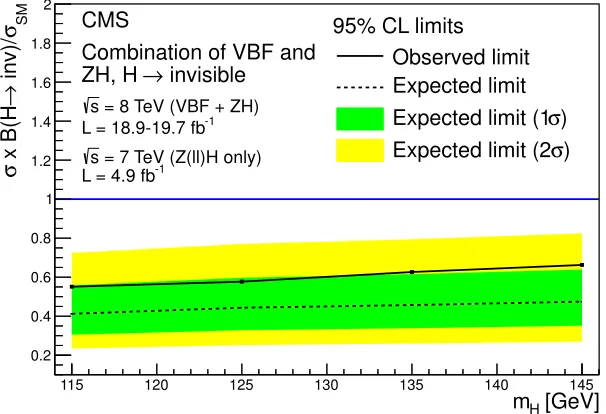
While the VBF process is favored by the larger SM cross section, the final state of two jets plus missing transverse energy suffers from large backgrounds. These are mainly events containing vector bosons and additional jets, where the vector bosons are not seen, like Z bosons decaying into neutrinos. The signal is analyzed in the variables of missing transverse energy and di-jet mass. The observed distributions of these variables are shown in Figure 8. They are well described by the SM background distributions as they are estimated from data, and no excess attributable to invisible Higgs production is seen. The combined analysis of the VBF and Z-associated processes results in upper limits of the invisible branching fraction of a Higgs produced if it is produced according to the SM production cross section, which is shown in Figure 9. The observed upper limit of this branching fraction is 58% at a mass of 125 GeV at 95% confidence level. This result represents a considerable improvement with respect to earlier direct searches.
8 Summary
[GeV]
miss T
E
150 200 250 300 350 400 450 500
Events / 20 GeV
-1
10 1 10
2
10
3
10
4
10 CMS
-1
= 8 TeV, L = 19.5 fb s
VBF H(inv)
Observed
inv) = 100%
→
B(H = 125 GeV,
H
VBF m
V+jets
, tW, DY(ll)+jets, VV t
t
[GeV]
jj
M
1500 2000 2500 3000 3500
Events / 100 GeV
-2
10
-1
10 1 10
2
10
3
10
4
10 CMS
-1
= 8 TeV, L = 19.5 fb s
VBF H(inv)
Observed
inv) = 100%
→
B(H = 125 GeV,
H
VBF m
V+jets
, tW, DY(ll)+jets, VV t
t
Figure 8.Distributions of missing transverse energy (left) and di-jet invariant mass (right) in the signal region of the invisible Higgs VBF analysis. A potential signal contribution from a hypothetical Higgs boson at a mass of 125 GeV decaying exclusively into invisible modes is shown as red lines [9].
[GeV]
H
m
115 120 125 130 135 140 145
SM
σ
inv)/
→
x B(H
σ
0.2 0.4 0.6 0.8 1 1.2 1.4 1.6 1.8 2
CMS
Combination of VBF and
invisible
→
ZH, H
= 8 TeV (VBF + ZH) s
-1
L = 18.9-19.7 fb
= 7 TeV (Z(ll)H only) s
-1
L = 4.9 fb
95% CL limits
Observed limit
Expected limit
)
σ
Expected limit (1
)
σ
Expected limit (2
will significantly extend the reach, especially towards higher masses, and open a rich future research programme in the BSM Higgs sector.
References
[1] CMS Collaboration, “Observation of a new boson at a mass of 125 GeV with the CMS experiment at the LHC”, Phys.Lett. B716 (2012) 3061.
[2] ATLAS Collaboration, “Observation of a new particle in the search for the Standard Model Higgs boson with the ATLAS detector at the LHC”, Phys.Lett. B716 (2012) 129.
[3] CMS Collaboration, “Precise determination of the mass of the Higgs boson and studies of the compatibility of its couplings with the standard model”, CMS PAS HIG-14-009 (2014).
[4] CMS Collaboration, “Search for neutral MSSM Higgs bosons decaying to a pair of tau leptons in pp collisions”, JHEP10(2014) 160.
[5] M. Carena et al., “MSSM Higgs Boson Searches at the LHC: Benchmark Scenarios after the Discovery of a Higgs-like Particle”, Eur.Phys.J. C73 (2013) 2552.
[6] CMS Collaboration, “Search for a light charged Higgs boson in the H+→c¯s channel”, CMS PAS HIG-13-035 (2013).
[7] CMS Collaboration, “Search for lepton flavor violating decays of the Higgs boson”, CMS PAS HIG-14-005 (2014).
[8] CMS Collaboration, “Search for the resonant production of two Higgs bosons in the final state with two photons and two bottom quarks”, CMS PAS HIG-13-032 (2014).
![Figure 1. Upper limits on σ · B(φ → ττ) at 95% CL for gluon fusion (left) and b-quark associated neutral Higgsboson production (right) for a single narrow resonance (right) [4].](https://thumb-us.123doks.com/thumbv2/123dok_us/8174313.1365102/2.482.44.438.380.562/figure-upper-fusion-associated-neutral-higgsboson-production-resonance.webp)
![Figure 2. Expected and observed exclusion at 95% CL limits in the mA − tan β parameter space for the MSSMmmaxhand mmod+hbenchmark scenarios [4].](https://thumb-us.123doks.com/thumbv2/123dok_us/8174313.1365102/3.482.53.439.111.299/figure-expected-observed-exclusion-parameter-mssmmmaxhand-hbenchmark-scenarios.webp)
![Figure 3. Left: Di-jet mass distributions after all selections. The dotted line represents the total expected eventyield in the presence of a charged Higgs boson [6]](https://thumb-us.123doks.com/thumbv2/123dok_us/8174313.1365102/4.482.54.423.77.258/figure-distributions-selections-represents-expected-eventyield-presence-charged.webp)
![Figure 4. Left: Upper limits by category for lepton-flavor violating Hthe plane of the flavor-violating Yukawa couplings Y → μτ decays [7]](https://thumb-us.123doks.com/thumbv2/123dok_us/8174313.1365102/5.482.55.440.72.281/figure-category-avor-violating-avor-violating-yukawa-couplings.webp)
![Figure 5.Left: Di-photon invariant mass spectrum from the low-mX analysis for a mass hypothesis ofmX = 350 GeV [8]](https://thumb-us.123doks.com/thumbv2/123dok_us/8174313.1365102/6.482.82.408.317.538/figure-left-photon-invariant-mass-spectrum-analysis-hypothesis.webp)