© 2017, IRJET | Impact Factor value: 5.181 | ISO 9001:2008 Certified Journal | Page 468
DEBLURRING OF LICENSE PLATE IMAGE USING BLUR KERNEL
ESTIMATION
S. Bemila Joy
1, Dr.M. Kanan
21Master of Engineering in Applied Electronics, Department of ECE, Kathir College Of Engineering,
Coimbatore,Tamilnadu
2 Head of The Department, Department of ECE, Kathir College Of Engineering, Coimbatore, Tamilnadu
---***---
Abstract -
As the unique identification of a vehicle, licenseplate is a key clue to uncover over-speed vehicles or the ones involved in hit-and-run accidents. However, the snapshot of over-speed vehicle captured by surveillance camera is frequently blurred due to fast motion, which is even unrecognizable by human. Those observed plate images are usually in low resolution and suffer severe loss of edge information, which cast great challenge to existing blind de-blurring methods. For license plate image de-blurring caused by fast motion, the blur kernel can be viewed as linear uniform convolution and parametrically modelled with angle and length. In this paper, we propose a novel scheme based on sparse representation to identify the blur kernel. By analyzing the sparse representation coefficients of the recovered image, we determine the angle of the kernel based on the observation that the recovered image has the most sparse representation when the kernel angle corresponds to the genuine motion angle. Then, we estimate the length of the motion kernel with Radon transform in Fourier domain. Our scheme can well handle large motion blur even when the license plate is unrecognizable by human. We evaluate our approach on real-world images and compare with several popular state-of-the-art blind image de-blurring algorithms. Experimental results demonstrate the superiority of our proposed approach in terms of effectiveness and robustness.
1. OBJECTIVE AND SCOPE OF THE PROJECT
The snapshot of over-speed vehicle captured by surveillance camera is frequently blurred due to fast motion, which is even unrecognizable by human. Those observed plate images are usually in low resolution and suffer severe loss of edge information, which cast great challenge to existing blind de-blurring methods. This paper, we propose a novel scheme based on sparse representation to identify the blur kernel. By analyzing the sparse representation coefficients of the recovered image, we determine the angle of the kernel based on the observation that the recovered image has the most sparse representation when the kernel angle corresponds to the
genuine motion angle. Then, we estimate the length of the motion kernel with Radon transform In Fourier domain.
2. EXISTING SYSTEM
Blind image de-convolution is an ill-posed problem that requires regularization to solve. However, many common forms of image prior used in this setting have a major drawback in that the minimum of the resulting cost function does not correspond to the true sharp solution. Accordingly, a range of workaround methods are needed to yield good results (e.g. Bayesian methods, adaptive cost functions, alpha-matte extraction and edge localization). In this paper we introduce a new type of image regularization which gives lowest cost for the true sharp image. This allows a very simple cost formulation to be used for the blind de-convolution model, obviating the need for additional methods. Due to its simplicity the algorithm is fast and very robust. We demonstrate our method on real images with both spatially invariant and spatially varying blur. In this work blurring kernel is formed by constraint equation in which the first term is the likelihood that takes into account the formation model Eqn. 1 The second term is the new l1=l2 regularizer on x which encourages scale-invariant sparsity in the reconstruction. To reduce noise in the kernel, we add l1 regularization on k. The constraints on k (sum-to-1 and non-negativity) follow from the physical principles of blur formation. The scalar weights and control the relative strength of the kernel and image regularization terms. Eqn. 2 is highly non convex. The standard approach to optimizing such a problem is to start with an initialization on x and k, and then alternate between x and k updates [4]. To make consistent progress along each of the unknowns and avoid local minima as far as possible, only a few iterations are performed in each update.
2.1 DISADVANTAGES OF EXISTING SYSTEM
Not enough de-blurring
© 2017, IRJET | Impact Factor value: 5.181 | ISO 9001:2008 Certified Journal | Page 469
3. PROPOSED SYSTEM
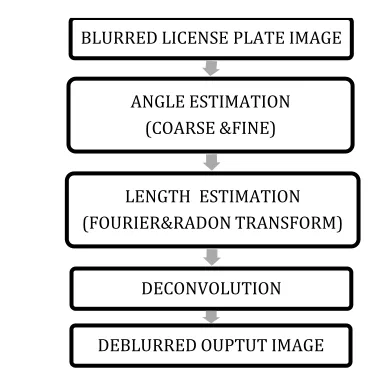
In this paper, we target on this challenging BID problem: blind de-blurring of fast moving license plate, which is severely blurred and even unrecognizable by human. Our goal is to recover a sharp license plate with confidence that the restored license plate image can be recognized by human effortlessly. Generally speaking, the blur kernel is dominated by the relative motion between the moving car and static surveillance camera, which can be modeled as a projection transform. However, the kernel can be approximated by linear uniform motion blur kernel. The task of blur kernel estimation can be reduced to the estimation of two parameters in the linear motion kernel: angle (θ) and length (l). Given a linear kernel I^θ,l,kθ,l, a corresponding de-blurred image I^θ,l can be obtained by applying NBID on the blurred image B with kθ,l. Then the sparse representation coefficients of I^θ,l on pre-trained dictionary can be denoted as A(θ, l), which is a function of θ and l. We observe that A(θ, l) shows very useful quasi-convex characteristic under a fixed l. By utilizing this interesting characteristic, we can infer the true angle of the blur kernel efficiently. Once the angle is determined, on the direction parallel to the motion, the power spectrum of blurred image is obviously affected by the linear kernel based on which the spectrum is a sinc-like function, and the distance between its two adjacent zero-crossings in frequency domain is determined by the length of kernel. In order to reduce the effect of noise and improve the robustness of length estimation, we utilize the Radon transform in frequency domain. After kernel estimation, we obtain the final de-blurring result with a very simple NBID algorithm.
[image:2.612.61.252.517.702.2]3.1 BLOCK DIAGRAM
Fig 1.4 Block diagram of proposed system
3.2 PROPOSED SYSTEM ADVANTAGES
Speed and very low complexity, which makes it very well suited to operate on real scenarios.
This model can handle very large blur kernel.
This model is very robust so that the images which even cannot be identified by eyes can also de-blurred
4. PROJECT DESCRIPTION
4.1 INTRODUCTION
License plate is the unique ID of each vehicle and plays a significant role in identifying the trouble-maker vehicle. Nowadays, there are lots of auto over-speed detection and capture systems for traffic violation on the main roads of cities and high-ways. However, the motion of vehicle during the exposure time would cause the blur of snapshot image. Therefore, the exposure time (shutter speed) has significant impact on the amount of blur. For video shooting exposure time is largely dependent on the illumination situations. In usual outdoor scene with sunshine, the typical exposure time is about 1/300 second. For a vehicle running at 60 miles per hour, during the exposure time, the displacement of license plate is about 9 centimeters which is comparable with the size of the license plate (14 × 44 centimeters in China), i.e., the length of kernel is about 45 pixels when the license plate image is with size of 140×440 pixels and the angle between camera imaging plane and horizontal plane is about 60 degree. In such a scenario, the blur of license plate cannot be neglected. In an ideal scenario with sound illumination, the blur from shorter exposure time, say, 1/1000 second, can be minor and may not damage the semantic information. However, under poor illumination situations, the camera has to prolong the exposure time to obtain a fully exposed image, which easily incurs the motion blur. Besides, for high-resolution digital cameras, high-speed video-graphy is also susceptible to motion blur [1]. When the vehicle is over-speeded, such blurring effect from fast motion becomes much more severe, resulting in plates far from detectable, recognizable and difficult for retrieval .In this scenario, the fundamental task of license plate de-blurring is to recover the useful semantic clue for identification. For example, for a blurred snapshot of over-speed vehicle, the most important issue is to recognize its license plate afterimage de-blurring.
In the last decades, blind image de-blurring/de-convolution (BID) has gained lots of attention from the image processing community. Although some advances have been made, it is still very challenging to address BLURRED LICENSE PLATE IMAGE
ANGLE ESTIMATION (COARSE &FINE)
LENGTH ESTIMATION (FOURIER&RADON TRANSFORM)
DECONVOLUTION
© 2017, IRJET | Impact Factor value: 5.181 | ISO 9001:2008 Certified Journal | Page 470
many real-world cases. Mathematically, the model of image blurring can be formulated as:
B(x, y) = (k ∗I )(x, y) + G(x, y) (1)
where B, I, and k denote the blurred image, the sharp image we intend to recover, and the blur kernel, respectively; G is the additive noise (usually regarded as white Gaussian noise); and ∗denotes convolution operator. For BID, the kernel k and sharp image I are both unknown. According to whether the kernel k is spatially-invariant or not, the BID problem can be divided into two categories: uniform BID and non-uniform BID. For uniform BID, the kernel k is often called point spread function.
In recent years, many effective BID algorithms have been proposed. Due to the ill-posed nature of BID, prior knowledge is usually introduced to avoid falling into the incorrect solutions. Most of them simultaneously estimate kernel from the blurred image and apply a non-blind image de-blurring (NBID) algorithm recursively to approach the true solution [6]–[10]. Another alternative is to take a two-step strategy, in which the key point is to estimate an accurate kernel, then NBID algorithm is only applied once to obtain the final restored image [11]–[13]. Compared with the classical BID problems, license plate de-blurring has its own distinctive characteristics. In this scenario, instead of improving the visual quality, we are more interested in generating a recognizable result. The challenges for license plate de-blurring lie in three aspects.
1) The surveillance camera is usually designed for capturing a big scene that includes a whole vehicle; therefore, the license plate only occupies a small region of the whole image. This leads to insufficient details for kernel estimation.
2) Due to the fast motion, the size of blur kernel is very large. The edge information is degraded severely and is unavailable from blurred images. Therefore, the methods based on large scale edges cannot work robustly and even may fail in some situations.
3) The content of license plate image is very simple, most of edges lie in horizontal and vertical directions. Thus, the methods based on isotropy assumption may also not work well for license plate image.
4.2 ESTIMATION OF BLUR KERNEL
Generally, the blur kernel is determined by the relative motion between the moving vehicle and static surveillance camera during the exposure time. When the exposure time is very short and the vehicle is moving very fast, the motion can be regarded as linear and the speed can be
considered as approximately constant. In such cases, the blur kernel of license plate image can be modeled as a linear uniform kernel with two parameters: angle and length. In the following we introduce how to utilize sparse representation on over-complete dictionary to evaluate the angle of kernel robustly. After the angle estimation, frequency domain-based method is proposed to estimate the length of kernel.
4.2.1 ANGLE ESTIMATION OF UNIFORM KERNEL:
Scarcity on learned over-complete dictionary as the prior of sharp image has been well discussed [21], [22], however, sparse representation has received little attention in parameter inference. In fact, parameter estimation also corresponds to an optimization problem in a Bayesian view. For angle estimation, it can be regarded as solving the following problem:
Where B is the blurred image, I denotes the latent image to be recovered, kθ is the linear uniform motion kernel determined by angle θ (ignore length here), and p(I ) is the prior of the sharp image. By introducing sparse representation, in our angle estimation algorithm, we attempt to solve:
where D is pre-learned over-complete dictionary on the sharp license plate images, Ωi is the patch extraction operator, and αi is the sparse representation coefficients of the i-th patch. The physical meaning of Eq. (4) is that the angle we intend to estimate is the one with which the recovered sharp image has the sparsest representation. The key to solve Eq. (4) is to estimate the gradient ∑| |. However, it is difficult to directly solve such a two-layer optimization problem. In order to investigate the relation between ∑| |and the variable θ, we decompose Eq. (4) into two simpler sub-problems. For a given parameter pair (θ, l), we first solve the following optimization problem,
Then the sparse representation coefficient can be computed by solving:
© 2017, IRJET | Impact Factor value: 5.181 | ISO 9001:2008 Certified Journal | Page 471
l).The main difficulty in solving the optimization by Eq. (4) is that the gradient cannot be calculated efficiently. However, the quasi-convex property from the sparse representation brings a great improvement on this optimization problem. Even though the gradient ∂ A/∂θ has no closed form, we can estimate the gradient by computing Eq. (5) and (6) twice. Then we use the gradient descent method to find the optimization value. In Fig. 4 and Fig. 5, we can see that there are several outliers on the curves. In order to reduce the effect of outliers, the step of gradient descent should not be too small. However, large step may lead to the degradation of accuracy.
So we propose a two-step coarse-to-fine angle estimation algorithm, which will Different from the general natural scene images, license plate images usually only contain some specific characters, such as English letters and digits. Therefore, license plate images are characterized by very particular and limited patterns, which can be well learned by sparse representation in this paper, our dictionary is trained on sharp license plate images. Hence, the prior knowledge about license plate images is already embedded in the over-complete dictionary. In this view, the prior used in this paper is more specific and adaptive, which is beneficial to angle estimation. Sparse representation coefficients show great potential in the angle estimation of linear uniform kernel. A natural extension is to apply it to the length inference. However, sparse representation coefficients do not show such quasi-convex characteristic with the variation of length.
4.2.2 LENGTH ESTIMATION OF UNIFORM KERNEL:
Once the direction of motion has been fixed, we can rotate the blurred image to make this direction horizontal. Then the uniform linear motion blur kernel has the form as below:
The magnitude of the frequency response of k(x,y)on horizontal direction is given by the following equation:
Where N is the size of blurred image in pixel. Given two successive zero points v1, v2 of Fk(v), it is easy to obtain that:
Thus, the core of length estimation is to estimate the distance between two adjacent zero points of frequency response of kernel. In frequency domain, the uniform blur model can be written as:
Where F denotes the Fourier transform operator. We can find that the zero points of Fk is also the zero points of FB
without considering noise. In most of real situations, it is difficult to directly search zero points in the frequency response of observed image. Due to noise, the zero points of FK may not exactly denote the zero points of FB; however, the magnitude of FB around zero points still can be distinguished from other points as the power spectrum of natural images along lines through the origin point obeys the following power-law
where the value of γ may vary with the angle of lines due to the presence of large scale edge. Next, we exploit the power-law and Radon transform to infer the distance between two adjacent zero points of |Fk |.
Radon transform is an integral transform that collects the sum of a function over straight lines. Radon transform result can be represented by the angle between horizontal axes α and the distance to the origin point ρ . For BID, Radon transform is proposed to estimate the motion blur kernel, especially when the observed image is corrupted by noise. In our length estimation algorithm, we adopt the modified Radon transform which only considers the center area of blurred image. The modified Radon transform is defined as:
Where f is a general 2D function to be Radon transformed. For the blurred images, under weak noise assumption (FG
≈0), we have
Based on the assumption of power-law, for one fixed angle
α, Rlog|FI |(ρ)is also a polynomial function. We use a three
order polynomial function to fit Rlog|FB|(ρ).
© 2017, IRJET | Impact Factor value: 5.181 | ISO 9001:2008 Certified Journal | Page 472
4.3 MATERIALS AND METHODS
The work presented in this study consists of three major modules:
1. Blur Angle Estimation 2. Blur Length Estimation 3. Image De convolution
4.3.1 MODULE DESCRIPTION
MODULE 1: BLUR ANGLE ESTIMATION
In the angle estimation stage, we adopt a twostep coarse -to-fine framework. In the first step, the quasi-convex property is utilized to find the initial best angle under coarse granularity for any moderate length. The algorithm is summarized in Algorithm 1. In general, it only takes several iterations for Algorithm 1 to converge. Once the initial estimated angle is obtained, we perform the fine angle estimation. In Algorithm 1, all the operations are applied on a fixed length; whereas the fine estimation of angle is implemented on a multi-length setting, the details of which can be found in Algorithm 2. In both Algorithms 1 and 2, it is critical to solve Eq. (5) and (6). The over-complete dictionary D is pre-trained on the sharp license plate images. Both dictionary learning and Eq. (6) are solved with Lee’s feature-sign algorithm [46]. For Eq. (5), there are many successful algorithms [47]. In this paper, we adopt the popular split-Bregman method [48]. We rewrite problem (5) into the following form:
The detail of solving Eq. (15) (or equally Eq. (5)) is listed in. In the angle estimation stage, the NBID algorithm does not involve complicated prior information. The reason is that complicated prior usually incurs high computational complexity. The length estimation scheme is summarized in Algorithm 4 and its principle can be found.
COARSE ANGLE ESTIMATION:
For the Eq. (5), λ is set as 500. We find that λ can vary in a wide range without notable impact on the final de-blurred results. In the coarse angle estimation stage, the step is 5 considering the robustness and computing complexity. Another parameter is the starting angle θ0. For over-speed car license plate blur, the angle of motion kernel is usually in the range [70, 110]. So we set θ0 as 90°. For Eq. (6),
sparse representation is applied to overlapped patches. The patches with the size of 8 × 8 are sampled every 6 pixels along horizontal and vertical axes. And the sum of absolute value of all patches’ sparse representation coefficients is regarded as the final score.
ALGORITHM 1:
INPUT:
blurred image B, step Δ, initial angle θ0, moderate length l, k=0Step 1: while not converged do
Step 2: Generate linear kernel , ,
Step 3: solve equation (5) with , , to get
, ,
Step 4: solve equation (6) with , , to get
, ,
Step 5: if ( ==min ( , , ))
Step 6: Converged and return
Step 7: else if ( ==min( , , ))
Step 8: Step 9: else
Step 10: Step 11: end while OUTPUT:
FINE ANGLE ESTIMATION:
In the fine angle estimation stage, centering at the output θ
of the last module, we generate a series of parameter pairs
(θi, li ), where the length lilies in the range [25, 49] with step size 3, and θi lies in the range [θ −10, θ +10] with step size 5. That means we have 45 images to apply NBID and sparse coding algorithm. Since this process is highly separated, parallel algorithm can be designed for it. Then we select six angles corresponding to the smallest sparse representation scores. The average of the six angels is taken as the final angle. In the angle estimation stage, de-convolution is done on each RGB channel independently. Sparse representation is only implemented on the luminance channel considering the computing complexity.
ALGORITHM 2:
INPUT: blurred image B, θ from 1, moderate length l Step 1: generate series of pairs (θi, li ),
Step 2: solve equ (5) with Ki to get Ii Step 3: solve equ (6) with Ii to get Ai Step 4: sort Ai in increasing order Step 5: get top k-Ai and θ
© 2017, IRJET | Impact Factor value: 5.181 | ISO 9001:2008 Certified Journal | Page 473
MODULE 2: BLUR LENGTH ESTIMATION
ALGORITHM 3:
INPUT: blurred image B, output of algorithm 2 θ
Step1: Extend B into square image of size NxN and calculate logarithm of frequency magnitude denoted by log(| |)
Step2: Apply radon transform on log(| |) over angle θ to
get | | (ρ)
Step3: Fit | | (ρ) by third order polynomial to get
̂ | | (ρ)
Step4: Get consecutive distance between minimum of
| | (ρ) - ̂ | | (ρ)
Step 5: Get estimated length L=N/d OUTPUT: Blur length L
MODULE 3: IMAGE DECONVOLUTION:
From length and angle uniform blur kernel is created. After obtaining the blur kernel, the final non-blind de-blurring is done with the NBID algorithm proposed by LUCY RICHARDSON
4.3.2 METHODOLOGIES - GIVEN INPUT AND
EXPECTED OUTPUT:
MODULE-1:
Input image is blurred license plate image which undergoes coarse and fine angle estimate algorithm to get blur angle.
MODULE-2:
Input blurred license plate image is radon transformed to find length of blur kernel
MODULE-3:
From blur angle and length blur kernel is produced and then NBID de-convolution is done frequency domain.
5. SNAP SHOT
ORIGINAL IMAGE
BLURRED INPUT IMAGE
OUTPUT IMAGE
6. CONCLUSION
© 2017, IRJET | Impact Factor value: 5.181 | ISO 9001:2008 Certified Journal | Page 474
estimate the angle efficiently. The length estimation is completed by exploring the well-used power-spectrum character of natural image. One advantage of our algorithm is that our model can handle very large blur kernel. As shown by experiments ivory the license plate that cannot be recognized by human, the de-blurred result becomes readable.
Another advantage is that our scheme is more robust. This benefits from the compactness of our model as well as the fact that our method does not make strong assumption about the content of image such as edge or isotropic property. In our scheme, we only use very simple and naïve NBID algorithm. And there is still obvious artifact in the de-blurred results. However, for many practical applications, people are more interested in identifying the semantics of the image. From this view, our scheme brings great improvement on the license plate recognition. In future, I am planning to estimate the length using cepstral analysis. This method will estimate the length accurately than kernel estimation method which gives more clear image than we have obtained now.
7. REFERENCES:
[1] Y.-W. Tai, H. Du, M. S. Brown, and S. Lin, “Correction of spatially varying image and video motion blur using a hybrid camera,” IEEE Trans. Pattern Anal. Mach. Intell., vol. 32, no. 6, pp. 1012–1028, Jun. 2010
[2] W. Zhou, H. Li, Y. Lu, and Q. Tian, “Principal visual word discovery for automatic license plate detection,” IEEE Trans. Image Process., vol. 21, no. 9, pp. 4269–4279, Sep. 2012
[3] L. Xu, S.Zheng, and J. Jia, “Unnatural l0 sparse representation for natural image deblurring,” in Proc. IEEE Conf. Comput. Vis. Pattern Recognit. (CVPR), Jun. 2013, pp. 1107–1114.
[4] Q. Shan, J. Jia, and A. Agarwala, “High-quality motion deblurring from a single image,” ACM Trans. Graph., vol. 27, no. 3, p. 73, 2008
[5] J. P. Oliveira, M. A. T. Figueiredo, and J. M. Bioucas-Dias, “Parametric blur estimation for blind restoration of natural images: Linearmotion and out-of-focus,” IEEE Trans. Image Process., vol. 23, no. 1, pp. 466–477, Jan. 2014
[6] J.-F. Cai, H. Ji, C. Liu, and Z. Shen, “Blind motion deblurring from a single image using sparse approximation,” in Proc. IEEE Conf. Comput. Vis. Pattern Recognit. (CVPR), Jun. 2009, pp. 104–111.
[7] M. Elad and M. Aharon, “Image denoising via sparse and redundant representations over learned dictionaries,” IEEE Trans. Image Process., vol. 15, no. 12, pp. 3736–3745, Dec. 2006.
[8] O. Whyte, J. Sivic, and A. Zisserman, “Deblurring shaken and partially saturated images,” in Proc. IEEE Int. Conf. Comput. Vis. Workshops (ICCV Workshops), Nov. 2011, pp. 745–752.
[9] D. Krishnan, T. Tay, and R. Fergus, “Blind deconvolution using a normalized sparsity measure,” in Proc. IEEE Conf. Comput. Vis. Pattern Recognit. (CVPR), Jun. 2011, pp. 233– 240.