http://dx.doi.org/10.4236/apm.2014.410062
Irreducible Representations of Algebraic
Group
SL
(
6,
K
)
in
char
K
= 3
Zhongguo Zhou
College of Science, Hohai University, Nanjing, China
Email:
[email protected]
Received 15 August 2014; revised 12 September 2014; accepted 21 September 2014
Copyright © 2014 by author and Scientific Research Publishing Inc.
This work is licensed under the Creative Commons Attribution International License (CC BY).
http://creativecommons.org/licenses/by/4.0/
Abstract
For each irreducible module
L
( )
λ
Xi Nanhua defined an element which generated this module.
We use this element to construct a certain basis for
L
( )
λ
and then compute
dimL
( )
λ
,
deter-mine its formal characters in this paper. In order to obtain faster speed we modify the algorithm
to compute the irreducible characters.
Keywords
Irreducible Character, Semisimple Algebraic Group, Composition Factor
1. Introduction
The determination of all irreducible characters is a big theme in the modular representations of algebraic groups
and related finite groups of Lie type. But so far only a little is known concerning it in the case when the
charac-teristic of the base field is less than the Coxeter number.
Gilkey-Seitz gave an algorithm to compute part of characters of
L
( )
λ
’s with
λ ∈
X T
1( )
for
G
being of
type
G
2,
F
4,
E
6,
E
7and
E
8in characteristic 2 and even in larger primes in
[1]
. Dowd and Sin gave all
characters of
L
( )
λ
’s with
λ ∈
X T
1( )
for all groups of rank less than or equal to 4 in characteristic 2 in
[2]
.
They got their results by using the standard Gilkey-Seitz algorithm and computer. L. Scott
et al
. computes the
characters for
A
4when
p
=
5
,
p
=
7
by computing the maximal submodule in a baby Verma module
[3]
.
Anders Buch and Niels Lauritzen also obtain this result for
A
4when
p
=
5
with Jantzen’s sum formula
[4]
.
An element
( )
1n n
p ρ λ
u
−
− −
∈
x
for each irreducible module
L
( )
λ
with
λ ∈
X
n( )
T
was defined in [
[5]
, §
39.1, p. 304] and [
[6]
, p. 239]. This element could be used in constructing a certain basis for
L
( )
λ
, computing
( )
cha-racters for the special linear groups
SL
(
5,
K
)
,
SL
(
6,
K
)
and
SL
(
7,
K
)
, the special orthogonal group
(
7,
)
SO
K
and the symplectic group
Sp
(
6,
K
)
over an algebraically closed field
K
of characteristic 2 in
[7]
[8]
and for the special orthogonal group
SO
(
6,
K
)
and the symplectic group
Sp
(
6,
K
)
over an algebraically
closed field
K
of characteristic 3 in
[9] [10]
. However, it needs so much time to compute the irreducible
cha-racters for other groups. In the present note, we shall work out all irreducible chacha-racters for the simple algebraic
groups of type
A
5over an algebraically closed field
K
of characteristic 3 with modified algorithm to obtain
faster speed. We shall freely use the notations in
[9] [11]
without further comments.
2. Preliminaries
Let
G
be the simple algebraic group of type
A
5over an algebraically closed field
K
of characteristic 3.
Take a Borel subgroup
B
and a maximal torus
T
of
G
with
T
⊂
B
. Let
X T
( )
be the character group
of
T
, which is also called the weight lattice of
G
with respect to
T
. Let
R
⊂
X T
( )
be the root system
as-sociated to
(
G T
,
)
, and choose a positive root system
R
+in such a way that
−
R
+corresponds to
B
. Let
{
1,
2,
3,
4,
5}
S
=
α α α α α
be the set of simple roots of
G
such that
{
1,
2,
3,
4,
5,
ij i j, 1
5
}
R
+=
α α α α α α
=
α
+ +
α
≤ < ≤
i
j
Let
ω
i(
1
≤ ≤
i
5
)
be the fundamental weights of
G
such that
(
ω α
i,
j)
δ
ij∨
=
, the Kronecker delta, and denote
by
λ
=
(
λ λ λ λ λ
1,
2,
3,
4,
5)
the weight
λ λ ω λ ω
=
1 1+
2 2+
λ ω λ ω
3 3+
4 4+
λ ω
5 5with
λ λ λ λ λ ∈
1, , , ,
2 3 4 5
, the
integer ring. Then the dominant weight set is as follows:
( )
{
(
1,
2,
3,
4,
5)
( )
1,
2,
3,
4,
50
}
X T
+=
λ λ λ λ λ
∈
X T
λ λ λ λ λ
≥
Let
W
=
N
G( )
T
T
be the Weyl group and let
W
3be the affine Weyl group of
G
. It is well-known that
for
λ
∈
X T
( )
+,
H
0( )
λ
is the induced
G
-module from the 1-dimensional
B
-module
K
λwhich contains a
unique irreducible
G
-submodule
L
( )
λ
of the highest weight
λ
. In this way,
X T
( )
+parameterizes the
fi-nite-dimensional irreducible
G
-modules. We set
ch
( )
λ
=
ch
(
H
0( )
λ
)
and
ch
3( )
λ
=
ch
(
L
( )
λ
)
for all
( )
X T
λ
∈
+. Moreover,
ch
( )
λ
is given by the Weyl character formula, and for
λ
∈
X T
( )
+, we have
( )
det
( )
( ) ( )
(
(
)
)
ch
det
w Ww W
w e w
w e w
λ ρ
λ
ρ
∈ ∈
+
=
∑
∑
For
λ =
(
a b c d e
, , , ,
)
∈
X T
1( )
, we have
(
)
(
)(
)(
)(
)(
)(
)(
)(
)(
)
(
)(
)(
)(
)(
)
(
)
0
8 3
1
dim
, , , ,
1
1
1
1
1
2
2
2
2
2 3 5
3
3
3
4
4
5 .
H
a b c d e
a
b
c
d
e
a
b
b
c
c
d
d
e
a
b
c
b
c
d
c
d
e
a
b
c
d
b
c
d
e
a
b
c
d
e
=
+
+
+
+
+
+ +
+ +
+ +
+ +
+ + +
+ + +
+ + +
+ + + +
+ + + +
+ + + + +
Let
F
nbe the
n
-th Frobenius morphism of
G
with
G
n⊂
G
the scheme-theoretic kernel of
F
n. Let
[ ]
nV
be the Frobenius twist for any
G
-module
V
. It is well-known that
V
[ ]
nis trivial regarding as a
G
n-
module. Moreover, any
G
-module
M
has such a form if the action of
G
non
M
is trivial. Let
( ) (
{
1,
2,
3,
4,
5)
( )
1,
2,
3,
4,
53
}
n n
X
T
=
λ λ λ λ λ
∈
X T
+λ λ λ λ λ
<
Then the irreducible
G
-modules
L
( )
λ
’s with
λ ∈
X
n( )
T
remain irreducible regarded as the
G
n-modules.
On the other hand, any irreducible
G
n-module is isomorphic to exactly one of them.
For
λ
∈
X T
( )
+, we have the unique decomposition
( )
( )
0 1 0 1
3
nwith
X
nT
,
X T
λ λ
=
+
λ
λ
∈
λ
∈
+( )
( ) ( )
0 1[ ]
nL
λ
≅
L
λ
⊗
L
λ
Therefore we can determine all the characters
ch
3( )
λ
with
λ
∈
X T
( )
+by using the Steinberg tensor
product theorem, provided that all the characters
ch
3( )
λ
with
λ ∈
X T
1( )
are known.
Recall the strong linkage principle in
[12]
. We define a strong linkage relation
µ λ
↑
in
X
+( )
T
if
L
( )
µ
occurs as a composition factor in
H
0( )
λ
. Then
H
0( )
λ
is irreducible when
λ
is a minimal weight in
( )
X T
+with respect to the partial ordering determined by the strong linkage relations.
Let
g
be the simple Lie algebra over
which has the same type as
G
, and
U
the universal enveloping
algebra of
g
. Let
e
α,
f
α,
h
i(
α
∈
R i
+,
=
1, 2, 3, 4, 5
)
be a Chevalley basis of
g
. We also denote
e
αI,
f
αIby
,
I Ie
f
, respectively, where
I
∈ =
{
1, 2, 3, 4, 5,12, 23, 34, 45,13, 24, 35,14, 25,15
}
The Kostant
-form
U
of
U
is the
-subalgebra of
U
generated by the elements
e
α( )
k:
=
e
αkk
!
,
f
α( )
k:
=
f
αkk
!
for
α
∈
R
+and
k
∈
+. Set
(
)(
1
) (
1
)
:
!
i i i
i
h
c
h
c
h
c
k
h
c
k
k
+
+ −
+ − +
+
=
Then
h
ic
k
+
∈
U
for
i
=
1, 2, 3, 4, 5
,
c
∈
,
k
∈
+. Define
U
k:
=
U
⊗
K
and call
U
kthe hyperal-
gebra over
K
associated to
g
. Let
k, ,
k 0k+ −
U
U
U
be the positive part, negative part, zero part of
U
k, respec-
tively. They are generated by
e
α( )
k,
f
α( )
kand
ih
k
, respectively. By abuse of notations, the images in
U
kof
( )
ke
α,
f
α( )
k,
ih
c
k
+
, etc. will be denoted by the same notations, respectively. The algebra
U
kis a Hopf alge-
bra, and
U
khas a triangular decomposition
U
k=
U U U
k− 0k k+. Given a positive integer
n
, let
U
nbe the sub-
algebra of
U
kgenerated by the elements
e
α( )
k,
f
α( )
k,
ih
k
for
α
∈
R
+,
i
=
1, 2, 3, 4, 5
and
0
3
nk
≤ <
. In
particular,
U
=
U
1is precisely the restricted enveloping algebra of
g
. Denote by
n, ,
n 0n+ −
U
U
U
the positive
part, negative part, zero part of
U
n, respectively. Then we have also a triangular decomposition
U
n=
U U U
n− 0n n+.
Given an ordering in
R
+, it is known that the PBW-type bases for
U
kresp. for
U
nhave the form of
( )
5( )
=1
a i c
R i i R
h
f
e
b
α α
α α
α∈ + α∈ +
∏
∏
∏
with
a
α, ,
b c
i α∈
+resp. with
0
, ,
3
n ia
αb c
α≤
<
.
Let
λ
=
(
λ λ λ λ λ
1,
2,
3,
4,
5)
∈
X
n( )
T
. We set
λ
I=
∑
i I∈λ
ifor
I
∈
, here each element
I
is also viewed as
a certain set of simple roots. Following
[5]
[6]
, we define an elements
x
λin
U
n−by
( ) ( ) ( ) ( ) ( ) ( ) ( ) ( ) ( ) ( ) ( ) ( ) ( ) ( ) ( )
1 12 13 14 15 2 23 24 25 3 34 35 4 45 51 2 3 4 5 1 2 3 4 1 2 3 1 2 1
f
λf
λf
λf
λf
λf
λf
λf
λf
λf
λf
λf
λf
λf
λf
λ λ=
x
As a special case of [
[5]
, Theorems 6.5 and 6.7], we have
Theorem 1 Assume that
g
is a simple Lie algebra of the simple algebraic group of type
A
5over an
algebraically closed field K of characteristic
3
. Let
λ
=
(
λ λ λ λ λ
1,
2,
3,
4,
5)
∈
X
n( )
T
.
(i) The element
x
λlies in
U
n−.
(ii) Let
J
λbe the left ideal of
U
kgenerated by the elements
( )
k,
i,
i,
( )
kii i
h
e
f
k
k
λ α
∨
−
(
i
=
1, 2, 3, 4, 5, 1, 3
k
≥
k
i≥
n)
and the elements
f
n−
∈
U
with
( )
3n 10
f
ρ λ
− −
=
x
. Then
U
kJ
λ≅
L
( )
λ
(Note
that
L
( )
λ
has a
U
k-module structure, which is irreducible).
(iii) As a
U
n−-module,
L
( )
λ
is isomorphic to
( )
3n 1 n ρ λ− − −
U x
.
By abuse of notations, the images in
U
kJ
λ≅
L
( )
λ
of
(ki) if
and
( )
kI Inotations. We shall use this theorem to computer the multiplicities of the weight spaces for all the dominant
weight of
L
( )
λ
, to compute
dim
L
( )
λ
, and to determine
ch
(
L
( )
λ
)
=
ch
3( )
λ
(
λ
∈
X T
1( )
)
in this note,
when
G
is the simple algebraic group of type
A
5.
3. Characters of Irreducible Modules of
G
From now on we shall assume that
n
=
1
. Denote by
V
∗the dual module of
V
, then we have by the duality
that
ch
H
0( )
λ
∗=
ch
(
−
w
0λ
)
, and
ch
L
( )
λ
∗=
ch
3(
−
w
0λ
)
. Furthermore, the elements
f
I(
I
∈
)
satisfy the
following commutator relations:
1 2 2 1 12 2 3 3 2 23
3 4 4 3 34 12 3 3 12 123
23 4 4 23 234 1 23 23 1 123
2 34 34 2 234 1 234 234 1 1234
12 34 34 12 1234 123 4 4 123 1234
,
,
,
,
,
,
,
,
,
,
I I I
f f
f f
f
f f
f f
f
f f
f f
f
f f
f f
f
f f
f f
f
f f
f f
f
f f
f f
f
f f
f
f
f
f f
f f
f
f
f
f f
f
f f
′f f
′=
+
=
+
=
+
=
+
=
+
=
+
=
+
=
+
=
+
=
+
=
Ifor all the other ,
I I
′∈
.
Now we can obtain our main theorems. Let
e
( )
w Ww
( )
ν
ν
=
∑
∈ν
be the sum of weights of the W-orbit of
ν
for all
ν
∈
X T
( )
+. It is well-known that
{
ch
( )
ν ν
∈
X T
( )
+}
,
{
ch
3( )
ν ν
∈
X T
( )
+}
and
{
e
( )
ν ν
∈
X T
( )
+}
form bases of
X T
( )
W, the W-invariant subring of
X T
( )
, respectively. According to the Weyl
character formula and the Freudenthal multiplicity formula, we get a change of basis matrix
( )
( )
, X T
A
a
λν λ ν+
∈
=
from
{
e
( )
ν ν
∈
X T
( )
+}
to
{
ch
( )
ν ν
∈
X T
( )
+}
, which is a triangular matrix with 1 on its diagonal,
i.e
.
( )
( )
( )
,
ch
X T
a e
λνν λ ν
λ
ν
+
∈
=
∑
with
a
λλ=
1
(cf.
[10]
). Based on our computation, we get another change of basis matrix
( )
, X T( )
B
b
λν λ ν+
∈
=
from
{
e
( )
ν ν
∈
X T
( )
+}
to
{
ch
3( )
ν ν
∈
X T
( )
+}
, which is also a triangular matrix with 1 on its diagonal.
Let us mention our computation of
B
more detailed. First of all, we compute
x
2ρ λ−for any
λ ∈
X T
1( )
. It
is well known that for each dominant weight
ν
of
H
0( )
λ
,
β λ ν
= −
can be expressed in terms of sum of
positive roots, and there exist many ways to do so. Each way corresponds to an element
f
βx
2ρ λ−in
U
n. Then
we compute various
f
βx
2ρ λ−. Note that each
f
βx
2ρ λ−can be written as a linear combination of the basis
ele-ments of
U
nwith non-negative integer coefficients, and the typical images of all non-zero
f
βx
2ρ λ−’s generate
the weight space
L
( )
λ
νof the irreducible submodule
L
( )
λ
of
H
0( )
λ
. Therefore, we can easily determine
the dimension of
L
( )
λ
ν, provided that we compute the rank of the set of all these non-zero
f
βx
2ρ λ−’s. It can
be reduced to compute the rank of a corresponding matrix. Finally, we obtain the formal character of
L
( )
λ
,
which can be written as a linear combination of
e
( )
ν
’s with non-negative integer coefficients. That is
( )
( )
( )
3
,
ch
X T
b e
λνν λ ν
λ
ν
+
∈
=
∑
with
b
λλ=
1
. In this way, we get the second matrix
B
.
For example, we assume that
G
is the simple algebraic group of type
A
5and
λ =
(
2,1, 2,1, 2
)
.
It is easy to see that
(
)
( ) ( )
2 2( ) ( )
2 22ρ λ− 01010
f f f f f
2 1 3 2 4f
3f f f
2 1 5f
4f f
3 2=
=
=
x
x
x
For
ν =
(
3, 0,1, 2, 2
)
, we have
λ ν
− = −
(
1,1,1, 1, 0
−
)
=
α
2+
α
3.
First we compute each of the set
{
2 3,
23}
SS
ν=
f f
x
f
x
. Then we compute the rank of the set
SS
ν, which is equal to 2. So we have
(
)
(
3,0,1,2,2)
{
1 2 2 3 3 4 1 2 2 3 34 1 2 3 234 1 2 23 34 1 23 234 1 2 23 3 41 23 23 4 12 2 3 3 4 12 2 3 34 12 23 34 12 234 3 12 23 3 4
123 23 4 123 2 3 4 123 2 34 12
, , , , ,
,
,
,
,
,
,
, ,
,
SS
f f f f f f
f f f f f
f f f f
f f f f
f f f
f f f f f
f f f f
f f f f f
f f f f
f f f
f f
f
f f f f
f
f f
f
f f f
f
f f
f
µ
=
x
x
x
x
x
x
x,
x
x
x
x
x
x
x
x
3 234f
x
, ,
f
1234f
23x
f
1234f f
2 3x
}
and then we compute the rank of the set
SS
µ, which is equal to 13. So we have
(
)
(
)
2,0,1,1,3dim
L
2,1, 2,1, 2
=
13
.
By this methods, we can calculate all multiplicity
b
λνFinally, we obtain the formal character of irreducible
module
ch
3(
2,1, 2,1, 2 .
)
When
λ
lies in
X T
( )
+but not in
X T
1( )
, we can also compute the formal character
ch
3( )
λ
by using
the Steinberg tensor product theorem. For
λ
∈
X T
( )
+, we have the unique decomposition
( )
( )
0 1 0 1
1
3
with
X T
,
X T
λ λ
=
+
λ
λ
∈
λ
∈
+Then the Steinberg tensor product theorem tells us that
( )
( ) ( )
0 13 3 3
ch
λ
=
ch
λ
⋅
ch
3
λ
Therefore, we can determine all characters
ch
3( )
λ
with
λ
∈
X T
( )
+, provided that all characters
ch
3( )
λ
with
λ ∈
X T
1( )
are known. For example, when
λ =
(
0, 2, 0, 0, 3
)
, we have
(
)
(
)
(
)
(
(
) (
) (
)
)
(
)
(
) (
) (
) (
) (
) (
) (
)
3
3 3
ch
0, 2, 0, 0, 3
ch
0, 2, 0, 0, 0 ch
0, 0, 0, 0, 3
0, 2, 0, 0, 0
1, 0,1, 0, 0
0, 0, 0,1, 0
0, 0, 0, 0, 3
0, 2, 0, 0, 3
2, 0, 0, 0,1
1, 0,1, 0, 3
1,1, 0, 0, 2
0,1, 0, 0,1
0, 0, 0,1, 3
0, 0,1, 0, 2 .
e
e
e
e
e
e
e
e
e
e
e
=
⋅
=
+
+
⋅
=
+
+
+
+
+
+
Therefore, from the two matrices
A B
,
, we can easily get the third change of basis matrix
D
=
AB
−1from
( )
( )
{
ch
3ν ν
∈
X T
+}
to
{
ch
( )
ν ν
∈
X T
( )
+}
, which is still a triangular matrix with 1 on its diagonal. The
ma-trix
D
gives the decomposition patterns of various
H
0( )
λ
with
λ
∈
X T
( )
+.
We list the matrix
D
in the attached tables. In all these tables, the left column indicates
λ
’s. For two
weight
ν λ
∈
X T
( )
+, the number
d
λνin tables is just the multiplicity of composition factors
( ) ( )
0
:
H
λ
L
ν
.
4. Faster Algorithm
In paper
[9] [10]
, we compute the multiplicity
b
λνone by one for a fixed weight
λ
However, noticing that
some information computing
b
λνmay be useful to compute
b
λµfor
ν µ
So we compute all possible
f
βsuch that
SS
λ=
{ }
f
βx
spanning to the whole
L
( )
λ
firstly. Then we compute
SS
λ=
{ }
f
βx
in some ordering:
if
1 2
f
β=
f f
β βthen we first obtain
2
1
y
=
f
βx
save this result and compute
1
2 1
y
=
f
βx
=
f y
βinstead of
com-puting
1 2
f
βx
=
f f
β βx
directly. In fact we only need compute
f y
βfor some positive root
β
and
y
∈
SS
λin
one step.
For example, suppose to compute
{
f f
3 4x
,
f f
23 4x
}
we can compute
y
1=
f
4x
at the first step, and then
compute
y
2=
f y y
3 1,
3=
f y
23 1In this way, we can avoid much repeated work.
In order to obtain the results the computer must work several days. So we must be careful to avoid error.
There are facts to verity the results.
At firstly, we compute the dimension of weight space, then by Sternberg tensor formula and Weyl formula we
obtain the decomposition pattern of
H
0( )
λ
.
At last checking all the data we find that
1). Symmetry of dimension of weight space. Checking the results the two equations are satisfied:
(
)
(
)
(
)
(
)
(
)
(
)
(
)
(
)
1 2 3 4 5 5 4 3 2 1
1 2 3 4 5 5 4 3 2 1
1 2 3 2 1 , , , , 1 2 3 2 1 , , , , 1 2 3 4 5 , , , , 5 4 3 2 1 , , , ,
dim
,
,
,
,
dim
,
,
,
,
,
dim
,
,
,
,
dim
,
,
,
,
.
L
L
L
L
µ µ µ µ µ µ µ µ µ µ
µ µ µ µ µ µ µ µ µ µ
λ λ λ λ λ
λ λ λ λ λ
λ λ λ λ λ
λ λ λ λ λ
=
=
2). Symmetry of composition factors. From the
0( )
s
H
λ ′
decomposition patterns, the following equations
are hold:
(
) (
)
(
) (
)
0 0
1
,
2,
3,
2,
1:
1,
2,
3,
4,
5 1,
2,
3,
2,
1:
5,
4,
3,
2,
1H
λ λ λ λ λ
L
µ µ µ µ µ
H
λ λ λ λ λ
L
µ µ µ µ µ
=
3). Positivity of multiplicity of composition factors. All the multiplicity of composition factors we obtained
are nonnegative.
4). Linkage principle is hold. If the multiplicity of composition factors
H
0( ) ( )
λ
:
L
ν
≠
0
then we have
.
µ λ
↑
From the representation theory of algebraic groups, all the above results should be hold, so the computational
data is compatible with the theory.
5. Main Results
Theorem 2 When
G
=
SL
(
6,
K
)
,
let
(
) (
) (
) (
)
{
(
) (
) (
)
(
) (
) (
) (
) (
) (
)
}
1( )
2, 2, 2, 2, 2 , 1, 2, 2, 2, 2 , 1, 2, 2, 2, 2 , 2,1, 0, 2, 2 , 2, 2, 0,1, 2 , 2, 2, 2, 0,1 , 1, 0, 2, 2, 2 ,
2, 0,1, 2, 2 , 2, 2,1, 0, 2 , 0, 2, 2, 2, 2 , 2, 2, 2, 2, 0 , 0,1, 2, 2, 2 , 2, 2, 2,1, 0
X T
.
Λ =
⊂
Then
H
0( )
λ
is an irreducible G -module for all
λ
∈ Λ
and the decomposition patterns of
H
0( )
λ
for all
( )
1
\
X T
λ ∈
Λ
are listed in
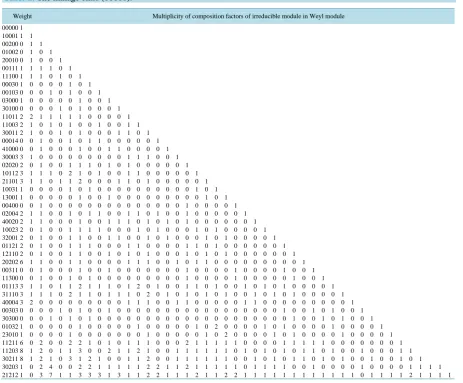
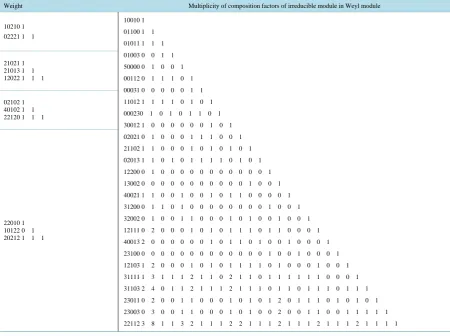
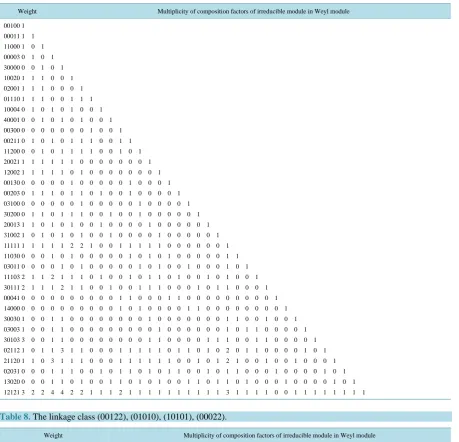
Tables 1-8
.
Remark:
The table should be read as following. We list the weights in the first collum and write the
multip-licity of composition factors as the others elements of tables. For example, from the third row in
Table 1
, we
obtain 00200 0 1 1, this mean
(
)
3(
)
3(
)
3(
)
[image:6.595.83.547.343.726.2]ch 0, 0, 2, 0, 0
= ⋅
0 ch
0, 0, 0, 0, 0
+ ⋅
1 ch 1, 0, 0, 0,1
+ ⋅
1 ch
0, 0, 2, 0, 0
Table 1.
The linkage class (00000).
Weight Multiplicity of composition factors of irreducible module in Weyl module 00000 1
Table 2.
The linkage class (00001), (10002).
Weight Multiplicity of composition factors of irreducible module in Weyl module
00001 1 12000 1 1 31000 0 1 1 00120 1 0 0 1 11020 2 1 0 1 1 00104 0 0 0 1 0 1 30020 2 1 1 0 1 0 1 22001 1 1 1 0 0 0 0 1 11004 2 0 0 1 1 1 0 0 1 10121 1 0 0 1 1 0 0 0 0 1 21110 2 1 1 1 1 0 1 1 0 0 1 30004 3 0 0 0 1 0 1 0 1 0 0 1 20300 0 0 0 1 0 0 0 0 0 0 1 0 1 10113 2 1 0 1 1 1 0 0 1 1 0 0 0 1 13010 0 0 0 0 0 0 0 1 0 0 1 0 0 0 1 10032 0 0 0 0 0 0 0 0 0 1 0 0 0 1 0 1 20211 2 0 0 1 1 0 1 1 0 1 1 0 1 0 0 0 1 01122 1 1 0 0 1 0 0 0 1 1 0 0 0 1 0 1 0 1 20203 4 1 1 0 1 0 1 1 1 1 0 1 0 1 0 0 1 0 1 00312 0 1 0 0 0 0 0 0 0 0 0 0 0 0 0 0 0 1 0 1 11212 4 2 1 1 1 0 1 1 1 1 1 0 1 1 1 1 1 1 1 1 1
10002 1 20100 0 1 00201 1 0 1 20011 1 1 0 1 20003 1 0 0 1 1 11101 1 1 1 1 0 1 03001 0 0 0 0 0 1 1 30101 0 1 0 1 0 1 0 1 02110 0 0 1 1 0 1 1 0 1 10202 1 0 1 1 1 1 0 0 0 1 41001 0 0 1 0 0 1 1 1 0 0 1 01300 0 0 1 0 0 0 0 0 1 0 0 1 10040 0 0 0 0 0 0 0 0 0 1 0 0 1 40110 1 0 1 1 0 1 1 1 1 0 1 0 0 1 01211 0 0 1 1 0 1 1 0 1 1 0 1 0 0 1 01130 0 0 0 1 1 0 0 0 0 1 0 0 1 0 1 1 01203 0 1 0 1 1 1 1 0 0 1 0 0 0 0 1 0 1 00320 0 0 0 0 0 0 1 0 0 0 0 1 0 0 1 1 0 1 01041 0 0 0 0 1 0 0 0 0 1 0 1 1 0 1 1 1 0 1 11220 0 0 1 1 1 1 1 0 1 1 0 1 1 0 1 1 0 1 0 1 30220 1 0 2 1 1 1 0 0 1 1 0 0 1 1 0 0 0 0 0 1 1 21221 2 1 3 1 2 1 1 0 1 1 0 1 1 1 1 1 1 1 1 1 1 1
Table 3.
The linkage class (10210), (21021), (02102), (22010), (10010).
Weight Multiplicity of composition factors of irreducible module in Weyl module
10210 1 02221 1 1
10010 1 01100 1 1 01011 1 1 1 01003 0 0 1 1 50000 0 1 0 0 1 00112 0 1 1 1 0 1 00031 0 0 0 0 0 1 1 11012 1 1 1 1 0 1 0 1 000230 1 0 1 0 1 1 0 1 30012 1 0 0 0 0 0 0 1 0 1 02021 0 1 0 0 0 1 1 1 0 0 1 21102 1 1 0 0 0 1 0 1 0 1 0 1 02013 1 1 0 1 0 1 1 1 1 0 1 0 1 12200 0 1 0 0 0 0 0 0 0 0 0 0 0 1 13002 0 0 0 0 0 0 0 0 0 0 0 1 0 0 1 40021 1 1 0 0 1 0 0 1 0 1 1 0 0 0 0 1 31200 0 1 1 0 1 0 0 0 0 0 0 0 0 1 0 0 1 32002 0 1 0 0 1 1 0 0 0 1 0 1 0 0 1 0 0 1 12111 0 2 0 0 0 1 0 1 0 1 1 1 0 1 1 0 0 0 1 40013 2 0 0 0 0 0 0 1 0 1 1 0 1 0 0 1 0 0 0 1 23100 0 0 0 0 0 0 0 0 0 0 0 0 0 1 0 0 1 0 0 0 1 12103 1 2 0 0 0 1 0 1 0 1 1 1 1 0 1 0 0 0 1 0 0 1 31111 1 3 1 1 1 2 1 1 0 2 1 1 0 1 1 1 1 1 1 0 0 0 1 31103 2 4 0 1 1 2 1 1 1 2 1 1 1 0 1 1 0 1 1 1 0 1 1 1 23011 0 2 0 0 1 1 0 0 0 1 0 1 0 1 2 0 1 1 1 0 1 0 1 0 1 23003 0 3 0 0 1 1 0 0 0 1 0 1 0 0 2 0 0 1 1 0 0 1 1 1 1 1 22112 3 8 1 1 3 2 1 1 1 2 2 1 1 1 2 1 1 1 2 1 1 1 2 1 1 1 1 21021 1
21013 1 1 12022 1 1 1
02102 1 40102 1 1 22120 1 1 1
Table 4.
The linkage class (10012), (10100).
Weight Multiplicity of composition factors of irreducible module in Weyl module
10012 1 01102 1 1 50002 0 1 1 02201 0 1 0 1 40201 1 1 1 1 1 12210 0 1 0 1 0 1 24001 0 0 0 1 1 0 1 31210 1 2 0 1 1 1 0 1 23110 0 2 1 1 1 1 1 1 1 22300 0 1 0 0 0 1 0 1 1 1 22211 1 2 1 1 1 1 1 1 1 1 1
10100 1 10011 1 1 10003 0 1 1 01101 1 1 0 1 00202 0 1 1 1 1 20012 1 1 1 0 0 1 50001 0 0 0 1 0 0 1 00040 0 0 0 0 1 0 0 1 11102 1 1 1 1 1 1 0 0 1 02200 0 0 0 1 0 0 0 0 0 1 03002 0 0 0 0 0 0 0 0 1 0 1 30102 1 0 0 0 0 1 0 0 1 0 0 1 02111 0 0 0 1 1 1 0 0 1 1 1 0 1 40200 0 1 0 1 0 0 1 0 0 1 0 0 0 1 41002 0 0 0 1 1 0 1 0 1 0 1 1 0 0 1 02030 0 0 1 0 1 1 0 1 0 0 0 0 1 0 0 1 02103 1 0 1 0 1 1 0 0 1 0 1 0 1 0 0 0 1 40111 1 1 1 1 1 1 1 0 1 1 1 1 1 1 1 0 0 1 24000 0 0 0 0 0 0 0 0 0 1 0 0 0 1 0 0 0 0 1 40030 1 0 1 0 0 1 0 0 0 0 0 0 1 0 0 1 0 1 0 1 40103 2 0 1 0 1 1 0 0 1 0 1 1 1 0 1 0 1 1 0 0 1 12120 0 0 1 1 1 1 0 0 1 1 1 1 1 0 0 1 0 0 0 0 0 1 31120 1 1 2 2 2 1 0 1 1 1 1 1 1 1 1 1 0 1 0 1 0 1 1 23020 0 0 0 2 1 0 1 0 1 1 2 1 0 1 1 0 0 0 1 0 0 1 1 1 22121 3 2 3 3 2 1 1 1 1 1 2 1 2 1 1 1 1 1 0 1 1 1 1 1 1
Table 5.
The linkage class (12010), (02101), (01012), (20101), (20002).
Weight Multiplicity of composition factors of irreducible module in Weyl module
12010 1 10212 1 1 10131 0 1 1 20221 1 1 1 1
02101 1 01202 1 1 01040 0 1 1 21220 1 1 1 1
01012 1 12201 0 1 31201 1 1 1 23101 0 1 1 1 22202 1 1 1 1 1
20101 1 01220 0 1 01204 1 1 1 01042 0 1 1 1 21222 1 1 1 1 1
[image:8.595.87.540.60.730.2]20002 1 10201 1 1 01210 0 1 1 02220 0 1 1 1 12221 1 1 0 1 1
Table 6.
The linkage class (00002), (00010).
Weight Multiplicity of composition factors of irreducible module in Weyl module
00002 1 21000 0 1 00210 1 0 1 20020 1 1 0 1 12001 1 1 0 0 1 31001 0 1 0 0 1 1 11110 1 1 1 1 1 0 1 20004 1 0 0 1 0 0 0 1 10300 0 0 1 0 0 0 1 0 1 03010 0 0 0 0 1 0 1 0 0 1 30110 1 1 0 1 1 1 1 0 0 0 1 10211 1 0 1 1 1 0 1 0 1 0 0 1 10130 0 0 0 1 0 0 0 0 0 0 0 1 1 10203 1 1 0 1 1 0 0 1 0 0 0 1 0 1 10041 0 0 0 0 0 0 0 0 1 0 0 1 1 1 1 01212 0 1 0 1 1 0 1 0 1 1 0 1 0 1 0 1 20220 1 0 0 1 1 0 1 0 1 0 1 1 1 0 0 0 1 01131 0 0 0 1 0 0 0 1 1 0 0 1 1 1 1 1 0 1 00321 0 0 0 0 0 0 0 0 1 1 0 0 0 0 0 1 0 1 1 11221 2 1 1 1 1 0 1 1 2 1 1 1 1 1 1 1 1 1 1 1
Table 7.
The linkage class (00100).
Weight Multiplicity of composition factors of irreducible module in Weyl module 00100 1
[image:9.595.87.547.98.540.2]00011 1 1 11000 1 0 1 00003 0 1 0 1 30000 0 0 1 0 1 10020 1 1 1 0 0 1 02001 1 1 1 0 0 0 1 01110 1 1 1 0 0 1 1 1 10004 0 1 0 1 0 1 0 0 1 40001 0 0 1 0 1 0 1 0 0 1 00300 0 0 0 0 0 0 0 1 0 0 1 00211 0 1 0 1 0 1 1 1 0 0 1 1 11200 0 0 1 0 1 1 1 1 0 0 1 0 1 20021 1 1 1 1 1 1 0 0 0 0 0 0 0 1 12002 1 1 1 1 1 0 1 0 0 0 0 0 0 0 1 00130 0 0 0 0 0 1 0 0 0 0 0 1 0 0 0 1 00203 0 1 1 1 0 1 1 0 1 0 0 1 0 0 0 0 1 03100 0 0 0 0 0 0 1 0 0 0 0 0 1 0 0 0 0 1 30200 0 1 1 0 1 1 1 0 0 1 0 0 1 0 0 0 0 0 1 20013 1 1 0 1 0 1 0 0 1 0 0 0 0 1 0 0 0 0 0 1 31002 1 0 1 0 1 0 1 0 0 1 0 0 0 0 1 0 0 0 0 0 1 11111 1 1 1 1 1 2 2 1 0 0 1 1 1 1 1 0 0 0 0 0 0 1 11030 0 0 0 1 0 1 0 0 0 0 0 1 0 1 0 1 0 0 0 0 0 1 1 03011 0 0 0 0 1 0 1 0 0 0 0 0 1 0 1 0 0 1 0 0 0 1 0 1 11103 2 1 1 2 1 1 1 0 1 0 0 1 0 1 1 0 1 0 0 1 0 1 0 0 1 30111 2 1 1 1 2 1 1 0 0 1 0 0 1 1 1 0 0 0 1 0 1 1 0 0 0 1 00041 0 0 0 0 0 0 0 0 0 0 1 1 0 0 0 1 1 0 0 0 0 0 0 0 0 0 1 14000 0 0 0 0 0 0 0 0 0 0 1 0 1 0 0 0 0 1 1 0 0 0 0 0 0 0 0 1 30030 1 0 0 1 1 0 0 0 0 0 0 0 0 1 0 0 0 0 0 0 0 1 1 0 0 1 0 0 1 03003 1 0 0 1 1 0 0 0 0 0 0 0 0 0 1 0 0 0 0 0 0 1 0 1 1 0 0 0 0 1 30103 3 0 0 1 1 0 0 0 0 0 0 0 0 1 1 0 0 0 0 1 1 1 0 0 1 1 0 0 0 0 1 02112 1 0 1 1 3 1 1 0 0 0 1 1 1 1 1 0 1 1 0 1 0 2 0 1 1 0 0 0 0 1 0 1 21120 1 1 0 3 1 1 1 0 0 0 1 1 1 1 1 1 0 0 1 0 1 2 1 0 0 1 0 0 1 0 0 0 1 02031 0 0 0 1 1 1 0 0 1 0 1 1 0 1 0 1 1 0 0 1 0 1 1 0 0 0 1 0 0 0 0 1 0 1 13020 0 0 0 1 1 0 1 0 0 1 1 0 1 0 1 0 0 1 1 0 1 1 0 1 0 0 0 1 0 0 0 0 1 0 1 12121 3 2 2 4 4 2 2 1 1 1 2 1 1 1 1 1 1 1 1 1 1 3 1 1 1 1 0 0 1 1 1 1 1 1 1 1
Table 8.
The linkage class (00122), (01010), (10101), (00022).
Weight Multiplicity of composition factors of irreducible module in Weyl module
00122 1 22100 0 1 11022 1 0 1 22011 0 1 0 1 30022 0 0 1 0 1 22003 0 0 0 1 0 1 21112 1 1 1 1 1 1 1
01010 1 21012 1 1 12021 0 1 1 12013 1 1 1 1 31021 1 1 1 0 1 31013 2 1 1 1 1 1 22022 3 1 2 1 1 1 1
10101 1 20102 1 1 02120 0 1 1 02104 1 1 1 1 40120 1 1 1 0 1 40104 2 1 1 1 1 1 22122 3 1 2 1 1 1 1
00022 1 02012 1 1 40012 0 1 1 12102 0 1 0 1 31102 1 1 1 1 1 22200 0 0 0 0 0 1 23002 0 0 0 1 1 0 1 22111 1 1 1 1 1 1 1 1