© 2018, IRJET | Impact Factor value: 6.171 | ISO 9001:2008 Certified Journal | Page 852
A PROPOSED HARMONISATION FRAMEWORK FOR E-COMMERCE
WEBSITES ACROSS THE GLOBE
Lauretta Gyedua Shardow
1, Rose-Mary Owusuaa Mensah
21ICT Educator, Al Rayan International School, East Legon, Ghana
2Postgraduate Student, Kwame Nkrumah University of Science and Technology, Kumasi, Ghana
---***---Abstract - Buying and selling on the Internet, popularly
called e-commerce has become a major source of revenue for many business ventures. As a result, new and traditional businesses which hitherto were operating physical workspaces are now exploiting digital technology in order to extend their customer base, gain market advantage and increase their profit margins. The user interface of an e-commerce website serves as the main point of contact between the seller and buyers and therefore has a direct correlation with user online shopping experience and the revenue generated by the web store. However, designing a good user interface for a website is quite challenging and therefore, interface design guidelines need to be instituted for developers to assist them with the process. In this research, we sought to establish whether or not there is a need for a harmonization framework for e-commerce websites. To address this question, we conducted a usability study by selecting e-commerce websites from some countries across the globe. Results from our research indicated that, there is indeed a need for a harmonization framework to guide e-commerce website developers and store owners with regards to designing user interfaces for their websites. Therefore standard heuristics and guidelines for designing user interfaces are proposed to serve as a guide to website developers. The study also identifies relevant features which need to be on e-commerce websites.
Key Words: e-commerce, user interface,
harmonization, framework, heuristics
1.0 INTRODUCTION
The Internet has revolutionized our world by enhancing daily human activities such as communication, education, social networking and trading. Among the numerous benefits of using the Internet, is to engage in buying and selling, known as e-commerce. E-commerce business activities on the internet can be among organizations or among individuals. In the instances where buying and selling is among organizations, we mostly term it as B2B e-commerce. Electronic transactions have been in existence as early as the 1960s.
The advent of the World Wide Web in 1990 [1] paved a major way for web-based buying and selling activities. Subsequently many companies such as Amazon and eBay have transformed the e-commerce industry and consumers can now purchase almost everything online. Many companies have reported increased customer base and
generation of a lot of revenue due to e-commerce. An estimation has been made that there would be an impact of the internet gradually on almost all commerce by the year 2050 [2]. For this reason, new and traditional businesses which hitherto were operating physical workspaces are now exploiting digital technology in order to extend their customer base, gain market advantage and increase their profit margins. E-commerce also offers sellers additional benefits such as overcoming geographical limitations, around-the-clock availability and performing analysis based on sales and customer behaviour. Consumers also benefit from distinct services such as easy search and access to products, comparison of prices and making purchases while saving time and money.
The visual appeal of an e-commerce website is very essential; the interface of a website has a direct correlation with user online shopping experience. A user interface of a website serves as the main point of contact between a seller and buyers, and therefore has to be usable. The usability of a website is very critical in human-computer interaction since it has the power to convert site visitors from just being “lookers” to “buyers” [3]. A well-structured navigation system of an e-commerce website typically lessens the time it takes users and visitors to search for and access information on a site. Websites must be such that, visitors can easily access the relevant parts of the site as quickly as possible. Moreover, people should be able to search for products they are interested in, even when the products do not appear in a particular section or product catalogue. More so, the payment system for a website needs to be straightforward and easy-to-use. When customers see their purchase information and dates for delivery at the checkout point, it gives them some assurance, trust and also sets their minds at ease.
1.1 Statement of the Problem
© 2018, IRJET | Impact Factor value: 6.171 | ISO 9001:2008 Certified Journal | Page 853 online sales because users are not able to locate what they
need [6][7].
Studies have shown that, a poorly designed user interface can lead to perceived irritation and negative effects on various aspects of consumer purchasing behaviour such as satisfaction, trust, attitude, purchasing intention, and buying behaviour [8][9]. Previous studies suggest that the impact of website design on online shopping is as important to consumers as the effects of good service and low prices in traditional retailing [10]. A lot of time and effort must be put in to be able to develop a standard and easy-to-use interface. Designing a good user interface for a website is quite challenging; therefore, interface design guidelines need to be instituted for developers to assist them with the process. Establishing guidelines for the development of user interfaces for e-commerce websites requires gathering information and meta data such as the type of online store, the geographical location, kind of products and target users.
Our study aimed at conducting research in order to inform the developers of e-commerce websites and online store owners about the best practices to be adopted in the development of interfaces of their e- websites. By so doing, it would help increase productivity and boost online sales on e-commerce websites. It would also reduce the time spent and efforts made by these e-commerce website developers, who in turn can channel these resources into other tasks aimed at maximizing benefits on e-commerce platforms.
1.2 Research Objectives
The purpose of this study was:
To know the user’s experience when interfacing with the various features of e-commerce websites such as product catalogue, navigation, page format, registration, personalization, checkout point, customer service.
To identify common design features and issues with the interfaces of e-commerce sites
To determine the levels of importance of features as perceived by prospective buyers on e-commerce sites
Propose standard heuristics for the development of the interfaces of e-commerce sites
2.0 E-COMMERCE
In this modern era, technological advancements have changed the faces of businesses. There are lots of businesses and organisations that are established without necessarily any physical location or presence. These businesses run on computer networks mainly the internet, where they are able to reach almost all their customers and fulfil their needs. [11] defines e-commerce as “the sharing of business information, maintaining business relationships, and the conducting business transactions by means of
telecommunications networks”. Treese and Stewart gave their view of Internet-commerce as follows: “the use of the global Internet for purchase and sale of goods and services, including service and support after the sale” [12].
E-commerce provides customers with a variety of goods, products and services. This is so because shoppers are able to visit several shops online at any time of the day to buy products. Quite a good number of shoppers often gather a great deal of information about a product from different webstores before deciding on the site to purchase the product from. Electronic commerce enables customers to narrow their search easily when looking through products. With the rise of e-commerce, location would not be a barrier to buying products and services. Companies are also able to increase their customer base at very little operational costs and are also able to generate more revenue. Nevertheless, there are some factors; both technical and non-technical, inhibiting the successful deployment and realisation of the full potentials of e-commerce. Some of these factors are security issues, limited bandwidth and unavailability of universal standards for e-commerce website developers.
2.1 User Interface For E-Commerce Websites
Quite a limited number of work and research has been carried out justifying the need for standard interfaces for e-commerce websites. Prior to 1985, systems were constructed with a text-based interface. Information was organized in a linear fashion and presented to the user based on a fixed, hierarchical fashion [13]. Recently, more graphical features have been introduced into the design of e-commerce website interfaces. Designers of e- e-commerce websites must include certain features such as; catalogue development, users tracking, payment processing, online fulfilment, web site security, privacy, business-business sales models, and business-customer sales models [14]. Designing a website involves a lot of technical investigation and most importantly, a blend of intuition and experience in order to bring out the best design outcome and user experience. [15] [16][17][18].
© 2018, IRJET | Impact Factor value: 6.171 | ISO 9001:2008 Certified Journal | Page 854 interface does not guarantee system success, a poorly
designed interface would likely lead to user dissatisfaction and ultimately system failure.
[21] addressed differences in preferences and perception of web site design across culture. They considered menu layout, access to product info, professional design, logical info presentation, screen design, navigation, sequencing, product attributes, and product availability as important web site features. [22] also conducted similar research and found that South Korean and American national product websites did not differ significantly. They used the same graphics, animated content, and hyperlinks. They differed in one way only; the South Korean sites typically offered a link to digitized video of products’ television commercials, a feature that none of the American sites offered. Based on these studies, many presume that the design and content characteristics of website across countries should be similar.
[23] identified that, an essential problem with e‐commerce sites is that the controls and organization are different for each site and there is no standard way of building the navigation of the sites. The study proposed a solution to minimize users' look up time and make e‐commerce sites usable so visitors can easily and quickly access information. He developed an e-menu system to provide an implementation method by which an agent of the artificial intelligence (AI) user interface creates a standard navigation menu, called E‐menu, to increase the usability of e‐commerce. [24] also proposed an approach to reengineer user interfaces of e-commerce websites. They utilized the knowledge embedded in business processes to reengineer the user interfaces of existing e-commerce applications that implement business processes in order to increase the usability of user interfaces. They leveraged the contextual knowledge in business workflows by automatically generating navigational sequences which indicate the progress of a workflow and associate tasks with the user interface components which implement these tasks.
[26] argues that, to remain competitive, e-commerce user interfaces need to evolve as customer behaviour and technologies change. He discussed features which e-commerce website designers may find useful when building their sites. He suggested that websites should personalize user interfaces to display products which are likely to interest shoppers and also encourage additional purchases by using automated recommendation tools. [26] also lists social media connection, mobile commerce and flash sales as very important features of e-commerce sites.
It has been observed that people usually talk about the brands they like and potential purchases as well as discuss their online shopping experiences with friends. Therefore, e-commerce website developers need to explore these opportunities by incorporating social media into their websites. For example, the Facebook “share” button can enable website visitors to post a link to the website on their Facebook pages. Also, the Facebook “like” button, can also be
displayed on the products web page so that when a user clicks on the “like” button, the number of “likes” for a product increases which can go a long way to boost purchases.
E-commerce websites can send tweets about their promotions, deals and products and also include the URLs of the respective web pages. Blogs can help to boost sales and increase revenue of webstores. E-commerce websites can also create simple, fun and easy-to-use blogs to enhance interaction among the webstore staff and website customers and visitors. Theses blogs can also have sections dedicated to customer reviews and customer showcase of purchased products. Another important feature which can be incorporated into e-commerce user interfaces is social commerce [26]. Social commerce is a form of e-commerce mediated by social media involving convergence between the online and offline [27]. According to Forrester [25], the social commerce market would grow to about US$30 billion in U.S. by 2015. Thus, consumers, businesses and individual retailers are now recognising the implications of such a paradigm shift in ecommerce [28].
Shoppers do not arrive at a site alone but bring their entire social networks with them [29] Social commerce has gone way beyond an increased presence within social networks (e.g., through collecting fans, likes and followers) [30],, and now creates economic value as well [31]. It is therefore crucial to recognize that social commerce is not just a simple fusion between ecommerce and social networking technology but presents many opportunities for e-commerce websites. In e-commerce businesses, automated product recommendation should be in the top list of marketing strategies businesses need to focus on [32].
Automated product recommendations in the online shop serves as an informative product showcase and useful buying guide that aims to achieve increase of the shopping cart value, increase of the frequency of visits, increase in conversions and establishing of a solid base for the retargeting [33]. [26] suggests that another essential feature which needs to be added to the user interface of e-commerce websites is dynamic product customization. Shoppers should be able to customize their preferred products.
© 2018, IRJET | Impact Factor value: 6.171 | ISO 9001:2008 Certified Journal | Page 855 Mobile e-commerce, m-commerce involves the use of mobile
phones, laptops, tablets and other handheld computing devices for e-commerce transactions. Studies have also proved that m-commerce is now 34% of all e-commerce transactions globally based on an accurate weighting of e-commerce market size by country [35]. This tremendous growth in mobile commerce can be attributed to the increased availability of smart mobile phones and technological advancements. Also, people carry their mobile phones on them more than their laptops and personal computers. One major challenge with m-commerce is getting users to download the mobile app. Also, developers have to create and maintain several apps from different operating systems and runtime environments. However, the benefits derived from mobile commerce overpower the setbacks and therefore e-commerce businesses are encouraged to maintain desktop websites as well as mobile versions of their webstores.
Considerable amount of research has been carried out to justify the need for standard interfaces for e-commerce websites. It is very evident that standardizing the user interface of such websites would be of benefit to business organizations. However, in order to ascertain the global and essential features which need to be included in the user interfaces, extensive research needs to be conducted. A few researchers have suggested some features which they consider as a “must-have” for e-commerce sites. Nonetheless, more effort has to be put into the research activities in order to identify and establish standard and global features which need to be included in the user interface of e-commerce sites.
3.0 METHODOLOGY
The purpose of this study was to know the user’s experience of the various features of the e-commerce websites, to identify common design features and issues in e-commerce sites, to determine the levels of importance of features as perceived by prospective buyers on e-commerce sites and to propose standard heuristics for the development of the interfaces of e-commerce sites. To realize our objectives, a usability study was carried out in order to get first hand feedback from the test participants. In our research, remote usability testing was used because users in different locations and time zones were made to participate in this study.A number of countries were selected across various continents. Countries considered included Ghana, Nigeria, USA, South Africa, South Korea, Japan, Canada, New Zealand, Brazil, Australia, France, Argentina and Germany. These countries were chosen at random from the various continents. Also, a total of seventy websites were selected from the countries mentioned above using random sampling technique.
A questionnaire was designed using Google forms consisting of 14 questions. A total of 105 test users were invited to participate in the survey; however only 100 people
participated in the survey. They were selected irrespective of any previous knowledge they had on e-commerce, however, users needed to be able to use computers. The ages of the participants ranged from 18 to 60. Each of these users was assigned to one e-commerce website on which he would carry a usability test. The link to the form containing the questionnaire was emailed to the selected test users, together with the sites they would consider. After the email was sent to test users, follow ups were made in order to ensure that the users carried out the study.
4.0 DATA ANALYSIS AND FINDINGS
The responses obtained from the usability study on user interfaces for e-commerce websites have been categorized under the following sections:
1. Familiarity with e-commerce websites 2. Simplicity of website design
3. Navigation and ease of search 4. Payment process
5. Customer care and support
6. Common features peculiar to e-commerce websites 7. Features on e-commerce websites and their
perceived order of importance
8. website design practices across countries and continents
4.1 Familiarity with e-commerce websites
E-commerce has become widely popular in recent times and the number of people shopping online across the globe has increased within a few years. A lot of people have either visited at least one e-commerce site and may have even gone ahead to purchase from an e-commerce website. In an attempt to find out how familiar people are with e-commerce websites, we presented the test participants with three questions:
i. Have you visited this website before?
ii. What do you think is the purpose of the website? iii. Who do you think is the intended audience?
© 2018, IRJET | Impact Factor value: 6.171 | ISO 9001:2008 Certified Journal | Page 856 purposely to serve the needs of their customers and also, to
attract prospective buyers and online shoppers.
4.2Simplicity Of Website Design
The user interface design of an e-commerce website is very essential for the success or otherwise of the website. For this reason, many e-commerce website owners and developers are investing a lot of time and money to make sure that the “look” and “feel” of their websites meet the required standards. In the survey, we asked the test participants what they felt with regards to the organization of content on the websites. More specifically, we focused on the arrangement of content, font sizes and font styles. From the responses received, 66 of the participants, representing 66% indicated they were satisfied with the organization of the content on the websites. The remaining 34, representing 34% of the participants responded in the negative, expressing dissatisfaction about the arrangement of information on the websites.
Another important factor to consider when designing websites is to ensure that nothing distracts visitors from the website. Visitors who get distracted when they visit e-commerce sites either leave the sites or lose their urge to shop. Research has also proven that consumers see online advertisements as “annoying” and “distracting”. A lot of attention has been drawn on the need to maintain simplicity on e-commerce sites and also, the importance of keeping customers focused on these sites. Therefore, we asked the participants whether they found any obstructions on the websites. Majority of the respondents responded in the negative, whilst a few of the indicated they encountered a few obstructions
For the participants who indicated they saw some obstructive things on the websites, they were given opportunity to explain in details their concerns. Some of the comments given by the participants are as follows:
Overlapping images depending on the platform for access(mobile phone or web browser on a pc)
Speed of access
Advertisements from other websites not native to the site
A lot of text on the websites
Poorly arranged product catalogue
A lot of images on the websites
4.3Navigation And Ease Of Search
One of the important ways to boost sales on e-commerce websites is to improve the navigation system on the website. On a website with a good navigation system, shoppers are able to easily and quickly find products. Typically, the top level of an e-commerce website should include product category information. Product categories are then arranged
into hierarchies which move from general to more specific items. Most websites also include a clearly labeled “home” button, in addition to using the company logo as a link to the home page. Many researchers still continue to debate whether it is simply enough to use the company logo as a link to home page, or just create a home page button or use both of the previously mentioned options.
On e-commerce sites, it is recommended that the company logos should be clickable and should redirect visitors to the home pages of the websites. We therefore decided to find out from the test participants whether the websites they visited used the company logo as a link to the home page. 81 of them representing 81% of our test users responded in the positive while the remaining 19 participants representing 19% indicated that the company logo was not used as a link to the home page. For the question “How easy was it to return to the home page after navigating to other pages?”, 73 people representing 73% indicated in was quite easy while the remaining 27 participants representing 27% indicated it was quite difficult.
In some instances, products are not readily visible on the website and therefore, visitors need to use the search functionality in order to search for products. Shoppers are likely to leave the website if they cannot find what they are looking for easily. Hence, website developers need to take steps in order to reduce the time taken by visitors to find their desired products. Some suggested measures they can take include using a search button, “autocomplete” with image thumbnails, never return a “no” results page” and adding same sub-categories under multiple parent categories when necessary. The responses from test participants on how easy it was for them to search for items
suggested that, on many of the websites, it was easy to search
for items while a few of the websites still needed some improvement.
4.4 Payment Process
© 2018, IRJET | Impact Factor value: 6.171 | ISO 9001:2008 Certified Journal | Page 857 Fig -1: Chart showing responses based on ease of use of
payment systems
4.5Customer Care And Support
Typically, it is not possible for buyers and sellers on e-commerce platforms to communicate face-to-face. In such instances, providing excellent online customer service is the way out. It is therefore imperative for such websites to have well defined customer service strategies. For the websites used in the usability study, we sought to identify whether or not they had any mechanisms for interacting with their customers and prospective buyers. Various channels of communication for customer support we considered included social media, tracking all customer interactions using tickets, online chat forums, help desk features and webinars. Participants were asked to check the websites they were assigned, to see if they can identify any social media features. 75% of the participants could identify at least one of the above mentioned features. However, about 25% indicated they could not find any features of customer support.
4.6Common Features On E-Commerce Websites
Website developers have many choices regarding the designing of e-commerce websites. Whereas there are no strict laid down rules about which features to include, their choices of selection are often influenced by the relevance of these features. There are many design features which are common to many websites; however, recent trends in e-commerce have led to the introduction of other new but very important features. Such features include automatic product recommendation, hierarchical and orderly arrangement of product catalogue, personalization, social media, and customer care and support systems.
In an attempt to identify the extent to which these features have been adopted by website developers into e-commerce sites, the participants of the survey were asked to look for the above mentioned features on the various websites. From their responses as shown in figure 2, most of the websites they visited had arranged their product catalogue in an orderly and very efficient way. The second most common feature participants identified was social media features, giving an indication that developers are now harnessing the potentials of boosting sales and expanding customer base through social media. The third most identified feature was “automatic product recommendation”, where websites suggested relevant products customers may like. The fourth was FAQ followed by personalization and online help system respectively.
Fig -2: Chart showing responses based on common features of e-commerce websites
4.7 Features And Their Perceived Order Of Importance
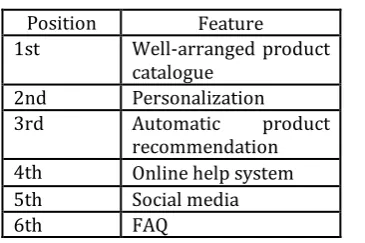
[image:6.595.312.561.318.469.2]Participants of the survey were also asked to rate some of the features on e-commerce websites according to their order of importance. The table below presents their responses.
Table.-1: importance of some features of e-commerce sites as rated by participants
Position Feature
1st Well-arranged product catalogue
2nd Personalization
3rd Automatic product
recommendation
4th Online help system
5th Social media
[image:6.595.348.531.643.764.2]© 2018, IRJET | Impact Factor value: 6.171 | ISO 9001:2008 Certified Journal | Page 858
From table 1 above, the feature which was rated as most important by the test participants was well-arranged product catalogue followed by personalization, automatic product recommendation, online help system, social media and FAQ respectively
4.8Website Design Practices Across Countries
And Continents
With the increased availability of internet worldwide, online businesses are reaching more markets across continents. There is therefore the need for website developers to develop their systems in a way such that people all over the world can access them and also be able to make purchases. Two questions which need to be addressed are:
a. Does culture have a major impact on the design of websites?
b. Do web design practices vary across countries?
Our survey attempted to address this question, and this was a motivating factor for selecting people and websites from different parts of the world. Some of the participants were made to visit websites which were not from their country and sometimes even their continent. Their responses indicated that the e-commerce websites they visited were very similar to those in their home countries. The major difference the observed was the fact that some of the websites were in different languages which they were not familiar with. Even in those cases, most of the websites automatically detected their location and offered to switch the language to the visitor’s native language. In other cases, the websites had features which enabled the visitors to switch the language to one which they are familiar with. Based on the responses from the participants and other relevant sources of information, we argue that culture does not have a major impact on website design and therefore website design practices do not differ significantly across countries.
5.0 DISCUSSIONS
The results of the study indicated that the interfaces of websites are not harmonized across the globe. Whereas most of the participants identified all the websites as e-commerce sites, some found it difficult to perform tasks such as searching for products, adding products to the shopping cart and paying for items selected. Others also complained the interfaces of some of the websites were clumsy with either too much text or too many images. Many of the respondents also complained about the poorly arranged product catalogue, many advertisements on the websites and non-compatibility of the websites on mobile platforms.
Based on the responses from the participants and other relevant sources of information, it also emerged that culture does not have a major impact on website design and therefore website design practices do not differ significantly
across countries. The participants of the survey also suggested that they would be happy to see some uniformity with respect to the interfaces of e-commerce websites. When asked if they would wish there were some guidelines for website developers and store owners about how they can design their websites to meet global standards, most of the respondents agreed to such a proposal. These findings were broadly in line with our hypothesis that there is a need for a harmonisation framework for designing the interfaces of e-commerce websites. We therefore propose six standard heuristics which can serve as a guideline for website developers. We also outline a list of key and important features which need to be present on the interfaces of e-commerce websites.
5.1 Proposed Harmonisation Framework For
E-Commerce Websites
Based on interviews with experts in the field of human computer interaction and website design, responses from the usability study and reviewing relevant literature, we make some proposals with regards to developing interfaces for e-commerce websites. We propose six standard heuristics which can serve as a guideline for website developers and also outline a list of key and important features which needs to be present on e-commerce websites. The proposed heuristics are presented as follows.
5.1.1 Proposed Standard Heuristics For The Development Of E-Commerce Website Interfaces
1. Easy navigation system: Access to any page of choice from other pages
2. Use of self-explanatory language 3. Easy search of items
4. Frequent customer status updates 5. Customer focused personalized content 6. Non-disruptive advertisements on web pages;
Developers must ensure that adverts are streamlined and do not take the users attention of the main content of the page.
5.1.2 Proposed Standard Features For The Interfaces Of E-Commerce Websites
Well-arranged product catalogue
Good navigation system; A well-structured, distinct, simple, clear and easily accessible system which would enable users to easily move from one page to another.
Registration/Login box, shopping cart, search box
Personalization
Automatic product recommendation
Featured products
Related products
Popular products
© 2018, IRJET | Impact Factor value: 6.171 | ISO 9001:2008 Certified Journal | Page 859
Good payment gateway
Social media presence
Online help system and FAQs
The above standards have been proposed to enable e-commerce website designers develop sites that can serve a wide range of users especially since the world has turned into a global village. These proposals have encapsulated the various heuristics created by the likes of Jakob Nielsen.
5.2 Recommendations
The following are some of the recommendations which we make for website developers and store owners;
Developers should invest more time and effort in developing interfaces for e-commerce websites
The interfaces of e-commerce websites should be simple, attractive and usable.
Developers always need to keep themselves abreast with the latest trends in e-commerce design.
E-commerce website owners need to employ abled staff who would interact with visitors who come to the sites in order to obtain suggestions on ways to improve their sites.
Security technologies should be enforced.
6.0 FUTURE STUDY
This research focused primarily on justifying the need for a harmonisation framework for the interfaces of e-commerce websites. The e-commerce websites used in the usability study were not limited to a specific industry. Rather, they were selected from industries such as fashion, furniture, automobile, IT supplies and general household merchandise. In order to achieve even more precise results, this survey needs to be performed industry by industry. Also, the sample population of the websites and participants for the survey needs to be increased.
One avenue for further study would be research into designing the interfaces of industry-specific e-commerce websites. Usability studies and further research can be conducted industry by industry in order to determine which design elements would fit each of the various industries. Although this would be a very big and challenging task, it has the potential of resulting in more accurate and precise information about the preferences of the online and customers shoppers with respect to industry-specific e-commerce websites.
7.0 CONCLUSION
The user interface of a website represents the main component that “showcases” the website to the world. Consequently, e-commerce website interfaces needs to be designed in a way that could trigger positive user experience. E-commerce websites with standard and easy to
use interfaces tend to attract more customers, thereby leading to increase in revenue for the store. On the other hand, a poorly designed user interface often leads to perceived irritation and negative effects on customers and businesses in general.
Over the years, website designers and store owners have been educated on the need to focus more on the interfaces of their websites. It is undoubted that e-commerce website developers and owners have come a long way in working towards improving the interfaces of their websites. However, there is still the need for some form of consistency among the interfaces of e-commerce websites to help online shoppers to easily identify products of interest and smoothly go to through the purchase process if the need be.
This research is therefore a step in the right direction; we believe it would go a long way in providing user interface design guidelines to the public. If these design guidelines are adopted by developers, online shoppers would have pleasurable shopping experiences and increase in revenue for the e-commerce websites. Having justified the need for a harmonisation framework for e-commerce websites, we hope that website site owners and developers all over the world would be quick to adopt this harmonisation framework to their websites in order to achieve maximum results.
REFERENCES
[1]McPherson Stephanie Sammartino (2009), Tim Berners-Lee: Inventor of the World Wide Web, Twenty-First Century Books
[2]Malhotra, R. (2005) “The Impact of Internet and E-commerce”, Proceedings of the International Conference, 2004 on Business & Finance: Banking, insurance and financial services, Vol 1, ICFAI University Press
[3]Berthon P, Pitt L.F. and Watson R T, (1996) “The World wide web as an advertising medium: toward an understanding of conversion efficiency”, Journal of Advertising research, 36.01, 43-54
[4]Cho, N and Sanghyuk Park. (2001), “Development of Electronic Commerce User-Consumer Satisfaction Index (ECUSI) for Internet Shopping”, Industrial Management and Data Systems, Vol. 101, No. 8, pp. 400-6
[5]Nielsen, J. (1998), “Failure of Corporate Websites”
Retrieved February 10, 2016 from
https://www.docmeeting.com/corti/tp/useit/981018.html
[6]Cohen, J., & Thompson, M. J. (1999, February). Mass appeal.The Standard. Retrieved
© 2018, IRJET | Impact Factor value: 6.171 | ISO 9001:2008 Certified Journal | Page 860 [7] Seminerio, M. (1998, September 10). Study: One in three
experienced surfers find online shopping difficult. In Interactive Week. Retrieved from:
http://www.zdnet.com/intweek/quickpoll/981007/981007 b.html
[8]Azeem, M. A. (2012), Consumers' attitudes toward commercial e-mail spam and web pop-ups: interference, perceived loss of control, and irritation”, Information and Knowledge Management, 2.1, pp 21-33
[9]Gao, Y., & Wu, X. (2010). A cognitive model of trust in e-commerce: evidence from a field study in China. Journal of Applied Business Research, 26(1), 37-44.
[10]Koufaris, M., (2002)“Applying the technology acceptance model and flow theory to online consumer behavior”, Information Systems Research, 13.2, pp 205-224.
[11]Zwass, V. (1996). Electronic Commerce: Structures and Issues. International Journal of Electronic Commerce, 3 – 23
[12]Treese, G. W., & Stewart, L. C. (1998). Designing Systems for Internet Commerce. In G. W. Treese, & L. C. Stewart, Designing Systems for Internet Commerce (p. 6). Pearson Education.
[13]Ramarapu, N.K., Frolick, M.N., Wilkes, R.B. and Wetherbe, J.C. (1997). The Emergence of Hypertext and Problem Solving: An Experimental Investigation of Accessing and Using Information from Linear versus Nonlinear Systems, Decision Sciences, vol. 28 (4), 825-849.
[14]Coopee, T., Mitchell, L., MacDonald, T., & Steinacher, S. ,. (2000). “Catching Net Customers”,. Info World Vol. 22, 54-55.
[15]Nielsen, J. (2000). Designing Web Usability. USA: New Riders Press. Nielsen, J. (1999), “Web Research: Believe the Data” Retrieved February 10, 2016 from
http://www.useit.com/alertbox/990711.html.
[16]Sharma, V., & Sharma, R. (2000). Developing e-Commerce Sites. USA: Addison-Wesley.
[17]Sklar, J. (2000). Principles of Web Design. MA: Thompson Learning. Association for Information Systems, 31sMay, 2012, 105-127.
[18] Niederst, J. (1999). Web Design in a Nutshell. USA: O’Reilly.
[19]Gonzalez, M. (1999). Developing the e-commerce user interface, retrieved from
https://web.njit.edu/~turoff/coursenotes/CIS732/samplep ro/ecom.html on 17th March, 2016
[20]Burns, J., &Madey, G. (2001). A framework for effective user interface design for web-based electronic commerce applications. Informing Science, 4 (2)
[21]Cyr, D. and Haizley Trevor-Smith. (2004), “Localization of Web Design: An Empirical Comparison of German, Japanese, and US Web site Characteristics”, Journal of the American Society for Information Science and Technology, Vol.55, No.13, pp.1199-1208.
[22]Yoon, D., and F. Cropp. (1999), “Cultural Differences in Internet Advertising: A Content Analysis of Internet Advertising between United States and Korea”, Proceeding of the 1999 Conference of the American Academy of Advertising, pp. 89-96.
[23]Shin‐Ping Tucker, (2008) "E‐commerce standard user interface: an E‐menu system", Industrial Management & Data Systems, Vol. 108 Iss: 8, pp.1009 – 1028
[24]Qi Zhang, Ying Zou, Xulin Zhao, "Improving the Usability of E-Commerce Applications using Business Processes", Software Engineering IEEE Transactions on, vol. 33, pp. 837-855, 2007, ISSN 0098-5589.
[25]Anderson, M., Brusa, J., Price, J., and Sims, J. Turning “like” to “buy”: social media emerges as a commerce channel. Booz and Company, New York, NY, 2011.
[26]Najjar, L.J. (2011) ‘Advances in e-commerce user interface design’, Proceedings of the 1st International Conference on Human Interface and the Management of Information: Interacting with Information – Volume Part II, Springer-Verlag, Orlando, FL, pp.292–300
[27]Wang, C., and Zhang, P. The evolution of social commerce: an examination from the people, business, technology, and information perspective. Communication of the Association for Information Systems, 31sMay, 2012, 105-12728
[28]Lina Zhou, Ping Zhang and Hans-Dieter Zimmermann, Social Commerce Research, an integrated view, Electronic Commerce Research and Application, February 15, 2013
[29]Marsden, P., 2010. A new age of enlightenment. Marketing, January 13, 2010 from
www.socialcommercetoday.com/downloads/Marsden_Mark eting_Forward_Thinking_Jan-10.pdf.
[30]Griffith, E. Can social shopping finally take off? Adweek, November 22, 2011. Available at
www.adweek.com/news/advertising-branding/can-social-shopping-finally-take-136611.
© 2018, IRJET | Impact Factor value: 6.171 | ISO 9001:2008 Certified Journal | Page 861 [32]Nguyen, D. How product recommendation helps
e-Commerce websites increase conversion rates, retrieved on 17th March, 2016 from
blog.beeketing.com/how-product-recommendation-helps-e-commerce-sites-increase-conversion-rates/
[33]Daniela La Marca,Product recommendations in e-commerce retrieved on 17th March, 2016 from
http://www.mediabuzz.com.sg/best-practices-nov-13/product-recommendations-in-e-commerce
[34]Meghan Keane, comScore: Flash buying sites are making people spend more money online, 27th May, 2010, retrieved
from https://econsultancy.com/blog/5998-comscore-flash-buying-sites-are-making-people-spend-more-money-online/
[35]Criteo, State of Mobile Commerce Growing like a weed online article retrieved on 17th March, 2015 from
http://www.criteo.com/media/1894/criteo-state-of-mobile-commerce-q1-2015-ppt.pdf