© 2017, IRJET | Impact Factor value: 5.181 | ISO 9001:2008 Certified Journal | Page 743
First Order Analysis of Elevated water Tanks during Seismic activity using
Staad.pro v8i
Arbaj Khan Demrot
M.Tech(student),Civil Engineering Department
Truba Institute of Engineering and Information Technology, Bhopal(M.P)
---***---Abstract -
An Earthquake plays an important role in studying the behavior of structure, since they were used for living and storing purpose. Earthquake shaking depend on the intensity of vibration, the nature of rock, the surface soil type and depth of soil above the bed rock. As we have seen in past many elevated structure were collapsed or damaged during the seismic activity. When there is horizontal ground motion, the tank wall and liquid are subjected to horizontal acceleration. So, in Staad.Pro, we compare all the overhead tanks on the basis of First order analysis by using given parameters for the same capacity (300m3), height (16m)and bracing interval, and checked that how much displacement is affected during seismic activity(in Zone II and V) due to self weight in empty condition for different shapes of elevated storage tanks like rectangular, circular and Intz type tank.
Key Words: Seismic, bracing, overhead, Intz, bed rock,
Staad.Pro
1. INTRODUCTION
Elevated storage tanks were designed according to their usage. Liquid storage tanks are used mainly by municipalities and industries for storing water, inflammable liquids and other chemicals. Thus water tanks are very important for public utility and to provide water at longer distance under the effect of gravitational force. The basic aim of elevated water tanks is to available water supply with sufficient flow, at right time and to wider area of distribution system. Storage tanks are designed in different shapes and sizes. Storage tanks may be designed above ground, on ground and below ground.
But in this research paper it is dealt about elevated structures when dead load and sesmic load( Zone II and V) is applied. P-delta effect is a type of moment produced by the inertial vertical loads and lateral displacements of columns when structure undergoes seismic activity.
Fig - 1: P-delta effect
What is first order analysis? An analysis that doesn't deal with P-Delta Effects. With a slender column, if we apply vertical and horizontal loads and the column deflects appreciably from these loads, the deflection of the column will induce, which are known as secondary moments, essentially the vertical load will be eccentric from the columns center and this eccentricity multiplied by the vertical load creates a moment. The first applied loads are first order.
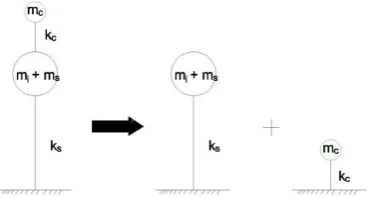
[image:1.595.312.501.399.498.2]Hence, we know a two- mass idealization of the tank as compared to one- mass idealization which was used in IS1893:1984. This idealization was proposed by Housner(1963b) and is being commonly used in most of the international codes.
Fig - 2: Mass Idealization in Elevated tanks
For liquid storage tanks IS 1893:1984 has provided very limited provision and they were mainly of elevated tanks. Even for elevated tanks, effect of sloshing is not included. At last we found that there is no proper code for seismic design of liquid storage tanks. So compared to provisions of IS 1893:1984 , GSDMA guidelines provided some provisions.
analysis of ground water supported tanks is presented
for elevated tanks, only two degree of freedom is used
p-delta effect, base shear and base moment were considered
sloshing effect and maximum sloshing wave height
© 2017, IRJET | Impact Factor value: 5.181 | ISO 9001:2008 Certified Journal | Page 744 The First Order analysis is depend on :
height of individual elements and whole structure amount of horizontal and vertical load acting structural features and geometry.
2. Design and Detailing of Overhead Tanks
[image:2.595.41.545.166.776.2]2.1 Rectangular Overhead Water tank
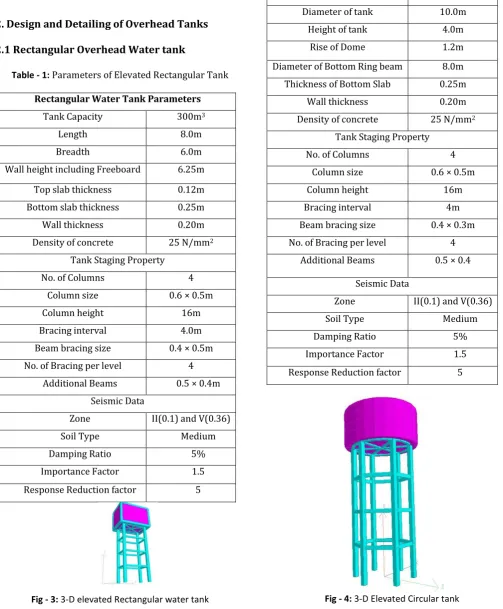
Table - 1: Parameters of Elevated Rectangular Tank
Rectangular Water Tank Parameters
Tank Capacity 300m3
Length 8.0m
Breadth 6.0m
Wall height including Freeboard 6.25m
Top slab thickness 0.12m
Bottom slab thickness 0.25m
Wall thickness 0.20m
Density of concrete 25 N/mm2
Tank Staging Property
No. of Columns 4
Column size 0.6 × 0.5m
Column height 16m
Bracing interval 4.0m
Beam bracing size 0.4 × 0.5m
No. of Bracing per level 4
Additional Beams 0.5 × 0.4m
Seismic Data
Zone II(0.1) and V(0.36)
Soil Type Medium
Damping Ratio 5%
Importance Factor 1.5
Response Reduction factor 5
Fig - 3: 3-D elevated Rectangular water tank
2.2 Circular Overhead Water tank
Table - 2:Parameters of Elevated Circular Water Tank
Circular Water Tank Parameters
Tank Capacity 300m3(approx.)
Diameter of tank 10.0m
Height of tank 4.0m
Rise of Dome 1.2m
Diameter of Bottom Ring beam 8.0m
Thickness of Bottom Slab 0.25m
Wall thickness 0.20m
Density of concrete 25 N/mm2
Tank Staging Property
No. of Columns 4
Column size 0.6 × 0.5m
Column height 16m
Bracing interval 4m
Beam bracing size 0.4 × 0.3m
No. of Bracing per level 4
Additional Beams 0.5 × 0.4
Seismic Data
Zone II(0.1) and V(0.36)
Soil Type Medium
Damping Ratio 5%
Importance Factor 1.5
Response Reduction factor 5
© 2017, IRJET | Impact Factor value: 5.181 | ISO 9001:2008 Certified Journal | Page 745
2.3 Intz tank
[image:3.595.403.464.248.380.2]Table - 3: Parameters of Elevated Intz tank
Fig - 5: 3-D Elevated Intz tank
3. Objective of the Study
The main objective of this study is to perform First order analysis by checking maximum displacement in Elevated water storage tanks for the same storage capacity, same bracing interval and same height during seismic activity. Here, 16m height of column(4+4+4+4) end to end graphs were observed in Staad.pro in Zone II and Zone V. In
ninties when computers and softwares were not born, we generally prefer first order analysis for whole structure but here it is applied for slender columns in series at 4m interval. And we know that these structures are still stand.
4. Results and Discussion
4.1 Rectangular tank
[image:3.595.268.562.356.774.2]Rectangular overhead tanks are mainly used for 50000 to 80000 litres. But here it is designed for 300000 litres. The analysis is performed in Staad.pro
Fig - 6: 3-D Displacement view Rectangular tank
Graph- 1: Showing Deflection curves and Displacement
values(in mm) for Rectangular tank for
ZONE II
Graph- 2: Showing Deflection curves and Displacement
values(in mm) for Rectangular tank for ZONE V Intz tank Parameters
Capacity of Tank 300m3
Size of Bottom Ring beam 0.8 × 0.6m
Size of Top Ring beam 0.4 × 0.3m
Column size 0.8 × 0.6m
Rise of Top dome(h1) 1.8m
Height of cylindrical tank(h2) 3.6m
Height of Conical dome(h3) 1.8m
Rise of Bottom Spherical dome(h4)
1.2m
Diameter of Bottom Circular girder(D1)
5.4m
Diameter of Cylindrical portion(D) 9.0m
Seismic Data
Zone II(0.1) and V(0.36)
Soil Type Medium
Damping Ratio 5%
Importance Factor 1.5
© 2017, IRJET | Impact Factor value: 5.181 | ISO 9001:2008 Certified Journal | Page 746 For the deflection curves and displacement, 4 m height
slender column is selected per bracing, the graphs were taken from Staad.pro.
4.2 Circular tank
[image:4.595.370.494.131.274.2]Circular overhead tanks are used to store water upto 700000 litres. But here it is designed for 300000 litres.
Fig - 7: 3-D Displacement view Circular tank
Graph- 3: Showing Deflection curves and Displacement
values(in mm) for Circular tank for
ZONE II
Graph- 4: Showing Deflection curves and Displacement values(in mm) for Circular tank for ZONE V
4.3 Intz Tank
Fig - 8: 3-D Displacement view and showing slender column
for which graphs were drawn in case of Intz tank
For larger capacities, Intz tanks were used to store upto one million litres. But here it is designed for 300000 litres.
Graph- 5: Showing Deflection curves and Displacement values(in mm) for Intz tank for ZONE II
[image:4.595.43.556.198.789.2]© 2017, IRJET | Impact Factor value: 5.181 | ISO 9001:2008 Certified Journal | Page 747
5. Final Result
Graph- 7: Graph showing Displacement(in mm) values
The above graph is showing the displacement for Rectangular, Circular and Intz Tank. For rectangular tank it is 44.427mm in Zone V which is higher than the others, for the same capacity of 300m3 and same height of 16m with 4m bracing intervals. Here, the displacement calculated is based on first order analysis between end points in columns of different elevated tanks at 4m interval.In Zone II and Zone V, Intz tank has lower displacement values, hence more safer. The values shown above in graph are obtained in empty condition.
6. Method Used
Staad.Pro.V8i ensures on time completion of any project related to civil engineering. In this we design structures and perform analysis in different conditions. For static and dynamic analysis of bridges, tunnels, culverts, buildings, transmission towers, stadium or any other structure. Here for designing, we can use over 80 international codes. The structure model is generated which consists of beams and columns and then material and load is inputted to the line type frame structure for analysis. For first order analysis the structure is subjected to dead load and seismic load in X and Z direction due to self weight. Staad.Pro is the first choice for structural engineers.
7. CONCLUSIONS
Overall displacement and deflection is depend on geometry of structural element.
Displacement increases as we move from Zone II to Zone V for all elevated tanks.
The starting loads plus seismic load in X and Z direction due to self weight are known as first order.
The storage capacity of tank is depend on geometry of tank.
It is clear that maximum deflection curve felt, is in rectangular tank during seismic activity because of its slender structure.
Rectangular water tanks are uneconomical for higher capacities compared to other elevated storage tanks, because of its geometry.
Intz tanks are more safer as compared to others as displacement is very less.
In Intz tank, the geometry is spread on wider base.
Maximum displacement felt in rectangular tank compared to both of them, hence geometry of tank matters.
As structural elements are built monolithic, so exact behaviour of columns on ground is somewhat difficult to say.
REFERENCES
[1] STAAD.Pro. 2007, Structural Analysis and Design
programming-2007 for analysis of displacement and Deflection curves.
[2] IS: 456 (2000) “Plain and Reinforced Concrete- Code for
Practice” Bureau of Indian Standard, New Delhi.
[3] Mr.Sandip L Gongale, Mr.Mayur K Ghumde, Analysis of Elevated Service Reservoir by using Commercial software ,International Research Journal Engineering and Technology, Volume :03 Issue : 12 Dec 2016. [4] IITK –GSDMA, Guidelines for Seismic design of liquid