An ABC-Analysis and JIT purchasing Implementation for Optimization
of Non-Active Raw Materials in Inventory Management: A Case Study
Vivek kumar
1, Susheel Malviya
2, Sachin Jain
31
P.G Student BIST Bhopal, India
2A.P & Head, (Dept. of ME) BIST Bhopal, India
3
A.P (Dept. of ME)
BIST Bhopal, India
---***---Abstract
- Inventory management of raw material is animportant part of any manufacturing company, especially for capital cost point of view and the unusual or non-active raw material in inventory is wastage of money for raw material capital cost, especially in small scale industry. Based on the inventory management methods, some inventory management concepts were considered to minimize the uncertainty raw material capital costs and also improve the raw material purchasing strategy to improve their inventory performance. On the basis of a case analysis for an Induction Cooking Equipment Company which is located in Bangalore, some attempts were made to achieve the goal of minimizing raw material cost, inventory from purchasing activities and purchasing strategy points of view. Regarding the imbalanced inventory structure and imperfect inventory management system of Company, some new improvement solutions including ABC analysis, inventory replenishment method, and overall purchasing strategy were proposed in order to solve the current existing problems and promote the long-term development of the company. The recommended solutions described in the paper were presented based on JIT purchasing methodology, relevant literatures and theoretical calculations. Nevertheless, the new ideas and methods suggested in this paper will enhance the vision of purchasing executives during the decision-making process, aiming at minimizing the inventory costs and maximizing the services.
Key Words: Inventory Management, ABC Analysis, Purchasing, Just-in-Time Management.
1. INTRODUCTION
Inventory of raw material items in any type of manufacturing company is one of the tough works to how to manage their demand at exact time period. Raw material inventory is also a large capital carrying of any manufacturing companies. Especially in small scale industries if the production is job shop than it is very difficult to managed their raw material inventory, in case of a typical product manufacturing unit there are so many number of raw material are stored in the company storage that is also a part of inventory. The Large number of raw materials contains the company which is taken for case study, the case company involves into manufacturing of commercial induction cooking equipment and the present study is intended to determine the industry practice in inventory
management to evaluate management performance. In order to evaluate the performance of the inventory management referring the monthly reports of the raw material inventory data. The collected data is a primary, case company originally faced, the such type of problem like year to year the increasing the cost of non-active raw material. An effective raw material inventory management should:
Ensure a continuous supply of raw materials to
facilitate uninterrupted production.
Minimize the wastage of raw materials.
Maintain sufficient stocks of raw materials in
periods of short supply and anticipated price changes.
Minimize the non-active items cost.
Control investment in inventories and keep it at an
optimum level.
It permits a better utilization of available stocks by
facilitating interdepartmental transfer with in a company.
For the problem of inventory management and develop their purchasing strategy in this study with the reference of previous data study performed. Due to large number of increasing non active items, applying the ABC analysis and JUST IN TIME (JIT) purchasing theory for solve their problem.
1.1 ABC-analysis definition
ABC analysis is an inventory categorization method which consists in dividing items into three categories, A, B and C: A being the most valuable items, C being the least valuable ones. This method aims to draw managers’ attention on the critical few (A-items) and not on the trivial many (C-items). The ABC approach states that, when reviewing inventory, a company should rate items from A to C, basing its ratings on the following rules: A-items are goods which annual consumption value is the highest. The top 70-80% of the annual consumption value of the company typically accounts for only 10-20% of total inventory items. B-items are the interclass items, with a medium consumption value. 15-25% of annual al consumption value typically accounts for 30% of total inventory items. C-items are, on the contrary, items with the lowest consumption value. The lower 5% of the annual consumption value typically accounts for 50% of total inventory items. [4]
1.2 JIT Purchasing Concept
As a buying process, the purchasing function is directly link to the inventory level control and cost management. The purchasing function plays a significant role in the whole supply chain, starting from the supplier selection to follow-up and evaluation. Even though the purchasing seems separated from some operations such as materials requirements planning, inventory management, incoming inspection and quality control, etc., in order to maximize the company’s efficiency, purchasing operations are implemented interrelated with those activities. Especially in terms of the current global business environment, in which there are more competitions as well as cooperation, the purchasing function of an organization becomes increasingly critical towards the excellent performance of the organization and the whole supply chain.
2. Literature Review
It is possible to utilize the concept of ABC model in formation of rational inventory policy which should give the best possible service level to production while minimizing investment costs (Fuller, 2000) .ABC analysis tends to measure the significance of each item of inventory in terms of value. According to Onwubolu and Dube (2006), when ABC analysis is applied to an inventory situation, it shows the importance of items and level of control placed on the items. ABC classification is a method of classifying inventory items according to the money value to a firm [6]. Class A items though smaller volumes but tends to generate higher sales value followed by the class B items. The class C items are of a very large volume but generate a very small sales value. Class ‘A’ items normally range from 5% to 20% of all inventory items and account for between 50% and 80% of sales value. The class B items normally range from 20% to 40% of all inventory items and account for 20% to 40% of sales value. The class C items normally constitute 50% to 70% of all inventory items and account for 5% to 25% sales value. Reported that is the basis for material management processes and help to define how stock is managed and is an appropriate technique for classifying inventory items according to the importance of their contribution to the annual cost of the entire inventory system.
Particulars A items B items C items
Control Tight Moderate Loose
Requirement Exact Close Exact Same Estimated
check Regular Some Little/No
Expenditure Industrial Individual Group/None
Safety Stock High Medium Rare
Chart -1: ABC analysis chart (Source: Wannenwetsch (2006)[6]
3.Methodology
The research was based on the case company. All the data were collected from the company’s database, interviews of the personnel from the related departments and the company’s website. By implementing an ABC analysis and update their inventory System, detailed information about Inventory items and transactions could be found. In addition, according to the expectations of the company, appropriate approaches needed to be found in order to eliminate the stocks with 0 turnovers and prevent the related problems from happening in the future. In terms of the inventory system, the overall structure could be thus optimized by adjusting the percentage distribution of active and non-active products. Meanwhile, the most suitable purchasing strategies were expected to be designed as well regarding different groups of items, in order to reduce inventory cost and improve efficiency. The main academic approaches include inventory management, JIT Management and Quality Management. Concerning the research and analysis methods, a combination of qualitative and quantitative methods was applied.
3.1 PROCESS OVERVIEW
Step1:- Collect Primary Inventory Data From Case Company. Step2:- Data Observation.
Step3:- Historical Data Analysis. Step4:- Present System Analysis. Step5:- Carrying Cost Analysis.
Step6:- Apply ABC Analysis Method in Inventory Items. Step7:- Update Inventory System.
Step8:- Apply & Suggest JIT Purchasing with ABC analysis as per aspect.
4. Data Collection, Analysis and Findings
Raw Material Inventory management of Lorman Technology pvt. Ltd. Bangalore: A case study.
Lorman technology pvt. Ltd. Located in Bangalore. The company is principally engaged in the business of
manufacturing and sales of commercial induction cooking equipment. The company manufactures various types of products which include Tawas, Deep Fryer, Rice Boiler, Stock Pot, Brit Pan, Thermic Boiler, Idly Pan etc.[3] The company has total 575 raw material items with 11 different aspects like circuit board, hardware, electronics, electrical, packing, coil winded, coil groove, bits, vessel, glass and wheels. To improve their Raw material inventory management system so as to be classifies the items in different aspects. The data used for calculation is collect from company. Table 1 shown below shows the summery of Available items cost, used items cost of raw materials from the month Nov-16 to Mar-17.
Nov-16 Dec-16 Jan-17 Feb-17 Mar-17
Available Items
Cost (in lakhs) 53.15 80.81 70.07 56.31 43.77
Used Items
Cost (in lakhs) 14.76 10.74 13.76 12.54 13.06
Total Raw Material Cost (in lakhs)
[image:3.595.305.579.101.216.2]67.91 91.55 83.83 68.85 56.83
Table: 1 Monthly Price Summery of Raw Materials
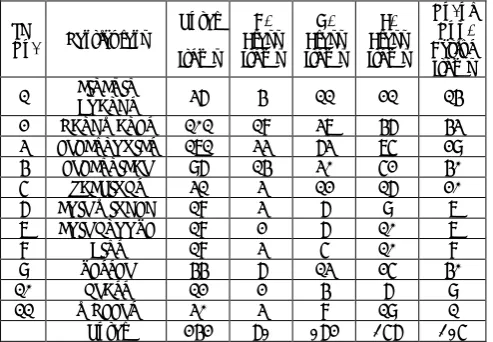
ABC-Analysis performs for Mar-17 available raw materials inventory. The ABC Analysis done for all items but due to large amount of stock items this paper shows only circuit board items (in Annexure). Table 2 shown below shows the ABC analysis of 11 different items and also shows the non-active raw materials.
SL
No. Particulars
Total
Items A-Class Items
B-Class Items
C-Class Items
No. of Non-Active
Items
1 CIRCUIT BOARDS 36 4 11 21 14
2 HARDWARES 101 18 37 46 43
3 ELECTRONICS 171 33 63 75 29
4 ELECTRICAL 96 14 30 52 40
5 PACKINGS 31 3 12 16 20
6 COIL WINDED 18 3 6 9 7
7 COIL GROOVE 18 2 6 10 7
8 BITS 18 3 5 10 8
9 VESSEL 44 6 13 25 40
10 GLASS 12 2 4 6 9
11 WHEELS 30 3 8 19 1
Total 575 91 195 289 218
Table 2 ABC-Analysis of 11 different aspects of items for Mar-17 Source: Raw material items form company (Lorman
Tech.)[3]
After ABC analysis performed for all items, categorized into three classes that are A-class, B-class, and C-class and also calculate the number of non-active items after that analyze and calculate the cost of non-active items as shown in table 3.
Nov-16 Dec-16 Jan-17 Feb-17 Mar-17
Available Items
Cost (in lakhs) 53.15 80.81 70.07 56.31 43.77
Used Items
Cost (in lakhs) 14.76 10.74 13.76 12.54 13.06
Total Raw Material
Cost (in lakhs) 67.91 91.55 83.83 68.85 56.83
Non-Active Material
[image:3.595.38.294.261.349.2]Cost (in lakhs) 15.57 16.37 17.00 18.35 20.90
Table 3 Cost summery of items including non-active raw
material cost
5. JIT purchasing implementation
Just-in-time (JIT) is an inventory strategy companies employ to increase efficiency and decrease waste by receiving goods only as they are needed in the production process, thereby reducing inventory costs. This method requires producers to forecast demand accurately. [7]
The list of methodologies of JIT purchasing that “is important but not exhaustive".
Setup reduction
Lot size of one
Balanced flow
Control by visibility
Compact plant layout
Elimination of defects
House keeping
Smoothing materials handling
Purchasing control
Findings:-
Our analysis shows that company follows the ABC analysis for multiple items. It observed that there are 218 items out of 575 items are active and also increasing their non-active items in inventory, and month to month the cost of non-active items is increasing. JIT purchasing rule implementation is beneficiary for non-active item reduction.
3. CONCLUSIONS
In conclusion, this paper is focused on operations management in order to achieve inventory optimization and purchasing activities improvement for the case company. In general, the study paper is of great reference and the output of it is useful, since some recommended solutions were found to solve the current existing problems through in-depth investigation and comprehensive research, and some attempts were made to improve the current performance and prevent the problems recurrence in the future. The contribution for the company is optimizing the current inventory structure, eliminating non-active stocks, and improving the quality of purchasing activities and organization. And from a scholar point of view, the thesis
[image:3.595.35.282.449.620.2]deeply analyzed the relationship between purchasing activities and inventory level control.
1. Due to undefined purchasing management system
the non-active raw material cost is gradually increasing.
2. To keep down capital investment in inventories.
3. To minimize the possibility of disruption in the
production schedules of firm for want of raw material, stock and spares.
4. To minimize the excessive carrying cost.
5. Minimize investment in inventories and minimize
the carrying cost and time.
Suggestion:
1. For purchasing of raw material suggest the ABC
analysis report.
2. Use JIT purchasing management system.
REFERENCES
1. ABC analysis review paper,
http://www.ijreat.org/Papers%202013/Issue5/IJR EATV1I5006.pdf
2. WAREHOUSE OPTIMIZATION BEDNARxFMT,
https://www.theseus.fi/bitstream/handle/10024/ 96261/Michal_Matyi.pdf?sequence=1
3. Lorman induction cooking equipment product data,
http://www.lormantechnologies.com/
4. Muller, Max. “Essentials of inventory management” ,
Amacom books, New York, 2003
5. Some Primary data of lorman technology, from own
website www.lorman.in
6. Wannenwetsch (2006) , “ABC-analysis”, Available :
http://johanneswoe.wordpress.com2013, August 16.
7. www.investopedia.com/terms/j/jit.asp
Annexure
The ABC analysis perform for circuit board items as show below in table 4, in this table first we rank the all 36 items in accordance with the total value giving first
rank to the
items with highest total value and so on. And calculate the
total monthly demand cost of Mar-17
.
Table 4
Item
No. Material Name Particular Monthly Demand Unit Cost Monthly Cost of Used Items
1
SEMIKRON SET 38 3325 126350
2
MODULE CARD READY 5KWH 23 3450 79350
3
GEYSER READY FC SMALL 16 3325 53200
4
POWER CARD READY 0.3MF/4C/CC 36 425 15300
5
POWER SUPPLY READY 3PHASE 25 425 10625
6
POWER CARD READY 10MF/2C/CC 25 396 9900
7
RAILWAYS READY 5KWH 5 1873 9365
8
BFW PCB LORMAN-2A 78 92.11 7184.58
9
POWERCARD FULL BOARD LT--3P30KW 10 287.02 2870.2
10
RAILWAYS LT-RL3KW 10 273.06 2730.6
11
AUTOMATIC KEYPAD LT--103 108 25 2700
12
AUTOMATIC KEYPAD 5KWH 45 54 2430
13
FLAT CARD READY 5KWH 2 838 1676
14
POWER SUPPLY LT--DRV 64 24.69 1580.16
15
MANUAL KEYPAD LT--102 28 55 1540
16
MODULE CARD LT-RL3KWCON 145 10 1450
17
AUTOMATIC KEYPAD BFW 20 52 1040
18
FLAT RC PCB LT-- 1PMB3 1 787.2 787.2
19
MANUAL KEYPAD READY 5KWH 13 32 416
20
DRIVE CARD LT--DRV1 20 20 400
21
DRIVE CARD READY 3PHASE 2 150 300
22
POWER CARD READY 0.15MF/4C/CC 40 5 200
23
DRIVE CARD READY LT-IGBT2C 0 23.63 0
24
POWERCARD
CAPACITOR
SIDE 0 287.2 0
25
POWERCARD TERROID SIDE 0 430 0
26
POWERCARD CENTER PIECE 0 430 0
27
POWER CARD READY 0.3MF/4C/WHC 0 804 0
28
POWER CARD READY 0.3MF/2C/CC 0 396 0
29
POWER CARD READY 10MF/2C/WHC 0 564 0
30
POWER CARD READY 0.3MF/2C/WHC 0 1128 0
31
MANUAL KEYPAD READY 3PHASE 0 56 0
32
MANUAL KEYPAD READY BFW 0 68 0
33
AUTOMATIC KEYPAD 3PHASE 0 35 0
34
BFW PCB READY 2A 0 1096 0
35
DRIVE CARD READY NEW 0 23.63 0
36
GEYSER LT--SP3KW1 0 202.92 0
No. Material Name Particular Demand
Cumulative % of
Materials Cost Cost
Cumulative % of total
usage 1 SEMIKRON SET 38
5.039787798
3325 126350
38.12673671
2 MODULE CARD READY 5KWH 23
8.090185676
3450 79350
62.07099123
3 GEYSER READY FC SMALL 16
10.21220159 3325 53200 78.12435406
4 POWER CARD READY 0.3MF/4C/CC 36
14.9867374
425 15300
82.74120464
5 POWER SUPPLY READY 3PHASE 25
18.30238727
425 10625
85.94735088
6 POWER CARD READY 10MF/2C/CC 25
21.61803714
396 9900
88.93472479
7 RAILWAYS READY 5KWH 5
22.28116711 1873 9365 91.76065981
8 BFW PCB LORMAN-2A 78
32.62599469
92.11 7184.58
93.92864232
9 POWERCARD FULL BOARD LT--3P30KW 10
33.95225464
287.02 2870.2
94.79473935
10 RAILWAYS LT-RL3KW 10
35.27851459
273.06 2730.6
95.61871139
11 AUTOMATIC KEYPAD LT--103 108
49.60212202 25 2700 96.43344973
12 AUTOMATIC KEYPAD 5KWH 45
55.57029178
54 2430
97.16671423
13 FLAT CARD READY 5KWH 2
55.83554377
838 1676
97.67245551
14 POWER SUPPLY LT--DRV 64
64.32360743
24.69 1580.16
98.1492766
15 MANUAL KEYPAD LT--102 28
68.03713528 55 1540 98.61397921
16 MODULE CARD LT-RL3KWCON 145
87.26790451
10 1450
99.05152387
17 AUTOMATIC KEYPAD BFW 20
89.9204244
52 1040
99.36534901
18 FLAT RC PCB LT-- 1PMB3 1
90.0530504
787.2 787.2
99.6028905
19 MANUAL KEYPAD READY 5KWH 13
91.77718833 32 416 99.72842055
20 DRIVE CARD LT--DRV1 20
94.42970822
20 400
99.84912253
21 DRIVE CARD READY 3PHASE 2
94.69496021
150 300
99.93964901
22 POWER CARD READY 0.15MF/4C/CC 40 100
5 200
100
23 DRIVE CARD READY LT-IGBT2C 0
0 23.63 0 0
24 POWERCARD CAPACITOR SIDE 0 0
287.2 0
0
25 POWERCARD TERROID SIDE 0 0
430 0
0
26 POWERCARD CENTER PIECE 0 0
430 0
0
27 POWER CARD READY 0.3MF/4C/WHC 0
0 804 0 0
28 POWER CARD READY 0.3MF/2C/CC 0 0
396 0
0
29 POWER CARD READY 10MF/2C/WHC 0 0
564 0
0
30 POWER CARD READY 0.3MF/2C/WHC 0
0 1128 0 0
31 MANUAL KEYPAD READY 3PHASE 0
0 56 0 0
32 MANUAL KEYPAD
READY
BFW 0
0
68 0
0
33 AUTOMATIC KEYPAD 3PHASE 0
0 35 0 0
34 BFW PCB READY 2A 0 0
1096 0
0
35 DRIVE CARD READY NEW 0 0
23.63 0
0
36 GEYSER LT--SP3KW1 0
0 202.92 0 0
754 331394.74
Table 5
Category Item No
Approximate Percentage of Items (%)
Percentage
Usage (%) Action
A 1 To 4 15% 82.74% Close Control
B 5 To 15 53% 13.87% Regular Control
C 16 To 36 32% 3.39% Rarely Control
Item Monthly Unit Monthly