ABSTRACT
ROMANO, TARA LYNN. Evaluation of an Assets-Based Youth Development Program Designed to Provide Underprivileged Youth with Educational and Employment Resources. (Under the direction of R. David Mustian)
This study was an evaluation of a 4-H Youth Development Program that provided a series of weekend camps and a weeklong summer camp to underprivileged youth. This program attempted to provide the youth with additional knowledge, skills, and aspirations necessary for a successful educational and employment future. This program took place in Carteret County, NC. The major purposes of this study were: (1) to determine whether or not the youths’ knowledge, skills, and aspirations increased due to their participation in this program; and (2) to provide
recommendations for the program so that the program may increase its effectiveness and possibly be replicated by other counties in North Carolina.
A case study research design was used to gather data for this evaluation, with a variety of different data collected from program staff, local schools, parents and guardians of the program participants, and the participants themselves. Surveys, pre– and post-tests, interviews, and observations were the tools used to collect the data. A control group of inactive participants (who had rarely attended program activities) was used as a comparison for the group of youth that were active program participants. An analysis of the data determined if any trends or patterns existed that supported the program’s objectives of increasing the youth’s knowledge, skills, and
aspirations.
The major findings of this study were that: (1) the program, while providing some benefits to the children in terms of support and relationship-building, did not completely achieve its
EVALUATION OF AN ASSETS-BASED YOUTH
DEVELOPMENT PROGRAM DESIGNED TO PROVIDE
UNDERPRIVILEGED YOUTH WITH EDUCATIONAL
AND EMPLOYMENT RESOURCES
by
TARA LYNN ROMANO
A thesis submitted to the Graduate Faculty of North Carolina State University in partial
fulfillment of the requirements for the Degree of Master of Science
DEPARTMENT OF AGRICULTURE AND EXTENSION EDUCATION
Raleigh
2001
APPROVED BY:
_________________________ ____________________________
BIOGRAPHY
Tara Lynn Romano received a BS degree in Agricultural Engineering from Pennsylvania State University in 1992. She served for two years as an Agricultural Extension Volunteer with the U.S. Peace Corps in Senegal, West Africa. In 1999, after three years in the Foreign Agricultural Service at the U.S. Department of Agriculture, she enrolled in the graduate program of
ACKNOWLEDGEMENTS
The writer would like to thank the members of her advisory committee for their assistance and suggestions: Drs. R. David Mustian, Elizabeth B. Wilson, and George W. Bostick. Special thanks are given to Dr. Mustian, who guided her through the lengthy process.
Thanks are also extended to the Carteret County 4-H staff and the Assets Camp program staff, who helped her collect the data for this study and provided her with the support needed to
TABLE OF CONTENTS
Page
LIST OF TABLES vi
LIST OF FIGURES vii
CHAPTER
I. INTRODUCTION 1
Background 1
Statement of Problem 11
Significance of this Study 12
Objectives of the Study 13
II. FRAME OF REFERENCE 15
The Effectiveness of Youth Development Programs 15 Programs that Could Mitigate the Effects of
Poverty 17
Evaluations of Youth Development
Programs 18
Elements of an Effective Youth Development
Program 20
Other Factors Affecting Positive Youth
Development 20
4-H Youth Development Programs 23
Description of Program 26
Program Participants 27
Program Activities 30
III. RESEARCH METHODS 34
Introduction 34
Research Design 35
Population and Sample 36
Instrumentation 36
Data Collection 40
Reliability and Validity 43
Data Analysis 45
Limitations of this Study 47
IV. RESULTS 49
Profile of Participants 49
Demographics 49
Education 50
Program Participation 52
Pre- and Post-Test Data 54
Camp Counselor Surveys 55
Parent Surveys 58
Report Cards 63
Teacher Surveys 67
Participant Interviews 69
Observations 70
Changes Resulting from Program Monitoring 76
V. SUMMARY, CONCLUSIONS, AND
RECOMMENDATIONS 80
Summary 80
Conclusions 81
Recommendations 81
BIBLIOGRAPHY 95
LIST OF TABLES
Page
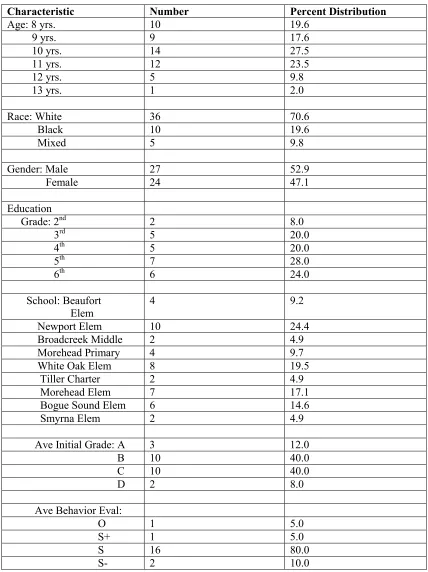
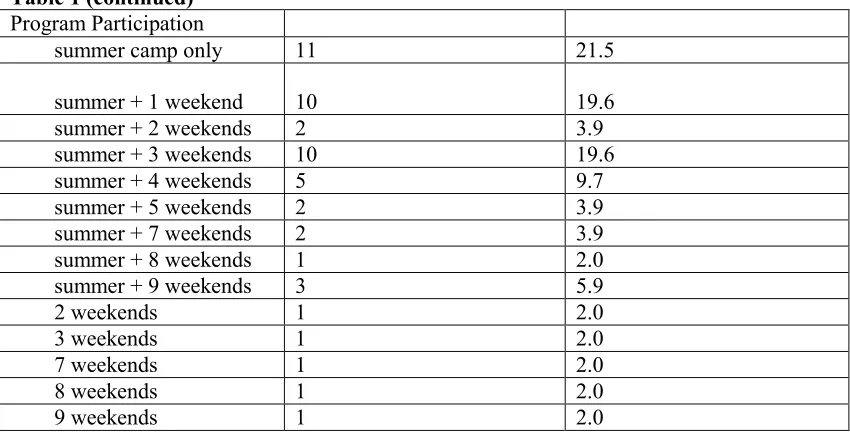
1. Distribution of respondents by demographic factors 53
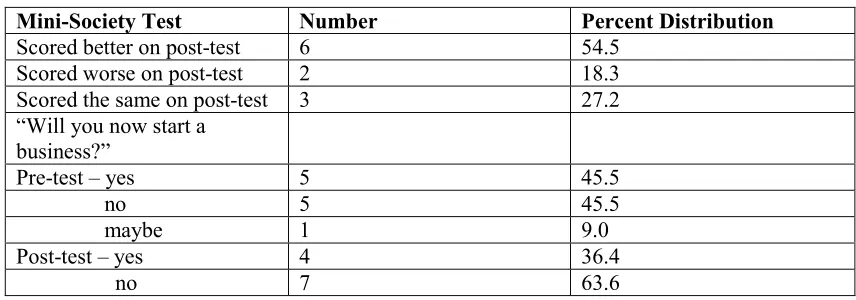
2. Mini-Society pre- and post-test results 55
3. Wild Over Work pre- and post-test results 55 4. Counselor survey results regarding changes in youths’
behavior 57
5. Report cards, total group 66
6. Report cards, control group 66
LIST OF FIGURES
Page
CHAPTER 1
INTRODUCTION
Background
The news media, economists, and traders on Wall Street spent the last few years reporting on the prosperous U.S. economy, and the past few months reporting just as much on the predicted economic slump. With national unemployment and inflation numbers low, there was much talk about how well Americans were living. There rosy reports covered up for the fact that not everyone had enjoyed the benefits of a growing economy. Almost 16 percent of all U.S. counties experienced no growth in annual per capita income between 1991 and 1997, which include approximately 24 million Americans, or about 10 percent of the population (Stark, 1999). With the national unemployment rate around 4.3 percent in the first half of 1999, 13 percent of U.S. counties had to contend with unemployment rates at or above 8 percent, with slightly more than half of these counties experiencing rates of 10 percent or more (Stark, 1999). In addition to these geographic pockets of struggling economies, the gap between income groups is also widening: between 1989 and 1996, income growth mostly occurred in families whose earnings were in the top 20 percent of income distribution, with the remaining families either experiencing no increase or a decline in income (Stark, 1999). The U.S. Census Bureau estimated the 1998 poverty rate to be 12.7 percent, a decline from previous years (Weinburg, 1999). The poverty rate for children was estimated to be about 20 percent (14.5 million), which was the highest for any age group. However, there has been some doubt as to whether the methods used to determine poverty levels were
poverty rate could be too low. Including families whose income does not exceed 200 percent of the poverty level (twice as great), the number of children living in poverty would increase to 40 percent (National Center for Children in Poverty, 2000). The U.S. Census Bureau commissioned a study by the National Academy of Sciences to develop different
experimental poverty measures that may more accurately describe the level of poverty that exists. This study, entitled “Poverty Among Working Families: Findings From Experimental Poverty Measures” (September, 2000), used different methods for determining a family’s income that included non-cash government benefits and job-related expenses. These methods, the study indicated, would more accurately represent a working family’s income and therefore provide a more accurate number of the working families living in poverty. Using these experimental methods, the poverty rate was estimated to be at approximately 15 percent, higher than the official findings using traditional government measurements that did not take into account family costs such as day care and transportation. The findings of this study also indicated that full-time working families made up a higher proportion of those in poverty than was thought previously (53 percent instead of 45 percent), and that the majority of families in poverty had at least one family member who worked at some point during the past year (approximately 80 percent). Another finding indicated that poverty rates for people in full-time working families were particularly high among demographic
compared with 6.6 percent of people with a high school diploma, and 2.5 percent and 1.4 percent of those with associate and college degrees, respectively.
With approximately 20 percent of the nation’s children living in poverty, many studies were undertaken to determine the effects this chronic poverty was having on these children. The U.S. Department of Education stated that living in poverty put a child at a greater risk for falling behind in school, higher than the risks associated with race, geographic region, or living with a teen- or single-parent. Other statistics showed the effects of poverty on a child’s education. Poor children were:
- 2 times more likely to repeat a grade
- 3.4 times more likely to be expelled from school - 1.3 times more likely to have a learning disability - 2 times more likely to drop out of school
- 33 percent less likely to attend a 2- or 4-year college - 50 percent less likely to earn a bachelor’s degree
Poor children also tended to score lower on national reading, math, and vocabulary tests (Sherman, 1997).
younger age to bring in some income for the family. Another problem the children could have been facing was attendance at poor schools that had inadequate resources, such as qualified teachers and staff, technology, up-to-date textbooks, and tutoring services. All of these problems could have a negative impact on a child’s learning and development. These negative effects on children’s education will directly impact their future
These cycles of poverty don’t just affect the children; they also affect society as a whole. According to the report “Poverty Matters: The Cost of Child Poverty in America” (Sherman, 1997), many aspects of our society feel the repercussions of this issue. Poor children require more medical and social services, and schools have to spend extra money on students that are held back, or require special education or tutoring. Poor children grow up to be less educated and productive workers, which affects productivity in our industries. This report estimates that the American labor force loses as much as $130 billion in future productive capacity for every year 20 percent of the children are in poverty. Consumers have to pay for this lost productivity through higher prices, lower quality, or a limited selection of goods. Taxpayers will have to pay more money for the increased expenditures of social services, medical care, and cash assistance for their fellow citizens in poverty. They will also have to pay higher taxes to compensate for those who are not paying taxes because of poverty. Cutting back on these expenditures could force society to foot the bill for higher criminal justice expenditures, or face the consequences of a more violent society (people with less money, and
opportunities, may be more likely to turn to crime (Zahn, 1999)). Therefore, just because people are not feeling the direct effects of poverty does not mean this poverty will not affect them in some way.
poverty line), an increase of 5 percent from 1990. Much of the highest poverty was
concentrated in the western and eastern parts of the state. This leaves the central part of the state, including the Triangle and Triad areas as the more prosperous section, accounting for the overall low unemployment rate and high average family income ($43,012 in 1996, U.S. Census statistics) of the state. But these statistics boasting of a booming economy were misleading, due to the wide disparity between economies in different counties.
Wake County is one of the more prosperous counties in the state. The state capital is located here, and many well-known colleges and industries are located in or near the county. The population is growing as more people are attracted to the educational and employment opportunities in the area, and the economy is thriving as a result. The U.S. Census estimated the poverty rate for Wake County to be 7.8 percent, with 11.3 percent of children living in poverty (1997). The median household income was estimated at $51,391. By contrast, estimates for Carteret County, on the eastern coast of the state and mainly known for beach tourism, were much higher – 11.8 percent poverty overall, and 18.7 percent for children. The median household income was $34,348. The job markets were very different in these
counties, which contributed to this income disparity. The Economic Development
Information System (EDIS) is a service of the North Carolina Department of Commerce, and provides employment statistics on each of the counties in the state. In Carteret County, the 1999 unemployment rate was 3.9 percent, compared to 1.4 percent in Wake County. The service and retail industries account for 53 percent of Carteret’s workforce, with average weekly earnings of $299.28. These same industries accounted for 48 percent of Wake’s workforce, but with average weekly earnings of $492.27. This difference was due to the fact that the service industry also included professional, scientific, and technical services,
largest employers in Carteret County were listed as Atlantic Veneer Corp Manufacturing, Wal-Mart, and Peppertree Resorts, Ltd. (NC Department of Commerce, 2000).
A big difference between these types of employment is education. One needs much more education to work for one of the large businesses in Wake County than one does to work for one of the major employers in Carteret County. The percentage of high school and college graduates was much higher in Wake County than in Carteret County – 85.4 percent and 35.3 percent compared to 75.5 percent and 16.2 percent, respectively (NC Department of
Commerce, 1999). As stated above, children growing up in poverty were less likely to obtain the education they needed to lift them out of poverty and into stable, profitable employment. Finding a job is difficult enough, without the added handicap of lacking proper qualifications. That is exactly what this poverty is to children – a handicap, one they have through no fault of their own. And this handicap could be with them their entire lives.
Children in poverty have less access to resources needed to help them succeed in school and prepare them for future employment. There are many reasons for this, most beyond their control. One of the reasons is that poor children tend to live in poor areas, which then affects the quality of the school they attend. If a school is located in a poor area, where property tax revenue is low due to the poverty, the school will have less resources to expend on the students, despite receiving a bigger share of the state’s federal funding for public schools. This lack of resources can contribute to the hiring of less qualified teachers and lower retention rates of qualified staff, and a lack of up-to-date resources, such as new textbooks and computers.
scores, the average dropped to 963 (Carteret County Schools, 2000). SAT scores should certainly not be the only basis for judging a school’s performance, and rankings can be tricky, as the average is based on a self-selected portion of the student population who take the test (although when statistically adjusted to take into account how many students in each state took the test, North Carolina still ranked 45th in the country (Hood & Joyner, 2000). However, North Carolina had other indications that its public education system was lacking. In the publication “Quality Counts ‘98”, from Education Week on the Web, the report on North Carolina was mixed. While the school system received high marks for its standards and assessments practices, the system received a “C+” or lower for teacher quality, school climate (number of children per class, student engagement, and parental involvement), and adequacy and allocation of resources. North Carolina’s overall rank during the 1990s for its National Assessment of Educational Progress (NAEP) test results was 34 out of 43, with anywhere from 40 – 50 percent of the students in public schools lacking basic skills in the subject being tested (children that went to private schools fared much better on the tests, with 8th grade students being twice as proficient in reading as their public school counterparts). In addition, North Carolina ranked 47th in ACT scores last year and only 54 percent of students who took the Advanced Placement tests scored a 3 or better (compared to the national average of 62 percent (Hood & Joyner, 2000)). Clearly, there were some problems. While throwing money at a problem is rarely a solution, the lack of resources faced by poor schools can compound the educational problems poor children face; as stated above, children at private schools, where it could be assumed that adequate resources exist, along with smaller class size and increased parental involvement, seemed to have higher
counties in the eastern and western portions of the state, including Carteret County. This lack of spending can put already underprivileged children at even more of a disadvantage in a system that one would hope could be an equalizer in our society, giving every child the same chance to educate himself despite his parents’ economic, educational, or racial background. Yet students in poor schools tended to score lower on standardized tests and were more likely to be performing below their grade level. They were also less likely to be prepared for higher education, with just 28.3 percent of poor students enrolled in college preparatory classes, compared with 65.1 percent of high-income students (U.S. Department of Education, 1995). These schools may even have done harm to their students by just passing them through the system – a 1995 U.S. Department of Education report found that “A” students at poor schools were scoring on tests at the same level of “C” and “D” students from affluent schools.
Children who were getting “B” and “C” grades at poor schools could very well have flunked out of a more wealthy school. This disparity in school performance means that poor schools, while possibly graduating a majority of their students, were turning out young adults who were not prepared to compete in today’s economy and become self-sufficient citizens. In addition to attending poor schools, low-income children usually lack many of the resources needed in their home lives to provide them with the assets and competencies needed to succeed. Reading skills are something schools expect students to be able to easily work on at home, with access to books, libraries, and parental aid. However, poor children may not have these resources, due to factors such as parents with low literacy levels, parents who are not home much because of odd work hours, lack of transportation needed to go to the library, or lack of funds to purchase books. The stress of living in poverty may mean parents do not have time to be involved in their child’s schooling or to help them with their
With such limited resources to draw on, these children may be forced to stay in this cycle of poverty as they grow older, eventually passing it on to their children. As children, they have limited control over their lives, and are not necessarily able to make the choices necessary to help themselves break out of this cycle. They do take note of what is going on around them and internalize what they see, whether that is the actions of the adults in their lives or their attitudes. As the children get older, they tend to adopt these attitudes and conduct their lives similarly. Therefore, early intervention that provides additional resources to these children is needed to help them break the cycle.
Poverty does not have to be a way of life for these children. There are a number of things that could be done to provide poor children with the resources necessary to help them break out of the cycle of poverty. The Children’s Defense Fund suggested that the federal government could fund youth development and job training programs that fostered a work ethic in young people and helped them to acquire the skills needed for future success (Sherman, 1997). Another suggestion was that poor children needed continuous and early intervention to keep their school work and home lives on track, with programs such Smart Start and mental health and substance abuse services (Risman, 1999).
Carteret County is one of many counties in North Carolina that needs to address the issue of children in poverty. There are many different ways to combat this issue, with no one way that can be considered right or one way that will be completely inclusive of all the problems that are faced by these children. Yet by planning a long-term strategy that focuses on a few of their problems, takes into account their special needs, and integrates well with their home and school lives (where they spend much more time than they do with a program), steps can be taken to give these children the chance they deserve.
Statement of Problem
children also need to develop employment aspirations for themselves, something they may lack if they grow up around adults who are chronically unemployed or in low-income jobs. The Secretary’s Commission on Achieving Necessary Skills (SCANS) report (U.S.
Department of Labor, 1991) and the Search Institute’s Developmental Assets framework (1996) defined a core group of competencies and skills. The SCANS report was appointed by the Secretary of Labor in 1991 to determine the skills needed by youth to succeed in a high-performance workplace (thereby encouraging a high-performance economy). The report listed the fundamental skills that make up a solid foundation for a high-performance worker – basic (reading, writing, math, listening, speaking); thinking (creative, decision-making, problem-solving, knowing how to learn, reasoning); and personal (responsibility, self-esteem, sociability, self-management, integrity). The five competencies identified as most necessary for achievement included: the ability to identify, allocate, and organize resources; interpersonal skills (conflict management, teamwork); the ability to acquire and use information; the ability to understand complex inter-relationships; and the ability to work with a variety of technologies.
The Search Institute’s Developmental Assets framework (1996) identified 40 assets that youth need to grow into productive, healthy adults. These assets were established as either internal or external to the youth, and divided into categories. External asset categories covered support, empowerment, boundaries and expectations, and constructive use of time. Examples of these assets included family support, a caring school climate, safety, family and school boundaries, high expectations for youth, and youth programs. Internal asset categories covered a commitment to learning, positive values, social competencies, and positive identity. These assets included achievement motivation, reading for pleasure, caring, honesty,
The NCSU Department of 4-H Youth Development pilot program “Reducing Inter-Generational Poverty Through Weekend Academies and Assets-Based Summer Residential Experiences” attempted to provide these resources to children in Carteret County through monthly weekend camps (academies) that took place during the school year and a weeklong summer camp experience. Eligible children were 8-12 years old and identified by the Carteret County Department of Social Services (DSS) as living with families whose income was no greater than 200 percent of the current poverty guidelines. The current poverty guidelines, issued by the U.S. Department of Health and Human Services, start at $8,590 per person, with $3,020 added for each additional family member (2001). Approximately 50 children have been identified, and an effort was made to have as many of the same children at each camp as possible. In addition to the traditional camp activities of swimming, horseback riding, canoeing, and arts and crafts, the children also participated in workshops covering conflict management, entrepreneurship, writing skills, personal development, and job skills development.
Significance of this Study
The 4-H program was intended to provide these children with knowledge, skill, and ambition growth in areas linked to positive motivation, self-sufficiency, and employability. The assets covered were linked to the SCANS and Developmental Assets reports. The purpose of evaluating this program was to determine if the goals of the program were being met. If the goals of the program were not met, this study was to provide suggestions for program modifications.
intense, evaluation was a key element for this program. Evaluation of the program was necessary to demonstrate whether or not the program achieved its goals and if money should continue to be allocated to support it. If this program did not accomplish its goals, aspects of the program may need to be redesigned, or the whole program should be discontinued so those funds could be given to a more productive program. The program activities were also not meeting the needs of the children being served if the program did not achieve its objectives.
Objectives of the Study
The objectives of the 4-H program were to increase knowledge, skills, and ambitions of poor children in the areas known to relate to future economic well-being, and to develop a program that could possibly be replicated by other counties in the state. These objectives, therefore, of this study are the following:
1. The purpose of this study was to determine whether or not the participating children’s knowledge, skills, and aspirations in certain areas are being increased due to this program. Identification of the occurrence of certain immediate and
intermediate outcomes provided this determination.
a. The immediate outcomes include: the children will learn better
communication (demonstrated by the children’s ability to express their themselves effectively and in socially acceptable ways), conflict resolution, writing, and job skills; the children will learn about
entrepreneurship; and the children will learn how to follow camp rules and behave appropriately while at camp.
assignments and homework more consistently) and in their behavior; the children will be more respectful of their peers and adults; and the children will engage in socially acceptable behavior.
2. This study was also to provide recommendations for the program so that it may increase its effectiveness in helping this population, and possibly be
CHAPTER II
FRAME OF REFERENCE
The Effectiveness of Youth Development Programs
While youth have always had their share of difficulties developing from dependent children into healthy, productive adults, youth in the 1990’s have had more difficulties than most. The wider availability of drugs and guns has increased the incidences of violence in our society, including violence among youth. Gangs are more commonplace, as youths seek a group to identify with. With more families choosing to have two wage earners, and with the increase in single-parent homes, more youth are spending more time unsupervised after school. More children are living in poverty, accounting for the largest group of the U.S. population living below the poverty line (U.S. Census Bureau, 1999). Access to media such as cable television and the Internet have made youth savvier about the world around them, while also sending them conflicting messages about what is expected of them. This media, coupled with the fear of violence that could exist in their schools and neighborhoods, has also made it easier for youths to shut themselves out of society, giving them alternatives to productively interacting with the world around them. Any or all of these factors can be a detriment to healthy youth development, and can handicap a child during his adult life.
The review of literature revealed a substantial amount of research regarding the effects of different factors on children and their development and also ways to mitigate these effects. Some of the research indicated that chronic poverty could have the biggest effect on a child’s educational development, more so than other factors such as race or family structure
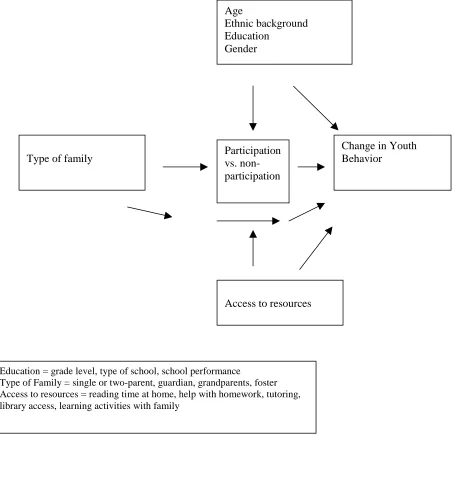
Figure 1: Schematic of factors that can affect youth development.
Change in Youth Behavior
Participation vs. non-participation Age
Ethnic background Education
Gender
Type of family
Access to resources
Education = grade level, type of school, school performance
cause a positive change in youth behavior, although not necessarily – sometimes desired changes can occur without program participation, due to the natural process of maturation or outside influences such as parental or school guidance. Other factors could affect youth development, such as age of the child, ethnic or racial background, educational level, and gender. The type of family could also affect youth development - a two-parent home versus a single-parent home or no parents (guardians, grandparents, foster). The different family structures could be a result of divorce, parents never getting married in the first place, young parents, and parents with low educational attainment (that may not be able to provide for their children). A child’s access to resources could also affect his development. This includes the economic conditions of the family (poverty, near-poverty, middle income, and high income) and the quality of the school the child attends. In addition to these factors independently affecting youth development, these factors could affect a child’s participation in an educational or community program and also the effects of that program on the child. Programs That Could Mitigate the Effects of Poverty
Investments need to be made in programs that provide poor children with early and continual intervention in education, health, and social development (Risman, 1999, Zahn, 1999, Sherman, 1997, Stark, 1999, National Center for Children in Poverty, 2000). Different types of programs addressing child development are available, such as Head Start, after-school programs, Big Brothers/Big Sisters, and programs provided by organizations such as 4-H and Boys and Girls Clubs. Other programs aimed at tackling a specific issue are also available, such as teen pregnancy, school violence, and drug use.
parents and educators also see these programs as ways to improve and broaden their children’s education and give them the opportunity to acquire new skills. These programs can also provide assistance to children who are struggling in school.
Youth development programs, ones that address educational, employment, and social development skills, are becoming more popular now than programs that address problems as they emerge, such as teen pregnancy and drug addiction (Killian & Brown, 1999). These latter programs are seen as short-term interventions that only produce short-term solutions. However, programs that address issues such as interpersonal skills, self-control, problem solving, cognitive competencies, self-efficacy, and academic achievement can also provide long-term solutions to the problems above, as well as better prepare youth for productive adulthood (Catalano, Bergland, Ryan, Lonczak, &Hawkins, 1998). In addition to school programs, these programs can also be conducted in the community, in the family, or some combination of the three. This also includes camping programs, which have been shown to have positive effects on a child’s aspects of self (self-confidence, self-esteem, self-image) even in a short period of time (Marsh, 1999). Research has shown these various types of programs can provide benefits to children who may be suffering from the impacts of poverty. Evaluations of Youth Development Programs
same basic concepts of youth development for various audiences (preschool, elementary age, preadolescence, and adolescence).
After-school programs received extensive evaluation by the U.S. Departments of
Education and Justice (2000), which provided evidence of successful results from a variety of programs around the country. Some of the findings included youth who participate in regular after-school programs are less likely to start using drugs and alcohol or participate in violent activities; more likely to develop new skills; less likely to miss school or be held back; and have better social skills.
Another large study was done to evaluate different types of youth development programs that either took place in cooperation with the child’s school, family, community, or some combination of the three (Catalano et al., 1998). In a study of 25 youth development programs, serving youth from ages 6 – 20, 19 showed positive changes in youth behavior, including interpersonal skills, quality of peer and adult relationships, self-control, problem solving, cognitive competencies, self-efficacy, commitment to schooling, and academic achievement. Twenty-four of the programs showed a decrease in risky behaviors, such as drug and alcohol use, misbehavior in school, aggressive behavior, violence, truancy, high-risk sexual behavior, and smoking (although these programs were not all aimed specifically at these behaviors). There were some indications that having the school and family involved in some way in the programs contributed to greater success of the programs.
sites without clubs (Schinke, Cole, & Orlandi, 1991). An evaluation of early childhood care programs indicated these programs might have effects on IQ, achievement, grade retention, and socialization (Barnett, 1995).
Much of this research was done on programs that primarily serve underprivileged youth. It should also be noted that much of the research evaluated short-term effects (no more than a year out of the program) of these programs, and did not study any possible long-term effects. Elements of an Effective Youth Development Program
Elements of effective youth development programs were identified throughout the research. Promotion of healthy relationships, self-efficacy, positive ambitions, and
competence in social, emotional, cognitive, and behavioral skills were considered essential elements by some (Catalano et al., 1998, Brown, 1999, Lattimore, Mihalic, Grotpeter, & Taggart, 1998). Others indicate promotion of youth leadership, youth input in program planning, and school and parental involvement are also necessary for successful programs (Quinn, 1999, Killian & Brown, 1999). Still others advocate starting early and receiving multi-level funding to assure the program is around for the same youth for more than one year (Lattimore et al., 1998, Devaney, Ellwood & Love, 1995).
Other Factors Affecting Positive Youth Development
As stated earlier, research indicates that poverty is the biggest factor negatively impacting on a child’s educational attainment, more so than a single-parent home or race. In fact, a report written by CSR, Incorporated, for the Department of Health and Human Services (1997), indicated that recent research has demonstrated that family process, rather than family structure, has a stronger influence on how youth develop, and if adults in single parent, divorced, or guardian families develop positive relationships with the children and exert an appropriate level of control, behavioral problems typically attributed to those family
child’s development, particularly if they are combined with other factors (for example, a single female-headed household is more likely to experience poverty, which will most likely decrease the child’s chance for positive development).
There has been much research into many different factors that can affect a child’s development, including age, race or ethnic background, education level, gender, family resources, family structure, and participation in extracurricular activities. As this review indicates, there also has been some research on the effectiveness of youth development programs. However, there appears to be little research on what, if any, effects these factors may have on the outcomes of the youth participating in these programs (for example, do white youth fare better in youth development programs than minority youth, or do girls show more positive outcomes then boys?). The research instead focuses on the need these factors create for youth development programs; an example would of this research would study how a lack of participation in extra curricular activities can be detrimental to youth who have too much unstructured time on their hands, or how girls can suffer from societal pressure that makes them feel they don’t need to excel in traditional male domains. The research may also look at the barriers to positive youth development, such as poverty, an unstable home life, discrimination, quality of schools, educational achievement, and the availability of
would be appropriate to that age (Youth Starts With You, 1999)). Some youth development professionals also have ideas about which ages will respond best to youth programs (before age five, or no later than 12), but no research was found that substantiated these claims. The lack of research regarding how these factors affect program outcomes could be because it’s rather difficult to generalize this type of information from program to program, as many factors could contribute to why one program obtained good results from a certain population and another did not. An example of this could be that Hispanic children did not change their behavior after participating in a program, while white children responded well, because this particular program was too centered on Euro-American traditions and values that the Hispanic children were not familiar with. This does not mean that with some culturally sensitive tweaking this same program could not produce similar results in that population. It would be difficult, though, to attempt to state across the board that girls get more out of youth development programs than boys, or affluent children respond better than underprivileged children – there are just too many factors involved. This type of analysis could be useful for individual programs, however, and might be beneficial for program developers to study. If there is a disparity between what certain segments of the program’s participants are gaining from the program, this could indicate that the program is only meeting the needs of a portion of its audience, and ignoring the needs of other segments of its audience. Using this
information to redesign aspects of the program to meet everybody’s needs could be beneficial to all involved.
the school, family, and community of the youth - has the best chance of successfully influencing positive change in participating youth.
4-H Youth Development Programs
4-H Youth Development is a national youth program that is a part of the Cooperative Extension Service and began as a way for extension to further disseminate information in rural areas to improve food production and preservation. The organization has expanded since its beginnings in the early 1900s, and now includes urban youth and a wider variety of programs beyond the scope of agriculture. The organization exists at the federal, state, and county levels, but the decentralized nature of it provides much autonomy at the local levels. As a result, different activities and programs exist in different 4-H clubs around the country, although the programs all share some commonalities. The mission of the National 4-H Organization is “to create supportive environments in which culturally diverse youth and adults can reach their fullest potential”. Youth are the core audience for the programs, but the organization relies on the support of adult volunteers who are trained in 4-H program delivery for many of its activities; thereby the mission includes helping adults “reach their fullest potential” as well. The goal of the organization is to create competent, contributing, productive members of society. The organization does this by building life skills such as positive self-esteem, communication, decision-making, citizenship, leadership, learning how to learn, and problem solving.
All youth between the ages of 5 and 19 (21 in some states) are eligible to participate in 4-H. Major activities include fairs, shows, camps, and conferences. Participation usually starts at the local club level, and can move on to county, district, state, national, and
after-school, school enrichment, or special interest clubs. Project clubs are organized around a common interest in a subject, such as horses or cooking. Community clubs cover a variety of topics. Both of these types of clubs generally meet on a monthly basis. After-school clubs can be a project or community club, but meet in an organized childcare setting. School enrichment clubs provide supplemental curriculum for schools to use in their classes. Special interest clubs are generally short-term groups that meet for a special project, such as health and first aid or community clean up. Videos and educational materials are also available in some states for youth to use. Youth who live in more remote areas can also enroll in 4-H as an individual member and work on individual projects. In 1999, 6.6 million youth were involved in 4-H (National 4-H Website, 2001).
4-H programs center on delivering hands-on projects and activities that provide youth with an in-depth learning experience, giving youth the opportunity for “learning by doing” (the 4-H slogan). Research-based curriculum and activity guidelines are available from 4-4-H offices on a variety of topics, such as public speaking, employment, and resolving conflicts. More than 200 projects are available for 4-H participants to undertake, either individually or with a club. Project areas include animal science, citizenship, communications, family and
camp, or attend conferences that will further develop life skills, such as leadership and volunteering.
The goal of North Carolina’s 4-H program is “to assist youth and adults in becoming competent, coping, and contributing members of a global society, developing essential life skills through planned “learn by doing” experiences” (North Carolina Cooperative Extension Service). The clubs are community based and determined by local needs and interests. They are coordinated by 4-H Extension staff, but are operated by local volunteers. In 1998, 215,172 North Carolina youth participated in 4-H. The majority of the youth participated in special interest clubs or school enrichment programs, with another large segment enrolled in clubs and school-aged childcare programs. Youth from minority racial/ethnic groups make up 35 percent of 4-H participants in North Carolina. Approximately 80 percent of 4-H participants live in towns with populations under 50,000. Approximately 80 percent are between the ages of 5 and 12 (North Carolina Cooperative Extension Service).
In addition to the volunteer adult leaders, youth involved in the clubs are encouraged to take on leadership roles as appropriate for their age. For example, younger members will be assigned at each meeting to lead the 4-H pledge or take roll, while older youth will elect club officers. This gives the members an opportunity to gain leadership skills. The clubs are also encouraged to participate in at least one citizenship activity each year and complete at least two community service projects each year. These activities will help the youth develop a variety of skills, depending on what the activity is, and also develop a sense of belonging to the community.
year. 4-H camps strive to provide youth with a learning experience as well as a fun-filled adventure, and try to provide more interactive activities than can usually be found at school or home. The camps also help to create interdependence and a feeling of community among the youth, as well as a chance to interact with a diverse group of people. The focus at camp is more on group cooperation and shared success, rather than competition, and tries to
emphasize teamwork. 4-H camps provide a good opportunity for meeting the organization’s goals of developing youth into productive, caring adults.
Description of Program
The grant entitled “Reducing Inter-Generational Poverty Through Weekend Academies and Assets-Based Summer Residential Experiences” was administered by the Department of 4-H Youth Development at North Carolina State University (NCSU), in partnership with the Carteret County Department of Social Services, the Carteret County Cooperative Extension Service, the Humanities Extension Program at NCSU, the Work-Study Program at NCSU, the Department of Agricultural and Resource Economics at NCSU, and the Departments of Social Services (DSS) in 13 flood-affected counties in eastern North Carolina. “Work First Pilot Projects”, a program administered by the Jordan Institute at the University of North Carolina - Chapel Hill, funded this program.
children. NCSU and camp staff provided instructors for the program. At the weekend camps, the NCSU Work-Study program provided camp counselors to mentor the campers.
Program Participants
The target population for these camps was youth 8-12 years old whose family eligibility had been certified by DSS not to exceed 200 percent of the federal poverty level. That is the only criteria the children were required to meet. The weekend academy program started in Carteret County in September 1999, with 21 children who lived in the county. The children attended six weekend camps throughout the school year (during the fall and spring – there were no camps during the winter months of December, January, and February, nor were there any in June and July) before attending a weeklong summer camp in August. The cycle then started again in September 2000. In addition to the same 21 children that had been attending the camps since the beginning, another group of 32 more children from Carteret County were selected to attend the summer camp in July 2000, and efforts were made to get these children to regularly attend the weekend camps the second season. This group of 53 children provided the population for this study. While many other children from other counties have benefited from the camp scholarships made available by this grant, only children from Carteret County attended weekend camps.
Observing the behavior of the participants at the start of the program indicated that some behavioral problems existed among the youth. There was a lot of yelling and verbal fighting that went on at the initial camps, particularly on Friday nights when the children first arrived at the camp. There had been some cases when this fighting escalated into something
included breaking into a camp building during the night and climbing up to the roof of another camp structure. These behaviors reinforced the need for this program, to redirect the youth and provide opportunities for skill development and attitude change.
These extreme behaviors were not typical of most of the participants; however, many of them have exhibited behavior that was not always appropriate for a situation. For example, many of the participants seemed to have a difficult time paying attention when someone else, either an adult or a peer, was talking and would continually either talk to others or interrupt the person speaking, despite many reprimands. Many of the participants had difficulty following directions and would not listen when adults told them to do something, such as “settle down”. The participants would yell and bicker with one another, calling each other names and telling others to “shut up”. Some would resort to physical fighting and very aggressive behavior four or five times in a weekend. These behaviors indicated a lack of respect on the part of the participants for others around them. The participants also did not always show much interest in learning and had a hard time staying focused on the workshop activities. A number of the participants, even at their young ages, had already adopted a “tough” persona, thinking it was okay to make fun of others or use violence as a means of solving conflict (saying that they would hit someone), or just acting like they did not care about anything.
Many of the youth also seemed to have a difficult time taking care of their basic hygiene needs. Soap, shampoo, toothpaste, and deodorant were provided at the weekend camps, and some participants really needed to be encouraged to use them. Sometimes one would refuse to take a shower during the weekend, or wear the same clothes all weekend.
The Department of Social Services does not give out confidential information regarding specific participant’s home lives, but it was possible to gather some information based on what was known about the participants and interactions with the parents or guardians.
Certainly, some of the behavior exhibited by the participants indicated their situation at home may be less than ideal, and at the very least that they were not learning proper behavior or how to interact in a socially acceptable way, and have developed bad habits and coping mechanisms based on the behavior they saw at home. However, without knowing the full story, one can only guess at what some of their home lives may have been like, and only in certain instances can facts be presented to support these guesses.
participants had these issues, but many of the camp counselors that had gotten to know different children over the course of the camps felt that many of the children had sad stories. There were also some indications that the parents or guardians were not very involved in the participants’ lives, which could be detrimental to the youth. The extension staff that worked with the participants believed that many of the parents placed their child in this program because they very much wanted to get rid of them for the weekend. Parents also proved very difficult to get in touch with, and the majority was unresponsive to the program’s letters, announcements, and requests. This was not true of all of the parents, of course, but it appeared to be true of enough of them to provide troubling insight into the participants’ lives.
Program Activities
Both the weekend academies and the summer camps were designed to address
competencies that have been identified as necessary to breaking out of the cycle of poverty. These competencies came out of the SCANS report and the Search Institute’s Developmental Assets Framework. The weekend academies used activities from four different sets of established 4-H curriculum: Discovering Myself (writing and communication skills), Heart to Heart (team-building, working with and respecting others, conflict management), From My Hand to Yours (different expressions of service to others) and Wild Over Work (job skills, the world of employment). The academies also incorporated other activities and curriculum: journal and story writing, entrepreneurship, public speaking, and character education. The youth also participated in activities covering the environment, diet, health, fitness, personal hygiene, and etiquette. These topics and concepts were incorporated into the workshops that occupied approximately 25 percent of the weekend activities. The remaining time was spent participating in traditional camp activities, including songs, skits, games (many that
The weekend academies began at 5:00 pm on Friday evening and ended at 1:00 pm Sunday afternoon. The youth were transported to and from the Mitchell 4-H Center in Swansboro, NC, by Carteret County Extension staff and volunteers. At least one
representative from the Carteret County Extension staff was present each weekend, usually a 4-H program assistant or volunteer. The camp coordinator was also present. During the first season, the extension representative and camp coordinator were the same person, but for the second season an Americorps Volunteer from Public Allies worked with the NCSU 4-H Youth Development Department to develop the camp workshops every month.
Approximately 20 camp counselors were present at each academy, in an effort to keep the child-to-counselor ratio low, and to provide the youth with as much of a mentoring
taught to respect others, the value of teamwork, positive self-image, and the value of learning for the sake of learning.
The weeklong summer camps (referred to as “assets-based summer residential experiences” in the grant) were similar to the weekend academies, but took place for five days. There were also more youth present, and the counselor-to-camper ratio was higher, although there were also more adults present. Most of these adults were conducting the workshops, designing their lesson plans based on the curriculum that was used at the
weekend academies. The counselors, meanwhile, were assigned to a group of youth that they spent the week with, accompanying them to all of their activities and living with them in the cabins. The youth arrived early Monday afternoon and departed late Friday morning. They were assigned to groups based on their age and sex, with usually eight or nine youth per group. The youth stayed with their group throughout the week, attending the same workshops. Most of the youth attended a series of four different workshops, each an hour long. The workshops focused on employment skills and knowledge (using the Wild Over Work curriculum), conflict management, personal development, or writing. The youth attended each workshop topic four times, for a total of 16 hours, which represented
approximately 25 percent of their time at camp. A group of youth (between 25 – 30) did not attend any of these workshops, instead they spent 20 hours (approximately 32 percent of their time at camp) during the week participating in “Mini-Society”, an entrepreneurial activity that involved youth developing a society and the systems needed to run it and then coming up with an idea for a business that would be successful in that society. The non-workshop activities included a talent show, swimming, horseback riding, arts and crafts, campfire, and a dance.
interactive as possible. Except for the writing classes, in which the children wrote in journals and composed poetry, the workshops were designed to not resemble schoolwork. In the Wild Over Work workshop, youth learned about different work opportunities available to them by following what it takes, and how many people are involved, to make a wheat seed into a loaf of bread they can buy at the store. They also played games that emphasized teamwork. In the conflict management workshops, they created skits that demonstrated appropriate and inappropriate ways to handle conflict. In the personal development workshops, they worked on projects designed to develop their teamwork and leadership skills.
CHAPTER III
RESEARCH METHODS
Introduction
There are many different research approaches that can be taken when conducting an evaluation, both qualitative and quantitative. Deciding what approach to take involves many factors. The audience to be evaluated, the type of project being evaluated, the size of the project’s population, the scope of the project, the type of information desired from the
evaluation, how the data can best be collected, and the level of generalization from the project population to the total population all affect the appropriateness of the evaluation approach.
A case study is a qualitative approach to research that is defined as an in-depth study of a
The case study method was the chosen research method for this evaluation, based on the reasons stated above. The phenomenon was the pilot 4-H camp program that was being conducted with a small population of children in Carteret County, and while there were defined outcomes that were being looked for in the evaluation of the program, due to fact that this program was in its beginning stages, there was some uncertainty as to what the program effects would be. The focus of this case study was the effects of the program on the
participating population, and the type of data collected and analyzed reflected this focus. Research Design
Population and Sample
The program served children in Carteret County between the ages of 8-12 who were
identified by the local Department of Social Services (DSS) as being eligible for the program. This eligibility was based on only one factor: the child lived in a family whose income was below 200 percent of the federal poverty level. Children from these families constituted the population being served by this program. The sample population was not a random sample, as it was comprised of a self-selected sample of 53 children whom DSS identified and notified of the program, then elected, or their parents or guardians elected, to participate in the program. The participants then had to fill out some paperwork verifying that they were eligible for the program, and that was basically all that was required of them. They were notified of the camp dates, given a list of things they needed to bring (clothes and personal items only), and told where they were to meet their transportation (usually a Carteret County Extension Office van). Therefore, the sample was comprised of participants who were willing and able to perform these requirements, few as they were. This number represents all of the children who have been a participant of the program at some time during the program’s operation; some of the children participated more than others, and there was some attrition, either due to a lack of interest or families moving away.
Instrumentation
The basic objectives of this program were to increase the knowledge, skills, and ambitions of the participating children in the areas of job skills, entrepreneurship, personal
development, writing, and conflict resolution. These variables could be measured in a variety of ways.
Job skills included competencies such as teamwork, leadership, responsibility, and good communication. These skills also included an understanding of basic concepts in
employer, and consumer. An understanding of different types of employment available was also a part of job skill development. Some of these variables, such as definitions, could be measured using a pre- and post-test format, determining what the participant knows before and after the program. If the participant scored better on the post-test than the pre-test, than it may be possible to assume that the change was due to the program. Other instruments used included surveys, both of the participants and people in a position to observe the participants, to determine if the program increased the participants’ skills in competencies such as
teamwork and communication.
Competency in entrepreneurship included knowledge of what drives markets (supply and demand), the steps needed to start a business, and what costs are involved. It also included developing creative and problem-solving skills and an ability to understand the market. Again, a pre- and post-test instrument was used to measure the variables that depend on basic knowledge, while the other variables were measured by observation, surveys, and interviews. Personal development and conflict resolution skills included the ability to interact
appropriately with others, take responsibility for one’s actions, show respect and
consideration for others, demonstrate a feeling of self-worth, accept differences in others, resolve problems constructively, follow the limits set as appropriate, and take care of personal needs. These variables were best measured by direct observation of the children while at camp and also outside of camp (such as at school and at home). Surveys, particularly of people who observed the participants outside of the program confines, were also an important instrument to be used for measuring this variable.
generally spent time writing at each camp, so progress was determined by comparing and evaluating writing samples in chronological order.
Determining if the results of these variable measurements were actually the result of the program itself, or resulted from other factors, such as maturation, different programs, or other motivations on the part of the participant are difficult for any program. This study attempted to counteract that by looking at the results of these measurements for participants who only participated in the weeklong summer program, and comparing these results to participants who attended a number of the camps.
During the weeklong summer assets camp at Sertoma 4-H Center, pre- and post-tests were used for two of the workshops - Mini-Society (entrepreneurship) and Wild Over Work (job skills). In a pre- and post-test situation, the exact same test was administered before and after the workshop to determine if the participants gained any knowledge or skills as a result of the workshop. A higher score on the post-test could indicate that the participants learned
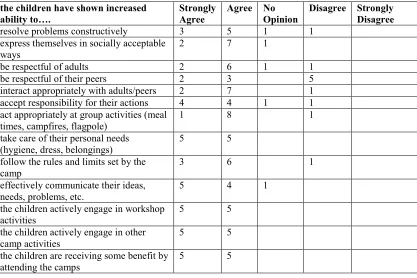
The surveys used for this evaluation were designed to cover the different knowledge, skills, and ambitions that the camps had been addressing. Three surveys were designed, for three different audiences: camp counselors, teachers, and parents or guardians. These surveys were designed to collect audience observations of the participants’ behaviors and skills as related to what the camps were teaching. All three of the surveys consisted mainly of a five-point agree-disagree Likert scale, with a few free answer questions (mainly “yes or no”), and space for additional comments. All three of the surveys contained many of the same
questions, although different questions were added or subtracted based on the question’s relevancy to that audience. The surveys all contained questions relating to the participants’ improved ability to resolve problems constructively, respect and interact appropriately with adults and peers, communicate effectively, accept personal responsibility, and follow rules and limits. The camp counselor survey also included questions about the organization of the weekend camps, such as counselor training and logistics of transportation and schedules, in an effort to gain feedback on these aspects of the camp that could be improved. The teacher survey included questions that addressed the participants’ behavior, study habits, and performance in school. This survey also asked for information about parental involvement with the school. The parent survey addressed the participants’ behavior at home and at school, and included questions about the children’s involvement in other activities (such as Girl or Boy scouts, or Boys and Girls clubs) and if the parents felt that these camps had provided a good experience for their child. The teacher and parent surveys were each specific to a particular child, while the camp counselor surveys were based on the children as a group. Copies of these surveys are included in the appendix.
not, what their favorite activities were at camp, what they learned from the workshop activities, and what they would change about the camps.
Data Collection
Data collection for case studies is usually best done by using a variety of methods and data sources. For this case study, those methods included tests, self-report measures, surveys, interviews, and observation. The data sources included school documents such as report cards, DSS and 4-H demographic data, program products (such as writing samples), program participants, and people who had the opportunity to observe the program participants: parents or guardians, teachers, school counselors, camp counselors, and camp staff and volunteers. The pre- and post-test data was collected at the summer assets camp that took place July 31, 2000 –August 04, 2000 at Sertoma 4-H Center. At the first Mini-Society and Wild Over Work workshops, the participants were given the pre-test specific to their workshop. They were then given the same test at the last workshop. These tests were then collected and sorted, putting the pre- and post-test of each participant together so the tests could be compared.
Once the release forms were received, the surveying process was begun. Twelve camp counselors were surveyed – these twelve were chosen by the camp coordinator because they had been with the program since it started and attended many of the camps, thereby allowing them time to observe the children and any changes that may have taken place in the
children’s behaviors and abilities over the course of the program. The surveys were emailed to the counselors, who then emailed them back when they were finished. The school counselors were contacted to distribute the teacher surveys. They were given the names of the children from their school that were involved with the program and asked to distribute the surveys to the proper teachers. As most of the children were in elementary school, this usually meant just one teacher, although some of the children in middle school had a team of teachers (these teachers each filled out an individual survey). Along with the survey, the teachers were given a cover letter describing the program and the evaluation, and the name of the child they were presenting their observations on. The teachers were not informed of which children were active participants, and which children constituted the control group. The surveys were faxed to the school and then faxed back when finished.
called, usually a number of times, during different times of the day, until they were
successfully contacted and completed the survey. Messages were sometimes left, although not all of the participants had answering machines, and since the call was long-distance, they were not required nor expected to call back.
A 4-H program volunteer in Carteret County, who acted as a liaison between the program and parents or guardians, collected copies of the report cards at the end of each quarter. In addition to the 18 release agreements, there existed an additional nine that allowed for the release of only a child’s report card. These release forms were obtained in the beginning of the program, and only allowed for the release of report cards. It was not possible to survey teachers or parents based on these release forms (which was why a new one was written), but their report cards were collected anyway, in an effort to obtain as much data as possible. Demographic data (age, race, family structure) was obtained from a variety of resources, including DSS information, program files and school records.
Reliability and Validity
Case study research does not lend itself easily to traditional reliability and validity measures such as internal and external validity. The nature of case study research usually involves studying participants in their natural settings, thereby preventing the research from being conducted in an experimental setting that controls for extraneous variables, which is the best way to determine a cause-and-effect relationship. Because case studies tend to be descriptive documentations of a small segment of the population, it can be difficult to generalize the findings to a larger population. Case studies can also be difficult to replicate exactly, due to the subjectivity that may arise in the study, either on the part of the researchers or the participants (with the belief that no two people experience the same reality).
surveys, interviews, and questionnaires. This included a review of the instruments by other people involved with the program to determine if the questions were appropriate for the audience, if the questions accurately reflected what had taken place in the program, and if the questions measured what the program is trying to accomplish. The camp coordinator and state 4-H leader (who wrote the grant for the program) reviewed the instruments to determine the validity of instrument content (for example, making sure a question on a survey wasn’t evaluating a behavior that the camp workshops had not attempted to address). 4-H staff also reviewed the instruments to determine if they were appropriate for the audience, as the 4-H staff, particularly in Carteret County, were more familiar with the audience. The instruments were also reviewed for clarity and thoroughness. A pilot test of the instruments was not conducted, mainly because the population in this study was very difficult to reach and develop relationships with, making data collection and feedback very complicated. Evaluation strategies for youth development programs formulated by the Arizona Cooperative Extension Service (based on work done by the National Center on Educational Outcomes) were modified to meet this program’s survey needs. Their indicators for family involvement, personal and social adjustment, presence and participation, responsibility and independence, contribution and citizenship, academic and functional literacy, and personal satisfaction were used as a starting point for developing the surveys and modified to meet the program’s objectives, focusing only on indicators that this program was addressing.
the participants and the participants themselves, that yields similar results about the effect of the program on the participants, will provide some validity to the results. If data found from pre- and post-tests were to match data found from school documents, such as increased knowledge about a subject, this would also provide additional validity. Another procedure is pattern matching, which determines that if what was proposed by the program in theory is matched by patterns found in the research, the results have more validity. By taking the objectives set out by this program, and determining if these objectives were met, we can further add validity to our results.
Data Analysis
Data analysis for case study research is not as simple as plugging data into a statistical analysis. The data are generally less straightforward than that, and have to be analyzed for patterns and themes that emerge from all the notes and documents that have been generated. For evaluation purposes, the data have to be analyzed to see if the data support the objectives that the program has set forth. For this study, that analysis involved determining what collected data provide support, or provide a contradiction, to the objectives set out by the program.
The pre- and post-test data were analyzed simply by comparing the scores on the pre-test to those on the post-test and determining what percentage of the children scored better on the pre-test than the post-test. A t-test, with a .05 level of significance, was then performed to see if these results were significantly different.