© 2018, IRJET | Impact Factor value: 6.171 | ISO 9001:2008 Certified Journal | Page 2768
A STUDY ON THE STRENGTHENING OF RC BEAMS USING TEXTILE
REINFORCEMENT
P.B Jayakrishnan
1,Paul Shaji
21PG Student, Dept. of Civil Engineering, Mar Athanasius College of Engineering, Kerala, India
2Assistant Professor, Dept. of Civil Engineering, Mar Athanasius College of Engineering, Kerala, India
---***---Abstract -
Textile reinforcement concrete is a newtechnology of composite material which can even replace reinforcement to some extent . Textile reinforcement is a common method for retrofitting of concrete structures . These textile reinforcement comprises fabric meshes . Jute , glass fibres , Nylons etc are the most commonly used fabric meshes . This project is mainly concerned on the strengthening of concrete structures by providing textile reinforcement. The beam sections used in this research is of size 150 x 250 mm and of 1500mm in length. The beam is designed for 5 ton. When 50KN is applied to the beam, it will fail. After failure the beam is repaired using retrofitting method with basalt textile mesh. Some beams are retrofitted before applying load and a comparison in strength of beam before and after using basalt mesh is studied.. Flexural strength was determined and crack pattern studies were carried out .The effectiveness of various profiles of wrappind is studied and maximum deflection and maximum load comparison is made.
Key Words: (Textile reinforced concrete, Fibre reinforced mortar, Textiles, Compressive Strength, Flexural Strength, Textile reinforced mortar
1.INTRODUCTION
Textile reinforcement is now being a common method for retrofitting of concrete structures. Textiles comprise fabric meshes made of long woven, knitted or even unwoven fibre rovings in at least two (typically orthogonal) directions. Mortarsin which the textile reinforcement is embedded serve as binders containing polymeric additives inorder to have improved strength properties. Materials with high tensile strengths with negligible elongation properties are reinforced with woven or unwoven fabrics. The fibres used for making the fabric are of high tenacitylike Jute, Glass, Fibre, Kevlar, Polypropylene, Polyamides (Nylon) etc.
1.1 Need for textile reinforcement
The use of fibre reinforced polymers (FRP) in strengthening and retrofitting projects has gained increasing popularity among structural engineers, due to numerous attractive features of these materials, such as: high specific strength (i.e. strength to weight ratio), corrosion resistance, ease and speed of application and minimal change of cross sections. Despite its advantages over other methods, the FRP
strengthening technique is not entirely problem-free. The organic resins used as to bind and impregnate the fibres entail a number of drawbacks, namely: (a) poor behaviour at temperatures above the glass transition temperature; (b) relatively high cost of resins; (c) potential hazards for the manual worker;One possible course of action aiming at the solution of the drawbacks of FRP would be the replacement of organic binders with inorganic ones, e.g. cement based mortars, leading to the substitution of FRP with fibre reinforced mortars (FRM). The problem arising from such a substitution would be the relatively poor bond conditions in the resulting cementitious composite as, due to the granularity of the mortar. Fibre matrix interactions could be enhanced when continuous fibre sheets are replaced by TEXTILES. The latter comprise fabric meshes made of long woven, knitted or even unwoven fibre rovings in at least two (typically orthogonal) directions. The quantity and the spacing of rovings in each direction can be controlled independently, thus affecting the mechanical characteristics of the textile and the degree of penetration of the mortar matrix through the mesh openings. It is through this mechanical interlock that an effective composite action of the mortar-grid structure is achieved. For the cementitious matrix, the following requirements should be met: non-shrinkable; high workability; high viscosity; low rate of workability loss (application of each mortar layer should be possible while the previous one is still in a fresh state); and sufficient shear (hence tensile) strength, in order to avoid premature debonding.
1.2
Textile reinforced concrete
© 2018, IRJET | Impact Factor value: 6.171 | ISO 9001:2008 Certified Journal | Page 2769 the exact orientation to support the efforts. This results in
higher strengths for TRC than in FRC.
2.
TEXTILE MATERIALS
Textile fibres have a great influence on the strength of composite materials, their properties as well as their magnitude. Materials which are most applicable for use in TRC structures are alkali-resistant glass (AR-glass), carbon
and aramid fibres. Besides these materials, basalt, steel and polymer fibres such as PBO can also be used. Steel fibre yarns are however not economically feasible. Comparisons between them are shown below in Table 1.
Table -1
Textile Diameter range Density Tensile strength Young’s modulus Advantages Disadvantages (m) (kN/m3) (GPa) (GPa)
AR–
glass 9 to 27 2800 1.4 70 to 80
Very good adhesion to concrete
Low tensile strength
Carbon 7 1800 2 to 5 200 to 450 Superior tensile strength Expensive
Aramid 12 1400 3 60 to 130 Low density low brittleness
Negative heat expansion, low resistance to alkali attacks
Basalt 9 to 13 2600 2.99 95 High elongation and equivalent
thickness Expensive
PBO 8 2445 5.80 270 High strength Expensive
From the above table, it is clear that these fibres have great strengthening capacity. Their high tensile strength and their good resistance to corrosion, for example, make them a good choice for a reinforcing material. Despite the fact that they remain expensive and present some challenges in regards to production, these fibres nevertheless are reasonable alternatives to traditional steel bars or short fibres.
2.2
Concrete matrix
The concrete used for TRC needs to fulfil demands, mechanical properties and durability, which are necessary to get proper composite material behaviour. Usually the maximum grain size used is less than 2mm, thus the concrete matrix is also called fine-grained concrete. Matrix composition should have chemical compatibility with textile reinforced materials, consistency for full penetration, planned production process and mechanical properties for load-carrying capacity of a TRC element
2.3 Basalt fabric meshes
Basalt textile meshes is used here for retrofitting of RC beams. Basalt mesh Geo grid is available in different sizes with epoxy coatings for concrete and composites and asphalt coatings for asphalt reinforcement.
Basalt mesh is better than steel for many reasons
Stronger than steel wire of comparable size
Far lighter and easier to handle and install
Will not rust or corrode or cause cracking of concrete
Flexible for easier design
Does not conduct electricity or induce electric field
It binds well with asphalt and concrete
Basalt fiber geo grid mesh is used for reinforcing asphalt concrete(covering in construction, reconstruction and repair of airport, runways, highways and any pavements, pedestrain ways, road inclines and banks).
The reinforcement with basalt mesh increases the overall reliability, safety and the cutting process output. The strength of basalt mesh is as good metal reinforcement, however it is 2.6 times lighter, thereby simplifying transportation and handling in construction. It is more durable than metallic and glass fiber reinforcement due to its excellent performance.
3 BEAM CASTING
© 2018, IRJET | Impact Factor value: 6.171 | ISO 9001:2008 Certified Journal | Page 2770 used for casting of beam is M25. Place the reinforcement cage
in to the mould .a cover of 25mm is provided and a cover block is used for it, . Pour the concrete in to the mould and compact the specimen by needle vibrator.
Fig 1: Longitudinal section of the beam
Fig 2: Beam reinforced with steel rebar 3.1 Testing of beams
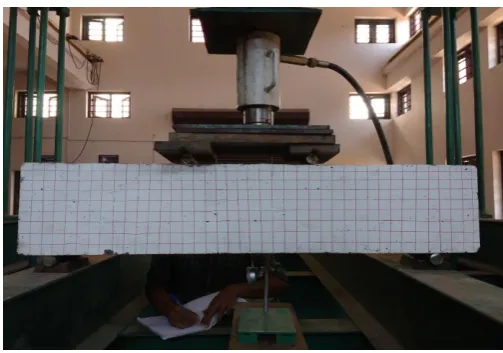
[image:3.595.40.276.140.207.2]The specimens casted were tested for their failure load using loading frame of capacity 5 ton after 28 daysThe apparatus used for testing the specimen is a loading frame of capacity 10 tonnes.the loading frame consisted of steel frames to transfer the load to foundation and pumps and jack to apply the load to specimen. There was only one type of jack available in the labouratory and it was of capactity 10 ton.
Fig 3 : Loading aarangement of the specimen
3.2 Failure load
[image:3.595.41.275.234.418.2]The specimen casted were tested for their failure load .the specimens were placed on the loading frame with two end simply supported. The load was applied manualy at a constant rate without shock. For testing of beams, hydraulic jack of 10Ton capacity was used and a plate section was placed below the jack and 2 rollers were placed below the plate sections for uniformly transfering the load throughout the beam. The beams were placed above the I section with roller support at distance 75mm from both ends, beam was placed over the roller support, spacing between the rollers is 1000mm.load is applied corresponding deflections are measured till the beam fails. load applied was measured using a dial gauge with 0.01T accuracy.
Fig 4: Crack pattern after loading 3.3 Retrofitting of RC beams
[image:3.595.308.570.271.427.2] [image:3.595.35.287.573.749.2]© 2018, IRJET | Impact Factor value: 6.171 | ISO 9001:2008 Certified Journal | Page 2771 strengthened with fiber sheets arecured for 3 days at room
temperature before testing.
Fig 5: Fixing the basalt mesh over the beam using epox resin
4. Test results
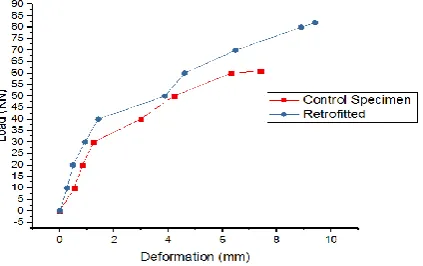
[image:4.595.329.546.87.245.2]We have tested the beams and noted the various loads and their corresponding deflections. 7.4 KN ia the ultimate load of the control specimen. After retrofitting this control specimen with basalt textile mesh using epoxy resin , the ultimate load was found to be 9.4KN. Also comparison has been made on their strength and deformations.
Table 1:Load and corresponding deflection values of control specimen before and after retrofitting
Fig 6: Strength comparison of beams using graph
Fig 7: Strength comparison of control specimen
Fig 8:Deflection comparison of control specimen
5. CONCLUSION
Based on experimental investigations the flexural behaviour of reinforced concrete beams externally strengthened by basalt fibre is studied.From the test results and calculated strength values the following conclusions are drawn
1. The strengthened beams showed a remarkable increase in the flexural toughness.
2. Ductile failure was noticeable in comparison with the brittle failure of unstrengthened beam.
3. Retrofitting of control specimen using basalt textile mesh is effective as the flexural strength of the control specimen is increased by 30-35%.
[image:4.595.45.286.118.257.2] [image:4.595.318.532.289.452.2] [image:4.595.39.286.415.554.2] [image:4.595.54.266.607.740.2]© 2018, IRJET | Impact Factor value: 6.171 | ISO 9001:2008 Certified Journal | Page 2772 REFERENCES
[1] Catherine G. Papanicolaou, Thanasis C. Triantafillou, Myrto Papathanasiou and Kyriokos Karlos (2007), “Textile reinforced mortar (TRM) versus FRP as strengthening material of URM walls: out-of-plane cyclic loading”, Journal of Materials and Structures.1-8
[2] Christoph Hankers and Dirk Matzdorff (2012), “Strengthening reinforced concrete elements using textile reinforced shotcrete”, Technical paper, planzwo GmbH, 1-11
[3] Christian Escrig, Lluis Gil, Ernest Bernat-Maso, Francesc Puigvert (2015),”Experimental and analytical study of reinforced concrete beams shear strengthened with different types of textile-reinforced mortar”, Journal of Construction and Building Materials; Science Direct, Vol. 85,248-260,1-7
[4] Natalie Williams Portal, Karin Lundgren, Holger Wallbaum and Katarina Malaga (2015), “Sustainable Potential of Textile – Reinforced Concrete”, Journal of Materials in Civil Engineering, ASCE, Vol. 27, 1-12,1-9
[5] Oluwafunmilayo Awani, Tamer El-Maaddawy and Najif Ismail (2017), “Fabric-reinforced cementatitious matrix: A promising strengthening technique for concrete structures”, Journal of Construction and Building Materials; Science Direct, Vol. 132, 94-111,1-5
[6] Mansi Shah, Hardik Solanki, Kaizad Engineer, Harishkuma (2017)“Experimental and numerical study of RC beam using textile reinforced concrete”, International journal of Advance Engineering and research Development Vol. 4 Issue 5,1-8
[7] Yousef A. Al-Salloum, Hussein M. Elsanadedy, Saleh H. Alsayed, and Rizwan A. Iqbal (2012), “Experimental and Numerical Study for the Shear Strengthening of Reinforced Concrete Beams Using Textile-Reinforced Mortar”, Journal of Composites for Construction, Vol. 16, 74-90,1-7