S T U D Y P R O T O C O L
Open Access
PREventing Delayed Graft Function by
Driving Immunosuppressive InduCtion
Treatment (PREDICT-DGF): study protocol
for a randomized controlled trial
Marion Chapal
1, Yohann Foucher
1,2,3, Monique Marguerite
3, Karine Neau
3, Emmanuelle Papuchon
1, Pascal Daguin
1,
Emmanuel Morélon
4, Georges Mourad
5, Elisabeth Cassuto
6, Marc Ladrière
7, Christophe Legendre
8and Magali Giral
1,2,9,10*Abstract
Background:In kidney transplantation, the use of Anti-Thymocyte Globulins (ATG) as induction therapy has been described as a possible treatment for reducing the prevalence of Delayed Graft Function (DGF). ATG possesses pharmaceutical proprieties that could help control the lesions caused by ischemia reperfusion injury. However, other studies have questioned this potential protective effect. We hypothesized that the benefits related to ATG for reducing DGF prevalence may be higher and more consistently recognized if only patients with high DGF risk are considered. We recently proposed a scoring system entitled DGFS (Delayed Graft Function Score) for such stratification of kidney transplant recipients according to their risk of DGF. Using the DGFS calculation, we aim to determine whether a short course of ATG can decrease the incidence of DGF in comparison with Basiliximab in kidney transplant recipients with low immunological risk but high DGF risk.
Methods:We conduct a phase IV, open label, randomized, multicentric and prospective study, to compare ATG in parallel with a control group treated by Basiliximab. The 1:1 randomized allocation of patients between groups is stratified on the clinical center, and on the hypothermic machine-perfusion device. We aimed to include a total of 384 patients to achieve a statistical power at 0.80. The study was initiated at the Nantes University hospital in July 2014, with data collection continuing until April 2018, and publication of the results proposed for 2019.
Discussion:The main expected benefits of this study arei) the reduction of unjustified ATG over-prescriptions associated with serious adverse events,ii) the reduction of chance losses related to ATG under-prescription,
iii) the decrease in the incidence of DGF which was described as a risk factor of graft failure and patient death, andiv) the reduction in hospitalization duration and number of post transplantation dialysis sessions, both being associated with reduced medical costs. In conclusion, the current study is innovative by proposing a more efficient and personalized induction therapy.
Trial registration:The study was registered in the Clinical Trials Registry (#NCT02056938, February 5, 2014), and in the European Clinical Trials Database (EudraCT #2014-000332-42, January 30, 2014).
Keywords:Delayed graft function, Kidney transplantation, Randomized clinical trial, Anti-thymocyte globulins
* Correspondence:[email protected]
1ITUN and Inserm U1064, Nantes University, 30 Boulevard Jean Monnet,
Nantes 44035, France
2SPHERE (EA4275), Nantes University, Nantes, France
Full list of author information is available at the end of the article
Background
The current 10-year patient and graft survival of first kidney transplantation varies from 25 % to 40 % de-pending on inclusion criteria and countries. Therefore, much still has to be done to improve long-term out-comes for kidney transplant recipients. As part of this objective, delayed graft function (DGF) is well known among the main risk factors of poor long-term out-come, increased hospitalization duration and acute re-jection [1, 2]. DGF is the major clinical manifestation of renal injuries that are linked to ischemia reperfusion injury. Until now, this has been unavoidable in kidney transplantation and occurs after cold and warm preser-vation of the kidney. Preventing DGF by focusing primar-ily on donor management, organ procurement, infusion and preservation supplies, and drug monitoring, is thus probably the most beneficial strategy for prolonged long-term graft and patient survival. Thus, the predic-tion of DGF is of primary importance in kidney trans-plantation for adapting as far as possible the medical management of high-risk transplantations.
However, although the risk factors for DGF have been well-described in the literature for a number of years, it is difficult to predict this complication in practice at an individual level. Several scoring systems have been pro-posed within the last few years [3, 4], but these are not used routinely for medical decision making because of the important number of included parameters or the absence of validation. Therefore, we recently proposed an alternative scoring system entitled the delayed graft function score (DGFS) [5]. The DGFS is composed of only five variables: the cold ischemia time, the donor age, the last donor serum creatinine level, the recipient body mass index, and the induction therapy used. The DGFS is associated with a good predictive capacity, with area under the receiver operator characteristic (ROC) curve at 0.73 (95 % CI from 0.68 to 0.77). By using the learning sample, we calculated a DGFS threshold value at 0.4 to obtain a positive predictive value of 40 %, an ac-ceptable percentage to consider recipients with a high risk of DGF (the overall percentage of DGF was 25.1 %). By using the validation sample, this decision rule corre-sponds to sensitivity of 47.5 % (95 % CI from 40.3 to 55.0), a specificity of 83.5 % (95 % CI from 79.5 to 86.9), a positive predictive value of 57.7 % (95 % CI from 48.5 to 64.5), and a negative predictive value of 77.9 % (95 % CI from 73.7 to 81.6).
The use of anti-thymocyte globulins (ATG, Thymo-globuline®, Sanofi) as induction therapy has already been described as a possible treatment for reducing the prevalence of DGF [6–8]. ATG possesses pharma-ceutical proprieties that could help to control or pre-vent the lesions caused by ischemia reperfusion injury. However, other studies have questioned this possible
protective effect [9–12]. Therefore, despite this well-established depleting treatment as an induction therapy in patients with high immunological risk [13], there is no consensus on whether ATG is better than basilixi-mab (anti IL2-R, Simulect®, Novartis) to prevent DGF for patients with a low immunological risk. We hypothe-sized that the benefit related to ATG for reducing DGF prevalence may be higher than expected if only proposed to patients with high DGF risk.
The main objective of the PREDICT-DGF study out-lined here is to determine whether a short course of ATG is more efficient than basiliximab in decreasing the incidence of DGF in kidney transplant recipients with low immunological risk, but high DGF risk assessed by the DGFS calculation. We also aim to evaluate the risk/benefit ratio related to induction therapy by ATG in patients with low immunological risk, i.e., the con-sequences of a possible reduction in DGF incidence, against adverse effects related to such depleting induc-tion therapy.
Methods/design
Study design
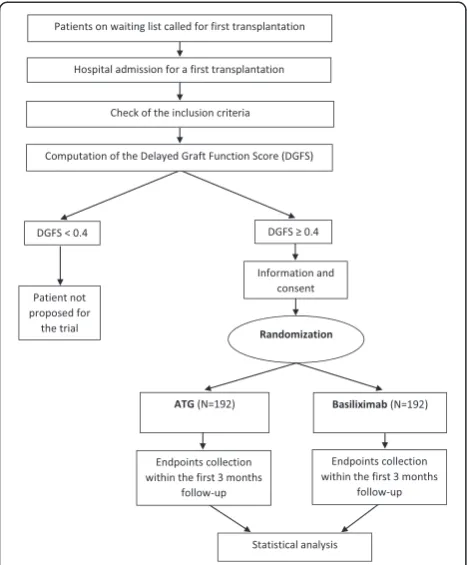
We are conducting a phase IV, open label, randomized, multicenter prospective study, to compare ATG in paral-lel with a control group treated by basiliximab. The 1:1 randomized allocation of patients between groups is stratified on the clinical center, and on the hypothermic machine-perfusion device. The participation of each patient is scheduled for 3 months. The study design is outlined in Fig. 1.
Ethical approval and registration
All procedures will be explained to patients and the informed consent form will be reviewed and signed. The study was registered in the Clinical Trials Registry (#NCT02056938), and in the European Clinical Trials Database (EudraCT #2014-000332-42). It has received approval from the ethical research committee (Tours, France, Comité de Protection des Personnes–CPP, refer-ence # 14/13-929) that is applicable for all French centers involved in this study. The French national agency for drugs safety also approved the study (Agence Nationale pour la Sécurité du Médicament, ANSM # 140175A-11), especially regarding the classification as a phase IV study. ATG and basiliximab have both been approved for marketing and the present protocol respects the corresponding indications.
Study population
disease; 2) patients under hemodialysis (because the occurrence of DGF, defined by the need for dialysis within the first seven days post transplantation, is not correctly evaluated for patients on peritoneal dialysis or for patients who will receive pre-emptive trans-plantation); 3) patients with kidneys transplanted from deceased donors with heartbeat; 4) patients with writ-ten informed consent; 5) patients affiliated with the French social security system; 6) patients considered at low immunologic risk (i.e., first kidney transplant re-cipients with no anti-HLA immunization prior to trans-plantation and sera negative for anti HLA immunization, regardless of the technique used for this evaluation); 7) patients considered at high-risk of DGF (i.e., DGFS higher than 0.4), and 8) patients without medical contraindication to ATG (i.e., leukopenia lower than 3,000/mm3, thrombopenia lower than 100,000/mm3, previous history of cancer (except basal cell skin can-cers), current history of hepatitis C virus (HCV)/hepa-titis C virus (HBV)/HIV infection, or Epstein-Barr virus (EBV)-matching donor positive and recipient negative).
For ethical considerations, pregnant or lactating women and patients under guardianship are not included.
Calculation of delayed graft function score
The DGFS calculation is facilitated by an application avail-able on smartphones, tavail-ablets or computers at www. divat.fr/en/online-calculators. The results are exportable as a simple file in portable document format (PDF).
Studied treatment (ATG)
Thymoglobuline® is used in this study. It is a rabbit anti-human thymocyte immunoglobulin. The first infu-sion begins prior to kidney reperfuinfu-sion, to study the potential effects on ischemia reperfusion injury mecha-nisms [14–16]. In fever or respiratory syndrome related to possible cytokine release, paracetamol (1 g every 6 h) is prescribed, and Polaramine® (2 mg orally) prescribed in patients with associated cutaneous rash. The total dur-ation of Thymoglobuline® administrdur-ation is 4 days, in-cluding the first day of the surgery, with a daily dose of 1.5 mg/kg [17]. The monitoring of blood T cell deple-tion provides informadeple-tion for the adaptadeple-tion of the Thymoglobuline® daily dose. The aim is to maintain peripheral blood lymphocytes below 200/mm3and CD3 counts below 20/mm3. Thymoglobuline® dosing is halved if the white blood cell (WBC) counts falls below 2,000− 3,000/mm3, or if the platelets fall in between 50,000 and 75,000/mm3. Thymoglobuline® is prematurely withdrawn if the WBC falls below 2,000/mm3 or the platelets fall below 50,000/mm3.
Control treatment (basiliximab)
The control treatment is Simulect®, which is a recombin-ant murine/human chimeric monoclonal recombin-antibody di-rected against the interleukin-2 receptorα-chain (CD25 antigen). Two infusions of Simulect® are performed with a dose of 20 mg, the first immediately after surgery and the second 3 days afterwards.
Other treatments
In parallel with Thymoglobuline® or Simulect®, the ther-apy includes one intravenous bolus of corticosteroids (methylprednisolone 500 mg). All patients receive the same immunosuppressive maintenance therapy with 1) Tacrolimus (Prograf®) regardless of the delayed admin-istration post-surgery which respects normal practice at each center, and 2) mycophenolate mofetil (Cellcept®, with a daily dose of 2 g) and prednisolone (with a dose of 1 mg/kg orally tapered at 10 mg every 5 days to a dose of 5 mg until the surveillance biopsy at 3 months). Fi-nally, concomitant prophylaxis by Trimethoprim/Sulfa-methoxazole and Valgancyclovir will be used to prevent pneumocystis and cytomegalovirus (CMV) infection. Fig. 1Preventing delayed graft function by driving immunosuppressive
[image:3.595.57.291.89.372.2]Primary outcome measures
The primary endpoint will be the occurrence of a DGF defined as the need for dialysis within the first seven days post transplantation. This definition of DGF is the most commonly recognized and published. Never-theless, this definition is insufficient since the decision to dialyze may not only depend on the insufficiency of the post-transplantation renal function but also on hyperhydration or hyperkaliemia for instance. The def-inition of the DGF will thus consider, 1) the number of days after transplantation to reach an estimated glom-erular filtration rate (eGFR) above 10 mL/min, calculated using the modification of the diet in renal disease (MDRD) formula [18], 2) the evolution of the MDRD eGFR until hospital discharge, and 3) the number of dialyses performed after the transplantation without taking into account dialysis exclusively prescribed for hyperhydration or hyperkaliemia.
Secondary outcome measures
The following endpoints will also be considered: 1) the occurrence of histologically proven acute rejection epi-sodes within the 3 months following the transplantation and subclinical acute rejection episodes on the 3-month surveillance biopsies (BANFF 2011 classification); 2) the percentage of renal fibrosis on the 3-month surveillance biopsies using the computerized quantification described by Meas-Yedid et al. [19]; 3) the time between trans-plantation surgery and hospital discharge; 4) the evolu-tion of the Tacrolimus trough level; 5) the hematologic monitoring within the first three months after surgery including WBC blood cell count, CD3 subpopulation analysis, and CD4, CD8, CD19, natural killer (NK) cell, and platelet counts, and 6) the occurrence of infections within the study follow-up, especially CMV and BK vi-ruses assessed at three months by RT-PCR, as either primary or secondary infections.
Follow-up time
Follow-up at 3 months is required for the previous endpoints for full completion of the study. Nevertheless, patients will be followed for some years after the end of the trial for incidence of cancer, post-transplant lym-phoproliferative disorders, infections, graft and patient survival. This will be possible because these patients will be part of the prospective DIVAT cohort (www.divat.fr).
Sample size
Based on the results of the randomized trial pub-lished by Noel et al. [13] and according to our previ-ous observational study [5], we can expect 40 % DGF in patients treated with basiliximab versus 28 % in patients with ATG (odds ratio (OR) = 1.7). To respect a type I error at 0.05 and a power at 0.80 (one-tailed
test), 192 patients will have to be included in each group. We therefore aim to include a total of 384 pa-tients. We chose one-tailed testing because no paper has described a higher incidence of DGF for ATG-treated patients compared to other non-depleting induc-tion therapies. The literature heterogeneity consists in the statistical significance of the ATG effect for prevent-ing the DGF occurrence. Even if the two-tailed test takes into account the possibility that the reference treatment might be better [20], the one-tailed test seems the most adapted in our situation for both ethical and cost-efficiency considerations [21].
Data acquisition
Data collection will be performed by the investigators or the clinical research assistants by using an electronic case report form accessible from the web and developed with Clinsight®. Data are anonymously extractable to keep the identities of patients confidential.
Data analysis
Analysis will be performed by respecting the principle of intention-to-treat analysis. No intermediate analysis will be performed. Depending on the observed switches or dropouts, protocol analysis may be secondarily per-formed in order to evaluate the robustness of the find-ings. According to the sample size and the random assignment of treatments, both groups are expected to be comparable. In order to validate this comparability, a preliminary description of the two groups will be performed according to the mean, standard deviation and range for continuous variables, and according to percentage and effective for categorical variables. For binary endpoints, logistic regression with random inter-cept and/or slope will be performed to estimate the treat-ment effect, taking into account possible between-center differences. The same methodology will be used to assess the percentage of renal fibrosis and the time between surgery and hospital discharge. However, these will use linear models with random intercept and/or slopes.
P <0.05 will be considered statistically significant for all tests. The statistical analyses will be performed using R software [22].
Discussion
data collection is planned for April 2018 and the pub-lication of results for 2019.
The objective of our study is to reduce the preva-lence of DGF to improve the long-term outcomes of kidney transplant recipients. ATG is of potential inter-est to such a reduction, but the possible benefits are continually debated, probably due to the heterogeneity of its indication between countries, between centers, and even amongst physicians. Importantly, the main indica-tion for this treatment is for patients with high immuno-logical risk, i.e., patients having repeat transplantation and/or HLA immunization prior to transplantation). We hypothesized that the use of ATG in induction could be more beneficial in patients who present a low immunological risk but a high DGF risk. The use of the DGFS, to objectively identify patients with high DGF risk, is particularly important as it may allow heterogeneity practices to be aligned.
The consequences of the PREDICT-DGF study may be several-fold. One outcome may be to reduce exces-sive ATG prescription, which is associated with serious adverse events such as cytokine release syndrome, fever, serum sickness, infectious disease or post-transplant lym-phoproliferative disorders. Another outcome may be to avoid ATG under-prescription and therefore to reduce the incidence of DGF. We also expect a shorter hospital stay, a reduction in the number of post transplantation dialyses, both being associated with a reduction of med-ical costs. Finally, this reduction may improve long-term graft and patient survival.
In conclusion, the current study is innovative as it will allow the effects of two types of induction therapy in kidney transplant recipients with low immunological risk to be evaluated, using for the first time a predict-ive tool to assess the risk of DGF. We believe this will result in a more efficient and personalized induction therapy.
Trial status
The trial is ongoing.
Abbreviations
CMV:cytomegalovirus; DGF: delayed graft function; DGFS: delayed graft function score; ATG: anti-thymocyte globulins; WBC: white blood cell; MDRD: modification of the diet in renal disease; eGFR: estimated glomerular filtration rate; PREDICT-DGF: preventing delayed graft function by driving immunosuppressive induction treatment.
Competing interests
This study was supported by a grant from the French Ministry of Health (PHRC-13-0523, 2013) and financial support from Sanofi (the laboratory providing the Thymoglobuline®). Nevertheless, the principal investigator of the trial is free to publish all the results of this trial. The publication of this protocol is an additional guarantee of this independence. No authors have any non-financial competing interests.
Authors’contributions
MC, YF, and MG are responsible for study conceptualization. MG is the principal investigator. CL, EM, GM, ML and EC are co-investigators in Paris Necker, Lyon, Montpellier, Nancy and Nice. KN, EP and MM organize the trials in practice. PD is in charge of the web application related to the DGFS. All authors read and approved the final manuscript.
Acknowledgements
The previous construction of the DGFS was supported by a grant from the French National Agency of Research (ANR-11-JSV1-0008-01). The present PREDICT-DGF study is supported by a grant from the French Ministry of Health (PHRC-13-0523, 2013) and by a subvention from Sanofi. The protocol was also independently peer reviewed by this institution.
Author details
1ITUN and Inserm U1064, Nantes University, 30 Boulevard Jean Monnet,
Nantes 44035, France.2SPHERE (EA4275), Nantes University, Nantes, France. 3Délégation à la recherche clinique et à l’innovation, CHU Nantes, Nantes,
France.4Néphrologie, Transplantation et Immunologie Clinique, Hôpital Edouard Herriot, Lyon, France.5Service de Néphrologie, Dialyse et Transplantation, Hôpital Lapeyronie and Université Montpellier I, Montpellier, France.6Service de Néphrologie, Hôpital Pasteur, Nice, France.7Service de Transplantation Rénale, CHU Brabois, Nancy, France.8Service de Transplantation Rénale et de Soins Intensifs, Hôpital Necker, APHP and Universités Paris Descartes et Sorbonne Paris Cité, Paris, France.9Centre d’Investigation Clinique en Biothérapie, Nantes University Hospital, Nantes, France.10CENTAURE Fondation, Nantes, France.
Received: 28 November 2014 Accepted: 11 June 2015
References
1. Giral-Classe M, Hourmant M, Cantarovich D, Dantal J, Blancho G, Daguin P, et al. Delayed graft function of more than six days strongly decreases long-term survival of transplanted kidneys. Kidney Int. 1998;54:972–8.
2. Remuzzi G, Lesti M, Gotti E, Ganeva M, Dimitrov BD, Ene-Iordache B, et al. Mycophenolate mofetil versus azathioprine for prevention of acute rejection in renal transplantation (MYSS): a randomised trial. Lancet. 2004;364:503–12. 3. Irish WD, Ilsley JN, Schnitzler MA, Feng S, Brennan DC. A risk prediction
model for delayed graft function in the current era of deceased donor renal transplantation. Am J Transpl. 2010;10:2279–86.
4. Jeldres C, Cardinal H, Duclos A, Shariat SF, Suardi N, Capitanio U, et al. Prediction of delayed graft function after renal transplantation. Can Urol Assoc J. 2009;3:377–82.
5. Chapal M, Le Borgne F, Legendre C, Kreis H, Mourad G, Garrigue V, et al. A useful scoring system for the prediction and management of delayed graft function following kidney transplantation from cadaveric donors. Kidney Int. 2014;86:1130–9.
6. Kaden J, May G, Strobelt V, Groth J, Muller P. Intraoperative T-cell depletion prior to completion of anastomoses by high-dose single ATG bolus as a new approach to improve long-term results after kidney transplantation. Transpl Proc. 1997;29:344–7.
7. Kyllonen LE, Eklund BH, Pesonen EJ, Salmela KT. Single bolus antithymocyte globulin versus basiliximab induction in kidney transplantation with cyclosporine triple immunosuppression: efficacy and safety. Transplantation. 2007;84:75–82.
8. Turunen AJ, Lindgren L, Salmela KT, Kyllonen LE, Makisalo H, Siitonen SM, et al. Association of graft neutrophil sequestration with delayed graft function in clinical renal transplantation. Transplantation. 2004;77:1821–6. 9. Haririan A, Morawski K, Sillix DH, El-Amm JM, Garnick J, West MS, et al.
Induction therapy with basiliximab versus Thymoglobulin in African-American kidney transplant recipients. Transplantation. 2005;79:716–21. 10. Mourad G, Rostaing L, Legendre C, Garrigue V, Thervet E, Durand D.
Sequential protocols using basiliximab versus antithymocyte globulins in renal-transplant patients receiving mycophenolate mofetil and steroids. Transplantation. 2004;78:584–90.
12. Ulrich F, Niedzwiecki S, Pascher A, Kohler S, Weiss S, Fikatas P, et al. Long-term outcome of ATG vs. Basiliximab induction. Eur J Clin Invest. 2011;41:971–8.
13. Noel C, Abramowicz D, Durand D, Mourad G, Lang P, Kessler M, et al. Daclizumab versus antithymocyte globulin in high-immunological-risk renal transplant recipients. J Am Soc Nephrol. 2009;20:1385–92.
14. Preville X, Flacher M, LeMauff B, Beauchard S, Davelu P, Tiollier J, et al. Mechanisms involved in antithymocyte globulin immunosuppressive activity in a nonhuman primate model. Transplantation. 2001;71:460–8. 15. Chappell D, Beiras-Fernandez A, Hammer C, Thein E. In vivo visualization of
the effect of polyclonal antithymocyte globulins on the microcirculation after ischemia/reperfusion in a primate model. Transplantation. 2006;81:552–8. 16. Aiello S, Cassis P, Mister M, Solini S, Rocchetta F, Abbate M, et al. Rabbit
anti-rat thymocyte immunoglobulin preserves renal function during ischemia/reperfusion injury in rat kidney transplantation. Transpl Int. 2011;24:829–38.
17. Brennan DC, Daller JA, Lake KD, Cibrik D, Del Castillo D. Rabbit
antithymocyte globulin versus basiliximab in renal transplantation. N Engl J Med. 2006;355:1967–77.
18. Levey A, Coresh J, Greene T, STevens L, Zhang Y, Hendriksen S, et al. Using standardized serum creatinine values in the modification of diet in renal disease study equation for estimating glomerular filtration rate. Ann Intern Med. 2006;145:247–54.
19. Meas-Yedid V, Servais A, Noel LH, Panterne C, Landais P, Herve N, et al. New computerized color image analysis for the quantification of interstitial fibrosis in renal transplantation. Transplantation. 2011;92:890–9. 20. Walker AM. Low Power and Striking Results—A Surprise but Not a
Paradox. N Engl J Med. 1995;332:1091–2.
21. Knottnerus JA, Bouter LM. The ethics of sample size: two-sided testing and one-sided thinking. J Clin Epidemiol. 2001;54:109–10.
22. R Core Team. R: A Language and environment for statistical computing. R Foundation for Statistical Computing Vienna, Austria; 2010. 3-900051-07-0. http://www.R-project.org/.
Submit your next manuscript to BioMed Central and take full advantage of:
• Convenient online submission
• Thorough peer review
• No space constraints or color figure charges
• Immediate publication on acceptance
• Inclusion in PubMed, CAS, Scopus and Google Scholar
• Research which is freely available for redistribution