Sleptogenesis
Rouzbeh Allahverdi
TRIUMF, 4004 Wesbrook Mall, Vancouver, British Columbia, Canada V6T 2A3
Bhaskar Dutta
Department of Physics, University of Regina, Regina, Saskatchewan, Canada S4S 0A2
Anupam Mazumdar
CHEP, McGill University, 3600 University Road, Montre´al, Quebec, Canada H3A 2T8 共Received 27 January 2003; published 20 June 2003兲
We propose that the observed baryon asymmetry of the Universe can naturally arise from a net asymmetry generated in the right-handed sneutrino sector at fairly low reheat temperatures. The initial asymmetry in the sneutrino sector is produced from the decay of the inflaton, and is subsequently transferred into the standard model共s兲lepton doublet via three-body decay of the sneutrino. Our scenario relies on two main assumptions: a considerable branching ratio for the inflaton decay to the right-handed 共s兲neutrinos, and Majorana masses which are generated by the Higgs mechanism. The marked feature of this scenario is that the lepton asymmetry is decoupled from the neutrino Dirac Yukawa couplings. We exhibit that our scenario can be embedded within minimal models which seek the origin of a tiny mass for neutrinos.
DOI: 10.1103/PhysRevD.67.123515 PACS number共s兲: 98.80.Cq, 11.30.Fs, 12.60.Jv
I. INTRODUCTION
The consistency of the abundance of the light elements synthesized during the big bang nucleosynthesis 共BBN兲 re-quires that the baryon asymmetry of the Universe 共BAU兲 parametrized as B⫽(nB⫺nB¯)/s, with s being the entropy density and nB the number density of the baryons, be in the range (0.3⫺0.9)⫻10⫺10 关1兴. This asymmetry can be pro-duced from a baryon symmetric universe provided three con-ditions are simultaneously met: B and/or L violation, C and CP violation, and departure from thermal equilibrium 关2兴. Any produced asymmetry will, however, be washed away by the standard model 共SM兲(B⫹L)-violating sphaleron transi-tions which are active from temperatures 1012 GeV down to 100 GeV 关3兴, if B⫺L⫽0. Therefore an asymmetry in B
⫺L, which is subsequently reprocessed by sphalerons, is generally sought in order to yield the net baryon asymmetry given by B⫽a(B⫺L). Here a is a model-dependent param-eter; in the case of the SM, a⫽28/79, while in the minimal supersymmetric standard model共MSSM兲, a⫽32/92关4兴.
An attractive mechanism for producing B⫺L asymmetry is from the decay of the heavy right-handed共RH兲Majorana neutrinos关5兴. Since the RH neutrinos are the SM singlets, a Majorana mass MN, which violates the lepton number, is compatible with all of its symmetries, and hence can be ar-bitrarily large beyond the electroweak scale. This provides a natural explanation for the light neutrinos via the seesaw mechanism关6兴.
The lepton asymmetry can be generated from the interfer-ence between the tree-level and the one-loop diagrams in an out-of-equilibrium decay of the RH neutrinos in the early Universe, provided CP-violating phases exist in the neutrino Yukawa couplings. The asymmetry thus obtained will be par-tially converted into the baryon asymmetry via sphaleron effects. This is the standard lore for producing lepton asym-metry from on-shell RH neutrinos, commonly known as
lep-togenesis 关5,7,8兴. This can be accomplished in different ways.
In thermal leptogenesis scenario, RH neutrinos come into equilibrium with the primordial thermal bath through Yukawa interactions. The decay of the lightest RH neutrino easily satisfies the out-of-equilibrium condition by virtue of having a sufficiently small Yukawa coupling关8兴. In a model-independent analysis in Ref. 关9兴, the authors have param-etrized thermal leptogenesis by four parameters; the CP asymmetry, the heavy RH neutrino mass, the effective light neutrino mass, and the quadratic mean of the light neutrino masses. The final result was that an acceptable lepton asym-metry could be generated with TR⬃M1⫽O(1010) GeV, and 兺im,i⬍
冑
3 eV.This is marginally compatible with the upper bound on TR allowed from thermal gravitino production in supersym-mteric models 关10兴. Gravitinos with a mass O(TeV) decay long after nucleosynthesis and their decay products can change abundance of the light elements synthesized during BBN. For 100 GeV⭐m3/2⭐1 TeV, a successful nucleosyn-thesis requires n3/2/s⭐(10⫺14⫺10⫺12), which translates into TR⭐(108⫺1010) GeV 关10,11兴. The possibility of non-thermal gravitino production 关12兴 does not give rise to any threat as described in 关13,14兴. It was also suggested that gravitinos can also be produced directly from the inflaton decay关15兴, and in the decay of heavy stable neutral particles 关16兴, but the yielded bounds will not be severe.
the inflaton mass, which leads to the instabilities during the inflaton oscillations, described as in Ref. 关19兴. The inflaton condensate fragments as a result of that and forms interesting solitons.
In supersymmetric models there are additional options as one can also excite sneutrinos 关20兴. In fact sneutrinos are produced more abundantly than neutrinos during preheating 关21兴. Another possibility is creating a condensate of sneutri-nos which yields the right asymmetry through its decay关22兴, or via Affleck-Dine mechanism关23兴.
Recently it has been noticed that successful leptogenesis does not require on-shell RH共s兲neutrinos关24,25兴. A minimal model was proposed in Ref.关25兴, where the lepton asymme-try is directly generated from the inflaton decay into the Higgs boson and leptons via off-shell RH 共s兲neutrinos. This model naturally results in a sufficiently low reheat tempera-ture, and yields desirable baryon asymmetry for a rather wide range of inflationary scale, neither invoking preheating in a particular model nor any unnaturally suppressed couplings.
In this paper we propose a completely new scenario for leptogenesis, called sleptogenesis.1 We show that an asym-metry between sneutrinos and anti-sneutrinos can be gener-ated, through a phase mismatch between the inflaton cou-pling to the RH 共s兲neutrinos and the Majorana masses, in inflaton decay. Note that the RH neutrino and antineutrino are indistinguishable due to the Majorana nature of neutri-nos. After the共s兲neutrinos decay, the SM共s兲leptons carry the produced asymmetry which will be partially reprocessed to the baryon asymmetry. This scenario can emerge quite natu-rally provided the branching ratio for the inflaton decay to the RH 共s兲neutrinos is considerable, and there exists new Higgs field共s兲generating the Majorana masses. The first as-sumption is rather common in non-thermal scenarios of lep-togenesis, while the latter is necessary in models where the RH共s兲neutrinos are gauge non-singlet under some new phys-ics. The main feature of our scenario is replacing the depen-dence of the generated asymmetry on the neutrino Dirac Yukawa couplings with that on the Majorana Yukawa cou-plings. As a consequence, it is in principle possible to ac-commodate low-scale leptogenesis 关27兴 with an appropriate choice of model parameters. The minimal extension of MSSM that can accommodate the above mentioned Majo-rana sector is SU(3)c⫻SU(2)L⫻U(1)I3R⫻U(1)B⫺L. In this scenario, the RH 共s兲neutrino masses arise at the scale where U(1)I
3R⫻U(1)B⫺L→U(1)Y. The branching ratios of
lepton flavor violating decay modes, e.g. →␥, →e␥, will be able to discern these models in the near future.
II. THE SCENARIO
We begin by considering a simple model in a supersym-metric setup. The relevant part of the superpotential is given by
W傻1 2m⌽
2⫹1 2m⌺
2⫹1 2y⌽N
2⫹1 2g⌺N
2⫹hNH
uL
⫹htHuQ3tc. 共1兲
Here ⌽ is a gauge singlet superfield which comprises the inflatonand its superpartner共inflatino兲with mass m, and
N is the superfield comprising the RH neutrino N and
sneutrino N˜ . While ⌺ comprises the scalar field which generates Majorana mass for N through its vacuum expecta-tion value 共VEV兲, denoted as 0, and its fermionic partner
˜ . As we will describe later, in realistic particle physics models N and⌺ are charged under some gauge group共as a matter of fact, one needs to introduce another superfield ⌺¯ for anomaly cancellation兲. Since the inflaton is assumed to be a gauge singlet, its coupling to RH 共s兲neutrinos actually arises at the non-renormalizable level, and hence is small y ⬃O(m/ MP) 共we use the reduced Planck mass MP⬃2.4
⫻1018 GeV). This coupling will be responsible for decay of the inflaton to N and N˜ and, subsequently, reheating the Uni-verse.
Finally, Hu, L, Q3, and tc are the multiplets containing the Higgs boson which gives mass to the top quark, the left-handed lepton doublet, the third generation quark doublet and the RH top anti-quark, along with their superpartners, respectively. We have omitted all indices on N, and lepton doublets. Note that y and g are symmetric matrices. For sim-plicity, we assume that they can be diagonalized in the same basis, and hence only their diagonal elements yi and gi are relevant.
We also assume that m⭓10m. This implies that the dynamics ofis frozen during and after inflation, and hence ensures a simpler dynamics by virtue that all of the energy density is carried by . However, the mass of the RH 共s兲neutrinos Mi 共at least one of them兲is taken to be smaller than m, so that the inflaton decay to Ni and N˜i will reheat the Universe.2
An important point is that the interference between the tree-level and one-loop contributions to the decay process →N˜ N˜ results in an excess, or deficit, of N˜ over ND, pro-vided a relative phase exists between gi and yi. This hap-pens in exactly the same fashion as N decay generates a lepton asymmetry in the standard leptogenesis scenario 关5兴.
Note that it is meaningless to talk of any asymmetry be-tween N and N¯ , since there is no distinction between particle
1Baryogenesis with scalar fields has also been studied in Ref.关26兴,
though in a different context.
2Note that we have neglected another coupling of the form f⌽⌺2,
and anti-particle for a Majorana fermion. To put it another way, the mass term MNNN, which violates the lepton num-ber, makes particle and anti-particle indistinguishable. On the other hand, the supersymmteric mass term MN
2兩 N
˜兩2 for the sneutrino does not violate the lepton number.
In most of the realistic models of inflation only the real component of the inflaton has a VEV. Then it can be shown from Eq. 共1兲 that →NN and →N˜ N˜ decays occur at the same rate, and the total decay rate is given by
⌫d⯝81
兺
iyi2m. 共2兲
Note that ⌬L⫽2 in →N˜ N˜ decay. By taking into account the one-loop self-energy and vertex diagrams, shown in Fig. 1, we find that3
nN˜i⫺nNDi
n ⫽⫺ 1 8
Im关共yg†兲 ii兴2
兺
i 共yy†兲ii f
冉
m2
m2
冊
, 共3兲where
f共x兲⫽
冑
x 2冋
2
x⫺1⫹ln
冉
1⫹ 1x
冊册
. 共4兲These diagrams are similar to those in leptogenesis via N˜ decay 关20兴 共with proper replacements兲. The expression for the asymmetry parameter therefore has exactly the same structure as in the standard leptogenesis关28兴. There are slight differences though between the two cases. Here only half of the inflatons decay to RH sneutrinos, anddecay to N does not lead to any asymmetry. On the other hand, the lepton number is violated by two units in→N˜ N˜ decay. Finally, a
factor of 1/2 arises in our case since identical particles appear in the loop. Note that in the limit m⭓10m, we simply have f⯝3m/2m.4
The created asymmetry is then transferred into the SM 共s兲leptons via N˜idecay. There are two two-body decay chan-nels read from Eq.共1兲: N˜i→L¯iHD and N˜i→L˜iH, which have the same rate. Here hidenotes diagonal elements of the neu-trino Yukawa matrix h and, for simplicity, we assume that non-diagonal elements can be neglected. Since the two-body decays produce the same number of anti-leptons as leptons, no net lepton asymmetry will be yielded.
However, there exists a term hihtN˜iL˜ QD3Dtc in the scalar potential which results in the three-body decay N˜i →LDQ˜3t˜c. This channel is responsible for transferring the asymmetry into the SM共s兲leptons, though with suppression by a factor ⯝3/322 共note that h
t⬇1). The 1/322 is the ratio of phase space factors for three-body decay to the total decay rate, and note that N˜ decays to all three colors of squarks. In addition, we also have the usual dilution due to the entropy release from reheating by a factor of TR/m, where TRdenotes the reheat temperature. A thermal bath of the SM particles共and their superpartners兲is typically formed right after N˜ and N decay共for details on thermalization, see Ref.关30兴兲, and hence TRis determined by the details of these decays.
Here we assume that all N˜i 共and Ni) decay very rapidly right after they have been produced. This will simplify the calculations while preserving the essence of our scenario. It will be the case if⌫i⭓⌫d, where⌫iis the decay rate of N˜i 共and, by virtue of supersymmetry, Ni). The 共s兲neutrinos, with mass Mi, initially having an energy⯝m/2, and hence their decay rate共at the time of production兲is given by
⌫i⯝ hi
2 Mi
2
2m. 共5兲
Note that the decay rate at the N˜irest frame is hi2Mi/4, and the time-dilation factor will be 2m/ Mi.
The requirement that the 共s兲neutrinos decay when H
⯝⌫d translates into the condition 4hi2Mi2⭓y2m2, where y2⫽兺iyi
2
. In the minimal seesaw model the limit on the light neutrino masses, with the current cosmological and laboratory bounds on the absolute neutrino masses taken into account, translates to
hi2
具
Hu0典
2Mi
⭐10⫺9 GeV, 共6兲
3There are also contributions from supersymmetry breaking terms
to these diagrams which will be suppressed as m3/2/m.
4In the limit m
⫽mthe perturbative results in Eqs.共3兲,共4兲break
[image:3.612.107.244.52.211.2]down. In this case one has to actually take into account the finite decay width of and . This has been done for the standard lepotogenesis with degenerate Majorana 共s兲neutrinos, and it is shown that no asymmetry will be yielded, as expected, in the x ⫽1 limit关29兴.
where
具
Hu0典
⯝174 GeV is the Higgs boson VEV. Since Mi⬍m, the instant 共s兲neutrino decay requires that y2
⬍10⫺14(m/1 GeV). This results in a tiny y, which also fulfills the requirement from the model building point of view. A small coupling y also ensures a sufficiently low TR. After setting all the pieces together, including the repro-cessing by sphalerons and dilution from reheating, we obtain
B⯝ 9
642 1 8
兺
i yi2gi2y2 TR
m, 共7兲
where
TR⯝ g
*
1/4
3 共y 2M
Pm兲1/2. 共8兲
Here g
* is the number of relativistic degrees of freedom
(g
*⯝200 in the MSSM when TR⬎1 TeV). Note that n
⯝g
*TR 4/3m
, while s⯝g*TR 3/2.
Let us denote N˜1as the sneutrino which makes the largest contribution to the asymmetry. Then Eq. 共7兲 implies that it has the largest combination yg, but not necessarily the largest y or g. Note that the inflaton mainly decays into the 共s兲neutrino with the largest y, while the heaviest共s兲neutrino has the largest coupling g关see Eq.共1兲兴. The maximum asym-metry is yielded when y1⬎y2,y3. For y2⯝y1
2
the expression in Eq.共7兲is further simplified to
B⯝ g12
29 TR
m. 共9兲
Therefore a successful leptogenesis requires that
g12TR
mⲏ5⫻10
⫺8. 共10兲
A couple of important comments are in order now. The pres-ervation of the lepton number by the sneutrino mass term has been a key point in our scenario. This is true for the sneutrino supersymmetric mass derived from the superpoten-tial. However, supersymmetry must be broken in any realis-tic model and this inevitably introduces soft breaking terms. The soft breaking mass term m3/22 兩N˜兩2, with m3/2 being the gravitino mass, also preserves the lepton number. On the other hand, the A-term associated with the Majorana mass term, which has the form am3/2MNN˜ N˜⫹H.c., breaks the lep-ton number in the sneutrino sector. This term will cause an oscillation between the sneutrino and anti-sneutrino, similar to the neutrino flavor oscillations, with a frequency am3/2. In consequence, any asymmetry between N˜ and ND only sur-vives for a time ⭐(am3/2)⫺1, while being washed out by N˜⫺ND oscillations at longer time scales. Therefore the suc-cess of our proposed scenario requires that N˜1 decay early enough, i.e.⌫1⭓am3/2.
The value of m3/2depends on the mechanism for commu-nicating supersymmetry breaking to the observable sector. In
gravity-mediated models m3/2⯝100 GeV⫺1 TeV, while in gauge-mediated models substantially smaller values m3/2
⯝1 KeV are possible. The situation then depends on the exact value of a, which is determined by the structure of the Ka¨hler potential. For minimal Ka¨hler terms one typically has a⯝O(1), while a⬇0 can be obtained in non-minimal cases. Let us focus on the former case, as it will clearly result in a more stringent bound. Then it is required that
h12
8M1⭓10
2 共10⫺6兲 GeV, 共11兲
in gravity 共gauge兲-mediated models in order to preserve the lepton asymmetry. By taking into account the see-saw con-straint in Eq. 共6兲, we obtain the absolute lower bound
M1⭓108.5 共104.5兲 GeV, 共12兲
on the mass of the RH neutrino with the largest contribution to the asymmetry. Note that the above bound is only meant for the minimal Ka¨hler structure and can be significantly weakened for non-minimal kinetic terms.
III. WASHOUT OF THE GENERATED ASYMMETRY
We now turn our attention to various interactions which can wash out the produced asymmetry. First, let us briefly recount the thermal history of the Universe in our scenario. The inflaton mainly decays into the N1 multiplet when H
⯝⌫d, and a lepton asymmetry is generated in the decay to the sneutrino component N˜1. Then N˜1, as well as other 共s兲neutrinos, decays promptly and we obtain a thermal bath consisting of the SM degrees of freedom 共and their super-partners兲with temperature TRestimated in Eq. 共8兲.
The first lepton-number violating interaction is the N and N˜ -mediated scattering of leptons and Higgs bosons 共also their superpartners兲in a thermal bath. These scatterings have been considered in detail in the standard leptogenesis sce-nario关31,7,8兴. As an illustration, a sample scattering of this type will be inefficient only if
⌫Ł⯝ h4 163
TR3
MN2⬍g* 1/2TR
2
MP. 共13兲
Note that there exists a large number of such scattering, es-pecially in the MSSM关8兴.
By using the relationship in Eq. 共6兲, we obtain the con-straint on reheat temperature which will avoid erasure of the lepton asymmetry. This bound turns out to be smaller than the gravitino overproduction bound TR⬍1010GeV.
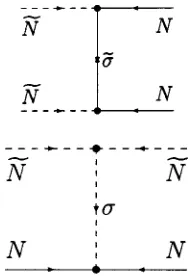
There are also other lepton number violating interactions, namely, the ˜ and -mediated N˜1N˜1 and N˜1N1 scatterings, shown in Fig. 2.5These processes can erase the lepton asym-metry carried by N˜1before it decays, provided they occur at
5Note that˜ and-mediated scatterings can be neglected due to
a higher rate. Note that the number density of N1 and N˜1 is
⯝g
*TR 4
/3m. This will result in
⌫N˜1N1⯝ Cg14
243 g
*TR 4
mm2, 共14兲
and
⌫N˜1N˜1⯝ Cg14
123 g
*TR 4
mm2, 共15兲
where C is a multiplicity factor representing different contri-buitions to the same process, and C/2⬃O(1). Also recall the decay rate ⌫1⯝h12M21/4m for N˜1. With the help of Eqs.共6兲,共10兲we find that these processes will be inefficient, provided
冉
TR 1 GeV冊
2
⬍10⫺2
冉
M1 1 GeV冊
3
. 共16兲
Note that TR⬍M1 for a perturbative decay of N1 共for details see Ref.关30兴兲. Therefore this bound is easily satisfied as long as M1⬎100 GeV. In conclusion, the only non-trivial con-straint in our scenario will be that of generating sufficient asymmetry, given in Eq.共10兲.
So far we have only considered the N˜1N˜1and N˜1N1 scat-terings. On the other hand, N˜1N˜1→NiNi and N˜1N1→N˜iNi annihilaitions can also happen through diagrams in Fig. 2. The rate for such processes is ⬀g1
2 gi
2
, which will be larger than the one considered above, provided N1 is not the heavi-est RH neutrino共note that Mi⬀gi). However, as we shall see shortly, successful baryogenesis requires that M1 not be much smaller than m. This implies that M1 is not very different from the largest Mi⬍m, and hence the rate for various processes represented by diagrams in Fig. 2 are in general comparable. Moreover, Eq.共14兲will indeed give the largest rate if N1 is the heaviest RH neutrino.
IV. MODEL PARAMETERS
We can now estimate the range of parameters within which our scenario can accommodate a successful
baryogen-esis. As an example, mⲏ10m, which guarantees that does not play any dynamical role in the post-inflationary era, while from Eq. 共16兲, M1ⲏ10TR guarantees the survival of generated asymmetry. Then the observed baryon asymmetry can be obtained provided
g12M1
mⲏ5⫻10
⫺6. 共17兲
For g1ⲏ10⫺2, this would require that M1 be 共at least兲 an order of magnitude smaller than m. This is at par with the standard non-thermal leptogenesis where 共s兲neutrinos are produced perturbatively. Note that a smaller M1/m is al-lowed as g1 increases.
It is important to notice that, contrary to the standard lep-togenesis scenario, sufficient asymmetry can be obtained with much smaller values of M1. In fact, it is evident from Eq. 共10兲that Bonly depends on the ratio M1/m. There-fore, as advertised earlier, our scenario can accommodate low scale leptogenesis without making unnatural assump-tions共e.g. having highly degenerate Majorana neutrinos, Ref. 关27兴兲. This is a consequence of generating the lepton asym-metry directly in the inflaton decay, and hence decoupling it from the neutrino Dirac Yukawas. One should, nevertheless, keep in mind the lower bound on M1, from Eq.共12兲, which arises for the minimal Ka¨hler potential. However, this has an entirely different origin, namely to avoid the earsure of the asymmetry by N˜⫺ND oscillations induced by soft supersym-metry breaking terms. Moreover, it can be substantially weakened for a non-minimal Ka¨hler structure.
V. EMBEDDING IN REALISTIC MODELS
The RH neutrino sector in Eq.共1兲can be naturally added by extending the MSSM to incorporate a gauged U(1)B⫺L symmetry. Three fermions, with the same quantum number as the RH neutrinos, will then be required for gauge anomaly cancellation. The RH neutrinos obtain Majorana mass through the scalar component of the ⌺ superfield 共with a B
⫺L charge of 2兲, which spontaneously breaks U(1)B⫺L symmetry. The present neutrino oscillation data indicates the scale of symmetry breaking vB⫺L be somewhere around 1012⫺1015GeV. The presence of heavy RH neutrinos will ensure the light SM neutrino masses via the seesaw mecha-nism 关6兴.
Note that the inflaton is considered to be a gauge singlet, and does not share any charge with other multiplets in Eq. 共1兲. Thus its coupling to the RH neutrino sector is deter-mined by non-renormalizable terms which, after symmetry breaking, result in y⬃O(vB⫺L/ MP).
The simplest extension of the electroweak sector has the gauge group SU(2)L⫻U(1)I3R⫻U(1)B⫺L, with the fer-mion quantum numbers assigned as follows: Q(2,0,⫹13); L(2,0,⫺1); uc(1,⫺12,⫺
1 3); d
c(1,⫹1 2,⫺
1 3); e
c(1,⫹1 2,⫹1); N(1,⫺12,⫹1). As mentioned earlier, three N are required
from anomaly cancellations conditions. The Higgs fields have the assignment Hu(2,⫹12,0); Hd(2,⫺12,0); ⌺(1,⫹1, ⫺2), ⌺¯ (1,⫺1,⫹2). Note that with the above charge
[image:5.612.126.221.56.195.2]ments, two superfields ⌺ and ⌺¯ are required for anomaly cancellation. The mixings and mass differences among dif-ferent neutrino flavors as observed in difdif-ferent experiments can be generated in this model via flavor violating Majorana couplings 关32兴. Indeed it is possible to find good fits of the experimental data with Majorana masses ⬎108 GeV 关32兴. The branching ratios of lepton flavor violating decay modes, e.g.→␥, →e␥ can distinguish these models.
VI. CONCLUSION
In this paper we have proposed a leptogenesis scenario where the lepton asymmetry is created in the RH sneutrino sector at relatively low reheat temperatures. This happens via a phase mismatch between the Majorana masses and the cou-pling of the RH共s兲neutrinos to a gauge singlet inflaton. The prompt decay of the sneutrinos then transfers the lepton asymmetry to the SM lepton sector. The realization of this scenario requires a considerable branching ratio for the infla-ton decay to 共at least one of兲the RH 共s兲neutrinos, and new Higgs boson field共s兲whose VEV is responsible for generat-ing the Majorana masses. The first requirement is a typical ingredient of non-thermal leptogenesis scenarios. The second one will be a necessary part of model building when the RH 共s兲neutrinos have gauge quantum charges under some new physics, e.g. models with a gauged U(1)B⫺Lsymmetry. The mixings and mass differences among different neutrino fla-vors as observed are generated in this model via flavor vio-lating Majorana couplings. The remarkable difference from the standard leptogenesis is that here the asymmetry depends on the neutrino Majorana Yukawa couplings rather the Dirac Yukawas. There exists another source for the washout of the asymmetry in this scenario, in addition to the usual lepton number violating scatterings of leptons and Higgs bosons,
namely the scattering of RH sneutrinos off each other or RH neutinos. We saw that for reheat temperatures compatible with the limit from thermal gravitino production, the wash-out processes do not lead to any meaningful constraints on the model parameters.
The maximum asymmetry is yielded when heavier 共s兲neutrinos have larger couplings to the inflaton. In this case the lepton asymmetry is mainly created in inflaton decay to the heaviset RH sneutrino N˜1 with mass M1. An acceptable baryon asymmetry can then be obtained for moderate Majo-rana Yukawa couplings g1ⲏ10⫺2, and mⲏ10M1.
One important point is that the low-energy supersymme-try breaking induces the N˜⫺ND oscillations and, in conse-quence, erases the initial lepton asymmetry. This demands that the decay rate of RH sneutrinos must be larger than the frequency of such oscillations. The latter quantity depends on the form of the Ka¨hler potential, as well as the mecha-nism for mediation of supersymmetry breaking. For minimal Ka¨hler structure we require M1⬎108.5GeV in gravity-mediated models, and M1⬎104.5GeV in gauge-mediated models. These bounds can be substantially weakened for non-minimal cases. There will be no other constraints on M1 besides this, and hence low scale leptogenesis can, in prin-ciple, be accommodated with a proper choice of the infla-tionary model.
ACKNOWLEDGMENTS
A.M. thanks CITA for financial support. He also acknowl-edges the hospitality of the Department of Physics, Univer-sity of Regina where part of this work has been carried out. The research of R.A. and B.D. is supported by the National Sciences and Engineering Research Council of Canada.
关1兴For a review, see K.A. Olive, G. Steigman, and T.P. Walker, Phys. Rep. 333, 389共2000兲.
关2兴A.D. Sakharov, Pis’ma Zh. E´ ksp. Teor. Fiz. 5, 32共1967兲 关JETP Lett. 5, 24共1967兲兴.
关3兴V.A. Kuzmin, V.A. Rubakov, and M.E. Shaposhnikov, Phys. Lett. 155B, 36共1985兲.
关4兴S.Y. Khlebnikov and M.E. Shaposhnikov, Nucl. Phys. B308, 885共1988兲.
关5兴M. Fukugita and T. Yanagida, Phys. Lett. B 174, 45共1986兲. 关6兴M. Gell-Mann, P. Ramond, and R. Slansky, in Supergravity,
edited by P. van Nieuwenhuizen and D.Z. Freedman共 North-Holland, Amsterdam, 1979兲; T. Yanagida, in Proceedings of Workshop on Unified Theory and Baryon Number in the Uni-verse, edited by O. Sawada and A. Sugamoto共KEK, Tsukuba, 1979兲; R.N. Mohapatra and G. Senjanovic, Phys. Rev. Lett. 44, 912共1980兲.
关7兴M.A. Luty, Phys. Rev. D 45, 455共1992兲.
关8兴M. Plu¨macher, Z. Phys. C 74, 549共1997兲; Nucl. Phys. B530, 207 共1998兲; W. Bu¨chmuller and M. Plu¨macher, Phys. Rep.
320, 329共1999兲; Int. J. Mod. Phys. A 15, 5047共2000兲. 关9兴W. Buchmuller, P. Di Bari, and M. Plumacher, Nucl. Phys.
B643, 367共2002兲.
关10兴J. Ellis, J.E. Kim, and D.V. Nanopoulos, Phys. Lett. 145B, 181 共1984兲; J. Ellis, D.V. Nanopoulos, K.A. Olive, and S.-J. Rey, Astropart. Phys. 4, 371共1996兲.
关11兴S. Sarkar, Rep. Prog. Phys. 59, 1493共1996兲.
关12兴A.L. Maroto and A. Mazumdar, Phys. Rev. Lett. 84, 1655 共2000兲; R. Kallosh, L. Kofman, A.D. Linde, and A. Von Pro-eyen, Phys. Rev. D 61, 103503 共2000兲; G.F. Giudice, I.I. Tkachev, and A. Riotto, J. High Energy Phys. 08, 009共1999兲;
11, 036共1999兲; M. Bastero-Gil and A. Mazumdar, Phys. Rev. D 62, 083510共2000兲.
关13兴R. Allahverdi, M. Bastero-Gil, and A. Mazumdar, Phys. Rev. D
64, 023516共2001兲.
关14兴H.P. Nilles, M. Peloso, and L. Sorbo, J. High Energy Phys. 04, 004共2001兲.
关15兴H.P. Nilles, K.A. Olive, and M. Peloso, Phys. Lett. B 522, 304 共2001兲.
关16兴R. Allahverdi, K. Enqvist, and A. Mazumdar, Phys. Rev. D 65, 103519共2002兲.
关17兴G. Lazarides and Q. Shafi, Phys. Lett. B 258, 305 共1991兲; T. Asaka, K. Hamaguchi, M. Kawasaki, and T. Yanagida, ibid.
关18兴G.F. Giudice, M. Peloso, A. Riotto, and I.I. Tkachev, J. High Energy Phys. 08, 014共1999兲.
关19兴K. Enqvist, S. Kasuya, and A. Mazumdar, Phys. Rev. Lett. 89, 091301共2002兲; Phys. Rev. D 66, 043505共2002兲.
关20兴B.A. Campbell, S. Davidson, and K.A. Olive, Nucl. Phys.
B399, 111共1993兲.
关21兴L. Boubekeur, S. Davidson, M. Peloso, and L. Sorbo, Phys. Rev. D 67, 043515共2003兲.
关22兴H. Murayama and T. Yanagida, Phys. Lett. B 322, 349共1994兲; K. Hamaguchi, H. Murayama, and T. Yanagida, Phys. Rev. D
65, 043512共2002兲.
关23兴Z. Berezhiani, A. Mazumdar, and A.P. Lorenzana, Phys. Lett. B 518, 282共2001兲.
关24兴L. Bento and Z. Berezhiani, Phys. Rev. Lett. 87, 231304 共2001兲.
关25兴R. Allahverdi and A. Mazumdar, Phys. Rev. D 67, 023509
共2003兲.
关26兴E. Ma, M. Raidal, and U. Sarkar, Phys. Rev. D 60, 076005 共1999兲.
关27兴See, for example, T. Hambye, Nucl. Phys. B633, 171共2002兲. 关28兴M. Flanz, E.A. Paschos, and U. Sarkar, Phys. Lett. B 345, 248
共1995兲; L. Covi, E. Roulet, and F. Vissani, ibid. 384, 169 共1996兲; A. Pilaftsis, Phys. Rev. D 56, 5431共1997兲; W. Bu¨ch-muller and M. Plu¨macher, Phys. Lett. B 431, 354共1998兲. 关29兴A. Pilaftsis, Int. J. Mod. Phys. A 14, 1811共1999兲.
关30兴S. Davidson and S. Sarkar, J. High Energy Phys. 11, 012 共2000兲; R. Allahverdi and M. Drees, Phys. Rev. D 66, 063513 共2002兲; P. Jaikumar and A. Mazumdar, hep-ph/0212265. 关31兴M. Fukugita and T. Yanagida, Phys. Rev. D 42, 1285共1990兲. 关32兴K.S. Babu, B. Dutta, and R.N. Mohapatra, Phys. Rev. D 67,