Munich Personal RePEc Archive
Knowledge creation as a square dance on
the Hilbert cube
Berliant, Marcus and Fujita, Masahisa
Washington University in St. Louis
1 September 2007
Online at
https://mpra.ub.uni-muenchen.de/4680/
Knowledge Creation as a Square Dance on the
Hilbert Cube
Marcus Berliant
andMasahisa Fujita
September 1, 2007
Abstract
This paper presents a micro-model of knowledge creation through the interac-tions among a group of people. Our model incorporates two key aspects of the cooperative process of knowledge creation: (i) heterogeneity of people in their state of knowledge is essential for successful cooperation in the joint creation of new ideas, while (ii) the very process of cooperative knowledge creation a¤ects the heterogeneity of people through the accumulation of knowledge in common. The model features myopic agents in a pure externality model of interaction. Surprisingly, in the gen-eral case for a large set of initial conditions we …nd that the equilibrium process of knowledge creation converges to the most productive state, where the popula-tion splits into smaller groups of optimal size; close interacpopula-tion takes place within each group only. This optimal size is larger as the heterogeneity of knowledge is more important in the knowledge production process. Equilibrium paths are found analytically, and they are a discontinuous function of initial heterogeneity. JEL Classi…cation Numbers: D83, O31 Keywords: knowledge creation, knowledge ex-ternalities, dynamic R and D, endogenous agent heterogeneity
The …rst author is grateful for funding from the Kyoto Institute of Economic Research at Kyoto University, from Washington University in St. Louis, and from the American Philosophical Society. The second author is grateful for Grants Aid for Scienti…c Research Grants S 13851002 and A 18203016 from the Japanese Ministry of Education and Science. We thank two anonymous referees, Alex Anas, Bob Hunt, Katsuhito Iwai, Felix Kubler, Fan-chin Kung, Charles Leung, David Levine, Koji Nishikimi, Joseph Perktold, Richard Rogerson, Tony Smith, and Takatoshi Tabuchi for helpful comments. Evidently, the authors alone are responsible for any remaining errors and for the views expressed herein.
Department of Economics, Washington University, Campus Box 1208, 1 Brookings Drive, St. Louis, MO 63130-4899 USA Phone: (1-314) 935-8486, Fax: (1-314) 935-4156, e-mail: [email protected]
1
Introduction
How do knowledge creation and transfer perpetuate themselves? How do agents change during this process? What are the implications of the knowledge production process for R & D team size and characteristics?
There are a number of empirical regularities that we seek to address. Kaplinsky (1983) …nds that in industries with rapid technical change, such as the computer software industry, …rms start large but then generate spin-o¤s, so the average …rm size decreases dramatically at a certain point in time. Why and when does this occur? Can we explain why the mean number of team members in the Broadway musical industry increased from 2 to 7 be-tween 1880 and 1930, and has remained constant since then?1 Why are there
a large number of small …rms in Higashi Osaka or in Ota ward in Tokyo, each specializing in di¤erent but related manufacturing services? Another example is the third Italy, where a large number of small …rms produce a great variety of di¤erentiated products. Yet another example is the restaurant industry in Berkeley, California.2 In each case, the heterogeneity of workers and tacit
knowledge accumulated within …rms play a central role in the operation of the …rms.
To address these empirical questions, we construct a dynamic model of group knowledge creation. As people create and transfer knowledge, they change. Thus, the history of meetings and their content is important. If people meet for a long time, then their base of knowledge in common increases, and their partnership eventually becomes less productive. Similarly, if two persons have very di¤erent knowledge bases, they have little common ground for communication, so their partnership will not be very productive.
For these reasons, we attempt to model endogenous agent heterogeneity, or horizontal agent di¤erentiation, to look at the permanent e¤ects of knowledge creation and growth.3 In describing our model, the analogy between partner
dancing and working jointly to create and exchange knowledge is useful, so we will use terms from these activities interchangeably. We assume that it is not possible for more than two persons to meet or dance at one time, though more than one couple can dance simultaneously. When agents meet, they create
1See Guimeràet al (2005) and Barabási (2005) for data and comment. 2In Berkeley, the parent restaurant is Chez Panisse.
3For simplicity, we employ a deterministic framework. It seems possible to add stochastic
new, shared knowledge, thus building up knowledge in common. When agents are not meeting with each other, their knowledge bases grow more di¤erent. The fastest rate of knowledge creation occurs when common and di¤erential knowledge are in balance. Knowledge creation and individual production all occur simultaneously at each point in time. The income of an agent at any given time is generated at a rate proportional to the agent’s current stock of knowledge, as is new knowledge when an agent dances alone. Agents seek to maximize the current ‡ow of income (the same as production) under certainty about everyone’s state of knowledge, so a myopic core concept is used. The dancers can work alone or with a partner. The suitability of dance partners depends on the stock of knowledge they have in common and their respective stocks of exclusive knowledge.
For simplicity, we deal primarily with the case when the agents are sym-metric. Our model is analytically tractable, so we do not have to resort to simulations; we …nd each equilibrium path explicitly. In this paper we con-sider only knowledge creation, not transfer. In Berliant and Fujita (2006), we work out the two person case with both knowledge creation and transfer, while allowing asymmetries. The results are similar, but the calculations are more complicated.
Our results are summarized as follows. There is a unique sink point that depends discontinuously on initial conditions. Only one of four speci…ed sequences of dance patterns can occur along the equilibrium path. When the initial state features relative homogeneity of knowledge between agents, the sink will be the most productive state,where the population splits into smaller groups of optimal size; close interaction takes place within each group only. This optimal size is larger as the heterogeneity of knowledge is more important in the knowledge production process. The result demonstrating that the sink point is the most productive state is most surprising to us, as we posit a model with myopic agents and no markets, but rather with only externalities in interactions between agents, so one would not expect e¢cient outcomes. It is also surprising to note that from an initially symmetric situation, the model generates asymmetries in the following sense. Both the size and characteristics of research teams are endogenous; workers in the same group continue to work together, but their knowledge pro…le drifts away from the pro…le of workers who are not part of the same group. This creates the boundaries of research teams endogenously.
al-though it is at a more micro level than large aggregate models, we do not work out completely its microfoundations. That is left to future research.
Future applications and extensions of the model are numerous.4 For
in-stance, to address questions related to how knowledge diversity or patent policy a¤ects long run economic growth, it would be possible to employ our model as the R & D sector of a growth model. To address questions related to R & D …rm agglomeration, a spatial dimension could be introduced explicitly, where agents can interact only with others in their region, but migration can lead to recombinations of agents from di¤erent regions.
We believe that our model can be tested further by examining the dynamic pattern of teams. Do R & D teams experience employment turnover early in an industry and then settle down? Does …rm size in an industry begin large and then suddenly become small? Is team size related to the mutual knowledge required for an industry’s R & D process? Do coauthorships in economics or other …elds follow the interaction paths predicted by our model? Di¤erentiation of agents in terms ofquality (or vertical characteristics) of knowledge is studied in Jovanovic and Rob (1989) in the context of a search model. In contrast, our model examines (endogenous) horizontal heterogeneity of agents and its e¤ect on knowledge creation and consumption.
Our work is related to the literature on teams; see for example Holmstrom (1982) or Aoki (1994). In general, this literature explores how the moral hazard or free rider problem is solved in group production. Smaller or more homogeneous groups will reduce this problem. Our framework abstracts from information asymmetry, instead focusing on the dynamics of the endogenous composition and size of teams due to knowledge heterogeneity. Empirical work must account for both aspects.
Section 2 gives the model and notation, Section 3 analyzes equilibrium in the case of two participants or dancers for expositional purposes, Section 4 extends the model to N persons and analyzes equilibrium, whereas Section 5 explores the e¢ciency properties of equilibrium. In order to investigate the nature of optimal group size, Section 6 extends the basic model to allow the importance of heterogeneity in knowledge creation to vary exogenously. Section 7 gives our conclusions and suggestions for future dancing. Appendices 0-2 provide the proofs of key results. Appendix 3 and the Technical Appendix
4An important question for future research is whether the surprising result that the sink
are available on the …rst author’s personal web-page.
2
The Model - Ideas and Knowledge
In this section, we introduce the basic concepts of our model of ideas and knowledge.
An idea is represented by a box. It has a label on it that everyone can read (the label is common knowledge in the game we shall describe). This label describes the contents. Each box contains an idea that is described by its label. Learning the actual contents of the box, as opposed to its label, takes time, so although anyone can read the label on the box, they cannot understand its contents without investing time. This time is used to open the box and to understand fully its contents. An example is a recipe for making “udon noodles as in Takamatsu.” It is labelled as such, but would take time to learn. Another example is reading a paper in a journal. Its label or title can be understood quickly, but learning the contents of the paper requires an investment of time. Production of a new paper, which is like opening a new box, either jointly or individually, also takes time.
Suppose we have an in…nite number of boxes, each containing a di¤erent piece of knowledge, which is what we call an idea. We put them in a row in an arbitrary order.
There are N persons in the economy, where N is a …nite integer. People are indexed by i and j. At this point, we assume that there are only two people; general indexing is used so that we can add more people to the model later. We assume that each person has a replica of the in…nite row of boxes introduced above, and that each copy of the row has the same order. Our model features continuous time. Fix time t 2 R+ and consider any person
i. A box is indexed by k = 1;2; ::: Take any box k. If person i knows the idea inside that box, we put a sticker on it that says 1; otherwise, we put a sticker on it that says 0. That is, let xk
i(t) 2 f0;1g be the sticker on box k
for person i at time t. Thestate of knowledge, or just knowledge, of person i at time t is thus de…ned to be Ki(t) = (x1
i(t); x2i(t); :::)2 f0;1g1. The reason
we use an in…nite vector of possible ideas is that we are using an in…nite time horizon, and there are always new ideas that might be discovered, even in the preparation of udon noodles. More formally, let H be the Hilbert cube; it consists of all real sequences with values in [0;1]. That is, if N is the set of
natural numbers, then H = [0;1]N
Ki(t), is a vertex of the Hilbert cube H. Notice that given any vertex of H, there exists an in…nite number of adjacent vertices. That is, given Ki(t)with
only …nitely many non-zero components, there is an in…nite number of ideas that could be created in the next step.
In this paper, we will treat ideas symmetrically. Extensions to idea hier-archies and knowledge structures will be discussed in the conclusions.
GivenKi(t) = (x1i(t); x2i(t); :::),
ni(t) =
1
X
k=1
xki(t) (1)
represents the number of ideas known by person i at time t. Next, we will de…ne the number of ideas that two persons, iandj, both know. Assume that j 6=i. De…ne Kj(t) = (xj1(t); x2j(t); :::)and
ncij(t) =
1
X
k=1
xki(t) xkj(t) (2)
So nc
ij(t) represents the number of ideas known by both persons i and j at
time t. Notice that i and j are symmetric in this de…nition, so nc
ij(t) =ncji(t).
De…ne
ndij(t) =ni(t) ncij(t) (3)
to be the number of ideas known by person i but not known by person j at time t. Then, it holds by de…nition that
ni(t) =ncij(t) +ndij(t) (4)
De…nenij(t)be the total number of ideas possessed by personsiandj together
at time t. Then, tautologically
nij(t) = ncij(t) +ndij(t) +ndji(t) (5)
Knowledge is a set of ideas that are possessed by a person at a particular time. However, knowledge is not a static concept. New knowledge can be produced either individually or jointly, and ideas can be shared with others. But all of this activity takes time.
separately and also creates new knowledge separately, away from everyone else. If two persons do decide to meet at a given time, then they collaborate to create new knowledge together.
So consider a given time t. In order to explain how knowledge creation and commodity production work, it is useful for intuition (but not technically necessary) to view this time period of …xed length as consisting of subperi-ods of …xed length. Each individual is endowed with a …xed amount of labor that is supplied inelastically during the period. In the …rst subperiod, in-dividual production takes place. We shall assume constant returns to scale in physical production, so it is not bene…cial for individuals to collaborate in production. Each individual uses their labor during the …rst subperiod to produce consumption good on their own, whether or not they are meeting. We shall assume below that although there are no increasing returns to scale in production, the productivity of a person’s labor depends on their stock of knowledge. Activity in the second subperiod depends on whether or not there is a meeting. If there is no meeting, then each person spends the second sub-period creating new knowledge on their own. Evidently, the new knowledge created during this subperiod di¤ers between the two persons, because they are not communicating. They open di¤erent boxes. Since there is an in…nity of di¤erent boxes, the probability that the two agents will open the same box (even at di¤erent points in time), either working by themselves or in distinct meetings, is assumed to be zero. If there is a meeting, then they create new knowledgetogether, so they open boxes together.5 We wish to emphasize that
the division of a time period into subperiods is purely an expositional device. Rigorously, whether or not a meeting occurs determines how much attention is devoted to the various activities at a given time.
What do the agents know when they face the decision about whether or not to meet a potential partner j at time t? Each person knows both Ki(t)
and Kj(t). In other words, each person is aware of their own knowledge and is also aware of all others’ knowledge. Thus, they also know ni(t),nj(t), nc
ij(t) =
nc
ji(t), ndij(t), and ndji(t) (for all j 6= i) when they decide whether or not to
meet at time t. The notation for whether or not a meeting of persons i and j actually occurs at time t is: ij(t) = ji(t) = 1 if a meeting occurs and ij(t) = ji(t) = 0if no meeting occurs at time t. For convenience, we de…ne ii(t) = 1 when person i works in isolation at time t, and ii(t) = 0 when person imeets with another person at time t.
Next, we must specify the dynamics of the knowledge system and the ob-jectives of the people in the model in order to determine whether or not two persons decide to meet at a particular time. In order to accomplish this, it is easiest to abstract away from the notation for speci…c boxes, Ki(t), and to fo-cus on the dynamics of the quantity statistics related to knowledge,ni(t),nj(t),
nc
ij(t) =ncji(t),ndij(t), andndji(t). Since we are treating ideas symmetrically, in
a sense these quantities are su¢cient statistics for our analysis.6
The simplest piece of the model to specify is what happens if there is no meeting between person i and anyone else, so i works in isolation. Let aii(t)
be the rate of creation of new ideas created by person i in isolation at time t (this means that i meets with itself). Then we assume that the creation of new knowledge during isolation is governed by the following equation:
aii(t) = ni(t)when ii(t) = 1. (6)
So we assume that if there is no meeting at timet, individual knowledge grows at a rate proportional to the knowledge already acquired by an individual.
If a meeting occurs between i and j at time t ( ij(t) = 1), then joint
knowledge creation occurs, and it is governed by the following dynamics:7
aij(t) = [ncij(t) ndij(t) ndji(t)]13 when ij(t) = 1 for j 6=i (7)
So when two people meet, joint knowledge creation occurs at a rate propor-tional to the normalized product of their knowledge in common, the di¤erential knowledge of i from j, and the di¤erential knowledge of j from i. The rate of creation of new knowledge is highest when the proportions of ideas in com-mon, ideas exclusive to person i, and ideas exclusive to person j are split evenly. Ideas in common are necessary for communication, whereas ideas ex-clusive to one person or the other imply more heterogeneity or originality in the collaboration. If one person in the collaboration does not have exclusive
6In principle, all of these time-dependent quantities are positive integers. However, for
simplicity we take them to be continuous (inR+) throughout the paper. One interpretation
is that the creation of an idea occurs at a stochastic time, and the real numbers are taken to be the expected number of jumps (ideas learned) in a Poisson process. The use of an integer instead of a real number seems to add little but complication to the analysis.
7We may generalize equation (7) as follows:
aij(t) = max
n
( ")ni(t);( ")nj(t); ncij(t) n d ij(t) n
d ji(t)
1 3o
ideas, there is no reason for the other person to meet and collaborate. The multiplicative nature of the function in equation (7) drives the relationship between knowledge creation and the relative proportions of ideas in common and ideas exclusive to one or the other agent. Under these circumstances, no knowledge creation in isolation occurs.
Whether a meeting occurs or not, there is production in each period for both persons. Felicity (or instantaneous utility) in that time period is de…ned to be the quantity of output.8 De…ney
i(t)to be production output (or felicity)
for person i at time t, that is consumed by person i. The output is taken to be numéraire. Normalizing the coe¢cient of production to be 1, we take
yi(t) = ni(t) (8)
so output of private good for person i at time t is a function of person i’s human capital; in turn, this is assumed to be person i’s stock of knowledge. Person i’s lifetime utility is given by
Ui(0) =
Z 1
0
e t yi(t)dt
where the constant is the discount rate common to all agents. In the present context, since yi(t) = ni(t) is the stock variable that is actually …xed at time t for each consumer i, what the consumer can choose at time t is the rate of increase of income or knowledge, the ‡ow variable:
_
yi(t) = _ni(t) (9)
At this point, we introduce the assumption that the agents are myopic in choos-ing their partners (or workchoos-ing in isolation). In particular, they do not foresee the consequences of their choice of action on the future path of consumption, but rather only see the immediate consequences, namely agent i’s objective at time t is to maximizey_i(t).
By de…nition,
_
yi(t)
yi(t)
= n_i(t)
ni(t)
(10) which represents the rate of growth of income. Since yi(t) is the stock
vari-able, choosing partners to maximize y_i(t) is the same as choosing partners to maximize y_i(t)
yi(t).
8Given that the focus of this paper is on knowledge creation rather than production, we
We now describe the dynamics of the system, dropping the time argument. Let us focus on agent i, as the expressions for the other agents are analogous.
_
yi = _ni = N
X
j=1
ij aij (11)
_
ncij = ij aij for all j 6=i (12) _
ndij = X k6=j
ik aik for all j 6=i (13)
Equation (11) is based on the assumption that once learned, ideas are not forgotten. Thus, the increase in the knowledge of person i is the sum of the knowledge created in isolation and the knowledge created jointly with someone else. Equation (12) means that the increase in the knowledge in common for personsiandj equals the new knowledge created jointly by them. Finally, equation (13) means that all the knowledge created by personi either in isolation or joint with persons other than person j becomes a part of the di¤erential knowledge of person i from person j.
By de…nition, it is also the case that
N
X
j=1
ij = 1
Furthermore, on the equilibrium path it is necessary that
ij = ji for all i and j
Concerning the rule used by an agent to choose their best partner, to keep the model tractable in this …rst analysis, we assume a myopic rule. At each moment of timet, personiwould like a meeting with personj when the rate of growth of income while meeting withj is highest among all potential partners, including himself.9 As we are attempting to model close interactions within
groups, we assume that at each time, the myopic persons interacting choose a core con…guration. That is, we restrict attention to con…gurations such that at any point in time, no coalition of persons can get together and make themselves better o¤ in that time period. In essence, our solution concept at a point in time is the myopic core.
In order to analyze our dynamic system, we …rst divide all of our equations by the total number of ideas possessed by i and j:
nij =ndij +ndji+ncij (14)
and de…ne new variables
mcij mcji = n c ij
nij =
nc ji
nij
mdij = n d ij
nij, m d ji =
nd ji
nij
By de…nition, md
ij represents the percentage of ideas exclusive to person i
among all the ideas known by person i or person j. Similarly, mc
ij represents
the ideas known in common by persons i and j among all the ideas known by the pair. From (14), we obtain
1 =mdij+mdji+mcij (15)
whereas (4) and (14) yield
ni = (1 mdji) nij (16)
Using these identities and new variables, for each pair of dancersiandj(i6=j), we obtain (see Theorem A1 in Technical Appendix a):
aij
ni
=G(mdij; mdji) for i6=j (17) where
G(mdij; mdji) 1 m d
ij mdji mdij mdji
1 3
1 md ji
(18)
which represents the growth rate of their knowledge when two persons i and j meet. Then, using (6) and (11), we can rewrite the income growth rate, equation (10), as follows:
_
yi
yi = n_i
ni
= ii +
X
j6=i
ij G(mdij; mdji) (19)
Furthermore, using (6), (7) and (17), we have (see Theorem A2 in Technical Appendix a):
_
mdij = 1 mdij ii 1 mdji jj mdij ij mdij 1 mdji G(mdij; mdji)
+ 1 mdij 1 mdji X
k6=i;j
ik G(mdik; mdki)
1 mdij mdij X
k6=i;j
fori; j = 1;2; ; N:Thus, the dynamics of the system are described in terms of md
ij (i; j = 1;2; ; N) only. Before analyzing the general model with any
population, to provide intuition we …rst examine the two person case. This system, with analogous equations for agent j, represents a partner dance on the vertices of the Hilbert cube.
3
The Two Person Model
Consider N = 2 and we call the two agents i and j. Applying (19) to the present context and setting ii= 1 ij and jj = 1 ji yields
_
yi
yi
= n_i
ni
= (1 ij) + ij G(mdij; mdji) (21) _
yj
yj
= n_j
nj
= (1 ji) + ji G(mdji; mdij)
Likewise, by omitting the last two lines in equation (20) and setting ii= 1 ij
and jj = 1 ji = 1 ij (since ij = ji in equilibrium), we have
_
mdij = (1 ij) 1 mdij 1 mdij mdji
ij mdij 1 mdji G(mdij; mdji) (22)
_
mdji = (1 ij) 1 mdji 1 mdij mdji
ji mdji 1 mdij G(mdji; mdij)
To provide intuition, here we focus on the special case where the initial state is symmetric, namely md
ij(0) =mdji(0) = m(0). It should be clear from
these equations that once the general system attains a symmetric state, say at time 0, then in equilibrium the state remains symmetric forever.10 Along any
symmetric equilibrium path,
mdij = mdji=m
mc = 1 m
Hence the state of the system is completely speci…ed by the scalar m, repre-senting the percentage of the total number of ideas exclusive to each person.
10Berliant and Fujita (2006) show that there is a large set of initial conditions from which
To study this system in greater detail, we must study whether each person does better creating new ideas in isolation or together. Setting
yi =yj =y
we use (21) to obtain
_
y(t)
y(t) = [1 ij(t)] + ij(t) G(m(t); m(t))
To simplify notation, we de…ne the growth rate when the two persons meet,
ji = ij = 1, as
g(m) G(m; m) = [(1 2m) m
2]13
1 m (23)
Thus
_
y(t)
y(t) = [1 ij] + ij g(m) (24)
In order to maximize the income growth rate given by (24), both agents want to meet (i.e., ij = ji = 1) when g(m)> .
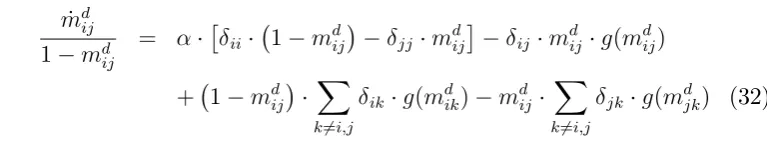
[image:14.595.152.461.465.551.2]Figure 1 illustrates the graph of the functiong(m)as a bold line for = 1.
FIGURE 1 GOES HERE
Di¤erentiatingg(m)yields
g0(m) = 3
(1 2m) m2
(1 m)3
2
3 m (2 5m)
(1 m)4 (25)
implying that
g0(m)>
<0 as m < >
2
5 form 2(0; 1
2) (26)
Thus,g(m) is strictly quasi-concave on[0;1
2], achieving its maximal value
atmB = 2
5; we call the latter the “Bliss Point.” Presuming thatg(m
B)> , it
is the point where the rate of increase in income is maximized for each person. De…ne the set of states where meetings occur to be
M =fm 2[0;1
2]jg(m)> g
Since g is strictly quasi-concave, M is convex. Let mJ be the greatest lower
bound ofM and letmI be the least upper bound ofM. HenceM = (mJ; mI);
Next we discuss the dynamics of the system, assuming that the equilibrium condition ij = ji = always holds. Consider …rst the case where there is
no meeting, so = 0 is …xed exogenously. Then from equations (22), the dynamics are given by the following equation:
_
m = (1 m)(1 2m)
If there is no meeting ( = 0), then m_ is non-negative, and positive on
(0;1=2). So if there is no meeting, the vector …eld points to the right, and the system tends to m= 1=2.
With a meeting, = 1. Then (22) implies:
_
m= m [(1 2m) m2]13 (27)
This expression is negative on (0;1=2) and the vector …eld points to the left. The sink is at 0, so the system eventually moves there under the assumption of a meeting.
Next, we combine the case where there is no meeting ( ij = 0) with the
case where there is a meeting ( ij = 1), and let the agents choose whether or
not to meet. The model follows the dynamics for meetings ( ij = 1) on M
and the dynamics for no meetings ( ij = 0) on the complement of M.
So given various initial compositions of knowledge m(0), where will the system end up? If the initial composition of knowledge is such that the couple has little in common, namely m(0) mI , the sink will be m = 1=2; the
myopic return to no meeting dominates the return to meeting, since the two persons have little in common. If the initial composition of knowledge is such that the couple has more in common, namely m(0)< mI, then the sink point
will be m =mJ. It is the remaining stable point of our model.
Without loss of generality, we can allow ij to take values in [0;1] rather
than in f0;1g. The interpretation of a fractional ij is that at each instant
of time, a person divides their time between a meeting ij proportion of that
instant and isolation(1 ij)proportion of that instant.11 The purpose of this
generalization is to capture the limit of a sequence of dance patterns where two partners are alternating between working together and then in isolation for shorter and shorter periods. All of our results concerning the model when
ij is restricted to f0;1g carry over to the case where ij 2[0;1]. The reason 11An alternative interpretation is that at each instant of time, they devote their attention
to working together for ijproportion of that instant and to working in isolation for(1 ij)
is that except on the boundary of M, persons strictly prefer ij 2 f0;1g to
fractional values of ij, as each person’s objective function is linear in ij.
It may seem trivial to allow fractional ij when discussing equilibrium
be-havior with two people, but allowing fractional ij is crucial to Section 4, where
we consider the general case. Detailed analysis of the two person case, allow-ing asymmetric states, knowledge transfer, and includallow-ing analysis of e¢ciency, can be found in Berliant and Fujita (2006).
4
Equilibrium Dynamics
4.1
The General Framework
The model with only two people is very limited. Either two people are meeting or they are each working in isolation. With more people, the dancers can be partitioned into many pairs of dance partners. Within each pair, the two dancers are working together, but pairs of partners are working simultaneously. This creates more possibilities in our model, as the knowledge created within a dance pair is not known to other pairs. Thus, knowledge di¤erentiation can evolve between di¤erent pairs of dance partners. Furthermore, the option of switching partners is now available.
We limit ourselves to the case where N is divisible by 4. In equilibrium, this will be a square dance on the vertices of the Hilbert cube. When the population is not divisible by 4, our most useful tool, symmetry, cannot be used to examine dynamics. Although this may seem restrictive, when N is large, asymmetries apply only to a small fraction of the population, and thus become negligible.12 In the general case, we impose the assumption of pairwise
symmetric initial heterogeneity conditions for all agents.
The initial state of knowledge is symmetric among the dancers, and given by
ncij(0) = nc(0) for all i6=j (28) ndij(0) = nd(0) for all i6=j (29)
At the initial state, each pair of dancers has the same number of ideas, nc(0),
in common. Moreover, for any pair of dancers, the number of ideas that one dancer knows but the other does not know is the same and equal to nd(0). Given that the initial state of knowledge is symmetric among the dancers, it
turns out that the equilibrium con…guration at any time also maintains the basic symmetry among the dancers.13
When all dancers are pairwise symmetric to each other, that is, when mdij =mdji for all i6=j (30) using the functiong de…ned by (23), the income growth rate (19) is simpli…ed as
_
yi
yi = n_i
ni
= ii +
X
j6=i
ij g(mdij) (31)
and the dynamics (20) can be rewritten as
_
md ij 1 md
ij
= ii 1 mdij jj mdij ij mdij g(mdij)
+ 1 mdij X
k6=i;j
ik g(mdik) mdij
X
k6=i;j
jk g(mdjk) (32)
Sincenij =nji by de…nition, we can readily see, by using (16), that
condi-tion (30) is equivalent to
ni =nj for all i and j (33)
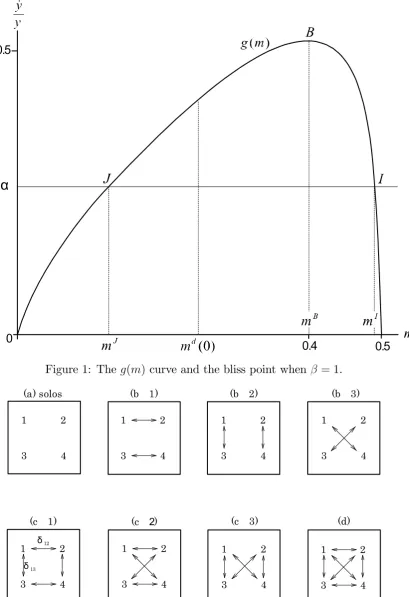
[image:17.595.114.498.257.337.2]Next, taking the case ofN = 4, we illustrate the possible meetings, noting that the equilibrium path speci…es a meeting for every time. Figure 2 gives the possibilities at any …xed time forN = 4. Given that the initial state of knowl-edge is symmetric among the four dancers, as noted above, the equilibrium con…guration at any time also maintains the basic symmetry among dancers.
FIGURE 2 GOES HERE
Panel (a) in Figure 2 represents the case in which each of the four dancers is working alone, creating new ideas in isolation. Panels (b-1) to (b-3) represent the three possible con…gurations of partner dancing, in which two couples each dance separately but simultaneously. In panel (b-1), for example, 1 and 2 dance together. At the same time, 3 and 4 dance together.
Although panels (a) to (b-3) represent the basic forms of dance with four persons, it turns out that the equilibrium path often requires a mixture of these
13It is possible that, beginning from an initial state that is asymmetric, there are
basic forms. That is, on the equilibrium path, people wish to change partners as frequently as possible. The purpose is to balance the number of di¤erent and common ideas with partners as best as can be achieved. This suggests a square dance with rapidly changing partners on the equilibrium path.
Please refer to panels (c-1) to (c-3) in Figure 2. Each of these panels represents square dancing where a dancer rotates through two …xed partners as fast as possible in order to maximize the instantaneous increase in their income. In panel (c-1), for example, dancer 1 chooses dancers 2 and 3 as partners, and rotates between the two partners under equilibrium values of
12 and 13 such that 12 + 13 = 1. In the case where 12 = 13 = 1=2,
for example, this means in practice that person 1 works with person 2 for half a week and with person 3 for half a week. This can be the best of two worlds: it can achieve high knowledge productivity through cooperation while it simultaneously avoids accumulating too much knowledge in common with any particular partner. Dancers 2, 3 and 4 behave analogously. In order for this type of square dance to take place, of course, all four persons must agree to follow this pattern.14 Finally, panel (d) depicts square dancing in which each
dancer rotates though all three possible partners as fast as possible. That is, for all i6=j, ij 2(0;1), and for all i, ii= 0 and Pj6=i ij = 1.
At this point, it is useful to remind the reader that we are using a myopic core concept to determine equilibrium at each point in time. In fact, it is necessary to sharpen that concept in the model with N persons. When there is more than one vector of strategies that is in the myopic core at a particular time, namely more than one vector of joint strategies implies the same, high-est …rst derivative of income for all persons, the one with the highhigh-est second derivative of income is selected. The justi…cation for this assumption is that at each point in time, people are attempting to maximize the ‡ow of income. The formal de…nition of the myopic core and proof that it is nonempty can be found in Appendix 0. Although the theorem in the appendix is general, in the remainder of this paper we shall focus on the symmetric case.
Now we are ready to investigate the actual equilibrium path, depending on the given initial composition of knowledge,
mdij(0) =md(0) = n d(0)
nc(0) + 2nd(0)
which is common for all pairs i and j (i6=j). In Figure 1, letmJ and mI be
de…ned on the horizontal axis at the left intersection and the right intersection
between the g(m)curve and the horizontal line at height , respectively.
4.2
The Main Result
In the remainder of this paper, we assume that
< g(mB) (34)
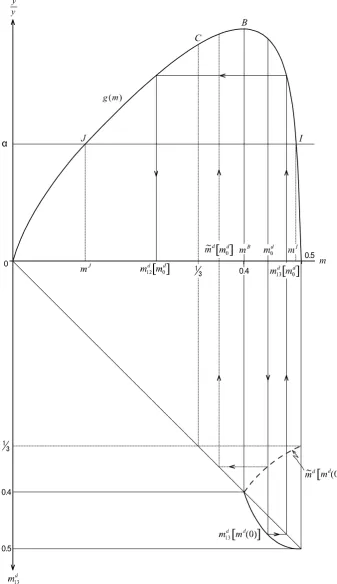
so as to avoid the trivial case of all agents always working in isolation. Figure 3 provides a diagram explaining our main result.
FIGURE 3 GOES HERE
The top horizontal line represents the initial common state md(0), while
the bottom horizontal line represents the …nal common state or sink point, md(1). There are four regions of the initial state that result in four di¤erent
sink points. Corresponding to each initial region, the associated equilibrium dance forms are illustrated by taking the case with N = 4. To be precise:15
Proposition 1: Assume that N is a multiple of 4. The equilibrium path and sink point depend discontinuously on the initial condition, md(0). The
pattern of interaction between persons and the sink point as a function of the initial condition are given in Figure 3 and as follows.
(i) For 0< md(0) 2=5 =mB, the equilibrium path consists of an initial
time interval (possibly the empty set) in which all N persons work indepen-dently, followed by an interval in which all persons work with another but trade partners as rapidly as possible (with ij = 1=(N 1)for all iand for all j 6=i).
When the bliss point, 2=5, is attained, the agents split into groups of 4, and they remain at the bliss point.16
15At this point, it is useful to recall the following notation. In any symmetric situation, the
percentage of ideas known by one agent but not another is given bymJ for the lowest value
at which meetings are desirable, mI for the highest value at which meetings are desirable,
andmB for the bliss point or the maximal productivity of a meeting.
16The con…guration of workers necessary to maintain the bliss point is not unique. Each
(ii) When mB < md(0) mb, where mb is de…ned by (54), the equilibrium
path consists of three phases. First, the N persons are paired arbitrarily and work with their partners for a nonempty interval of time. Second, they switch to new partners and work with their new partners for a nonempty interval of time. Finally, each person works alternately with the two partners with whom they worked in the …rst two phases, but not with a person with whom they have not worked previously. The sink point is 1=3.
(iii) For m < mb d(0) mI, the equilibrium path pairs the N persons into
N=2couples arbitrarily, and each person dances exclusively with the same part-ner forever. The sink point is mJ.17
(iv) For mI < md(0) 1=2, each person dances alone forever. The sink
point is 1=2.
4.2.1 Case (i): 0< md(0) 2=5 =mB
First suppose that the initial state is such that mJ < md(0) mB
Then, since g(md
ij(0)) =g md(0) > for any possible dance pairs consisting
of i and j, no person wishes to dance alone at the start. However, since the value of g(md
ij(0)) is the same for all possible pairs, all forms of (b-1) to (d)
in Figure 2 are possible equilibrium dance con…gurations at the start. To determine which one of them will actually take place on the equilibrium path, we must consider the second derivative of income for all persons.
In general, consider any time at which all persons have the same composi-tion of knowledge:
mdij =md for all i6=j (35)
where
g(md)>
Focus on personi; the equations for other persons are analogous. Since person i does not wish to dance alone, it follows that
ii= 0 and
X
j6=i
ij = 1 (36)
Substituting (35) and (36) into (31) yields
_
yi
yi
=g(md)
17As in the two person case, once mJ is attained, the couples split and dance alone
Likewise, substituting (35) and (36) into (32) and arranging terms gives
_
mdij = 1 md g(md) 1 2md (1 md) ij (37)
Since the income growth rate y=y_ above is independent of the values of
ij (j 6= i), in order to examine what values of ij(j 6= i) person i wishes to
choose, we must consider the time derivative of y_i=yi. In doing so, however,
we cannot use equation (31) because the original variables have been replaced. Instead, we must go back to the original equation (19). Then, using equations (35) to (37) and setting ij = ji (which must hold for any feasible meeting),
we obtain the following (see Technical Appendix b for proof): d( _yi=yi)
dt = 1 m
d g(md) g0(md)
"
1 2md (1 md) X j6=i
2
ij
#
(38)
Now, suppose that
md< mB 2=5
and hence g0(md)>0. Then, in order to maximize the time derivative of the
income growth rate, person i must solve the following quadratic minimization problem:
minX j6=i
2
ij subject to
X
j6=i
ij = 1 (39)
which yields the solution for person i:
ij = 1
N 1 for all j 6=i (40)
Although we have focused on person i, the vector of optimal strategies is the same for all persons. Thus, all persons agree to a square dance in which each person rotates through allN 1possible partners while sharing the time equally.
The intuition behind this result is as follows. The condition md < 2=5
mB means that the dancers have relatively too many ideas in common, and
thus they wish to acquire ideas that are di¤erent from those of each possible partner as fast as possible. That is, when mJ < md
ij = md < mB in Figure
1, each dancer wishes to move the knowledge composition md
ij to the right as
quickly as possible, thus increasing the growth rate g(md
ij) as fast as possible.
Taking the case ofN = 4and using Figure 2, let us consider how this objective can be achieved in a cooperative manner.
Given that mJ < md
ij = md < mB and thus < g(mdij), dance form (a)
achieves only the growth rate less thang(md
ij); the latter could be achieved
by dancing with any other person. Dance in the form (b-1), where f1;2g
and f3;4g respectively dance exclusively with one partner, is possible. In this manner, however, each pair just accumulates more knowledge in common, pushing md
12 and md34 to the left in Figure 1. Indeed, setting 12 = 1 and 34= 1 in (37) yields
_
md12= _md34 = (1 md) g(md) md<0,
working against the objective of increasing the myopic growth rate g(md ij).
Observe that when partners dance in form (b-1), the actual pair f1;2g accu-mulates more ideas in common. But from the view point of dancers 1 and
2, dancers 3 and 4 are accumulating new ideas that are di¤erent. Consider, for example, the potential partners 1 and 3, who are not dancing together at present and hence 13= 0. From (37) we have
_
md13= (1 md) g(md) (1 2md)>0
Sinceg is monotonically increasing on the domain mJ;2=5 ,the value g(md
12)
of the actual dance partnership f1;2g is decreasing with time, while the value g(md
12)of the potential partnership f1;3gis increasing with time. Hence, given
the symmetric situation of the four dancers, everyone wants to change partners immediately.
This suggests that when mJ < md
ij = md < 2=5 (= mB) for all i 6= j, on
the equilibrium path, agents perform a square dance with rapidly changing partners represented by one of panels (c-1) to (d) in Figure 2. Actually, we can show that the square dance con…gurations (c-1) to (c-3) cannot occur on the equilibrium path. For example, suppose that a dance in the form of panel (c-1) occurs, where 12 = 13= 1=2, 14= 0 and so forth. Then, equation (37)
yields
_
md14 = (1 md) g(md) (1 2md)
> m_d12 = _md13= (1 md) g(md) 1 3m d 2
Thus, dancer1wants to change partners from2and3to4immediately. There-fore, when mJ < md
ij = md < 2=5 (= mB) for all i 6= j, on the equilibrium
path, only con…guration (d) in Figure 2 can take place, where ij = 1=3for all
i6=j.
Returning to the general case withN 4, when mJ < md(0) = md ji(0) < 2=5 (=mB)for alli6=j, on the equilibrium path, the square dance with
1=(N 1) for all i 6= j takes place at the start. Then, since the symmetric condition (35) holds thenceforth, the same square dance will continue as long asmJ < md<2=5 (=mB). The dynamics of this square dance are as follows.
The creation of new ideas always takes place in pairs. Pairs are cycling rapidly with ij = 1=(N 1) for alli =6 j. Dancer 1, for example, spends 1=(N 1)
of each period with dancer 2, for example, and (N 2)=(N 1)of the time dancing with other partners. Setting md
ij =md and ij = 1=(N 1) in (37),
we obtain
_
md= (1 md) g(md) (N 2) (2N 3)md
N 1 (41)
Setting m_d= 0 and considering that md<1, we obtain the sink point
md = N 2
2N 3 (42)
Surprisingly, when N = 4, md = 2=5 = mB. The value of m_d is positive
when md < mB = 2=5, and zero if md = 2=5. Hence, beginning at any point
md(0) < 2=5, the system moves to the right, eventually settling at the bliss
point mB.
Since the right hand side of equation (42) is increasing inN,
md = N 2
2N 3 >2=5 m
B when N >4. (43)
Hence, when N > 4 and N is divisible by 4, beginning at any point mJ <
md(0) < 2=5, the system moves to the right and reaches mB = 2=5 in …nite
time. When N agents reach the bliss pointmB, they break into groups of 4to
maintain heterogeneity at the bliss point.18
18When the number of agents is not divisible by 4, then the bliss point cannot be
main-tained for the unlucky N N~ persons, where N~ is the largest number divisible by 4 and not exceeding N. Given that our game does not permit any side payments, these unlucky persons have no choice but to do the best by themselves. When N N~ = 3, the unlucky3
persons perform a square dance in which they set ij = 1=3fori6=j. Substituting 3forN
in (41) yields
_
md = 1 md g(md) 1 3m
d
2
Thus, starting from the bliss point, the unlucky 3 persons eventually settle at md = 1=3.
WhenN N~ = 2, substituting2 forN in (41) yields
_
md= 1 md g(md) md
Hence, starting from the bliss point, the unlucky2 persons gradually move tomJ and stay
Next, when0 md(0)< mJ, it is obvious that the four persons work alone
until they reach mJ.19 Then they follow the path explained above, eventually
reaching mB.
4.2.2 Case (ii): mB < md(0) mb 20
Next, let us consider the dynamics of the system when it begins to the right of mB = 2=5 but to the left of m < mb I (where mb will be de…ned soon).
For example, consider md
0 in Figure 4, where the g(m) curve from Figure 1
is duplicated in the top part of Figure 4. In other words, the initial state re‡ects a higher degree of heterogeneity than the bliss point. In this case, the equilibrium process progresses through the following three phases (please refer to the sequence of dance forms (b-1), (b-2) and (c-1), leading to md(1) = 1=3 in the middle of Figure 4).
FIGURE 4 GOES HERE
Phase 1: Since the initial state re‡ects a higher degree of heterogeneity than the bliss point, the dancers want to increase the knowledge they have in common as fast as possible, leading to …delity and couple dances.
To be precise, since md
ij(0) = md(0) for all i 6= j and g(md(0)) > , the
situation at time 0 is the same as that in Case (i) except that we now have md(0) > mB. Hence, focusing on person i as before, the time derivative of
_
yi=yi at time 0 is given by (38). However, since g0(md) = g0(md(0)) < 0 at
time0, in order to maximize the right hand side of equation (38), personinow must solve now the following quadratic maximization problem:
maxX j6=i
2
ij subject to
X
j6=i
ij = 1 (44)
Thus, person i wishes to choose any partner, say k, and set ik = 1, whereas ij = 0for allj 6=k. The situation is the same for all dancers. Hence, without
loss of generality, we can assume that N persons agree at time 0 to form the following combination of partnerships:
P1 ff1;2g;f3;4g f5;6g; ;fN 1; Ngg (45)
19Movement to the right beyond mJ requires application of the second order conditions
for equilibrium selection. When the dancers are exactly atmJ, the rate of growth in income
from working in isolation and from working with all other dancers with equal intensity are the same, so the derivatives of the respective growth rates of income must be examined to determine which is chosen.
and initiate pairwise dancing such that21
ij = ji = 1 for fi; jg 2P1, ij = ji = 0 for fi; jg2= P1 (46)
In order to examine the dynamics for this pairwise dance, let us focus on the partnership f1;2g 2 P1; the equations for other partnerships are analogous.
Since 12 = 21 = 1 and 1k = 2k = 0 for all k 6= 1;2, setting i = 1 and
j = 2 in (32) yields
_
md12 = 1 md12 m12d g(md12)<0 (47)
This means, as expected, that the proportion of di¤erential knowledge for each couple decreases with time. Since the dynamicsm_d
ij and the initial point
md
ij(0) =md(0) are the same for all fi; jg 2 P1, as long as the same pairwise
dancing continues, we have that
md12(t) = md34(t) = =mNd 1;N(t) mda(t)< md(0) (48)
where the subscript a inmd
a means any actual partnership.
To study how long the same pairwise dance can continue, let us focus on a
shadow partnershipf1;3g2= P1, which is just a potential partnership for person
1. Since 12 = 34 = 1 under the present pairwise dance, whereas 1k = 0 for
k 6= 2, setting i= 1 and j = 3 in (32) and usingmd
12=md34 yields
_
md13= 1 md13 1 2md13 g(md12)>0 (49)
implying that the proportion of the di¤erential knowledge increases for any pair of persons who are not dancing together. By symmetry, as long as the same pairwise dancing continues, we have that
md(0) < md
s(t) md13(t) =md24(t) = =mdij(t) for all fi; jg2= P1 (50)
where the subscript s in md
s means any shadow partnership. Since g(m) is
decreasing at md(0) > mB, (48) and (50) together mean that the following
relationship holds at least initially:
g(mda(t))> g(md(0))> g(mds(t)) (51)
Hence, the pairwise dance P1 will continue at least for a while.
21Here we adopt the convention that fi; jg 2 P
1 means eitherfi; jg 2 P1 or fj; ig 2P1,
To examine exactly how long the same pairwise dance will continue, let us focus on person 1 again. To see if person 1 continues to dance with person 2
or if person 1 wishes to switch to shadow partner3, we take the ratio of (47) to (49) at time t >0. Following calculations we obtain:
_
md12(t)
_
md
13(t)
>2 when md12(t)> 2
5 m B
The important implication is thatmd
12(t)is decreasing at a rate more than
twice the speed of increase ofmd
13(t), at least initially. Provided that md(0) is
su¢ciently close to2=5, eventually there will be a timet0such thatg(md
12(t0)) =
g(md
13(t0)) and partners change fromf1;2g and f3;4g to, for example, f1;3g
and f2;4g.
Indeed, focusing on an actual partnershipf1;2gand a shadow partnership
f1;3g, we can show the following (see Appendix 1 for a proof of the next result):
Assuming symmetry of initial conditions forN persons, suppose that2=5< md(0) < mI. If initial partnerships are given by P
1 in (45), and the same
partnerships are maintained, then there exists a time t0 such that fort >0, g(md12(t))>
<g(m
d
13(t)) as t
< >t
0 (52)
There is a unique switching time t0 as a function of md(0), which is denoted
by ts md(0) . Denoting
md12 ts md(0) md12 md(0) , md13 ts md(0) md13 md(0)
and using the equality in (52) we have the switching position as follows:
md13 md(0) = 2 5 +
md(0) 2
5 1 md(0)
md(0)2h2 1
md
(0) 2 4 1
md
(0)
i (53)
In Figure 4, we draw the md
13 md(0) curve in the bottom part (using a bold
line). For illustration, we take md
0 as the initial value ofmd(0) and, using the
real lines with arrows, we show in this diagram how to determine the switching positions md
13 md0 and md12 md0 .
Letm^ be the critical value of md(0) such that
md13[ ^m] =mI (54)
Using Figure 4, we can readily show that 2=5 < m < m^ I. Suppose that 2=5 < md(0) mb. Then, under the partnership f1;2g and f3;4g, it holds
that
and hence partnerships f1;2g and f3;4g continue until time t0. However, if they maintained the same partnerships longer, then
g md12(t) < g md13(t) for t > t0
This implies that the original partnership cannot be continued beyond time t0, and suggests that the dancers switch to the new partnerships. Since all other potential partners are indistinguishable, as shown in Appendix 2, a single dance partner is chosen from those not used in the …rst phase, and this dance continues for some time.
Two examples of new equilibrium partnerships at timet0 are given by
P2 ff1;3g;f2;4g;f5;7g;f6;8g; ;fN 3; N 1g;fN 2; Ngg (55)
and
P20 ffN;1g;f2;3g;f4;5g; ;fN 2; N 1gg (56) There exist many other possibilities for equilibrium partnerships to be cho-sen by N dancers at timet0. It turns out, however, that the essential charac-teristics of equilibrium dynamics are not a¤ected by this choice at time t0, as explained at the end of this case.
Phase 2: Hence, let us assume that N persons agree to choose the new partnerships P2 at timet0. It turns out, however, that these new partnerships
last only for a limited time (for details, see Appendix 2). To examine this point, we focus on the dynamics of a four-person group, 1, 2, 3 and 4, where the initial partnerships f1;2gand f3;4g switch to the new partnershipsf1;3g
and f2;4g at time t0. Referring to Figure 4, at the switching time t0 the new partnership f1;3g is at state md13 md0 , whereas the former partnership
is at state md12 md0 . As the new partnerships mature, partners build up
knowledge in common, so md13 moves to the left from md13 md0 , while the
former partnership f1;2g builds up di¤erential knowledge since they are no longer working together, somd12moves to the right frommd12 md0 . Eventually,
the values of the previous partnershipf1;2gand the current partnershipf1;3g
meet somewhere between md12 md0 and md13 md0 . Due to the shape of the
function g, the value of partnership f1;3g moves up quickly relative to the movement of shadow partnershipf1;2gup, so equality of the values of the two partnerships is achieved to the left of B at a certain time t00. Let t00 be the time at which md
12(t) and md13(t)become the same:
md
Notice that although our focus has been on agent 1, our arguments are applicable to all agents. So, for example, agents 3 and 4 dance in the …rst phase, whereas agents 2 and 4 dance in the second phase. At the end of the second phase, the values of the four partnerships
f1;2g;f1;3g;f3;4g and f2;4g
are all the same, as are their states.
When equality (57) is achieved, partnerships f1;4g and f2;3g have never coalesced, so these partners have little in common. Thus, in Figure 4, their state is to the right of the initial state md
13 md0 , so they will never coalesce.
Although we focus on the four person model, the same applies to any potential partnership that never forms in the …rst two phases. Thus the third phase will involve only those partnerships realized in the …rst two phases.
Analogous to the notation used for the …rst switching time and position, there is a unique switching time t00 as a function of md(0), which is denoted
byets md(0) . Analogous to the notation used for the …rst switching position,
the second switching position is the unique state where md
12(t) meets md13(t),
which is de…ned by:
~
md md(0) md
12 ~ts md(0) =md13 ~ts md(0) =md34 ~ts md(0) =md24 t~s md(0)
(58) Using the equality in (57), the switching position m~d md(0) is:
~
md md(0) = 2 5
md(0) 2 5
5md(0) 1 (59)
In Figure 4, the m~d md(0) curve is represented in the bottom part by a
bold, broken line. Takingmd
0 as the initial value ofmd(0), and using the broken
lines with arrows, we demonstrate how to determine the second switching position m~d md(0) .
Phase 3: To see what form of dance will take place immediately after the second switching time, observe that if partnerships f1;3g and f2;4g were maintained beyond time t00, then it would follow that
g md12(t) > g md13(t) for t > t00 (60)
of the di¤erential knowledge for the shadow partnershipf1;3g would increase. This means that the following relationship,
md12(t)< md(t00)< md13(t)< mB
holds immediately after t00, and thus
g md12(t) < g md13(t) (61)
which contradicts the assumption that f1;2g is the actual partnership. Fur-thermore, since dancers1and 4do not meet beforet00, the following inequality
g md13(t) > g md14(t) (62)
holds immediately after t00. Thus, immediately after time t00, the equilib-rium dance cannot include partnerships f1;4g and f2;3g. Hence, provided that g(1=3) > , we can see from Figure 2 that the only possible equilib-rium con…guration immediately after t00 is a square dance in the form (c-1), involving a rapid rotation of non-diagonal partnerships, f1;2g, f1;3g,
f2;4g and f3;4g. That is, for dancer 1, 11 = 0 and 1j = 12 if j = 2
or 3, 14 = 0.22 Analogous expressions hold for all other four-person groups,
f5;6;7;8g; ;fN 3; N 2; N 1; Ng.
The dynamics for this square dance are as follows. We set
mdij md for fi; jg 2P2 (63)
Then, since conditions (35) and (36) hold also in the present context, setting
ij = 1=2in (37), we get
_
md= (1 md) g(md) 1 3m d
2 (64)
which is negative when md > 1
3, and zero if md = 1
3. Thus, beginning at any
point md(t00)> 1
3, the system moves to the left, eventually settling at md= 1 3.
We can readily show that, along the path above, relation (62) holds for all t t00 where md
13(t) md(t).
It is interesting to observe that, in the entire equilibrium process starting with the symmetric state of knowledge such that md
ij(0) = md(0) > mB for
all i 6= j, partnerships f1;4g and f2;3g, for example, never coalesce. That is, given that the proportion of di¤erential knowledge for all pairs of dancers
22Similar to Case (i), this result can also be obtained from the second order condition for
at the start exceeds the most productive point mB, they try to increase the
proportion of knowledge in common as quickly as possible through partner dancing. These initial stages of building up knowledge in common through partner dancing, however, divide all possible pairs of partners, who were sym-metric at the start, into two heterogenous groups: those pairs that developed a su¢cient proportion of knowledge in common through actual meetings, and those pairs that increased further the proportion of exclusive knowledge be-cause they did not have a chance to work together. Since the latter group of potential partners is excluded from the square dance in the last stage, the equi-librium process of the four-person system ends up with a state of knowledge that is less than the most productive state.
Finally, we may note that there exist many di¤erent structures of equilib-rium partnerships to be chosen at timet0. However, the choice does not a¤ect, in the following two stages, the dynamics of md (the proportion of di¤erential
knowledge, common to all active partnerships). Indeed, choosing in Phase 2 either partnerships P2 orP20, in Phase 3 each person wants to dance with the
two partners whom the person met in the previous two stages. Thus, whether P2 or P20 is chosen at time t0, the dynamics of md are the same in the last two
stages.
4.2.3 Case (iii): m < mb d(0) mI
Next supposemd(0)is such thatm < m^ d(0) mI. As in Case (ii), dancers are
more heterogeneous than at the bliss point, so they would like to increase the knowledge they hold in common through couple dancing, for example using con…guration (b-1) in Figure 2. The initial phase of Case (iii) is the same as the initial phase of Case (ii). However, using (53), we know thatmd
13[md(0)] > mI.
Thus, g md
12(t) > g md13(t) for all t before md12(t) reaches mJ, whereas
g md
12(t) > > g md13(t) when md12(t) reaches mJ. So each dancer keeps
their original partner as the system climbs up to B and on to J. When the system reaches md(t) = mJ, each dancer uses fractional
ij to attain mJ by
switching between working in isolation and dancing with their original partner.
4.2.4 Case (iv): mI < md(0) 1=2
Finally, suppose md(0) > mI. Then, g md(0) < , and hence there is no
reason for anyone to form a partnership. Thus, each person dances alone forever, and eventually reaches md= 1=2.
There are important remarks to be made about our Main Result. First, the sink point changes discontinuously with changes in the initial conditions. Second, from each set of initial conditions, the N persons eventually divide into many separate groups between which no interaction occurs.23 Thus, from
an initial state that is symmetric, we obtain an equilibrium path featuring asymmetry.
5
E¢ciency: The General Case
Next we consider the welfare properties of the equilibrium path. To construct an analog of Pareto e¢ciency for this model, we use a social planner who can choose whether or not people should meet in each time period. As noted above, we shall allow the social planner to choose values of ij in[0;1], so that
persons can be required to meet with various partners for certain percentages of the total time in a period, and not meet for the remainder of the period. The feasibility condition ij = ji is imposed for all paths considered. To
avoid dependence of our notion of e¢ciency on a discount rate, we employ the following alternative concept. A path of ij is a measurable function of time
(on [0;1)) taking values in [0;1]. For each path of ij, there corresponds a
unique time path of md
ij determined by equation (22), respecting the initial
condition, and thus a unique time path of income yi(t; ij). We say that a
path 0ij (strictly) dominates a path ij if
yi(t; 0ij) yi(t; ij)and yj(t; 0ij) yj(t; ij) for all t 0
with strict inequality for at least one person over a positive interval of time. We examine each of the cases enumerated above, beginning with Case (iii). Let t0 be the time at which the equilibrium path reachesmJ. Let the planner
set 0ij(t) = ij(t)fort t0, taking the same path as the equilibrium path until
t0. At time t0, the planner takes 0
ij(t) = 0 until mI is attained, prohibiting
meetings so that the dancers can pro…t from ideas created in isolation. Then the planner sets 0ij(t) = 1 until mJ is attained, permitting meetings and the
development of more knowledge in common. The last two phases are repeated as necessary.
From Figure 1, the income paths yi(t; 0ij) and yj(t; 0ij) generated by the path 0ij clearly dominate the income pathsyi(t; ij)and yj(t; ij)generated by
path. What distinguishes this case is the fact that at the sink point, meeting and not meeting have the same one period payo¤ for all persons. Thus, the social planner can change ij for a length of time without changing payo¤s,
but after this length of time, payo¤s can be made higher.
Now consider Case (iv). The equilibrium cannot be dominated. It has each person always working in isolation. Thus, md(0) lies in(mI;1
2]and m
d moves
right with time. If there were a dominating path, then the social planner must force some pair to work together over a non-trivial interval of time. The …rst such interval of time will have values of md in (mI;1
2], so the persons
working together will have lower income during this interval, contradicting the assumption of domination.
Consider Case (i). Let ij(t) be the equilibrium path. When md(0) > mJ, ij(t) = 1=(N 1)for alltand for all pairsiandj, and the payo¤s from meeting
always exceed not meeting for any person. Examining equation (38) and the implied optimization problem (39), this is the unique path of meetings that maximizes income over each non-negligible interval of time. So the equilibrium path is not dominated by any other feasible path. Furthermore, the equilibrium path either approaches (when N = 4) or reaches in …nite time (when N > 4) the most productive state, mB. When md(0) mJ, similar to Case (iv),
strict domination cannot occur when md mJ. The equilibrium path begins
at md(0) and reaches mJ in …nite time. Combining this with what we have
determined about the equilibrium path starting atmd(0)> mJ, we obtain that
the equilibrium path is not dominated, and approaches the most productive state.
In fact, for case (i) when md(0) > mJ, there is a stronger e¢ciency
re-sult. As detailed in Appendix 3, the equilibrium path satis…es all the …rst order conditions for a utilitarian socially optimal path where the planner has foresight.
Finally, consider Case (ii), when mB < md(0) mb. Examining
equa-tion (38) and the implied optimizaequa-tion problem (44), this path of meetings maximizes income over each non-negligible interval of time. So the equilib-rium path is not dominated by any other feasible path, but unlike Case (i), it approaches md= 1=3, that is not the most productive state.