Munich Personal RePEc Archive
Modelling procurement effects on
cooperation
Eriksson, Per-Erik and Pesämaa, Ossi
Luleå University of Technology
2007
Online at
https://mpra.ub.uni-muenchen.de/8730/
This article was downloaded by:[Lulea University of Technology] On: 14 August 2007
Access Details: [subscription number 768611920] Publisher: Routledge
Informa Ltd Registered in England and Wales Registered Number: 1072954 Registered office: Mortimer House, 37-41 Mortimer Street, London W1T 3JH, UK
Construction Management and
Economics
Publication details, including instructions for authors and subscription information: http://www.informaworld.com/smpp/title~content=t713664979
Modelling procurement effects on cooperation
Online Publication Date: 01 August 2007
To cite this Article: Eriksson, Per Erik and Pesämaa, Ossi (2007) 'Modelling procurement effects on cooperation', Construction Management and Economics, 25:8, 893 - 901
To link to this article: DOI: 10.1080/01446190701468844 URL:http://dx.doi.org/10.1080/01446190701468844
PLEASE SCROLL DOWN FOR ARTICLE
Full terms and conditions of use:http://www.informaworld.com/terms-and-conditions-of-access.pdf
This article maybe used for research, teaching and private study purposes. Any substantial or systematic reproduction, re-distribution, re-selling, loan or sub-licensing, systematic supply or distribution in any form to anyone is expressly forbidden.
The publisher does not give any warranty express or implied or make any representation that the contents will be complete or accurate or up to date. The accuracy of any instructions, formulae and drug doses should be independently verified with primary sources. The publisher shall not be liable for any loss, actions, claims, proceedings, demand or costs or damages whatsoever or howsoever caused arising directly or indirectly in connection with or arising out of the use of this material.
Downloaded
B
y:
[
Lulea
Universit
y
of
T
echnology]
A
t:
14:
16
14
A
ugust
2007
Modelling procurement effects on cooperation
PER ERIK ERIKSSON
*
and OSSI PESA
¨ MAA
Lulea˚ University of Technology, Business Administration and Social Sciences, Lulea˚, 971 87 Sweden
Received 23 November 2006; accepted 22 May 2007
Cooperative arrangements, such as partnering, have received increased interest in recent years. Several studies show however that cooperative relationships are not easily achieved in construction. Implementation of cooperative relationships requires changes in several elements of the traditional procurement procedures. The purpose of this paper is therefore to propose and test a sequential model regarding clients’ cooperative procurement procedures. We especially ask: what elements in clients’ procurement procedures facilitate the establishment of cooperation and trust in their relationships with contractors? The model was tested through structural equation modelling. The empirical data required for the test were collected through a survey responded to by 87 Swedish professional construction clients. The empirical results show that cooperative procurement procedures are triggered by clients’ wish to involve contractors early in specification, which has a simultaneous effect on procedures regarding bid invitation and compensation. Furthermore, these simultaneous effects breed a certain kind of partner selection based on task-related attributes, which also has a direct positive effect on trust and above all on cooperation in client–contractor relationships. Besides these implications from the model, the improvement of measurements for future modelling is discussed.
Keywords: Cooperation, partnering, procurement, SEM
Introduction
In recent years increased interest in cooperative arrangements, such as partnering, has been noticeable in the construction industry as a result of escalating conflicts and adversarial client–contractor relationships (Bresnen and Marshall, 2000; Nget al., 2002; Chanet al., 2003). The increased need for cooperation also stems from the increased complexity, uncertainty and time pressure that characterize construction projects (Gidado, 1996; Pietroforte, 1997). These character-istics require relation-specific investments, knowledge sharing, flexibility and integration, which are facilitated in long-term cooperative relationships (Pietroforte,
1997; Rahman and Kumaraswamy, 2002).
Partnering, aiming at increasing cooperation and integration between the involved actors by building trust and commitment and decreasing disputes, can bring about advantages regarding quality, safety per-formance, sustainability, dispute resolution, human resource management, innovation, and also time and cost reductions (Barlowet al., 1997; Egan, 1998; Chan
et al., 2003). Implementing cooperative relationships is however not an easy and straightforward task (Saad
et al., 2002; Chan et al., 2003); it should therefore be done in a proper way and for the proper reasons in suitable projects (Bresnen and Marshall, 2000; Ng et al., 2002). In their empirical studies of the implemen-tation of cooperation in construction supply chains, Akintoyeet al.(2000) and Saadet al. (2002) found that cooperation was conceived to be important and beneficial. However, they also found that a lack of understanding of the concept and its prerequisites hindered successful implementation.
Procurement determines responsibilities and autho-rities in the construction process (Loveet al., 1998) and affects the degree of cooperation and integration between the participants (Briscoe et al., 2004). To facilitate cooperative relationships many elements of the traditional procurement procedures thus need to be changed. With this in mind, it seems relevant to increase the understanding of partnering implementa-tion through cooperative procurement procedures (i.e. procurement procedures that facilitate cooperation). The purpose of this paper is therefore to propose and test a sequential model of clients’ cooperative
*Author for correspondence. E-mail: [email protected]
Construction Management and Economics
(August 2007)
25
, 893–901
Construction Management and Economics
ISSN 0144-6193 print/ISSN 1466-433X online#2007 Taylor & Francis http://www.tandf.co.uk/journals
Downloaded
B
y:
[
Lulea
Universit
y
of
T
echnology]
A
t:
14:
16
14
A
ugust
2007
procurement procedures. We especially ask: what elements in clients’ procurement procedures facilitate the establishment of cooperation and trust in their relationships with contractors? The model is tested through a structural equation modelling technique, based on empirical survey data from 87 Swedish professional construction clients. Apart from this unique empirical dataset, the paper offers (1) a model of how cooperation is formed through clients’ procurement procedures; (2) how individual measures are linked to one another; and (3) a report on how well the individual measurements work in the context of construction.
Cooperative procurement procedures
According to Korczynski (1996), there are two main ways for the client side (including management contractors) to manage the relationships with construc-tion actors: the competitive low-trust route and the cooperative high-trust route. These two routes start with the way of handling specification and affect the entire procurement process. The competitive route, which is traditional in construction (Kadefors, 2004), is based on a comprehensive and fixed design, seeking to gain short-term profits by passing on risks and pressuring contractors to lower their prices (Korczynski, 1996). Hence, this fixed design approach is mostly coupled with fixed price compensation. This traditional procurement paradigm receives criticism for hindering contractor input regarding planning and technical solutions, which hampers innovation and buildability (Korczynski, 1996; Dubois and Gadde, 2002). Furthermore, it makes parallel design and construction impossible, leading to longer project duration (Cheung et al., 2001). Hence, it seems important that a new stream of cooperative procure-ment procedures emerges. Such a cooperative route seeks to obtain long-term gains through increased cooperation and integration of design and construction,
through early involvement of contractors (Korczynski, 1996).
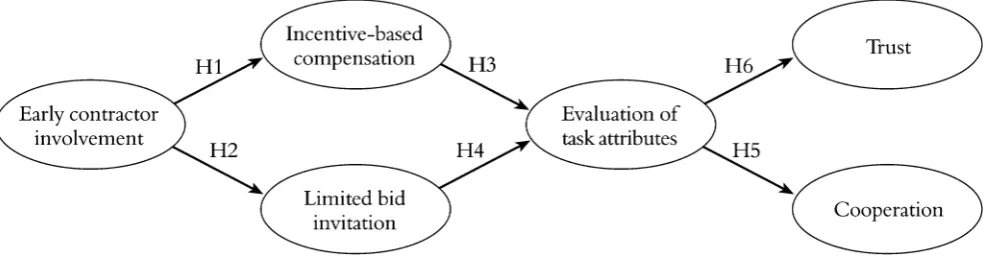
We argue that complex, uncertain and more custo-mized construction solutions require the procurement procedures to become more negotiable in nature (Bajari and Tadelis, 2001; Cheng and Li, 2002; Rahman and Kumaraswamy, 2002). Increased integra-tion and cooperaintegra-tion between the actors through early involvement of contractors in specification is thus suitable in order to achieve efficient and value-adding solutions (Korczynski, 1996; Barlow et al., 1997; Briscoe et al., 2004). Such integration of design and construction affects procurement procedures and cooperation throughout the entire project. This is because it becomes important to establish a trust-based cooperative relationship in order to facilitate contrac-tors’ contributions in the design stage (Korczynski, 1996). Cooperative procurement procedures therefore demand a different kind of approach, involving more joint specification together with incentive-based com-pensation (Bajari and Tadelis, 2001; Loveet al., 2004) and limited invitation of contractors that are able to meet and fulfil certain task-related attributes (Geringer, 1991; Love et al., 2004). All of these procurement elements are assumed to increase trust and cooperation in inter-organizational relationships (Korczynski, 1996; Bayliss et al., 2004; Eriksson, 2006). In our depicted model (see Figure 1), we therefore propose that clients’ desire to involve contractors early in specification affects their choices regarding compensation, bid invitation and task attributes, which further facilitates trust and cooperation. In order to develop and test this model, individual hypotheses connecting the different elements of the overall process are required. Below, these hypotheses are briefly discussed.
Specification effects on compensation and bid invitation
[image:4.609.58.550.572.700.2]Fixed price compensation is well suited to fixed and comprehensive design (Bajari and Tadelis, 2001).
Figure 1 The model: cooperative procurement procedures
Downloaded
B
y:
[
Lulea
Universit
y
of
T
echnology]
A
t:
14:
16
14
A
ugust
2007
However, this approach may cause win–lose profit protection attitudes, which inhibit flexibility (Nget al., 2002) and discourage value-adding solutions. An alternative approach is early involvement of contractors in which the actors jointly specify both contract and construction-related activities (Korczynski, 1996). This early involvement is an effect of the many complex and uncertain processes clients perceive in the beginning of a new construction process. Since joint specification requires a lot of time and effort, it is often coupled with some kind of cost-plus (reimbursement) compensation (Bajari and Tadelis, 2001), which is motivation for the activity to be prioritized. Reimbursement contracts are occasionally coupled with cost incentives that reward (or penalize) contractors for having actual costs below (or above) a cost target (Bajari and Tadelis, 2001). Such incentive-based compensation is important in partnering arrangements so that all participating actors can reap the benefits of increased cooperation and integration between design and construction (Egan, 1998; Baylisset al., 2004; Loveet al., 2004).
Hypothesis 1: Early contractor involvement in specifica-tion has a significant effect on incentive-based compen-sation.
Additionally, joint specification requires close rela-tionships and a long-term focus (Grandori, 1997), since relation-specific investments are needed (Williamson, 1985). Thus, specification is also related to bid invitation procedures. For cooperation to emerge, continuance is of the essence (Heide and John, 1990), which can only be obtained when the buyer utilizes a small pool of potential vendors who are regularly used as suppliers (Spekman, 1988). The constant replacement of actors between construction projects creates cost inefficiencies in the traditional competitive procurement route, since a new learning curve must be climbed by the supplier each time (Cox and Thompson, 1997) and because it discourages relation-specific investments. Loveet al. (2004) there-fore argue that when integration of design and construction is desired, contractors who have pre-viously worked with the design participants should be selected. By using the same project team members, a partnering culture based on cooperation and teamwork can emerge (Loveet al., 2004). In order to enhance a long-term perspective on contractors’ involvement and contributions in joint specification, professional clients should therefore utilize a small number of suppliers contracted on a regular basis, which is facilitated by limited bid invitations (Eriksson, 2006).
Hypothesis 2: Early contractor involvement in spe-cification has a significant effect on limited bid invitation.
Compensation and invitation effects on task-related attributes
When purchasing standard products based on price, the client does not take the opportunity to influence the characteristics of the supplier, since these are consid-ered less important (Heide and John, 1990). Such price-based bid evaluation coupled with fixed price compensation is traditional in construction. However, when incentive-based compensation is chosen, in order to motivate the contractor to contribute to value-adding design solutions, the initial bid price is of less importance than the characteristics of the contractor. Cooperative procurement procedures therefore contain an element in which the client evaluates the contrac-tor’s ability to perform crucial tasks. Such an evaluation of what Geringer (1991) calls task-related attributes is a complex and time-consuming effort. It requires a broad base of information ranging from earlier experiences, quality and environmental management systems, finan-cial record, a change of attitude, references, cooperative and technical skills (Spekman, 1988; Parkhe, 1998). When clients initiate relational contracting, involving joint specification and incentive-based compensation, such a partner selection based on task-related attributes should be performed (Rahman and Kumaraswamy, 2002; Loveet al., 2004).
Hypothesis 3: Incentive-based compensation has a significant effect on task-related attributes.
When clients decide to invite a limited number of contractors to bid, they lose short-term price focus (Eriksson, 2006) and gain long-term benefits, by increasing the opportunities for continuous learning and relation-specific investments. Then it is important to ensure that contractors are trustworthy and able to contribute to better construction solutions (i.e. increased buildability), in order to reap the benefits from closer ties (Brownet al., 2001; Loveet al., 2004). Thus, when only a few bidders are invited, it is important to perform a partner selection based on task-related attributes.
Hypothesis 4: Limited bid invitation has a significant effect on task-related attributes.
Task attributes’ effects on trust and cooperation
A key aspect of cooperative relationships is joint actions that the partners perform together (Heide and John, 1990). In a construction context, establishment of joint objectives, team-building activities, shared information, shared office building and joint dispute resolution techniques are joint actions that are considered important aspects of partnering relationships (Barlow,
Downloaded
B
y:
[
Lulea
Universit
y
of
T
echnology]
A
t:
14:
16
14
A
ugust
2007
2000; Cheung et al., 2003; Bayliss et al., 2004). To facilitate this cooperation, the characteristics of the partners are of importance. Careful partner selection, based on task-related attributes, has therefore been found to set a proper basis for cooperation to emerge both in a general industry context (Heide and John, 1990; Stump and Heide, 1996) and in construction (Brownet al., 2001).
Hypothesis 5: Task-related attributes have a significant effect on cooperation.
Another beneficial effect of evaluation of task-related attributes is trust, which is an important ingredient in partnering arrangements (Korczynski, 1996; Cheng and Li, 2002). Trust decreases the need for authority and control, since the parties instead can build a common organizational culture that encourages self-control (Aulakhet al., 1996; Adler, 2001). When trust is present, transaction parties believe that they can get what they want from each other without the exercise of authority and control (Ha˚kansson and Snehota, 1995). Hence, trust has the role of decreasing traditional monitoring and formal control that can create negative feelings for the entity and increase the propensity for opportunistic behaviour (Ghoshal and Moran, 1997). In cooperative relationships, the buyer should therefore trust the supplier to execute self-control of work in progress and finished work (Hagen and Choe, 1998). A key prerequisite for establishing this trust is knowledge about the partner and behaviour predictability, which is facilitated by careful partner selection based on task-related attributes (Parkhe, 1998; Das and Teng, 2001).
Hypothesis 6: Task-related attributes have a significant effect on trust.
Method
Sample
The data required for the test of our model was collected through a survey. The sample consists of the 104 members of an association called The Swedish Construction Client Forum, which has the objective of promoting the interests of construction clients in Sweden. The members are regional, national or international industrial and property companies, muni-cipalities and regional authorities, and also government services and agencies, which procure construction work regarding civil engineering, housing, industrial facil-ities, etc. Hence, the Forum represents the majority of professional construction clients in Sweden. Registered contact persons in all of the member organizations were first approached by e-mail or telephone in order to ask
them if they or other more suitable persons were willing to participate in the study, on behalf of their organiza-tion. Hence, it was up to the contact person to choose the most suitable respondent, given that the survey involved procurement and project management pro-cesses. Only four people declined to participate at this stage, owing to lack of time, so a paper version of the survey was then sent out by mail to the 100 people that had agreed to participate. These people were mostly procurement managers, project managers or directors of the construction and facilities department in their organizations. After two reminders, a total of 87 responses were received, representing a response rate of 84% of the total sample size.
Measure: procurement procedures
The survey concerns different aspects of the organiza-tions’ procurement procedures. It was first piloted by five respondents, resulting in only minor changes. In the final version the respondents were asked how often they used different procurement procedures, measured by seven-point Likert scales (e.g. to what extent do you use reimbursement compensation including cost incen-tives? 15very seldom and 75very often). The excep-tion to this is the quesexcep-tion regarding task-related attributes in bid evaluation, in which the importance of the attributes was estimated (15unimportant and 75very important) in order to better assess their relative impact on bid evaluation results.
Multivariate analysis
The data were computed into the statistical package of social science (SPSS). For conducting structural equation modelling (SEM) we used an additional SPSS package called AMOS (analysis of moment structures). SEM is a multivariate technique used to estimate a series of interrelated dependent relationships simultaneously (Hairet al., 1998). It has been applied in construction management contexts before, for example by Wong and Cheung (2005). They argue that it is appropriate when interrelationships of different hypotheses are investigated in a holistic manner, such as in the modelling of how different trust attributes affect partnering success (Wong and Cheung, 2005). Like these authors, we utilize SEM to produce an accurate representation of the overall results, which in our model means an investigation of how different elements of procurement procedures are interconnected and together facilitate the establishment of trust and cooperation (see Table 3). In this study SEM also provides a factor structure, giving informa-tion about how well each latent construct is reflected by the suggested items (Hairet al., 1998) (see Table 2).
Downloaded
B
y:
[
Lulea
Universit
y
of
T
echnology]
A
t:
14:
16
14
A
ugust
2007
Results and analysis
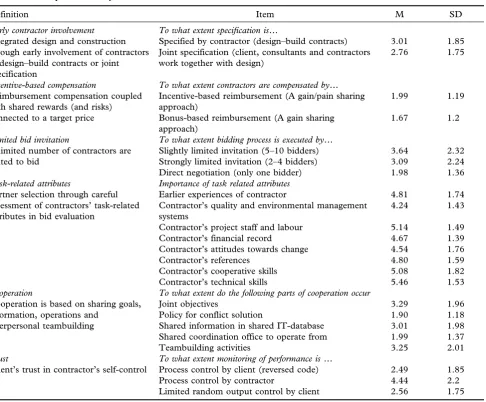
In Table 1 we report the respondents’ mean ratings (M) and standard deviations (SD) on items regarding early contractor involvement, incentive-based compensation, limited bid invitation, task-related attributes, coopera-tion and trust.
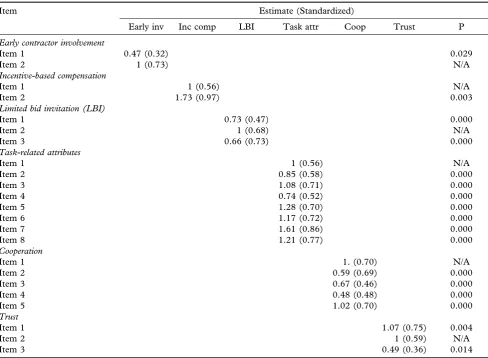
In order to investigate the suitability of the items measuring the constructs in Table 1, a factor analysis was conducted in AMOS. Table 2 reports the unstan-dardized and stanunstan-dardized factor estimates of each item. The factor scores prove that 18 out of 23 scores have an estimate that exceeds a 0.5 cut-off point. The measurement estimate on each latent construct is reported, since future studies may benefit from this information. The results suggest that the 18 items with satisfactory scores may be considered appropriate measures of their latent constructs, while the remaining
five items need to be further developed in future research. This is further discussed in the conclusions.
To investigate the relationships between the different constructs (Table 1) proposed in the model (Figure 1), a SEM analysis was conducted. The overall model receives only limited support if considering that IFI50.8 (see Table 3). According to the rule of thumb, IFI should exceed 0.9 and in exploratory analysis a 0.8 level. More importantly, however, the most conserva-tive criterion, chi-square divided by degrees of freedom, proves an almost perfect fit (x2/d.f.53.50), despite the
relatively small sample size. As a rule of thumb, models having a x2/d.f. of more than five may be considered
[image:7.609.69.556.322.724.2]poor and less than two as over-fitted (Hairet al., 1998). This means that the overall model of the proposed cooperative procurement procedures fits our data. Hence, it seems that clients involving contractors early in specification adopt a system perspective on their
Table 1 Descriptive summary of summated scales
Definition Item M SD
Early contractor involvement To what extent specification is…
Integrated design and construction through early involvement of contractors in design–build contracts or joint specification
Specified by contractor (design–build contracts) 3.01 1.85 Joint specification (client, consultants and contractors
work together with design)
2.76 1.75
Incentive-based compensation To what extent contractors are compensated by…
Reimbursement compensation coupled with shared rewards (and risks) connected to a target price
Incentive-based reimbursement (A gain/pain sharing approach)
1.99 1.19
Bonus-based reimbursement (A gain sharing approach)
1.67 1.2
Limited bid invitation To what extent bidding process is executed by…
A limited number of contractors are nvited to bid
Slightly limited invitation (5–10 bidders) 3.64 2.32 Strongly limited invitation (2–4 bidders) 3.09 2.24 Direct negotiation (only one bidder) 1.98 1.36
Task-related attributes Importance of task related attributes
Partner selection through careful assessment of contractors’ task-related attributes in bid evaluation
Earlier experiences of contractor 4.81 1.74 Contractor’s quality and environmental management
systems
4.24 1.43
Contractor’s project staff and labour 5.14 1.49 Contractor’s financial record 4.67 1.39 Contractor’s attitudes towards change 4.54 1.76 Contractor’s references 4.80 1.59 Contractor’s cooperative skills 5.08 1.82 Contractor’s technical skills 5.46 1.53
Cooperation To what extent do the following parts of cooperation occur
Cooperation is based on sharing goals, information, operations and
interpersonal teambuilding
Joint objectives 3.29 1.96 Policy for conflict solution 1.90 1.18 Shared information in shared IT-database 3.01 1.98 Shared coordination office to operate from 1.99 1.37 Teambuilding activities 3.25 2.01
Trust To what extent monitoring of performance is …
Client’s trust in contractor’s self-control Process control by client (reversed code) 2.49 1.85 Process control by contractor 4.44 2.2 Limited random output control by client 2.56 1.75
Downloaded
B
y:
[
Lulea
Universit
y
of
T
echnology]
A
t:
14:
16
14
A
ugust
2007
procurement procedures, adapting them in their entirety to facilitate more cooperative relationships. This result is quite different from earlier research. Cheung et al. (2001) argue that there is a need for a more objective and systematic selection model, since construction procurement decisions are often judg-mental and subject to biases of the decision maker. Our results, on the contrary, show that such a model
regarding a systematic view on cooperative procure-ment procedures is evident.
[image:8.609.56.545.83.441.2]The individual hypotheses in the model also show some interesting results if focusing on the standardized estimates (presented in brackets) and level of signifi-cance (p,0.05) (see Table 3). Unexpectedly, early contractor involvement in specification does not have a significant positive effect (+0.48) on incentive-based
Table 2 Factor analysis measurements
Item Estimate (Standardized)
Early inv Inc comp LBI Task attr Coop Trust P
Early contractor involvement
Item 1 0.47 (0.32) 0.029
Item 2 1 (0.73) N/A
Incentive-based compensation
Item 1 1 (0.56) N/A
Item 2 1.73 (0.97) 0.003
Limited bid invitation (LBI)
Item 1 0.73 (0.47) 0.000
Item 2 1 (0.68) N/A
Item 3 0.66 (0.73) 0.000
Task-related attributes
Item 1 1 (0.56) N/A
Item 2 0.85 (0.58) 0.000
Item 3 1.08 (0.71) 0.000
Item 4 0.74 (0.52) 0.000
Item 5 1.28 (0.70) 0.000
Item 6 1.17 (0.72) 0.000
Item 7 1.61 (0.86) 0.000
Item 8 1.21 (0.77) 0.000
Cooperation
Item 1 1. (0.70) N/A
Item 2 0.59 (0.69) 0.000
Item 3 0.67 (0.46) 0.000
Item 4 0.48 (0.48) 0.000
Item 5 1.02 (0.70) 0.000
Trust
Item 1 1.07 (0.75) 0.004
Item 2 1 (0.59) N/A
Item 3 0.49 (0.36) 0.014
Table 3 Test of model and hypotheses
Item Estimate (Standardized) Decision
confirmed if p,0.05 Prop. Effect Inc Comp LBI Task attr Coop Trust p
H1 Early inv + 0.25 (48) 0.088 Rejected H2 Early inv + 0.47 (0.40) 0.082 Rejected H3 Inc Comp + 0.495 (0.37) 0.010 Confirmed
H4 LBI + 0.192 (0.32) 0.028 Confirmed
H5 Task attr + 0.723 (0.491) 0.001 Confirmed H6 Task attr + 0.029 (0.02) 0.88 Rejected Note: Model Fit:x25885.861, d.f.5253, p50.000, IFI50.80,x2/d.f.53.501.
[image:8.609.55.555.599.710.2]Downloaded
B
y:
[
Lulea
Universit
y
of
T
echnology]
A
t:
14:
16
14
A
ugust
2007
compensation (Hypothesis 1), nor (+0.4) on limited bid invitation (Hypothesis 2). This may indicate that many clients still perform a traditional competitive approach entailing open bid procedures and fixed price compen-sation when involving contractors in specification. Since many of the respondents represent public clients, for whom limited bid invitations are restricted, the rejection of Hypothesis 2 is not a surprise. Fixed price compensa-tion is however not stipulated by law, for which reason the rejection of Hypothesis 1 cannot be explained by such an argument. As anticipated, we found that both incentive-based compensation (Hypothesis 3) (+0.37) and limited bid invitation (Hypothesis 4) have signifi-cant positive effects on task-related partner attributes (+0.32). This indicates that clients’ partner selection is highly dependent on their earlier choices regarding type of compensation and bid invitation. Desirable task-related partner attributes (Hypothesis 5) also have a strong positive significant effect on cooperation (0.491), as predicted. This is in line with earlier research, which has found that careful partner selection forms a proper basis for cooperation to emerge both in a general industry context (Heide and John, 1990; Stump and Heide, 1996) and in construction (Brownet al., 2001). Unexpectedly, task-related attributes (Hypothesis 6) have only a weak and not significant positive effect on trust in contractor’s self-control (+0.02). The rejection of Hypothesis 6 may be due to trust being harder and taking more time to establish than cooperation. It requires a cultural change, which may be facilitated by a widespread long-term use of cooperative procurement procedures. To summarize Table 3: the overall model was supported, the individual hypotheses Hypothesis 1, Hypothesis 2 and Hypothesis 6 were rejected, while Hypothesis 3, Hypothesis 4 and Hypothesis 5 were confirmed.
Conclusions
This paper offers three contributions that are important to consider in the context of construction procurement. The first conclusion considers the overall procurement process, which relates to the model and how the order of the procurement procedures is formed. The second contribution considers the isolated hypotheses in the model, regarding interconnections between individual procedures. Finally, we discuss the measurements and how future research may benefit from them.
Starting with the overall model, it confirms that clients’ desire to involve contractors in specification triggers them to perform cooperative procurement procedures. We can now verify that clients are bound by the chosen specification procedure in their
subsequent decisions regarding compensation, bid invitation and partner selection, in order to facilitate trust and cooperation with contractors. This systematic view on procurement is quite different from earlier research results, which have found that construction procurement decisions are often judgmental and subject to biases of the decision-maker.
When looking at the individual hypotheses, we did not find any support for the first two hypotheses. Early involvement in specification and its relations to compensation and bid invitation were both insignif-icant, which may indicate that many clients still perform open bid procedures and fixed price compen-sation when involving contractors in specification. An additional contribution to the rejection of Hypothesis 1 and Hypothesis 2 is that the measure of early contractor involvement reports somewhat weak internal reliability (discussed below). On the positive side, we found support for the idea that partner selection based on task-related attributes is positively influenced by both incentive-based compensation and limited bid invita-tion, supporting Hypothesis 3 and Hypothesis 4. Furthermore, the model confirms that clients perform-ing such a partner selection are more likely to establish cooperation than trust in their relationships with contractors, supporting Hypothesis 5 but rejecting Hypothesis 6. Hence, it confirms that the extent of cooperation is highly dependent on a partner selection based on task-related attributes, which is in line with earlier research. The rejection of Hypothesis 6 may be because the establishment of trust requires not only a short-term change of procurement procedures in a specific project but also a long-term cultural change.
Finally, we reported that 18 out of 23 items proved a satisfying loading to their constructs regarding com-pensation, invitation, task attributes and cooperation, despite the relatively small sample size. We believe it is important to report also the weak results in order to develop better future instruments. Starting with the specification construct, which is mediated by the others, it plays an important role in how cooperation is formed in the construction industry. As aforemen-tioned, the construct in itself reports weak internal reliability if focusing on factor estimates, and addition-ally it has a limited isolated effect on the subsequent constructs in the model (Hypothesis 1 and Hypothesis 2). Future research should thus focus on more details of the specification process (a better construct) or, given a larger sample, test if client, contractor or joint specification treated as different groups, have moderat-ing effects on this kind of model. Next, the construct of trust in contractor’s self-control may also benefit from a more fine-grained instrument consisting of a larger number of suitable items. Another interesting idea for future research would be to investigate the procured
Downloaded
B
y:
[
Lulea
Universit
y
of
T
echnology]
A
t:
14:
16
14
A
ugust
2007
parties’ opinions regarding different procurement procedures’ effects on cooperation. Since this study has a pure client perspective, we cannot compare their responses with those of the contractors.
Practical implications
The results imply that clients planning to implement cooperative relationships need to reassess their entire procurement process. Our model has verified that early involvement of contractors, limited bid invitation, incentive-based compensation and task-related attributes together affect trust and cooperation in client–contractor relationships. Therefore, partnering approaches based on only one or two of these procedures (e.g. incentive-based compensation) are not suitable. Furthermore, partnering initiated in the construction stage, based on the client’s fixed design, may not be suitable since cooperative procurement procedures are triggered by clients’ desire to integrate design and construction through early involvement of contractors in specification.
References
Adler, P. (2001) Market, hierarchy and trust: the knowledge economy and the future of capitalism.Organization Science,
12(2), 215–34.
Akintoye, A., McIntosh, G. and Fitzgerald, E. (2000) A survey of supply chain collaboration and management in the UK construction industry. European Journal of Purchasing and Supply Management,6, 159–68.
Aulakh, P., Kotabe, M. and Sahay, A. (1996) Trust and performance in cross-boarder marketing partnerships: a behavioral approach. Journal of International Business Studies,27(5), 1005–32.
Bajari, P. and Tadelis, S. (2001) Incentives versus transaction costs: a theory of procurement contracts.Rand Journal of Economics,32(3), 387–407.
Barlow, J. (2000) Innovation and learning in complex offshore construction projects.Research Policy,29(7–8), 973–89. Barlow, J., Cohen, M., Jashapara, A. and Simpson, Y. (1997)
Towards Positive Partnering, The Policy Press, Bristol. Bayliss, R., Cheung, S., Suen, H. and Wong, S.-P. (2004)
Effective partnering tools in construction: a case study on MTRC TKE contract in Hong Kong.International Journal of Project Management,22(3), 253–63.
Bresnen, M. and Marshall, N. (2000) Building partnerships: case studies of client–contractor collaboration in the UK construction industry. Construction Management and Economics,18(7), 819–32.
Briscoe, G., Dainty, A., Millett, S. and Neale, R. (2004) Client-led strategies for construction supply chain improvement.
Construction Management and Economics,22(2), 193–201. Brown, D., Ashleigh, M., Riley, M. and Shaw, R. (2001)
New project procurement process. ASCE Journal of Management in Engineering,17(4), 192–201.
Chan, A., Chan, D. and Ho, K. (2003) An empirical study of the benefits of construction partnering in Hong Kong.
Construction Management and Economics,21(5), 523–33. Cheng, E. and Li, H. (2002) Construction partnering process
and associated critical success factors: quantitative investi-gation.ASCE Journal of Management in Engineering,18(4), 194–202.
Cheung, S.-O., Lam, T.-I., Leung, M.-Y. and Wan, Y.-W. (2001) An analytical hierarchy process based procurement selection method.Construction Management and Economics,
19(4), 427–37.
Cheung, S., Ng, T., Wong, S.-P. and Suen, H. (2003) Behavioral aspects in construction partnering.International Journal of Project Management,21(5), 333–43.
Cox, A. and Thompson, I. (1997) Fit for purpose contractual relations: determining a theoretical framework for con-struction projects.European Journal of Purchasing & Supply Management,3(3), 127–35.
Das, T. and Teng, B.-S. (2001) Trust, control, and risk in strategic alliances: an integrated framework. Organization Studies,22(2), 251–83.
Dubois, A. and Gadde, L.-E. (2002) The construction industry as a loosely coupled system: implications for productivity and innovation.Construction Management and Economics,20(7), 621–32.
Egan, J. (1998) Rethinking Construction, Construction Task Force Report for Department of the Environment, Transport and the Regions, HMSO, London.
Eriksson, P.E. (2006) Procurement and governance manage-ment: development of a conceptual procurement model based on different types of control. Management Revue,
17(1), 30–49.
Geringer, J. (1991) Strategic determinants of partner selec-tion criteria in internaselec-tional joint ventures. Journal of International Business Studies,22(1), 41–62.
Ghoshal, S. and Moran, P. (1997) Bad for practice: a critique of the transaction cost theory. Academy of Management Review,21(1), 13–47.
Gidado, K.I. (1996) Project complexity: the focal point of construction planning. Construction Management and Economics,14(3), 213–25.
Grandori, A. (1997) An organizational assessment of interfirm coordination modes.Organization Studies,18(6), 897–925. Hagen, J. and Choe, S. (1998) Trust in Japanese interfirm
relations: institutional sanctions matter. Academy of Management Review,23(3), 473–90.
Hair, J.F., Black, B., Babin, B., Anderson, R.E. and Tatham, R.L. (1998)Multivariate Data Analysis, 6th edn, London, Prentice Hall.
Heide, J.B. and John, G. (1990) Alliances in industrial purchasing: the determinants of joint action in buyer– supplier relationships.Journal of Marketing Research,27(1), 24–36.
Ha˚kansson, H., and Snehota, I. (eds) (1995) Developing Relationships in Business Networks, International Thomson Business Press, London.
Kadefors, A. (2004) Trust in project relationships: inside the black box. International Journal of Project Management,
22(3), 175–82.
Downloaded
B
y:
[
Lulea
Universit
y
of
T
echnology]
A
t:
14:
16
14
A
ugust
2007
Korczynski, M. (1996) The low-trust route to economic development: inter-firm relations in the UK engineering construction industry in the 1980s and 1990s. Journal of Management Studies,33(6), 787–808.
Love, P., Skitmore, M. and Earl, G. (1998) Selecting a suitable procurement method for a building project.
Construction Management and Economics,16(2), 221–33. Love, P., Irani, Z. and Edwards, D. (2004) A rework
reduction model for construction projects. IEEE Transactions on Engineering Management,51(4), 426–40. Ng, T., Rose, T., Mak, M. and Chen, S.E. (2002)
Problematic issues associated with project partnering—the contractor perspective. International Journal of Project Management,20(6), 437–49.
Parkhe, A. (1998) Building trust in international alliances.
Journal of World Business,33(4), 417–38.
Pietroforte, R. (1997) Communication and governance in the building process.Construction Management and Economics,
15(1), 71–82.
Rahman, M. and Kumaraswamy, M. (2002) Joint risk management through transactionally efficient relational contracting. Construction Management and Economics,
20(1), 45–54.
Saad, M., Jones, M. and James, P. (2002) A review of the progress towards the adoption of supply chain management (SCM) relationships in construction. European Journal of Purchasing & Supply Management,8(3), 173–83.
Spekman, R. (1988) Strategic supplier selection: under-standing long-term buyer relationships.Business Horizons,
31(4), 75–81.
Stump, R. and Heide, J.B. (1996) Controlling supplier opportunism in industrial relationships. Journal of Marketing Research,33(4), 431–41.
Williamson, O. (1985)The Economic Institutions of Capitalism, The Free Press, London.
Wong, S.-P. and Cheung, S. (2005) Structural equation model of trust and partnering success. ASCE Journal of Management in Engineering,21(2), 70–80.