https://doi.org/10.5194/wes-4-163-2019
© Author(s) 2019. This work is distributed under the Creative Commons Attribution 4.0 License.
Multipoint high-fidelity CFD-based aerodynamic shape
optimization of a 10 MW wind turbine
Mads H. Aa. Madsen1, Frederik Zahle1, Niels N. Sørensen1, and Joaquim R. R. A. Martins2
1Aerodynamic Design Section, DTU Wind Energy, Risø Campus, Frederiksborgvej 399,
4000 Roskilde, Denmark
2Department of Aerospace Engineering, University of Michigan, Ann Arbor, MI 48109, USA
Correspondence:Mads H. Aa. Madsen ([email protected])
Received: 3 October 2018 – Discussion started: 26 October 2018 Revised: 29 January 2019 – Accepted: 22 February 2019 – Published: 3 April 2019
Abstract. The wind energy industry relies heavily on computational fluid dynamics (CFD) to analyze new tur-bine designs. To utilize CFD earlier in the design process, where lower-fidelity methods such as blade element momentum (BEM) are more common, requires the development of new tools. Tools that utilize numerical op-timization are particularly valuable because they reduce the reliance on design by trial and error. We present the first comprehensive 3-D CFD adjoint-based shape optimization of a modern 10 MW offshore wind turbine. The optimization problem is aligned with a case study from International Energy Agency (IEA) Wind Task 37, making it possible to compare our findings with the BEM results from this case study and therefore allowing us to determine the value of design optimization based on high-fidelity models. The comparison shows that the overall design trends suggested by the two models do agree, and that it is particularly valuable to consult the high-fidelity model in areas such as root and tip where BEM is inaccurate. In addition, we compare two differ-ent CFD solvers to quantify the effect of modeling compressibility and to estimate the accuracy of the chosen grid resolution and order of convergence of the solver. Meshes up to 14×106cells are used in the optimization whereby flow details are resolved. The present work shows that it is now possible to successfully optimize mod-ern wind turbines aerodynamically under normal operating conditions using Reynolds-averaged Navier–Stokes (RANS) models. The key benefit of a 3-D RANS approach is that it is possible to optimize the blade planform and cross-sectional shape simultaneously, thus tailoring the shape to the actual 3-D flow over the rotor. This work does not address evaluation of extreme loads used for structural sizing, where BEM-based methods have proven very accurate, and therefore will likely remain the method of choice.
1 Introduction
Wind turbine rotor optimization aims to maximize wind en-ergy extraction and has been an important area of research for decades. A common metric is to minimize the levelized cost of energy (LCoE) (Ning et al., 2014), which can be de-creased by lowering installation costs and operating expenses or by increasing the annual energy production (AEP). Sim-ply upscaling the turbine leads to an increase in swept area, which in turn extracts more energy. However, a naive upscal-ing does not capture the complexity of the problem (Ashuri, 2012).
A major drawback of naive upscaling is that mass in-creases with the cube of the rotor radius. The industry avoids the prohibitive mass increase by improving the blade de-sign, which has resulted in blades that are more slender for a given power rating, where the increase in loads (and there-fore mass) can be kept low. This further results in blades with increased capacity factors.
concurrent design optimization process is vital for the in-dustry because, as previously shown, concurrent design processes result in a larger gain compared to sequential counterparts (Barrett and Ning, 2018), which is the main principle in multidisciplinary design optimization (MDO) (Martins and Lambe, 2013).
The use of 3-D CFD is particularly valuable near the tur-bine blade root and tip, since the blade element momentum (BEM) method uses empirical models to capture 3-D ef-fects for these regions. The increase in fidelity also allows us to explore out-of-plane features such as blade pre-bend and winglets, which is outside the scope of traditional BEM approaches.
Industry still relies heavily on BEM, given that the 3-D CFD shape design of rotors poses several challenges. One of these challenges is modeling all the load cases that drive the design during an optimization. Much work has been done in steady-state computations with steady uniform inflow, but to truly generate realistic loads, one should transition to tur-bulent inflow and accurately resolve the time domain. This poses an immense challenge in terms of memory and com-putation time and is an active area of research.
In this paper, we present results from a high-fidelity aero-dynamic shape optimization of a 10 MW offshore wind tur-bine rotor. By “high-fidelity”, we mean a detailed model-ing of the rotor in 3-D and the use of Reynolds-averaged Navier–Stokes (RANS) equations to model the aerodynam-ics throughout the optimization. The optimization is based on the case study from the International Energy Agency (IEA) Wind Task 371, which allows for a comparison with the low-fidelity BEM results from this case study. Low-fidelity tools offer a fast and reliable modeling approach. However, BEM does not capture the physics as completely as high-fidelity CFD-based tools that solve the RANS equations. In the present work, we aim to quantify the pros and cons of each approach.
Ideally, one would include all the relevant disciplines in such an optimization. This has been addressed in previous work using BEM-based aeroelastic tools combined with var-ious cross-sectional analytical or finite-element-based struc-tural tools.
Zahle et al. (2016) showed that simultaneous design of the aerodynamic shape and structural layout of a blade leads to passive load alleviation. This was achieved through bend– twist coupling, which increased the AEP without increasing loads and blade mass. The LCoE has been minimized by other researchers while taking aerodynamics, structures, and controls into account, thereby truly treating it as an MDO problem both for 5 MW turbines (Ashuri et al., 2014) and for 20 MW turbines (Ashuri et al., 2016). While we could tackle high-fidelity aerostructural optimization using tools that have already been demonstrated in aircraft wing design (Kenway
1https://community.ieawind.org/tasks/taskdirectory (last access:
18 March 2019)
and Martins, 2014; Brooks et al., 2018; Kenway et al., 2014), we focus solely on aerodynamic shape optimization in the present work.
We start the remainder of this paper with a literature re-view on wind turbine optimization. We then explain the methodology (Sect. 3), followed by a comparison between the compressible flow solver and an incompressible flow solver (Sect. 4). The design optimization problem is pre-sented in Sect. 5, followed by the optimization results in Sect. 6. We end with our conclusions in Sect. 7.
2 Literature review
This literature review on wind turbine optimization is di-vided into three overall approaches: those that use low-fidelity and multi-low-fidelity models (Sect. 2.1), approaches that use CFD models without adjoint sensitivities (Sect. 2.2), and approaches that use CFD models with adjoint solvers (Sect. 2.3).
2.1 Low-fidelity and multi-fidelity shape optimization CFD-based aerodynamic shape optimization is still rarely used in wind energy research, but both the aerospace and the automotive communities have been using it increasingly of-ten (Chen et al., 2016; He et al., 2018). However, when it comes to low-fidelity shape optimization, the wind energy community has a large body of work.
BEM codes have been used extensively throughout the wind energy community for aerodynamic optimization. These codes are easy to implement and incur low compu-tational cost. Robustness has been an issue in BEM codes, as they do not always converge (Maniaci, 2011). Robustness is critical, especially when the analysis is part of an optimiza-tion cycle. A lack of robustness will slow down the conver-gence in the best case, and interrupt the optimization alto-gether in the worst case. To address this issue, Ning (2014) re-parameterized the BEM equations using a single local in-flow angle, resulting in guaranteed convergence.
It has long been known that the design of wind turbines is inherently a multidisciplinary endeavor. There have been more than two decades of research where BEM has been cou-pled with elastic beam models to account for structural de-flections and material failure (Fuglsang and Madsen, 1999), including work in wind turbine optimization considering site-specific winds (Fuglsang and Thomsen, 1998, 2001; Fuglsang et al., 2002; Kenway and Martins, 2008).
study of load alleviation is that of Zahle et al. (2016), who maximized AEP without exceeding the original overall loads of a 10 MW reference wind turbine (RWT). They achieved a 8.7 % AEP increase through passive load alleviation without an increase in the blade mass and only minor increases in the loads, despite blades that were 9 % longer. The parameteri-zation was comprised of 60 design variables and just as in the work of Bottasso et al. (2013), they computed the gradi-ents with finite differences. After an initial step size study, they ran a reduced set of design load cases to obtain the final turbine design, which was then evaluated on the full design load basis. Their work is a demonstration of the power of integrating design approaches.
As we will detail later, gradient-based optimization al-gorithms, combined with an adjoint method for computing the gradients, provide a powerful approach to address large-scale problems. For multidisciplinary systems, it is necessary to compute coupled derivatives, which presents additional challenges (Martins et al., 2005; Hwang and Martins, 2018). Ning and Petch (2016) introduced the application of the cou-pled adjoint method to the MDO of wind turbines.
One obstacle in using BEM codes is that the lift and drag data must be at hand. Typically, one uses data from wind tun-nel experiments or low-fidelity numerical models, such as a panel code (Kenway and Martins, 2008). Another option is to use high-fidelity methods such as RANS CFD to generate the lift and drag coefficients for the BEM code (Barrett and Ning, 2016, 2018). Barrett and Ning (2018) combine BEM with both panel and 2-D RANS CFD in a comparison be-tween two integrated blade design approaches (“precompu-tational” and “free-form”) and a sequential approach. They used a panel code iteratively to converge the BEM residual and then either a panel code or CFD to generate the final lift and drag coefficients. Like Zahle et al. (2016), they ar-gued for the integrated design approach, but they found that the precomputational approach achieved most of the benefits yielded by the free-form approach. This is impressive, since the precomputational approach took marginally more com-putation time than the sequential approach.
Gradient-based, gradient-free, and hybrid approaches have all been used to optimize airfoils using panel codes. An example of a gradient-based optimization approach is the Risø-B1 airfoil family, which currently is in commercial use by several manufacturers. Fuglsang et al. (2004) described the design and experimental verification process, where they used an in-house MDO tool. They carried out the numeri-cal design studies using XFOIL (Drela, 1989) and used the VELUX wind tunnel for 2-D experimental verification. Due to concerns with XFOIL’s accuracy in predicting separation, they opted to verify the optimization results using the CFD code EllipSys2D, thus combining fidelities in an attempt to balance speed and accuracy.
Grasso et al. optimized airfoils dedicated to both the blade tip (Grasso, 2011) and the blade root (Grasso, 2012), us-ing gradient-based and hybrid approaches, respectively, both
based on the panel code RFOIL, which is based on XFOIL. More recent airfoil studies have turned to large, offshore, pitch-controlled wind turbines, including tests with vortex generators that resulted in the development of a new airfoil family (Grasso, 2016).
Medium-fidelity vortex methods are popular aerodynamic models in wind turbine applications. Vortex theory is based on potential flow, which does not model the viscous effects modeled in RANS CFD. However, it does provide a more re-alistic solution than BEM codes while still keeping the com-putational cost low compared to CFD. Well-established vor-tex codes in the wind energy community include the GEN-eral Unsteady Vortex Particle (GENUVP) code (Voutsinas, 2006), the Aerodynamic Wind Turbine Simulation Module (AWSM) (Garrel, 2003), and the method for interactive ro-tor aeroelastic simulations (MIRAS) (Ramos García et al., 2016).
These vortex codes have been widely used in analysis, but applications to design optimization have been less frequent. Early optimization studies were performed by Zhiquan et al. (1992), Chattot (2003), and Badreddinne et al. (2005). More recent efforts based on vortex codes include those of Ses-sarego et al. (2016), who report on a surrogate-based opti-mization methodology, and of Lawton and Crawford (2014), who use the complex-step method to carry out the gradient-based optimization of a winglet. Researchers have also de-veloped analytic gradient computation for vortex methods by reformulating the vortex dynamics using the finite element method (FEM) (McWilliam, 2015). However, BEM is still well entrenched and is currently the default choice for opti-mization.
2.2 High-fidelity CFD-based shape optimization without adjoint gradients
Barrett and Ning (2016) compared two numerical models of different fidelities (a panel code and RANS CFD) to wind tunnel data. They found that the choice of aerody-namic model had a large impact on the optimal design, which thereby stresses the need for high-fidelity models such as RANS. This agrees with Lyu et al. (2014), who report seri-ous issues with Euler-based aircraft wing design due to miss-ing viscous effects (compared to RANS-based design). They found that while Euler-based design yields some insights, the RANS-based optimization is needed to achieve a realistic de-sign. Therefore, we limit the discussion in the present section to RANS CFD optimization.
achieving similar results. Liang and Li (2018) used two design variables (thickness and camber) to carry out 2-D shape optimization with a gradient-free method of airfoils (NACA0015) for vertical axis wind turbines (VAWTs). A subsequent 3-D modeling and CFD evaluation of the VAWT using the optimized airfoils achieved power coefficient in-creases up to 7 %. Finally, Zahle et al. (2014) carried out an airfoil optimization and wind tunnel validation. The de-veloped optimization framework, based on the open-source framework OpenMDAO (Gray et al., 2019), included a com-bination of panel (XFOIL) and CFD (EllipSys2D) codes for the analysis, where the turbulence is described using the k−ωshear-stress transport (SST) turbulence model (Menter, 1993) and two transition models: γ−Regθ (Menter et al.,
2004; Langtry et al., 2004; Sørensen, 2009) and the eN Drela–Giles transition model (Drela and Giles, 1986) de-scribed by Madsen (2002, chap. 6). They used a total of 21 design variables and computed the gradients using finite differences. They ran 20 optimizations under various condi-tions, and since each optimization involved 2640 CFD simu-lations, they split the procedure into two steps of increasing fidelity to save time. First, they optimized using XFOIL, and then, they used this intermediate result as a starting point for a subsequent CFD-based optimization. Such “warm starts” are now common practice, and we also use them in the present work. Using this framework, Zahle et al. (2014) com-pleted the optimization of a 30 % and a 36 % airfoil called LRP22-303and LRP2-36, respectively. Finally, through ex-perimental results from the Stuttgart Laminar Wind Tunnel for both LRP2-30 and LRP2-36, as well as the FFA-W3 counterparts (FFA-W3-301 and FFA-W3-360), they demon-strated that the new airfoils exhibit a superior performance compared to the FFA-W3 airfoils.
Shape optimization has also been used to optimize tur-bine blades using 3-D CFD in conjunction with gradient-free and gradient-based methods. Vucina et al. (2016) used 3-D RANS and a genetic algorithm to optimize the shape of wind turbine blades with up to 25 design variables. They concluded that their gradient-free framework was functional and robust, but also that many CFD evaluations were needed for the optimizer to converge due to the high number of vari-ables. As a final example of the use of gradient-free meth-ods with 3-D CFD models, Elfarra et al. (2014) optimized a winglet, also using a genetic algorithm. They used two de-sign variables (cant and twist angle) to optimize the torque, resulting in a 9 % increase in power production. The results were obtained by training a surrogate model (an artificial neural network) using 24 CFD samples to reduce computa-tional time.
There has been an increasing interest in blade extensions and winglets for wind turbines, since they can offer a
cost-2LRP stands for Light Rotor Project.
3https://energiteknologi.dk/node/1197 (last access: 18 March
2019)
effective alternative to a complete blade redesign for site-specific performance enhancements. Zahle et al. (2018) ex-plore such a design problem. They used 12 design variables to maximize the energy production while satisfying certain load constraints from the original blade design. Like El-farra et al. (2014), they also used a surrogate model that they trained using a random sampling strategy. Here, they seek a more balanced design by using multiple wind speeds throughout the sampling. Using gradient-based optimization on the resulting surrogate model, they obtain a power in-crease of 2.6 % by adding a winglet, while not increasing the flapwise bending moment at 90 % radius.
To optimize with respect to large numbers of variables, gradient-based algorithms are the only hope if one wishes to achieve convergence to an optimum in a reasonable amount of time (Yu et al., 2018). The efficiency of gradient-based op-timization is dependent in large part on the cost and accuracy of computing the gradients. Finite differences provide a way to compute gradients that is easy to implement, but they are subject to numerical errors, and they scale poorly with the number of design variables (Martins et al., 2003).
The complex-step derivative approximation method is an alternative to finite differences that is much more accurate but still scales linearly with the number of variables (Martins et al., 2003). This method has been widely used, including in some wind energy applications (Barrett and Ning, 2018; Kenway and Martins, 2008). Some efforts tried to reduce the computational cost by using semi-empirical gradients (Fuglsang and Madsen, 1999), surrogate models (Ribeiro et al., 2012; Elfarra et al., 2014; Zahle et al., 2018), and mixed-fidelity models (Barrett and Ning, 2018; Zahle et al., 2014).
For large numbers of variables, the adjoint method pro-vides an efficient way to compute the required gradients (Pe-ter and Dwight, 2010; Martins and Hwang, 2013), a fact that has also been verified in the wind energy community (Vor-spel et al., 2017). The adjoint method is the subject of the next section.
2.3 High-fidelity CFD-based optimization using the adjoint method
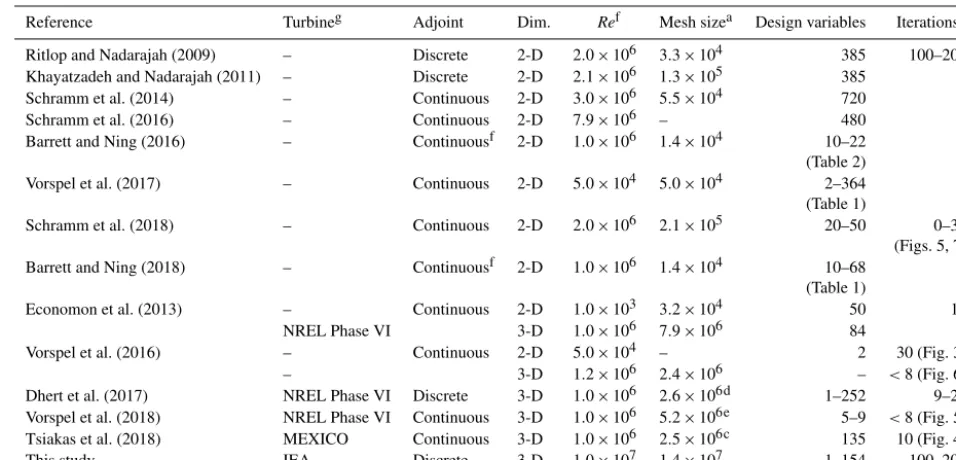
We now detail previous efforts on RANS CFD-based shape optimization using the adjoint method, which we also use in the present work. These efforts are listed in Table 1.
frame-Table 1.Overview of related work using the adjoint method.
Reference Turbineg Adjoint Dim. Ref Mesh sizea Design variables Iterationsb
Ritlop and Nadarajah (2009) – Discrete 2-D 2.0×10⁶ 3.3×10⁴ 385 100–200 Khayatzadeh and Nadarajah (2011) – Discrete 2-D 2.1×10⁶ 1.3×10⁵ 385 – Schramm et al. (2014) – Continuous 2-D 3.0×10⁶ 5.5×10⁴ 720 – Schramm et al. (2016) – Continuous 2-D 7.9×10⁶ – 480 – Barrett and Ning (2016) – Continuousf 2-D 1.0×10⁶ 1.4×10⁴ 10–22 –
(Table 2)
Vorspel et al. (2017) – Continuous 2-D 5.0×10⁴ 5.0×10⁴ 2–364 – (Table 1)
Schramm et al. (2018) – Continuous 2-D 2.0×10⁶ 2.1×10⁵ 20–50 0–30 (Figs. 5, 7) Barrett and Ning (2018) – Continuousf 2-D 1.0×10⁶ 1.4×10⁴ 10–68 –
(Table 1)
Economon et al. (2013) – Continuous 2-D 1.0×10³ 3.2×10⁴ 50 10 NREL Phase VI 3-D 1.0×10⁶ 7.9×10⁶ 84 3 Vorspel et al. (2016) – Continuous 2-D 5.0×10⁴ – 2 30 (Fig. 3) – 3-D 1.2×10⁶ 2.4×10⁶ – <8 (Fig. 6) Dhert et al. (2017) NREL Phase VI Discrete 3-D 1.0×10⁶ 2.6×10⁶d 1–252 9–23 Vorspel et al. (2018) NREL Phase VI Continuous 3-D 1.0×10⁶ 5.2×10⁶e 5–9 <8 (Fig. 5) Tsiakas et al. (2018) MEXICO Continuous 3-D 1.0×10⁶ 2.5×10⁶c 135 10 (Fig. 4) This study IEA Discrete 3-D 1.0×10⁷ 1.4×10⁷ 1–154 100–200
aNumber of cells in largest mesh used for optimization.bNot all papers state the number of optimization iterations explicitly. In some cases, we report the number of iterations estimated from the cited figures. As mentioned in Vorspel et al. (2017), this number depends on the optimization problem and optimizer settings, meaning that cross-setup comparison is difficult. cTsiakas et al. (2018) only gives the number of mesh nodes.dReduced geometry where the root section was removed.eApplied symmetric boundary conditions (BCs) double the mesh size compared to others.fIn cases where a range of Reynolds numbers were used, we report the maximum values.gWe only found high-fidelity shape optimization for three turbine configurations in the literature: two smaller turbines – NREL Phase VI and MEXICO (Schepers et al., 2012) – and the large, commercial-scale IEA 10 MW wind turbine. We find it reasonable to assume that the simulations for NREL Phase VI and MEXICO have a Reynolds number on the order ofRe=106(Sørensen et al., 2002, p. 152; Schepers et al., 2012, p. 10), while we estimate the Reynolds number for the IEA turbine to be on the order ofRe=107(Bak et al., 2013, p. 15–16).
work that included the cited improvements, where they at-tempted to postpone the onset of transition. They concluded that both the capability and accuracy of the discrete adjoint optimization framework improved by including the new ad-joint variables for the transition model.
There have been several contributions to 2-D RANS shape optimization that use the continuous adjoint approach (Schramm et al., 2014, 2015, 2016, 2018). In these efforts, the continuous adjoint implemented for ducted flows in the flow solver OpenFOAM (Weller et al., 1998) was extended to handle external aerodynamics. First, Schramm et al. (2014) optimized the lift-to-drag ratio of the DU 91-W2-250 profile using 720 design variables while constraining cross-sectional area. They use the “frozen turbulence” assumption, which means that no adjoint equation is used for the turbulence model. Since each surface point in this work is a design vari-able, they smooth the gradient for stability. The result is a 5.7 % to 59 % increase in lift-to-drag ratio for angles of at-tack ranging from 6.15 to 9.66◦.
In a later work, Schramm et al. (2015, 2016) presented a finite-difference verification of the adjoint gradients. The same group performed the shape optimization of an upstream leading edge (LE) slat for the DU 91-W2-250 airfoil and a validation of the framework using wind tunnel data, show-ing good agreement below stall (Schramm et al., 2016). The optimization, which used 480 design variables, resulted in a 2 % decrease in drag. As mentioned previously, there have
been other efforts in turbine blade design using 2-D RANS CFD with the adjoint method (Barrett and Ning, 2016, 2018) that used the open-source compressible solver SU2 (Palacios et al., 2013). These works couple the 2-D RANS and ad-joint model to BEM, panel, and beam element analysis codes to arrive at a 3-D multi-fidelity and multidisciplinary design framework.
Vorspel et al. (2017) present a benchmark of different op-timization algorithms (Nelder–Mead, steepest descent, and quasi-Newton) for unconstrained shape optimization in 2-D, where the continuous adjoint solver within OpenFOAM is used. The benchmark optimization problem is to find a target lift coefficient from any baseline shape. However, they both consider computation time and ease of use to grade the al-gorithms. As already mentioned, they point to the use of the adjoint method to compute the gradient for a large number of design variables. They recommend that further analysis be done within constrained optimization and within multidisci-plinary optimization.
assump-tion. Finally, they specifically mention thickness constraints as a future work topic.
OpenFOAM with a continuous adjoint solver has also been used in 3-D. This was done by Vorspel et al. (2016), who first performed a 2-D test case with two design vari-ables. The 3-D test case consisted of an extruded airfoil with a spanwise length of five chords and a mesh of 2.4×10⁶ cells with any+of 2.5. They investigated both a twist and a bend–twist coupling case but found that the bending had no discernible effect. This is something they expect to change for future rotating blades applications.
The above work does not model the rotation, which is im-portant to get the correct local angle of attack along the blade and thus accurately compute the forces acting on the blade. Several 3-D adjoint-based optimization efforts model rota-tion effects, three of which studied the NREL Phase VI rotor (Economon et al., 2013; Dhert et al., 2017; Vorspel et al., 2018), and another which studied the MEXICO rotor (Tsi-akas et al., 2018). Economon et al. (2013) used a continu-ous adjoint formulation to perform single-point aerodynamic shape optimization using a compressible RANS model. In 2-D, they reduced drag starting from a NACA 4412 pro-file baseline by 4.86 % under imposed thickness constraints. They used a total of 50 design variables and completed 10 de-sign iterations. In 3-D, they improved the torque coefficient on a mesh with 7.9 million cells by 4 % using 84 shape vari-ables with no constraints imposed on geometry or loads. The free-form deformation (FFD) box covered part of the blade such that both the trailing edge and the innermost part of the blade could not deform.
The optimization was not fully converged, as only three design iterations were performed. One drawback in this early work is the use of the frozen turbulence assumption, which they also identified as an area of future work.
Dhert et al. (2017) used a discrete adjoint solver to carry out a multipoint optimization of a two-bladed rotor using a 2.6 million cell mesh, where they maximized the torque co-efficient using up to 252 design variables. They used pitch, twist, and local shape design variables while constraining the thickness between 15 % and 50 % of the local blade chord to ensure adequate space for a structural box. The final multi-point optimization resulted in a 22.1 % increase in torque co-efficient but also increased the thrust by 69 %. The original design was meant to be a three-bladed rotor, which explains the low thrust coefficients in the reported results (Dhert et al., 2017, Table 1). They found the optimized shapes for both sin-gle and multipoint optimization exhibited highly cambered trailing edges at the root region where the wind speed is re-duced. While this does agree with what has been reported in 2-D cases (Ritlop and Nadarajah, 2009), it is also exactly what one would expect when chord is not included as a de-sign variable.
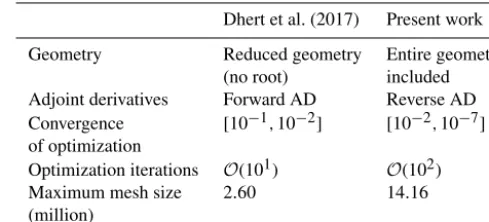
The present work builds on Dhert et al. (2017), who used the same CFD solver, ADflow. Our improvements are sum-marized in Table 2. One major improvement has to do with
Table 2.Overview of differences between the work by Dhert et al. (2017) and the present work.
Dhert et al. (2017) Present work
Geometry Reduced geometry Entire geometry
(no root) included
Adjoint derivatives Forward AD Reverse AD
Convergence [10−1,10−2] [10−2,10−7] of optimization
Optimization iterations O(101) O(102)
Maximum mesh size 2.60 14.16
(million)
the adjoint implementation that was used. As we will explain in more detail later (in Sect. 3.2.2), our adjoint implemen-tation uses the automatic differentiation (AD) technique to compute certain derivatives (Mader et al., 2008). One ma-jor improvement is that we implemented the more memory-efficient reverse automatic differentiation. Dhert et al. (2017) was forced to use the less memory-efficient forward auto-matic differentiation because the reverse option did not in-clude the rotating terms required to model wind turbine ro-tors. We also added constraints on maximum thrust and flap-wise bending moment to align with the IEA case study and enlarged the design space to include chord design variables. Furthermore, Dhert et al. (2017) carried out their studies on the turbine blade excluding the root because of flow solu-tion convergence issues, whereas we include the root. This was made possible by the robustness of the new approxi-mate Newton–Krylov (ANK) solver in ADflow, which also increases its speed (Yildirim et al., 2018). Finally, we achieve an optimality convergence tolerance that is up to 5 orders of magnitude lower.
Table 3.Overview of aerodynamic optimization works of wind turbine rotors using the adjoint method.
Reference Multi Turbu- Deformation Geometry Load constraints Geometric Design variables lence (X= full blade) (X= full blade) Thrust Moment constraints Twist Chord Shape
Economon et al. (2013) X X X
Dhert et al. (2017) X X X X X
Vorspel et al. (2018) X X
Tsiakas et al. (2018) X X X X
This study X X X X X X X X X X
Multi: multipoint optimization; turbulence: whether the turbulence model is included in the adjoint solver; deformation: whether the entire blade was allowed to deform; geometry: whether the entire blade was modeled; geometric constraints: whether any geometric constraints were imposed.
Finally, Tsiakas et al. (2018) used a continuous adjoint approach that included the SA turbulence equations to op-timize the MEXICO RWT. The flow was modeled by the incompressible RANS equations and solved in a co-moving frame of reference. They maximized the power for a single wind speed of 10 m s−1. Compared to the present work, they used a different parameterization technique based on volu-metric non-uniform rational B splines (NURBS), which con-fine the blade in a small volume. NURBS are used both for the deformation of the surface and the volume meshes, and the outermost NURBS control points are fixed to keep the outer volume mesh fixed. This only ensures C0 continuity. They use 385 NURBS, resulting in 135 design variables, which are only allowed to move in the direction perpendicu-lar to the rotor plane. This choice of parameterization limits the design space; for example, no chord increase can be ob-tained without simultaneously changing profile shape. The flow and adjoint solvers take advantage of graphics process-ing unit (GPU) hardware, resultprocess-ing in fast solutions. Indeed, they state that the overall optimization process can run up to 50 times faster on GPUs than on CPUs. They obtained a 3 % increase in the objective function and attribute this modest improvement to the limited freedom in the parameterization. In spite of the contributions cited above, many improve-ments are needed before we achieve the ultimate goal of pro-viding a “push-button solution” for wind turbine manufac-turers. This paper contributes with some of these improve-ments by including all of the following features in a compre-hensive high-fidelity 3-D RANS-based shape optimization framework:
1. enforcement of geometric constraints to ensure struc-tural feasibility,
2. normal operation rotor load constraints limiting thrust and flapwise bending moment,
3. more precision and stability in the convergence of flow and adjoint solvers,
4. inclusion of a turbulence model in the adjoint solver,
5. a comprehensive set of design variables, and
6. modeling and deformation of the entire blade shape.
In Table 3, the present work is compared to the above-cited 3-D shape optimization efforts on wind turbine rotors.
As previously mentioned, structural considerations are crucial in wind turbine design. Anderson et al. (2018) par-tially addressed this issue by coupling the NSU3D RANS solver with the AStrO structural finite element solver through a fluid–structure interface to converge on realistic, steady-state loads on the SWiFT RWT. They used Abaqus to make a finite element model with shell elements. They performed a purely structural optimization of the composite blade, with the loads computed by the CFD. The optimization’s objec-tive was to, using gradient-based optimization, minimize the off-axis stress with respect to 16 310 ply orientation vari-ables. They completed 10 optimization iterations consider-ing five different load cases and achieved a reduction in the maximum fatigue stress between 40 % and 60 %. They did so without adding any constraints, but they did assume the material to be a single-ply, unidirectional fiber composite for each blade section. The logical next step would be to per-form the simultaneous optimization of the structural sizing and aerodynamic shape optimization, as is already done in aircraft wing design (Kenway and Martins, 2014).
3 Methodology
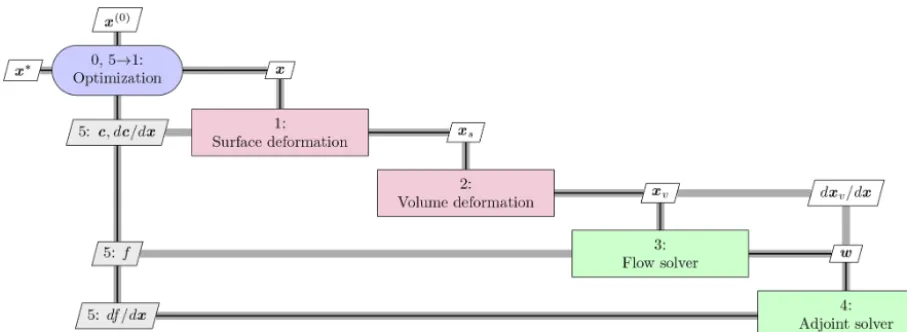
We now briefly describe all components of the optimization framework. The overall workflow is shown in Fig. 1 using an extended design structure matrix (XDSM) diagram (Lambe and Martins, 2012). An initial set of design variable val-ues,x(0), is given to the optimizer. The optimizer passes the
current design variables to the surface deformation module, prompting it to update the surface mesh (except for the very first iteration). The surface deformation module also pro-vides analytic derivatives of the surface mesh with respect to the design variables, dxs/dx. After the surface mesh has
been updated, it is passed to the volume deformation mod-ule, which updates the volume mesh and computes its ana-lytic derivatives with respect to the surface mesh, dxv/dxs.
opti-mizer, which computes a new step for another optimization iteration. Both the surface and volume deformation steps are fast explicit operations. On the other hand, the flow and ad-joint solvers are costly iterative operations that take up the vast majority of the computation time. The optimization pro-cess involves O(102) major iterations, which is an absolute minimum bound on the number of CFD solutions and mesh updates; there are additional CFD solutions within each ma-jor iteration.
3.1 Geometry and mesh deformation
To deform the surface geometry and mesh, we use the Python module pyGeo developed by Kenway et al. (2010), which implements the FFD (Sederberg and Parry, 1986) technique. Some of the key features of FFD are analytic derivatives and a machine-precision representation of the baseline geometry. The volume deformation tool is called IDWarp and is based on the inverse distance weighting function (Edward et al., 2012). IDWarp is a fast and unstructured deformation algorithm that has been demonstrated in aerodynamic (Yu et al., 2018; He et al., 2018) and aerostructural applications (Brooks et al., 2018).
3.2 Flow and adjoint solvers 3.2.1 EllipSys3D
EllipSys3D is an in-house, structured, multi-block, finite vol-ume method (FVM) flow solver developed at DTU Wind En-ergy by Michelsen (1992, 1994) and Sørensen (1995), and we use it in the present work to perform the comparison be-tween CFD solvers. It discretizes the incompressible RANS equations using general curvilinear coordinates and couples velocity and pressure through the SIMPLE algorithm.
In this study, we run EllipSys3D using the third-order quadratic upwind interpolation for convection kinematics (QUICK) scheme and thek−ωSST (Menter, 1993) model to calculate the turbulent eddy viscosity, which compares favor-ably to other turbulence models for wind turbine applications (Reggio et al., 2011).
EllipSys3D has been validated against experimental data for the MEXICO RWT (Bechmann et al., 2011) and the NREL Phase VI RWT (Sørensen et al., 2002; Sørensen and Schreck, 2014), and also in a blind comparison (Simms et al., 2001). In addition, the unsteady interaction between tower and blade has been simulated for the NREL Phase VI RWT with EllipSys3D using overset grid capabilities, and an over-all good agreement was found with experimental data (Zahle et al., 2009). EllipSys3D has been used in various rotor ap-plications to perform computations, such as aerodynamic power (Johansen et al., 2009) and fluid–structure interac-tion (Heinz et al., 2016). The latter work also encompasses a comparison across fidelities between the CFD-based tool, HAWC2CFD, and the BEM-based HAWC2 solvers where a
good agreement was found. EllipSys3D has also been com-pared with OpenFOAM for a case with atmospheric flow over complex terrain. EllipSys3D was found to be 2–6 times faster while producing almost identical numerical results (Cavar et al., 2016). More recent sources also show that these two solvers yield comparable results (Sørensen et al., 2016; Yilmaz et al., 2017; Boorsma et al., 2018).
3.2.2 ADflow
ADflow is a compressible RANS solver based on SUmb (Weide et al., 2006), a structured FVM CFD solver written in Fortran 90 that uses cell-centered variables on a multi-block grid. Unlike EllipSys3D, ADflow uses the Spalart–Allmaras (SA) turbulence model (Spalart and Allmaras, 1994) and works with state variables computed using the Jameson– Schmidt–Turkel (JST) scheme. More recently, Kenway et al. (2017) implemented overset mesh capability. ADflow is wrapped with Python to provide a more convenient user in-terface and to facilitate integration with optimization algo-rithms and other components of an MDO framework.
ADflow has been coupled to a structural finite element solver in the MACH (MDO for aircraft configurations with high fidelity) framework (Kenway et al., 2014), which has been used to perform not only aerostructural optimization of aircraft configurations (Kenway and Martins, 2014; Brooks et al., 2018; Burdette and Martins, 2018, 2019) but also hy-drostructural optimization of hydrofoils (Garg et al., 2019, 2017).
As previously mentioned, we use an ANK solver, which is implemented in ADflow to provide robustness. The ANK implementation is important since it is crucial to properly converge the flow field in order to obtain accurate gradi-ents. Newton–Krylov (NK) methods are not robust because they might not converge if the starting point is outside the basin of attraction. ANK addresses this convergence issue using a globalization method called pseudo-transient con-tinuation, which starts with the stable but inefficient back-ward Euler method with a small time step, and then increases the time step to approach the higher convergence rate of the NK solver. The ANK method involves the solution of large linear systems using preconditioners. These systems are solved in a matrix-free fashion with the generalized minimal residual (GMRES) algorithm (Saad and Schultz, 1986) using the Portable, Extensible Toolkit for Scientific Computation (PETSc) library (Balay et al., 2018a, b, 1997). The adjoint solver linear systems are solved using the same algorithm. ADflow is considered converged when the ratio of the L2 norm of the residuals at iterationnand the same norm of the free stream residual is below a given tolerance, i.e., when
η≤ kR
nk
2
Rfs
2
. (1)
Figure 1.Extended design structure matrix (XDSM) showing the optimization framework. Green blocks are iterative solvers, whereas red boxes represent explicit functions. Black lines represent the process flow in the order of the numbers; gray lines represent data dependencies.
is set to 10−7. These convergence thresholds are not to be confused with the optimality tolerance, which we set to 10−4. One crucial capability in ADflow is the efficient computa-tion of gradients through its adjoint solver. Together with the geometry and mesh deformation tools mentioned above, and the optimization software mentioned in the next section, this enables aerodynamic shape optimization with respect to hun-dreds of design variables (Lyu et al., 2014; Chen et al., 2016; Dhert et al., 2017). All the optimization results in Sect. 6 are obtained with the ADflow framework.
We now derive the adjoint equations and briefly explain how they are assembled and solved. A detailed description of the implementation is provided in previous work (Mader et al., 2008; Mader and Martins, 2011; Lyu et al., 2013). The CFD solver computes the flow field, w, for a given set of design variables, x, by converging the residualsR(x,w) of the governing equations to zero. Then, any function of in-terest,f(x,w), can be computed. Gradient-based optimizers require the gradient of the objective and constraint functions with respect to the design variables. To compute this gradi-ent, we use the equation for the total derivative:
df dx =
∂f ∂x+
∂f ∂w
dw
dx. (2)
Here, the partial derivatives correspond to derivatives of ex-plicit functions, while the total derivative involves the iter-ative solution of the governing equations. Thus, the partial derivatives can be found analytically at a low computational cost, but the direct computation of the total derivative dw/dx should be avoided. A similar total derivative equation can be written for the residuals, which must remain zero for the CFD solution to hold, and thus
dR dx =
∂R ∂x +
∂R
∂w dw
dx =0. (3)
We can now substitute the solution of the Jacobian given by the above equation into the total derivative equation (Eq. 2)
to obtain
df dx =
∂f ∂x −
∂f ∂w
∂R
∂w −1
| {z }
9T
∂R
∂x, (4)
where we have only partial derivative terms that can be found analytically at a low computational cost. The linear system in this equation can either be solved by computing the solution Jacobian, dw/dx, from the linear system from Eq. (3) or by solving the adjoint system:
∂R
∂w T
9= ∂f
∂w T
, (5)
where9 is the adjoint vector, which can be substituted into the total derivative equation (Eq. 2), i.e.,
df dx =
∂f ∂x −9
T∂R
∂x. (6)
The cost of the adjoint method is independent of the num-ber of design variables because the adjoint equation (Eq. 5) does not containx. However, if there are multiple functions of interestf, we need to solve Eq. (5) for eachf with a dif-ferent right-hand side. Given that our problem hasO(102) design variables and only a few functions of interest, the ad-joint method is particularly advantageous.
compute those derivatives. This process is labor intensive and prone to programming errors. To address this drawback, Mader et al. (2008) pioneered the use of automatic differen-tiation to compute the partial derivatives. Automatic differ-entiation is a technique that takes a given code and produces new code that computes the derivatives of the outputs with respect to the inputs (Griewank, 2000). Using a pure auto-matic differentiation approach to compute our derivatives of interest, df/dx, would mean applying the automatic differ-entiation tool to the whole CFD code, including the iterative solver. While this produces accurate derivatives, it is not an efficient approach. By selectively using automatic differenti-ation to produce code that computes only the partial deriva-tives, which do not involve the iterative solver, we lower the adjoint implementation effort while keeping the efficiency of the traditional adjoint implementation approach. There are still many details involved in making our adjoint implemen-tation approach efficient; these details have been presented in previous work (Mader et al., 2008; Lyu et al., 2013).
As briefly mentioned in the introduction, there are two modes for automatic differentiation: the forward mode and the reverse mode. Dhert et al. (2017) had used automatic dif-ferentiation in forward mode to compute and store the flow Jacobian, ∂R/∂w, as well as the other partial derivatives. Then, these stored matrices are used by the adjoint solver to compute transpose-matrix-vector products to converge the adjoint solution,9. Using the reverse mode, no storage of the Jacobian is needed. Instead, a matrix-free approach is used, where the transpose-matrix-vector products required to con-verge the adjoint solution are computed directly through the reverse mode derivative routines. While the reverse mode is more efficient in terms of memory usage, the reverse mode implementation was missing the rotation terms required for wind turbine modeling. We have fixed this for the implemen-tation in the present work and use the reverse mode instead. The implemented reverse AD routines may also lead to speed up depending on the number of Krylov iterations needed to converge the adjoint system.
3.3 Optimizer
We use the Sparse Nonlinear OPTimizer (SNOPT) (Gill et al., 2002) for all optimizations herein. SNOPT imple-ments a sequential quadratic programming (SQP) algorithm. We use it through the open-source Python wrapper py-OptSparse4, which provides a common interface to this and other optimization software. The convergence in SNOPT is set through the “major optimality tolerance” setting (Gill et al., 2007). We aim at converging all optimization problems to 10−4.
4https://github.com/mdolab/pyoptsparse (last access: 18 March
2019)
4 Flow solver comparison
In this work, we use ADflow as the CFD solver in the design optimization due to its adjoint gradient computation and inte-gration with geometry parameterization, mesh deformation, and optimization tools. However, EllipSys3D has been more thoroughly validated for wind turbine rotor flows, so in this section, we verify ADflow against EllipSys3D for a three-bladed pitch-regulated rotor geometry. In this section, we only include a mesh convergence study for one operational condition. A more detailed flow comparison is included in Appendix A.
4.1 Fluid model and computational mesh
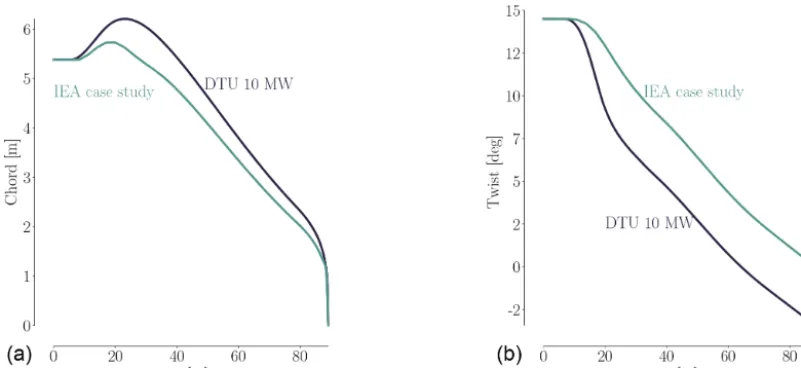
All simulations are steady-state 3-D RANS of the rotor only, where effects from both tower and nacelle have been ne-glected. Since we study a rigid upwind turbine, neglecting tower and nacelle should have a limited effect. We also note that we compute the flow field using a co-rotating, non-inertial reference frame that is attached to the rotor. There-fore, the RANS equations have additional terms to account for Coriolis and centripetal forces. Just as for the IEA Wind Task 37 case, the three-bladed pitch-regulated rotor geome-try in the analysis is a design based on the DTU 10 MW RWT (Bak et al., 2013), where both chord and twist distributions have been altered to allow for more room for improvement using design optimization. We compare the twist and thick-ness distributions for the DTU 10 MW RWT and the IEA Wind Task 37 baseline in Fig. 2
The surface mesh consists of three blades, each with 36 blocks. For each blade, there are 256 cells in the chordwise direction and 128 in the spanwise direction (tip excluded). The surface mesh is generated using the in-house Parametric Geometry Library (PGL). The tip was constructed using four blocks of 32×32 cells each, resulting in a total surface mesh with 110 592 mesh cells.
The spherical volume mesh has an O–O topology gener-ated with the hyperbolic in-house mesh generator HypGrid (Sørensen, 1998). Setting the first boundary layer cell height to 10−6m yields ay+of around 1 for the given operational conditions, and a total of 128 cell layers are grown from the surface mesh where the farthest vertices reach a distance of 1740 m. This results in a total of 432 blocks, each with 32×32×32 cells, which is equivalent to 14.155776 million cells. Given a span ofR=89.166 m, the surrounding spher-ical mesh expands to about 20 times the blade span.
Figure 2.Comparison of chord(a)and twist(b)for the DTU 10 MW RWT and the perturbed design used as the starting point for the IEA optimization case study. Both the chord and twist are reduced. The baseline blade design is based on the FFA-W3 airfoil family with relative thicknesses in the range of[24 %,36 %].
Figure 3.The baseline wind turbine design with the spherical L0 mesh around it. The blade span is 89.166 m, and the spherical mesh stretches to 20 times the blade span.
4.2 Mesh convergence study
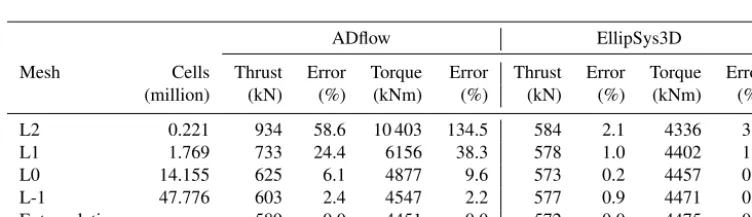
To quantify the mesh dependence for each solver, we com-pute the integrated metrics – torque and thrust – for the three mesh levels (L0, L1, and L2) and list them in Table 4. The operational condition corresponds to a wind speed of 8 m s−1 and rotor speed of 6.69 rpm at zero blade pitch, which is one of the conditions listed in Table A1 in Appendix A. As is ev-ident from the results for meshes L2, L1, and L0 in Table 4, ADflow does not produce a sufficiently mesh-independent
Figure 4.Baseline geometry used in the flow solver comparison and as starting point for the optimization. Each blade has a surface mesh with 36 square blocks. Each block has 32×32 cells, resulting in 110 592 surface mesh cells.
solution on mesh L0. This agrees with an earlier mesh con-vergence study (Dhert et al., 2017, Table 1), where up to 22 million cells were used without reaching convergence. Therefore, we generated a finer mesh with more than 47 mil-lion cells called L-1. The L-1 mesh is made exclusively for the present grid convergence study and will not be used in the ensuing optimizations.
Figure 5. Richardson extrapolation (Eq. 7) for the grid convergence study for thrust(a)and torque(b). Between the two solvers, the extrapolated continuum values for thrust differ by 3 %, whereas the errors for the torque values vary by less than 0.7 %.
Table 4.Mesh convergence study for the compressible solver ADflow and the incompressible solver EllipSys3D. The operational conditions for the convergence study correspond to the 8 m s−1 case listed in Table A1. The error percentages are estimated using the Richardson extrapolations from Fig. 5.
ADflow EllipSys3D
Mesh Cells Thrust Error Torque Error Thrust Error Torque Error
(million) (kN) (%) (kNm) (%) (kN) (%) (kNm) (%)
L2 0.221 934 58.6 10 403 134.5 584 2.1 4336 3.2
L1 1.769 733 24.4 6156 38.3 578 1.0 4402 1.7
L0 14.155 625 6.1 4877 9.6 573 0.2 4457 0.5
L-1 47.776 603 2.4 4547 2.2 577 0.9 4471 0.2
Extrapolation ∞ 589 0.0 4451 0.0 572 0.0 4475 0.0
Roache (1994):
fc≈f1+
f1−f2
r2−1 , (7)
wherefc is the continuum value, f1andf2 are the values
obtained using the L0 and L1 meshes, respectively, andris the grid refinement ratio.
In Table 4, we can also see that the two solvers tend to con-verge towards the same thrust and torque continuum values – 0.3 % difference for thrust and 0.7 % difference for torque. Based on the results in this table, we determine that the L0 mesh represents a reasonable compromise between accuracy (less than 10 % error) and speed.
It is clear from Fig. 5 that mesh level L2 is very coarse and yields very different results. As we will demonstrate later, the suggested design trends from such a coarse mesh can some-times lead to savings in computation time and, other some-times, lead to completely wrong design trends. Thus, one should use such coarse meshes with care. We report the results
ob-tained with L2 throughout the presented work to substantiate this claim.
suction side close to the trailing edge (TE). The resulting sectional forces on the blade differed up to 12.9 % (Sørensen et al., 2017, Table 3). The cited Mach number of 0.2457 is within the Mach number range of the present work, where we have Mach numbers close to 0.3 at the tip depending on the inflow speed. The effects of compressibility near the tip region have recently been studied by Sørensen et al. (2018). This work also includes results obtained with EllipSys3D. They find that classical compressibility corrections to incom-pressible results can be applied in a post-processing step in order to reduce the lift and drag error to within 2.5 % for Mach numbers up to 0.3. The cases studied by Sørensen et al. (2018) include Mach numbers ranging from 0 to 0.5.
This suggests that we could hope to further align the re-sults between ADflow and EllipSys3D in future work by us-ing classical compressibility corrections. Based on the grid convergence study above and in Appendix A, where we pro-vide more details on the flow phenomena and solver perfor-mance, we conclude that while there are discrepancies due to different turbulence models, compressibility effects, and nu-merical scheme order, the trends for the two solvers largely agree.
5 Implementation
In this section, we first introduce the design optimization problems for all the CFD and BEM cases we solve. We then explain the FFD parameterization, geometric constraints, and rotor load constraints.
5.1 Design optimization problem
We adapt and extend the design optimization problem from the IEA Wind Task 37 case study, which is to maximize the AEP for a range of wind speeds by varying chord and twist, while constraining the increase in thrust and bending moment to be no more than 14 % and 11 %, respectively. Thickness constraints are enforced over the blade to ensure structural integrity. Mathematically, the IEA Wind Task 37 design op-timization problem can be expressed as follows:
maximize AEP with respect to twist
chord (8)
subject to T ≤1.14·Tinit
Mbend≤1.11·Mbendinit.
The AEP is computed using a specified Weibull distribution (with scale and shape parametersA=8 andk=2, respec-tively) and the power produced for each wind speed, which is computed from the torque, Q, produced by the turbine (P =ω·Q).
We solve four different CFD-based optimizations derived from the problem above:
Single-point pitch optimization: This is used to maximize torque on the turbine with respect to blade pitch for a single wind speed (which in this case is equivalent to maximizing AEP). The purpose of this case is to vali-date the newly implemented rotational terms in the ad-joint solver.
Single-point planform optimization: This is the same as the IEA Wind Task 37 problem (Eq. 8), except with the objective of maximizing torque for a single wind speed. We solve this problem because it is well suited for com-parison with BEM.
Single-point full shape optimization: This is the same as the single-point planform optimization but with the dition of blade shape variables. This problem takes ad-vantage of the additional design freedom that is not available for BEM-based models.
Multipoint full shape optimization: This is the same as the IEA Wind Task 37 problem (Eq. 8) but with the ad-dition of blade shape variables.
The single-point optimizations are all performed for a wind speed of 8 m s−1and rotational rate of 6.69 rpm at zero blade pitch, which is one of the conditions listed in Table A1 in Appendix A. For the multipoint optimizations, we use the wind speeds 5, 8, and 11 m s−1, and the relevant oper-ational conditions can again be found in Table A1 in Ap-pendix A. Furthermore, we use the initial values at 12 m s−1 in the thrust and flapwise bending moment constraint for the multipoint optimizations because we know from the solver comparison (Appendix A, Fig. A1) that the maximum thrust occurs at that speed.
In addition to the CFD-based optimizations, we solve two BEM-based optimization problems for comparison with the CFD-based planform optimization:
BEM1: identical to the single-point planform optimization.
BEM2: identical to the multipoint full shape optimization, except the shape variables are replaced by spanwise thickness distribution variables.
The thickness is handled by interpolating between the pre-defined airfoil data. While both BEM1 and BEM2 use spec-ified airfoil polar data, BEM2 can change the relative thick-ness of the airfoils. The airfoils vary from 72 % to 24 % in relative thickness.
5.2 Parameterization
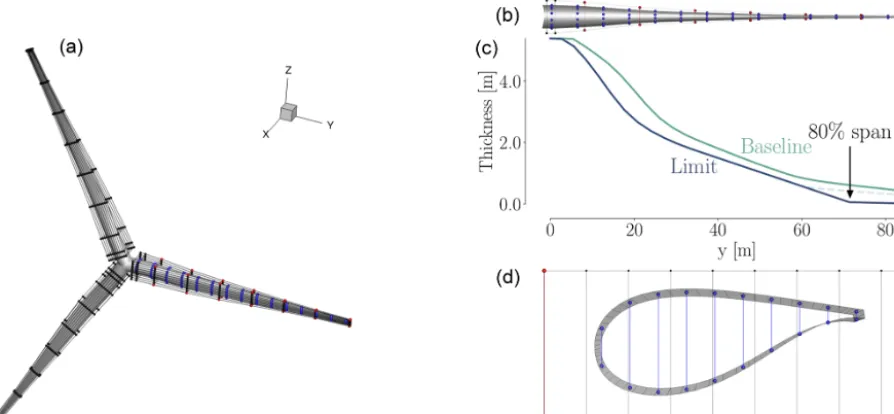
Figure 6.Overview of baseline geometry and FFD boxes(a). Each FFD box has nine spanwise sections. Each blade(b)has 15 thickness constraints (blue) and seven LE/TE constraints (red). Thickness distributions(c)are for the baseline thickness (green) and minimum allowed thickness (purple). Profile section(d)at 36 m span shows the shape control points (20), the thickness constraints (10 blue segments) and LE/TE constraints (two red segments). The LE/TE constraints are only relevant for the full shape optimizations.
and bottom of the FFD box. Our approach to deciding on the number of control points is to use the largest number possible to provide maximum freedom in the optimization. However, as the density of control points approaches that of the CFD mesh, numerical issues occur because the physical model no longer resolves the effect of the geometry change. We have found that, as a rule of thumb, we should have no more than one control point for every four CFD mesh points.
The FFD boxes are used to apply the pitch, twist, chord, and shape variables to each blade. Since we want all three blades to have the same pitch and shape, the variables are forced to be the same. Furthermore, the FFD boxes have two fixed sections close to each other at the root to ensure C1 continuity there, while the seven outer sections are free to move and deform the blades. Pitch,xpitch, is achieved by
ro-tating all free FFD sections by the same amount along the reference axis, which is at 35 % of the chord from the LE. Twist,xtwist, is achieved by rotating each spanwise section
of FFD control points independently. The chord variables, xchord, are achieved by scaling each spanwise section in the
chord and thickness direction. Thus, the relative thickness at each section is preserved during the CFD planform opti-mization. Only for the full shape optimizations, where the shape variables are added, can the relative thickness change. The shape variables, xshape, move each control point
inde-pendently in the direction perpendicular to the chord to con-trol the airfoil shape.
In Fig. 6, the thickness constraints are highlighted in blue. The thickness constraints in the BEM comparison are only enforced on the inner 80 % of the blade, as detailed in the
definition of the IEA case study. This is also visualized in Fig. 6c.
There were a few necessary changes we made to the IEA case study, but only for the full shape optimizations. One such deviation is the dashed segment connected to the thick-ness limit curve in Fig. 6, which prevents negative cell vol-umes. Furthermore, there are constraints applied to the LE and TE of the FFD box. The LE/TE constraints (shown in red in Fig. 6) are only implemented for the single-point and mul-tipoint full shape optimizations. These constraints force each pair of points to move exactly the same amount in opposite directions, so that the midpoint in the segment remains sta-tionary. This ensures that the individual FFD control points do not apply skewing twist, since they are meant to control only airfoil profiles. Finally, we mention that the thickness limit is fully imposed only for the fourth thickness constraint (counting from the LE), while the remaining nine constraints in a section are relaxed to not unnecessarily restrict the pos-sible design space.
6 Results
optimiza-Figure 7.Variation of torque with the pitch design variable.
tion problems where all variables, including airfoil shape variables, are allowed to change. First, we solve the problem as a single-point optimization (Sect. 6.3). Then, we solve it as a multipoint optimization (Sect. 6.4).
6.1 Pitch optimization
In the pitch optimization, the pitch angle for the seven outer FFD sections on each blade is controlled by a single design variable. The optimization result is an increase in torque of 25.7 %, 26.1 %, and 23.0 % for mesh levels L2, L1, and L0, respectively. Figures 7–9 summarize the optimization history for the three mesh levels.
Figure 7 shows the torque as a function of pitch. Before optimizing, we performed a sweep of CFD evaluations of the torque for the whole range of pitch values, for all three mesh levels. These are represented by black dots in Fig. 7. The thin black lines are linearly interpolated from these points. Although the torque value varies between mesh levels, the trends are consistent, and the maximum torque is achieved around 7◦of pitch. The optimization histories for each mesh are shown in color; they start from the initial pitch,x0, and
end at the optimal one,x∗. The purple line shows the opti-mization history on the finest (L0) mesh that was obtained by using the result from a coarser mesh (L2) as a starting point. We use this “warm start” technique since coarser meshes are much faster to converge. This technique leads to a reduction of computation time since fewer steps are taken by the opti-mizer on the finest mesh level. This is seen in Table 6, where only four steps were needed instead of the 16 steps taken in the original optimization. In this case, it reduced the compu-tation time at approximately 50 %. As expected, the result of this warm start optimization is identical to the result of op-timizing solely on the finest mesh level. Now that we have introduced (and visualized in Fig. 7) the use of warm starts,
Figure 8.Convergence history for the pitch optimizations.
we will start using them regularly. This means that an L1 op-timization from now on uses the result of an L2 opop-timization, and an L0 optimization uses the result of an L1 optimization. As shown in Fig. 8, all optimizations converged to an op-timality of at least 10−4(black dashed line). Figure 9 shows the merit function, which combines the scaled objective func-tion value and constraint feasibility. The merit funcfunc-tion value is equivalent to the scaled objective function value when all constraints are satisfied towards the end of the optimization process. As we can see in Fig. 9, the curves flatten towards the end, and further iterations are not worthwhile because the optimizer reaches the limit of what it can achieve with the provided precision of the function evaluations. The pitch optimizations are summarized in Table 6.
6.2 Planform optimization
For the planform optimization, described in Sect. 5.1, both twist and chord are controlled at the seven outer FFD sec-tions along the blade, which results in 14 design variables. The high-fidelity planform optimization results are visual-ized in Figs. 10–12, which show the final chord and twist distributions as well as the history of the convergence and merit functions.
to-Table 5.Overview of optimization problems.
Design variables
Optimization problem Objective Pitch Twist Chord Shape Total BEM comparison
Single-point pitch Torque 1 1
Single-point planform Torque 7 7 14 X
Single-point full shape Torque 7 7 140 154
Multipoint full shape AEP 7 7 140 154
Table 6.Pitch design variable optimization. All runs used 216 processors. This means that, for example, the L2 optimization had an actual wall-clock time just under 30 min.
Mesh Cells Twist Torque (x0) Torque (x∗) CPU time Iterations Improvement
(million) (◦) (kNm) (kNm) (h)
L2 0.221 8.35 10 403 13074 106.9 20 25.7 %
L1 1.769 6.67 6156 7763 1004.1 19 26.1 %
L0∗ 14.155 7.19 4877 6001 6436.3 4 23.0 %
L0 14.155 7.19 4877 6001 12 734.7 16 23.0 %
∗Warm start with the L2 optimum, resulting in a total CPU time of 106.9h+6436.3 h=6543.2 h.
Figure 9.Merit function history as a function of steps taken by the optimizer.
wards the tip compared to its baseline. The result is a more aggressive twist distribution.
Comparing the results across mesh levels, there is a much larger spread than for the pitch optimization. The result us-ing the coarsest (L2) mesh is significantly different from the ones obtained with the finer meshes (L1 and L0); therefore, the L2 mesh is too coarse to obtain physically representative results, which is consistent with the mesh convergence study (Table 4). We cannot rule out that, in some cases, the L2 re-sult can be useful to perform a warm start sequence, as shown
for the pitch optimization (Fig. 7 and Table 6). However, the planform results certainly show that one should use the L2 mesh with care and not for final results.
Figure 11 shows the convergence history for the three mesh levels. Again, all optimizations were converged to at least 10−4. In Fig. 12, we see a similar trend to that of the pitch optimization (Fig. 9), where much of the improvement is gained in the first half of the optimization. Thus, an easy way to speed up the design process would be to take an in-termediate design. However, one should make sure to check the constraint feasibility, since SQP methods often explore infeasible regions before fully converging. The sharp initial decrease for L1 is due to the (infeasible) warm start from L2. Note that the function is scaled differently for each mesh level to accommodate all the results in one figure.
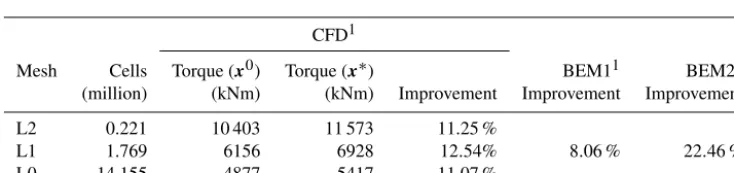
We now compare our L0 result from the planform op-timization to our results from the BEM1 and BEM2 opti-mization problems. We obtain the BEM results by running HAWTOpt2 (Zahle et al., 2016), which uses HAWCStab2 (Hansen, 2004) as the underlying analysis code. Since this is a comparison between results obtained with completely dif-ferent models, we do not expect an exact match, but we ex-pect similar trends. As previously mentioned, the CFD plan-form optimization problem and the BEM1 optimization are completely identical in problem definition, and the relative thickness is fixed in both optimizations. For the BEM2 op-timization, the main difference is that it is solved as a mul-tipoint optimization and that the relative thicknesses can be changed through interpolation. We refer to Sect. 5 for further information.
Figure 10.Final chord and twist distributions for the CFD-based planform optimizations.
Figure 11.Convergence history for all three mesh levels.
shown in Fig. 13. Although both chord and twist distribu-tions show clear discrepancies for the final designs, there are several similar traits. When it comes to chord, there is a large difference in maximum chord. BEM1 converges to a 26 % increase, BEM2 converges to a 74 % increase, and the CFD optimization converges to somewhere between these two (43 %). BEM1 is the surprising result of the three, be-cause it seems that the relation between power and thrust is so poor that it makes little sense to increase the chord at the root. This is owed to the fact that BEM1 has fixed relative thick-ness for all sections. It makes sense that BEM2 can increase the chord further since it can change the relative thickness. Given that our CFD-based planform optimization also has fixed relative thickness, it also makes sense that the BEM2 chord values are larger than those from the CFD-based plan-form optimization.
Both the BEM1 and the BEM2 results have a steeper, more pronounced increase in chord values, which we suspect our CFD framework could not reproduce due to difference in the
Figure 12.Scaled merit function history for the CFD-based plan-form optimizations.
parameterization. The two innermost fixed FFD sections en-suring theC1mesh continuity make such a steep increase in chord impossible so close to the root. As a final comment on the discrepancies at the root, we suspect that BEM pro-file data for such thick airfoils are far from precise. Besides, the empirical 3-D correction used on said 2-D profile data is also likely to be imprecise. Needless to say, the combination of the two could yield shaky results. To make matters worse, we know from the comparative analysis (Fig. A3) that sep-aration reaches up to about 37 m span, which further com-plicates the situation. A more uniform picture is seen for the tip region where the chord distributions have converged to a reduced chord, where only minor differences can be seen. In conclusion, the overall trends in optimal chord distribu-tion are mirrored across the BEM and CFD models, and the discrepancies are less pronounced towards the tip.
As for the twist comparison (Fig. 13b), both CFD and BEM results exhibit the overall trend of decreasing the twist relative to the baseline, but the BEM twist is consistently 1– 2◦ lower than the CFD result. This difference is likely due to the different modeling. The CFD parameterization is lim-ited near the root due to the two fixed sections that enforce C1 continuity, so it cannot match the more abrupt change in twist for the BEM result in that region. The BEM2 result exhibits an increase in twist near the root, which is very dif-ferent from the BEM1 trend. This is because BEM2 is free to control the chord while lowering the relative thickness. Thus, BEM2 uses a large chord increase near the root to optimize the loading, instead of using twist. The planform optimiza-tion and BEM comparison are summarized in Table 7.
Using values for torque from Table 7, we can obtain the power coefficient,CP, defined as
CP=
P
Figure 13. Comparison between optimal chord(a)and twist(b)distributions for the IEA Wind Task 37 case study. The three design optimization problems – (i) single-point planform optimization, (ii) BEM1, and (iii) BEM2 – are further described in Sect. 5.1.
Table 7.Planform optimization comparison between CFD and BEM results.
CFD1
Mesh Cells Torque (x0) Torque (x∗) BEM11 BEM22
(million) (kNm) (kNm) Improvement Improvement Improvement
L2 0.221 10 403 11 573 11.25 %
L1 1.769 6156 6928 12.54% 8.06 % 22.46 %
L0 14.155 4877 5417 11.07 %
1Relative improvement in torque.2Relative improvement in AEP.
where P is power, ρ is the air density, V is wind speed, and A is the area swept by the rotor. The resulting coef-ficients are CP= [1.04,0.62,0.48]for mesh levels L2, L1,
and L0, respectively. Clearly, the coarser the mesh, the more unphysical the coefficient. The Betz limit for power coeffi-cients (CPBetz =0.59) is violated for L2 and L1, which draws the results from coarse mesh levels into doubt. Judging from the huge spread in these coefficients, it is not surprising that the optimized designs differ greatly across mesh levels.
6.3 Single-point shape optimization
We now solve the full shape optimization problem as a single-point optimization. As stated in Sect. 5, this problem is equivalent to optimizing for torque, when only a single wind speed is used. Figure 14 shows convergence (left) and scaled merit function (right) histories for the free-form shape opti-mizations. Since we typically request an optimization con-vergence tolerance that is smaller than what is possible for the level of the CFD solver convergence, the optimizer stops before the optimization convergence tolerance is met. Com-paring the convergence history to similar plots for the pitch and planform optimizations (Figs. 8 and 11), we see that as the mesh is refined, the optimization is better converged, and the finest mesh level almost meets the requested tolerance
(black dashed line). However, the scaled merit function plots (Fig. 14b) do seem flat for L2 and L1 (albeit the latter curve is less smooth), hinting that the merit function could have plateaued.
Table 8 shows the improvement achieved by the optimiza-tion. The achieved improvement on the finest mesh (15.89 %) is higher than that of the planform optimization (11.07 %, Table 7), which is expected because this case includes all the planform design optimization variables plus the additional freedom to optimize the airfoil shapes. One should not com-pare these results to the pitch optimization results since they do not include any thrust constraint. A comparison to the BEM code results is given farther down in Table 9 once the multipoint optimization results have been presented.
We now turn to the shape and pressure (Cp) distributions
for the baseline and optimized geometries in Fig. 15. The op-timized blade increases the chord near the root. This design trend agrees with the planform optimization result.
Comparing the airfoil shapes and correspondingCp
produc-Figure 14.Convergence history(a)and scaled merit function history(b)for the single-point shape optimizations.
Figure 15. Comparison ofCpdistributions for the baseline and optimized result from the single-point shape optimization. There is an increase in TE camber, especially at the root, as well as a less pronounced suction peak.
Table 8.Overview of single-point optimization results for the op-erational conditions of the 8 m s−1case listed in Table A1.
Mesh Cells Torque (x0) Torque (x∗) Improvement (million) (kNm) (kNm)
L2 0.221 10 403 12705 22.13 % L1 1.769 6156 7373 19.77 % L0 14.155 4877 5652 15.89 %
ing the thinnest airfoils that satisfy these constraints. The in-creased camber, owed to the physical incentive to generate more lift, is consistent with the results of Dhert et al. (2017), but the increase in camber here is more modest because the optimizer can increase the torque by tailoring camber, chord, and twist instead of just camber. The incentive to operate at high lift coefficient is due to the fact that highCl/Cdis most
easily achieved by operating at highCl, especially for airfoils
designed assuming a fully turbulent boundary layer.