http://dx.doi.org/10.4236/ajcm.2014.43011
A Five-Step P-Stable Method for the
Numerical Integration of Third Order
Ordinary Differential Equations
D. O. Awoyemi
1, S. J. Kayode
2, L. O. Adoghe
31Department of Mathematics, Landmark University, Umuaru, Nigeria
2Department of Mathematical Sciences, Federal University of Technology, Akure, Nigeria 3Department of Mathematics, Ambrose Alli University, Ekpoma, Nigeria
Email: [email protected]
Received 26 December 2013; revised 26 February 2014; accepted 6 March 2014
Copyright © 2014 by authors and Scientific Research Publishing Inc.
This work is licensed under the Creative Commons Attribution International License (CC BY).
http://creativecommons.org/licenses/by/4.0/
Abstract
In this paper we derived a continuous linear multistep method (LMM) with step number k = 5 through collocation and interpolation techniques using power series as basis function for ap-proximate solution. An order nine p-stable scheme is developed which was used to solve the third order initial value problems in ordinary differential equation without first reducing to a system of first order equations. Taylor’s series algorithm of the same order was developed to implement our method. The result obtained compared favourably with existing methods.
Keywords
Continuous Collocation, Multistep Methods, Interpolation, Third Order, Power Series, Approximate Solution
1. Introduction
Linear multistep methods (LMM) for solving first order initial value problems (ivps) is of the form
0 0
k k
j n j j n j
j y hj f
α + β +
= =
=
∑
∑
(1)where
α
j andβ
j are uniquely determined and α0+βj≠0,αk =1a system first order has some serious drawback which includes wastage of human effort and computer time [6]. The LMM in (1) generates discrete schemes which are used to solve first order odes. Various forms of this LMM have been developed [1]-[4]. Other researchers have introduced the continuous LMM using the continuous collocation and interpolation technique. This has led to the development of continuous LMM of form
( )
( )
( )
0 0
k k
j n j j n j
j j
Y x α t y+ h β t f +
= =
=
∑
+∑
(2)j
α
andβ
j are expressed as continuous functions of t and are at least differentiable once.The introduction of continuous collocation methods as against the discrete schemes enhances better global error estimation and ability to approximate solution at all interior points [6]-[10]. In this study, we shall develop con-tinuous multistep collocation method for the solution of third order ordinary differential equations using power series as the basis function.
Power Series Collocation
In [6] [8] [9], some continuous LMM of Type (2) were developed using power series of form
( )
0
k j j j
Y x a x
=
=
∑
: (3)In [10] Chebyshev polynomial function of the form
( )
( )
0 k
k j j
j
x x Y x a T x
h
=
−
=
∑
(4)where T xj
( )
are some Chebyshev function used to develop continuous LMM.The use power series as basis function for derivation of continuous LMM are based on the property of analytic function that given the Taylor’s polynomial of the form
( )
( )(
0)
0 !
r n
n
r
y x x x P x
r
=
−
=
∑
(5)The approximate function p x
( )
reduces to Y x( )
as n→ ∞ In this study we proposed the polynomial function of the form in [7]:( )
(
)
0
k j
j n
j
Y x a x x
=
=
∑
− (6)which is of Type (3) to develop a continuous LMM for the solution of initial value problem of the form:
(
, , ,) ( )
, 0;( )
0,( )
Ny′′′= f x y y y y a′ ′′ =y y a′ = ∂ y a′′ = ∂ (7) This paper is organized as follows: Section 1 consists of introduction and background of study; Section 2, we derive a continuous approximation to Y x
( )
for exact solution y x( )
, and specific methods; Section 3 consists of the analysis and implementation followed by numerical examples.2. Derivation of
the Method
Consider the third order differential Equation (7), we proposed an approximate solution of the form:
( )
( )
0
M
k j j
j
y x aψ x
=
=
∑
(8)where ψj
( )
x =(
x x− n)
j,j≥0.The derivative of (8) up to the third order yield
( )
(
)(
)
3( )
0 1 2
k
k j j
j
y x j j j aψ − x
=
And a x b≤ ≤ where a s′j are the parameters to be determined. By substituting (8) and (9) into (7) we have
(
)(
)
3( )
(
)
0 1 2 , , ,
k
j j
j j j j a x f x y y y
ψ − =
′ ′′
− − =
∑
(10)Collocating (10) at x x= n i+,i=0 1
( )
m and interpolating (8) at x x= n i+,i=0 1( )
m−1 we obtained the system of equations given below(
)
0
M
j j n i n i
j a x y
ψ + +
=
=
∑
(11)(
)(
)
3( )
0 1 2
M
j j n i
j j j j a x f
ψ − +
=
− − =
∑
(12)The above equations are solved to obtain the values of a s′j which when substituted into Equation (6) yield a
method of the form in Equation (13)
( )
1( )
( )
0 0
k k
j n j j n j
j j
Y x −α t y+ h β t f+
= =
=
∑
+∑
(13)The continuous polynomial obtained when the values of a s′j are substituted into (6) and simplified is as
follows
( )
(
)
(
)
(
)
(
)
(
)
(
)
(
)
(
)
(
)
(
)
(
)
2 410 9 8 6
10
5 6 8
5 4 3 7 2
9 10
2
9 8
10
1 59520 3305158 5968895 8146800
59520
8869224 4685898 1424760 253425
24490 1024
1 6211314 11400365 1562776
59520
n n n
n n n n
n n n
n n
Y x h h x x h x x h x x
h
h x x h x x h x x h h x x
h x x x x y
h x x h x x
h = − − + − − − + − − − + − − − + − − − + − − − +
(
)
(
)
(
)
(
)
(
)
(
)
(
)
(
)
(
)
(
)
(
)
(
)
(
)
4 65 6 7 8
5 4 3 2
9 10
1
2 4 5
9 8 6 5
10
6 7
4 3
00
17084088 9069483 2770920 495075
48030 1952
1 898062 158251 199800 1963080
59520
907074 235800 3532
n
n n n n
n n n
n n n n
n n
h x x
h x x h x x h x x h x x
h x x x x y
h x x h x x h x x h x x
h
h x x h x x
+ − − − + − − − + − − − + − + − − − + − − − + − − − +
(
)
(
)
(
)
(
)
(
)
(
)
(
)
(
)
(
)
(
)
(
)
(
)
8 9 10
2
2
2 4
9 8 6
10
5 6 7 8
5 4 3 2
9 10
3
7
5 2850 96
1 7311962 13490545 18291600
59520
19701528 10278870 3085320 542175
51830 2080
1 1601
399974400
n n n n
n n n
n n n n
n n n
h x x h x x x x y
h x x h x x h x x
h
h x x h x x h x x h x x
h x x x x y
h + + − − − + − + − − + − − − + − − − + − − − + − − − + −
(
)
(
)
(
)
(
)
(
)
(
)
(
)
(
)
(
)
(
)
(
)
2 39 8 7
4 5 6 7
6 5 4 3
8 9 10
2
9 7
64924 27846271 6666240
50359720 518336784 269004260 81125040
14366570 98910 56000
1 9863776238 18418906560
399974400
n n n
n n n n
n n n n
n
h x x h x x h x x
h x x h x x h x x h x x
h x x h x x x x f
h x x h
h − + − + − − − + − − − + − − − + − − − + − − +
(
)
(
)
(
)
(
)
(
)
(
)
(
)
(
)
2 4 8 65 6 7
5 4 3
8 9 10
2
1
25437064780
27743628290 14672416610 4463635120
794196650 5482910 3109568
n n
n n n
n n n n
x x h x x
h x x h x x h x x
h x x h x x x x f +
− − −
+ − − − − −
(
)
(
)
(
)
(
)
(
)
(
)
(
)
(
)
(
)
2 4
9 8 6
7
5 6 7
5 4 3
8 9 10
2
2
7
1 2355609311 43809648630 59823556780
399974400
64857656850 34104473030 10321466720
1828259700 12572860 7107968
1 109697
399974400
n n n
n n n
n n n n
h x x h x x h x x
h
h x x h x x h x x
h x x h x x x x f
h + + − − + − − − + − − − + − + − + − − − + −
(
)
(
)
(
)
(
)
(
)
(
)
(
)
(
)
(
)
(
)
2 49 8 6
5 6 5
5 4 5
8 9 10
2
3
9 8
7
70700 20392494160 27749220780
29987527570 157505754790 4732439520
834535300 5715660 3219328
1 177230988 329512510
399974400
n n n
n n n
n n n n
n
h x x h x x h x x
h x x h x x h x x
h x x h x x x x f
h x x h
h + − + − − − + − − − + − + − + − − − + − − +
(
)
(
)
(
)
(
)
(
)
(
)
(
)
(
)
(
)
(
)
(
)
(
)
24 5 6
6 5 4
7 8 9 10
3 2
4
2 4 5
9 8 6 5
7
449080800 486136784 255405332
77358320 13746850 95110 54208
1 2399724 4458670 5990880 6383440
399974400 36208
n
n n n
n n n n n
n n n n
x x
h x x h x x h x x
h x x h x x h x x x x f
h x x h x x h x x h x x
h + − − − + − − − + − + − + − − − + − − + − − − + −
− 4
(
)
6 3(
)
7 2(
)
8(
)
9(
)
105 52h x x− n +941680h x x− n −154930h x x− n +950h x x− n −448 x x− n fn+
(14) Evaluating (14) at x x= n+5 the following discrete method is obtained
5 4 3 2 1
3
5 4 3 2 1
29 68 68 29
31 31 31 31
21 1177 1921 1921 1177 21
2480 2480 1240 1240 2480 2480
n n n n n n
n n n n n n
y y y y y y
h f f f f f f
+ + + + + + + + + + − − + + − = + + + + + (15)
3. Analysis and Implementation of the Method
3.1. Basic Properties of the Method
The method (15) is a specific member of the conventional LMM which can expressed as
3
0 0
k k
j n j j n j
j y h j y
α + β +
= =
′′′ =
∑
∑
(16)Following [1] [2], we define the local truncation error associated with (16) by the difference operator
( )
(
)
3(
)
0
; k j n j n
j
L y x h α y x jh h β y x jh
=
′′′
= + − +
∑
(17)where y x
( )
is assumed to have continuous derivatives of sufficiently high order. Therefore expanding (23) in Taylor series about the point x to obtain the expression( )
( )
( )
( )
( )
1 1( )
2 2( )
0 1 2 1 2
; p p p p P p
p p p
L y x h C y x C hy x C hy x C h y x C h y+ + x C h y+ + x
+ +
′ ′′
= + + + + + +
(18)
where the C C C0, , , ,1 2 Cp+2 are defined as
0 0 k j j C α =
=
∑
, 1 0k j j
C jα
=
=
∑
, 22 1 1 2! k j j
C jα
=
=
∑
,(
)(
)
31 1
1 1 2
!
k k
q q
q j j
j j
C j q q q j
q α β
−
= =
= − − −
∑
∑
In the sense of [1], we say that the method (20) is of order p and error constant Cp+2 ≠0 if
0 1 2 p 1 0, p 2 0
C =C C= ==C + = C + ≠
2 0.005403 2
p p
C + = − C +
3.2. Zero-Stability of the 5-Step Method
Considering the first characteristics polynomial of the method of Equation (15) given as
( )
5 29 4 68 3 68 2 29 1 031 31 31 31
r r r r r r
ρ = − − + + − =
Putting r=1,
ρ
( )
r =0 implying that r−1 is a factor. Therefore solving the polynomial it is found that(
)
31
r− is also a factor of the polynomial and r=1,1,1. The other roots which are called spurious roots are 0.776216472
r= − and −1.28829956.
3.3. Region of Absolute Stability of the 5-Step Scheme
Applying the boundary locus method, we have that
( )
5 29 4 68 3 68 2 29 1 031 31 31 31
r r r r r r
ρ = − − + + − =
( )
3(
21 5 1177 4 3842 3 3842 2( )
1177 21)
2480
h
r r r r r r r
σ = + + + σ + +
In the spirit of Lambert (1973),
( )
( )
( )
( )
( )
ii e e r h r
r
θ
θ ρ ρ
σ σ
= =
By letting r=eiθ =cosθ+isinθ and substituting this into the express above to yield
( )
2480 cos5{
29cos 4 68cos3 68cos 2 29cos 1}
21cos5 1177cos 4 3842cos3 3842cos 2 1177cos
x θ θ θ θ θ θ
θ θ θ θ θ
− − + + +
=
+ + + +
At θ =0 and θ =180
for 0≤ ≤θ 180 at an interval of 30 we have that X
( ) (
θ
= 0,∞)
. The method is therefore said to be p-stable.3.4. Implementattion
Single step method can be used to solve higher order ordinary differential equations directly without the need to first reducing it to an equivalent system of first order.
Consider the initial value problem in (7). For our method of order p=9, Taylor series expansion is used to calculate.
1, 2, 3
n n n
y+ y+ y+ and their first, second, third derivatives up to order p=9.
(
)
( )
( ) ( )
( ) ( )
( )
( )
( )
( )
( )
( )
( )
2 3 4
5 6 7 8 9
2! 3! 4!
5! 6! 7! 8! 9!
1 1 4
n j n
n n n
n n
iv v vii
n n n n n
y y x jh
jh y x jh f jh f y x jhy x
jh f jh f jh f jh f jh f
j
+ ≡ +
′′ ′
′
≅ + + + +
′′ ′′′
+ + + + +
=
(
)
( )
( ) ( )
( )
( )
( )
( )
( )
( )
( )
2 3 4 5 6
7 8 9
2! 3! 4! 5! 6!
7! 8! 9!
iv
n n n n n
n j n n n
v vi vii
n n n
jh f jh f jh f jh f jh f
y y x jh y x jhy x
jh f jh f jh f
+
′ ′′ ′′′
′ ≡ ′ + ≅ ′ + ′′ + + + + +
(
)
( )
( )
( )
( )
( )
( )
( )
( )
( )
2 3
4 5 6 7 8 9
2! 3!
4! 5! 6! 7! 8! 9!
n j n
n n
n n
iv v vi vii viii
n n n n n n
y y x jh
jh f jh f
y x jhf
jh f jh f jh f jh f jh f jh f
+
′′ ≡ ′′ +
′ ′′
′′
≅ + + +
′′′
+ + + + + +
(
)
( )
( )
( )
( )
( )
( )
( )
( )
2 3 4
5 6 7 8 9
2! 3! 4!
5! 6! 7! 8! 9!
n j n
iv
n n n
n n
v vi vii viii ix
n n n n n
y y x jh
jh f jh f jh f
f jhf
jh f jh f jh f jh f jh f
+
′′′ ≡ ′′′ +
′′ ′′′
′
≅ + + + +
+ + + + + +
Then the known values of xn and yn are substituted into the differential equations. Next the differential
equation is differentiated to obtain the expression for higher derivatives using partial differentiation as follows
(
, , ,)
jy′′′= f x y y y′ ′′ = f
iv
x y y y j
y f y f y f ff y y f Df
x y y y
′ ′′
∂ ∂ ∂ ∂
′ ′′ ′ ′′
= + + + = + + + =
′ ′′
∂ ∂ ∂ ∂
( )
( )
( ) (
)
( )
(
)
( )
(
)
2 2 2
2 2
2 2 2
2 2 2
v
xx yy y y y y xy xy xy
yy yy y y j y j y
j y j j y j j y j j y j
y f y f y f f f y ff y f ff
y y f y ff y ff Df f f y f
D f f Df f y f D f f Df f y f
′ ′ ′′ ′′ ′ ′′
′ ′′ ′ ′′ ′ ′
′′ ′ ′′ ′
′ ′′ ′ ′′
= + + + + + +
′ ′′ ′ ′′ ′′
+ + + + + +
′′ ′′
= + + + = + + +
where
D y y f
x y y y
∂ ′ ∂ ′′ ∂ ∂
= + + +
′ ′′
∂ ∂ ∂ ∂
and
( )
2
D =D D
P j
D f where p is the order of the method.
3.5. Numerical Experiments
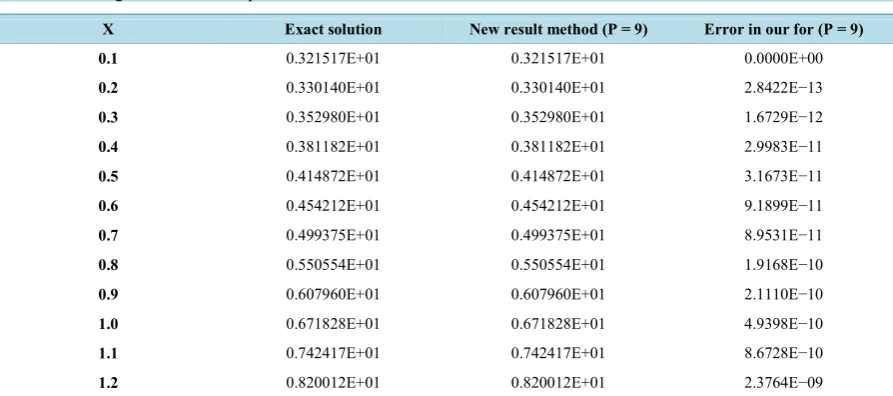
Our methods of order p=9 were used to solve some initial value problems of both general and special nature using Taylor’s series. Our results were compared with the results of other researchers in this area as seen in Table 1. In Table 2 and Table 3, the accuracy of our method is seen in the small error values.
The following initial value problems were used as our test problems:
3.6. Problem 1
( )
( )
( )
, 0 1, 0 1, 0 1.
1, 0.1
y y y y y
o x h
′′′= − = ′ = − ′′ =
≤ ≤ =
Exact solution: y x
( )
=e−x.3.7. Problem 2
( )
( )
( )
2 2 2
. 2 3 10 34 e 16e 10 6 34.
0 3, 0 0, 0 0,0 1
x x
y y y y x x x
y y y x
− −
′′′− ′′− ′+ = − − + +
′ ′′
= = = ≤ ≤
3.8. Problem 3
ex
y′′′ = , y
( )
0 =3,y′( )
0 1,= y′′( )
0 =5 Exact solution: 2 2+ x2+ex [image:7.595.88.538.166.316.2].
Table 1. Showing the result of test problem 1.
X Exact solution New result method (P = 9) Error in our for (P = 9) Error in [11] (P = 9)
0.1 0.904837 0.940837 0.0000+00 2.1760E−12
0.2 0.818731 0.818731 2.7756E−14 1.3935E−11
0.3 0.740818 0.740818 1.5838E−12 3.4443E−11
0.4 0.670320 0.670320 2.7879E−11 6.4477E−11
0.5 0.606531 0.606531 2.9477E−11 1.0316E−10
0.6 0.548812 0.548812 8.5048E−11 1.4979E−10
0.7 0.496585 0.496585 8.0357E−11 2.0486E−10
0.8 0.449329 0.449329 1.6601E−10 2.6756E−10
0.9 0.406570 0.406570 1.1176E−10 6.9382E−10
1.0 0.367879 0.367879 1.4871E−10 1.4224E−10
Table 2. Showing the result of test problem 2.
X Exact solution New result method (P = 9) Error in our for (P = 9)
0.1 0.299819E+01 0.299819E+01 6.6218E−13
0.2 0.298681E+1 0.298681E+01 6.2238E−11
0.3 0.295939E+01 0.295939E+01 3.5134E−09
0.4 0.291189E+01 0.291189E+01 6.1100E−07
0.5 0.284197E+01 0.284197E+01 6.4183E−07
0.6 0.274843E+01 0.274843E+01 1.8082E−06
0.7 0.263083E+01 0.263083E+01 1.3511E−06
0.8 0.248921E+01 0.248921E+01 1.3367E−06
0.9 0.232389E+01 0.232390E+01 7.9041E−06
1.0 0.213534E+01 0.213537E+01 3.7360E−05
Table 3. Showing the result of test problem 3.
X Exact solution New result method (P = 9) Error in our for (P = 9)
0.1 0.321517E+01 0.321517E+01 0.0000E+00
0.2 0.330140E+01 0.330140E+01 2.8422E−13
0.3 0.352980E+01 0.352980E+01 1.6729E−12
0.4 0.381182E+01 0.381182E+01 2.9983E−11
0.5 0.414872E+01 0.414872E+01 3.1673E−11
0.6 0.454212E+01 0.454212E+01 9.1899E−11
0.7 0.499375E+01 0.499375E+01 8.9531E−11
0.8 0.550554E+01 0.550554E+01 1.9168E−10
0.9 0.607960E+01 0.607960E+01 2.1110E−10
1.0 0.671828E+01 0.671828E+01 4.9398E−10
1.1 0.742417E+01 0.742417E+01 8.6728E−10
[image:7.595.90.537.522.720.2]4. Discussion of Result
We have developed and implemented our methods using Taylor series of the same order as the schemes that we developed. Some special and general third order initial value problems (ivps) were used to test the efficiency of our methods. Our method was found to be zero stable, consistent and convergent. The better accuracy of our method can be shown from the numerical examples.
References
[1] Lambert, J.D. (1973) Computional Methods in ODEs. John Wiley & Sons, New York.
[2] Fatunla, S.O. (1988) Numerical Methods for Initial Value Problems in Ordinary Differential Equations. Academic Press Inc., Harcourt Brace, Jovanovich Publishers, New York.
[3] Butcher, S.C. (2003) Numerical Methods for Ordinary Differential Equations. John Wiley & Sons, New York. http://dx.doi.org/10.1002/0470868279
[4] Henrici, P. (1962) Discrete Variable Method in Ordinary Differential Equations. John Wiley & Sons, New York. http://dx.doi.org/10.1002/zamm.19660460521
[5] Bruguano, L. and Trigiante. D. (1998) Solving Differential Problems by Multistep Initial and Boundary Value Methods. Gordon and Breach Science Publishers, Amsterdam, 280-299.
[6] Awoyemi, D.O. (2003) A P-Stable Linear Multistep Method for Solving General Third Order Ordinary Differential Equations. International Journal of computer Mathematics, 80, 987-993.
http://dx.doi.org/10.1080/0020716031000079572
[7] Okunuga, S.A. and Ehijie, J. (2009) New Derivation of Continuous Multistep Methods Using Power Series as Basis Function. Journal of Modern Mathematics and Statistics, 3, 43-55.
[8] Adesanya, A.O. (2011) Block Methods for Direct Solutions of General Higher Order Initial Value Problems of Ordi-nary Differential Equations. Ph.D. Thesis, the Department of Mathematical Sciences, Federal University of Technolo-gy, Akure.
[9] Adeniyi, R.B. and Alabi, M.O. (2006) Derivation of Continuous Multistep Methods Using Chebyshev Polynomial Ba-sis Functions. Abacus, 33, 351-361.
[10] Onumanyi, P., Oladele, J.O., Adeniyi, R.B. and Awoyemi, D.O. (1993) Derivation of Finite Difference Method by Collocation. Abacus, 23, 2-83.