Analysis of Lead Uptake by
Dicranum
scoparium
from Contaminated Soil Solutions
Catherine Garton and Jenna Rausch
University of Michigan Biological Station EEB 381 General Ecology
Abstract
Heavy metals, such as lead, are toxic pollutants that can affect the health of ecosystems. These pollutants can accumulate on impervious surfaces in urban areas and flow into natural habitats during storms. Bioremediation facilities, which mimic natural land filtration, can improve watershed quality in contaminated areas. In this study, we assessed the ability of moss to serve as a bioremediation tool by absorbing and sequestering lead. We collected samples of moss (Dicranum scoparium) and made plugs with layers of rock, soil, and moss to recreate the natural environment. Each moss plug was saturated with one of three treatments: distilled water, stormwater, and a lead solution. Samples were collected four times over the course of one week and were analyzed for changes in lead concentrations. We found that our samples of Dicranum
scoparium contained high concentrations of lead (upwards of 2,000 ppb) prior to any
Introduction
Heavy metals are major pollutants in stormwater which affect the health of organisms and their ecosystems. Lead is particularly concerning due to its direct toxicity to humans, which can include neurological defects, anemia, and death (Wara, Ara, Usmani, 2015). Lead can be generated by industrial and automotive exhaust, as well as corrosion of metals on cars and residential structures, which are prevalent in urban areas (Brezonik & Stadelmann, 2002; Mikkelsen, 1994 ). Urbanization is also characterized by increases in the percentage of
impervious surfaces and accompanying decreases in the natural environment for absorption and filtration (Leopald, 1968; Barbosa, Fernandes, & David, 2012). Impermeable surfaces include roofs and roads made of cement, concrete, asphalt, steel, or other materials through which water cannot flow (Mikkelsen, 1994). During storms, water runoff flows rapidly across these surfaces, collecting contaminants and releasing them into the local watershed (Mikkelsen, 1994). The direct discharge of stormwater into streams and rivers can degrade the quality of the water and elevate the potential for floods (Leopald 1968; Krug & Goddard, 1986).
Pervious surfaces, such as vegetated areas, slow runoff speeds and allow water to infiltrate and percolate through the ground (Barbosa, Fernandes, & David, 2012). These natural environments can help filter contaminants from stormwater and thus decrease the contaminants entering watersheds. Man-made bioretention facilities can attempt to mimic natural
environments. These plots, consisting of layers of soil, mulch, and plant species, filter contaminated water by retaining pollutants (Davis, et al., 2001). Research shows that
bioretention is an effective treatment for urban stormwater runoff, reducing metal contaminants by over 92% (Davis, et al., 2001). Most heavy metals are retained by the mulch layer and underlying soil, while the plant tissue itself accumulates a smaller percentage of the total metal accumulation (Davis, et al., 2001). Limited research has been done on the efficacy of different plant species in heavy metal accumulation. Using plants that are effective in uptaking lead would confer many benefits to bioremediation facilities. Not only would this increase the overall
Mosses, if able to sequester lead, could be particularly advantageous as a bioremediation tool. These nonvascular bryophytes do not have true roots but instead rhizoids that anchor them, making them easy to remove and replace in a new environment (Jones & Dolan, 2012). Mosses have already been used as bioindicators of airborne heavy metal pollutants in industrial areas (Turkan, Henden, Celik, & Kivilcim, 1994). Other research has demonstrated that moss can absorb Hg2+ from aqueous solutions of various concentrations into its tissue (Kondoh, Fukuda,
Azuma, Ooshima & Kato, 1998). While moss has been shown to sustain potentially toxic concentrations of metals without damage, other research also demonstrates a decline in photosynthetic rates from heavy metal exposure (Brown & Wells, 1990). More research is needed to assess the extent to which moss can absorb lead.
In our study, we assessed the ability of moss to sequester lead from contaminated soil. We also studied if this capacity would change given the presence of additional pollutants, such as additional heavy metals found in stormwater. To perform our experiment, we analyzed the concentrations of lead in washed moss tissue that had been saturated with distilled water, stormwater, or lead solution. We expected to detect the presence of lead in moss tissue exposed to lead and stormwater solutions, but not in moss saturated in distilled water. Lead in the contaminated moss tissue would indicate that the moss was able to uptake lead from our
treatment solutions. We also expected that the lead uptake would differ between the stormwater and lead-only treatment groups, due to the presence of additional pollutants in the stormwater.
Methods
allowed to rest for two days in mottled sunlight and natural rain exposure. This ensured acclimatization and survival after initial removal from forest.
[image:5.612.97.511.139.374.2]
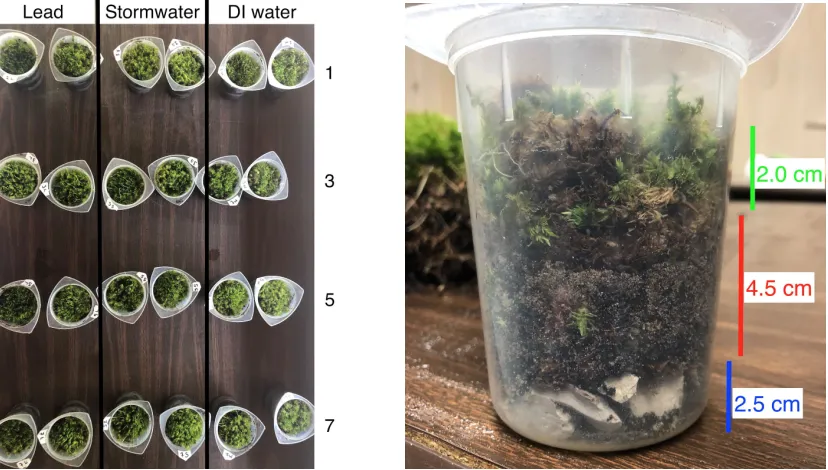
Figure 1. This shows our experimental set-up of moss plugs. The first image depicts the three treatment groups, each with 2 samples to be collected on days 1, 3, 5, and 7. The second image shows a cross-section of a single moss plug. It has three layers: moss (green), soil (red), and rock
and sand (blue).
We separated the moss samples into three treatment groups, each of which contained eight plugs. We mixed plugs taken from different plots into each of the three treatment groups to ensure an even mixture of any soil variation. Two additional plugs were reserved for
pre-treatment testing to detect any existing contaminants. Each of the plugs in the three treatment groups were saturated on day 1 with 100 mL of either distilled water, stormwater, or lead
solution. The distilled water solution was a control to determine if exposure to heavy metals caused mortality to the moss.
Figure 2. The red star shows where our stormwater sample was collected.
We tested 3 mL of this water using inductively coupled plasma mass spectrometry (ICPMS) to detect a full suite of heavy metals and metalloids. After finding the existing concentration of lead and other metals in the stormwater (Table 1), we created a separate, lead-only solution of the same concentration through serial dilutions of lead trihydrate.
Table 1. Concentrations of heavy metals in stormwater from Mackinaw City, MI.
Iron (Fe) 389 ppb
Strontium (Sr) 158 ppb
Barium (Ba) 25 ppb
Nickel (Ni) 18 ppb
Manganese (Mn) 16 ppb
Lead (Pb) 15 ppb
[image:6.612.72.543.495.630.2]days 1 (three hours after treatment), 3, 5, and 7 for testing. The replicates were destructively sampled and were removed from the experiment after collection. We washed each sample with distilled water to remove surface contaminants and soil, and we dried off excess water after washing. We placed moss tissue samples into 15 mL collection tubes and stored in a freezer until analysis.
To detect the lead concentrations in our specimens, we dissolved the solid moss tissue in concentrated nitric acid and autoclaved each solution at 125° Celsius for 1 hour. This digests the organic matter, which burns off as CO2, leaving heavy metals in solution. We diluted the
resulting heavy metal solution to 15 mL with distilled water and tested with ICPMS to determine the lead concentrations.Using R, we analyzed the concentration of lead in moss with ANOVA to detect differences between each treatment group. For this test, we included data from all days, categorizing our samples by treatment group only. Comparison of these treatment groups
allowed us determine if moss takes up lead into its tissues and if uptake is affected by additional contaminants. We also used regression analysis to detect any correlation between lead uptake time over 7 days.
Results
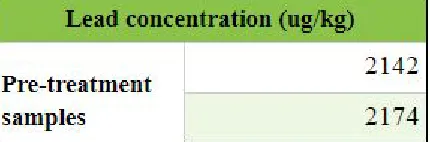
[image:7.612.200.415.536.607.2]Prior to treatment with solution, the moss already contained a significant amount of lead (Table 2). The concentration of lead in our pre-treatment samples (2142 and 2174 ppb) far exceeded the amount exposed to the moss in the contaminated treatment solutions (15 ppb).
Table 2. Lead content in moss tissue prior to treatment.
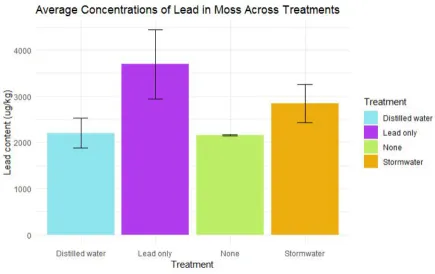
lead concentration of each moss group was 2158 ppb for pre-treatment, 2203 ppb for distilled water, 2842 ppb for stormwater, and 3690 for lead only.
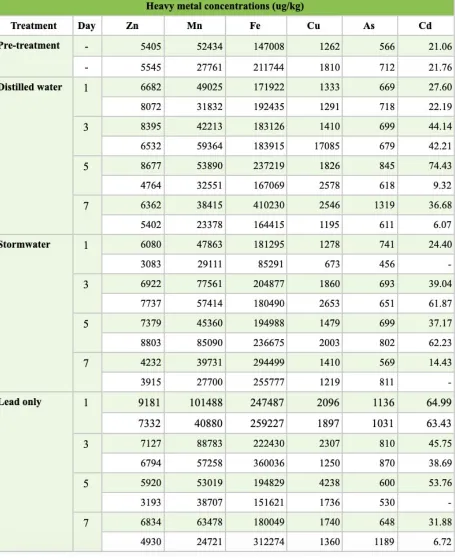
Table 3. Lead content in moss samples across treatment and time.
No significant difference was seen in lead uptake (Figure 3) between any of the treatments or the pre-treatment samples (ANOVA, F=1.575, P = 0.224).
[image:8.612.97.532.380.654.2]The moss also absorbed additional heavy metals (Table 4). Uptake of lead did not appear to be correlated strongly with absorption of other contaminants.
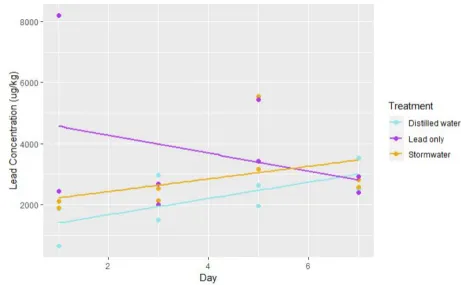
The regression analysis (Figure 4), shows that lead uptake and time are generally poorly correlated, meaning that lead uptake did not increase in the samples over time (R2 distilled water
= 0.4191, R2 stormwater = 0.0406, R2 lead only = -0.0356). Despite the weak correlation, there
was still a statistically significant linear relationship between lead uptake and time for the distilled water treatment (F = 6.051, P = .0491). Stormwater did not have a significant linear relationship between lead uptake and time (F = 1.296, P = .2983). The lead treatment cannot be accurately interpreted by regression based on its negative R2 value, and it also showed no
[image:10.612.73.534.255.540.2]statistical significance (F = .7596, P = .417).
Figure 4. There is a statistically significant linear relationship between time and lead uptake for the distilled water treatment, but not for the lead-only or stormwater treatments.
Discussion
water. Each treatment group averaged over 2,000 ppb (>2 μg/g) of lead. Analysis of the
pre-treatment samples demonstrated that all samples had high concentrations of lead before any experimental intervention. In fact, the pre-existing lead content of the moss averaged 2158 ppb, dwarfing the 15 ppb concentration we added via treatment. Therefore, the change in lead content after saturation was negligible.
We further expected that the lead uptake would differ between the stormwater and lead-only treatment groups, due to the presence of additional pollutants in the stormwater. Although the lead-only treatment group did have higher lead content on average, with a mean of 3690 ppm in comparison to 2842 ppb for stormwater, the difference was not statistically
significant. We may have seen this result because the lead-only treatment group had a high outlier at 8,200 ppb. Moreover, the quantity of lead we added is too small to account for this difference.
There was no significant difference between the lead content of moss before or after treatment, or between the contaminated treatments and distilled water. It is possible that the variation of pre-existing lead concentrations among samples simply masked the effect of adding a small amount of additional lead. Moss grows slowly and survives through the winter, allowing it to accumulate lead over long periods of time (Minami, Nagao, Ikegami, Koshiba, 2004). The age of our moss was unknown, but if age varied across our samples, older specimens may have already been saturated with lead.
Although we did not see increasing lead concentrations over time in moss exposed to lead, we did find a statistically significant linear correlation between lead uptake and time for our control group treated with distilled water. As time went on, the moss tissue exposed to distilled water had higher concentrations of lead. The pattern could have been spurious based on the random alignment of pre-existing differences in lead concentrations. On the other hand, it is also possible that adding distilled water affected the physiological response of the moss (or the behavior of the lead ions in the soil) differently from the polluted water, stimulating the moss in distilled water to uptake more lead over time.
Health Administration states that blood lead levels of workers must be maintained below 40 micrograms per 100 grams of whole blood, or 0.4 μg/g (U.S. Department of Labor, 1991). Risk of disease increases above that point, and fatal encephalopathy has been associated with lead blood levels as low as 1.5 μg/g (U.S. Department of Labor, 1991). Additionally, the Centers for Disease Control have set the standard elevated blood lead level for adults to be 10 μg/dL and for children 5 μg/dL, where a dL is equivalent to 100 grams (Wani, Ara, & Usmani, 2015). This suggests the concentrations of lead we found in the environment may be consequential.
Lead is both an industrial pollutant and a naturally occurring element, and it does not dissipate over time (Stehouwer, 2019). Douglas Lake drains into the Carp Creek Gorge, so it is possible that the lake contains lead that accumulates in the Gorge. However, our samples were collected away from the stream, so it is more likely that the source of lead originates from the soil. Lead occurs in soil naturally below 50 ppm on average, and possibly much lower in uncontaminated soils (Motto, Daines, Chilko, & Motto, 1970). In this area of Michigan, past samples found less than 10 ppm of lead (Lovering, 1976). According to the University of Michigan Biological Station director, Knute Nadelhoffer, residents once found an unexploded bomb in the Carp Creek Gorge (2019). During World War Two, bombs were also dropped on the island in Douglas Lake for practice (Nadelhoffer, personal communication). Little is known about the effects of these activities on the current ecology of the area, but it is possible that heavy metals from the explosives are still present. Additional investigations should study lead and heavy metal content of Douglas Lake, as well as the air and soil lead concentrations of the surrounding area, to detect any specific sources.
environment. The soil directly under each moss sample may have had different characteristics depending on its immediate environment, and this may have explained some of the variation in data. This could be further clarified by using more replicate samples. We used two replicates per treatment per day. This small sample size made it difficult to determine whether the variation could be attributed to different starting concentrations of lead across patches of moss (even with close proximity), or because of human error such as unevenly applied treatments.
Additional research could clarify several questions. First, further investigation is needed to understand the physiology of heavy metal absorption by bryophytes, as well as the behavior of heavy metal ions in soil environments (based on topography, organic matter content, etc.). Answers to these questions might shed light on why we found so much natural variation in lead content between samples, despite being collected from the same 3 x 3 meter area. Additional studies should also test uncontaminated moss to assess its maximum absorption capacity and the rate of uptake. Finally, for bioremediation purposes, it may be worth inquiring into arsenic, zinc, copper, manganese, and iron, since it was unclear whether their uptake correlated with that of lead.
The results of our experiment were positive in terms of bioremediation potential, since we found moss does sequester lead from the environment in high quantities. Although this study did not capture the immediate effects of contamination, the concentration of lead we detected suggests that moss naturally absorbs lead from environmental pollution. Because of this, as well as the fact that moss is durable and can be easily grown and transplanted, moss could potentially serve as a bioremediation tool in contaminated zones.
Acknowledgements
We thank the University of Michigan Biostation Station for offering its land and resources for our project. We also greatly appreciate Clara Shaw, Andrew Stevens, Zoe
Works Cited
Barbosa, A. E., Fernandes, J. N., & David, L. M. (2012). Key issues for sustainable urban stormwater management. Water Research, 46(20), 6787-6798.
doi:10.1016/j.watres.2012.05.029
Brezonik, P. L. & Stadelmann, T. H. (2002). Analysis and predictive models of stormwater runoff volumes, loads, and pollutant concentrations from watersheds in the Twin Cities metropolitan area, Minnesota, USA. Water Research, 36(7), 1743-1757.
doi:10.1016/s0043-1354(01)00375-x
Davis, A. P., Shokouhian, M., Sharma, H., & Minami, C. (2001). Laboratory study of biological retention for urban stormwater management. Water Environment Research, 73(1), 5-14. Jones, V. & Dolan, L. (2012). The evolution of root hairs and rhizoids. Annals of Botany, 110(2),
205-212. doi: 10.1093/aob/mcs136
Kondoh, M., Fukuda, M., Azuma, M., Ooshima, H., & Kato, J. (1998). Removal of mercury ion by the moss Pohlia flexuosa. Journal of Fermentation and Bioengineering, 86(2),
197-201. doi:10.1016/s0922-338x(98)80061-5
Krug, W. R., & Goddard, G. L. (1986). Effects of urbanization on streamflow, sediment loads, and channel morphology in Pheasant Branch Basin near Middleton, Wisconsin.
Water-Resources Investigations Report 85-4068. doi:10.3133/wri854068
Leopold, L. B. (1968). Hydrology for urban land planning - A guidebook on the hydrologic effects of urban land use. Geological Survey Circular 544. doi:10.3133/cir554 Lovering, T. G. (1976). Lead in the environment: A comp. of papers on the abundance and
distribution of lead in rocks, soil, plants, and the atmosphere, and on methods of analysis
for lead used by the U.S. Geological Survey. Washington, DC: United States
Government. Print.
Mikkelsen, P. S., Weyer, G., Berry, C., Waldent, Y., Colandini, V., Poulsen, S., . . . Rohlfing, R. (1994). Pollution from Urban Stormwater Infiltration. Water Science and Technology, 29(1-2), 293-302. doi:10.2166/wst.1994.0676
(2004). Cold acclimation in bryophytes: Low-temperature-induced freezing tolerance in
Physcomitrella patens is associated with increases in expression levels of stress-related
genes but not with increase in level of endogenous abscisic acid. Planta, 220(3), 414-423. doi:10.1007/s00425-004-1361-z
Motto, H. L., Daines, R. H., Chilko, D. M., & Motto, C. K. (1970). Lead in Soils and Plants: Its Relationship to Traffic Volume and Proximity to Highways. Environmental Science And
Technology,4(3), 231-237.
Nadelhoffer, K. Personal communication, June 12, 2019.
Stehouwer, R. (2019). Lead in Residential Soils: Sources, Testing, and Reducing Exposure. Retrieved from
https://extension.psu.edu/lead-in-residential-soils-sources-testing-and-reducing-exposure Turkan, I., Henden, E., Ummuhan, C., & Kivilcim, S. (1994). Comparison of moss and bark
samples as biomonitors of heavy metals in a highly industrialised area in Izmir, Turkey.
The Science of the Total Environment, 166, 61-67.
U.S. Department of Labor. (1991). Substance data sheet for occupational exposure to lead. Occupational Safety and Health Administration. Retrieved from
https://www.osha.gov/pls/oshaweb/owadisp.show_document?p_id=10031&p_table=STA NDARDS
Wani, A., Ara, A., & Usmani, J. (2015). Lead toxicity: a review. Interdisciplinary Toxicology,