Kernel Hebbian Algorithm for Single-Frame
Super-Resolution
Kwang In Kim1, Matthias O. Franz1, and Bernhard Sch¨olkopf1
Max Planck Institute f¨ur biologische Kybernetik Spemannstr. 38, D-72076 T¨ubingen, Germany
{kimki, mof, bs}@tuebingen.mpg.de http://www.kyb.tuebingen.mpg.de/
Abstract. This paper presents a method for single-frame image super-resolution using anunsupervised learning technique. The required prior knowledge about the high-resolution images is obtained from Kernel Principal Component Analysis (KPCA). The original form of KPCA, however, can be only applied to strongly restricted image classes due to the limited number of training examples that can be processed. We therefore propose a new iterative method for performing KPCA, the
Kernel Hebbian Algorithm. By kernelizing the Generalized Hebbian Al-gorithm, one can iteratively estimate the Kernel Principal Components with only linear order memory complexity. The resulting super-resolution algorithm shows a comparable performance to the existing supervised methods on images containing faces and natural scenes.
A. Leonardis, H. Bischof (Eds):
1
Introduction
The problem of image super-resolution, where one achieves high-resolution en-largements of pixel-based images [1], has a lot of potential applications in graph-ics, image processing, and computer vision. Methods of image super-resolution can be conveniently divided into three complimentary classes [1]: 1) interpo-lation and sharpening enlarges the low resolution image using generic image interpolation techniques and sharpen the resulting image for better visibility; 2)
aggregation from multiple frames extracts a single high-resolution frame from a sequence of low-resolution images; 3) single-frame super-resolution extracts high-resolution image details from a single low-resolution image, which cannot be achieved by simple sharpening. All three approaches rely on a certain type of prior knowledge about the image class to be reconstructed. The third approach, in particular, needs a specific characterization of its respective image class which is often available in the form of example patterns.
Whereas the first two methods have already been extensively studied [2], [3], the third method has been introduced only recently. Hertzmann, et. al [4] pro-posed a patch-wise reconstruction technique. During the training phase, pairs of low-resolution patches and the corresponding high-resolution patches are col-lected. In the super-resolution phase, each low-resolution patch of the input image is compared to the stored low-resolution patches and the high-resolution patch corresponding to the nearest low-resolution patch is selected as recon-struction. In [1], Freeman et. al. presented a similar technique to extract high-frequency details from a low-resolution image. Both algorithms already demon-strated impressive super-resolution results.
Here, we propose an alternative approach to super-resolution based on an un-supervisedlearning technique. Instead of encoding a fixed relationship between pairs of high- and low-resolution image patches, we rely on a generic model of the high-resolution images that is obtained from Kernel Principal Compo-nent Analysis(KPCA) [5]. In contrast to linear Principal Component Analysis (PCA) which has already been widely used in image analysis, KPCA is capable of capturing part of the higher-order statistics which are particularly impor-tant for encoding image structure [6]. Recent success in related applications [7] further motivates the use of KPCA for image super-resolution. Capturing these higher-order statistics, however, can require a large number of training examples, particularly for larger image sizes and complex image classes such as patches taken from natural images. This causes problems for KPCA, since KPCA requires to store and manipulate thekernel matrix the size of which is the square of the number of examples. To overcome this problem, a new itera-tive algorithm for KPCA, theKernel Hebbian Algorithm (KHA) is introduced. It is based on the generalized Hebbian algorithm (GHA), which was introduced as an online algorithm for linear PCA [8][9]. The resulting algorithm estimates the kernel principal components with linear order memory complexity, making it applicable to large problems.
super-resolution method while Section 3 and formulates the KHA. Experimental results are presented in Section 4 and conclusions are drawn in Section 5.
Principal component analysis. Given a set of centered observations xk =RN, k= 1, . . . , l, andlk=1xk = 0, PCA diagonalizes the covariance matrix1 C = 1
l
l
j=1xjxj.This is readily performed by solving the eigenvalue equationλv=
Cv for eigenvaluesλ≥0 and eigenvectors vi∈RN\0.
Generalized Hebbian algorithm. From a computational point of view, it can be advantageous to solve the eigenvalue problem by iterative methods which do not need to compute and storeCdirectly. This is particulary useful when the size of Cis large such that the memory complexity becomes prohibitive. Among the ex-isting iterative methods for PCA, the generalized Hebbian algorithm (GHA) is of particular interest, since it does not only provide a memory-efficient implementa-tion but also has the inherent capability to adapt to time-varying distribuimplementa-tions. Let us define a matrixW(t) = (w1(t), . . . ,wr(t)), whereris the number of eigenvectors considered and wi(t) ∈ RN. Given a random initialization of W(0), the GHA applies the following recursive rule
W(t+ 1) =W(t) +η(t)(y(t)x(t)−LT[y(t)y(t)]W(t)), (1)
wherex(t) is a randomly selected pattern froml input examples, presented at time t, y(t) = W(t)x(t), and LT[·] sets all elements above the diagonal of its matrix argument to zero, thereby making it lower triangular. It was shown in [8] fori = 1 and in [9] for i > 1 that W(t) →Vi as t → ∞.2 For a detailed discussion of the GHA, readers are referred to [9].
Kernel principal component analysis. When the data of interest are highly non-linear, linear PCA fails to capture the underlying structure. As a nonlinear ex-tension of PCA, KPCA computes the principal components (PCs) in a possibly high-dimensionalReproducing Kernel Hilbert Space (RKHS)F which is related to the input space by a nonlinear mapΦ:RN →F [10]. An important property of a RKHS is that the inner product of two points mapped byΦcan be evaluated usingkernel functions
k(x,y) =Φ(x)·Φ(y), (2)
which allows us to compute the value of the inner product without having to carry out the mapΦexplicitly. Since PCA can be formulated in terms of inner products, we can compute it also implicitly in a RKHS. Assuming that the data are centered inF (i.e.,lk=1Φ(xk) = 0)3 the covariance matrix takes the form
C= 1
lΦΦ, (3)
1 More precisely, the covariance matrix is defined as the E[xx]; C is an estimate
based on a finite set of examples.
2 Originally it has been shown thatw
i converges to the i-th eigenvector ofE[xx], given an infinite sequence of examples. By replacing eachx(t) with a random selec-tionxi from a finite training set, we obtain the above statement.
whereΦ=Φ(x1), . . . , Φ(xl). We now have to find the eigenvaluesλ≥0 and eigenvectorsv∈F\0 satisfying
λv=Cv. (4)
Since all solutionsvwithλ= 0 lie within the span of{Φ(x1), . . . , Φ(xl)}[5], we may consider the following equivalent problem
λΦv=ΦCv, (5)
and we may represent v in terms of an l-dimensional vector q as v = Φq. Combining this with (3) and (5) and defining anl×l kernel matrixK byK= ΦΦ leads tolλKq=K2q.The solution can be obtained by solving thekernel eigenvalue problem [5]
lλq=Kq. (6)
It should be noted that the size of the kernel matrix scales with the square of the number of examples. Thus, it becomes computationally infeasible to solve directly the kernel eigenvalue problem for large number of examples. This mo-tivates the introduction of the Kernel Hebbian Algorithm presented in the next section. For more detailed discussions on PCA and KPCA, including the issue of computational complexity, readers are referred to [10].
2
Image Super-Resolution
Single-patch super-resolution. To reconstruct a super-resolution patch (or small image) from a low-resolution image patch which wasnotcontained in the training set, we first scale up the image to the same size as the training images by nearest neighbour interpolation, then map the image (call itx) into the RKHS F using Φ, and project it onto the KPCA subspace spanned by a limited number of KPCs to getP Φ(x). Via the projectionP, the image is mapped to an image which is consistent with the statistics of the high-resolution training images. However, at that point, the projection still lives inF, which can be infinite-dimensional. We thus need to find itspreimage, i.e., the corresponding point in RN. To find it, we minimizeP Φ(x)−Φ(z)2 over z∈ RN. Note that this objective function can be computed in terms of inner products and thus in terms of the kernel (2). For the minimization, we use gradient descent [11] with starting points obtained using the method of [12].
the resulting high-frequency images. These image patches are contrast normal-ized [1] and then fed to KPCA.
In the super-resolution phase, the input image is rescaled to the original resolution using bicubic interpolation and band-pass filtered to remove the low-frequency components. Then, the resulting high-low-frequency component image is divided into a set of small image patches each of which is reconstructed based on the KPCA in the same way as in single patch super-resolution. The resulting image containing only high-frequency components is then superimposed on the bicubic interpolation to give the final reconstruction.
3
Kernel Hebbian Algorithm
As noted in the introduction, the advantage of the GHA over conventional PCA is that it does not require the storage of the covariance matrix. This is partic-ularly useful when the size of covariance matrix is large. Similarly, the direct formulation of KPCA becomes impractical for large sample sizes since the as-sociated kernel matrix is too large to be stored in memory. For this case, we reformulate the GHA in a RKHS to obtain a memory-efficient approximation of KPCA.
The GHA update rule of Eq. (1) is represented in the RKHSF as
W(t+ 1) =W(t) +η(t)
y(t)Φ(x(t))−LT[y(t)y(t)]W(t)
, (7)
where the rows ofW(t) are now vectors inF andy(t) =w(t)Φ(x(t)).Φ(x(t)) is a pattern presented at timetwhich is randomly selected from the mapped data points{Φ(x1), . . . , Φ(xl)}. For notational convenience we assume that there is a functionJ(t) which mapsttoi∈ {1, . . . , l}ensuringΦ(x(t)) =Φ(xi). From the direct KPCA solution, it is known thatw(t) can be expanded in the mapped data pointsΦ(xi). This restricts the search space to linear combinations of the Φ(xi) such thatW(t) can be expressed as
W(t) =A(t)Φ (8)
with anr×lmatrixA(t) = (a1(t), . . . ,ar(t)) of expansion coefficients. The ith rowai = (ai1, . . . , ail) of A(t) corresponds to the expansion coefficients of theith eigenvector ofKin theΦ(xi), i.e.,wi(t) =Φai(t). Using this represen-tation, the update rule becomes
A(t+ 1)Φ=A(t)Φ+η(t)y(t)Φ(x(t))−LT[y(t)y(t)]A(t)Φ. (9)
The mapped data pointsΦ(x(t)) can be represented as Φ(x(t)) =Φb(t) with a canonical unit vectorb(t) = (0, . . . ,1, . . . ,0) inRl(only theJ(t)-th element is 1). Using this notation, the update rule can be written solely in terms of the expansion coefficients as
or equivalently in component-wise form
aij(t+ 1) =
aij(t) +ηyi(t)−ηyi(t)ik=1akj(t)yk(t) if J(t) =j
aij(t)−ηyi(t)ki=1akj(t)yk(t) otherwise,
(11)
where
yi(t) = l
k=1
aik(t)Φ(xk)·Φ(x(t)) = l
k=1
aik(t)k(xk,x(t)), (12)
which does not requireΦ(x) in explicit form and accordingly provides a practical implementation of the GHA inF.
It can be shown that the proposed algorithm (7) (and equivalently (10)) will converge, and that W will approach the matrix whose rows are the first r eigenvectors of the covariance matrix C, ordered by decreasing eigenvalue, provided thatk is continuous with respect to both of its arguments, and Ais randomly initialized [13].
During the derivation of (10), it was assumed that the data are centered in F which is not true in general unless explicit centering is performed. Centering can be done by subtracting the mean of the data from each pattern. Then each pattern (Φ(x(t))) is replaced by Φ(x(t)) =. Φ(x(t))−Φ(x), where Φ(x) is the sample meanΦ(x) = 1llk=1Φ(xk). The centered algorithm remains the same as in (11) except that Eq. (12) has to be replaced by the more complicated expression
yi(t) = l
k=1
aik(t)(k(x(t),xk)−k¯(xk))−ai(t) l
k=1
(k(x(t),xk)−¯k(xk)). (13)
with ¯k(xk) = 1l lm=1k(xm,xk) and ai(t) = 1llm=1aim(t). This is directly applicable in the batch setting where all the samples are known in advance; in an online setting, one should instead use a sliding mean, in order to be able to adapt to changes in the distribution. It should be noted that not only in training but also in testing, each pattern should be centered, using the training mean.
The time and memory complexity for each iteration of KHA isO(r×l×N) andO(r×l+l×N), respectively, wherer,l, andN are the number of PCs to be computed, the number of examples, and the dimensionality of input space, respectively.4This rather high time complexity can be lowered by precomputing and storing the whole or part of the kernel matrix. When we store the entire kernel matrix, as KPCA does, the time complexity reduces toO(r×l).
4
Experimental Results
4.1 Single-patch Case: Super-resolution of Face Images.
In order to investigate the single-patch super-resolution capabilities of KPCA, we performed face image super-resolution where the each single face image is
4 ¯k(xk) andai(t) in (13) for eachk, i= 1, . . . , lare calculated only once at the
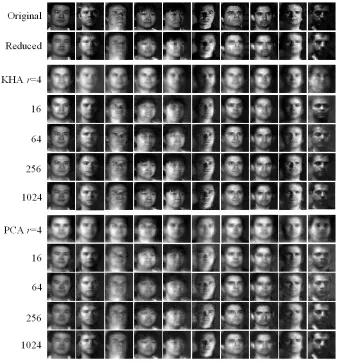
Fig. 1. Face reconstruction based on PCA and KHA using a Gaussian kernel with
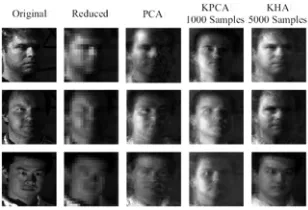
Fig. 2.Face reconstruction examples obtained from KPCA and KHA trained on 1,000 and 5,000 examples, respectively. Occasional erroneous reconstruction of images indi-cates that KPCA requires a large amount of data to properly sample the underlying structure
regarded as a single patch. The Yale Face Database B contains 5,760 images of 10 persons [14]. 5,000 images were used for training while 10 randomly se-lected images which are disjoint from the training set were used to test the method (note, however, as there are only 10 persons in the database, the same person, in different views, is likely to occur in training and test set). For train-ing, (60×60)-sized face images were fed into the KHA with a Gaussian kernel (k(x,y) = exp(−x−y2/(2σ2))). The learning rateηwas fixed at 0.05 during training. Then, the test images were blurred and subsampled to a 20×20 grid and scaled up to the original resolution (60×60), before doing the reconstruc-tion. To avoid overflow during the computation of exponential term in the ker-nel, each pixel value is normalized into the interval around zero ([−0.05,0.05]). Figure 1 shows reconstruction examples obtained using different numbers of components. For comparison, reconstructions obtained by linear PCA are also displayed. While the images obtained from linear PCA look like somewhat un-controlled superpositions of different face images, the images obtained from its nonlinear counterpart (KHA) are more face-like. In spite of its less realistic re-sults, linear PCA was slightly better than the KHA in terms of the mean squared error (average 9.20 and 8.48 for KHA and PCA, respectively for 100 PCs). This stems from the characteristics of PCA which is constructed to minimize the MSE, while KHA is not concerned with MSE in the input space. Instead, it seems to force the images to be contained in the manifold of face images. Similar observations have been reported by [15].
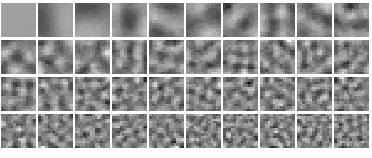
Fig. 3. The first 40 kernel PCs of 40,000 (14×14)-sized patches of natural images obtained from the KHA using a Gaussian kernel withσ= 40
by KPCA due to the lack of training examples were corrected by the KHA using a larger training set.
4.2 Super-resolution of natural images.
To examine the applicability of the KHA to larger scale problems, we trained our algorithm on more than 40,000 patterns obtained from natural images. Figure 3 shows the first 40 KPCs of the 12×12-sized image patches obtained from the KHA using a Gaussian kernel. The plausibility of the obtained PCs can be demonstrated by increasing the size of the Gaussian kernel such that the distance metric of the corresponding RKHS becomes more and more similar to that of the input space [10]. As can be seen in Fig. 3, the KPCs approach those of linear PCA [9] as expected.
Fig. 4.Training images of size 396×528. The training patterns are obtained by sam-pling 2,500 points at random from each image
[image:9.595.207.410.426.579.2]parameter was set to a rather small value (1) to capture the nonlinear structure of the images. The reconstruction of the high-frequency image is then obtained based on the first 200 KPCs. When applied to non-overlapping patches, the resulting image as a whole shows a block structure since each patch is recon-structed independently of its neighborhood. To reduce this effect, the patches are chosen to slightly overlap into their neighbours such that the overlapping regions can be averaged.
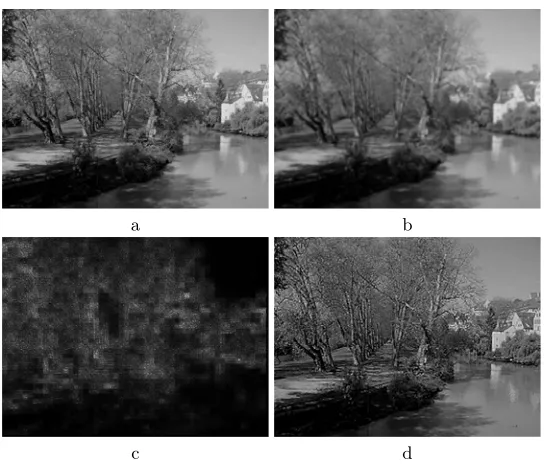
A (396×528)-size image not contained in the training set was used for testing. The (198×264)-sized low-resolution image was obtained by blurring and sub-sampling. Fig. 5 shows the super-resolution result. The final reconstruction was post-processed using high-boost filtering [16] to enhance the edges that become slightly blurred since only the first 200 KPCAs are used in the reconstruction. It should be noted that the original KHA reconstruction of the high-frequency com-ponents still contains blocking artifacts even with the use of overlapping patches. This, however, does not severely degrade the final result since the overall struc-ture is contained in the low frequency input image and the KHA reconstruction only adds the missing high-frequency information. Regarding more advanced techniques for the removal of blocking artifacts, readers are referred to [1] where the spatial relationship between patches is modeled based on Markov random fields.
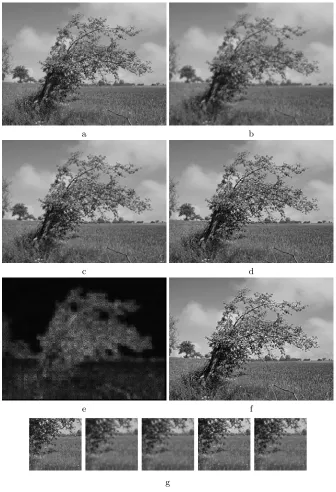
Fig. 6 shows another super-resolution result. The low resolution image is obtained in the same way as in Fig. 5. For comparison, bicubic interpolation and the nearest neighbor technique also have been applied. Again, for all the methods the final reconstructions are high-boost filtered. In comparison to the image stretching (Fig. 6.b), bicubic interpolation (Fig. 6.c) produces far better results. However simple edge enhancement without any priori knowledge failed to completely remove the blurring effect. The two learning-based methods show better capability in recovering the complex local structure.
As shown in Fig. 6 the KHA and the nearest neighbor-based method showed comparable performances. However, the insight on the difference between the modeling capabilities of two methods can be gained by enlarging the size of reconstruction patch and performing super-resolution directly on raw images. For this, a new KHA image model was trained on raw image patches with-out high-pass filtering. Then, during the super-resolution, the input image was decomposed into (16×16) patches and reconstructed independently based on KHA. For comparison, the nearest neighbor-based model was trained in the same way. As highlighted in Fig. 7.e, two learning-based approaches again show better reconstruction results then bicubic reconstruction. Although the KHA reconstruction shown in Fig. 7.e is noisier, it preserves the overall tree structure which is lost by the nearest neighbor reconstruction (Fig. 6.d).
5
Discussion
a b
[image:11.595.172.444.192.426.2]c d
a b
c d
e f
[image:12.595.139.475.117.609.2]g
a b
c d
[image:13.595.140.474.150.462.2]e
was used to learn the statistics contained in a set of the training patterns. By mapping the input image into an RKHS and kernelizing the problem, we capture part of the higher-order statistics which are particularly important for encod-ing image structure. To overcome the memory complexity of KPCA, KHA was proposed as a method for the efficient estimation of the PCs in an RKHS. As a kernelization of the GHA, the KHA allows for performing KPCA without storing the kernel matrix, such that large datasets of high dimensionality can be pro-cessed. This property makes the KHA particularly suitable for applications in statistical image processing applications, where large training sets are required to capture the statistics of an image class with sufficient accuracy.
Compared to existing methods, the experimental results obtained using our approach are promising. It should be stressed, however, that statistical super-resolution methods can be compared in several important respects, out of which accuracy is only one. For instance, the methods proposed by Hertzmann et . al. [4] and Freeman et. al. [1] are based onsupervised learning, i.e., the training data are given as input-output pairs of low- and high-resolution images. In machine learning, it is generally believed that when feasible, a supervised learning ap-proach often leads to the best results. However, at the same time supervised algorithms can have shortcomings in that the data may be more expensive to obtain, and the solution can be less flexible in that it is strictly only useful for the exact task considered. In our case, this means that once trained on a training set containing labeled data, the above methods can strictly speaking only be used for the one image super-resolution task it was trained for. In contrast, our unsu-pervised method,5 which is only trained on high-resolution images, can directly be applied to a variety of image restoration tasks, including e.g. denoising, or image super-resolution using inputs of various resolutions, without retraining. We plan to experimentally corroborate this in future work.
These kinds of differences should be kept in mind when assessing the per-formance of the proposed method. We do not claim to have found the ultimate solution to the problem of image super-resolution—we even did not try to remove the blocking artifact to combine the patch-wise reconstruction, except boundary smoothing. The contribution of this paper lies in developing a specific nonlinear unsupervised machine learning technique that can be run on large databases and demonstrating its potential on image super-resolution.
There are various directions for further work. The KHA, as a general iterative algorithm of KPCA applicable to large datasets, can significantly enlarge the application area of KPCA, which is a generic machine learning technique that also enjoys some popularity in computer vision [10], [17]. For the image super-resolution, we plan to also explore supervised estimation methods in RKHS’s (e.g., [18]), to study in more detail the benefits and shortcomings of a more task-specific solution to the problem.
5 Our method is unsupervised in the sense that it is not given input-output pairs for
Acknowledgments The ideas presented in this study have greatly profited from discussions with A. Gretton, M. Hein, and G. Bakir.
References
1. Freeman, W.T., Jones, T.R., Pasztor, E.C.: Example-based super-resolution. IEEE Computer Graphics and Applications22(2002) 56–65
2. Keys, R.: Cubic convolution interpolation for digital image processing. IEEE Trans. Acoustics, Speech, Signal Processing29(1981) 1153–1160
3. Baker, S., Kanade, T.: Limits on super-resolution and how to break them. IEEE Trans. Pattern Analalysis and Machine Intelligence24(2002) 1167–1183
4. Hertzmann, A., Jacobs, C.E., Oliver, N., Curless, B., Salesin, D.H.: Image analo-gies. Computer Graphics (Proc. Siggraph 2001), NY, ACM Press (2001) 327–340 5. Sch¨olkopf, B., Smola, A., M¨uller, K.: Nonlinear component analysis as a kernel
eigenvalue problem. Neural Computation10(1998) 1299–1319
6. Field, D.J.: What is the goal of sensory coding? Neural Computation6 (1994) 559–601
7. Mika, S., Sch¨olkopf, B., Smola, A.J., M¨uller, K.R., Scholz, M., R¨atsch, G.: Kernel PCA and de-noising in feature spaces. In Kearns, M.S., Solla, S.A., Cohn, D.A., eds.: Advances in Neural Information Processing Systems 11, Cambridge, MA, MIT Press (1999) 536–542
8. Oja, E.: A simplified neuron model as a principal component analyzer. Journal of Mathematical Biology15(1982) 267–273
9. Sanger, T.D.: Optimal unsupervised learning in a single-layer linear feedforward neural netowork. Neural Networks12(1989) 459–473
10. Sch¨olkopf, B., Smola, A.: Learning with Kernels. MIT Press, Cambridge, MA (2002)
11. Burges, C.J.C.: Simplified support vector decision rules. In Saitta, L., ed.: Pro-ceedings of the 13th International Conference on Machine Learning, San Mateo, CA, Morgan Kaufmann (1996) 71–77
12. Kwok, J.T., Tsang, I.W.: (Finding the pre-images in kernel principal component analysis) 6th Annual Workshop On Kernel Machines, Whistler, Canada, 2002, poster available at http://www.cs.ust.hk/∼jamesk/kernels.html.
13. Kim, K.I., Franz, M.O., Sch¨olkopf, B.: Kernel Hebbian algorithm for iterative kernel principal component analysis. Technical Report 109, Max-Planck-Insitut f¨ur biologische Kybernetik, T¨ubingen (2003)
14. Georghiades, A.S., Belhumeur, P.N., Kriegman, D.J.: From few to many: illumi-nation cone models for face recognition under variable lighting and pose. IEEE Trans. Pattern Analalysis and Machine Intelligence23(2001) 643–660
15. Mika, S., R¨atsch, G., Weston, J., Sch¨olkopf, B., M¨uller, K.R.: Fisher discriminant analysis with kernels. In Hu, Y.H., Larsen, J., Wilson, E., Douglas, S., eds.: Neural Networks for Signal Processing IX, IEEE (1999) 41–48
16. Gonzalez, R.C., Woods, R.E.: Digital Image Processing. Addison Wesley, Mas-sachusetts (1992)
17. Mika, S., Sch¨olkopf, B., Smola, A.J., M¨uller, K.R., Scholz, M., R¨atsch, G.: Kernel PCA and de-noising in feature spaces. Advances in Neural Information Processing Systems, Cambridge, MA, MIT Press (1999) 536–542