International Journal of Emerging Technology and Advanced Engineering
Website: www.ijetae.com (ISSN 2250-2459, ISO 9001:2008 Certified Journal, Volume 4, Issue 1, January 2014)
258
Reducing HTTP Collapse with Usage of Pattern Methods
Abdul Mannan Virani
1, Somesh Kumar Dewangan
21M.Tech, 2M.Tech Associate Professor, CSE Dept, DIMAT, Chhattisgarh
Abstract-- Security is the major concern in today’s scenario
a vigorous security mechanism is needed to secure the network from unwanted traffic. There are lots of technologies developed to provide a se currently one of them is by utilizing “signature-based” detection can’t bare stressed traffic, where marketing value is incrementing. Signature predicated detection which is being used current security implements do not handle compressed traffic. GZIP compression is the scheme used to Compress HTTP traffic which requires decompression afore matching. This paper developed on the theme of compressed HTTP traffic. HTTP uses GZIP compression. Decompression phase is utilized by HTTP afore performing a string matching. In this a algorithm, Aho– Corasick-predicated algorithm for Compressed HTTP (ACCH) was habituated to provide more advantage than the commonly used Aho–Corasick pattern-matching algorithm. The advantage of this is that capitalizes on information amassed by the decompression phase in order to expedite. we explore that it is more expeditious to perform pattern matching on the compressed data, with the defect of decompression than on conventional traffic. We are the initial one that analyzes the quandary of “on-the-fly” multipattern matching on compressed HTTP traffic and solves it.
Keywords-- GZIP, Aho-Corasick (ACCH) algorithm, pattern-matching,LZ77 compression.
I. INTRODUCTION
Technologies for security, such as Network Intrusion Detection System (NIDS) or Web Application Firewall (WAF).This deals with signature-predicated detection techniques to identify attacks. Now a days, security implements is judged by the speed of the underlying string-matching algorithms that detect these signatures .HTTP compression nothing but content encoding is openly available method to compress textual content transferred from Web servers to browsers. Lots of websites and convivial sites are utilizing this HTTP compression. As per research 25% + industries are utilizing HTTP compression, and incrementing. This compressed content is built into HTTP 1.1 and was fortified by most browsers.
Most current security implements either ignore scanning compressed traffic, which causes of security apertures, or incapacitate the option for compressed traffic by re- engendering the “client-to” HTTPHeader to shows that compression is not backed by the client’s browser thus decays the consummate performance and bandwidth.
Less security implements HTTP compressed traffic by decompressing the entire page on the proxy and doing a signature scan on the decompressed page afore passing to the client. This option doesn’t applicable for security implements that performs at a high speed or when performing adscititious delay is not an option. In this paper, we explore a novel algorithm, Aho–Corasick predicated algorithm on Compressed HTTP (ACCH).
ACCH decompresses the traffic and then utilizes the data from the decompression phase to expedite the pattern matching. Categorically, the GZIP compression algorithm works by evading repetitions of strings utilizing back-references (pointers) to the reiterated strings. Our key insight is to store information engendered by the pattern-matching algorithm for the already-scanned decompressed traffic, and if any case of a pointer, utilize this information to get if it contains a match or one can securely expunges scanning bytes in it. ACCH can skip up to 84% of the data and boost the performance of the multi pattern-matching algorithm by up to 74%.
1.1 Problem Statement
IDS find the Intrusion using known attack patterns called signatures.
Every IDS will have more number of signatures ( more than 5000)
If Pattern matching algorithm is slow, the IDS attack response time will be very high.
The existing efficient algorithms such as Boyer
Moore (BM), Aho-Coarasick(AC) does not improve the throughput of IDS.
The proposed system is an Implementation of
Scalable look-ahead Regular Expression Detection System.
Works based on look-ahead Finite Automatic
Machine.
Improves the detection speed or attack-response time.
The proposed system should be capable of processing
more number of signatures with more Number of Complex Regular Expressions on every packet payload.
The attack response time should be less when
International Journal of Emerging Technology and Advanced Engineering
Website: www.ijetae.com (ISSN 2250-2459, ISO 9001:2008 Certified Journal, Volume 4, Issue 1, January 2014)
259
Should Provide pattern matching with Assertions
(back References, look-ahead, look-back, and Conditional sub-patterns).
Should use less memory ( Space complexity is low)
II. PROPOSED SYSTEM
1. Packet Capturing
2. Application Payload Extraction
3. HTTP Encoding Header Identification
4. Decompression of Payload
5. Alert Verification in SNORT.
Packet Capturing
The module opens the network interface card
Reads every packet that are received by the Network Interface Card (NIC).
Queues all the packets in buffer
Application Payload Extraction
The buffered packets will be in raw packet format.
The Module identifies the headers and payloads at each layer of TCP/IP.
Decodes the payload according to their header formats.
The Application Payload will be buffered or stored for
the next level.
HTTP Encoding Header Identification
If the packet payload is in the HTTP Protocol format,
the module checks for the HTTP Header
Accept-Encoding: gzip or
Accept-Encoding: deflate
Accept-Encoding: chunked Etc….
Presence of Accept-Encoding HTTP Header confirms
that the payload is in the encoding format.
If the Header is “Accept-Encoding: gzip” then the payload is in the compressed format.
Decompression of Payload
If the payload is in the gzip compression, the payloads
has to be buffered for all the incoming packets
The buffered payload is processed for gzip
decompression.
The decompressed data is passed on to the Pattern Matching for attack identification.
Alert Verification in SNORT
The SNORT IDS consists of several signatures
The signatures cannot be applied on the compressed data.
The decompressed payload can be used on to the
SNORT.
The module confirms that, the signatures are not
hitting for the compressed data and hitting for the decompressed data.
Multi pattern Matching:
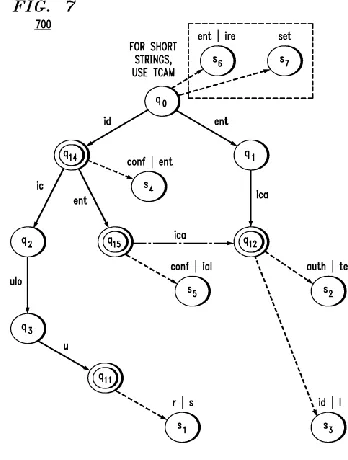
[image:2.612.353.527.368.598.2]Pattern matching has been a topic of intensive research resulting in several approaches; the two fundamental approaches are based on the Aho–Corasick (AC) and the Boyer–Moore algorithms. In this paper, we illustrateour technique using the AC algorithm .The basic AC algorithm constructs a deterministic finite automaton (DFA) for detecting all occurrences of given patterns by processing the input in a single pass. The input is inspected symbol by symbol (usually each symbol is a byte),such that each symbol results in a state transition. Thus, the AC algorithm has deterministic performance, which does not depend on the input, and therefore is not vulnerable to various attacks, making it very attractive to NIDS systems.Each arrow indicates a DFA transition made by a single byte scan.
Fig :Aho–Corasick DFA for patterns matching
International Journal of Emerging Technology and Advanced Engineering
Website: www.ijetae.com (ISSN 2250-2459, ISO 9001:2008 Certified Journal, Volume 4, Issue 1, January 2014)
260
For example, Snort patterns used in Section VII require 16.2MB for 1202 patterns that translate into 16 649 states. There are many compression algorithms for the DFA, but most of them are based on hardware solutions.At the bottom line, DFAs require a significant amount of memory; therefore they are usually maintained in main memory and characterized by random rather than consecutive accesses to memory.Challenges faced in multi pattern matching
1)Remove the HTTP header and store the Huffman
dictionary of the specific session inmemory. Note that different HTTP sessions would have different Huffman dictionaries.
2)Decode the Huffman mapping of each symbol to the Original byte or pointer representation using the specific Huffman dictionary table.
3)Decode the LZ77 part.
4)Perform multi-pattern matching on the decompressed Traffic.
Space: One of the problems of decompression is its
memoryrequirement: The straightforward approach
requires 32KB sliding window for each HTTP session.Note that this requirement is difficult to avoid since the back-referencepointer can refer to any point within the sliding window andthe pointers may be recursive unlimitedly (i.e., pointer may point to area with a pointer). Indeed the distribution of pointers on the real-life data set (see Section VII for details on the data set) is spread across the entire window. On the other hand, pattern matching of non-compressed traffic requires storing only one or two packets (to handle cross-packet data), where the maximum size of a TCP packet is 1.5KB. Hence, dealing with compressed traffic poses a higher memory requirement by a factor of 10. Thus, mid-range firewall, which handles 30K concurrent sessions, requires 1GB memory, while a high-end firewall with 300K concurrent sessions requires 10GB. This memory requirement has implication on not only the price and feasibility of the architecture, but also on the capability to perform caching. The space requirement is not in the focus of this paper. Still, recent work by Afek et al .has shown techniques that circumvent that problem and drastically reduce the space requirement by over 80%, with only a slight increase in time. It has also shown a method to combine that technique with ACCH, which achieves improvements of almost 80% in space and above 40% in the time requirement for the overall DPI processing of compressed Web traffic.
Time: Recall that pattern matching is a dominant factor in the performance of security tools, while performing decompression further increases the overall time penalty. Therefore, security tools tend to ignore compressed traffic. This paper focuses on reducing the time requirement by using the information gathered by the compression phase.We note that pattern matching with the AC algorithm requires significantly more time than decompression since decompression is based on consecutive memory reading from the sliding window, hence it has low read-per-byte cost. On the other hand, the AC algorithm employs a very large DFA that is accessed with random memory reads, which typically does not fit in cache, thus requiring main memory accesses.Appendix A introduces a model that compares the time requirements of the decompression and the AC algorithm.
Experiments on real data show that decompression takes only a negligible 3.5% of the time it takes to run the AC algorithm. Forthat reason, we focus on improving AC performance. We show that we can reduce the AC time by skipping more than 70% of the DFA scans and hence reduce the total time requirement for handling pattern matching in compressed traffic by more than 60%
2.1 Proposed Algorithm
Algorithm Native Decompression with Aho Corasick pattern matching
Trf – the input, compressed traffic (after Huffman decompression)
SWin132KB – the sliding window of LZ77, where SWinj is the information about the uncompressed byte which is located bytesbefore current byte
FSM(state,byte) – AC FSM receives state and byte and returns the next state, where startStateFSM is the initial FSM state
Match(state) – if state is “match state” it stores information about the matched pattern, otherwise NULL
1: state = function scanAC(state)
2: state=FSM (state,byte)
3: ifMatch (state) / NULL then
4: act according to Match (state) 5: end if
6: return state
7: procedure ZIPDecompressPlusAC(Trf1,..…, Trfn)
International Journal of Emerging Technology and Advanced Engineering
Website: www.ijetae.com (ISSN 2250-2459, ISO 9001:2008 Certified Journal, Volume 4, Issue 1, January 2014)
261
9: for =1 to ndo10: ifTrfi is pointer (dist,len)then
11: for j =0 to length-1 do
12: state scanAC (state, SWindistj )
13: end for
14: update SWin with bytes SWindistdistlen 15: else
16: state=scanAC(state,Trfi)
17: update SWin with the byte Trfi
18: end if 19:end
III. RESULTS AND DISCUSSIONS
In this section, we evaluate the performance benefit of ACCH algorithm and find the optimal CDepth, a key parameter of our algorithm, using real-life traffic.
A. Data Set
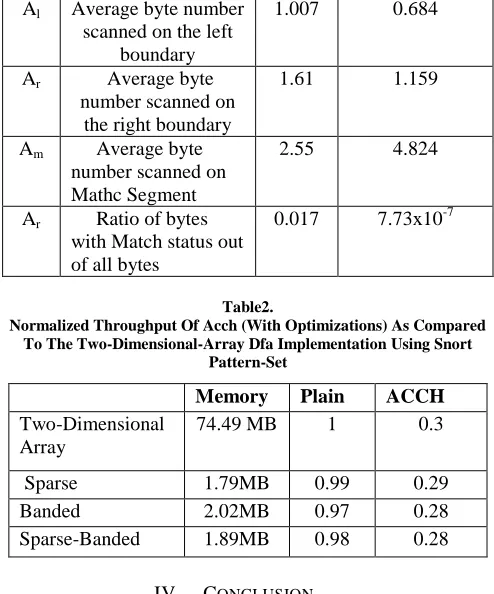
We use two data sets, one of the traffic and the other of the patterns. For the traffic, we use two data sources: traffic that was captured by a corporate firewall for 15 min and a list of the most popular Web pages taken from the Alexa Web site, which maintains Web traffic metrics and top sites lists. Table I shows the characteristics of both traces. No significantdifference was found between the results over those two data sets, therefore we refer to the Alexa data-set parameters. We use two signature data sets: one of ModSecurity an open-source Web application firewall, and the other ofSnort , an open-source network intrusion prevention and detection system.
B. ACCH Performance
In this section, we compare the performance benefit using the ACCH algorithm. We define as the scanned character ratio. is a dominant factor for performance improvement for ACCH over the Naive algorithm as shown later. The tradeoff of choosing different values for, as discussed in previous Section , can be shown in the graph. Snort patterns result in a significant amount of matches within the traffic (near 2% of the total number of
bytes are marked with), resulting in more Match Segments,
[image:4.612.320.567.183.480.2]which in turn cause a significantly higher. In order to check the influence of the amount of matches on , we synthesized a reduced Snort pattern-set by removing 88 of the most frequent patterns. The data contain 234 448 patterns from the reduced pattern-set (insteadof 14 M). Thus, match ratio has stronger influence on value than the number of patterns.
Table 1.
Parameters Analyzed Using Real-Life Data For Snort And Modsecurity.
Description Snort ModSecurity
Al Average byte number
scanned on the left boundary
1.007 0.684
Ar Average byte
number scanned on the right boundary
1.61 1.159
Am Average byte
number scanned on Mathc Segment
2.55 4.824
Ar Ratio of bytes
with Match status out of all bytes
0.017 7.73x10⁻⁷
Table2.
Normalized Throughput Of Acch (With Optimizations) As Compared To The Two-Dimensional-Array Dfa Implementation Using Snort
Pattern-Set
Memory Plain ACCH
Two-Dimensional Array
74.49 MB 1 0.3
Sparse 1.79MB 0.99 0.29
Banded 2.02MB 0.97 0.28
Sparse-Banded 1.89MB 0.98 0.28
IV. CONCLUSION
International Journal of Emerging Technology and Advanced Engineering
Website: www.ijetae.com (ISSN 2250-2459, ISO 9001:2008 Certified Journal, Volume 4, Issue 1, January 2014)
262
REFERENCES[1] M. Fisk and G. Varghese, “An analysis of fast string matching applied to content-based forwarding and intrusion detection,” Tech. Rep.CS2001-0670 (updated version), 2002.
[2] “Port80,” Port80 Software, San Diego, CA [Online]. Available: http://www.port80software.com/surveys/top1000compression [3] “Website Optimization, LLC,” Website Optimization, LLC, Ann
Arbor, MI [Online]. Available: http://www.websiteoptimization.com [4] P.Deutsch, “Gzip file format specification,” RFC 1952, May 1996
[Online].Available: http://www.ietf.org/rfc/rfc1952.txt
[5] P. Deutsch, “Deflate compressed data format specification,” RFC 1951, May 1996 [Online]. Available: http://www.ietf.org/rfc/rfc1951.txt
[6] J. Ziv and A. Lempel, “A universal algorithm for sequential data compression,” IEEE Trans. Inf. Theory, vol. IT-23, no. 3, pp. 337– 343, May 1977.
[7] D. Huffman, “A method for the construction of minimum-redundancy codes,” Proc. IRE, vol. 40, no. 9, pp. 1098–1101, Sep. 1952.
[8] “Zlib,” [Online]. Available: http://www.zlib.net
[9] A. Aho and M. Corasick, “Efficient string matching: An aid to bibliographic search,” Commun. ACM, vol. 18, pp. 333–340, Jun. 1975. [10] R. Boyer and J. Moore, “A fast string searchingalgorithm,” Commun.ACM, vol. 20, no. 10, pp. 762–772, Oct. 1977.
[10] N. Ziviani, E. de Moura, G. Navarro, and R. Baeza-Yates, “Compression:A key for next-generation text retrieval systems,” Computer, vol.33, no. 11, pp. 37–44, 2000.
[11] T. Song, W. Zhang, D. Wang, and Y. Xue, “A memory efficient multiple patternmatching architecture for network security,” in Proc. IEEE INFOCOM, Apr. 2008, pp. 166–170.
[12] J. van Lunteren, “High-performance pattern-matching for intrusion detection,”inProc. IEEE INFOCOM, Apr. 2006, pp. 1–13.
[13] V. Dimopoulos, I. Papaefstathiou, and D. Pnevmatikatos, “A memoryefficient reconfigurable Aho–Corasick FSM implementation for intrusion detection systems,” in Proc. IC-SAMOS, Jul. 2007, pp. 186–193.
Authors Profile
First Author: Abdul Mannan Virani received his B.E. (CSE) degree from RCET Bhilai, Pandit Ravi Shankar Shukla University (Pt.RSU) Raipur, in 2006.From 2006 to 2010 he worked in various multinational companies as Consultant and Customer support .He is currently an M.Tech student in the Computer Science Engineering from DIMAT Raipur, Chhattisgarh Swami Vivekananda University Bhilai. His Research interests are in the areas of Wireless and Network Security, with current focus on secure data services in cloud computing and secure computation outsourcing.
Second Author: Somesh Kumar
Dewanganreceived his M. Tech in