International Journal of Emerging Technology and Advanced Engineering
Website: www.ijetae.com (ISSN 2250-2459,ISO 9001:2008 Certified Journal, Volume 5, Issue 7, July 2015)
411
To Enhance the Power Consumption of the Data Centers Using
Improved VM Scheduling Policy
Archana Soni
1, Prof. Bharat Pahadiya
21M.Tech. Scholar, Department of CSE, Sanghvi Innovative Academy, Indore, MP, INDIA 2Assistant Professor, Department of CSE, Sanghvi Innovative Academy, Indore, MP, INDIA
Abstract-- Cloud computing is attracting great attention nowadays. The elastic nature of cloud makes it suitable for almost any type of organization. These security issues acts as a barrier in the growth of cloud computing. In this presented work the green computing is investigated on the data centers. The proposed technique compares the performance of both in terms of memory consumption, time consumption and their power preserving. According to the measured outcomes the performance of the proposed methodology is found optimum and efficient as compared to the traditional VM scheduling technique.
I. INTRODUCTION
A Cloud is a type of parallel and distributed system consisting of a collection of interconnected and virtualized computers that are dynamically provisioned and presented as one or more unified computing resources based on service-level agreements established through negotiation between the service provider and consumers. Cloud computing is a model that enables suitable, on-demand network access to a common pool of configurable computing assets such as networks, servers, storage, applications that can be quickly provisioned and free with least management attempt or service provider’s communication[1].
“Cloud computing is a collection of accessible techniques and technologies, packaged inside a new infrastructure paradigm that provides enhanced scalability, elasticity, business alertness, quicker startup time, compact management costs, and just-in-time accessibility of resources”[2].
Cloud computing represents significant opportunity for service providers and enterprises. Offering flexibility and choice, mobility and scalability, all coupled with potential cost saving. However, the area is causing organizations to hesitate most when it comes to moving business workloads into public cloud is security.[3]
II. BACKGROUND WORK
Prof. Riyaz A. Sheikh et al [4] examines the need and
provides a guideline which highlights our responsibilities as computer users and encourages us to take actions that maximize the usefulness of these amazing tools while minimizing the negative consequences that may occur during their use.
Anton Beloglazov et al[5] significantly reduce energy consumption, while ensuring a high level of adherence to the Service Level Agreements (SLA) and validate the high efficiency of the proposed algorithms by extensive simulations using real-world workload traces from more than a thousand PlanetLab VMs. The results of the experiments have shown that the proposed local regression based algorithm combined with the MMT VM selection policy significantly outperforms other dynamic VM consolidation algorithms in regard to the ESV metric due to a substantially reduced level of SLA violations and the number of VM migrations. In order to evaluate the proposed system in a real Cloud infrastructure, we plan to implement it by extending a real-world Cloud platform, such as OpenStack. Another direction for future research is the investigation of more complex workload models, e.g. models based on Markov chains, and development of algorithms that will leverage these workload models. Besides the reduction in infrastructure and on-going operating costs, this work also has social significance as it decreases carbon dioxide footprints and energy consumption by modern IT infrastructures.
International Journal of Emerging Technology and Advanced Engineering
Website: www.ijetae.com (ISSN 2250-2459,ISO 9001:2008 Certified Journal, Volume 5, Issue 7, July 2015)
412
There is a growing global movement to implement more environmental friendly computing. Not only the environmental organizations but also computer producers and users are taking care of it. People are realizing that going green is in their best interest. They have started to embrace environmentally sustainable products that will assist not only to save environment but also to more efficient energy consumption and capital and operational cost reduction. Here Meenakshi Gupta et al [6] take a look on full life cycle analysis not just the product on desk and what tactics the manufacturers and consumers of computers can follow as an initiative to green computing.In recent years, significant research has been conducted to boost the performance and increase the reliability of high performance computing (HPC) clusters. As the number of compute nodes in modern HPC clusters continues to grow, it is critical to design clusters with low power consumption and low failure rate. In particular, it is widely known that the internal disk drives of compute nodes (in the case of diskfull clusters) are a major source of failures. In addition, these diskfull HPC clusters tend to require more power and cooling requirements compared to diskless clusters. In this paper, K. Salah et al [7] propose and implement a large-scale Infini-band-based diskless HPC cluster. The paper presents the cluster configuration and evaluates its performance using various High Performance LINPACK (HPL) benchmarks. The performance is measured in terms of the overall efficiency, speed in Giga-Floating Point Operations per Second (GFLOPS), and HPL execution time. They also measure temperature and power consumption. We compare the performance measurements of diskless cluster to its diskfull counterpart. For their measurement and comparison, they consider three cluster sizes of 32, 64, and 126 compute nodes.
The researchers have seen a brusque changes advent in the field of research areas on maturing the energy efficient large computational resources. Here firstly the basics of Cloud Computing discussed and then green computing with its architectural elements, power efficiency, live migration are presented. A novel Green computing framework is applied to the Cloud in order to meet the goal of minimizing the power consumption. Gaganpreet Kaur
Sehdev et al [8] try to impose efforts on power
management with Live Migration. In Live Migration a running VM is moved from one physical host to another. Live migration is attractive to data center providers because moving a VM across distinct physical hosts can be leveraged for a variety of tasks such as power management, maintenance, or fault tolerance. Power consumption has found to be critical come forth in Cloud environment. Also servers take much energy to finish their tasks.
Green computing comes up to overcome the energy consumption problem in cloud computing.
In this paper Beatrice Valeri et al [9] study the factors that affect people’s decision in participating in leisure activities in the social and cultural environment. To this end, they collected the ratings of local people from three different cities around the world on standard leisure activities, and looked at the personal, social and contextual features shaping their preferences. Then used this dataset to evaluate how these features can be exploited to recommend places people would actually like. The initial results suggest that friends are a good source for recommending places, with higher precision and recall than considering only popular places; but these can be improved reducing the scope to similar friends in the context of the particular activity. We have also found that people preferences are sensitive to the companion (e.g., partner, friends, tourists) for which they look for different features. The results also suggest that similarities in the preferences of people can be extended to other activities, which points to the potential of profiling users based on lifestyle. Author finally present the design and prototype of a system, namely ComeAlong, which aims at helping people discover, find and participate to social and leisure activities.
Network-based cloud computing is rapidly expanding as an alternative to conventional office-based computing. As cloud computing becomes more widespread, the energy consumption of the network and computing resources that underpin the cloud will grow. This is happening at a time when there is increasing attention being paid to the need to manage energy consumption across the entire information and communications technology (ICT) sector. While data center energy use has received much attention recently, there has been less attention paid to the energy consumption of the transmission and switching networks that are key to connecting users to the cloud. In this paper,
Jayant Baliga et al [10] present an analysis of energy
International Journal of Emerging Technology and Advanced Engineering
Website: www.ijetae.com (ISSN 2250-2459,ISO 9001:2008 Certified Journal, Volume 5, Issue 7, July 2015)
413
III. PROPOSED WORK
The proposed work is indented to overcome the power consumption over cloud servers. Green computing is an advanced technique where the power consumption of system is reduced and better efficiency of system is targeted to achieve. During the request processing the cloud data centers frequently uses the virtual machine migration and allocation techniques to provide efficient computing experience. Basically cloud data centers are composed with a number of virtual machine and these virtual machines are incorporating a number of CPUs. In order to provide the efficient computing experience the taskand the VMs are scheduled according to the available resource allocation policies. Thus if the VM scheduling becomes efficient then power consumption is enhanced. Based on this concept an solution is suggested and simulated using CloudSim simulation tool. The basic implementation methodology is provided in further sections.
IV. METHODOLOGY USED
4.1 CloudSim
The CloudSim toolkit supports both system and behaviour modelling of Cloud system components such as data centers, virtual machines (VMs) and resource provisioning policies. Moreover, it exposes custom interfaces for implementing policies and provisioning techniques for allocation of VMs under inter-networked Cloud computing scenarios.
The usefulness of CloudSim is demonstrated by a case study involving dynamic provisioning of application services in the hybrid federated clouds environment. The result of this case study proves that the federated Cloud computing model significantly improves the application QoS requirements under fluctuating resource and service demand patterns. [5]
4.2 Simulation scenarios
In order to simulate the effectiveness and the power consumption criticalness there are two different simulation scenarios are desired to implement.
1. The simulation using the traditional VM scheduling: in this simulation implementation the traditional VM scheduling approach is implemented using the CloudSim discrete event simulator and performance of scheduling is calculated.
2. The simulation using the proposed scheduling approach:in this simulation analysis the enhanced correlation coefficient is implemented with the CloudSim simulation technique and the performance of power consumption is compared.
4.3 Implementation
International Journal of Emerging Technology and Advanced Engineering
Website: www.ijetae.com (ISSN 2250-2459,ISO 9001:2008 Certified Journal, Volume 5, Issue 7, July 2015)
[image:4.612.79.535.144.676.2]414
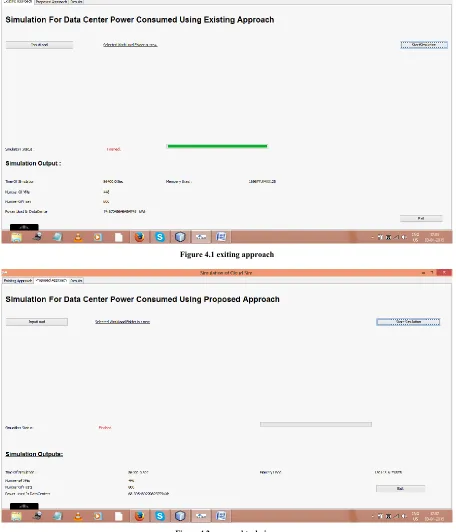
Figure 4.1 exiting approach
International Journal of Emerging Technology and Advanced Engineering
Website: www.ijetae.com (ISSN 2250-2459,ISO 9001:2008 Certified Journal, Volume 5, Issue 7, July 2015)
[image:5.612.78.533.130.383.2]415
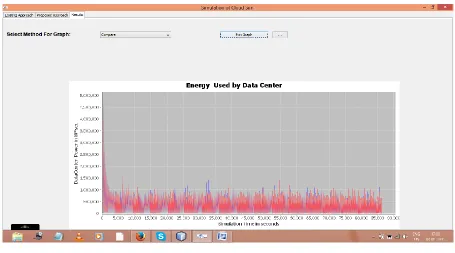
Figure 4.3 performance analysis
In addition of that the performance of both the simulation scenarios are compared using the figure 4.3. for simulating the performance of the methods user can select the method name from the drop down list and can visualize the performance.
V. RESULTS
The outcomes of the proposed technique and the traditional technique is evaluated and analysed. Therefore the performance evaluation of the system is provided in two sections first the computational overhead of techniques and the VM allocation performance gain.
5.1 Computational Complexity
The computational complexity of the implemented system is measured in terms of memory and time consumption of the algorithms.
5.1.1 Time Complexity
The amount of time required to schedule VM for allocating the resources are known as the time consumption. It demonstrate the amount of time consumed for efficient VM scheduling in terms of milliseconds.
Therefore the time consumption of the algorithm is given in Y axis and the different experiments are given in X axis. According to the evaluated results that is observed the time consumption of the algorithm depends on the number of iterations required for scheduling.
Most of the time the proposed scheduling needs less amount of time as compared the traditional MAD policy. 5.1.2 Memory consumption
The amount of main memory required for process the algorithms are known as the memory consumption of the system.
The evaluated memory consumption of the proposed and traditional scheduling technique is demonstrated . The amount of consumed memory is given using Y axis and the X axis shows the different experiment performed. According to the obtained results the memory consumption is less than the traditional VM allocation technique.
5.2 Scheduling Performance
International Journal of Emerging Technology and Advanced Engineering
Website: www.ijetae.com (ISSN 2250-2459,ISO 9001:2008 Certified Journal, Volume 5, Issue 7, July 2015)
[image:6.612.77.537.127.673.2]416
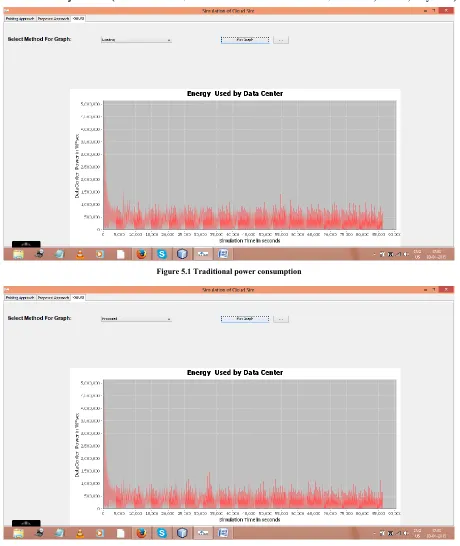
[image:6.612.80.533.128.397.2]Figure 5.1 Traditional power consumption
International Journal of Emerging Technology and Advanced Engineering
Website: www.ijetae.com (ISSN 2250-2459,ISO 9001:2008 Certified Journal, Volume 5, Issue 7, July 2015)
[image:7.612.79.535.128.395.2]417
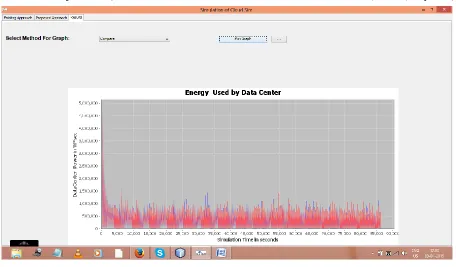
Figure 5.3 Comparative power consumption
According to the performed experimentation using the CloudSim simulator the power consumption using traditional MAD technique and proposed allocation technique is measured and compared. The performance of MAD is given using figure 5.1 and the performance of proposed methodology is given using figure 5.4. Additionally the comparative outcomes are given using figure 5.3. According to the power consumption the proposed technique minimizes the migration and maximizes the power preservation.
VI. CONCLUSION AND FUTURE WORK
In this presented work the cloud computing is investigated for their green computing technology and their power preservation techniques.
International Journal of Emerging Technology and Advanced Engineering
Website: www.ijetae.com (ISSN 2250-2459,ISO 9001:2008 Certified Journal, Volume 5, Issue 7, July 2015)
418
Table 6.1 performance summary
S. No
Parameters
Proposed technique
MAD
1
Time consumption
Similar
Similar
2
Memory consumption
Low
High
3
Power consumption
Low
High
The evaluated performance of both the techniques is compared in terms of different performance parameters. According to the estimated performance the outcome of the proposed technique is adoptable and efficient and also able to significant amount of power consumption.
The presented Spearman's rank correlation coefficient technique for VM allocation and scheduling is found optimum, efficient and adoptable. In near future the proposed work is enhanced more for preserving more power to achieve green computing.
REFERENCES
[1] Rabi Prasad Padhy,ManasRanjanPatra,Suresh Chandra Satapathy,
“Cloud Computing: Security Issues and Research
Challenges”,IRACST - International Journal of Computer Science and Information Technology & Security (IJCSITS),Vol. 1, No. 2, December 2011.
[2] https://www.cs.purdue.edu/homes/bb/cloud/cloud-complete.ppt
[3] Amar Gondaliya,” Security in Cloud Computing”, Cloud 20/20
Version 3.0, Unisys Confidential contest Technical Paper Contest 2011
[4] Prof. Riyaz A. Sheikh,Dr. U.A. Lanjewar, “Green Computing-
Embrace a Secure Future”,International Journal of Computer Applications (0975 – 8887) Volume 10– N.4, November 2010.
[5] SurajPandey, Linlin Wu, SiddeswaraMayura Guru, RajkumarBuyya,
“A Particle Swarm Optimization-based Heuristic for Scheduling Workflow Applications in Cloud Computing Environments”, 24th IEEE International Conference on Advanced Information Networking and Applications (AINA).
[6] Meenakshi Gupta, Garima Gupta, “Green Computing – A Step
towards Better Milieu”, Journal of Engineering, Computers &
Applied Sciences (JEC&AS) ISSN No: 2319-5606, Volume 2, No.9, September 2013
[7] K. Salah, R. Al-Shaikh, M. Sindi, “Towards Green Computing using
Diskless High Performance Clusters”, 2011 7th International
Conference onNetwork and Service Management (CNSM)
[8] Gaganpreet Kaur Sehdev, Anil Kumar, “Power Efficient VM
Consolidation using Live Migration- A step towards Green Computing”, International Journal of Science and Research Volume 3 Issue 3, March 2014
[9] Beatrice Valeri, Marcos Baez, Fabio Casati, “Come Along:
understanding and motivating participation to social leisure activities”, 2013 IEEE Third International Conference on Cloud and Green Computing