International Journal of Emerging Technology and Advanced Engineering
Website: www.ijetae.com (ISSN 2250-2459, ISO 9001:2008 Certified Journal, Volume 7, Issue 8, August 2017)
446
Comparative Study of Incremental Updates for Association
Rule Mining in Large and Dynamic Data Set
Piyush Kumar Dubey
1, Dr. Anil Rajput
2, Dr. Shailesh Jaloree
31Research Scholar, Department Of Computer Science, Barkatullah University, Bhopal, (M.P.), India
2Professor Department of Computer Science and Maths Science, Govt. C. S. A. PG College, Sehore (M.P.), India 3
Associate Professor, Department of Mathematics &Computer Science S.A.T.I. College , Vidisha (M.P.)
Abstract – Association rules are one of the most research areas of data mining and have freshly arriving much thought from the database neighbourhood. They have proven to be quite useful in the marketing and retail communities as well as other more diverse fields. In this broadsheet an overview of association rule explore has been presented. The intent of this broadsheet is to afford a thorough inspection of previous investigate on association rules. In the next fragment a formal explanation of association rules has given. There are a lot of suggestion tools to help advertising or personalization in ecommerce. This broadsheet will demonstrate how public set up e-commerce and what kind of information they imagine to sell their goods. It gives an synopsis of ecommerce like what is e-commerce, why people start and what kind of information they expect to sell their products. It’s describes Data Mining (DM) from justification. As regards what category of information people want how to accumulate, how to classify for DM discusses. This is shows association rule mining and concerted rule mining. It provides overview of case revision. Bring to a close this review work discuss advance study on DM.
Keywords:- Data mining, association rule mining, Association mining, Data Structure.
I. INTRODUCTION
Data Mining, likewise prominently known as Knowledge Discovery in Databases (KDD), alludes to the nontrivial extraction of verifiable, already obscure and possibly valuable data from data in databases. While data mining and information disclosure in databases (or KDD) are much of the time regarded as equivalent words, data mining is entirely of the learning revelation process.
The sorts of patterns that can be found rely on the data mining assignments utilized. All things considered, there are two sorts of data mining tasks: engaging data mining undertakings that depict the general properties of the current data, and prescient data mining assignments that attempt to do forecasts in light of induction on accessible data. One of the prominent illustrative data mining strategies is Association rule mining (ARM)[9], attributable to its broad use in promoting and retail groups notwithstanding numerous other differing fields. Mining association rules is especially valuable for finding connections among things from substantial databases.
The current age frequently referred to as the data age. In this data age, since it trust that data prompts power and achievement, and on account of refined advancements, for example, computers, satellites, and so on., it has been gathering enormous measures of data like business exchanges, logical data, medicinal data, satellite data, observation video and pictures, internet vaults to give some examples. With the tremendous measure of data put away in records, databases, and different stores, it is progressively critical, if a bit much, to grow capable means for investigation and maybe translation of such data and for the extraction of intriguing learning that could help in basic leadership.
The fundamental objective of this work is to give a careful review of past research on association rules. Encourage a formal meaning of association rules is given. Contains the depiction of successive and parallel algorithms and also different algorithms to discover association rules. gives another classification and examination of the essential algorithms. Presents speculation and expansion of association rules. Analyze the era of association rules when the database is being adjusted. In reference sections give data on various association rule items, data source and source code accessible in the market, and incorporate a table condensing documentation utilized all through the work.
Association rule mining deals with database
International Journal of Emerging Technology and Advanced Engineering
Website: www.ijetae.com (ISSN 2250-2459, ISO 9001:2008 Certified Journal, Volume 7, Issue 8, August 2017)
447
This is termed as in weighted association rule mining (WARM) [9]. In 2008, Sun et. al [6] proposed yet another algorithm for finding successive itemsets without preassigned weights. The advantage of this approach is that weights for items and transactions can be found from data itself rather than preassigning weights. Yen et. al [7] proposed a Graph-Based Approach for Discovering Various Types of Association Rules in which it can discover association rule mining utilizing diagram, and it gives better outcome when contrasted with Apriori algorithms. The chart based approach has been reached out to Generalized Association Rule Mining which is superior to cumulate algorithm [9]. Chart based association rule mining utilizes bit vector data structure for putting away datasets, which is superior to whatever other way to deal with store datasets. In the second piece of the investigation, two Graph based methodologies have been considered. In the first place is Primitive association rule mining and other is summed up association rule mining. In both the methodologies, charts are built and visit itemsets are found from graphs.II. DATA MINING
Data mining (DM) has as its prevailing objective, the era of non-evident yet valuable data for chiefs from expansive databases. The term data mining is utilized to portray the accumulation of investigation strategies used to construe rules from or fabricate models from expansive data sets[6]. Extraordinary compared to other known cases of data mining in business is the disclosure of association rules – connections between things that show a connection between the buy of one thing and the buy of another. Data mining or knowledge disclosure in databases (KDD) has risen as of late as a dynamic research region for separating verifiable, already obscure, and possibly helpful data from vast databases. Given a really huge measure of data, the test in data mining is to uncover hidden connections among different attributes of data and between a few depictions of data over some undefined time frame. These hidden patterns have gigantic potential in forecasts and personalizations in web based business. Data mining has been sought after as an examination theme by no less than two groups: the analysts and neural system. Presently a concise review of a portion of the components of each of these methodologies has been introduced.
A. Data-mining methods
-statistics by strict definition "insights" or measurable systems are not data mining. They were being utilized long before the term data mining was begat to apply to business applications. Be that as it may, factual strategies are driven by the data and are utilized to find patterns and construct prescient models.
a. Statisticians
Consider the causal connection between the needy factors and autonomous factors as proposed by the client (for the most part the space master), and attempt to catch the degree and nature of reliance between the factors. Knowing measurements in your regular day to day existence will enable the normal representative to settle on better choices by enabling them to make sense of hazard and vulnerability when every one of the actualities either aren't known or can't be gathered. Indeed, even with every one of the data put away in the biggest of data distribution centers business choices still simply turn out to be more educated estimates. The more and better data and the better comprehension of insights settle on the better the choice that can be made. Today data mining has been characterized autonomously of insights however "mining data" for patterns and expectations is truly what measurements is all about.
b. Neural Network
International Journal of Emerging Technology and Advanced Engineering
Website: www.ijetae.com (ISSN 2250-2459, ISO 9001:2008 Certified Journal, Volume 7, Issue 8, August 2017)
448
c. Algorithm AprioriIn experiments Apriori Algorithm has been utilized for finding the association rules in the info sets and utilized Principal Component Analysis and k-Means algorithms for clustering clients as per their purchasing propensities.
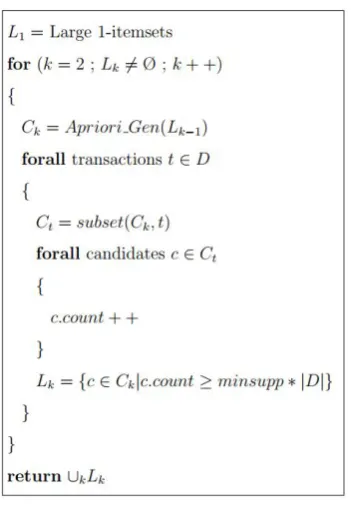
Finding Large Itemsets the algorithm Apriori functions as tails: It initially produces the 1-itemsets that have bolster more prominent than a prespecified least help, minsupp. This assignment is improved the situation every thing checking the quantity of occurances and choosing those whose help is more noteworthy than minsupp. At that point, the technique creates 2-itemsets utilizing these expansive 1-itemsets with the strategy Apriori Gen. There is a pruning step which prunes the created 2-itemsets. The algorithm continues producing the following itemsets and pruning until no huge itemset is cleared out. The itemsets are arranged lexicographically. The algorithm is given in Figure (1).
Figure (1)Algorithm Apriori
d. Market-Basket Analysis
The showcase crate issue expect some expansive number of things [4] , e.g., bread, drain. Clients fill their market bushel with some subset of the things, and become acquainted with what things individuals purchase together, Even if there's don't know their identity. Advertisers utilize this data to position things, and control the way a commonplace client crosses the store.
In addition to the marketing application, the same sort of question has the following uses:
1. Baskets = documents; items = words. Words showing up as often as possible together in documents may speak to phrases or connected ideas and can be utilized for insight gathering.
2. Baskets = sentences, items = documents. Two documents with a significant number of similar sentences could speak to literary theft or mirror locales on the Web.
B. Goals For Market-Basket Mining a. Association rules:
Association rule can be define as follows:
Let I = {i1, i2, ….., im} be a set of literals or items, D = {t1, t2, .. , tn} be a set of transactions, where each transaction ti is an itemset such that ti I. Each transaction, t, has a transaction-id (t.id) and an itemset (t.Itemset), i.e., t = (t.id, t.Itemset). A transaction t contains an itemset X if X is a subset of t.Itemset. An Association rule, R, denoted by R: X-> Y, where X and Y are itemsets that don t intersect. Each rule R has two esteem measures, support and certainty, meant by sup(R) and conf(R) separately. The help of a thing set[7], X, has bolster, s, in exchange set, D, if s% of exchange in D contain X. At that point, sup(R: X Y) = sup(X Y), conf(R: X Y) = sup(X Y)/sup(X) Different exchanges may contain same itemset, particularly for remote detected imagery. This proposes an approach to dispose of copy count. A few ideas are given underneath. Let U = {t | t is any conceivable transaction}, while D = {t| t is an exchange as of now happened}.
b. Causality:
Ideally, it is intriguing to realize that in an association rule the nearness of X1,… ., Xm really makes Y be purchased. However, "causality" is a subtle idea. By the by, for advertise wicker bin data, the accompanying test proposes what causality implies. On the off chance that the cost of diapers fallen sunrise and raise the cost of brew, there's can bait diaper purchasers, who will probably get lager while in the store, along these lines covering our misfortunes on the diapers. That technique works since diapers cause lager. Nonetheless, working it the other route round, running a deal on brew and raising the cost of diapers, won't bring about lager purchasers purchasing diapers in any extraordinary numbers, and lost of cash.
c. Frequent Itemsets:
[image:3.595.78.254.362.620.2]International Journal of Emerging Technology and Advanced Engineering
Website: www.ijetae.com (ISSN 2250-2459, ISO 9001:2008 Certified Journal, Volume 7, Issue 8, August 2017)
449
Along these lines, much data mining begins with the supposition that lone think about arrangements of things with high help; i.e., they seem together in numerous bushels. It at that point discover association rules or causalities just including a high-bolster set of things i.e., {X1,… ., Xm}. Y must show up in no less than a specific percent of the wicker bin, called the support threshold.C. Association Rule Mining
Association rule mining has its drawbacks as well. The most widely one is that the rules produced from the data set might be beyond any reasonable amount to be broke down, and the majority of them might be trifling or not fascinating to the space specialists. In this way, in exhibit think about, various fascinating measures for the association rules removed from the principal stage
investigated, and assess the outcomes after the determination of the rules with the diverse estimations. At the point when a reasonable number of fascinating rules are chosen, there will have the capacity to do the investigation of the outcomes from the area master's viewpoint. The exploration incorporates five extra areas. Second section gives a writing survey on the connection between data mining and measurements, and in addition clustering and association rule mining ideas. Third part depicts the system for this examination. The outcomes are broke down and talked about in fourth section, trailed by the model assessment in fifth part. At long last, last part six finishes up the examination and presents proposals for future research.
III. LITERATURE REVIEW
SR.NO. TITLE AUTHORS YEAR METHODOLOGY
1 "Knowledge Based Retrieval
Scheme from Big Data for Aviation Industry,"
A. Singh and A. Kaushik,
2015 Knowledge Based Data Aviation
2 GM-Tree: An efficient frequent
pattern mining technique for dynamic database,
R. K. Roul and I. Bansal,
2014 Mining technique for dynamic
database
3 "Proposed algorithm for frequent item set generation,"
A. Singh and J. Agarwal,
2014 Algorithm for frequent item
4 "An efficient way to find frequent pattern with dynamic
programming approach,"
D. Bhalodiya, K. M. Patel and C.
Patel,
2013 Dynamic programming
approach
5 "Probability-based incremental
association rule discovery using the normal approximation,"
A. Ariya and W. Kreesuradej,
2013 Probability-based incremental
association rule
6 "Table of contents," 2011 Performance table of contents
7 "Incremental update strategy for
indexed item set mining,"
Sathya and C. Chandrasekar,
2010 Incremental update strategy
8 "The dynamic data reduction and association rule parallel mining based on rough set,"
[8]He Youquan and Wang LiJun,
2010 Association rule parallel
mining based
9 "An efficient model for
information gain of sequential pattern from web logs based on dynamic weight constraint,"
D. K. Jha, A. Rajput, M. Singh
and A. Tomar,
2010 Efficient model web logs based on dynamic weight
International Journal of Emerging Technology and Advanced Engineering
Website: www.ijetae.com (ISSN 2250-2459, ISO 9001:2008 Certified Journal, Volume 7, Issue 8, August 2017)
450
A. Singh and A. Kaushik,[1]Big-data center layer engineering is characterized to play out the question investigation and the assessment of the Big Data. This plan is executed on powerful produced data segment. The idea of Big Data worries with a main part of data exhibited in vast volume with confused design and with expanding data set. The data for such framework can be taken from various sources and now and then from free sources. With the improvement of new cloud condition, unified framework, the utilization of Big Data is effectively accessible to the end clients so the criticality there exists in terms of quick recovery of data from the framework. To play out the investigative data recovery from such data framework there is the necessity of data driven model. Middle layer display is been exhibited to infer the significant and prescient data from Big Data. The introduced model will store the all parts of data set as Meta data with the goal that the client inquiry will be performed on the specific data set rather than entire data set. The association rule will be executed on aeronautics data set. Utilize the java swing as the front end and will utilize the prophet as the backend.R. K. Roul and I. Bansal [2],"GM-Tree: A efficient continuous example pattern mining technique for dynamic database.Since its beginning, mining regular patterns have turned into a basic issue in data mining. The fundamental issue around there is to discover the association rule that distinguishes the connections among an arrangement of things. In any case, the most costly stride in association rule is finding regular itemsets and thus it draw the consideration of numerous essential research. In this work propose a novel tree structure, called GM(Generate and Merge)Tree, which is a blend of prefix based incremental mining utilizing accepted requesting and bunch increasing procedures. Our approach influences the tree to structure more conservative, standardly requested of hubs and keeps away from successive increasing of exchanges. It also helps to give a scalable algorithm with minimum overheads of modifying the tree structure during update operations. This algorithm is especially expected to give better results in case of extremely large transaction database in a dynamic environment. The exploratory work has been done on two expansive datasets. Test outcomes demonstrate the proficiency and viability of the proposed approach by beating the conventional FP-Tree,
CanTree (Canonical-order Tree) and BIT(Batch
Incremental Tree).
A. Singh and J. Agarwal, [3] Data mining is a productive innovation to find patterns in huge databases. Association rule mining strategies are utilized to discover the relationship between's the different thing sets in the database, and this connection between's different thing sets are utilized as a part of basic leadership and example examination.
Lately the issue of finding regular things and association rules from huge datasets has been proposed by numerous analysts. Different research papers on association rule mining (ARM) are examined and dissected first to comprehend the current algorithms. The Apriori algorithm is the fundamental ARM algorithm, yet it requires such huge numbers of database sweeps to discover visit things. In Dynamic Item set checking (DIC) algorithm less number of database examines are required, yet complex data structure cross section is utilized. The primary concentration of this work is to propose another enhanced algorithm (FI-generator) and to contrast its execution and the current algorithms. A secondary data set is utilized to discover visit thing sets and association rules with the assistance of existing and proposed algorithm). Watched that the proposed algorithm discover the incessant thing sets and association rules from databases when contrasted with the current algorithms in less quantities of database examines. In the proposed algorithm an improved data structure nearness lattice is utilized. Proposed algorithm decreases the span of applicant K thing set in progressive emphasis. Pruning is additionally done at two phases which lessens the memory space.
D. Bhalodiya, K. M. Patel and C. Patel, [4] Data mining place viral angle in a considerable lot of the applications like market-wicker container examination, extortion recognition and so on. In data mining association rule mining and successive example mining, both are key element of market-wicker container investigation. In a given substantial measure of transnational database where each record comprises of things bought by client at store. One of the essential market crate investigation algorithm is an Apriori, which produce all hopefuls thing set continuous example. In this exploration paper authors portray the enhanced applicant 1-itemsets era and competitor 2-itemsets era from customary procedure. This algorithm uses the dynamic programming way to deal with encourage quick competitor itemset era and seeking. Results have compared with previous work that optimize the database scans and eliminate duplicate candidate itemset generation. This technique helps research scholar.
International Journal of Emerging Technology and Advanced Engineering
Website: www.ijetae.com (ISSN 2250-2459, ISO 9001:2008 Certified Journal, Volume 7, Issue 8, August 2017)
451
Likelihood based algorithm, one of an incremental algorithm, connected the rule of Bernoulli trial to foresee expected regular itemsets for diminishing gathered outskirt itemsets and various circumstances to rescan the first database. Notwithstanding, the numerical issue will happen when the algorithm manages a vast database. To control with this issue, the enhanced likelihood based incremental association rule disclosure utilizing ordinary guess to appraise the likelihood of event of expected regular itemset is presented in this exploration. Likewise, the certainty interim is connected to guarantee that the gathering of expected incessant itemsets is appropriately kept.The following topics are dealt with: fast incremental unearthly clustering for substantial data sets[6]; get to control through program change; appropriated errand relocation conspire for work based chip-multiprocessors; arrange risk appraisal in view of ready confirmation; GPGPU; interpersonal organization based data spread plan; runtime blame discovery strategy; prestack Kirchhoff time migration; multicore applications;
multithreaded applications; Linux kernel; virtual
machines; IP traffic forecasts; diffusion wavelets-based analysis; traffic matrices; P2P DHT; Barycentric coordinates based distributed localization; wireless sensor networks; Gaussian mixture model parameters; Loongson-3A quad-core SMP framework; mobile
element path planning; maximum temperature
minimization; leakage aware scheduling; peer-to-peer databases; routing queries; mining association rules; ant colony algorithm; handover delay in mobile WiMAX; VolP; UMTS; MPI applications; automatic energy status controlling; dynamic voltage scaling ; cloud computing; social engineering botnets; XML data placement strategy; and parallel query.
C. Sathya and C. Chandrasekar, R. K. Roul and I. Bansal [7] The greater part of the examination exercises in association rule mining centers around characterizing productive algorithms for thing set extraction. To decrease the computational many-sided quality of thing set extraction, bolster imperative is authorized on the removed thing sets. Late existing work, IMine file (Item set-Mine list), a data structure, gives a reduced portrayal of value-based data supporting effective thing set extraction from a social DBMS. In any case, when the value-based database is refreshed, IMine list should be
rematerialized. The proposed work exhibits an
incremental refresh system to take a shot at the dynamic exchange of DMBS for productive thing set extraction. Since no help edge is upheld amid the list creation stage, the incremental refresh is plausible without getting to the first value-based database. The record execution in terms of incremental updates is tentatively assessed with data sets described by various size and data distribution.
The execution time of continuous thing set extraction in light of incremental refresh system of IMine is superior to the best in class algorithm i.e., existing IMine algorithm without refresh methodology. The exploratory outcome demonstrates the adaptability of incremental refresh methodology for more successive database refreshes described by countless and with various example lengths.
He Youquan and Wang LiJun, [8] To dynamic increasing databases, the data dynamic diminishment and basic leadership rule mining are dealt with by the techniques for rehash check, arrange, seek, decrease data set generally, this investigation proposes another mining algorithm, which treat two dispart table all the while by utilizing program' many course parallel innovation. This technique enhances incredibly mining effectiveness of the framework, is of critical reference importance to data decrease and association rule mining of the expansive dynamic expanding databases.
D. K. Jha, A. Rajput, M. Singh and A. Tomar, [9] Data mining is the assignment of finding fascinating patterns from a lot of data. There are numerous data mining tasks, for example, classification, clustering, association rule mining, and successive example mining. Many incessant successive traversal design mining algorithms have been produced which mine the arrangement of continuous subsequences traversal design fulfilling a base help limitation in a session database. In any case, past incessant successive traversal design mining algorithms give level with weightage to consecutive traversal patterns while the pages in successive traversal patterns have diverse significance and have distinctive weightage. Another principle issue in a large portion of the
successive consecutive traversal design mining
International Journal of Emerging Technology and Advanced Engineering
Website: www.ijetae.com (ISSN 2250-2459, ISO 9001:2008 Certified Journal, Volume 7, Issue 8, August 2017)
452
IV. PROBLEM STATEMENT: REQUIREMENT OF NEW
AND BETTER ALGORITHMS
The mining of association rules on transactional database is usually an offline process since it is costly to find the association rules in large databases. With usual
market-basket applications, new transactions are
generated and old transactions may be obsolete as time advances .As a result, incremental updating techniques should be developed for maintenance of the discovered association rules to avoid redoing mining on the whole updated database. A database may allow frequent or occasional updates and such updates may not only invalidate existing association rules but also activate new rules. Since the underlying transaction database has been changed as time advances, some algorithms, such as Apriori, may have to resort to the regeneration of candidate itemsets for the determination of new frequent itemsets, which is, however, very costly even if the incremental data subset is small .Thus the research problem in incremental association rule mining can be expressed as:
The update problem can be reduced to finding the new set of frequent itemsets. After that, the new association rules can be computed from the new frequent itemsets.
An old frequent itemset has the potential to become infrequent in the updated database.
Similarly, an old infrequent itemset could become frequent in the new database.
In order to find the new frequent itemsets "exactly", all the records in the updated database, including those from the original database, have to be checked against every candidate set.
V. PURPOSE STATEMENT AND RESEARCH ISSUES
The research study seeks to develop algorithms and discover through study and analysis of available algorithms, processes and technology that can be drawn upon to implement incremental data mining systems. Corporates and companies possess massivevolumes of precisely recorded data.It has only recently been realized that this data is potentially extremely valuable.The Key Issues for which this research seeks solution are:
• Market basket dataset is a necessary requirement. So, real life datasets need to be converted to this form. So, developing an effective method to convert any real life data into market basket form without information loss, is an important issue.
• A two phase association mining often can be found to
be time and resource consuming in case of larger incremental datasets.
• User parameters, minimum support and minimum
confidence play a vital role in most of the existing rule mining process. However, these parameters are largely dependent on the dataset and without prior domain knowledge it seems to be difficult to estimate these parameters correctly.
• Algorithms based on support-confidence framework
may miss some less frequent butuseful interesting rules.
Single objective function (i.e. only frequency of occurrence) based rule generation cannotgenerate frequent as well as rare rules simultaneously
VI. CONCLUSIONS
Among the various techniques, the data partitioning is the one with great importance since the objective of my research is on the incremental mining where bulks of transactions may be appended or discarded as time advances. Using this we concentrate over the discovery of localized patterns in a sub-domain, which can be easily processed to obtain large-itemsets and valid rules, consecutively. Successful e-business needs shrewd suggestion framework. This work portray what is great data mining strategy and what is the prominent algorithm in this field and what sort of data framework needs and how framework can gather data for data mining. Framework is working with their data still individuals who work this framework need to uncover their assessment physically. This suggestion framework in this site outlined mechanization operation and additionally manual operation as their demand. This suggestion framework enables clients to discover things they need to purchase and is accessible strategically pitching in item detail page. This framework will be enhanced mining system with more different data, for example, web log, chose things and buy history and sought upgraded suggested things.
REFERENCES
[1] A. Singh and A. Kaushik, "Knowledge Based Retrieval Scheme from Big Data for Aviation Industry," 2015 International Conference on Computational Intelligence and Communication
Networks (CICN), Jabalpur, 2015, pp. 918-923.
[2] R. K. Roul and I. Bansal, "GM-Tree: An efficient frequent pattern mining technique for dynamic database," 2014 9th International
Conference on Industrial and Information Systems (ICIIS),
Gwalior, 2014, pp. 1-6.
[3] A. Singh and J. Agarwal, "Proposed algorithm for frequent item set generation," 2014 Seventh International Conference on
Contemporary Computing (IC3), Noida, 2014, pp. 160-165.
[4] D. Bhalodiya, K. M. Patel and C. Patel, "An efficient way to find frequent pattern with dynamic programming approach," [5] A. Ariya and W. Kreesuradej, "Probability-based incremental
association rule discovery using the normal approximation," 2013 IEEE 14th International Conference on Information Reuse &
International Journal of Emerging Technology and Advanced Engineering
Website: www.ijetae.com (ISSN 2250-2459, ISO 9001:2008 Certified Journal, Volume 7, Issue 8, August 2017)
453
[6] "Table of contents," 2011 12th International Conference onParallel and Distributed Computing, Applications and
Technologies, Gwangju, 2011, pp. v-x.
[7] C. Sathya and C. Chandrasekar, "Incremental update strategy for indexed item set mining," 2010 International Conference on
Communication and Computational Intelligence (INCOCCI),
Erode, 2010, pp. 519-523.2010 International Conference on
Communication and Computational Intelligence (INCOCCI),
Erode, 2010, pp. 519-523.
[8] He Youquan and Wang LiJun, "The dynamic data reduction and association rule parallel mining based on rough set," 2010 8th
World Congress on Intelligent Control and Automation, Jinan,
2010, pp. 2803-2806.
[9] D. K. Jha, A. Rajput, M. Singh and A. Tomar, "An efficient model for information gain of sequential pattern from web logs based on dynamic weight constraint," 2010 International Conference on Computer Information Systems and Industrial