Virtual Landscapes
A PRACTICE-BASED EXPLORATION OF NATURAL
ENVIRONMENT DESIGN IN
COMPUTER & VIDEO GAMES
VOL.I of II
Umran Ali
University Of Salford
School of Arts & Media
Supervisors: Dr Marianne Patera & Professor Erik Knudsen
A thesis submitted in partial fulfilment of the requirements for the degree of.
Doctor of Philosophy
I, Umran Ali, declare that the work in this thesis was carried out in accordance to the regulations of University of Salford, and is an original piece of research, except where indicated by reference in the text.
Signed………...
Date………...
―I'm designing the outlands of my latest experience. It's a game to end all
games: as the user, I want to feel Iike I‘m there, on the game grid... to
brace against the digital breeze whipping past my face, unforgiving and
undefined. It feels like I'm on a precipice and I can see the promise land
just across the way, there –a land when the biological and virtual worlds
meet. Now all I need is a compass to navigate ever forward.‖
Table of Contents ... iv
List of Figures ... xiv
List of Tables ... xvii
Abstract ... xix
Acknowledgements ... xx
Chapter 1 : Introduction... 1
Virtual Natural Environment ... 1
1.1 Motivation ... 2
1.2 Research Questions... 4
1.3 Research Objectives ... 4
1.4 Scope of the Research ... 5
1.5 Thesis Outline ... 6
1.6 1.6.1 Theoretical Framework and Literature Reviews ... 6
1.6.2 Studies... 7
1.6.3 Scenism & Conclusion ... 9
How to navigate through the thesis ... 10
1.7 Digital Artefact Guide... 11
1.8 Chapter 2 : Literature Review ... 13
Introduction ... 13
2.1 Structuring the review... 14
2.2 Emergence of Computer & Video Games ... 15
2.3 2.3.1 Introduction ... 15
2.3.2 Background ... 15
2.3.3 Section Summary: Emergence of Games ... 16
Technology & Design ... 16
2.4 2.4.1 Section Summary: Games as a construct ... 21
Games Design ... 22
2.5 2.5.1 Defining Games & Design ... 22
2.5.2 History of Games Design ... 23
2.5.3 The Role of the Games Designer ... 25
2.5.4 Gameplay: Play and the Magic Circle ... 27
2.5.5 Immersion ... 30
2.6.1 Gameworld Dimensions ... 34
2.6.2 Openworld Games ... 36
Game Space ... 41
2.7 2.7.1 Defining Gamespace ... 41
2.7.2 History of Gamespace Theory ... 42
2.7.3 Section Summary: Gameworlds & Gamespace ... 49
Level Design ... 50
2.8 2.8.1 Defining Level Design ... 50
2.8.2 Section Summary: Level Design ... 55
The Importance of Architecture ... 55
2.9 Architecture and Games Design Theory ... 57
2.10 Contemporary Games Design & Architecture... 59
2.11 2.11.1 Section Summary: Contemporary games design & Architecture ... 63
Architecture and Games Design Practice: The Witness ... 64
2.12 2.12.1 Introduction ... 64
2.12.2 Cross Collaboration ... 64
2.12.3 Barriers to Collaboration ... 65
2.12.4 Design Process ... 66
2.12.5 Conclusion... 71
2.12.6 Section Summary: Architecture and Games Design Practice: ... 73
The Future ... 73
2.13 The Future: Identifying the Gap ... 75
2.14 Chapter 3 : Methodology ... 76
Establishing a Research position ... 76
3.1 Art & Design Research ... 81
3.2 Practice as Research ... 82
3.3 3.3.1 Practice Based Research ... 84
3.3.2 Practice Led Research ... 84
Reflective Practice ... 85
3.4 Action Research ... 87
3.5 Role Duality Insider Vs. Outsider ... 88
3.6 Research Strategy ... 91
3.7 Research Methodology... 93
3.8 Triangulation/Mixed Methods ... 95
3.9 3.9.1 Pedagogic Practice ... 97
Case Study Model ... 98
3.10 Specific Methods ... 99
3.11 Artefacts/Methods/Justification Matrix ... 102
3.12 Research Problem/Chapter Matrix ... 103
3.13 Ethical Considerations ... 104
3.14 Chapter 4 : Reflection on Foundation Practice ... 106
Introduction ... 106
4.1 Justification of Chapter ... 106
4.2 Structure & Methodology ... 107
4.3 4.3.1 Rationale for Artefact Selection ... 107
4.3.2 Analysis method... 107
4.3.3 Artefact Review Process ... 108
Artefact 1 Lorian: Quake 3 Level ... 108
4.4 4.4.1 Background ... 108
4.4.2 Process of Development ... 109
4.4.3 Review ... 109
4.4.4 Reflection ... 111
4.4.5 Further Questions ... 112
Artefact 2: Eternal Knight: Morrowind Modification ... 112
4.5 4.5.1 Background ... 112
4.5.2 Process of Development: ... 113
4.5.3 Review ... 114
4.5.4 Reflection ... 116
4.5.5 Further Questions ... 118
Artefact 3: Religious Fossils ... 119
4.6 4.6.1 Background ... 119
4.6.2 Process of Development ... 120
4.6.3 Review ... 120
4.6.4 Reflection ... 123
4.6.5 Further Questions ... 124
Artefact 4 PlastiCity: Urban Planning Game ... 124
4.7 4.7.1 Background ... 124
4.7.2 Process of Development: ... 125
4.7.3 Review ... 125
4.8.1 Background ... 130
4.8.2 Process of Development ... 130
4.8.3 Review ... 131
4.8.4 Reflection ... 131
4.8.5 Further Questions ... 132
Foundation Practice Summary & Conclusions ... 133
4.9 4.9.1 Overview ... 133
4.9.2 Summary of Reflective Practice: Further Questions ... 134
Chapter 5 : Study 1: Virtual Landscapes ... 135
Introduction ... 135
5.1 Overview... 135
5.2 5.2.1 Research Context ... 136
5.2.2 Issues identified by Foundation practice ... 136
Questions & Problems ... 137
5.3 5.3.1 Main Research Question ... 137
5.3.2 Research Problems ... 137
5.3.3 Research Aim ... 138
5.3.4 Research Objectives ... 138
Literature Review ... 139
5.4 5.4.1 Existing design process ... 139
5.4.2 Current research ... 140
5.4.3 Landscape Architecture & Environment Design ... 140
5.4.4 Beyond Textual Analysis ... 141
5.4.5 Panoramic Framing ... 145
Methodology ... 148
5.5 5.5.1 Research Strategy ... 148
5.5.2 Research Methods ... 148
5.5.3 Rationale for Preliminary textual analysis ... 149
5.5.4 Summary of Textual to Visual Research Process ... 150
5.5.5 Visual Artefact Production Workflow ... 151
5.5.6 Visual Summary of Workflows & Process ... 154
5.5.7 Reflective Analysis ... 157
5.5.8 Software Packages ... 158
5.5.9 Visual Analysis: List of Selected Games ... 158
5.5.10 Summary of Visual Analysis Methodology ... 160
5.5.13 Interactive Archive Process ... 163
5.5.14 Study 1 Documentation Appendix ... 164
5.5.15 Natural Environment Design & Landscape Character Assessment ... 164
Research outcomes ... 164
5.6 5.6.1 Practice-based Outcomes ... 164
5.6.2 Virtual Photography (Workflow) ... 165
Analysis... 165
5.7 5.7.1 Artefact Review Summary ... 165
5.7.2 Virtual Landscapes: The Embryonic Era (1980-1990)... 168
5.7.3 Virtual Landscapes: The Transition Era (1990-2000) ... 169
5.7.4 Virtual Landscapes: The Modern Day Era: 2000-2010 ... 171
5.7.5 Landscape Character Assessment VNE Framework ... 172
Dissemination and Feedback ... 173
5.8 5.8.1 Dissemination Strategy ... 173
5.8.2 Dissemination Methods ... 175
5.8.3 Feedback ... 179
5.8.4 Statistics: Sales/Views ... 180
Critical Reflection ... 180
5.9 Limitations of Study ... 183
5.10 Further Questions ... 183
5.11 Conclusions ... 184
5.12 Chapter 6 : Study 2: ShadowMoss Island ... 186
Introduction ... 186
6.1 6.1.1 Research Context ... 186
6.1.2 Issues identified by Foundation practice ... 187
6.1.3 Virtual Landscapes ... 188
Questions & Problems ... 190
6.2 6.2.1 Main Research Question ... 190
6.2.2 Research Problems ... 190
Aims & Objectives ... 191
6.3 6.3.1 Research Aim ... 191
6.3.2 Research Objectives ... 191
Literature Review ... 192
6.4 6.4.1 Existing Design Approaches ... 192
6.4.5 The Physical Landscape ... 197
6.4.6 Landscape Character Assessment & Games Design ... 200
6.4.7 The Psychological Landscape ... 202
6.4.8 The Romanticised Virtual Environment ... 205
6.4.9 Place & Placelessness ... 207
6.4.10 Virtual World Placelessness ... 211
6.4.11 Genius Loci ... 213
Process/Methodology ... 214
6.5 6.5.1 Overview/Research Strategy ... 214
6.5.2 Drivers in Methodology ... 215
6.5.3 Specific Methods ... 216
Practice Based Outputs ... 218
6.6 Analysis... 219
6.7 6.7.1 The Elements of Landscape ... 219
6.7.2 Virtual Landscape Design Practice ... 221
6.7.3 Virtual Landscape Design Workflows ... 221
6.7.4 Future Proofing a Design Methodology ... 222
6.7.5 Cognitive Spatial Mapping for Virtual Environments ... 223
6.7.6 Analysis of Research Objectives ... 225
Dissemination & Feedback ... 226
6.8 Critical Reflection ... 226
6.9 6.9.1 Reflection of Assumptions & Expectations ... 227
6.9.2 Landscape & Psychology ... 228
6.9.3 Workflow & Pipelines ... 229
6.9.4 Reflection on Game & Play ... 233
6.9.5 Final Critical Reflection ... 234
Limitations of Study ... 234
6.10 Further Questions ... 235
6.11 6.11 Conclusion ... 235
Chapter 7 : Study 3 MindFlow: A Dynamic Multimedia Reference Tool ... 237
Introduction ... 237
7.1 7.1.1 Research Context ... 237
Questions & Problems ... 239
7.2 7.2.1 Main Research Question ... 239
7.2.2 Research Problems ... 239
7.3.2 Research Objectives ... 240
Literature Review ... 241
7.4 7.4.1 Modern Games Development ... 241
7.4.2 Pre-Production ... 241
7.4.3 Production ... 243
7.4.4 Post-Production ... 243
7.4.5 The importance of the Pre-production ... 244
7.4.6 Pre-Production In-depth ... 244
7.4.7 Multivariate Information ... 245
7.4.8 Beyond Visual References ... 245
7.4.9 Industry practice ... 246
7.4.10 Pipelines and Workflows ... 253
7.4.11 Perception & Cognition ... 255
7.4.12 The Digital Paradigm Shift ... 255
7.4.13 The Desktop Metaphor ... 256
7.4.14 Interface Metaphors ... 257
7.4.15 Alternative Interface Metaphors ... 259
7.4.16 File/Folder Data Structure... 262
7.4.17 Zooming User Interface ... 265
Reflection on Teaching Practice ... 266
7.5 7.5.1 Reflection on Teaching Pre-Production ... 266
7.5.2 Reflection on Teaching Summary ... 271
Process/Methodology ... 271
7.6 7.6.1 Overview/Research Strategy ... 271
7.6.2 Specific Methods ... 272
7.6.3 Process ... 273
7.6.4 Analysis of ShadowMoss journal ... 273
7.6.5 Review of Existing Design Software ... 273
7.6.6 Advent Interface Metaphor ... 276
7.6.7 Reflection on Teaching ... 277
7.6.8 Design Considerations: ... 278
7.6.9 MindFlow Design ... 279
7.6.10 MindFlow Pre-production Design Process ... 283
7.6.11 DeepZoom Composer ... 285
7.8.1 Pre-production Contextual Information Pipeline... 288
7.8.2 Analysis of ShadowMoss Journal ... 290
7.8.3 MindFlow Deepzoom: Qualitative Assessment ... 291
7.8.4 MindFlow Deepzoom: Quantitative Comparison ... 292
7.8.5 Analysis of Research Objectives ... 293
Critical Reflection ... 294
7.9 7.9.1 Reflection on Assumptions & Expectations ... 294
7.9.2 MindFlow as a Design Tool and Alternative to Concept Art ... 294
7.9.3 Pre-Production Referencing Process (PrePReP) ... 295
7.9.4 Designers & Programming ... 295
7.9.5 Game Development Tools ... 296
7.9.6 Deepzoom ... 296
7.9.7 Workflow ... 297
7.9.8 Collabortaive ZUI... 298
Limitations of Study ... 299
7.10 Further Questions ... 299
7.11 Conclusion ... 299
7.12 Chapter 8 : Scenism ... 301
Introduction ... 301
8.1 Questions & Problems ... 301
8.2 8.2.1 Main Research Question ... 301
Aims & Objectives ... 302
8.3 8.3.1 Research Aim ... 302
8.3.2 Research Objectives ... 302
Reframing of Ideas ... 302
8.4 8.4.1 Critical Incidents ... 302
Methodology & Process ... 304
8.5 8.5.1 Summary of Process ... 305
8.5.2 Convergence of Ideas: The Final Concept ... 309
Research Outputs ... 311
8.6 8.6.1 Scenism Framework ... 311
8.6.2 The Principles of Scenism ... 312
Analysis... 313
8.7 Critical Reflection ... 313
8.8 8.8.1 The Philosophy of Scenism ... 313
Limitations of Study ... 317
8.10 Further Questions ... 318
8.11 Conclusion ... 318
8.12 Chapter 9 : Discussion & Conclusions ... 319
Introduction ... 319
9.1 Discussion ... 319
9.2 9.2.1 Research Question 1 ... 319
9.2.2 Research Question 2 ... 320
9.2.3 Research Question 3 ... 322
9.2.4 Research Question 4 ... 323
9.2.5 Research Question 5 ... 324
9.2.6 Research Question 6 ... 324
9.2.7 Research Question 7 ... 325
Summary of Main findings ... 327
9.3 9.3.1 Space in Digital Games ... 327
9.3.2 Gameplace ... 327
9.3.3 Landscape Architecture & Games Design ... 328
9.3.4 World Architect ... 328
Effectiveness of Research Methods ... 329
9.4 Limitations of study... 331
9.5 Contribution to Knowledge ... 333
9.6 Further Questions ... 334
9.7 References ... 337
Appendix A: Umran Ali CV ... 3
Appendix B: Lorin Design Document ... 5
Appendix C: THE Research Article ... 8
Appendix D: Virtual Landscapes... 9
Appendix E: VNED Framework V3 - Design Guidelines ... 14
Appendix F: Virtual Landscape Reflective Analysis ... 19
Appendix G: LCA to VNED V1 Framework ... 23
Appendix H: LCA to VNED Design Framework V2 ... 25
Appendix I: List of Games Selected For Visual Analysis ... 28
Appendix J: Biophillic to VNE Design Grid ... 30
Appendix K: Preliminary Textual Analysis ... 32
Appendix L: EternalKnight Landscape Region Description ... 39
Appendix M: ShadowMoss Island Production Report 2 ... 40
Appendix N: ShadowMoss Island Production 1 Report ... 44
Appendix O: ShadowMoss Island Production Report 3: Embedded Genius Loci ... 81
Appendix P: Refined Virtual Landscape Design process... 85
Appendix Q: VNED-LCA Design Grid V2 ... 88
Appendix R: Biophilic Design for Virtual Landscapes ... ..91
Appendix S: MindFlow ShadowMoss Island Areas of Interest List………94
Appendix T: Refined Virtual Landscape Design Pro-Production: Contextual Reference ... 95
Appendix U: ShadowMoss Journal – MindFlow ... 96
Appendix V: ShadowMoss Journal Analysis and Reflection-in & On Action ... 100
Appendix W: ShadowMoss PrePReP ... 104
Figure 1: Literature Review Domains ... 13
Figure 2: Sony PS1 to PS4, CPU/GPU/System & Video RAM Comparison. ... 17
Figure 3: Wolfenstein player character comparison: 1992 Vs 2014 (Source: Gamesradar, 2016) ... 18
Figure 4: Kojima‟s Hierarchy of Technology & Games Design (Source: GDC 2009) ... 20
Figure 5: Domain of Games Design (Source creative.luiss.it) ... 26
Figure 6: Linear Vs Open World (Source: GDC Presentation, England, 2015)... 37
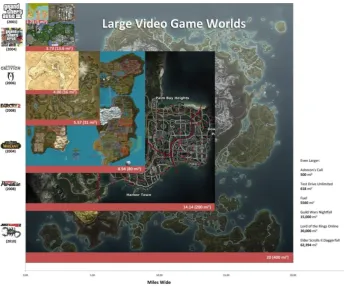
Figure 7: Comparison of Progression of Openworld games (Source Hexapolis.com 2014) .... 39
Figure 8: Elements of Level Design (Source: Byrne, 2005) ... 52
Figure 9: The Witness Island topographical design/map (Source Gamasutra.com 2016) ... 67
Figure 10: Overview of the Witness Production Process (Source Gamasutra.com 2016) ... 68
Figure 11: The Witness Island biome design (Source Gamasutra.com 2016) ... 69
Figure 12: The Witness History/Narrative design (Source Gamasutra.com 2016) ... 70
Figure 13: The Witness History/Narrative design (Source Gamasutra.com 2016) ... 71
Figure 14: The four elements of the research process (adapted from Crotty 1998, p3) ... 76
Figure 15: Hierarchal representation of the four elements of the research process (Source: Crotty (1998) ... 77
Figure 16: Triangulating „the gap‟ ... 96
Figure 17: Screenshots of Lorian: Quake 3 Level ... 110
Figure 18: EternalKnight Screenshot 1 ... 115
Figure 19: EternalKnight Screenshot 2 ... 115
Figure 20: Religious Fossils Poster ... 119
Figure 21: Religious Fossils Angel „X-Ray‟ ... 121
Figure 22: Religious Fossils Demon „X-Ray‟ ... 121
Figure 23: Religious Fossils Angel Photo/3D Composite ... 122
Figure 24: Religious Fossils Angel Photo/3D Composite ... 122
Figure 25: Bradford Police Station 3D Model ... 126
Figure 26: Bradford Topographic GIS Data/3D Model Overlay ... 127
Figure 27: PlastiCity In-Game Screenshot ... 128
Figure 28: Typical Game Viewpoint (Source Gamereplay.com 2016) ... 142
Figure 29: Visual components of a game ... 143
Figure 30: Hierarchy of Game Visual components ... 143
(Source: graphics.com) ... 153
Figure 33: Autopano Giga Interface (Source Kolor.com) ... 153
Figure 34: Phantasy Star Online; Before & After comparison of „raw Vs final panorama .... 154
Figure 35: TES 3 Morrowind: „Before/After‟ Workflow 1 Comparison ... 155
Figure 36: The Elder Scrolls 3: Morrowind – Before & After Comparison (Workflow 2) ... 156
Figure 37: StarFox Adventures: Before & After Comparison (Workflow 2) ... 156
Figure 38: Blurb Booksmart Interface (Source Blurb.com 2016) ... 162
Figure 39: PivotViewer Interface (Source: Microsoft.com 2016 ... 163
Figure 40: Components of Landscape ... 197
Figure 41: The landscape wheel from „Landscape Character Assessment (adapted from Tudor, 2014) ... 199
Figure 42: Landscape Character Assessment -Unit Hierarchy (Source: gov.uk) ... 199
Figure 43: Eternal Knight Landscape Region Map ... 201
Figure 44: County Durham Regional Character Map (Source Durham.gov.uk) ... 201
Figure 45: Proposed Virtual Landscape Design Framework ... 202
Figure 46: Categories of Biophillic Design (adapted from 2014, 14 Patterns of Biophilic Design) ... 204
Figure 47: Cliff Landscape, Phantasy Star Online (2001) ... 208
Figure 48: Lone Cypress Tree (Ali, 2004) ... 210
Figure 49: Typical Golf Course (Source mounttemplegolfclub.com) ... 212
Figure 50: Phantasy Star Universe: AOTI‟s Forest of Illusions exemplifying Golf Course Design ... 212
Figure 51: Components of Landscape ... 219
Figure 52: Refined Components of Landscape ... 220
Figure 53: ShadowMoss Island Route Flow ... 223
Figure 54: Stage of Games Production 1(Source: e-games.tech.purdue.edu) ... 242
Figure 55: Example Production schedule for a 20 month project (Source: Rabin 2005) ... 244
Figure 56: Crab & Seafood Warehouse Photographic Reference & In Game screenshot from Alan Wake (Source Dreadcentral.com 2015) ... 248
Figure 57: Collated WoLD Reference Sheet (Source worldofleveldesign.com) ... 252
Figure 58: Example Visual Reference Board (Source: worldofleveldesign.com) ... 252
Figure 59: Minority Report Interface (Source hellodesign.com) ... 256
Figure 60: Screenshot of Microsoft‟s BOB interface (Source: toastytech.com) ... 257
Figure 61: Screenshot of the NEZ Tool ... 258
Figure 62: Screenshot from virtual Jean Claude Risset computer game (Source: © Mathias Fuchs 2005) ... 259
Figure 65: Original (non-annotated) Witch (Source Sven Geruschkat
(http://www.svenger.de/) ... 269
Figure 66: Annotated Witch Reference: Interpretation A Example ... 270
Figure 67: Annotated Witch Reference: Interpretation B Example ... 270
Figure 68: Sketch of MindFlow Advent Interface ... 277
Figure 69: IdeaNode Sketch ... 280
Figure 70: Wireframe of MindFlow ... 281
Figure 71: High Concept Mock-up of MindFlow Tool ... 282
Figure 72: UX Storyboard for Theoretical MindFlow Design ... 282
Figure 73: Kyrandia Environment Art Asset (Source: legend of Kyrandia) ... 283
Figure 74: Upscaled Kyrandia Environment Art Asset ... 283
Figure 75: AoI Identified and highlighted ... 284
Figure 76: AoI Sequentially Numbered ... 284
Figure 77: AOI Folders ... 285
Figure 78: DeepZoom Composer Import ... 286
Figure 79: Image & Hotspot image composition in DeepZoom Composer ... 286
Figure 80: Deepzoom Composer Export settings ... 287
Figure 81: Screenshot of MindFlowDeep Zoom Interface ... 292
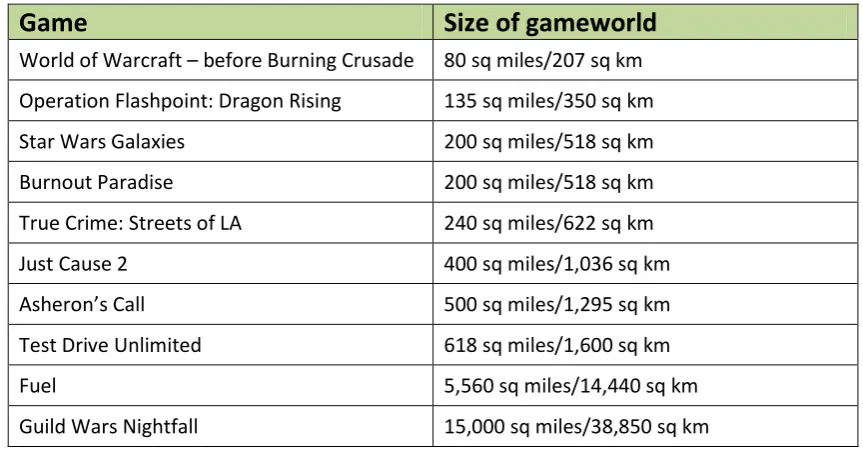
Table 1: Comparison of Game world Sizes ... 38
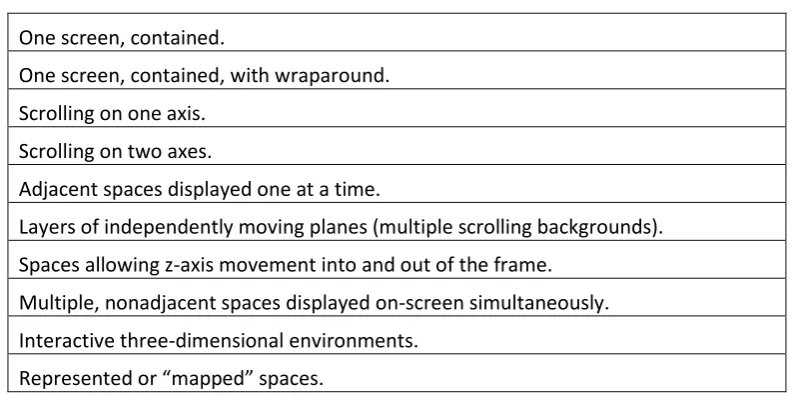
Table 2: Wolf‟s (2002) Typology of Gamespaces ... 44
Table 3: Philosophical Positions aligned to landscape design (Source: Calorusso (2002) ... 80
Table 4: Scriveners model of Creation Production (Source: Scrivener 2002) ... 86
Table 5: PBR Research guidelines (Source: Malins & Gray, 1995)... 94
Table 6: Research Methods Overview ... 107
Table 7: Summary of Artefact Evaluation & Analysis Framework ... 108
Table 8: Lorian Project Outcomes ... 110
Table 9: EternalKnight Project Outcomes ... 115
Table 10: Religious Fossils Project Outcomes ... 123
Table 11: PlastiCity Project Outcomes ... 128
Table 12: Virtually Factitious Project Outcomes ... 131
Table 13: Summary of Individual foundation artefact analysis ... 133
Table 14: Research Methods Overview ... 148
Table 15: List of VNE Games selected for textual analysis. ... 149
Table 16: Summary of emergent research process ... 150
Table 17: Example Reflective Analysis Record Entry ... 158
Table 18: Selected Games-Embryonic Era (1980-1990)... 158
Table 19: Selected Games - Transition Era: 1990-2000 ... 159
Table 20: Selected Games - Modern Day Era: 2000-2010 ... 160
Table 21: Selected sample of online forum postings ... 176
Table 22: List of Virtual Landscape publishers ... 178
Table 23: Sales/Views of Virtual Landscape outcomes ... 180
Table 24: Biophillic Design Physical vs Virtual environment ... 204
Table 25: Research Methods Overview ... 215
Table 26: Summary of Research Process ... 216
Table 27: Study Document Appendix/Reference ... 217
Table 28: Overview of study output ... 218
Table 29: Analysis of Research Objectives ... 225
Table 30: World of Level design Types of Visual Reference & Considerations (Source: worldofleveldesign.com) ... 251
Table 31: Example Workflow (Source Adapted from Polycount.com) ... 254
Table 34: Summary Review of VNE Prototyping Software ... 274
Table 35: Advent Interface Design Vs MindFlow Interface Design ... 276
Table 36: Summary of Study Outputs ... 288
Table 37: Pre Production Referencing Process Guidelines ... 289
Table 38: Analysis of Research Objectives ... 293
Table 39: Research Output/Type ... 305
Table 40: Keyword Output Test Results 1 ... 308
Table 41: Keyword Output Test Results 2 ... 308
I offer this thesis as an original and substantial contribution to knowledge in virtual natural environment design practice within computer and video games, by identifying areas of strong/weak practice and to develop a new design framework that utilises a cross-disciplinary approach for practitioners/students/researchers. The thesis combines theoretical frameworks as well practical guidance within a new design framework for virtual natural environment design.
The themes relating to this work were examined through a contextual review that focused on previous professional practice as well as critical games produced during the last 30 years. The contextual review involved a detailed textual and visual-based historical survey of virtual landscapes, resulting in a practice-based exploration of virtual natural environment design in computer and video games. One of the main artefacts produced in this research, a three-volume book series titled Virtual Landscapes, presents for the first time these virtual spaces in a digitally enhanced manner through high-resolution panoramic imagery.
A review of existing literature and current practice revealed that virtual natural environment design has so far been driven by mainly aesthetic principles and hinted that future emergent design practice should involve a cross/multi-disciplinary approach. The research proposes a new design framework for the creation of virtual landscapes that uses Landscape Character
Assessments amongst other elements of environmental design. ShadowMoss Island is a
practice-based exploration of how virtual natural environmental design can incorporate elements from Environmental Psychology and Geology, as well as personal reflections and observational analysis based on a field trip. The research proposes that psychological elements added to this new design framework can radically improve the success and impact of the final virtual natural environment.
Another practice-based artefact, MindFlow, was created as a pre-production tool for the
purpose of environmental design. The proposed tool enables the direct visualisation of collated multimedia (audio, images, video, annotations, design and decisions) in much more natural setting of a single visual space, allowing designers/artists to draw and influence the design and creation of virtual natural environments by bringing together all the different aspects in an
intuitive and user-friendly manner. MindFlow helps solve the problem of designers/artists
having to retain mental maps of image repositories structure by creating a single visual non-folder tree hierarchy virtual space.
I would like to convey my sincere gratitude to my three supervisors whom I have been privileged to work with during the many years this study has taken to complete, and without which the work would have never have started or finished.
To my first supervisor, Professor Mathias Fuchs; my sincere gratitude for inspiring and motivating me during the early years of the research, and allowing me to work with you on several projects which were completely transformative as a practitioner, and served as the foundation for this study. I am still in awe of your creative insight, intellect and your passion, as well as how you engage with your students and those around you, with respect and sincerity.
To my second supervisor, Professor Erik Knudsen, I would like to offer my sincere gratitude for guiding me when the research passed through a difficult part of my life, your insight, understanding and passion for creative practice and research is truly unique.
To my final supervisor, Dr Marianne Patera, I would like to offer my sincere gratitude in helping me to finish the writing up the thesis, your professionalism and sense of humour is second to none, and your ability to positively motivate is only matched by your unrivalled ability in structuring, formatting and editing the messy and jumbled work into a coherent body of work.
I would like to thank my dear wife Faiza for taking care of many things when I was busy with the research. To my dear children, Mariyam and Zayn, I offer you my eternal appreciation for being so patient with me, and I say this; I am sorry that daddy was always working, when you wanted to play or simply wanted a little bit of my time and I was unable to offer it, you were too young to understand why your father was always busy, but I hope one day you realise that it was to provide you with a better life and to honour what I‟ve always taught you, to follow your dreams with passion and commitment.
: Introduction
Chapter 1
The thesis is a practice-based investigation that proposes an interdisciplinary approach towards natural environment design in computer and video games. The purpose of this chapter is to provide an introduction to the thesis, the motivations in undertaking the investigation, as well as the research aims and objectives. A summary of both the theoretical framework underpinning the research and the scope of the research are provided. Finally the chapter concludes with an outline of the thesis as well as guidance in how to navigate the additional practice material.
In terms of language, the thesis makes extensive use of the first person since the investigation uses practice as a research method and within that framework it is important to reflect on the practice in order to guide the research through various challenges with a view to make an original contribution to knowledge.
In this thesis I will argue the current virtual natural environment design practice within computer and video games is not sufficiently developed to meet current or future demands. This will be demonstrated by identifying areas of strong/weak practice with an aim to develop a new design framework that utilises a cross-disciplinary approach for practitioners, students and researchers. The research will aim to propose theoretical frameworks as well practical guidance within a new design framework for virtual natural environment design.
Virtual Natural Environment
1.1
The term Virtual Natural Environment (VNE) is used extensively throughout the research. This research is located in the area of computer and video games, and subsequently, does not consider the use of virtual environment in the context of other areas such as animation, film or TV.
directly or with another elements present in the virtual simulation. Virtual environments, in the context of computer and video games, may also allow the user, or the player, restricted, partial or free movement in this space.
These virtual environments can also range in type i.e. they maybe two dimensional (2D), three dimensional (3D) a combination of both (i.e. 2.5D) or include Augmented and Virtual Reality (AR and VR respectively).
Virtual environments can vary in complexity; they can range from simplistic simulations of space (i.e. using basic 2D shapes and colours to simulate a space) to complex realistic simulations of space (i.e. using complex 3D geometrical forms, colours, textures and physics to simulate an environment).
Given the above definitions, a virtual natural environment, is a virtual environment that attempts to simulate a natural environment or includes a strong use of natural elements. Natural elements for the purpose of this investigation are defined here to include anything and everything that is not the built environment or manmade. Natural elements include landscapes, geology (i.e. terrain), flora and fauna and/or environmental phenomena such as climate, weather and seasons.
These natural environment simulations may also be abstract or realistic and can be purely fictional or based on a real physical natural environment. Definitions of these and other terms are provided in the glossary.
Motivation
1.2
The motivation for undertaking this research has come from a combination of personal professional practice, reflection and observation. The three significant strands that motivated me to undertake this investigation were:
of projects a number of residual tasks, both creative and technical remained, the majority of which concerned how to create more immersive and meaningful virtual environments. This investigation provided the opportunity to explore these issues whilst developing creative and technical skills that were not limited by a budget or constrained by a client brief.
2. Personal Interest: The natural world, in particularly scenic landscapes, has captivated and held my attention for many years and as a result I have been an active and keen walker, as well as developing an interest in nature landscape photography. I am also a keen and passionate video game player, and advocate for the transformative power that video games offer. After having played video games for over 30 years, I noticed a growing trend in how natural environments in games were growing in numbers and popularity but also how often they failed to capture the range, beauty, impact and reality of the natural world. This observation prompted a strong urge to conduct an initial review of natural environment design in computer and video games in order to see if my „hunch‟ - that game developers were struggling to develop this embryonic design discipline - was correct; this was later on proven to be the case. The drive to research this area was motivated purely by observations, reflections and conversations with game developers.
Research Questions
1.3
1. How have VNEs evolved in CVG over the last 30 years in both technological and design innovation and what has been (if any) the dominant design paradigm?
2. How have VNEs been perceived and experienced in games in CVG over the last 30 years 3. Can the intangible essence of natural landscapes be distilled into a structural
production-based framework for virtual landscape design?
4. How can one employ a practical approach to natural environment design which goes beyond the dominant paradigm exemplified by narrative/visual driven design?
5. How can one create a framework for VNE designers that incorporates (external design and otherwise) traditions but remains connected to the reality of games production? 6. How can one go beyond the current paradigms in organising and managing multivariate
contextual reference data in the pre-production phase of creating of a virtual environment?
Research Objectives
1.4
1. To conduct a literature and contextual review in order to explore the evolution of VNEs in CVG over the last 30 years focussing on technological and design innovation and to identify what is the current dominant design paradigm.
2. To examine how have VNEs been perceived and experienced in games over the last 30 years through reviewing the literature and a wide range of games.
3. To examine and define „landscape‟ into a structural production aligned framework for virtual landscape design. This step involved a literature/contextual review, creation of artefacts and the development of a proposed design framework.
5. To test the proposed VNE design framework through a practice-based process. This involves the creation of a NVE for a game.
6. To propose, develop and evaluate a new method for organising and managing multivariate contextual reference data for the pre-production phase of creating of a virtual natural environment.
7. To disseminate the research findings and practice outcomes of this study to a wider audience (researchers, games, developers, students, etc.) in order to gain feedback and generate discussion.
Scope of the Research
1.5
This thesis is not an in-depth analysis of where computer are video games are situated within society or related media; instead it proposes a practical model of how informed environment design can be achieved and incorporated in the creation of VNEs for games. It highlights the need for further exploration of games design, specifically environment design and encourages practitioner-academics, game developers and students to experiment with alternative theories and methods including using an interdisciplinary approach.
The thesis does not focus on areas such as narrative design or gameplay which already constitute a significant proportion of established research in video games. This research is located in the area of virtual environment design (both theory and practice) and is grounded in using practice as a method and as a focus for positioning the outputs of the research. Therefore, the design framework proposed by this research (composed of processes, tools and guidance) is intended to assist academics, students and practitioners in viewing games from an alternative perspective, and developing them from an informed position through the use of landscape architecture and aligned subject area.
The thesis does not focus on the aesthetics/visual elements of natural environment design, although there are several instances in which this is relevant to discuss and explore, it does so on a superficial level. The focus remains on developing a wider and more comprehensive design approach, process and practical implementation of VNE design. It is also not an analysis of games design or environment design in general as it looks specifically at VNE design within the context of computer and video games.
Thesis Outline
1.6
1.6.1
Theoretical Framework and Literature Reviews
The thesis does not entirely follow a traditional approach of presenting the literature review in a single chapter. Although it includes a literature review chapter at the beginning (Chapter 2) it also offers the relevant literature for each study in the corresponding chapters in order to maintain coherence and flow and not to overwhelm the reader by forcing constant referral back and forth between chapters in order to understand the different concepts presented in each study.
Chapter 2: Literature Review
This chapter is presents a „traditional‟ literature review. This chapter is not meant to provide a review of the entire spectrum of computer and video games research but is specifically located around games design. This is explored from a historical perspective, tracing the evolution and emergence of games design as a discipline. Games design is explored as a field of inquiry and as a practice, and related concepts such as gamespace, gameplay and level design are explored to illustrate the changing nature of the embryonic discipline. Contemporary (2010 onwards) games design, specifically (focused on environment design) is then explored in relation to emerging trends, specifically architecture-informed games design. This leads to the identification of the gap in the theoretical and practical knowledgebase in VNE design and the justification for the investigation.
Chapter 5: The relationship and perception between environment and landscape Chapter 6: The importance and meaning of landscape
Chapter 7: Interface & design metaphors
Chapter 3: Research Methodology
This chapter presents the research methodology strategy and techniques. The purpose of the chapter is to describe and justify the overall research strategy and the range of methods used, specifically focusing on using practice as research.
1.6.2
Studies
These chapters present preliminary studies (carried out before the research begun) as well as series of full studies conducted as part of the investigation.
Chapter 4: Reflection on Foundation practice
This chapter presents a critical analysis through reflective practice of my foundation practice, and arose as a direct result of recommendations in undertaking practice-based doctoral study as revealed and discussed in Chapter 3 (methodology). The chapter specifically looks at issues cantered on VNE design theory and practice, and by applying an action research orientated approach, identifies problems and further questions in order to drive and inform the nature of the practice studies (Chapters 5, 6 and 7).
Chapters 5, 6 and 7 are presented as three studies exploring specific areas of VNE design. A standardised methodological approach was used in order to create a unified and coherent structure that allowed me to systematically work through research problems, whilst offering potential readers a structure that would be clear and comprehendible. The structure is as follows:
1. Identify issues, problems and concerns derived from the previous work (either a study and/or the literature review)
2. Undertake a problem-specific literature and contextual review Use practice as a primary method to explore the problem
3. Analyse, discuss and reflect on findings
Chapter 5: Virtual Landscapes
This chapter presents a study that was designed to explore and illustrate the history and current state of VNE design theory and practice. VNEs across a range of computer and video game platforms and genres were visually analysed and the evolution and development was illustrated using panoramic photography and virtual field trips as a research method. The output of this study was then analysed and reflected upon and a series of observations were made about the process of VNE design. This was then used in conjunction with the specific literature review to create an initial VNE design framework. Finally a range of outputs was created in order to disseminate the work and gain insight into how VNEs were perceived and experienced by a broad range of individuals (i.e. gamers, members of the public and professionals from other subject areas).
Chapter 6:ShadowMoss Island
Chapter 7: MindFlow
This chapter arose through the exploration of study 2 (Chapter 6). MindFlow underpins ShadowMoss Island, and is another practice-based experiment, and was created as a pre-production/design tool and workflow for organising and presenting reference material for virtual environmental design. The proposed tool intents to enable the direct interactive visualisation of collated multimedia (audio, images, video, annotations, design and decisions) in a much more natural setting of a single visual space, allowing designers/artists a single visual point from which they can draw and influence the design and creation of VNEs in order to enable a greater synergy of different aspects to come together through user defined relationships. MindFlow aims to solve the problem of designers/artists having to retain mental maps of image repositories structure by creating a single visual non-folder tree hierarchy-driven virtual digital space from which they can organise, synthesise and be inspired by their contextual research.A prototype was created in Microsoft Silverlight and mock-ups created in Abode Photoshop serve to illustrate the intended design. Mindflow is composed of two components: a tool for organising visual and non-visual reference material, and a supporting framework for pre-production in the form of written guidance.
1.6.3
Scenism & Conclusion
Chapter 8: Scenism
This chapter unifies the work into a single idea or entity. A range of tools, processes, artefacts and extensive recommendations were made in the course of the research and this chapter presents a final „artefact‟ which was created as a result of the exploration around landscape design, both physical and virtual. This chapter discusses how the disparate elements can be brought together to form a unified and coherent construct, one that communicates the research in a more manageable and intuitive manner. The chapter concludes with presenting „Scenism‟ as the embodiment of the proposed VNE design framework.
Chapter 9: Discussion & Conclusions
How to navigate through the thesis
1.7
The accompanying exegesis to the practice-based research follows a structure that may require guidance for the reader. The written materials and practice are interconnected on several levels, and are not to be considered as separate elements; they are bound in meaning, in flow and in purpose, and as such they will need to be engaged as a coherent body of work. The original contribution of the thesis will be contained in the nexus between the written text and artefacts. The following are recommendations on how the work should be considered and „read‟, and suggests a basic roadmap of how the work should be digested:
1. Read Chapter 1: This provides the context for the investigation
2. Read Chapter 2: This is the „main‟ literature review from which the theory for NVE design was derived.
3. Read Chapter 3: This provides an overview and detail on the chosen methodology, its justification and proposed use in the creation of artefacts
4. Read Chapter 4: This introduces the Virtual Landscapes study and sets the context for the artefacts (books)
5. Have a look at the Virtual Landscapes Vol 1-3 books (ebooks)
6. Look at the Virtual Landscapes external media drive folders of panoramic images. 7. Use the PivotViewer Virtual Landscapes tool.
8. Read Chapter 5: This examines the ShadowMoss Island Game
9. Play the CryEngine 3: ShadowMoss Island game, and or watch the ShadowMoss Island trailer.
10. Read Chapter 6: This examines the pre-production (concepting) stage for VNE design 11.Use the MindFlow prototype and/or watch the MindFlow Deepzoom video
12.Read Chapter 8: This introduces the culmination of the research
Digital Artefact Guide
1.8
The accompanying exegesis has a range of digital work, including outputs and working files associated with it. The following lists a description of the digital media folders supplied on the external media drive.
Chapter 4-Foundation practice: A range of foundation practice work.
Chapter 5-Virtual Landscapes: Digital ebooks & Interactive PivotViewer Application & Video
Chapter 6-Shadowmoss Island: ShadowMoss Island Game & Video Trailers
Chapter 7-Mind Flow: Mindflow Prototype
: Literature Review
Chapter 2
Introduction
2.1
The research is concerned with both the evolution of games design, the emergence of gameworld and gamespace and the resulting shift in the roles of games/level designer as other design traditions such as architecture were introduced into the field.
[image:33.595.159.417.398.642.2]In order to provide a context for the research I intend to look at the following areas.
Figure 1 illustrates how these areas relate to each other. Games Design- with a focus on Level Design Gamespace with a focus on gameworlds Architecture with a focus on Landscape Design
Figure 1: Literature Review Domains
Games Design
(Level Design)
Architecture
(Landscape
Design)
GameSpace
Structuring the review
2.2
The structure of this chapter is as follows:
Section Area of Review Description
2.3 Emergence of Video Games Review of the history of the medium
2.4
Technology & Design
Review and definitions ofthe rate of technological
advancement, relationship between games technology and design
2.5
Games Design
Review and definitions of the emergence of games design as a critical aspect of the user experience (gameplay) and games development and the shift from scientific (computational) to visual-driven (aesthetics) design. A history of games design and the role of the game designer is also provided.
2.6
Gameworlds
Review and definitions of the concept of gamespace, gameworlds and implications for game design including an overview of openworld is provided.
2.7 Gamespace
Review and definitions of the concept of gamespace, gameworlds and implications for game design including an overview of openworld is provided.
2.8 Level design
Review of level design is offered, including the emergence of the level design role, a discussion on defining what level design is and an indication of the evolution of the role.
2.9 Importance of Architecture
Discusses the importance of architecture in video games and Virtual Worlds and the current and future use of architecture in video games
2.10 Architecture and Games Design Theory
Discusses the use of architecture in the context of games design
2.11 Contemporary Games Design & Architecture
Reviews contemporary approaches to games design that are derived from an architectural perspective
2.12 Architecture and Games Design Practice: The Witness
Reviews the design process for a contemporary game using an architecture informed approach , The Witness
2.13 The Future Early indicators of future trend in games design
Emergence of Computer & Video Games
2.3
2.3.1
Introduction
Computer & video games today have become, one of the most revolutionary forms of contemporary entertainment, whether it is mass-market explosion of bland sequels or the hyperreal crash physics of racing games such as the hyperreal media culture surrounding virtual figures such as Tomb Raider‟s Lara Croft, the nature of video games has placed them in a unique position.
Computer & video games are an enigma; embodying both the characteristics of post-modern media culture video games are often sold on the premise of ground breaking visuals (i.e. emphasis on style at the expense of substance and content), based on premises that exist outside history and time (i.e. confusions over time and space) but also demonstrate unique characteristics such allowing consumers to have unique experiences within a set product.
2.3.2
Background
As of 2015, Britain is a world leader in computer and video games production; the global games market is estimated to be worth over £80 billion by 2018, with the UK games market contributing £2.48 billion in 2015, and was ranked as the sixth largest in the world (Newzoo, 2015). The UK game market also consisted of just under 2000 video game companies employing ~10, 000 game developers (Mateos & Bakhshi, 2014), making it by far the largest software employment field in Europe. The UK computer and video games industry already exceeded cinema box office takings as well as spending on the rental of DVDs and video in 2009 (Chatfield, 2009).
unique interactive elements that ties together these forms into a potentially new one. However despite the rapid growth of digital games, they are still not truly understood nor recognised by society. As Salen & Zimmerman (2004, p.20) argued that ―The culture at large does not yet see games as a noble, or even particularly useful, endeavour. Games are one of the most ancient forms of designed human interactivity, yet from a design perspective, we still don't really know what games are‖.
2.3.3
Section Summary: Emergence of Games
The medium of games is only ~ thirty years old and has only just emerged in comparison to more established media forms (i.e. film) so it can be argued that it is still in the black and white era.
The language, grammar, tools and process in games development are still emerging as it is in the embryonic era as a medium (Salen & Zimmerman, 2004; Schell 2009).
Video games are primarily a practice-driven, entertainment-focused field, that only in the last decade has contributed to shared knowledge emerging through either academic studies or shared professional practice (Salen & Zimmerman, 2004).
There is a significant number and range of games if viewed as artefacts, however there is limited understanding of both the impact of these artefacts (Salen & Zimmerman, 2004).
Technology & Design
2.4
Video game technology has largely developed incremental advancements based on „generations‟ of consoles from the early Magnavox Odessy in 1976 marking Generation 1 to the first home consoles systems in the third generation (e.g. Nintendo‟s NES, Sega Master System), and the fifth generation which marked a significant expansion of games technologies, game genres and mass market appeal (e.g. Sony‟s first PlayStation console emerged during this era) to the modern day eighth generation in 2015 (e.g. Microsoft‟s Xbox One, Sony PS4).
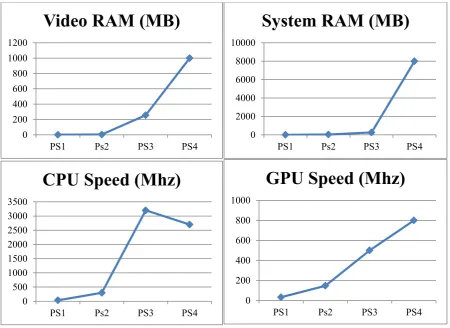
hardware technology. Figure 2 demonstrates the rapid advancement of Sony‟s PlayStation hardware architecture.
Figure 2: Sony PS1 to PS4, CPU/GPU/System & Video RAM Comparison.
Computer software has also seen an almost equivalent increase in complexity, capability and sophistication despite its relatively short lifespan. Figure 3 illustrates the visual changes in games software from a graphical perspective in only two decades. The evolution of the main player character from the game Wolfenstein is shown in 1992 and in 2014. From 32x32bit pixel resolution with 256 colours to full 3D models with a variety of individual 2,000 pixel texture maps just for the character‟s head, coupled with shadow maps, realistic hair and lighting to name a few of the graphic technologies. The evolution of games software in only two decades is clearly apparent (Orland, 2013).
0 200 400 600 800 1000 1200
PS1 Ps2 PS3 PS4
Video RAM (MB)
0 2000 4000 6000 8000 10000
PS1 Ps2 PS3 PS4
System RAM (MB)
0 500 1000 1500 2000 2500 3000 3500
PS1 Ps2 PS3 PS4
CPU Speed (Mhz)
0 200 400 600 800 1000
PS1 Ps2 PS3 PS4
Figure 3: Wolfenstein player character comparison: 1992 Vs 2014 (Source: Gamesradar, 2016)
If we consider video games purely as a construct then digital computer and video games can be considered to be a product of two components: technology and design.
Technology (consisting Hardware/Software technologies) Design: Games Design
Games technology can be broken down into two key areas:
Hardware: Digital hardware technologies have grown exponentially over the last few decades, from the early home computers to the emergence of arcade systems that made the shift from entertainment venues to home use - the revolution of the home game entertainment systems.
technology (hardware and software) and games design. Kojima (2009) discusses the advancement of the early MGS games were in line with the technological advancements, as the technology grew (this was mainly in the forms of hardware developments such as the MSX to the MSX2 or Sony‟s PlayStation 1, 2 and 3 platforms) the design grew, with the design hurdle being represented by what Kojima refers to „barrier/wall of impossibility‟. However there came a point where the technological advancement ceased (i.e. no new platform change) but he was tasked with a „mission impossible‟ utilising the same hardware to create a new experience/game. Kojima‟s innovative solution was to design around the problem using games design to overcome the „wall of impossibility‟.
This approach continued until the development of MGS3 on the PS2, where due to the long life cycle of the platform, Kojima was forced to innovate again, this time choosing to focus on both the software and the design of the new game in order to create a new deeper and more immersive experience. Kojima‟s response was to create his own 3D games engine (software) in order to make the shift from a closed to an openworld environment (a theme followed again in his recent MGS game in 2015 (which will be discussed later in the chapter), this ultimately helped Kojima evolve his design significantly.
Figure 4 illustrates Kojima‟s design philosophy and uses the metaphor of climbing a wall to illustrate his argument; the „foundation‟ is the game‟s hardware, with the software technologies (i.e. games engines) as the second layer (represented as the box), which would get you closer to jumping over the wall of impossibility, but the final step of games design (represented by a ladder) is what is required to finally overcome the challenge.
Kojima also notes two distinct types of games design: Designer-Driven games design and Technology-based games design:
Designer-driven Games Design: Kojima states this is/was his philosophy until recently, where given the foundation of hardware, designers would innovate in order to solve the gap.
Figure 4: Kojima’s Hierarchy of Technology & Games Design (Source: GDC 2009)
Kojima summarises his argument that in „making the impossible possible‘ in game production in order to confront barriers of impossibility developers must use a structured combination of hardware design, software capability and designer-driven game design.
Adams (2009, pp.33-34) also discusses the different influences on games design and specifically lists:
Art-driven: Adams states art-driven games are rare and exist to show off someone‟s artwork and aesthetic sensibilities
Market-driven: These are games where developers have chosen to develop for a certain market and design is focused on increasing sales.
Designer-driven: Here the games designer retains creative control of the game and the production is tightly controlled and directed by the game designer. Adams has a somewhat negative view of a designer-driven approach as it ignored play-testing or other external input.
games to promote a new platform on launch. The problem with technology-driven games is that gameplay and creating an enjoyable experience are often secondary to demonstrating the functionality of the software.
Kojima‟s (2009) model of the relationship between technology, software and design is an original conceptualisation of three forces: hardware, software and design that are driving games development, and one that places design at the forefront of innovation and evolution of games as a medium. Salen & Zimmerman (2004, p.1) also reinforce this perspective that design is at the forefront of the different elements that constitute the elements of modern video games and they state ‖powered by the big bang of computer technology, game design has become a very big deal and the source of some provocative questions about the future of art and entertainment”. It would therefore be a reasonable position to hold that reviewing the progression of both technology and games design and their contemporary state and importance may give us insight into future directions games development may take, as well as any current deficiency or need.
The aim of this research is to focus on design, specifically games design as opposed to software or hardware technologies, although in some instances it may be appropriate to analyse software/hardware technologies driving or used within games design, the focus will remain on games design methodologies, both current and indications of future trends.
Given the importance of games design in determining the user experience, The following section provides an insight into the elements of games design; the diverse role of the game designer as stated the aim of the thesis is to offer new insight and knowledge into the area of games design, In addition critical terminology such as gameplay, immersion will be defined and discussed as they form a critical foundation of the discussion and arguments that follow later in the literature review and subsequent chapters.
2.4.1
Section Summary: Games as a construct
Games can be described as a combination of the result of two main components: technology (hardware/software) and design (Kojima, 2005).
New technologies such as VR and AR are impacting and require potentially new design paradigms especially considering the use and impact of space.
Games Design
2.5
2.5.1
Defining Games & Design
Games design both in and outside the games industry remains the most enigmatic of all game development disciplines. Many still refer to the ‗black art‘ of game design, a mystical discipline that is more art than science. However contemporary usage of „games design‟, a term with many meanings often refers to „digital games design‟ - a relatively new phenomenon. In order to attempt a definition of games design, we will take a step back and look at a wider definition of design by Salen & Zimmerman who state ―Design is the process by which a designer creates a context to be encountered by a participant, from which meaning emerges” (2004, p.41).
However, it is only recently that the field of games design has emerged as a discipline, as Salen & Zimmerman (2004, p.1) state ―For hundreds of years, the field of game design has drifted along under the radar of culture, producing timeless masterpieces and masterful time-wasters without drawing much attention to itself without, in fact, behaving like a ‗field‘ at all‖. This is arguably due to the emergence and rapid rise of digital games and their global impact on society and culture.
A review of the literature on games design reveals the following definitions from established game practitioners/theorists:
―The focus of a game designer is designing game play, conceiving and designing rules and structures that result in an experience for players‖ (Salen & Zimmerman, 2004, p.2)
“The [game] designer‘s role is the same: create the ideas and rules that comprise a game”. Rogers (2014, p.14)
―Game design is primarily an artistic process, but it is also a technical process. The game designer pursues grand artistic goals even as she grinds through mountains of code‖. (Crawford, 1983, p.45)
―Anyone who makes decisions about how the game should be is a game designer. Designer is a role, not a person‖ (Schell, 2009, p.xxv)
―Game design is what determines the form of the gameplay‖ (Rouse, 2001, p.xviii).
From the definitions we can see key elements of games design begin to emerge, namely: gameplay, experience, games design as multidisciplinary technical and artistic process. Therefore to summarise, we can define games design as:
A technical and artistic process in which systems and rules are designed in order to serve the function of gameplay.
2.5.2
History of Games Design
Modern games development has strong foundations in computer science; early games were the result of a lone programmer‟s efforts, level designers and game artist roles did not exist, design was often a secondary consideration and art and music were even less developed and extremely limited due to technological limitations. Bleszinski (2000, p.1) states that ―Programmers were the ‗one stop shop‘ of game creation; they were the ones responsible for designing, producing, and finishing products‖, which is echoed by Byrne (2005, p.9) who explains that ―In the heyday of the video arcade in the 1980s, many games were designed, programmed, and decorated by a single person.” This was possible since the complexity of games was such that this was a manageable task by a single individual, however the rapid evolution of computer and video games would rapidly see this practice change.
considerations, which I will argue later was perhaps detrimental to evolving games design closer to its true potential.
Katie Salen and Eric Zimmerman, both core members of Gamelab (a development company), in addition to extensively writing and practising in the field of games design discuss the emergence and need for games design theory in their book Rules of Play - Game Design Fundamentals (2004) commenting on both range of game design methodologies and their grounding. They state (p.1) that “More recently, within the field itself there has emerged a Babel of competing methodologies… few of them have attempted to ground their insights in a general theoretical system‖. So why do games, considered by some to be nothing more than entertainment requires a theoretical framework? As Salen & Zimmerman argue despite the rapid evolution of games technologies “games have remained creatively stunted.” (ibid, p.1) and the reality of modern games developmentis sadly limited to intellectually stunted, childish or adolescent games. One can argue that this due to the education and training of early game developers, many of whom learned „on the job‟ as opposed to studying games design in a formal manner, however this is changing due to acceptance and proliferation of games design as a subject of study within education, particularly higher education over the last decade.
Salen & Zimmerman perspective on games design theory is also echoed by Schell (2009, p.xxv) who states “at present, there is no unified theory of game design, no simple formula that shows us how to make good games‖ illustrating a startling revelation: a critical aspect of gameplay i.e. what the user experiences, which is created through games design is not driven by an established body of knowledge and as Salen & Zimmerman (2004, p.1) state until recently designers interested in games design theory would be ―forced to stitch together a set of perspectives from sociology, anthropology, psychology, and mathematics, each of which brought its blindman's view of the elephant, and none of which considered games as a creative domain‖. A possible explanation is that the bricolage approach was required until sufficient discourse and critical analysis took place in the field of games design theory leading to the development of theories around games design.
despite using ―incomplete, sometimes incorrect, and often semi-mystical‖ rules early alchemists were able to still accomplish things analogous to ancient alchemy ―Game designers await their Mendeleev. At this point we have no periodic table. We have our own patchwork of principles and rules, which, less than perfect, allows us to get the job done.” Schell‟s analogy is fantastical and although some (such as Yang, 2005) have argued against a grand monolithic theory of games design, given the field of digital games design is only a few decades old, with time it is logical to assume that this „periodic table‟ of the elements of games design will emerge as the medium of computer & video games, matures and develops, and the existing patchwork of principles develops into an established and agreed upon body of knowledge.
Salen & Zimmerman (2004, p.2) also comment on the nature of games design as body of theory stating ―…because of its status as an emerging discipline, game design hasn't yet crystallized as a field of inquiry‖ it is not unreasonable position to hold that the field of game design will eventually, given more time to evolve and develop, will become „crystalized‟ and unified through perhaps the work of a noted individual or when the wider field of games design theorists becomes more established and reaches a critical point (one can argue the underlying studies in the field of game design theory is only no more than 30 years old and as such still in its embryonic stages) a consensus of what game design is will eventually emerge.