International Journal of Emerging Technology and Advanced Engineering
Website: www.ijetae.com (ISSN 2250-2459, UGC Approved List of Recommended Journal, Volume 8, Issue 5, May 2018)
54
Construction Projects Cost Appraisal Using Artificial Intelligence: A Review
Preeti Pateriya
1, J. P. Tegar
21M.Tech Scholar, 2Professor, Department of Civil & Environment Engineering, NITTTR Bhopal-462002, India
Abstract— Construction process mostly depends on the concept of finance management for maintaining the project feasibility and its smooth operation during the entire project execution stages. Forecasting the construction cost at initial stage plays a vital role in any construction project. The forecasting of construction project cost at an early stage affects the decision making process and it gives insight into budgeting and the project feasibility studies. There are many parameters that affect the project construction cost like type of contract, project duration, project location, , quality of work, construction season, construction year, cost variation of material, labor skills and equipment economics.
Professionals and academic researchers has worked
considerably to predict the construction cost at early stage based on the above mentioned parameters using computer software and artificial intelligence and results has been encouraging. Recently Artificial intelligence algorithms are being used extensively to solve multi objective optimization problem by using the human learning and experiences. Considering the potentials of AI, its capability of decision making, Civil engineers are also harnessing for project planning and management including cost appraisal system of the mega construction projects. In the similar context Researcher author has carried out a critical review of various works done in the area of AI and construction project management. In this context this paper presents the reviews of literature pertaining to researches in forecasting the construction projects cost at initial stages.
Keywords — Artificial intelligence, forecasting construction cost, construction project, decision making.
I. INTRODUCTION
Cost estimation is actually the conjecture of cost at early stage of particular project or work. Accuracy in cost estimation of construction project plays a vital role in the success of the project. But it is very difficult to estimate construction cost at the planning stage precisely and rapidly, as drawings, documentation etc. are still incomplete since cost estimate is prepared at various stages during the life of a project on the basis of information available during the time of preparation of estimate. In any construction project mainly three parties are involved, named owner, design professional and construction professional. It is the responsibility of each party involved in the project to estimate the cost during various phases of the project.
An early estimate helps the owner to decide whether the project is affordable within the available budget, which satisfying the project’s objectives. For accurately estimation the cost of construction project various techniques have been used. While all these techniques used have their own merits and demerits, and the appropriateness of any particular method is usually reliant on the purpose it is used for, the information available at the time of estimation, and the people using it. The quality rate analysis is the main traditional cost estimation method. In this method, the entire project is divided into small discrete work items and a unit rate is established for each item. Then these unit rates are multiplied by the required quantity to find the cost for the work items. On the basis of material and labor context quantity rate analysis is the most accurate means of ascertaining cost. In addition to this traditional cost estimation approach, alternative cost estimation methods have been developed and used in recent years in an attempt to improve the reliability of cost estimation for predicting the actual cost of project. And all these non - traditional approaches were based on soft computing techniques i.e.; artificial intelligence. Artificial intelligence is one of the most widely used non-traditional approaches which is currently utilized to predict the early stage construction cost. Artificial intelligence is a science associated with intelligent software programme or machine that are capable for making inference and solve problem in much the same way as human’s do.(Minsky, 1968)
It relate to the part of computer science that focus on designing intelligent computer system that are similar to, what is recognized as intelligence in human behavior. (Barr and Feigenbaum 1981)
There are various factors that play a vital role in estimating the cost such as construction material costs, labor wage rates, construction site conditions, inflation factor, quality of plans and specification, regulatory requirements, size and type of construction projects, location of construction and contingency.
International Journal of Emerging Technology and Advanced Engineering
Website: www.ijetae.com (ISSN 2250-2459, UGC Approved List of Recommended Journal, Volume 8, Issue 5, May 2018)
55
The traditional methods for design modeling, optimization complex structure systems and manual observations of activities are difficult, time consuming and prone to error, so AI helps in automated data collection and data analysis techniques to improve several aspects of construction engineers and management for productivity assessment, safety management, idle time reduction, prediction, risk analysis, decision-making and optimizing construction costs. (Adeli, H. et al)
II. TECHNIQUES OF COST ESTIMATION
The studies used several optimization techniques which may be classical or numerical which leads to the development of methods used in modern technical scenario. After going through the detailed literature review the major optimization techniques utilized by researcher are as follow
A. Artificial intelligence.
Artificial neural network is a computational system inspired by its learning ability form the pattern similar to biological nervous system in the human having many applications in science and engineering. Due to its capability in capturing patterns of incomplete and noisy data sets.
B. Other optimization methods.
Regression analysis, Reference class forecasting, Case base reasoning, Neural network, Support vector machine, Fuzzy inference system, Swarm optimization, Fuzzy logic, Genetic algorithm, Artificial bee colony, Natural language processing, Expert system. network, Support vector machine, Fuzzy inference system, Swarm optimization, Fuzzy logic, Genetic algorithm, Artificial bee colony, Natural language processing, Expert system
.
III. FACTORS AFFECTING THE COST OF PROJECT
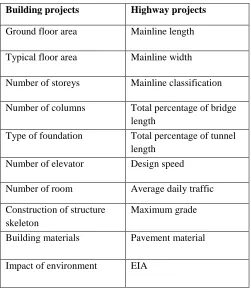
Cost of construction project depends upon the following parameters
A.Basic parameters considered for different construction
[image:2.612.311.562.229.519.2]projects.
Table I Input variables
Building projects Highway projects
Ground floor area Mainline length
Typical floor area Mainline width
Number of storeys Mainline classification
Number of columns Total percentage of bridge length
Type of foundation Total percentage of tunnel length
Number of elevator Design speed
Number of room Average daily traffic
Construction of structure skeleton
Maximum grade
Building materials Pavement material
International Journal of Emerging Technology and Advanced Engineering
Website: www.ijetae.com (ISSN 2250-2459, UGC Approved List of Recommended Journal, Volume 8, Issue 5, May 2018)
[image:3.612.42.301.177.554.2]56
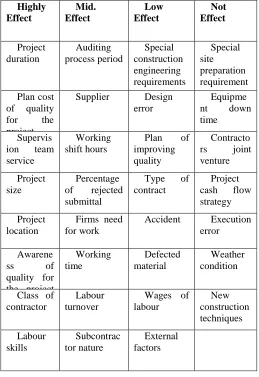
B. Factors affecting the cost of construction projectsTable II Affected variables
IV. EXISTING RESEARCH EFFORTS
Adeli et al. 1998 [1]presented network architecture for estimation of the cost of construction project. The problem is formulated in term of an error function consisting of a standard error term and a regularization term. The regularization neural networks are based on a solid mathematical foundation. This makes the cost estimation model consistently reliable and predictable. The result of estimation from the regularization neural network depends only on the training example. The problem of noise in the data, which is important in the highway construction cost data, is taking into account in a relation manner.
Lowe et al. 1999 [2] developed a model which will be able to predict the final cost of a building using only information typically available at the early stage. This model is objective, as it uses past project data to make its estimates. It has been shown how such a model could form an invaluable tool for the early stage cost estimator. This arises both from the provision of objective information, and the process of feedback of information which implementation of the model would engender. Furthermore, it has been determined that neural network would be suitable for other estimating problems and that the resultant feedback could create an industry which is far more responsibly receptive to new technologies.
Emsley et al. 2002 [3] developed neural network cost model using data collected form nearly 300 building projects. Date were collected form predominantly primary sources using real life data contained in project file, with some data obtained from the building cost information service supplemented with further information, and some from a questionnaire distributed nationwide. The best model obtained was a neural network model using all 41 variables and a voting of 0.798 and a MAPE of 16.6% which is an improvement upon result obtained from regression analyses generally and the best regression model specially (R2 of 0.661 and MAPE of 19.3% for the backward log cost model). Where linear regression and neural network models have been developed using the same variable, neural network always outperform those developed for direct comparison with neural network.
Gunaydin et al. 2004 [4] endeavored a research work to use artificial neural network systems to solve the cost estimation problems in pre-design phase of building projects. To train and test the artificial neural network system cost sheets and design datasheets were collected from 30 different projects with 8 different factors. In the estimation of the reinforced concrete structure per meter square cost of 4 to 8 storied residential building in turkey region, accuracy of 93% was achieved in cost estimation.
Sonmez 2004 [5]discussed the use of regression, neural network, and range estimation technique for conceptual cost estimation of building project. Two neural network model were developed to examine the possible need for nonlinear or interaction term in the regression model. Neural network can identified the relation between variable and the project cost. Regression analysis however, requires a decision about the class of relation (linear, quadratic, etc) to be used in modelling. By using regression analysis and neural network techniques simultaneously, a satisfactory conceptual cost model (which fits the data adequately and has a reasonable prediction performance) can be achieved.
Highly Effect
Mid. Effect
Low Effect
Not Effect
Project duration
Auditing process period
Special construction engineering requirements
Special site preparation requirement Plan cost
of quality
for the
project.
Supplier Design
error
Equipme
nt down
time
Supervis ion team service
Working shift hours
Plan of
improving quality
Contracto
rs joint
venture
Project size
Percentage of rejected submittal
Type of
contract
Project cash flow strategy
Project location
Firms need for work
Accident Execution
error
Awarene
ss of
quality for the project team
Working time
Defected material
Weather condition
Class of contractor
Labour turnover
Wages of labour
New construction techniques
Labour skills
Subcontrac tor nature
International Journal of Emerging Technology and Advanced Engineering
Website: www.ijetae.com (ISSN 2250-2459, UGC Approved List of Recommended Journal, Volume 8, Issue 5, May 2018)
57
G. H. Kim et al. 2005 [6] applied hybrid model of neural network (NN) and genetic algorithm (GA) to cost estimation of residential building to predict preliminary cost estimates. The research revealed that optimizing each parameter of back propagation networks using GAs is most effective in estimating the preliminary cost of residential building. This approach has the following disadvantage: when GA is applied to resolve the difficulty in determining the parameters of a BPN, GA also use trial and error to determine the parameters of the genetic operators.
Wilmot et al. 2005 [7] developed an artificial neural network model which relates overall highway construction costs described in term of a highway construction cost index, to the cost of construction material, labor, and equipment, the characteristics of the contract and the contracting environment prevailing at the time contract. The multilayer feed-forward network was chosen for this study. For training the back-propagation (BP) learning algorithm was used because it has strong classification and generalization capabilities. Predicted overall construction costs are not significantly different from observed cots at the 95% level of significance.
Wang et al. 2008 [8] this research summarizes pre-project planning data collected from 62 industrial pre-project and 78 building projects representing approximately $5 billion in total construction cost. Based on the information obtained, pre-project planning was identified as having direct impact on the project success (cost and schedule performance). Two techniques were then used to develop model for predicting cost and schedule growth statistical analysis and artificial neural network (ANN). To develop the ANN model a commercial software package Neurosolution was chosen for its ease of use (built-in with EXCEL), the calculated coefficient of correlation is about 0.75, which indicate that the ANN model is better than the linear regression model. Based on the collected data this research developed two models to predict the project performance (Cost and Schedule growth individually) using the project definition rating index (PDRI) score. This is first model was simple linear regression model and the second was artificial neural network (ANN) model. Both model show positive relationship between PDRI score and cost/schedule growth for this particular sample of project with better pre project planning are more likely to have a better project performance at completion.
Cheng et al. 2009 [9] proposed the use of an artificial intelligence approach, the evolutionary fuzzy neural inference model (EFNIM), to improve cost estimation accuracy.
The advantage inherent in genetic algorithm, Fuzzy Logic and Neural Network are incorporated into EFNIM, making this model highly applicable to identifying optimal solution for complex problem. Web –Based Conceptual Cost Estimators (EWCCE) obtained by integrating EFNIM, WWW and historical construction data to assist in project management. The overall construction cost estimators was established to estimate a total cost in the absence of categorized engineering plans. The category estimators, with additional data inputs were established to evaluate engineering costs within categories.
Arfa et al. 2011 [10]focused on developing an efficient model to estimate the cost of building construction projects at early stage using artificial neural network. The ANN model which was developed had a hidden layer and seven neurons. The achieved result from the model after training indicate that neural network reasonably succeeded in predicting the early stage cost estimation of buildings using basic information of the projects and without the need for a more detailed design. A sensitivity analysis was carried out to study the influence of each input parameter on the performance of ANN model to predict the cost of building.. Ismaail et al. 2011 [11] used artificial neural network ANN methodology for developing a cost estimation model for identifying overhead cost which frequently occur at a site in Egypt region. He developed and train the model in different cases of 52 building projects which were constructed in Egypt during the duration of seven year from 2002 to 2009 were collected and used as input data. The developed model of neural network consist of one input layer with ten neurons (nodes), one hidden layer having thirteen hidden node with sigmoid function and one output layer. The analysis of the collected data showed project duration, total contract value, project type, special site preparation needs and project’s location are identified as the top five factors that affect the value of the percentage of site overhead cost for building construction project in Egypt.
International Journal of Emerging Technology and Advanced Engineering
Website: www.ijetae.com (ISSN 2250-2459, UGC Approved List of Recommended Journal, Volume 8, Issue 5, May 2018)
58
In their study they formed that the contribution of some input parameter are more than the other like type of work having max contribution of 19.32% structural material having contribution of 16.5% and location is having contribution of 13.43% GFA having least.
Sonmez et al. 2011 [13] used integrated approach in which neural network are used for modeling the mapping function between the factors and costs, and bootstrap method is used to quantify the level of variability included in the estimated cost. Two techniques; elimination of the input variable and Bayesian regularization were implemented to improve generalization capabilities of the neural network model. Feed forward neural network are used to develop an adequate cost model for the continuous care retirement community CCRC project. The input buffer of the first neural network model consisted of 21 units, representing all of the factors (X1, X2, …..,X21) and the output layer consisted of 11 units representing the cost component (Y1, Y2,….,Y11). MAPE values for Model-1, Model-2, and Model-3 were 27.7, 13.5, and 11.7 respectively. Paired t-tests were performed to test the significance of the difference between 1 and Model-2 and between Model-Model-2 and Model-3. He found that the neural network present a powerful tool for modeling of the complex relations between factors and costs. Bootstrap techniques enable a pragmatic method for quantification of the prediction variability.
Tawfek et al. 2012 [14] identified factors affecting the expected cost of quality. A satisfactory neural network model was obtained through one hundred and six experiments for predicting the percentage of cost of quality for building construction projects in Egypt for the future projects this model consist of one input layer with 10 neuron (nodes), one hidden layer having eight hidden nodes with a tangent transfer function and one output layer. This result of testing for the best model indicated a testing roots mean square error (RMS) value of 0.259 and accuracy of (80%).
Sorrentino 2013 [15] developed a practical and automated system that uses an artificial intelligence technique for the planning of an infrastructure construction work, with aim of optimizing time cost quality simultaneously. The model is developed as a multi objective genetic algorithm to provide the capability of quantifying and considering quality in construction optimization. This work showed that the computational power of algorithms that, thanks to the speed of calculation and the simplicity of use can be modified as need during construction and permits continuous monitoring of the projects depending on the requirement the planner will be able to choose the option he/she prefers.
Cheryl Lyne et al. 2014 [16] developed a model using artificial neural network which can predict the overall cost of building projects in the island country Philippines. For this study database were collected from 30 complete projects and were randomly divide into 3 set 20% for validating the performance, 60% for training and 20% for generalization of network. Mainly six parameters as inputs were identified which were: floor area, volume of concrete, area of formworks, weight of reinforcing steel, number of storeys and number of basements. The several variables were first put into an ANN structure simulation done in MATLAB. The back propagation of feed forward technique was used to develop the best model for the total structure which can be considered as best consist of 7 nodes of the hidden layer, 1 output node 6 variables as input. ANN structure 6-7-1 was chosen as the best architecture with the highest correlation coefficient and lowest mean square error MSE. The ANN model developed also predicts the complete structural cost of building with sufficient training and outcomes of testing phase.
EIbeltagil et al. 2014 [17] emphasized on supporting decision makers to predict the conceptual cost of highway projects in Libya region. The factor that mainly affect highway construction project are identified at the beginning. After identification of factors next step was to develop an artificial neural network model for prediction of the cost of highway projects. Sixty seven completed project datasets were used for the training and testing of the networks. Training of the model is administered via propagation algorithm. The programming of model was done and implemented using MATLAB to facilitate its use. For minimization of error of the predicted cost of an optimization module was added to the artificial neural network model. Then validation of model was done and the results shown better prediction of conceptual cost of highway projects in Libya region.
Chandanshive et al. 2014 [18] developed an artificial neural network the resilient back propagation & levenberg marquaedt algorithm are used. Database of 58 building is used in this study which includes residential building, public & commercial building in the Mumbai & nearby region in the state of Maharashtra India. The input layer of the ANN model consists of 9 parameters and total structural skeleton. Cost estimate of building represent network can successfully predict early stage construction cost. Result obtained also shows higher regression co-efficient (R2 ,R) and lower root mean squared error
International Journal of Emerging Technology and Advanced Engineering
Website: www.ijetae.com (ISSN 2250-2459, UGC Approved List of Recommended Journal, Volume 8, Issue 5, May 2018)
59
Shafiee et al. 2015 [19] studied many small-scale industry projects in Iran and found that limited financial resources in the country, from another side, cause delays in the project completion. To respond to this issue in this research they have developed a new cost estimation model based on neural network method. That is why this study was divided into two main phases. In the first phase, a model was built for estimation of the portal frame steel structure weight based on initial specification. The output of this model and other parameters influencing costs of steel structure, were then used in the used in the second phase as the input of the second model to estimate construction cost of the steel structure so that a suitable estimates can be made of the costs of the main production building or the steel structure. The neural network model was then trained and evaluated using the data and finally a model was obtained with accuracy of 95%. The weight and cost estimation model of the portal frames developed is based on preliminary dimensional characteristics of the structure which helps consultant engineering companies to increase accuracy of their estimates in their feasibility studies
adel et al. 2016 [20] identified seven parameters that have significant impact on cost of highway projects. A neural network model was designed consisting of three layers. An input layer with seven neurons representing the cost factors. A hidden layer optimized by using genetic algorithms consisted of 26 neurons.
An output layer consists of one neuron representing the cost of each record of collected highway projects. The model was trained using Levenberg-Marquardt algorithm. It utilized hyperbolic tangent function as transfer function for both the hidden and the output layers. The model results for training, evaluation and validation segments were 4.51%, 5.82%, 16% respectively.
Yadav et al. 2016 [21] developed a cost estimation technique with the use of artificial neural network ANN. Data of last 23 years has been collected from schedule rate book and general studies. 8 input parameters namely cost of cement, sand, steel, aggregate, mason, skilled worker, non-skilled worker and the contractor per square feet construction were selected. This built ANN model reasonably predicted the total structural cost of building projects with correlation factor R-0.9960 and R2-0.9905 giving favorable training and testing phase outcomes. The average absolute error (AE) obtained for training set and test were 21.436 and 27.183 respectively. With error varying from 8.58% (maximum) to 0.11% (minimum).
International Journal of Emerging Technology and Advanced Engineering
Website: www.ijetae.com (ISSN 2250-2459, UGC Approved List of Recommended Journal, Volume 8, Issue 5, May 2018)
[image:7.612.45.563.158.722.2]60
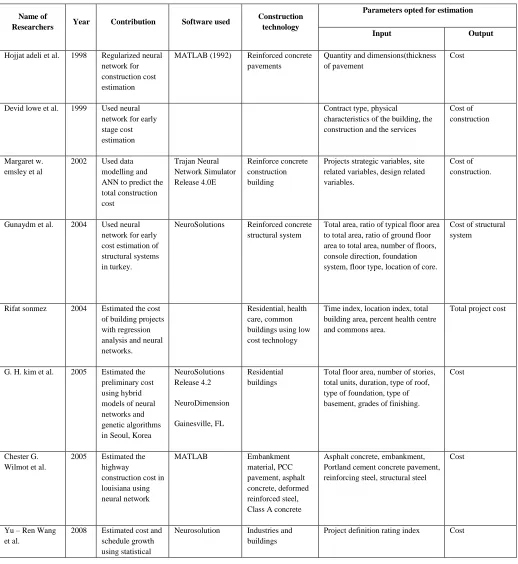
TABLE IIIWork done by various researchers in the field of cost estimation as discussed by this review paper
Name of
Researchers Year Contribution Software used
Construction technology
Parameters opted for estimation
Input Output
Hojjat adeli et al. 1998 Regularized neural network for construction cost estimation
MATLAB (1992) Reinforced concrete pavements
Quantity and dimensions(thickness of pavement
Cost
Devid lowe et al. 1999 Used neural network for early stage cost estimation
Contract type, physical
characteristics of the building, the construction and the services
Cost of construction
Margaret w. emsley et al
2002 Used data modelling and ANN to predict the total construction cost
Trajan Neural Network Simulator Release 4.0E
Reinforce concrete construction building
Projects strategic variables, site related variables, design related variables.
Cost of construction.
Gunaydm et al. 2004 Used neural network for early cost estimation of structural systems in turkey.
NeuroSolutions Reinforced concrete structural system
Total area, ratio of typical floor area to total area, ratio of ground floor area to total area, number of floors, console direction, foundation system, floor type, location of core.
Cost of structural system
Rifat sonmez 2004 Estimated the cost of building projects with regression analysis and neural networks.
Residential, health care, common buildings using low cost technology
Time index, location index, total building area, percent health centre and commons area.
Total project cost
G. H. kim et al. 2005 Estimated the preliminary cost using hybrid models of neural networks and genetic algorithms in Seoul, Korea
NeuroSolutions Release 4.2 NeuroDimension Gainesville, FL
Residential buildings
Total floor area, number of stories, total units, duration, type of roof, type of foundation, type of basement, grades of finishing.
Cost
Chester G. Wilmot et al.
2005 Estimated the highway
construction cost in louisiana using neural network
MATLAB Embankment material, PCC pavement, asphalt concrete, deformed reinforced steel, Class A concrete
Asphalt concrete, embankment, Portland cement concrete pavement, reinforcing steel, structural steel
Cost
Yu – Ren Wang et al.
2008 Estimated cost and schedule growth using statistical
Neurosolution Industries and buildings
International Journal of Emerging Technology and Advanced Engineering
Website: www.ijetae.com (ISSN 2250-2459, UGC Approved List of Recommended Journal, Volume 8, Issue 5, May 2018)
61
analysis and ANN. Min –Yuan
Cheng et al.
2009 Estimated the cost of construction project using fuzzy neural inference model.
Microsoft windows, visual basic for EFNIS, ASP, and a database
Reinforced concrete structure
Floor underground, total floor area, floors aboveground, site area, number of households, households in adjacent buildings, soil condition seismic zone, interior decoration, electromechanical infrastructure.
Total unit cost
Mohammd Arfa et al.
2011 Estimated the cost of building projects at early stage using ANN
MATLAB (2009b)
Reinforced concrete structure system
Ground floor area, typical floor area, no. of storeys, no. of columns, types of foundation, no. of elevators, and no. of rooms.
Cost of structural system
Ismaail et al. 2011 Estimated the overhead cost on construction projects in Egypt using neural network.
N-Connection Professional 2.0 (1997)
Reinforced concrete technology
Construction firm category, project size, project duration, project type, project location, type-nature of client, type of contract, contractor joint venture, special site preparation requirements, project need for extra men power
Site overhead cost
Ajibade Ayodeji Aibinu et al.
2011 Estimated the pre-tender building cost using AI
Neurosolutions 4.32
Project size, material, procurement route, project type, location, sector, estimating method and estimated sum
Estimate accuracy
Rifat sonmez 2011 Estimated the range of construction cost using neural network and bootstrap prediction intervals
Residential, health care, common buildings using Low cost construction technology
Total gross residential, commons, nursing facilities and structured parking area, construction cost index, no. of storeys, present area of commons and nursing facilities in the total building area, structured parking area, total gross building area per residential unit, site area, major demolition on site, site waste treatment, wood frame, steel frame, concrete frame, steel and concrete frame, masonry structure, wood exterior finish, vinyl exterior finish, masonry exterior finish, plaster exterior finish, no. of elevator stops, project duration
Cost of (site development, foundation and slab on grade, structure, enclosure, interior finishes, equipment and special construction, conveying systems, mechanical, fire protection, electrical, general requirements Hany Shoukry
Tawfek et al.
2012 Estimated the expected cost of quality in construction projects in Egypt using ANN
Neural Connection 2.0
Traditional reinforced concrete technology
Project duration, planned COQ, supervision team experience, project size, project location, awareness of quality for the project team, class of contractor, client type, labor skills, project type.
Cost of quality
Mariaros sorrentino
2013 Estimated time cost quality for construction using
MATLAB High modulus and mixed concrete
Construction excavation, embankment, geotextile, road foundation, tout venant, protection
International Journal of Emerging Technology and Advanced Engineering
Website: www.ijetae.com (ISSN 2250-2459, UGC Approved List of Recommended Journal, Volume 8, Issue 5, May 2018)
62
genetic algorithms layer, wearing cost Cheryl Lyne et
al.
2014 Estimated the cost of buildings in Philippines using ANN
MATLAB R2010a Reinforce concrete residential buildings
Number of storeys, number of basement, floor area, volume of concrete, area of formworks and weight of reinforcing steel.
Total structural cost
Emad Elbeltagil et al.
2014 Estimated the construction cost of highway in Libya using ANN.
MATLAB Reinforced concrete pavement
Project type, construction of detours, project location, year of project construction, project scope, size of project, project capacity, project duration, construction season, soil type, financial condition.
Cost of construction
Viren B. Chandanshive et al.
2014 Applied artificial neural network for prediction of early stage construction cost
MATLAB R2013a Total plot area, ground floor area, typical floor area, height of building, quantity of shear wall, quantity of exterior wall, number of columns, type of foundation, number of householders.
Total cost of structural skeleton
Alireza Shafiee et al.
2015 Estimated the cost industrial building at the projects definition phase using neural network
MATLAB R2014b Portal frame structure
Width, length of the hall, height, number of bays, crane load.
Weight and cost estimate
Richa yadav et al.
2016 Developed cost estimation model for residential building using ANN
NEURO XL 2.1 Reinforced Cement, sand, steel, aggregate, mason and skilled labor.
Total structural cost
Kareem adel et al.
2016 Developed a parametric model for conceptual cost estimation of highway projects in Egypt
NeuroSolutions V6.03
Asphalt pavement road
Project scope, project duration, year of construction, project region, mainline length, width and classification
Cost
Vinayak Raghunath Ambrule
2017 Estimated the cost of the building at pre design stage using ANN
Reinforced concrete building
V. CONCLUSION
In the context of construction project management, engineers and managers are encountered the problem of cost appraisal especially before the start of contract.
International Journal of Emerging Technology and Advanced Engineering
Website: www.ijetae.com (ISSN 2250-2459, UGC Approved List of Recommended Journal, Volume 8, Issue 5, May 2018)
63
This review of researches carried out has concluded that AI on a very specific project and for a specific parameters can be used successfully. Based on the learning through review of literature, researcher may further take up the application of AI in different context of project management including Cost estimation based on CPWD and market prevailing cost.
REFERENCES
[1] Hojjat Adeli and Mingyang Wu, 1998. ―Regularization Neural Network for Construction Cost Estimation‖, journal for construction engineering and management, , 124(1): 18-24.
[2] David Lowe, Adam Hickson, Anthony Harding, Margaret Emsley and Roy Duff, 1999 ―The Role of Neural Network in Early Stage Cost Estimation in The 21st Century‖ , In proceeding of the RICS
Construction and Building Research Conference, The university of Salford, 1-2 September, Edited by D Baldry and L Ruddock, ISBN 1-85406-968-2, The royal institution of chartered surveyors , vol. 2 pp. 161-168.
[3] Margaret W. Emsley, David J. Lowe, A. Roy Duff, Anthony Harding and Adam Hickson, 2002 ―Data Modelling and The Application of a Neural Network Approach to The Prediction of Total Construction Costs‖ , construction management and economic 20, 465-472.
[4] H. Murat Gunaydin, S. Zeynep Dogan, 2004 ―A Neural Network Approach for Early Cost Estimation of Structural Systems of Building‖, International journal of project management 22, 595-602. [5] Rifat Sonmez, 2004 ―Conceptual Cost Estimation of Building Projects with Regression Analysis and Neural Networks‖ , Can. J. Civ. Eng. 31: 677-683.
[6] G.H. Kim, D. S. Seo, and K. I. Kang, 2005 ― Hybrid Models of Neural Networks and Genetic Algorithms for Predicting Preliminary Cost Estimation‖, J. Comput. Civ. Eng., 19(2): 208-211.
[7] Chester G. Wilmot, M. ASCE, and Bing Mei, 2005 ―Neural Network Modeling of Highway Construction Costs‖, J. Constr. Eng. Manage. , 131(7): 765-771.
[8] Yu-Ren Wang, G. Edward Gibson, Jr., 2008 ―A Study of Project Planning and Project Success Using ANN and Regression Models‖, The 25th International Symposium on Automation and Robotics in
Construction June 26-29.
[9] Min-Yuan Cheng, Hsing-Chih Tsai, Wen-Shan Hsieh, 2009 ― Web-Based Conceptual Cost Estimates for Construction projects Using Evolutionary Fuzzy Neural Inference Model‖, Automation in construction 18 164-172.
[10] Mohammed Arafa and Mamoun Alqedra, 2011 ― Early Stage Cost Estimation of Buildings Construction Projects Using Artificial Neural Networks‖, Journal of Artificial Intelligence, 2011 ISSN 1994-5450 / DOI: 10.3923/ jai.
[11] Ismaail EISawy, Hossam Hosny, and Mohammed Abdel Razek, 2011 ― A Neural Network Model for Construction Project Site Over-head Cost Estimating in Egypt‖, IJCSI International Journal of Computer Science Issues , vol. 8, Issue 3, No. 1 , ISSN (online) : 1694-0814.
[12] Dr. Ajibade Ayodeji Aibinu, Dharma Dassanayake, Thien, Vui Chau, 2011 ― Use of Artificial Intelligence to Predict the Accuracy of Pre Tender Building Cost Estimate‖, Management and Innovation for a Sustainable Built Environment 20-23, Amsterdam, The Netherlands.
[13] Rifat Sonmez, 2011 ―Range Estimation of Construction Costs Using Neural Networks With Bootstrap Prediction Intervals‖, Expert System with Applications 38 9913-9917.
[14] Hany Shoukry Tawfek, Hossam EI-Deen H. Mohammed, Mohamed E. Abdel Razek, 2012 ―Assesment of the Expected Cost of Quality(COQ) in Construction Projects in Egypt Using Artificial Neural Network Model‖, Housing and Building National Research Centre HBRC Journal 8 132-143.
[15] Mariarosa Sorentino, 2013 ―Genetic Algorithms for Construction Time-Cost-Quality Trade-off; A Road Project Case Study‖, ISSN 2036 1602, SPECIAL ISSUE #2/.
[16] Roxas Cherly Lyne C., Ongpeng, Jason Maximino C., 2014 ― An Artificial Neural Network Approach to Structural Cost Estimation of the Building Projects in the Philippines‖, Presented at the DLSU Research Congress De La Salle University, Manila Philippines March 6-8 2014.
[17] Emad Elbeltagi, Ossama Hosny, Refaat Hassan Abdel-Razek, 2014 ―Conceptual Cost Estimate of Libyan Highway Projects Using Artifical Neural Network‖, Emad Elbeltagi et at Int. Journal of Engineering Research and Applications ISSN : 2248-9622, vol. Issue 8 (Version 5), pp. 56-66.
[18] Viren B. Chandanshive, Ajay R. Kambekr, 2014 ―Prediction of Early Stage Construction Cost of Building Projects Using Artificial Neural Network‖, International Journal of Scientific Engineering Research Volume 5, Issue 7, ISSN 2229-5518.
[19] AliReza Shafiee, Amin Alvnachi and Siamak Biglary, 2015 ―A Neural Network Based Model for Cost Estimation of Industrial Building at the Projects Definition Phase‖, 5th International/11th
Construction Specialty Conference. Vancouver British Columbia . [20] Kareem Adel, Ahmed Elyamany, Adel Mahmoud Belal, Akram
Soltan Kotb, 2016 ― Developing Parametric Model for Conceptual Cost Estimate of Highway Project‖, International Journal of Engineering Science and Computing .
[21] Richa Yadav, Monica Vyas, Vivekanada Vyas and Sanket Agrawal, 2016 ―Cost Estimation Model(Cem) for Residential Building Using Artificial Neural Network‖, International Journal of Engineering Research and Technology (IJERT) ISSN: 2278-0181 volume 5. [22] Vinayak Raghunath Ambrule, Prof. Abhijit. N. Bhirud, 2017 ―Use
Artificial Neural Network for Predesign Cost Estimation of Building Projects‖, International Journal on Recent and Innovation Trends in Computing and Communication ISSN: 2321-8169 vol. 5 Issue:2 173-176.
[23] Adeli H. and Hung S. L., 1995 ―Machine Learning-Neural Network, Genetic Algorithms and Fuzzy System‖ John Wiley & Sons, Inc., New York.
[24] Marvin L. Minsky, 1968 ―Semantic Information Processing‖ MIT Press, Cambridge, [3] Barr, A. and E.A. Feigenbaum, ―The Handbook of Artificial Intelligence‖, Vol. I, (Heuristech Press, and William Kaufman,1981).