Harnessing knowledge management in the
process of performance evaluation of
facilities in Malaysia: A critical success
factor
Mat Yasin, MF and Egbu, CO
Title
Harnessing knowledge management in the process of performance
evaluation of facilities in Malaysia: A critical success factor
Authors
Mat Yasin, MF and Egbu, CO
Type
Conference or Workshop Item
URL
This version is available at: http://usir.salford.ac.uk/12824/
Published Date
2010
USIR is a digital collection of the research output of the University of Salford. Where copyright
permits, full text material held in the repository is made freely available online and can be read,
downloaded and copied for noncommercial private study or research purposes. Please check the
manuscript for any further copyright restrictions.
Harnessing Knowledge Management In The Process of
Performance Evaluation of Facilities in Malaysia: A
Critical Success Factors
Yasin, M.F.M.
School of the Built Environment, The University of Salford, Salford, UK. (email: [email protected])
Charles Egbu, C.
School of the Built Environment, The University of Salford, Salford, UK. (email: [email protected])
Abstract
Knowledge is vital in decision making process similarly; performance evaluation of facilities is a strategic tool of generating and sharing new knowledge. Both contribute towards continuous improvement of organisational process performance The systematic management of expanding knowledge within the Facilities Management organisation are obviously very crucial. However, the awareness and knowledge to incorporate user feedbacks as part of the overall building process in Malaysia is relatively low, and the mistakes done in managing facilities largely remain continuous un-documented. The reception towards continuous improvement in developing countries such as Malaysia is, arguably, still at its infancy, and the practice is yet to be fully appreciated by many. Those hindrances and successful factors need to be identified the threat and opportunities can be assessed. To date, critical success factors (CFSs) for implementing knowledge management (KM) in Facilities Management (FM) specifically in facilities performance evaluation process have not been systematically investigated. This paper is aimed to bridge this gap in Malaysia context. Exiting studies on CSFs were reviewed to suit the facilities management field, industry and practice organisation. The identification of its critical success factors provides a means by which an organisation can access the threats and opportunities in overall facilities management environments.
1. Introduction
The concept of KM has been broadly practiced in general management discipline, manufacturing, finance and marketing as well as in built environment field such as in construction industry. Several authors such as (Varcoe, 1993, Alexender, 1994, Carder, 1995, McLennan, 2000, Puddy et al.,2001, Sapri and Pitt, 2005, Pathirage et. al. 2008, Das et al., 2009, Wahid and Fernie, 2009) identified the needs of knowledge management in FM industry for a reasons such as profession progression, strategic approach, innovation, business opportunity and to prepare for future challenges. Nutt (2000) characterises FM as “information saturated” ”data rich” but “knowledge poor” and Sink (1991) suggests that performance measurement is a “mystery….complex, frustrating, difficult, challenging, important, abused and misused” function, the existence of KM in FM organisation become more essential.
In broader FM context, Nutt (2000) sets out to explore four basic FM ``trails''. These trails correspond to the generic types of resource that are central to the FM function; the management of financial resources, human resources, physical resources, and the management of the resources of information and knowledge.
According to Nutt (1999), FM knowledge is of crucial importance and makes a proactive contribution to business, where FM still tends to be technically orientated and reactive. While the relevancy and potential value of available technical and management expertise is recognised, its application to the specifics of facilities operations and management is poorly developed. As contended by Nutt and McLennan (2000), the FM knowledge trail is at an early stage of development in which:
it sets out from an ever widening and ill-defined sphere of activity; it still needs greater internal coherence for many working in the field;
it lacks external coherence to many corporate and business organisations, and to the educated public at large;
it has too few secure methods of its own to underpin good practice;
it has already begun to make its own distinctive contribution within the management field; and
it is insufficiently supported by an adequate knowledge base.
Performance evaluation of facilities Egbu et. al.(2003) contended that failure to capture and transfer knowledge leads to the increased risk of „reinventing the wheel‟, wasted activity, and impaired organisational performance. They further stress that the successful KM could overcome learning barriers, in FM organisation, trough instilling a learning and knowledge sharing environment, providing vision and effective leadership and initiating knowledge sharing reward system.
2.
Identification of critical success factors
Oxford University Press 2002 defined success as “the achievement of something desired, planned or attempted, an event that accomplishes its intended purpose”. Whereas, critical success factor are frequently applied by different management field in various industries in which organisation needs to perform best if it is to achieve overall success and organisational goal. Rockart (1979) define the CSF as;
“…limited number of areas in which satisfactory results will ensure successful competitive performance for the individual, department or organization. CSFs are the few key areas where "things must go right" for the business to flourish and for the manager's goals to be attained.”
The concept was first introduced in 1962 by D Ronald Daniel with aims to assisting managers to better perform their jobs, especially in terms of direction, planning, management of operations, and control (Leidecker and Bruno, 1984). The process than refined by Rockart (1979) by identifying five prime sources:
i- the structure of the particular industry
ii- competitive strategy, industry position, and geographical location. iii- environmental factors
iv- temporal factors, and
v- functional managerial position.
In the context of harnessing knowledge management in the performance evaluation process of facilities, the critical success factors represent the few "factors" which are "critical" to the "success" of the implement the knowledge management in the facilities performance evaluation process.
2.1 FM as a support service
A review of various literature described facilities management as a support function (Olomolaiye, 2004; Alexander 1996, ) to the organisation, but its role in the maintenance of building facilities and in property management are also critical and demanding (Amaratunga et al, 2000; Underwood and Alshawi, 2000; Barrett, 1995). FM is popularly viewed as being divided into two entities based on these two aspects which show the importance of the project life-cycle because they are inter-related and share information from the project brief through to the design life of the building.
2.2
Malaysia FM industry
In Malaysia context, Mustapha and Adnan (2008) identified that the increasing awareness on the importance of a proper maintenance management system becomes the main contributing factor on the development of FM in Malaysia. Subsequent to this, the business management of various organizations has started to promote the need of facilities management as part of the business organization. However, up to the present date, no specific profession has been established in Malaysia. The responsibility of Facilities Manager is often being undertaken by various professionals, especially the Property Valuers, Mechanical and Electrical engineers and the Civil engineers. As noted, these professions are not specifically designed to cover the required skills and knowledge of what is expected from the facility managers.
2.3
Facilities performance evaluation
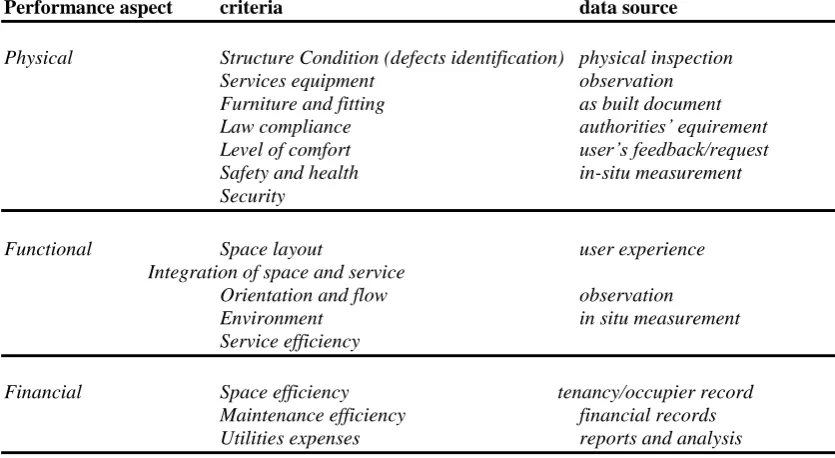
[image:5.595.106.524.479.708.2]The measurement of facilities has three main components, namely, physical, functional, and financial (Williams, 1996). Physical performance relates to the behaviour of the building fabric and embraces physical properties such as structural integrity, heating, lighting, energy efficiency, maintainability, and durability. Functional performance concerns the relationship of the building with its occupiers and embraces issues such as space, layout, ergonomics, image, ambience, communication, health and safety, and flexibility. Finally, financial performance arises from the physical and functional performances of the building and comprises capital and recurrent (life-cycle) expenditures, appreciation and efficiency of use etc. as illustrated in Table 1 below.
Table 1: Typical facilities performance norms
Performance aspect criteria data source
Physical Structure Condition (defects identification) physical inspection Services equipment observation Furniture and fitting as built document Law compliance authorities’ equirement Level of comfort user’s feedback/request Safety and health in-situ measurement Security
Functional Space layout user experience
Integration of space and service
Orientation and flow observation Environment in situ measurement Service efficiency
As part of the strategic planning process in FM industry specifically in conducting performance evaluation, identification of CSF‟s is essential. The identifications is based on three levels of critical success factors analysis as suggested by Hofer and Schendel (1978) which is Macro/Environment level, Industry level and firm level analysis.
2.4
Environmental factors
In the CSFs context, environmental factors referred to economical and technological changes. Business factors such as service offered and player in FM industry are on the supply side. Demand side are referred to market size of the FM industry and client requirement and expectation from FM services.
The technological aspect of FM industry mainly regarded to information technology (IT) and innovation. IT is broadly accepted as a tools to aid the FM processes and very crucial in conducting facilities performance evaluation. Nutt (1999) discussed broadly regarding to innovation in FM industry based on the four common origins of innovation as:
i. Practice-led Innovation ii. Theory-led innovation iii. Personal based innovation iv. Contextual based innovation
From those sources, he further suggests that innovation can be achieved via three basic areas such as 1) innovation through practice; 2) Innovation through research and 3) Innovation through collaboration.
3.
Critical success factors in harnessing knowledge
management
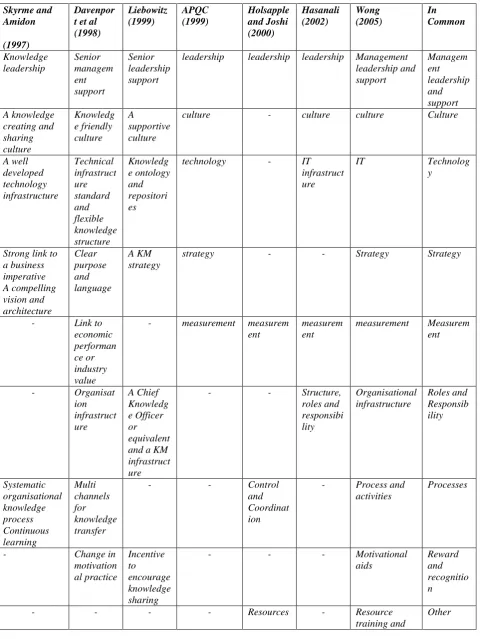
The critical success factors and/or key factor of success in harnessing KM in organisation and processes has been discussed by many authors such as Skyrme and Amidon (1997), Devanport et al (1998), Liebowitz (1999), APQC (1999), Holsapple and Joshi (2000), Hasanali (2002), Wong (2005) and Akhavan and Jafari (2006). The discussion covered in a broad area of management, culture, technology, strategy, measurement, infrastructure, processes, and human resources.
Table 2: Literature analysis on CSFs (adopted from Wong, 2005)
Skyrme and Amidon
(1997)
Davenpor t et al (1998) Liebowitz (1999) APQC (1999) Holsapple and Joshi (2000) Hasanali (2002) Wong (2005) In Common Knowledge leadership Senior managem ent support Senior leadership support
leadership leadership leadership Management leadership and support Managem ent leadership and support A knowledge creating and sharing culture Knowledg e friendly culture A supportive culture
culture - culture culture Culture
A well developed technology infrastructure Technical infrastruct ure standard and flexible knowledge structure Knowledg e ontology and repositori es
technology - IT infrastruct ure
IT Technolog
y
Strong link to a business imperative A compelling vision and architecture Clear purpose and language A KM strategy
strategy - - Strategy Strategy
- Link to economic performan ce or industry value
- measurement measurem ent
measurem ent
measurement Measurem ent
- Organisat ion infrastruct ure A Chief Knowledg e Officer or equivalent and a KM infrastruct ure
- - Structure, roles and responsibi lity Organisational infrastructure Roles and Responsib ility Systematic organisational knowledge process Continuous learning Multi channels for knowledge transfer
- - Control
and Coordinat ion
- Process and activities
Processes
- Change in
motivation al practice Incentive to encourage knowledge sharing
- - - Motivational
aids
Reward and recognitio n
- - - - Resources - Resource
training and
education Human resource management
4.
Harnesing knowledge management in performance
evaluation of facilities
Performance evaluation of facilities is the tools in facilities management to assist decision and policy maker in facilities management organisation to make a decision, develop or revising existing policy on facilities, planning, benchmarking on users satisfaction, safety & health and security for workplace facilities (Yasin and Egbu, 2008). However, as the facilities management frequently viewed as a support function, commonly less attention towards harnessing KM approach in FM processes. As analyse in the Table 2, a communal factors with consideration of characteristic of the facilities performance evaluation in FM organisation, five core factors are proposed as a key in successful implementation of KM in facilities performance evaluation in facilities management organisations.
4.1
Management leadership and support
Policy and decision maker within the organisation are responsible and has a key role in influencing the success of knowledge management. In the performance evaluation of facilities context, these key roles mainly are on the facilities managers and the evaluator team. In the event that the performance evaluation task being outsources to the external experts, the facilities managers are important to inculcate successful implementation of KM. Internally, the facilities managers should exhibit a willingness to share and offer their knowledge freely with others in organisation, to continuously learning and to gain new knowledge. As a policy and decision maker in facilities management organisation, facility manager are in the position to create the organisational culture to harnessing knowledge management in the organisation, implementing new technology such as IT in the organisation, embedding KM elements in organisational processes and activities, draw a strategy for implementing KM in organisation at the first place and make the conducive environment for KM to successfully grown and practice in the organisation
4.2
Culture
be the hindrance and biggest challenge in KM effort. The obstacle of creating a culture in organisation for creating a successful knowledge based enterprise was reported in Chase (1997) survey.
4.3
Technology
Main technologies that crucial in successful performance evaluation of facilities are the information technology and measurement apparatus. Dealing with masses of information, IT has a vital role as an enabler in facilities management organisation particularly in conducting facilities performance evaluation. IT can enable rapid search, access and retrieval of information, and can support collaboration and communication internally or between external parties effectively. In essence, it can certainly play a verity of roles to support KM process (Alavi and Leider, 2001, Lee and Hong, 2002) even though Wong and Aspinwall (2003) contended that it is only a tool and not an ultimate solution. Based on the characteristic of performance evaluation of facilities as discussed earlier in this paper, it can be benefit from IT in many forms of categories such as practice improvement, knowledge base, content and document management, user and client relationship management, data mining, workflow, search, and knowledge networking and mapping.
4.4
Strategy and purpose
Literature shows that the KM strategy should link or integrate to the organisation strategy (Zack, 1999, Cook, 1999, Maier and Remus, 2002). Strategy in facilities management organisation specifically in conducting performance evaluation should include KM approach such as sharing knowledge, innovation, mapping knowledge and knowledge re-use.
4.5
Measurement
The facilities management organisations need to know on how success and effective the KM approach trough the performance evaluation process. Such assessment of the achievement will benchmark and indicates the achievement of KM in the organisation. It is essential to provide basis for organisations to evaluate, compare, control and improve upon the performance of KM (Ahmad et al 1999). Measurement is also needed to demonstrate the value and worthiness of a KM initiative to management and stakeholders.
5.
Conclusion
The importance of knowledge management is clear to the organisation in various fields and in present days, many organisations search for the main reason and key factors for being successful in knowledge system design and implementation through their organisation. With analysing and cross reference to the previous works by various authors, the critical success factors for harnessing knowledge management in facilities performance evaluation has been identified as management leadership support, culture, strategy and purpose, technology, measurement as well as the KM process itself and human resources factor.
As awareness among the users grown towards the needs of performance evaluation and concurrently increasing role of FM, Knowledge Management is predicted to have a bigger role in the industry. Identification of its critical success factors is a strategic approach to ensure successful harnessing KM in organisation.
References
Akhavan P and Jafari M. (2006) “Critical issues for knowledge management implementation at a national level” The Journal of Information and Knowledge Management systems, Vol. 36, No.1, pp52-66.
Alavi M and Leidner D E (2001) “Review: knowledge management and knowledge management systems: conceptual foundations and research issues”, MIS Quarterly, Vol. 25, No.1, pp. 107-36. Alexender K. (1994) “A strategy for facilities management” Facilities, Vol. 12, No. 11, pp. 5-6.
Alexander K (Ed.) (1996) Facilities Management, Theory and Practice, London, E&FN Spon.
Amaratunga D, Baldry D and Sarshar M (2000) “Assessment of facilities management performance – what next?” Facilities, Vol. 18, No.1/2, pp. 66-75.
APQC (1999) “ Knowledge Management : Executive summary”, Consortium Benchmarking Study Best Practice Report, American Productivity & Quality Center, http://www.apqc.org (accessed 10 Oktober 2008)
Barret, P (1992), “Development of a post-occupancy building appraisal model”, in Barrett, P. (Ed.),
Facilities Management: Research Directions, RICS Books, Coventry
Carder P (1995) “Knowledge-based FM: managing performance at the workplace interface” Facilities, Vol. 13, No. 12, pp. 7-11.
Chase R L (1997) “The knowledge-based organization: an international survey” Journal of Knowledge Management”, Vol. 1, No. 1pp.38-49.
Das S, Poh K L and Chew Y L C (2009) “Standardising FM knowledge acquisition when information is inadequate” Facilities, Vol. 27, No. 7/8, pp. 315 -30.
Davenport T H, De Long D W and Beers M C(1998) “Successful knowledge management project”,
Sloan Management Review, Vol. 39, No. 2, pp.43-57.
Egbu C, Kurul E, Quintas P, Hutchinson V, Anumba C, Al-Ghassani A and Ruikar K (2003)
"Knowledge production, sources and capabilities in the construction industry".
Hasanali F (2002) “Critical success factors of knowledge management” http://www.providersedge.com/docs/km_articles/Critical_Success_Factors_of_KM.pdf (accessed 10 July 2009)
Holsapple C W and Joshi K D (2000) ”An investigation of factors that influence the management of knowledge organisations” Journal of Strategic Information System, Vol. 9, No.2/3, pp. 8-17.
Hofer C W and Schendel D E (1978) Strategy formulation: Analytical Concept, West Publishing Company, St Paul, Minn (1978) (as cited in Leidecker and Bruno, 1984)
Liebowitz J (1999) “Key ingredients to the success of an organisation‟s knowledge management strategy” Knowledge and Process Management, Vol. 6, No. 1, pp.37-40
Leidecker J K and Bruno A V (1984) “Identifying and using critical success factors” Long Range Planning, Vol.12, No. 1, pp.23-32.
Maier R and Remus U (2002) “Defining process-oriented knowledge management strategies”
Knowledge and Process management, Vol. 9, No.2, pp. 103-18.
McLennan P (2000) “Intelectual capital:future competitive advantage for facilities management”
Facilities, Vol. 18, No. 3/4 ,pp. 168-172.
Mustapha S A H S and Adnan H (2008) “Facility Management Challenges and Opportunities in the Malaysian Property Sector”, Journal of Sustainable Development, Vol 1, No.2, pp.79-84
Nutt B (1999b), "Strategig management: strategic dicision four competing directions for the future",
proceedings of Conference on Futures in Property and Facility Management. London, pp.27-35.
Nutt B (2000). "Four competing futures for facility management." Facilities 18(3/4): 124 - 132.
Olomolaiye A, Liyanage C L, Egbu C O and Kashiwagi D (2004) "Knowledge management for improved performance in facilities management” COBRA 2004 Conference proceeding.
http://www.rics.org/NR/rdonlyres/DC11F3F6-21B3-49A1-920F-76B5EF5DE0A8/0/knowledge_facilities.pdf (accessed on 23 January 2009)
Pathirage C, Haigh R, Amaratunga D and Baldry D (2008) “Knowledge management practices in facilities organisations; a case study” Journal of Facilities Management, Vol. 6, No.1, pp. 5-22.
Puddy J R, Price I and Smith L (2001) “FM policies and standards as a knowledge management system” Facilities, Vol. 19, No. 13/14, pp. 504-15.
Sapri M and and Pitt M (2005) “Performance measurement in facilities management; state of knowledge” 21st ARCOM conference proceeding, pp. 431-40.
Sink (1991) "The role of measurement in achieving world class quality and productivity management"
industrial Engineering, Vol. 23, No.6.
Skyrme D and Amidon D (1997) “The knowledge agenda” Journal of Knowledge Management, Vol. 1, No.1, pp27-37.
Underwood J and Alshawi M (2000). "Forecasting building element maintenance within an integrated construction environment." Automation in Construction 9(2) pp. 169-184
Varcoe B (1993) “Facilities System – What of the future?” Facilities, Vol. 11, No. 10, pp. 7-11.
Wahid Z and Fernie S (2009) “Knowledge based facilities management” Facilities, Vol. 27, No. 7/8, pp. 258-266.
Wong Y W and Aspinwall E (2003) “Is knowledge management equivalent to information technology?” Proceeding of the Forth European Conference on Knowledge Management, Oxford University, Oxford, pp989-97.
Wong Y W (2005) “Critical success factors for implementing knowledge management in small and medium enterprises” Industrial Management & data System, Vol. 105, No.3, pp. 261-279.
Yasin F and Egbu C O (2008) “Evaluating building performance for offices buildings” International Post Graduate Research 2008, conference proceeding. pp