International Journal of Emerging Technology and Advanced Engineering
Website: www.ijetae.com (ISSN 2250-2459, ISO 9001:2008 Certified Journal, Volume 3, Issue 8, August 2013)60
Triple Correlation Gold Code Channelized Receiver
Mamdouh Gouda
1, Adel El-Hennawy
2, Ahmed Ezzat Mohamed
31Misr University for Science & Technology 2, 3Ain Shams University
Abstract—In this paper the higher-order statistics (HOS) specified in terms of partial triple correlation function (TCF) of Gold code is studied. Detection of Gold code is presented using fixed and adaptive threshold techniques and a triple correlation Gold code channelized receiver is proposed. The receiver takes advantage of the TCF and use it for self-synchronization. The effect of changing the number of channels on the performance of triple correlation (TC) receiver in Additive White Gaussian Noise (AWGN) channel is performed to prove the immunity of the receiver against noise level. Also, the bispectrum of Gold code is considered to identify the presence of Gold code in noise.
Keywords—spread spectrum, Gold code, triple-correlation, HOS, Detection, Channelized.
I. INTRODUCTION
Spread-spectrum (SS) systems achieved widespread use in secure communication for several decades [1]. Thus the estimation of information sequence are of great importance in electronic warfare or wireless communication supervision. The spreading code sequence takes an important role in the spread-spectrum communications. Gold code are one of the most widely used codes in spread spectrum communication systems as it have favourable cross-correlation properties. If the linear feedback shift register (LFSR) are chosen appropriately, Gold sequences have better cross-correlation properties than maximum length LFSR sequences. Previous work proposed a receiver based on HOS where TCF was used to detect Gold code in high noise environment [2].
This paper presents triple correlation of partial Gold code and the effect of AWGN on the identification of Gold code using fixed and adaptive threshold detection techniques, a TC Gold code channelized receiver is proposed and its performance is analysed in AWGN channel. Also, the bispectrum of Gold code and its use in detection is illustrated.
II. TRIPLE CORRELATION OF PARTIAL GOLD CODE In practice, data sample lengths will be shorter than the unknown lengths of any complete sequences present.
A Gold code family can be generated by a preferred pair of m-sequences (u, ν) of period L = 2n – 1 where n is the number of stages used in LFSR and expressed as [3]:
,
, , , , 2 ,.., L1
G u u u uT uT uT
(1)
Where Tkν is the sequence ν delayed by k bits and indicates modulo-2 addition. For the L Gold sequences, individual bits may be expressed:
( ) mod , 0 1
k
i i i k L
w u i L
(2)
The partial TCF of k
w may be defined (N ≤ L) [4]:
1 1 ( , , )
N j
k k k k
N i i p i q
i j
C j p q w w w
N
(3)Using shift and add rule:
, {0,1,..., 1}
,
p kp
p
k k
i i p i i k i p i k p
i i p i k i k p
i r i S p kp
l
i r kp p
w w u u
u u
u r and S L
w l S r
(4)
1 1 ( , , )
p
N j
k l k
N i r i q
i j
C j p q w w
N
(5)Which is the partial cross-correlation between two subsequences of different Gold sequences, (5) may be rewritten:
1 1 ( , , )
N j k
N i i k i p i k p i q i k q
i j
C j p q u v u v u v
N
(6)International Journal of Emerging Technology and Advanced Engineering
Website: www.ijetae.com (ISSN 2250-2459, ISO 9001:2008 Certified Journal, Volume 3, Issue 8, August 2013)61
1 1 1 1 ( , , ) 1 1 , pq kpq N j kN i i p i q i k i k p i k q
i j N j i i i j N m
i pq kpq pq
i
C j p q u u u v v v
N
u v
N
w j and m
N
(7)Thus the general TCF may be regarded as a correlation between two Gold sequences, a cross-correlation of a pair of preferred m-sequences, or the average value of a Gold sequence. For a complete sequence (N = L), all these are 3-valued.
1 0 11 0 1
( 1)/ 2 ( 2)/ 2
, ,
:
( ) / , 1 / , [ ( ) 2] /
1 2 ( ) 1 2 k n n
C p q or
Where
t n L L t n L
for odd n t n
for even n
(8)
For (p′, q′) corresponding to a TCF peak for u and not forv:
' ' 1 ' ' 1 ' ' 1 ' ' 1 , ', ' 1 1 , 0 p q N j kN i k i k p i k q
i j
N j k
i i p i q i j k
N j k
i i r p q
i j k
C j p q v v v
N
v v v
N
v v r
N
(9)Thus CNk
j p q, ', '
is a partial autocorrelation function (ACF) value (for non-zero shift) of an m-sequence, with a mean of -1/L, and its statistical properties independent of kand j. Similar values arise if (p, q) is a peak for v and not for u.
Again, if p = q or either or both of p and q are zero, the average value of the partial TCF is θ-1, θ0 or θ1, depending on k.
For (p, q) exclusively a peak for u or v, the partial TCF in (9) reduces to a partial ACF of an m-sequence. Gives the following mean and variance:
2
1
E ( , , )
1 ' 1 1
var ( , , ) 1
' k
N
k N
C j p q
L
N
C j p q
N L L
(10)
As an N-length intercept is available, N′ = N - q products are used to estimateCNk( , , )j p q , assuming p ≤ q.
For the more general partial TCF expression (7) when (p, q) is not necessarily uor v peak, there are three possible cases: the mean value (actual value when N = L) may be θ-1, θ0 or θ1. Assuming each chip of the Gold sequence may be regarded as independent of the other chips, the first two moments about zero of the partial TCF are:
1 1
E ( , , ) E
1 N k m N i i l l
C j p q w
N N N
(11)
1 1 2 2 2E ( , , )
1 1
1 1
N N
k m m
N i j
i j
l l
C j p q E w w
N N N N
N N
(12) WhereE m m ,
l w wi j i j
(13)
So the variance is
2
1
var CNk( , , )j p q 1 N 1 l lN
N
(14)
Because this variance is zero when N = L (the partial TCF becomes θl), setting (14) to zero gives
2 1 1 l l L L
(15)
Substituting (15) into (14) gives
2 2
( ) ( )(1 )
1 1
var ( , , ) 1
1 1 ( 1)
1 1
1
k l l
N
L N L N
N
C j p q
N L L N L
International Journal of Emerging Technology and Advanced Engineering
Website: www.ijetae.com (ISSN 2250-2459, ISO 9001:2008 Certified Journal, Volume 3, Issue 8, August 2013)62
Assuming L is large and l2is small. The variance approximation in (16) is valid in all three above cases. The Central Limit Theorem may be used to show all three populations are approximately Gaussian with the same variance but means of θ-1, θ0 or θ1.
For the case l0 (θ0= -1/L) the exact variance is:
2
1 1
var ( , , ) 1
1 L ( 1)
k N
N L N
C j p q
N L L
(17)
The expression in (17) is approximately identical to the variance in (10), interpreting N′ and N as the number of products used to estimate the partial TCF.
III. FIXED AND ADAPTIVE THRESHOLD TECHNIQUES FOR GOLD CODE IDENTIFICATION
Real intercepts include signal and noise. Noise changes the structure of Gold code and hence the resulting TCF. Higher order statistics suppress the influence of Gaussian noise signals.
The noise effect on the communication channel makes it harder to identify the received signal correctly. To examine the effect of noise on the received signal, we compare the Gold code of length 63 generated by the preferred polynomials x6 x 1 and x6x5x2 x 1 under
different levels of noise and threshold techniques for decreasing the effect of noise [5].
-Ti [chips]
-T
i
[c
h
ip
s
]
0 10 20 30 40 50 60
[image:3.612.358.523.146.309.2]0 10 20 30 40 50 60
[image:3.612.84.247.474.636.2]Figure 1 Distribution of the triple correlation for Gold code of length 63, without noise effect using a hard decision threshold of 0.7
Figure 2 Distribution of the triple correlation for Gold code of length 63, with noise effect SNR 0 using a hard decision threshold of 0.7
The contour plot for the TCF of the mentioned code without noise effect taken into consideration and using a hard decision threshold of 0.7 is shown in Figure 1, while in Figure 2 the contour plot for the same code under SNR of 0 dB is shown using a fixed hard decision threshold of 0.7. It is obvious that the identification of the code under noise effect is difficult under high levels of noise. Later we will use an adaptive threshold to decrease the effect of noise.
For fixed threshold technique, a specific value of the threshold must be determined, and applied on the output of the TCF to refine it as much as possible, the selection of the threshold is very sensitive.
[image:3.612.358.524.497.661.2]International Journal of Emerging Technology and Advanced Engineering
Website: www.ijetae.com (ISSN 2250-2459, ISO 9001:2008 Certified Journal, Volume 3, Issue 8, August 2013)63
In the Adaptive Threshold (AT) technique, the value of the threshold is changeable according to the effect of the noise. The way of calculating the AT is done through determining the maximum values of the R matrix and set them into a new matrix, where R is the resultant TCF of the Gold code, then the value of the AT will be equal to the minimum value of the new matrix, by this way we guarantee that all the original peaks will persist within the resultant pattern. The contour plot for the TCF of the mentioned code under SNR of 0 dB using an AT is shown in Figure 3.
IV. TCGOLD CODE RECEIVER
There are two kinds of TC Gold code receivers; 1-stage and 2-stage receivers. The first type can be used if the Gold code length is divisible by three. On the other hand, the 2-stage receiver can be used with any code length where it uses the TC peaks of the pair of m-sequences that forms the Gold code.
q′ p′
r(t)
s′ r′
y(t) ΔT
L
Decision
[image:4.612.323.563.143.437.2]Stage-1 Stage-2
Figure 4. Triple correlation Gold code 2-Stage receiver
Figure 4 shows the 2-Stage triple correlation gold code receiver, where (-p′, -q′) and (-r′, -s′) are the TC optimum peaks for the m-sequences u and ν that constitute the Gold code respectively.
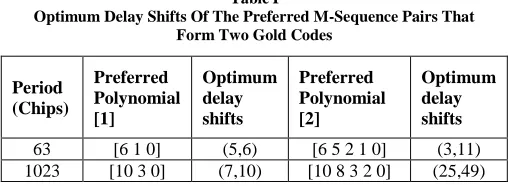
First, it is required to determine the optimum delay shifts for each generating polynomial. So, TCF for each polynomial is calculated and the location of peaks is determined as shown in Table I.
There are other TC peaks but the chosen ones are the optimum as they have minimum Bit Error Rate (BER) where they satisfy two factors [6]. First factor is choosing the minimum difference between delay pairs and the second factor is to choose the minimum delay pairs.
TableI
Optimum Delay Shifts Of The Preferred M-Sequence Pairs That Form Two Gold Codes
Period (Chips)
Preferred Polynomial [1]
Optimum delay shifts
Preferred Polynomial [2]
Optimum delay shifts
63 [6 1 0] (5,6) [6 5 2 1 0] (3,11) 1023 [10 3 0] (7,10) [10 8 3 2 0] (25,49)
At (-p′, -q′), Stage-1 output:
' ' ' ' ' '
i i i p i p i q i q i i p i q i j
uu u
(18)
At (-r′, -s′), Stage-2 output:
' ' 1
i j i j r i j s
(19) The integration period is from T L p' to L
wherep' ' ' ' q r s .
V. PROPOSED TCGOLD CODE CHANNELIZED RECEIVER To improve the performance of the TC Gold code receiver we can use a channelized receiver which consists of parallel triple correlation receivers [7].
q′ p′
r(t)
s′ r′
y(t)
ΔT
L
Decision Stage-1 Stage-2
q′ p′
s′ r′
Stage-1 Stage-2
ΔT
L
÷N Receiver-1
[image:4.612.329.560.301.439.2]Receiver-N
Figure 4 Block diagram of TC Gold code channelized receiver
The output from each receiver is combined together to increase the power of the desired received signal, and then
integrated by integrate and dump filter as shown in Figure 5.
In our designed system, we use gold code of length 63 chips generated by the preferred polynomials x6+ x +1 and
x6 + x5 + x2 + x +1, the receiver will consist of 6 channels where each channel consist of 2-Stage TC receivers and the optimum delay pairs for each polynomial were selected. The delay pairs are (6,5), (12,10), (23,8), (24,20), (25,14), (26,19) for the first polynomial and (11,3), (15,2), (17,7), (22,6), (25,24), (27,18) for the second polynomial.
The performance of the channelized receiver in AWGN channel assuming Eb/N0 from -2 to 4 dB are examined.
[image:4.612.65.280.361.429.2] [image:4.612.41.297.611.704.2]International Journal of Emerging Technology and Advanced Engineering
Website: www.ijetae.com (ISSN 2250-2459, ISO 9001:2008 Certified Journal, Volume 3, Issue 8, August 2013)64
-2 -1 0 1 2 3 4
10-6 10-5 10-4 10-3 10-2 10-1 100
Eb/N0 (dB)
BER
Eb/N0 vs BER
1-Channel 2-Channel 4-Channel 6-Channel
Figure 5 Eb/N0 vs. BER for TC Gold code channelized receiver using
different number of channels
Figure 6 shows that BER of TCF is improved significantly by using channelized receiver where the BER decreases with increasing the number of channels. There is a trade-off between the improvement in performance and the receiver complexity in order to select the optimum choice.
VI. BISPECTRUM OF GOLD CODE
The bispectrum is a complex valued function of two frequencies (f1, f2). The bispectrum of a Gaussian signal
has an average value of zero for all (f1, f2) pairs and a
variance dependent on signal power [8]. The bispectrum provides a frequency domain representation of a sequence, this can be used to reveal the presence of Gold code in Gaussian noise.
[image:5.612.57.287.132.318.2]The bispectrum may be estimated directly from the DFT of an N length windowed signal sample. Alternatively, the bispectrum may be estimated indirectly from the triple-correlation of the signal sample, the bispectrum estimates are then calculated as the two dimensional Discrete Fourier Transform of a suitably windowed TCF.
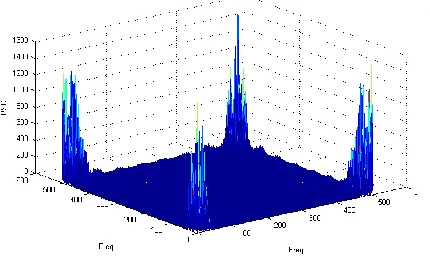
Figure 6 Absolute bispectrum of x(i)8 x 63 length Gold-sequence
Figure 7 shows the absolute bispectrum of a gold code of length 63 chips generated by the preferred polynomials
x6+ x +1 and x6 + x5 + x2 + x +1 sampled 8 sample/chip. The cross-sections of the bispectrum for f1=0 or f2=0, have a sinc2 shape. Gold codes may be distinguished from noise by the four characteristic peaks.
VII. CONCLUSION
[image:5.612.338.553.147.276.2]International Journal of Emerging Technology and Advanced Engineering
Website: www.ijetae.com (ISSN 2250-2459, ISO 9001:2008 Certified Journal, Volume 3, Issue 8, August 2013)65
REFERENCES
[1] R. C. DIXON, R.C, Spread spectrum systems, 3rd ed., John Wiley
and Sons, New York, 1994.
[2] M. Gouda, A. El-Hennawy, A.Ezzat, "Detection of Gold Codes Using Higher-Order Statistics", Informatics and Computational Intelligence (ICI), 2011, pp. 361-364.
[3] D.V. Sarwate and M.B. Pursley, "Crosscorrelation properties of pseudorandom and related sequences", Proceedings of the IEEE, Vol. 68, May 1980, pp. 593-619.
[4] E.R. ADAMS, "Identification of pseudo-random sequences in DS/SS intercepts by higher-order statistics", 2004.
[5] M. Gouda, Y. Ali, "Adaptive and Smart Threshold for M-sequence Identification Using Higher Order Statistics", Computer Modelling and Simulation, 2009, pp. 269-273.
[6] M. Gouda, A. Abdin, E. Essawy, "Optimum detection of data modulated m-sequences using triple correlation receiver", Signals, Circuits and Systems, 2008, pp. 1-4.
[7] M. Gouda, "High Immunity Triple Channelized Correlation Receiver", Computational Intelligence, Communication Systems and Networks, 2009, pp. 409-413.