Symmetry reduction in multiband
Hamiltonians for semiconductor quantum
dots: The role of interfaces and higher
energy bands
Tomic, S and Vukmirović, N
http://dx.doi.org/10.1063/1.3631048
Title
Symmetry reduction in multiband Hamiltonians for semiconductor
quantum dots: The role of interfaces and higher energy bands
Authors
Tomic, S and Vukmirović, N
Type
Article
URL
This version is available at: http://usir.salford.ac.uk/18490/
Published Date
2011
USIR is a digital collection of the research output of the University of Salford. Where copyright
permits, full text material held in the repository is made freely available online and can be read,
downloaded and copied for noncommercial private study or research purposes. Please check the
manuscript for any further copyright restrictions.
Symmetry reduction in multiband Hamiltonians for semiconductor quantum
dots: The role of interfaces and higher energy bands
Stanko Tomic´1and Nenad Vukmirovic´2,a) 1
Joule Physics Laboratory, School of Computing, Science and Engineering, University of Salford, Salford M5 4WT, United Kingdom
2
Scientific Computing Laboratory, Institute of Physics Belgrade, University of Belgrade, Pregrevica 118, 11080 Belgrade, Serbia
(Received 17 April 2011; accepted 25 July 2011; published online 12 September 2011)
The role of interfaces and higher bands on the electronic structure of embedded semiconductor quantum dots (QDs) was investigated. The term in the multibandkpHamiltonian that captures the effect of interface band mixing was derived starting from the microscopic theory. It was shown, analytically and numerically, that, with such a term included, the right symmetry of the QD system can be captured. It leads to splitting of otherwise degenerate energy levels of the order of several meV. The inclusion of additional higher bands beyond the ones from the standard eight-band model also leads to the reduction of symmetry from an artificially high one to the true atomistic symmetry of the system, however their quantitative effect is weaker. These results prove that the multiband kpHamiltonians are fully capable of describing the correct symmetry of a QD.VC 2011 American
Institute of Physics. [doi:10.1063/1.3631048]
I. INTRODUCTION
Semiconductor quantum dots (QDs) are highly interest-ing physical systems both as a platform for fundamental studies of interaction of charges, spins and photons on the nanoscopic scale,1–3 and due to various possible applications.4–16 While certain physical effects in QDs can be qualitatively understood solely based on discreteness of energy levels or using simple particle-in-a-box models, for most purposes an accurate treatment of the electronic struc-ture of QDs is necessary. Typical self-assembled QDs have millions of atoms and therefore the methods based onab ini-tiodensity functional theory, the workhorse of modern elec-tronic structure calculations, are far beyond the reach of present day computational capabilities.17 All the methods developed so far are therefore to a lesser or larger extent semiempirical.18–30 In the multiband envelope function methods (including thekpmethod) the system Hamiltonian is represented through a matrix of operators that act upon a vector of envelope functions of several bands. Such a repre-sentation where all the relevant quantities are slowly varying continuous functions may lead one to believe that the model is a continuous one and that it cannot capture the full sym-metry of the nanostructure.31
The multiband kp Hamiltonians32–49 are capable of reproducing the bulk band structure more accurately than the standard 8-band Hamiltonian. Some of these, that include a large number of bands (Z15 or 30 after incorporation of the spin degree of freedom), are even capable of reproducing the bulk band structure throughout the whole Brillouin zone. Unfortunately, these Hamiltonians have been rarely applied to nanostructures and have not been applied to QDs at all.
The effect of interface band mixing50–54has also so far been analyzed only for a single interface or a quantum well struc-ture. There is even a lack of appropriate framework for a description of the effect of interface induced band mixing in quantum dot heterostructures. The goal of this work is to explore the effects of higher bands and interfaces on the electronic structure of QDs.
The most widely used form of the multiband Hamiltonians for the description of III-V material nanostructures with zinc blende crystal structure is the 8-bandkpHamiltonian.55,56This Hamiltonian indeed yields a higher symmetry of the nanostruc-ture than the true atomistic one. When one is not interested in very fine details of the electronic structure, such a shortcoming can be converted into a strength from the computational point of view, as the existing symmetry (not necessarily the correct one) can be exploited to block-diagonalize the Hamiltonian and therefore reduce the computational time.57–60There is however a widespread belief61that the mentioned deficiency is a general feature of multibandkpHamiltonians and that these cannot be used if one needs to capture the true symmetry of the nanostruc-ture. If this were true, this would be indeed a serious issue. For example, models with high symmetry lead to degeneracies of eigenstates that would be otherwise split and as a consequence lead to inaccuracies in the prediction of polarization dependence of interaction with electromagnetic radiation or the distribution of the excitonic state population and their dynamics.
We find no reason that the mentioned shortcomings of the 8-band kp Hamiltonian would manifest also in multi-bandkpHamiltonians in general. In this work, we therefore analyze the kp Hamiltonians beyond the standard 8-band one, which either include the effect of higher energy bands or include the effect of interface induced band mixing. For the latter, we derive the analytical form of the appropriate Hamiltonian for all interfaces present in the model QD struc-ture and use it in the calculation to understand its role both a)Author to whom correspondence should be addressed. Electronic mail:
0021-8979/2011/110(5)/053710/7/$30.00 110, 053710-1 VC2011 American Institute of Physics
qualitatively and quantitatively. We show both analytically and numerically that beyond 8-band Hamiltonians are capa-ble of capturing the correct atomistic symmetry of QDs and quantify their effect on the electronic structure of QDs.
II. METHODS
As a model system, we consider a QD in the shape of a square-based pyramid, with base to height ratiob=h¼2, which is the most conventional shape assumed in previous theoretical considerations.18,19,26,29,62 The coordinate system is chosen so that vertices of the pyramid are at the points (b=2,b=2, 0), (b=2,b=2, 0), (b=2,b=2, 0), (b=2,b=2, 0), and (0, 0,h).
The kp Hamiltonians discussed in this paper have a general form:
Hkp¼HkþHsoþHþHpzþHif (1)
whereHkis the kinetic part,Hsois the part arising from
spin-orbit interaction, H is the strain part, Hpz is the
piezo-electric part of the Hamiltonian that depends on strain, and
Hifdescribes the interface induced band-mixing contribution
to the HamiltonianHkp. To identify the effect of the Hamil-tonians beyond the standard 8-band one, we have analyzed our model system using several different Hamiltonians that include only certain terms from Eq.(1), each with a different level of sophistication.
(a) The 8-band kp Hamiltonian consisting of the kinetic part only (without the spin-orbit interaction and strain). (b) The 8-band kp Hamiltonian consisting of the kinetic
part with the spin-orbit interaction taken into account (but without strain).
(c) The 8-band kp Hamiltonian consisting of the kinetic part with the interface band-mixing effects taken into account (but without spin-orbit interaction and strain). (d) The standard 8-bandkp Hamiltonian consisting of the
kinetic part with the spin-orbit interaction and strain, as well as the strain-induced piezoelectric potential. It was assumed that piezoelectric polarization depends linearly on strain, though there are some recent suggestions that quadratic effects should be included as well.16,63,64 (e) The 8-band kp Hamiltonian consisting of the kinetic
part with the spin-orbit interaction and strain, as well as the strain-induced piezoelectric potential and the inter-face Hamiltonian.
(f) The 14-bandkp Hamiltonian consisting of the kinetic part only (without the spin-orbit interaction and strain). (g) The 16-bandkp Hamiltonian consisting of the kinetic
part only (without the spin-orbit interaction and strain). (h) The 14-bandkp Hamiltonian consisting of the kinetic
part with the spin-orbit-interaction and strain (as well as the strain-induced piezoelectric potential).
(i) The 16-bandkp Hamiltonian consisting of the kinetic part with the spin-orbit-interaction and strain (as well as the strain-induced piezoelectric potential).
The explicit forms of the multiband Hamiltonians used in this work and the corresponding material parameters are given in Sec.Iof the supplementary information.65
Thekppwcode,30,59appropriately extended to treat the multiband Hamiltonians and the effect of interfaces, was used for all electronic structure calculations presented. Whenever possible, the symmetry of the Hamiltonian was exploited to reduce the computational effort, as described in our previous work.57–59It is in particular important to note that our numerical implementation in a plane wave basis does not reduce the symmetry of the problem; therefore, all energy level splittings that we report originate from the Hamiltonian itself and not from numerical artifacts. In all calculations where strain is taken into account, it has been modeled using the continuum mechanical model.26,66–70
III. INTERFACE TERM IN KP HAMILTONIAN
In the derivation of the interface-induced band mixing terms in the 8-band kp Hamiltonian applied to our model QD system, we follow the approach of Foreman outlined in Ref. 54. The envelope function Hamiltonian at a pointRin space (in the absence of strain and spin-orbit interaction) is equal to54
HmnðRÞ ¼
h2k2 2m0
dmnþ
h m0
kpmnþ ½umjHajunR: (2)
In this equation,umandunare the periodic Bloch functions of bandmandnof a bulk reference crystal,Ha¼p
2
=2m0þV(r)
is the microscopic Hamiltonian that we model using the local empirical pseudopotentials, the square brackets denote the averaging over a unit cell centered on R, k¼ i! and pmn¼[umjpjun], wherepis the momentum operator.
The term [umjVjun]R in the Hamiltonian [Eq. (2)] is a constant of a given material when R is far away from the interface, when the averaging does not include the interface region. Let the interface be perpendicular to the z-direction and located in the z¼0 plane. The “length” of the interface
Lifis determined by the region of space that consists of all
R-vectors such that the average [umjVjun]Rencompasses the interface region. In the case of the [001] interface Lif¼a=2
and in the case of other interfaces considered in this work
Lif ¼a=ð2 ffiffiffi 2
p
Þ, whereais the lattice constant of the bulk. Since the interface region is small and the envelope functions are slowly varying, the details of the variations of the [umjVjun]R are not of primary importance; it is only the integral of this term over the interface region that determines its role in the envelope function Hamiltonian. In the flat interface model, the pseudopotentials are modeled to be equal to those of material A at one side of interface and mov-ing sharply to those of material B at the other side of an interface. We then obtain
ðþLif=2
Lif=2
½umjHajunz0dz0¼ ðþLif=2
Lif=2
½umj
p2 2m0
þVjunz0dz0
½umj
p2
2m0
þVAþVB
2 junLif
þ ½umj
p2 2m0
þVAjun
Lif 2 þ ½umj
p2 2m0
þVBjun
Lif
2 : (3)
In the Eq.(3), the last two terms on the right hand side repre-sent the bulk contribution to the Hamiltonian, while the first two terms are the interface contribution. This implies that for each interface, the envelope function Hamiltonian contains an additional term of the formXmndh(z), withXmngiven by the expression:
Xmn¼ ðþLif=2
Lif=2
½umj
p2 2m0
þVjunz0dz0
½umj
p2
2m0
þVAþVB
2 junLif: (4)
When one chooses the bulk reference crystal as a virtual crystal being the “average” of crystals A and B, the last expression reduces to
Xmn¼ ðþLif=2
Lif=2
½umj
p2
2m0
þVjunz0dz0EmdmnLif; (5)
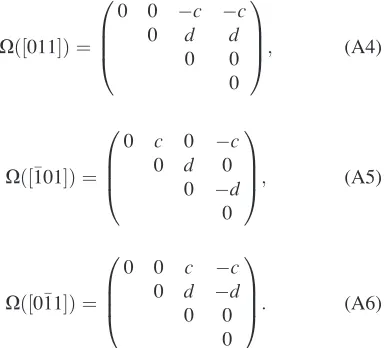
whereEmis the energy of bandmat theCpoint. The actual interface matrices are given in Appendix A, while the crucial steps needed to evaluate the elements of these matrices are outlined in Sec.II of the supplementary information.65 The total interface Hamiltonian is then given by the equation
Hif ¼Xð½001ÞdhðzÞ
þXð½101Þdhðrn1lÞ þXð½011Þdhðrn2lÞ
þXð½101Þdhðrn3lÞ þXð½011Þdhðrn4lÞ: (6)
In the above equation,dh(z) function represents the delta func-tion at a given interface, with an addifunc-tional constraint that the function is nonzero only at the face of the pyramid. The vectors niare the unit vectors perpendicular to the faces of the pyramid and are given asn1 ¼1=
ffiffiffi 2
p
ð1;0;1Þ,n2¼1= ffiffiffi 2
p
ð0;1;1Þ, n3¼1=
ffiffiffi 2
p
ð1;0;1Þ, n4 ¼1= ffiffiffi 2
p
ð0;1;1Þ, and l¼
b=ð2pffiffiffi2Þ. The integrals needed to represent Hifin the plane
wave basis are given in Sec. IV in the supplementary material.65
IV. RESULTS AND DISCUSSION
To understand the role of interfaces and=or higher energy bands, we start by analyzing the conventional 8-band
kpHamiltonian. We consider first its version in the absence of spin-orbit interaction. The symmetry group of such a Hamiltonian applied to a pyramidal square-based QD is the
C4v group. To show analytically that this is really the case, one needs to prove that the representations of the generators of the group, D(g), commute with the Hamiltonian H, i.e., [D(g),H]¼0. The generators of theC4vgroup are the
rota-tion by p=2 about the z axis, Rp=2, and the reflection with
respect to thex¼yplanerv. Equality of the operatorsD(g)H
andHD(g) can be established by showing that they yield the same results when they act on any of the plane wave basis vectors that span the Hilbert space of the system. Indeed, we have shown that [D(Ru),H8kp]¼0 foru¼np=2 and [D(rv),
H8kp]¼0 (see Sec. IIIof the supplementary material for a detailed proof).65
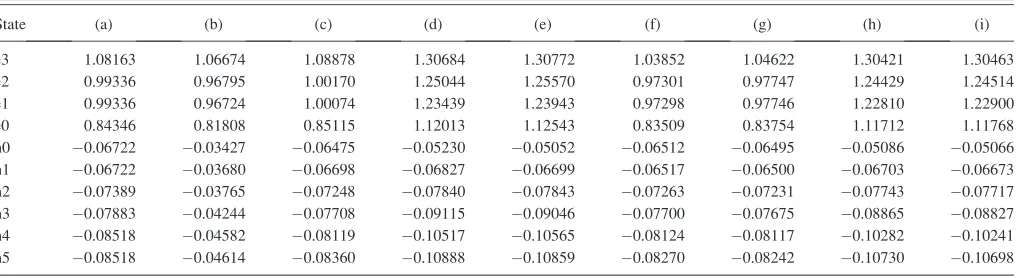
Several prominent features of the energy level structure [TableI(a)] and the wavefunctions [Fig.1(a)] arise as a con-sequence of high symmetry of the system. The pairs of energy levels (e1,e2), (h0,h1) and (h4,h5) are degenerate. The
presence of degenerate energy levels is a consequence of the fact that theC4vgroup has a two dimensional representation
E (the notation of Ref.71). Therefore, the states that trans-form according to that representation come in pairs and are degenerate. The high symmetry of the system can be also witnessed from the shape of the probability density isosurfa-ces [Fig.1(a)]: All of them exhibit perfectC4vsymmetry.
Next, we include the spin-orbit interaction in the 8-band kp Hamiltonian, case (b). The eigenstates now transform according to a representation of the double C4v group which is a direct product of the representation of the single C4v group and the representation D1=2 according to
which the spin functions transform (Ref. 71, p. 142). If the representation obtained from the direct product is reducible, the inclusion of spin-orbit interaction leads to the removal of degeneracy of energy levels. Indeed, the product
E D1=2 is equal to E10þE20 (the notation of Ref. 71). It
is well understood that the effect of spin-orbit interaction on the states in the valence band is rather strong. Here we would, however, like to emphasize a less known fact that the spin-orbit interaction also causes the splitting of the e1
and e2 states [shown in Table I(b)]. The existence of this
[image:4.612.54.562.626.765.2]splitting was established in Ref. 57for pyramidal QDs and later on analyzed again in Ref. 72 for lens-shaped QDs. It
TABLE I. Energies (in eV) of top six hole energy levels and bottom four electron levels, for a square-based pyramidal InAs=GaAs QD with base width
b¼100 A˚ , and base to height ratiob=h¼2 calculated using different models. The letters in the first row in the table specify the model used in the calculation.
State (a) (b) (c) (d) (e) (f) (g) (h) (i)
e3 1.08163 1.06674 1.08878 1.30684 1.30772 1.03852 1.04622 1.30421 1.30463
e2 0.99336 0.96795 1.00170 1.25044 1.25570 0.97301 0.97747 1.24429 1.24514
e1 0.99336 0.96724 1.00074 1.23439 1.23943 0.97298 0.97746 1.22810 1.22900
e0 0.84346 0.81808 0.85115 1.12013 1.12543 0.83509 0.83754 1.11712 1.11768
is important to note here that this energy level splitting effect is not a signature of symmetry reduction. Indeed, it can be seen from Fig. 1(b) that the wavefunction moduli still exhibit a perfectC4vsymmetry.
We proceed to understand the role of interfaces on the energy level structure and the symmetry of the system, case (c). For that purpose we calculate the electronic structure of a QD using the 8-bandkp Hamiltonian in the absence of spin-orbit interaction and the presence of interface effects [Fig.1(c)and TableI(c)]. Our analytical derivations, demon-strate thatboththe [001] interface and the joint effect of the other interfaces independently lead to the reduction of sym-metry from C4v to C2v since both commutators [D(Ru),
H[001]]¼0 and [D(Ru),Hif]¼0 only ifu¼np(see Sec.III
of Ref. 65). The C2v group has one dimensional irreducible representations only and cannot exhibit the doubly degener-ate eigenstdegener-ates. As a consequence, interface effects lead to splitting of the degenerate eigenstates by typically 1–3 meV, as shown in TableI(c). The low symmetry of the system can also be evidenced from the shape of the wavefunction isosur-faces. All the isosurfaces reduce their symmetry from C4v [Fig.1(a)] toC2v[Fig.1(c)]. The symmetry breaking is most pronounced for wavefunctions that were originally degener-ate, while it is weaker, but still present, for the other ones.
To quantify the role of the dot size on the magnitude of interface induced effects, we compare the electronic FIG. 1. (Color online) The wavefunctions squared for top six hole states and bottom five electron states for a square-based pyramidal InAs=GaAs QD with base widthb¼100 A˚ , and base to height ratiob=h¼2 calculated using dif-ferent models. The letters (a)–(c), (e)–(g) specify the model used in the calculation. The isosurfa-ces are plotted at 25% (transparent) and 75% of the maximal charge density.
structure of the Hamiltonians (a) and (c) for several different QDs sizes. We use the splitting of thee1ande2states as a
quantitative measure of interface effects. The results are summarized in Fig. 2. We find that the interface induced splitting of thee1ande2states decreases as the dot
dimen-sions and the dot volume to surface ratio increase. The inter-face effects become less important for dots with large volume to surface ratio.
To identify the role of higher energy bands, we have extended the Hamiltonian to include 14 bands, case (f). We have found analytically that the 14 band kp Hamiltonian commutes with the operators of theC2vgroup representation, i.e., [D(Ru),H14kp]¼0 only foru¼np(see Sec. III of Ref. 65). The terms that contain theP2element which couples the
top of the valence band, C5v, [that originates from the p bonding states (denoted aspb) of atoms in the bulk] with the second conduction band,C5c, [that originates from thep anti-bonding states (denoted aspa) of atoms in the bulk] are the only terms that prevent theC4vsymmetry. Therefore, theP2
element can be identified as the symmetry breaking term in
the 14-bandkpHamiltonian. This term introduces the split-tings, Table I(f), which are however less pronounced than these of the interface terms; for example, the splitting of e1
ande2is less than 0.1 meV. The effect of symmetry breaking
on the wavefunctions is generally similar [see Fig.1(f)] as in the case of interface-induced symmetry breaking. The inclu-sion of the additional band that gives the 16-bandkp Hamil-tonian does not lead to any significant qualitative nor quantitative changes in the results, TableI(g).
It has been previously established57 that the piezoelec-tric effect also reduces the symmetry from C4v toC2v. The results shown in Tables I(d),I(e),I(h) andI(i) indicate that splitting of e1 and e2 states induced by the piezoelectric
effect is stronger than the splittings induced by other effects. One should also stress that in the absence of piezoelectric effect, the strain would also give rise to symmetry reduction if it were modeled using the Valence force field model.26,66–68,70
There is an interest to understand the role of other QD materials on the symmetry breaking and energy level split-ting effects. We have therefore calculated the electronic structure of a QD based on a different material, namely, vir-tually strain free GaAs=Al0.35Ga0.65As QD. This type of
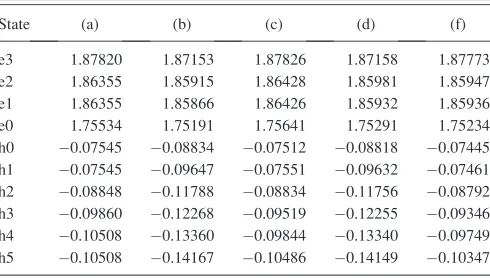
quantum dots cannot be realized via a conventional Stranki-Krastanov growth technique which requires lattice-mismatched materials. Nevertheless, there has been an increasing interest in this quantum dot material system in recent years due to the introduction of techniques for control-lable realization73–75of such quantum dots. The energy lev-els of this dot are summarized in Table II. These results suggest that the splitting ofe1ande2levels due to spin-orbit
interaction and higher energy bands is of the similar order of magnitude as for InAs=GaAs. On the other hand, interface effects are much weaker in this material. This can be under-stood from the fact that AlGaAs and GaAs are more similar materials than InAs and GaAs.
V. CONCLUSION
In contrast to a popular belief that multiband envelope functionkpHamiltonians cannot capture the right symmetry of QDs, we showed here the opposite. We put our conclu-sions into numbers for the case of square-based pyramidal QDs based on III-V materials with zinc blende crystal struc-ture. We showed that the inclusion of interface band mixing effects leads to the reduction of symmetry from an artificial
C4v, to the correct C2v. The main manifestation of interface effects are the energy level splittings between (e1, e2), (h0,
h1), and (h4, h5) states of the order of 1–3 meV in
[image:6.612.54.296.67.255.2]InAs=GaAs material system, which are much weaker in the AlGaAs=GaAs system. The splittings decrease as the dot size and consequently the volume to surface ratio increase. The inclusion of the additional bands beyond the standard 8 bands also leads to symmetry reduction to C2v, with split-tings which are however weaker than the ones due to interfa-ces. We have found that that the lowest order multiband Hamiltonian whose kinetic part has the correctC2vsymmetry is the 14-band kp Hamitonian. This symmetry reduction originates from the coupling between the top of the valence FIG. 2. The dependence of interface-induced splitting of thee1ande2levels
on the size of an InAs=GaAs QD.
TABLE II. Energies (in eV) of top six hole energy levels and bottom four electron levels, for a square-based pyramidal GaAs=AlGaAs QD with base widthb¼100 A˚ , and base to height ratiob=h¼2 calculated using different models. The letters in the first row in the table specify the model used in the calculation.
State (a) (b) (c) (d) (f)
[image:6.612.52.297.626.765.2](C5v) and the second conduction (C5c) band. The observed splittings are comparable to the ones that originate from spin-orbit coupling (these do not reduce the symmetry) and are much smaller than the ones from piezoelectric effect in strained systems. One can further note that other effects than the ones considered in this work can also affect the symme-try of the system, such as the atomic-scale randomness76 in QDs made of alloys, as well as the irregularity of the shape of the dot. Unfortunately, the mentioned symmetry reduction effects cannot be independently measured since in a given QD, they all act jointly. Despite that, our work provides a very important conceptual message: With appropriate treat-ment of relevant effects, the multiband envelope function Hamiltonians are fully capable of capturing the right symme-try of QD structures.
ACKNOWLEDGMENTS
S.T. thanks the STFC’s UK e-Science SCARF facility for providing computer resources. N.V. was supported in part by the Ministry of Science and Technological Develop-ment of the Republic of Serbia, under project No. ON171017, and the European Commission under EU FP7 projects PRACE-1IP, HP-SEE and EGI-InSPIRE.
APPENDIX A: INTERFACE HAMILTONIAN MATRICES
To evaluate the Xmn terms, Eq. (5), we represent the pseudopotentials using the plane waves, where the form fac-tors from Ref. 77 for InAs=GaAs, and Ref. 52 for GaAs=AlAs are used. In the basis
sa
j i; px;b
; py;b
; pz;b
; (A1)
we obtain the following expressions for the Xmn terms for the interfaces of interest in this paper:
Xð½001Þ ¼
0 0 0 a
0 b 0
0 0 0 0 B B @ 1 C C
A; (A2)
Xð½101Þ ¼
0 c 0 c
0 d 0
0 d 0 0 B B @ 1 C C
A; (A3)
Xð½011Þ ¼
0 0 c c
0 d d
0 0 0 0 B B @ 1 C C
A; (A4)
Xð½101Þ ¼
0 c 0 c
0 d 0
0 d
0 0 B B @ 1 C C
A; (A5)
Xð½011Þ ¼
0 0 c c
0 d d
0 0 0 0 B B @ 1 C C
A: (A6)
The values of the parametersa, b, c, anddfor the interfaces considered in this work are given in TableIII.
1
J. P. Reithmaier, G. Sek, A. Loffler, C. Hofmann, S. Kuhn, S. Reitzenstein, L. V. Keldysh, V. D. Kulakovskii, T. L. Reinecke, and A. Forchel,Nature
432, 197 (2004).
2Y. Le´ger, L. Besombes, J. Fernendez-Rossier, L. Maingault, and H.
Mari-ette,Phys. Rev. Lett.77, 107401 (2006). 3
A. Zrenner, E. Beham, S. Stufler, F. Findeis, M. Bichler, and G. Abstreiter,
Nature418, 612 (2002).
4D. Pan, Y. P. Zeng, M. Y. Kong, J. Wu, Y. Q. Zhu, C. H. Zhang, J. M. Li,
and C. Y. Wang,Electron. Lett.32, 1726 (1996). 5
D. Pan, E. Towe, and S. Kennerly,Appl. Phys. Lett.73, 1937 (1998). 6S. Maimon, E. Finkman, G. Bahir, S. E. Schacham, J. M. Garcia, and
P. M. Petroff,Appl. Phys. Lett.73, 2003 (1998). 7
P. Bhattacharya, S. Ghosh, and A. D. Stiff-Roberts, Annu. Rev. Mater. Res.34, 1 (2004).
8
N. Kirstaedter, N. N. Ledentsov, M. Grundmann, D. Bimberg, V. M. Ustinov, S. S. Ruvimov, M. V. Maximov, P. S. Kopev, Z. I. Alferov, U. Richter, P. Werner, U. Gosele, and J. Heydenreich,Electron. Lett.30, 1416 (1994). 9
A. Luque and A. Marti,Adv. Mater.22, 160 (2010).
10A. Marti, E. Antolin, C. R. Stanley, C. D. Farmer, N. Lopez, P. Diaz, E.
Canovas, P. G. Linares, and A. Luque,Phys. Rev. Lett.97, 247701 (2006). 11
S. A. Blokhin, A. V. Sakharov, A. M. Nadtochy, A. S. Pauysov, M. V. Maximov, N. N. Ledentsov, A. R. Kovsh, S. S. Mikhrin, V. M. Lantratov, S. A. Mintairov, N. A. Kaluzhniy, and M. Z. Shvarts,Semiconductors43, 514 (2009).
12
S. Tomic´, T. S. Jones, and N. M. Harrison,Appl. Phys. Lett.93, 263105 (2008).
13P. Michler, A. Kiraz, C. Becher, W. V. Schoenfeld, P. M. Petroff, L. D.
Zhang, E. Hu, and A. Imamoglu,Science290, 2282 (2000). 14
C. Santori, M. Pelton, G. S. Solomon, Y. Dale, and Y. Yamamoto,Phys. Rev. Lett.86, 1502 (2001).
15
S. Kako, C. Santori, K. Hoshino, S. Gotzinger, Y. Yamamoto, and Y. Ara-kawa,Nat. Mater.5, 887 (2006).
16
S. Tomic´ and N. Vukmirovic´,Phys. Rev. B79, 245330 (2009). 17
N. Vukmirovic´ and L.-W. Wang, Compr. Nanosci. Technol.1, 189 (2010). 18J. Kim, L.-W. Wang, and A. Zunger,Phys. Rev. B57, R9408 (1998). 19L. W. Wang, J. Kim, and A. Zunger,Phys. Rev. B
59, 5678 (1999). 20
A. J. Williamson and A. Zunger,Phys. Rev. B59, 15819 (1999). 21
L.-W. Wang and A. Zunger,Phys. Rev. B59, 15806 (1999).
22T. Saito, J. N. Schulman, and Y. Arakawa, Phys. Rev. B 57, 13016 (1998).
23
S. Lee, J. Kim, L. Jo¨nsson, J. W. Wilkins, G. W. Bryant, and G. Klimeck,
Phys. Rev. B66, 235307 (2002).
24R. Santoprete, B. Koiller, R. B. Capaz, P. Kratzer, Q. K. K. Liu, and M.
Scheffler,Phys. Rev. B68, 235311 (2003). 25
W. Sheng, S.-J. Cheng, and P. Hawrylak,Phys. Rev. B71, 035316 (2005). 26
O. Stier, M. Grundmann, and D. Bimberg,Phys. Rev. B59, 5688 (1999). 27
C. Pryor,Phys. Rev. Lett.80, 3579 (1998). 28H. Jiang and J. Singh,Phys. Rev. B
56, 4696 (1997). 29
C. Pryor,Phys. Rev. B57, 7190 (1998). 30
[image:7.612.370.562.63.237.2]S. Tomic´, A. G. Sunderland, and I. J. Bush,J. Mater. Chem.16, 1963 (2006).
TABLE III. Relevant material parameters of the interfaces: InAs=GaAs and GaAs=Al0.35Ga0.65As.
InAs=GaAs GaAs=Al0.35Ga0.65As
a[eV A˚ ] 0.61220 0.14899
b[eV A˚ ] 0.36633 0.02861
c[eV A˚ ] 0.32427 0.07039
d[eV A˚ ] 0.02855 0.00008
31G. Bester and A. Zunger,Phys. Rev. B71, 045318 (2005). 32
P. von Allmen,Phys. Rev. B46, 15382 (1992). 33
U. Ro¨ssler,Solid State Comm.49, 943 (1984). 34
H. Mayer and U. Ro¨ssler,Phys. Rev. B44, 9048 (1991). 35C. Hermann and C. Weisbuch,Phys. Rev. B15, 823 (1977). 36P. Pfeffer and W. Zawadzki,Phys. Rev. B
53, 12813 (1996). 37
P. Pfeffer and W. Zawadzki,Phys. Rev. B41, 1561 (1990). 38
M. Cardona, N. E. Christensen, and G. Fasol,Phys. Rev. B38, 1806 (1988). 39S. B. Radhia, S. Ridene, K. Boujdaria, H. Bouchriha, and G. Fishman,
J. Appl. Phys.92, 4422 (2002). 40
S. B. Radhia, K. Boujdaria, S. Ridene, H. Bouchriha, and G. Fishman,
J. Appl. Phys.94, 5726 (2003).
41O. Zitouni, K. Boujdaria, and H. Bouchriha,Semicond. Sci. Technol.20, 908 (2005).
42
M. Cardona and F. H. Pollak,Phys. Rev.142, 530 (1966). 43
N. Fraj, I. Saı¨di, S. B. Radhia, and K. Boujdaria, J. Appl. Phys. 102, 053703 (2007).
44
C. Bulutay, Turk. J. Phys.30, 287 (2006). 45
D. Rideau, M. Feraille, L. Ciampolini, M. Minondo, C. Tavernier, H. Jaouen, and A. Ghetti,Phys. Rev. B74, 195208 (2006).
46S. Richard, F. Aniel, and G. Fishman, Phys. Rev. B 70, 235204 (2004).
47
M. E. Kurdi, G. Fishman, S. Sauvage, and P. Boucaud,J. Appl. Phys.107, 013710 (2010).
48I. Saı¨di, S. B. Radhia, and K. Boujdaria, J. Appl. Phys. 104, 023706 (2008).
49
I. Saı¨di, S. B. Radhia, and K. Boujdaria, J. Appl. Phys. 107, 043701 (2010).
50U. Ro¨ssler and J. Kainz,Solid State Comm.121, 313 (2002). 51
J. P. Cuypers and W. van Haeringen,Phys. Rev. B48, 11469 (1993). 52
J.-B. Xia,Phys. Rev. B41, 3117 (1990). 53
P. C. Klipstein,Phys. Rev. B81, 235314 (2010). 54B. A. Foreman,Phys. Rev. Lett.81, 425 (1998). 55C. R. Pidgeon and R. N. Brown,Phys. Rev.
146, 575 (1966). 56
T. B. Bahder,Phys. Rev. B41, 11992 (1990). 57
N. Vukmirovic´, D. Indjin, V. D. Jovanovic´, Z. Ikonic´, and P. Harrison,
Phys. Rev. B72, 075356 (2005).
58N. Vukmirovic´, Z. Ikonic´, D. Indjin, and P. Harrison,J. Phys.: Condens.
Matter18, 6249 (2006).
59N. Vukmirovic´ and S. Tomic´,J. Appl. Phys.103, 103718 (2008). 60
S. Dalessi and M.-A. Dupertuis,Phys. Rev. B81, 125106 (2010). 61
A. Zunger,Phys. Stat. Sol. A190, 467 (2002). 62
M. A. Cusack, P. R. Briddon, and M. Jaros, Phys. Rev. B54, R2300 (1996).
63G. Bester, X. Wu, D. Vanderbilt, and A. Zunger, Phys. Rev. Lett. 96, 187602 (2006).
64
A. Schliwa, M. Winkelnkemper, and D. Bimberg, Phys. Rev. B 76, 205324 (2007).
65See supplementary material at http://dx.doi.org/10.1063/1.3631048 for the expressions for Hamiltonians used in this work (Sec. I), the derivation of the crucial matrix element for the evaluation of the interface term in the Hamiltonian (Sec. II), proofs of symmetry of the Hamiltonians (Sec. III) and the expressions for integrals of plane waves over the surfaces of the QD (Sec. IV).
66
D. Bimberg, M. Grundmann, and N. N. Ledentsov,Quantum Dot Hetero-structures(John Wiley, Chichester, U.K., 1999).
67
O. Stier,Electronic and Optical Properties of Quantum Dots and Wires
(Wissenschaft and Technik Verlag, Berlin, 2000). 68
C. Pryor, J. Kim, L. W. Wang, A. J. Williamson, and A. Zunger,J. Appl. Phys.83, 2548 (1998).
69A. D. Andreev, J. R. Downes, D. A. Faux, and E. P. O’Reilly,J. Appl.
Phys.86, 297 (1999). 70
M. Tadic´, F. M. Peeters, K. L. Janssens, M. Korkusin´ski, and P. Hawrylak,
J. Appl. Phys.92, 5819 (2002).
71G. L. Bir and G. E. Pikus,Symmetry and Strain-Induced Effects in
Semi-conductors(Wiley, New York, 1974). 72
J. Even, F. Dore´, C. Cornet, and L. Pedesseau,Phys. Rev. B77, 085305 (2008).
73
N. K. K. Watanabe and Y. Gotoh, Jpn. J. Appl. Phys. Part 239, L79 (2000).
74
A. Rastelli, S. Stufler, A. Schliwa, R. Songmuang, C. Manzano, G. Costan-tini, K. Kern, A. Zrenner, D. Bimberg, and O. G. Schmidt, Phys. Rev. Lett.92, 166104 (2004).
75
D. P. Kumah, S. Shusterman, Y. Paltiel, Y. Yacoby, and R. Clarke1,Nat. Nanotechnol.4, 835 (2009).
76V. Mlinar and A. Zunger,Phys. Rev. B79, 115416 (2009).
77See http://www.research.ibm.com/DAMOCLES/html_files/numerics.html#