International Journal of Emerging Technology and Advanced Engineering
Website: www.ijetae.com (ISSN 2250-2459,ISO 9001:2008 Certified Journal, Volume 4, Issue 3, March 2014)
370
Controller Area Network and its Applications
Akshay Rane
1, Ajit Shendge
2, Rushikesh Shinde
3,
Jyoti Patil
4, Ramakant Patil
5, Nilima Zade
61,2,3,4Students, Dept. Of Electronics, P.V.P.P.College of Engineering, Sion-Chunabatti, Mumbai, 400022.
5,6Asst. Prof, Dept. Of Electronics, P.V.P.P.College of Engineering, Sion-Chunabatti, Mumbai, 400022.
Abstract - The Control Area Network Protocol is a serial communication protocol. The CAN protocol is designed in such a way that the microcontrollers and other devices can communicates with each other within a vehicle in the absence of a host computer. The development of CAN protocol started originally in 1983 at Robert Bosch GmbH. In 1986 at the Society of Automotive Engineers in Detroit, Michigan the CAN protocol was officially released.
CAN protocol is a type of message-based protocol, which is dedicatedly designed for automotive applications but now it has vast applications in other engineering fields like aerospace, maritime, industrial automation and medical equipment.
Keywords - CAN protocol, Control Area Network Protocol,
CAN, CAN networks
I. INTRODUCTION
The CAN is serial communication protocol that supports real time systems with high reliability. It detects the collisions; it also detects the errors, retransmits corrupt messages and gives priority to the received and transmitted messages. The identifier length can be either 11 bits or 29 bits and the data length can vary from 0 to 8bytes. The fast growing use of the CAN protocol in the Industrial applications resulted in development of the CAN based network. In CAN based distributed control system, the major problem is the size of distributed area. The physical length limitation of the CAN bus is 2km at the rate of 20kbps. The maximum speed of the CAN protocol is 1mbps for 50metres and 500kbps for 100metres. Sleep mode and wakeup are available options for each node to reduce power consumption.
A.Standard and Extended Frame Format
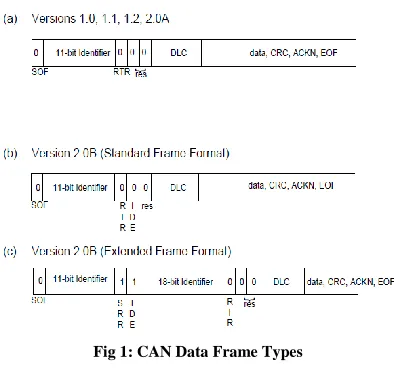
Fig. 1 gives an overview of the different CAN data frame types: All CAN messages start with the identifier (arbitration) field. There are one or three control bits coming along with the identifier. These bits define whether.
[image:1.612.345.542.206.390.2]It is a standard or an extended frame and whether it is a data or a remote frame.
Fig 1: CAN Data Frame Types
Fig. 1 (a) shows the data frame format, how it is specified in the CAN protocol specification versions 1.0, 1.1, 1.2 and 2.0 A. Fully compatible to that is the standard data format (Fig. 1 (b)), how it is specified in version 2.0 B. In contrast to that Fig. 1 (c) describes the extended data format with the 11+18=29 bit identifier (version 2.0 B).The meaning of the three control bits is as follows:
RTR bit - Remote Transmit Request
The RTR bit differentiates between data and remote frames. In data frames this bit is dominant (’0’), in remote frames this bit is recessive (’1’).
SRR bit - Substitute Remote Request
The SRR bit is a recessive bit. It is transmitted in extended frames at the position of the RTR bit of standard frames.
IDE bit - Identifier Extension
International Journal of Emerging Technology and Advanced Engineering
Website: www.ijetae.com (ISSN 2250-2459,ISO 9001:2008 Certified Journal, Volume 4, Issue 3, March 2014)
[image:2.612.65.268.133.321.2]371
Fig. 2 CAN Remote Frame Types
In case that several nodes within one system start a simultaneous transmission of message frames with the same identifier, the following rules are valid: Data frames have a higher priority than remote frames, and standard frames have a higher priority than extended frames. That means that e.g. a standard remote frame wins arbitration against an extended data frame, if the 11 most significant bits of the identifiers are equal.
B.CAN and OSI Model
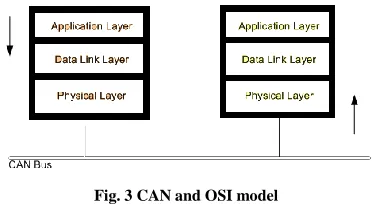
Many communication bus protocols do not use all the seven layers of this OSI Model. Since CAN is a closed network it doesn’t need to have security and to present the data in a user interface. Also it does not need to maintain sessions and logins. Hence it uses only two Layers such as Physical and Data Link Layer. The CAN OSI model shown in fig. 3 explains the transfer of data between two nodes.
Fig. 3 CAN and OSI model
The Physical Layer ensures the physical connection between the nodes in the network. The Data Link layer contains Frames and information to identify the frames and errors. It has information also to determine the bus access.
C.The CAN error process
The error is detected by the CAN controller (a transmitter or a receiver). An error frame is immediately transmitted. The message is cancelled at all nodes (exceptions exist - see CAN controller error modes). The status of the CAN controllers is updated (see CAN controller error modes). The message is re-transmitted. If several controllers have messages to send, normal arbitration is used.
i. Error detection
Error detection is handled automatically by the CAN controller. The detected errors are:
Bit errors:
1. Bit stuffing error: normally a transmitting node inserts a high after five consecutive low bits(and a low after five consecutive high). This is called bit stuffing. A receiving node that detects violation (more than five consecutive bits will see a bit stuffing violation.
2. Bit error: A transmitting node always reads back the message as it is sending. If it detects a different bit value on the bus than it sent, and the bit is not part of the arbitration field or in the acknowledgement field and error is detected.
Message errors:
1. Checksum error: each receiving node checks CAN messages for checksum errors.
2. Frame error: There are certain predefined bit values that must be transmitted at certain points within any CAN Message Frame. If a receiver detects an invalid bit in one of these positions a Form Error (sometimes also known as a Format Error) will be flagged.
3. Acknowledgement Error: If a transmitter determines that a message has not been acknowledged then an ACK Error is flagged.
ii. CAN controller error modes
A CAN controller can be in one of three states:
1. Error active: the normal operating mode for a controller. Messages can be received and transmitted. On detecting an error an active error flag is sent (see error signaling).
[image:2.612.75.261.533.635.2]International Journal of Emerging Technology and Advanced Engineering
Website: www.ijetae.com (ISSN 2250-2459,ISO 9001:2008 Certified Journal, Volume 4, Issue 3, March 2014)
372
3. Bus off: entered if the controller has serious problems with transmitting messages. No messages can be received or transmitted until the CAN controller is reset by the host microcontroller or processor.
The mode of the controller is controlled by two error counters - the transmit error counter (tx_count) and the receive error counter (rx_count). The following rules apply:
1. The CAN controller is in error active mode if tx_count <= 127 AND rx_count <= 127.
2. Passive mode is used if (tx_count > 127 OR rx_count > 127) AND tx_count <= 255.
3. Bus off is entered if tx_count > 255.
Once the CAN controller has entered bus off state, it must be reset by the host microcontroller or processor in order to be able to continue operation. In addition, this is only allowed after the reception of 128 occurrences of 11 consecutive recessive bits.
The counters are updated as follows:
1. When a receiver detects an error, the rx_count will be increased by 1, except when the detected error was a bit error during the sending of an active error flag or an overload flag.
2. When a receiver detects a dominant bit as the first bit after sending an error flag, the rx_count will be increased by 8.
3. When a transmitter sends an error flag, the tx_count is increased by 8.
Exception 1: If the transmitter is error passive and detects an ack error because of not detecting a dominant ack and does not detect a dominant bit while sending its passive error flag.
Exception 2: If the transmitter sends an error flag because a stuff error occurred during arbitration whereby the stuff bit is located before the RTR bit, and should have been recessive, and has been sent as recessive but monitored as dominant.
4. If a transmitter detects a bit error while sending an active error flag or an overload flag, the tx_count is increased by 8.
5. If a receiver detects a bit error while sending an active
error flag or an overload flag the rx_count is increased by 8.
6. Any node accepts up to 7 consecutive dominant bits after sending an active or passive error flag or an overload flag.
After detecting the 14th consecutive dominant bit (in the case of an active error flag or an overload flag), or after detecting the 8th consecutive dominant bit following a passive error flag, and after each sequence of additional 8 consecutive dominant bits every transmitter increases its
tx_count by 8 and every receiver increases its rx_count by 8.
7. After the successful transmission of a message (getting ack and no error until end of frame is finished) tx_count is decreased by 1 unless it was already 0.
8. After the successful reception of a message (reception without error up to the ack slot and the successful sending of the ack bit), rx_count is decreased by 1 if it was between 1 and 127. If rx_count was 0 it stays 0, and if it was greater than 127, it will be set to a value between 119 and 127. Note: If a node is the only one on the bus (or during start-up the only one that has become active), and it transmits a message, it will get an acknowledgement error, and will retransmit the message. This may lead to that node going to error passive mode, but not to it becoming bus off (due to exception 1 under point 3).
iii. Error signaling
When an error is detected by a node it sends an error flag on the bus. This prevents any other node from accepting the message and ensures consistency of data throughout the network.
The active error flag consists of six low bits, and is used if the node transmitting the error frame is in active error state. As low is dominant all other nodes will detect bit stuffing violation and send their own error flags. After this, nodes that want to transmit (including the one sending the interrupted message) will start to do so. As usual, the node whose message has the highest priority will win arbitration and send its message.
If the CAN controller is in error passive mode the error frame will consist of six passive (high) bits. Since the error flag only consists of passive bits, the bus is not affected. If no other node detected an error, the message will be sent uninterrupted. This ensures that a node having problems with receiving cannot block the bus.
International Journal of Emerging Technology and Advanced Engineering
Website: www.ijetae.com (ISSN 2250-2459,ISO 9001:2008 Certified Journal, Volume 4, Issue 3, March 2014)
373
iv. Calculation of baud rate and sample point
Baud rate: The baudrate of the bus can be calculated from:
Baudrate = fcrystal / (2*n*(BRP+1))
Where n is the number of time quanta for one bit and is defined as:
n = SYNCHSEG+TSEG1+TSEG2
BRP is the value of the BaudRate Prescaler. Warning: some CAN controllers (like Intel 526) has another way of calculating the number of time quantas in a bit! Consult your user’s manual.
Sample point
Quantabeforesample = TSEG1 + 1
Quanta after sample = TSEG2
Often the sample point is given in percent of the bit time. This is:
(TSEG1+1)/ (TSEG1+1+TSEG2)
D.How CAN Communication Works
As stated earlier, CAN is a peer-to-peer network. This means that there is no master that controls when individual nodes have access to read and write data on the CAN bus. When a CAN node is ready to transmit data, it checks to see if the bus is busy and then simply writes a CAN frame onto the network. The CAN frames that are transmitted do not contain addresses of either the transmitting node or any of the intended receiving node(s). Instead, an arbitration ID that is unique throughout the network labels the frame. All nodes on the CAN network receive the CAN frame, and, depending on the arbitration ID of that transmitted frame, each CAN node on the network decides whether to accept the frame.
If multiple nodes try to transmit a message onto the CAN bus at the same time, the node with the highest priority (lowest arbitration ID) automatically gets bus access. Lower-priority nodes must wait until the bus becomes available before trying to transmit again. In this way, you can implement CAN networks to ensure deterministic communication among CAN nodes.
Fig. 4 CAN contain built in priority for messages to avoid conflicts.
E.Available Products
If standard frames are used exclusively in an application, then both kinds of CAN controllers – those according to version 2.0 B ("passive" or "active") as well as those according to version 2.0 A (or even older versions) - can be used. That means that for these CAN networks the full range of available CAN controllers can be used. All future CAN products will still perform standard frame communication.
When extended frames are used in a CAN network, the number of usable products is only an extract of the full range of available CAN controllers. Because of the aim to offer very cheap CAN controllers, it is likely that even some future CAN controllers will be created which do not support extended frame "actively". For most applications the cheaper price will be more beneficial than the additional feature of extended frame communication.
II. CAN APPLICATIONS
International Journal of Emerging Technology and Advanced Engineering
Website: www.ijetae.com (ISSN 2250-2459,ISO 9001:2008 Certified Journal, Volume 4, Issue 3, March 2014)
374
Railway applications such as streetcars, trams, undergrounds, light railways, and long-distance trains incorporate CAN. You can find CAN on different levels of the multiple networks within these vehicles – for example, in linking the door units or brake controllers, passenger counting units, and more. CAN also have applications in aircraft with flight-state sensors, navigation systems, and research PCs in the cockpit. In addition, you can find CAN buses in many aerospace applications, ranging from in-flight data analysis to aircraft engine control systems such as fuel systems, pumps, and linear actuators.
Medical equipment manufacturer’s use CAN as an embedded network in medical devices. In fact, some hospitals use CAN to manage complete operating rooms. Hospitals control operating room components such as lights, tables, cameras, X-ray machines, and patient beds with CAN-based systems. Lifts and escalators use embedded CAN networks, and hospitals use the CAN open protocol to link lift devices, such as panels, controllers, doors, and light barriers, to each other and control them. CAN open also is used in nonindustrial applications such as laboratory equipment, sports cameras, telescopes, automatic doors, and even coffee machines.
III. CONCLUSION
Tab. 1 tries a summarizing valuation of the standard and extended frame formats regarding the number of different identifiers, the bus access time, the bus throughput, the CPU-load, the availability of products and the chip size/cost. The result is, that it is advantageous to use the standard frame format as long as the application allows to do so. From today’s point of view only the American automotive manufacturers have applications needing extended frames. Therefore it should be recommended for all other applications to use only standard frames.
Tab.1 Comparison of CAN Standard and Extended Frame Products
IV. FUTURE DEVELOPMENT
CAN Safety is a CAN-based technique providing safety in field bus systems. It is not related to secure communication where data encryption and decryption is used to protect systems from unauthorized access. It ensures the validity of CAN messages or the safety of the hardware in relation to explosions. This technology already exists, but is not commonly used in automotive applications.
There are three types of CAN Safety technologies:
safety-related communication, safety-critical
International Journal of Emerging Technology and Advanced Engineering
Website: www.ijetae.com (ISSN 2250-2459,ISO 9001:2008 Certified Journal, Volume 4, Issue 3, March 2014)
375
A safety-critical communication does not use a safe state, but redundancy instead. It can use redundant networks and/or redundant communication. Figure 5 shows an example of a safety-critical communication using a redundant communication. The intrinsically safe communication is simply a CAN physical layer rated for certain conditions to ensure the
[image:6.612.81.259.240.392.2]CAN hardware will not cause any explosions. It finds applications in the petrochemical and chemical industries.
Fig. 5 Safety-critical communication.
Even though this paper has explained the superiority of CAN over LIN, as technology evolves, a newer, faster and even more robust protocol is going to replace CAN in the near future. In the 21st century’s first decade, a communication system called FlexRay was developed by the FlexRay Consortium.
In 2010, this group released the latest version of the protocol, the FlexRayTM Communications System specifications Version 3.0.1. This new robust serial networking technology designed for advanced control applications in the automotive industry is a time-deterministic, scalable and fault-tolerant protocol having a data rate up to 10 Mb/s. Like most new technologies reaching the market, FlexRay is more expensive than older similar technologies such as LIN and CAN.
REFERENCES
[1] Bosch. “CAN Specification”, Version 2.0, Robert Bosch GmbH, 1991.
[2] Kadionik, Patrice. “Le bus CAN”, École Nationale Supérieure Électronique Informatique & Radiocommunications Bordeaux, 2001.
[3] Held, Gilbert. “Inter- and intra-vehicle communications”, Auerbach Publications, 2008.
[4] Provencher, Hugo. “Introduction au protocole de communication CAN” [Presentation], ELE4202 Commande des processus industriels, Département degénie électrique, École Polytechnique de Mtl, Automne 2009.
[5] MotoHawk Training. “CAN (Controller Area Network)” [Presentation], Woodward MotoTron Control Solutions, 28 October 2008.
[6] http://progrm77.blogspot.com/2012/10/can-controller-area-network.html