Mary Ann Liebert, Inc.
Solidification and Stabilization of Asbestos
Brake Lining Dust Using Polymeric Resins
Y. M. Chan,
1P. Agamuthu,
1* and R. Mahalingam
2†1
Institute of Postgraduate Studies and Research
University of Malaya
50603 Kuala Lumpur, Malaysia
2Department of Chemical Engineering
Washington State University
Pullman, WA 99164-2710
ABSTRACT
Two polymeric resins, Polymal and Hetron, were evaluated to solidify/stabilize (S/S) for ultimate disposal
brake lining dust containing asbestos. This dust was generated as part of a sequence of processing steps
in the manufacture of automobile brake linings. The mean grain size of the lining dust for disposal was
298.2
mm, the range being from 24.9 to 567.3
mm. Based on the Toxicity Characteristic Leachability
Pro-cedure (TCLP) and the American Nuclear Society (ANS) 16.1 (modified) leach protocols, although the
untreated lining dust contained high concentrations of Zn, Ba, Pb, Fe, Cu, and Cr, solidification with
Poly-mal and Hetron respectively reduced the leachable fraction of these heavy metals in the lining dust to less
than 14 and 18%, compared to untreated control; and the heavy metal concentrations in the TCLP leachate
were below the permissible limits set by the Malaysia Environmental Quality Act (EQA) (1974), the
En-vironment Quality (Sewage and Industrial Effluents) Regulations (1979), as well as the USEPA
regula-tory limit for TCLP. The final pH of the extract from the untreated dust ranged from 4.92 to 4.95, whereas
when polymeric resins were used, the pH increased to between 5.1 and 5.2. When the ANS 16.1
(modi-fied) leach test was performed, the leaching rate was highest for Zn, followed by Ba and Pb, while the
leaching of Cr, Cu, and Fe was too low for detection. The observed linear relationship between the
cu-mulative fraction leached (CFL) and the square root of the leaching time in all polymer resin treated
sam-ples indicates that the mechanism of leaching is mainly through diffusion. The Leachability Index (
L
i)
ob-tained ranged between 9 and 10, which exceeds the guidance value of 6, clearly indicating that the heavy
metal retention within the solidified matrix is quite effective. The hardening time when polymeric resins
were used ranged anywhere from 1.5 to 12 h, and this decreased as the amount of MEK Peroxide
initia-tor was increased. Compressive strength of the brake lining solid matrix was between 53 and 68 MPa,
which was much higher than the standard guidance limit for polymeric resin solidification. Between the
two resins, Polymal shows better performance in terms of heavy metal retention capability, whereas
Het-ron exhibits higher compressive strength. Despite the attractive performance features of either of the resins,
*Corresponding author: Institute of Postgraduate Studies and Research, University of Malaya, 50603 Kuala Lumpur, Malaysia.
INTRODUCTION
D
ONBRAKE(MALAYSIA) PRIVATELIMITED is asmall-medium industry (SMI) involved in the upstream and downstream production of friction materials for au-tomobiles, buses, and trucks. In 1997, the production of brake lining was 1/2 million pieces, which generated rev-enue of RM24 million (US$6.32 million). Other products that year included 3.77 million pieces of brake disc pads, 201,000 pieces of bonded shoes and 133,000 pieces of shoe lining.
The brake lining dust, which is generated during the manufacture of brake linings, particularly during cutting, grinding, drilling, and chamfering of the brake linings, forms the main process waste in this industry (Chan et al., 2000a). Brake lining dust constitutes 60% of the to-tal waste generated, which was approximately 583 met-ric tons in 1997. Under current management practice, the brake lining dust is packed in double-layered high-den-sity polyethylene (HPDE) plastic bags and placed into 200-L metal drums. The drums are sealed, labeled, and disposed of at the secure landfill at Bukit Nanas Inte-grated Waste Management Center. The annual cost of disposal is about RM283,000 (US$75,000), which in-cludes the cost of transportation.
The composition of the waste generated is closely re-lated to the type of raw materials used in the brake lin-ing manufacturlin-ing process such as asbestos, iron pow-der, friction dust, glass fiber, and resin, and 16% (wt.) of the raw materials used is lost as lining dust. The asbestos-containing friction materials include brake lining materi-als in roll, strip, or sheet form, brake blocks and liners, brake lining segments, disc brake pads, clutch facings, automobile transmission discs, and band liners.
Asbestos has been used in friction materials from less than 10% (wt.) in railroad brake shoes, to over 60% in some passenger car drum brake lining segments. The main reason for its ban in many countries is based on health implications, linking it to asbestosis, mesothe-lioma, and bronchogenic carcinoma (Manjunath and Cheremisinoff, 1995).
Solidification/stabilization (S/S) technologies have been widely used in waste treatment for a wide variety of hazardous and mixed waste materials, such as spent
pickle liquor, industrial sludge, filtered cakes, contami-nated ashes, and soils. S/S reduces the mobility of pol-lutants, thereby making the waste acceptable under cur-rent land-disposal requirements (Wiles, 1989); and sometimes it could be applied to “delist” a waste as haz-ardous under the Resource Recovery and Reauthoriza-tion Act (RCRA) (Means et al., 1995; U.S. EPA Engi-neering Bulletin, 1992, 1997). The technique is often chosen for wastes with poor handling characteristics (e.g., dusts, viscous sludges) or for a large volume of wastes that are difficult to treat using other technologies (e.g., power plant desulfurization sludges, nuclear industry de-bris). It is also used when chemical detoxification of a hazardous waste stream is either not technically applica-ble or prohibitively expensive (Powell and Mahalingam, 1992a, 1992b). S/S methods are designed to accomplish one or more of the following objectives (Wiles, 1989; Means et al., 1995; U.S. EPA Engineering Bulletin, 1997): (1) improve material handling by forming a mono-lith, (2) reduce the hazardous constituents’ solubility, (3) decrease the exposed surface area and porosity of the waste, and (4) reduce permeability.
Polymer encapsulation is a relatively new technology (Powell and Mahalingam, 1992a, 1992b). Polymers with their rapid setting, high strength, and elasticity, high im-permeability and high corrosive resistance appear to be an effective means of reducing leachability of solidi-fied/stabilized waste matrix prior to disposal into land-fill. The hydrophobic system after curing tends to resist leaching even if crushed to small particle size with leach-ing limited to parts per billion (ppb) range (Conner, 1990). It is particularly well suited to treat water-soluble salts such as chlorides and sulfates that generally are dif-ficult to immobilize in a cement-based system (U.S. EPA/ORIA, 1996; U.S. EPA Engineering Bulletin, 1997). Two classes of polymers, thermoplastic and ther-mosetting, are commonly applied for encapsulation.
Polymeric encapsulation has been successfully used to solidify low-level radioactive wastes and a wide spec-trum of toxic chemical wastes such as arsenic, cyanide, PCB, toxic metals, and pharmaceutical wastes (Subra-maniam and Mahalingam, 1979). Kim et al.(1992) have solidified borate waste using polyester to produce a high integrity monolith with very low diffusion coefficient.
S/S with either of them appears to be prohibitively expensive for the current Malaysian regulatory
mar-ketplace, although attractive elsewhere.
Breslin and Tisdell (1994) used high-density polyethyl-ene and polystyrpolyethyl-ene resins to retard the leaching of met-als and salts associated with combustor ash.
A wide range of performance tests may be used in con-junction with S/S treatability studies to evaluate short-and long-term stability of the solidified matrix. These in-clude total waste analysis for organics, leachability stud-ies using various protocols, permeability testing, uncon-fined compressive strength (UCS), treated waste, and/or leachate toxicity end points and durability test (freeze/ thaw and wet/dry weathering cycle tests) (LaGrega et al., 1994; Means et al., 1995). In addition, Grube (1992) de-scribed the application of physical and morphological measures to help determine the effectiveness of S/S tech-nologies through laboratory testing, observation, and analysis of visible characteristics.
Leach testing has been recognized as the primary and most widely used indicator for evaluating the retention capacity of solidified/stabilized waste mass. However, the leach test should simulate the actual environment con-ditions in the disposal site (Albino et al., 1996), but no single leach testing procedure or protocol can duplicate all possible field conditions. Many leaching tests have been described (Conner, 1990; LaGrega et al., 1994; Means et al., 1995), and these tests could be broadly clas-sified as (1) extraction tests, (2) leach tests, and (3) col-umn leach tests. Extraction tests, such as the Toxicity Characteristics Leaching Procedure (TCLP) and Extrac-tion Procedure (EP) Toxicity Tests, involve agitaExtrac-tion of ground/pulverized wastes (particles size less than 9.5 mm) in a leachant to achieve uniform mixing, for a spec-ified period. The resulting leachate is analyzed for heavy metals and other constituents leached. Leach testing in-volves no agitation of monolithic waste mass, and could be carried out either at a static condition (without re-placing the leachant) or at semidynamic leaching condi-tions (leachant is replaced at specified intervals) such as in an American Nuclear Society leach test (ANSI/ANS 16.1). The ANSI/ANS 16.1 developed a figure of merit (Leachability Index) for comparing the leaching resis-tance of S/S-treated waste and also to indicate contami-nant release rate. Column leach tests involve placing pul-verized waste in a column where it continuously contacts a leaching solution at a predetermined rate (Sharma and Lewis, 1994).
There is a wealth of information on the use of asbestos and the health implications. However, there is hardly any information on the S/S treatment of brake lining waste containing asbestos. Hence, this study is focused on so-lidification/stabilization of the brake lining dust using two polymeric resins as an alternate treatment and dis-posal option instead of direct landfilling into secure land-fills. The effectiveness of the S/S technique used is
eval-uated using leaching tests that include: (1) extraction tests (Toxicity Characteristics Leaching Procedure, TCLP) and (2) leach tests (American Nuclear Society Leach Test, ANSI/ANS 16.1 modified). Hardening time and compressive strength of the hardened matrix are also in-vestigated.
MATERIALS AND METHODS
Collection of samples
The brake lining dust, which is powdery gray, was ob-tained from Don Brake (M) P. Ltd. A Laser Diffraction Particle Size Analyzer (Coulter, Miami, FL) was used to analyze the particle size distribution of the dust prior to solidification.
Polymeric resins
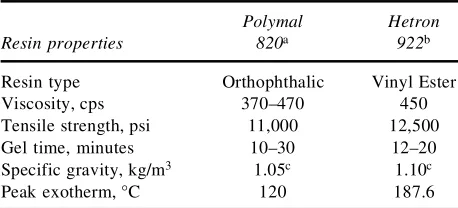
[image:3.524.269.498.540.644.2]Resins used were (a) Polymal 820 (an orthophthalic ester) and (b) Hetron 922 (a vinyl ester). Polymal 820 was produced by Takeda Chemical Industries, Japan, whereas Hetron was obtained from Ashland Chemical Co., Columbus, OH. The resins were prepromoted to fa-cilitate room temperature curing. Methyl Ethyl Ketone (MEK) Peroxide was used as the solidification initiator. Physical properties of the two resins are summarized in Table 1.
Polymeric encapsulation
Preliminary trials were carried out to determine both the resin-to-waste loading range and the corresponding initiator requirement, to ensure resin hardening was ac-complished within a reasonable time (24 h); the control samples were the ones without brake lining dust. Test samples were prepared by mixing a predetermined amount of initiator at room temperature into a batch of resin, and the brake lining dust was then added to the
ini-Table 1. Physical data for the two polymeric resins used.
Polymal Hetron Resin properties 820a 922b
Resin type Orthophthalic Vinyl Ester
Viscosity, cps 370–470 450
Tensile strength, psi 11,000 12,500
Gel time, minutes 10–30 12–20
Specific gravity, kg/m3 1.05c 1.10c
Peak exotherm, °C 120 187.6
aTakeda Chemical Industries.
tiated resin. The contents were mixed thoroughly for 2–3 min to obtain rapid and even distribution of the dust throughout the mixture. The resulting mixture was trans-ferred to specified molds, hand compacted, and left for solidification. Three different resin loadings were pre-pared (60, 50, and 45% wt.) for the detailed studies; also, below a resin loading of 40%, the added dust occasion-ally agglomerated, and complete wetting of dust was dif-ficult. Methyl Ethyl Ketone (MEK) Peroxide was used as the initiator, at 3 and 5% (wt.) based on the resin.
Leach tests
Toxicity Characteristics Leaching Procedure (TCLP). TCLP Protocol (U.S. EPA method 1311, 1992) was per-formed using the samples that were crushed to particle size smaller than 9.5 mm and transferred to flasks. A buffer of acetic acid and sodium hydroxide adjusted to pH 4.9360.05 was used as the appropriate extraction fluid. A liquid-to-solid ratio of 20:1 was used. The flasks were then covered with parafilm, capped with aluminum foil, and then mechanically shaken for 18 h continuously at 300 rpm and temperature set at 2562°C to allow for complete reaction.
After 18 h contact time, the leachates were filtered through a 0.8-m m pore size borosilicate glass fiber filter to separate the solid and liquid phases. The filtrate, i.e., the TCLP extract, was tested for pH using a Hanna In-strument Membrane pH Meter. Heavy metals in the TCLP extract were analyzed using Inductively Couple Plasma-Emission Spectroscopy (ICP-AES, Baird Model 2000). The results of this extraction test are expressed in terms of the percentage of leachable fraction f, for each element, which is defined as the amount of a particular heavy metal extracted relative to the amount originally present in untreated dust (Brodersen et al, 1992).
American Nuclear Society [ANSI/ANS 16.1 (modi-fied)]. Solidified specimens of thickness-to-diameter ratio 0.3 were suspended into the leachant (ultrapure wa-ter of resistivity518 Mohm-cm, processed by ELGAS-TATRUHQPS) using a nylon fishing line. The leachant
was contained in plastic beakers made of nonreactive polypropylene. Neither the beaker nor the fishing line contributed to the concentration of heavy metals in the leachate. The ratio of the leachant volume (cm3) to the
external geometry surface area (cm2) of the solid
speci-men was maintained at about 1060.2 (cm) throughout the static leaching procedure (American Nuclear Society (ANS), 1986). The leaching was carried out over a 28 day period as follows (i.e.,not over the 90-day period as is normally done for low-level radioactive wastes): the specimen was transferred into fresh leachant after 1, 2,
4, 7, and 14 days; next, the leachate samples from the 1st, 3rd, 7th, 14th, and 28th days were analyzed for pH and heavy metals, as was the case for the TCLP leachate samples.
Data obtained from this ANS 16.1 (modified) method was recorded in terms of Leaching Rate (l) and Cumu-lative Fraction Leached (CFL) reCumu-lative to the total mass in the waste sample. Subsequently, from these calcula-tions, the Effective Diffusivity (D) and Leachability In-dex (Li) were also obtained (ANS, 1986; Kim et al., 1992):
1. Leaching rate, ln(cm/day), for the nth interval is
ln5 }Aan o
} 3 }V
S} 3 }D
1 tn
} (1)
where anis the amount of constituent or heavy metal of interest leached from the specimen during the nth inter-val (mg); Aois the amount of constituent of interest ini-tially present in the specimen (mg); an/Ao is the incre-mental fraction leached; V/S is the ratio of specimen volume to surface area (cm); Dtn is the tn2tn21,
dura-tion of the nth leaching interval (days or seconds, as ap-propriate), and tn is the SDtn, cumulative leaching time since the beginning of the first leaching interval (days or seconds, as appropriate).
2. Cumulative fraction leached, CFL (cm), is
CFL5 }S
A a
o n
} 3 }V
S} (2)
3. Effective diffusivity, D(cm2/s), is a measure of the
diffusivity of each of the heavy metals of concern in the monolithic specimen of solidified/stabilized waste for each leaching interval.
D5
3
}a Dn/A
tn o
}
4
23
}VS}
4
2
T (3)
where T, the leaching time representing the “mean time” of the nth leaching interval (seconds), is given by
T5
3
}12} (tn1/21t1/2n21)
4
2(4)
4. Leachability Index, Li(dimensionless), gives a mea-sure of the effectiveness of the S/S technique for the control of leaching. It is defined as a material para-meter that characterizes the resistance of the solidi-fied waste to leaching of the constituents. Larger val-ues of Li imply smaller values for the contaminant diffusing out (i.e., a lower value for contaminant re-lease rate) (Morgan and Bostick, 1992).
Li5 }1n}
^
3
log1
}Db i}
2 4
n
where b is a defined constant (1.0 cm2/s), n is the
num-ber of leach intervals, and Diis the effective diffusivity of constituent i(cm2/s).
Physical testing
Hardening time.Hardening time was recorded based on visual observation and hand pressing the specimen.
Compressive strength test
Specimens for compressive strength test were prepared according to the American Standard Testing Material (ASTM, 1992) Test Method for Compressive Strength of Hydraulic Cement Mortars (using 2-inch or 50-mm cube specimens) C109/c 109M-95 testing protocols. Com-pressive strength measurements were performed on the cube specimens in duplicate at the 1st, 7th, 14th, and 28th days of curing (at 98% RH, temperature 3063°C) us-ing a calibrated hand-operated hydraulic compression apparatus (model ELE). Total maximum loads were recorded at the point of fracture, and the compressive strength was calculated as follows:
fm5 }PA} (6)
where fmis the compressive strength in psi or Mpa; Pis
the total maximum load in lbf or N, and Ais the area of loaded surface in inch2 or mm2.
RESULTS AND DISCUSSION
The estimated average grain size of the brake lining dust is 298.2 m m, the grain size ranging from 24.98 to 567.3 m m.
TCLP results
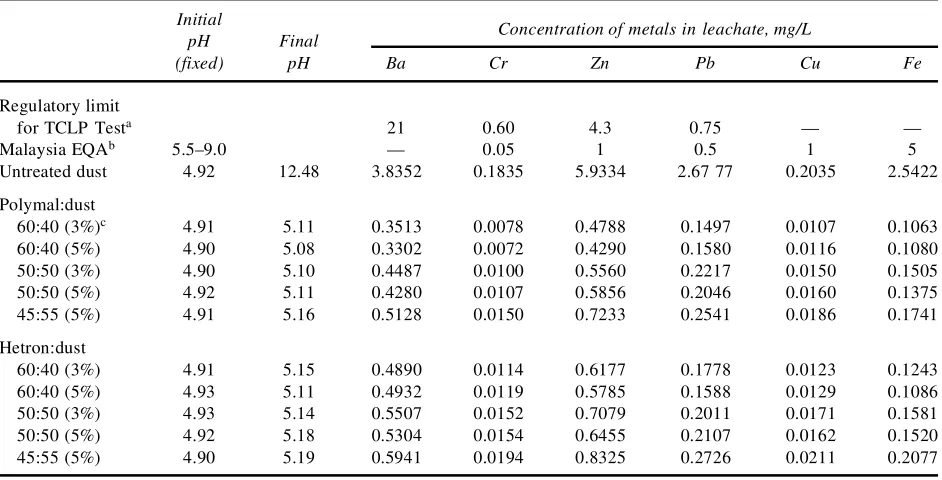
As shown in Table 2, TCLP extract of the untreated brake lining dust contains the highest concentration of Zn, followed by Ba, Pb, Fe, Cu, and Cr, the concentra-tions ranging between 0.18 to 5.9 mg/L. Among these heavy metals, the concentration of Zn, Pb, and Cr ex-ceeded the regulatory limit stipulated in Malaysia Envi-ronmental Quality (Sewage and Industrial Effluents, 1979), Standard B, which is for effluent release down-stream of the source of water intake. However, the met-als Ba, Cr, and Pb were within the permitted level for the TCLP test, while the regulatory limit for Zn, Cu, and Fe were not available. Solidification with Polymal and Het-ron reduced all the elements investigated to within the Malaysia EQA (1974) limit. Ba concentration in
Poly-Table 2. Summary of TCLP leach data, including initial and final pH of the extract.
Initial
pH Final
(fixed) pH Ba Cr Zn Pb Cu Fe
Regulatory limit
for TCLP Testa 21 0.60 4.3 0.75 — —
Malaysia EQAb 5.5–9.0 — 0.05 1 0.5 1 5
Untreated dust 4.92 12.48 3.8352 0.1835 5.9334 2.67 77 0.2035 2.5422
Polymal:dust
60:40 (3%)c 4.91 5.11 0.3513 0.0078 0.4788 0.1497 0.0107 0.1063
60:40 (5%) 4.90 5.08 0.3302 0.0072 0.4290 0.1580 0.0116 0.1080
50:50 (3%) 4.90 5.10 0.4487 0.0100 0.5560 0.2217 0.0150 0.1505
50:50 (5%) 4.92 5.11 0.4280 0.0107 0.5856 0.2046 0.0160 0.1375
45:55 (5%) 4.91 5.16 0.5128 0.0150 0.7233 0.2541 0.0186 0.1741
Hetron:dust
60:40 (3%) 4.91 5.15 0.4890 0.0114 0.6177 0.1778 0.0123 0.1243
60:40 (5%) 4.93 5.11 0.4932 0.0119 0.5785 0.1588 0.0129 0.1086
50:50 (3%) 4.93 5.14 0.5507 0.0152 0.7079 0.2011 0.0171 0.1581
50:50 (5%) 4.92 5.18 0.5304 0.0154 0.6455 0.2107 0.0162 0.1520
45:55 (5%) 4.90 5.19 0.5941 0.0194 0.8325 0.2726 0.0211 0.2077
aFederal Register 63, No. 100, May 26, 1998.
bRegulatory limit stipulated in Malaysia Environmental Quality Act 1974, Environmental Quality (Sewage and Industrial Effluents) Regulations, 1979, Standard B.
cQuantity in parentheses: wt.% MEK peroxide initiator used based on wt. of resin.
[image:5.524.29.500.398.638.2]mal-treated TCLP leachate ranged between 0.33 and 0.51 mg/L, whereas it was between 0.49 and 0.59 mg/L in Hetron-treated TCLP leachate. The U.S. EPA regulatory limit for Ba is 100 mg/L (Table 2). Similarly, for Cr and Cu (0.05 and 1.0 mg/L, respectively), it was reduced to below 0.02 mg/L.
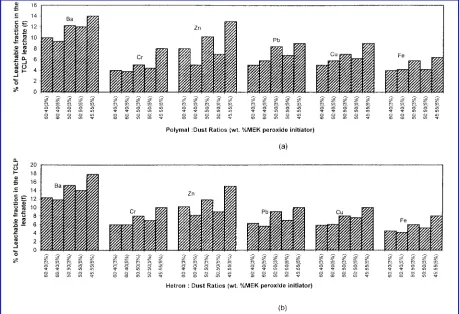
Polymal reduced the percentage of leachable fraction, f, of all the heavy metals of concern to less than 14%, where the leachable fraction ranged between 8.6–13.4% for Ba, 3.95–8.2% for Cr, 7.2–12.2% for Zn, 5.6–9.5% for Pb, 5.3–9.1% for Cu, and 4.2–6.9% for Fe (Fig. 1a). The percentage of leachable fraction in the extract of Het-ron-treated samples was relatively higher (by about 3%) when compared with Polymal-treated samples. The per-centage of leachable fraction in Hetron treated samples was 11.8–17.5% for Ba, 6.2–10.6% for Cr, 8.2–15% for Zn, 5.9–10.2% for Pb, 6.0–10.4% for Cu, and 4.3–8.2% for Fe (Fig. 1b). The leaching was reduced by 91.4–84.7% for Ba, 96.1–91.8% for Cr, 92.8–87.8% for Zn, 94.4–90.5% for Pb, and 95.8–93.1% for Fe. Simi-larly, Hetron also reduced the leaching of all the heavy
metals, but about 3% less than that exhibited by Poly-mal.
Effect of final pH of TCLP extract on
metal leaching
[image:6.524.33.493.343.657.2]The leaching of some metals relies heavily on pH con-trol. Some heavy metals, such as Cr, Pb, Zn, Cu, and Fe, exhibit amphoteric behavior and have higher solubility at both high and low pH (Conner, 1990). However, poly-meric resin solidification, unlike cement-based solidifi-cation, gave very minimal difference in pH between the initial and final extract. The pH of the initial extract was in the range of 4.90–4.93, however, the pH of the final extract ranged between 5.08–5.16 and 5.15–5.19 for Polymal- and Hetron-treated samples, respectively. Thus, there is little or no apparent relationship between pH and the percentage of leachable fraction of heavy metals. For Polymal treated samples, the percentage of leachable fraction increased as the resin loading decreased, while the final extract pH also increased. Similar trends were
observed for Hetron solidified samples except that the pH decreased at the 45% resin level.
ANS 16.1 (modified) leach rate
Based on the values of leach rate, l(cm/day), for each metal, rapid loss of heavy metals was recorded on the first interval, probably due to surface wash off of the so-lidified specimens (DeGroot and Sloot, 1992). Only Zn, Ba, and Pb were detected when the leachate was tested using ANS technique, whereas Cr, Cu, and Fe were be-low detection limit for all the ratios investigated (Figs. 2a and b). The leach rate of all the three metals decreased over the 28-day leaching period for both Polymal and Hetron. All the metals leached were below EQA limit, showing that these resins retained the metals quite ef-fectively. Leach rate of Zn was the highest for both resins, followed by Ba, which showed a relatively constant, av-erage leaching rate of 0.001 cm/day. The leaching of Pb only occurred after the second interval and decreased dur-ing the subsequent intervals (Fig. 2a and 2b).
Cumulative fraction leached (CFL)
Cumulative Fraction Leached was calculated using Equation (2). These are shown graphically in Fig. 3a (Polymal) and Fig. 3b (Hetron). The heavy metals leached (Zn, Ba, and Pb) are seen to follow a diffusion-controlled mechanism, because the CFL is almost lin-early related to the square root of the leaching time (Figs. 3a and b). For both resins, the CFL was the highest for Zn, followed by Ba and Pb, but decreasing as the brake lining dust loading increased. Hetron treatment gave slightly higher CFL values at all resin loadings. The max-imum CFL for Zn was at 0.031 cm (at 60% Hetron). The straight-line relationship between the CFL and the square root of the leaching time is also evident here.
Leachability Index
(L
i)
The effective diffusivity (Di) and Leachability Index (Li) for Zn were calculated according to Equations (3) and (5).
[image:7.524.266.496.45.352.2]The Leachability Indices of the three heavy metals (Zn, Ba, and Pb) obtained in this study (ANS 16.1 (modified))
[image:7.524.22.259.319.645.2]Figure 2. Leach rate of the heavy metals in the (a) Polymal-and (b) Hetron-treated samples, at a resin:dust ratio of 60:40 with 5% MEK peroxide initiator.
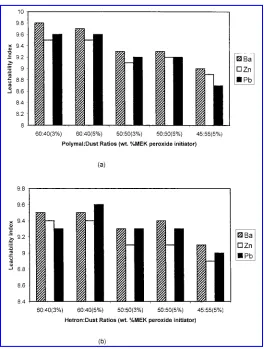
are summarized in Fig. 4. Polymal treated matrix gave Li values between 9 and 10, whereas Hetron gave Livalues between 9 and 9.8, and thus, the Li values obtained for both the resins used were higher than 6, the stipulated guidance value (Morgan and Bostick, 1992). Hence,
[image:8.524.131.395.41.390.2]Polymal and Hetron have effectively retained the heavy metals in the solidified matrix, although Polymal seems to perform slightly better than Hetron. Also, it is appar-ent there is no appreciable relationship between the amount of MEK Peroxide initiator and the leaching rate.
[image:8.524.111.415.516.656.2]Figure 5. Hardening times of Polymal- and Hetron-treated brake lining dust. The resins were treated with 3 and 5% MEK per-oxide initiator.
Hardening time
Polymeric resin solidification took 1.5 to 12 h, whereas cement-based binding took about 30–96 h (Fig. 5). The control samples (i.e., the ones without the brake lining dust) of both polymeric resins hardened immediately
[image:9.524.130.396.49.353.2]af-ter mixing in the MEK Peroxide initiator. The higher quantity of initiator (5%) shortened the hardening time compared to the 3% case. The hardening time also in-creased with the inin-creased loading of brake lining dust.
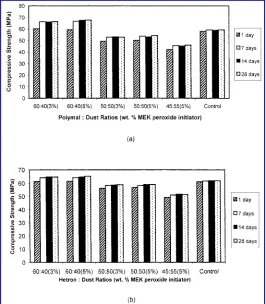
Figure 6. Compressive strength of the solidified waste after 1, 7, 14, and 28 days of solidification using (a) Polymal and (b) Hetron resins at different resin:dust ratios and with 3 and 5% MEK peroxide initiator.
Table 3. Standards guidance for solidified waste form.
Properties Test Methods Criteria
Leachability ANS 16.1 Leachability Index $6
Compressive strength ASTM C 39 or D 1074 414 kpa (60 psi)
Radiation stability See 1983 TPa 414 kPa compressive strength after 10E68 rads Biodegradation ASTM G 21 and G 22 No growth and compressive strength .414 kPa
Immersion See 1938 TPb 414 kPa compressive strength after 90 days
Thermal cycling ASTM B 553 414 kPa compressive strength after 30 cycles
aThe 1983 Branch technical Position (TP) paper calls for a minimum compressive strength of 345 kPa (50 psi). This has been raised to 414 kPa (60 psi) to accommodate an increased maximum burial depth at Hanford of 55 ft (from 45 ft) as defined by the U.S. Nuclear Regulatory Commission publication.
bThe 1983 Branch technical Position (TP) paper calls for a multistep procedure for biodegradation testing: if observed culture growth rated “greater than 1” is observed following a repeated ASTM G 21 test, or any growth is observed following a repeated test of ASTM G22 test, longer term testing for (at least 6 months) is called for using the Bartha-Pramer method. From this test, a total weight loss extrapolated for full size waste forms to 300 years should produce less than a 10% loss of total carbon in the sample.
[image:9.524.30.502.497.591.2]Compressive strength
Polymeric resin solidification exhibited relatively con-sistent compressive strength, between 53 to 68 MPa (Fig. 6). Generally, higher compressive strengths were ob-served for Hetron treated samples and the control, except for 60% resin loading, where Polymal-treated samples showed higher compressive strength of 60–67 MPa. The controls of both types of resins (cubes of resins without addition of dust) showed relatively lower compressive strength compared to the 60% resin loadings. Probably the presence of lining dust acted as a filler and enhanced the compressive strength of the solidified forms. How-ever, the compressive strength decreased as the lining dust was increased from 40 to 55%. The compressive strengths achieved with the polymeric resins were, how-ever, much higher than the standard guidance limit for solidified waste form (Table 3) which is at 414 kPa.
Cost evaluation
Under the current local waste management practice, the brake lining dust is packed in double-layered high-density polyethylene (HDPE) bags and placed in 200-L metal drums. The drums are next sealed, labeled, and dis-posed of at one of Malaysia’s secure landfills at the Bukit Nanas Integrated Waste Management Center. Thus, as can be seen, there is currently no special treatment process followed for the dust except in terms of secure packaging. The hauling and disposal of these drums (300 metric tons per annum) at this secure landfill is a low RM283,000 (US$75,000) per annum or US$0.25 per kg of waste; however, no qualifications are placed on the long-term leach stability of the constituents present in the dust through this disposal procedure. If one now chooses the next level of option for the treatment of these 300 tons of fines, namely a cement solidification/stabilization option (Chan et al.,2000b) with a 50:50 ratio of waste: cement, the cost increases to a modest RM397,200 (US$104,526) or US$0.33 per kg of waste. If, in addi-tion, an additive such as activated carbon is incorporated into the cement matrix, the cost rises to RM 571,200 (US$150,316) at US$0.50 per kg of waste. In these cost estimates, only the binder costs (cement at RM0.20 per kg, activated carbon at RM6.0 per kg) and waste hauling and disposal costs are included; no allowance has been made for the processing costs, which would normally in-clude capital equipment and operating costs such as util-ities, labor, and maintenance. Moving on to the Polymal and Hetron binders, these resins cost RM16.0 and RM18.5 per kg, respectively; the corresponding total costs, using a basis similar to the cement 50:50 binder, are prohibitively high at RM5.3MM (US$1.4MM) and RM6.1MM (US$1.6MM), respectively, which works out
to US$5.26 and US$4.70 per kg of waste.. It should, how-ever, be borne in mind the various attractive features lead-ing to the superiority of the resin S/S option. In a recent report, Biyani et al.(2000) have carried out a compre-hensive cost analysis for the S/S of sodium nitrate salt-containing low-level radioactive waste (dry bulk specific gravity 0.7) for the U.S. market. Their conclusions are an attractive $11.50 per kg of waste for the resin S/S case, while for the cement case it is substantially higher at $16.37 per kg of waste, both of these being inclusive of labor costs at US$5.12 and US$8.97 per kg, respectively.
CONCLUSIONS
The Polymal S/S process gave better performance for heavy metal retention capacity, whereas the Hetron case exhibited higher compressive strength; both resins, however, retained the metals well within the stipulated limits. Based on current regulatory requirements in Malaysia, the resin S/S option is not an economically vi-able one, although it may merit consideration elsewhere overseas.
ACKNOWLEDGEMENT
We are grateful to Ms. P. Jayanthi and Mr. Greg Simp-son from Don Brake (Malaysia) for their advice and sug-gestion, and for allowing us to conduct part of the research in their manufacturing facility. One of the authors (R.M.) wishes to thank the USIA Fulbright Scholar Program and the Malaysian-American Commission on Educational Ex-change (MACEE) for a Fulbright Visiting Professor Award at the University of Malaya that facilitated this au-thor’s participation in the research. The project was funded by a PJP grant from the University of Malaya.
REFERENCES
ALBINO, V., CIOFFI, R., DE VITO, B., and SANTORO, L. (1996). Evaluation of solid waste stabilization processes by means of leaching tests. Environ. Technol.17,309–315. AMERICAN NUCLEAR SOCIETY (ANS). (1986).
Measure-ment of the Leachability of Solidified Low-Level Radioactive Wastes by a Short-Term Test Procedure, (ANSI/ANS-16-1). LaGrange Park, IL: Am. Nuc. Soc., p. 35.
BIYANI, R.K., AGAMUTHU, P., and MAHALINGAM, R. (2000). Solidification/stabilization technologies—Polymer microencapsulation. In C.H. Oh, Ed. Handbook on Mixed Waste Treatment Technologies. Boca Raton, FL: CRC Press LLC (in press).
BRESLIN, V.T., and TISDELL, S.E. (1994). Thermoplastic stabilization of MSW combustor ash. J. Environ. Eng.120,
154–168.
BRODERSEN, K., HJEMAL, O., and MORTENSEN, S. (1992). Cement conditioning of waste materials and polluted soils using the GEODUR process. In T.M. Gillian and C.C. Wiles, Eds. Solidification/Stabilization of Hazardous, Ra-dioactive and Mixed Wastes, ASTM STP 1123. Philadelphia, PA: American Society for Testing and Materials, pp. 320–337.
CHAN, Y.M., AGAMUTHU, P., and MAHALINGAM, R. (2000a). Asbestos waste audit and recycling in an automo-bile brake manufacturing facility. J. Chem. Technol. Biotech-nol. (accepted).
CHAN, Y.M., AGAMUTHU, P., and MAHALINGAM, R. (2000b). Solidification and stabilization of asbestos waste from an automobile brake manufacturing facility using ce-ment. J. Hazardous Materials (in press).
CONNER, J.R. (1990). Chemical Fixation and Solidification of Hazardous Waste.New York: Van Nostrand Reinhold, pp. 259–273, 351–364, and 454–464.
DE GROOT, G.J., and VAN DER SLOOT, H.A. (1992). De-termination of leaching characteristics of waste materials leading to environmental product certification. In T.M. Gillian and C.C. Wiles, Eds. Solidification/Stabilization of Hazardous, Radioactive and Mixed Wastes, ASTM STP 1123. Philadelphia, PA: American Society for Testing and Materials, pp. 149–170.
GRUBE, W.E. (1992). Physical and morphological measures of waste solidification effectiveness of environmental con-trol technologies. In P.N. Cheremisinoff, Ed. Waste Mini-mization and Recycling. Houston, TX: Gulf Publishing Co., pp. 123–133.
KIM, H.Y., KIM, K.H., PARK, H.H., and SUH, I.S. (1992). Solidification of dried borate waste with polyester. In T.M. Gilliam and C.C. Wiles, Eds. Solidification/Stabilization of Hazardous, Radioactive and Mixed Wastes, ASTM STP 1123. Philadelphia, PA: American Society for Testing and Materials, pp. 297–303.
LAGREGA, M.D., BUCKINGHAM, P.L., EVANS, P.L., and THE ENVIRONMENTAL RESOURCES MANAGEMENT GROUP. (1994). Hazardous Waste Management.New York: McGraw-Hill, pp. 641–703.
MANJUNATH, C., and CHEREMISINOFF, P.N. (1995). As-bestos abatement and removal techniques. In Encyclopedia of Environmental Control Technology: Pollution Reduction and Contaminant Control, vol. 6. Gulf Publishing Co., pp. 447–475.
MEANS, J.L., SMITH, L.A., NEHRING, K.W., BRAUNING, S.E., GAVASKAR, A.R., SASS, B.M., WILES, C.C., and MASNI, C.I. (1995). The Application of Solidification/Sta-bilization to Waste Materials.Cincinnati, OH: Lewis Pub-lishers, p. 334.
MORGAN, I.L., and BOSTICK, W.D. (1992). Performance testing of grout-based waste forms for the solidification of anion exchange resins. In T.M. Gilliam and C.C. Wiles, Eds.
Solidification/Stabilization of Hazardous, Radioactive and Mixed Wastes, ASTM STP 1123. Philadelphia, PA: Ameri-can Society for Testing and Materials, pp. 133–145. POWELL, M.R., and MAHALINGAM, R. (1992a).
Continu-ous solidification/stabilization processing of hazardContinu-ous waste through polymeric microencapsulation. Indust. Eng. Chem. Res.31,543–549.
POWELL, M.R., and MAHALINGAM, R. (1992b). Leach studies on hazardous waste monoliths from continuous so-lidification/stabilization processing. Environ. Sci. Technol.
26,507–511.
SHARMA, H.D., and LEWIS, S.P. (1994). Waste Containment System, Waste Stabilization and Landfills: Design and Eval-uation.New York: John Wiley and Sons, Inc., p. 233. STEGEMEN, J.A., and COTE, P.L. (1992). A proposed
proto-col for evaluation of solidified waste. In R.W. Piggot, Ed.
Proceedings of Cement Industry Solutions to Waste Man-agement, Calgary, CPCA, Toronto (Canada), pp. 1–12. SUBRAMANIAN, R.V., and MAHALINGAM, R. (1979).
Im-mobilization of hazardous residuals by polyester encapsula-tion. In R.B. Pojasek, Ed. Toxic and Hazardous Waste Dis-posal, Vol. 1. Ann Arbor, MI: Ann Arbor Science Publisher, pp. 247–295.
U.S. EPA, ENGINEERING BULLETIN. (1992). Solidifica-tion/Stabilization of Organics and Inorganics, EPA/540/S-92/015. Cincinnati, OH: U.S. Environmental Protection Agency, Office of Research and Development.
U.S. EPA, ENGINEERING BULLETIN. (1997). Technology Alternatives for The Remediation of Soils Contaminated with As, Cd, Cr, Hg and Pb,EPA/540/S-97/50. Cincinnati, OH: U.S. Environmental Protection Agency, Office of Emergency and Remedial Response.
U.S. EPA/ORIA. (1996). Process for Specific Low-Level Mixed Waste (LLMW).Cincinnati, OH: Office of Remediation and Indoor Air (ORIA), U.S. Environmental Protection Agency. U.S. EPA METHOD 1311. (1992). Toxicity Characteristics Leaching Procedure.Washington, DC: U.S. Environmental Protection Agency, Method 1311 (Reviewed).
1. A. Faik, S. Guillot, J. Lambert, E. Véron, S. Ory, C. Bessada, P. Echegut, X. Py. 2011. Thermal storage material from inertized wastes: Evolution of structural and radiative properties with temperature. Solar
Energy . [CrossRef]
2. V ROUBICEK, H RACLAVSKA, D JUCHELKOVA, P FILIP. 2007. Wear and environmental aspects