Journal of Criminal Law and Criminology
Volume 56
Issue 4
December
Article 7
Winter 1965
Delinquency and Middle Class Goals
Bertram Spiller
Follow this and additional works at:
https://scholarlycommons.law.northwestern.edu/jclc
Part of the
Criminal Law Commons
,
Criminology Commons
, and the
Criminology and Criminal
Justice Commons
This Article is brought to you for free and open access by Northwestern University School of Law Scholarly Commons. It has been accepted for inclusion in Journal of Criminal Law and Criminology by an authorized editor of Northwestern University School of Law Scholarly Commons.
Recommended Citation
THE JoUnN.AL or CRImINAL LAW, CRnUNOLOGY AN-fD POLICE SCIENCE Vol. 56, No. 4 Copyright @ 1965 by Northwestern University School of Law Printed in U.S.A.
DELINQUENCY AND MIDDLE CLASS GOALS
BERTRAM SPILLER*
The author is an Associate Professor of Sociology and Anthropology and Acting Head of the Department of Sociology and Anthropology at Washburn University of Topeka, Kansas. He is also a Research Associate at the Menninger Foundation and was formerly a Fellow at the Judge Baker
Guidance Center, Boston.
In this article, Dr. Spiller tests the common assumption that much delinquency can be accounted for by the rejection of or inability to attain middle class goals. In a study of two urban lower class gangs, little evidence was found to support this hypothesis. Instead, greater support was given to behavior supporting lower class culture, -but there were striking differences between gangs, and
even within segments of a gang, both quantitatively and qualitatively. Prestige in terms of middle class values was unimportant. However, evidence was found for a continuum among gangs and for bases of prestige to vary with that continuum. Violence and violative behavior, as avenues of prestige, were most important in the lowest class gang, while culturally neutral adolescent behavior was
more predominant in the less delinquent gang.-Editor.
Recent research in delinquency has stressed the dissociation between culturally approved goals of success and status-striving and structurally-linked lack of opportunity. Cohen, modelling his theory on the Merton-Durkheim position, states that status-discontent, motivated by class-linked opportunities for achievement, which are generally closed to the working class population, induces frustration in the working class boy, when he is unable to realize the cultural goals; he reacts by displacing his frustration through aggressive, often delinquent behavior.' He is apt to flaunt the middle class norms, merely because they are middle class, and, for the sake of being "ornery," to espouse those lower class male adoles-cent goals which are opposed to the dominant code. Cohen's argument rests mainly on the as-sumption that the working class boy is socialized under the aegis of middle class norms, which mean something to him, and he must "come to terms" with these norms.2 When he encounters middle class institutions, such as schools, and is rejected by them because he cannot measure up to their standards of cleanliness, punctuality, and achievement orientation, he rejects these norms, turns them upside down, and engages in "nonutilitarian", "negativistic", and "malicious behavior."
* The writer is grateful to National Institute of
Mental Health Grant M-4010(A) for assisting in the support of the research into this subject. The research was the basis for the writer's doctoral dissertation,
Bases of Prestige Among High and Lowe Delinquent Street-Corner Groups (Boston University, 1961).
1 COHEN, DELmNQUENT Boys 186 (1955).
2 Ibid. 87.
The assumption that all segments of society internalize middle class strivings is just as crucial to Block and Niederhoffer's theory as to Cohen's. Block and Niederhoffer maintain that delinquency is a result of the frustrated striving for adult status. Because our society does not make ade-quate preparation for the induction of adolescents to adult status, young people spontaneously de-vise their own rituals and symbolic behavior to assist themselves in orienting to adulthood. The adolescent retreats from the barriers to adult sta-tus, such as compulsory school laws and work cer-tificates, by utilizing the gang as a "structured outlet for hostility to the adult social world".3 While Block and Niederhoffer do not maintain as steadfastly as Cohen that lower class boys internal-ize the American Creed, it nevertheless is crucial to their theory, inasmuch as they maintain that gang delinquency is the attempt to solve a prob-lem of adolescent role disjunction cnmmn to all social classes.
Cloward and Oblin extend the Merton-Durk-heim "illicit means" theory by formulating what they call the "illegitimate opportunity structure".4 Since the legitimate avenues to the most prestige-ful and income-producing occupations are almost closed to the lower classes, the residents of these slum areas select illegitimate means to achieve the status symbols. If youngsters live in areas where there is an integration of adult carriers of criminal and conventional values, and limited
3
BLocK & NIEDERHOFFER, TE GANG: A STUDY
oF AnOLESCENT BEHAVIOR 138 (1958).
4 CLOwARD & 0=aN, DELINQUENy AND
access to success-goals by legitimate means, de-linquency will be more or less rational, disciplined, and oriented toward a criminal career. Where the illegitimate means are not available, the re-sponse will be that of the typical fighting gang. When individuals cannot meet the criteria of the fighting gang and do not have illegitimate oppor-tunities available to them, they adhere to the "retreatist" or drug addict subculture.5 These for-mulations axe predicated upon two basic assump-tions: 1) the success-goal is universal and is inter-nalized by all strata of American society; 2) residents of "integrated" and "unintegrated" areas do not fully internalize the institutional norms which would insulate them from deviant solutions to their status-discontent.
These theories have been subjected to some criticism since their inception. Cohen and Short responded to the criticism of Cohen's theory by modifying it slightly. Instead of speaking of a generic "delinquent subculture", they delineated several subspecies: the "parent male subculture", the "conflict-oriented subculture", the "drug ad-dict subculture", "semi-professional theft", and the "middle class delinquent subculture."6 This still left the question of universal internalization of middle class values unsettled.
Wilensky and Lebeaux noticed the gap in sub-stantive data which Cohen's assumptions raised and pointedly asked where was the evidence of negativism, maliciousness, and nonutilitarian stealingY They specifically noted that "middle class values and criteria of status are not inter-nalized by all with the same intensity".8 They go on to ask for research relative to the degree to which lower class delinquents internalize the suc-cess goals, the resources available to them for status achievement, and who experiences how much status-discontent.9
Kitsuse and Dietrick also questioned Cohen's assumptions. They raised similar objections as Wilensky and Lebeaux and pointed to certain contradictory statements in Cohen's work.10 Then, however, they say that despite the "logical ambiguities and inconsistencies in Cohen's state-ments, it may be maintained nevertheless that
5 bid. 161-186.
6 Cohen & Short, Research in Delinquent Subcdtures,
14 J. Soc. IssuEs, 20-37 (1958).
7 NVIIENSKY & LEBEAUX, INDusTRIAL SocIETY AND
Soc.AL WErxAR 185-203 (1958). 8 Ibid. 202.
9 Ibid.10
Kitsuse & Dietrick, Delinquent Boys: A Critique, 24 Am. Soc. Rxv. 208-215 (1959).
empirical research demonstrates the validity of his major thesis"." They do not mention this "em-pirical research", nor is the writer aware of what this could be.
A study by Gordon, et al. also attacked the same general problem raised here. Their results were somewhat ambivalent. On the one hand, they found that their six groups of gang, non-gang lower class and non-gang middle class boys "evaluated images representing salient features of a middle class style of life equally highly".2 This would support Cohen, Cloward and Ohlin, and Block and Niederhoffer. But, on the other hand, there were sufficient differences between the groups to warrant their saying that Cohen's reaction-formation assumption was not supported. It is significant that these researchers used the seman-tic differential test. It may be that the lack of ex-pected differences between their study groups was due to the tendency of paper and pencil tests to cancel out the differences between verbal and ob-served behavior. The authors implied as much. Reiss and Rhodes found that there is no simple relationship between ascribed status and delin-quency. The social structure of the school, the cultural tradition of the neighborhood, and the homogeneity of the area were variables which had to be considered.3 Delinquency varied according to whether a boy lived in a high status or low status school. Low status boys attending high status schools had significantly fewer chances of becoming delinquent than low status boys attend-ing low status schools. Thus, there was little evi-dence that low status boys were more prone to delinquency the more they were subjected to pressures from middle class norms. This definitely contradicts Cohen's assumption.
In a recent review of delinquency, Bordua sum-marizes and criticizes the theories of Thrasher, Cohen, Cloward and Ohlin, and Miller.4 How-ever, he makes little of the basic criticism of Cohen, and Cloward and Ohlin except to indicate that Cohen's presentation of what lower class boys have or have not internalized is confused.1 5 Bordua
n Ibid. 213.
2Gordon, Short, Cartwright, and Strodtbeck, Values and Gang Delinquency: A Study of Street-Corner Groups,
69 Amr. J. Soc. 117 (1963).
13 Reiss & Rhodes, The Distribution of Juvenile
De-linquency in the Social Class Structure, 26 Amr. Soc.
Xxv. 729 (1961).
14Bordua, Delinquent Subcultures: Sociological In-terpretations of Gang Delinquency, Tnm ANNAMS 338
(Nov. 1961).
DELINQUENCY AND MIDDLE CLASS GOALS
apparently recognizes that this is a critical issue in Cohen's theory but does not seem to perceive it as
especially damaging to Cohen's position.
Thus, we have seen that the three theories being considered here pivot around the internal-ization of the American Creed by all social classes. Some critiques of this assumption have been presented which question this basic premise. If it can be demonstrated, then, that there is a dif-ferential response to this creed depending upon social class, all three theories will need revision. The research with which this paper is concerned is aimed at testing whether lower class adolescent street-corner groups do use the middle class norms as a "measuring rod" of behavior related to
ac-quisition of status.
TAE METHOD
The data which were used to test the middle class values assumption were those of the files of Special Youth Project Research. These consisted of the "process records" of trained social workers who interacted with street-corner groups in their own milieu. Three male social workers maintained continuous contact with four age segments of the two gangs being studied here for periods ranging from nine to twenty nine months. These process records constitute a very rich body of ethnographic type of data of the daily activities of these boys and total 3654 pages of material for the four groups.1 6 Most of this consisted of observed be-havior dictated by the workers, and smaller amounts consisted of interviews with the project director and the research staff, and taped tran-scriptions of group interaction.
This body of material was converted into "be-havior sequences" or "acts" and subjected to a standardized content-analysis system modeled after the Yale Cross Cultural Survey, but modi-fied for use with the material to be analyzed. Each "act" was based upon the "object-oriented-behavior-sequence ... an observed reported series of events in which an identifiable actor or set of actors orient to an identifiable object of orienta-tion in an identifiable way".7 Each act was ex-tracted from the records by trained coders (all Ph.D. candidates) who typed up each sequence on
16 For more details on the nature of the data, the
distribution of pages per group, dates of collection, etc., see Spiller, Bases of .Prestige Anong High and Low
Delinquent Street-Corner Groups (unpublished Ph.D.
dissertation, Boston University, 1961) 35-39.
- Walter B. Miller, Records Coding Manual, on
file, Special Youth Project Research, P. 2.
separate data cards and coded the behavior. There were 65 major categories of behavior, such as sexual behavior, theft, and vandalism, which could be utilized. Each set of records was then checked independently by another coder for re-liability. In all there were 14,549 typed data cards for the four groups being studied here. Each of these cards was then duplicated one or more times, according to the number of actors and objects, and filed chronologically in appropriate drawers." The concept which was used to extract status-oriented behavior from the records was that of "prestige". Prestige is a more fluid version of status and refers to some acquired command or preeminence of one individual over another and fluctuates continuously.19 It has the advantage of being readily observed and recorded. It would be visible in the "deference shown to an individual, in the readiness of others to support him in vary-ing ways, to take his advice, imitate his example, or merely express their admiration or approval"".2 The alternative concepts, status and esteem, were rejected as the major conceptual tool because status is too stable over time, and esteem involves an invidious value judgment.
In denoting the universe of status-oriented acts, each original typed card was read and evaluated as to whether it contained prestige-oriented material in the light of Nadel's criteria. It was also de-cided that, for the sake of reliability and impar-tiality, only those acts which were obviously prestige-oriented would be denoted as such. It was felt that "reading in" too much might have biased the data. The total number of prestige-oriented acts during the "effective contact" period of the workers was 5471. Out of this uni-verse of available acts, a 19.5% sample was randomly selected. This consisted of 1068 be-havior sequences.
Ideally it would have been desirable to have had two disinterested people code the data-one as a reliability check on the other. This was not pos-sible for reasons which cannot be discussed here. One of the authors, who was also a coder, per-formed the coding of the prestige-oriented material. In order to establish some measure of reliability of coding, it was decided that the test-retest method would be used. This consisted of coding
I's For more details on the coding system, see Spiller,
op. cit. supra note 16, at pp. 39-44, 172-176.
9 There is fair-sized literature on this concept, but
the best description is in NADEL, Tan FOUNDATION Or SOCIAL ANTHROPOLOGY 171-172 (1953).
the first 50 prestige-oriented cards for one of the groups, then repeating the process after a lapse of time and comparing the results. The comparison indicated there was a high degree of correspond-ence between the first and second codings. In 82% of the codings there was complete correspondence, with two categories accounting for most of the discrepancies. These categories were redefined more rigorously so as to eliminate most of the confusion.
In order to facilitate analysis, the coding was programmed for IBM. All of the categories used in the larger research project were incorporated. In addition, several categories were added which were pertinent to this study. These included four modes of prestige-orientation; granting, denying, seeking, and accepting. When prestige is being granted, group members either support the be-havior or suggestions of another, follow his ex-ample, admire or approve him, take his advice, or generally defer to him. Denying is the opposite of granting. Seeking consists of behavior which is designed to gain the support, adherence, admira-tion, or generally further or maintain the status of the individual within the group. Affirming that the support or admiration which has been given by others to ego was well-deserved is the accepting mode.
In addition to the machine tabulation of results, the writer perused the original cards to get a "feel" for the qualitative aspects of the material. This was done by arranging the data cards according to the group rubric, the four modes of prestige-orientation, and the seven major target-roles. In this way much of the qualitative "flavor" was retained and many insights gained.
Finally, all of the behavior categories, such as drinking, vandalism, and fighting, were classified as to whether they were essentially lower class, middle class, or culturally neutral (adolescent).21
Each category was conceptualized as dual be-havior which can be engaged in by either lower
21 Lower class adolescent behavior is characterized
by free expression of feelings with intense loyalty to a corporate group (specifically to those displaying ag-gressive masculinity), and pronounced suspicion of out-siders, especially authority figures, resulting in refine-ment of conning techniques, and use-abuse and discard of property. Middle class adolescent behavior is charac-terized by an acceptance of law-supportive institutions, a tendency to defer gratification, and an orientation to achievement by directed work effort, which results in a tendency to atomistic behavior. Adolescent, or cul-turally neutral, behavior is defined as pleasure-oriented behavior such as sports, club activities, outings, danc-ing, datdanc-ing, and the like.
class or middle class boys. No category of behavior is the exclusive property of either social class, but the overall patterning in each class will differ. "Hanging around" is an age-graded activity, but it is relatively unimportant to middle class boys, while it will always exert a high priority in the typical lower class individual's life. Indices of lower or middle classness for each of these cate-gories were formulated. For example, the lower class version of drinking is typically characterized by open, conspicuous, even flamboyant, heavy to moderate drinking in a group or individual situation, accompanied by expressed or covert approval of drunkenness, violative behavior, in-hibition release, and aggression. The middle class version of drinking is characterized by light to moderate consumption of alcohol in individual or group situations accompanied by a concern for concealment, disapproval of excessive, conspicu-ous drinking, and condemnation of violative be-havior resulting from drinking.
CHAP4crTERSTICS OF
Tu?
GRoupsThe study consisted of the Junior age segments (ages, 14-16), of the "Bandits" and "Outlaws", and the Intermediate age segments (ages, 16-18) of the same two groups.Y The aggregates of both groups have been known to "hang out" at the same corners in Roxbury, Massachusetts for over thirty years, and are well-known to each other, the police, local inhabitants, and others. Each possesses a similar four age-graded aggregate of about 100 members each. Although less is known of the Midget and Senior groups of each aggre-gate, the two groups being studied here were well matched for ethnicity (predominantly Irish), religion (predominantly Catholic), and age (an average difference of only four months between the mean ages of the comparable age segments).n
They differed, however, on some other impor-tant variables. As can be seen in Table 1, the Inter-mediate Bandits were most delinquent, while the the Junior Outlaws were least delinquent. This same gradient of Intermediate Bandits to Junior Outlaws held true for social class origins (measured by father's occupation). The Intermediate Bandits had no fathers in the entrepreneur or supervisory category, while the ratio increased from 3.8% for the Junior Bandits, to 10.0% for the Intermediate
22 These are pseudonyms.
2For more details on the history, and matching of
DELINQUENCY AND MIDDLE CLASS GOALS
TABLE 1
GROI' MEMBERS winTE ON.eicAL REco ns: AGEs 10-16
Court Suspended
Commit-Appear- Commit- ments
ances ments
Intermediate Bandits 84.4% 46.9% 50.0%
N = 32
Junior Bandits N = 34 20.6 14.7 14.7 Intermediate Outlaws 15.4 7.7 7.7
N = 26
Junior Outlaws N = 24 8.3 0.0 0.0
Outlaws, to 14.3% for the Junior Outlaws. The ratios of skilled and semi-skilled tended to fluctuate between 53% and 62%, with no pattern being discernible. However, a similar gradient appeared in the unskilled category: Intermediate Bandits 46.5%, Junior Bandits 34.6%, Intermediate Out-laws 35.0%, and Junior OutOut-laws 23.7%. The gradient in educational attainment by the four groups was less obvious and tended more to dif-ferentiate between the aggregates. There were no college entrants among either Bandit group, while the Intermediate Outlaws had 19.2%, and the Junior Outlaws had 4.2%. On the opposite side of the ledger, 15.6% of the Intermediate Ban-dits did not complete grammar school, 2.9% of the Junior Bandits did not complete grammar school, none of the Intermediate Outlaws failed to com-plete grammar school, and 8.3% of the Junior Outlaws failed to do so.n
Thus, it can be seen that there was an associa-tion among higher delinquency, lower class origins, and early school drop-outs; and con-versely, lower delinquency was associated with higher social class origins and more education. What is striking about these findings is that such minor differences in social class origins and educa-tional attainment should be so clearly related to varying rates of delinquency. There was not a par-ticularly large social class gap between the Inter-mediate Bandits and Outlaws, yet, their delin-quency rates differed greatly. Not only did rates of delinquency differ between the matched age groups, but between brother groups as well. Small differences in social class origins were associated with, sometimes, drastically different delinquency rates. In a comparison of the Bandit and Outlaw neighborhoods, it was also found that, although both neighborhoods would be described
24 See Spiller, ibid. 59-65, for more details on social
class and education.
TABLE 2
ORIENTATIONS TO LOWER CLASS, MIDDLE CLASS, AND
ADoLEscENT BEHAVIOR
Behavior Intermediate Junior Intermediate junior Areas Bandits Bandits Outlaws Outlaws
N = 473 N = 472 N = 514 N = 435
Lower Class 56.0% 32.2% 24.7% 24.8% Adolescent 41.0 64.4 70.5 70.8 Middle Class 3.0 3.4 4.8 4.4
as "depressed areas," the Bandit area had more crowded conditions, less home ownership, greater incidence of dilapidated dwellings, and lower valued homes.25 Thus, the conditions tradition-ally associated with lower social classes were also more strongly evident in the ecological realm as well. Social class origins, then, would appear to be the most cogent variable as far as delinquency among these groups is concerned.
TsE FINDINnGs
If the middle class values hypothesis is to be supported, we would expect that the study groups would exhibit a great interest in things middle class. As Table 2 indicates, none of the groups exhibited anything but passing interest in prestige-oriented middle class behavior. What is striking is that as social class declines, the proportion of lower class oriented status behavior increases, and as social class rises, the ratio of adolescent behavior increases. There is also a slight tendency for middle class behavior to increase with social class, but the N's are too small to be accepted with any confidence.
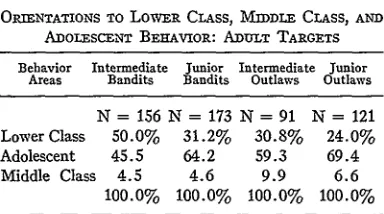
Since these figures contain all modes of orienta-tion in all types of social interacorienta-tion, it could be objected that the almost exclusively adolescent milieu unduly influenced the results. Therefore, the percentages of interaction towards adult targets only were calculated. Table 3 demonstrates that the same general relationships between social class, delinquency, and commitment to behavior remained essentially the same. There was a gen-eral increase in orientation to middle class status orientations, but it was hardly striking and did not indicate any basic shift in outlook. In fact, the orientation to lower class behavior was even more supportive of the gradient from Intermediate
,5 It was also found that 70-80% of the members of
both sets of groups lived within 12 contiguous blocks. For more details on the demographical data, see Spiller,
ibid. 45-54.
TABLE 3
ORIENTATIONS TO LOWER CLASS, MIDDLE CLASS, AND ADOLESCENT BEHAVIOR: ADULT TARGETS
Behavior Intermediate Junior Intermediate Junior
Areas Bandits Bandits Outlaws Outlaws
N= 156N= 173 N=91 N= 121 Lower Class 50.0% 31.2% 30.8% 24.0%
Adolescent 45.5 64.2 59.3 69.4
Middle Class 4.5 4.6 9.9 6.6
100.0% 100.0% 100.0% 100.0%
Bandits to Junior Outlaws. Another fact worth noting is that both Bandit groups were more in-volved with adults in all types of situations than the Outlaws so that theoretically they had greater opportunity to demonstrate any middle class status problems which they might have had.
To further substantiate this contention, the orientations when the groups were not interacting with their social workers and other local, presum-ably lower class, adults were determined. Table 4 demonstrates that even when they were interact-ing with middle class adults (teachers, social workers, businessmen, etc.), the results still con-formed to the gradient. The fact that the Bandits did not utilize middle class avenues of prestige when interacting with middle class adults attests to the entrenchment of lower class values. It also tends to vitiate the middle class values hypothesis. If the Cohen, Cloward and Ohlin assumptions were true, these boys should have increased their middle class status-oriented behavior, when in the pres-ence of such individuals.26 The fact that they were more adolescent and lower class oriented indicates their cultural foci.
26 Spiller also computed the orientations of the group to the three behavior areas under each of the four modes of prestige-orientation. The same gradient pattern appeared in the Conferring and Denying modes, but in the Seeking mode the junior Outlaws were more lower class oriented than the Intermediate Outlaws, but less so than the Junior and Intermediate Bandits. This was not due to any "status dilemma" but to the temporary "desertion" by their worker. He transferred his major attention to the Intermediates for several months, and during this period, a more delinquent clique of Juniors attempted to demonstrate how "bad" they could be so that the worker would return to them. 53.2% of their behavior was adolescent-oriented even in this mode and this was still greater than either Bandit group. Numerically, the seeking mode was not as important as the conferring and denying modes, so it was not felt that this single exception nullified the gradient pattern. The accepting mode was numerically unimportant, and is therefore not included in these discussions. See Spiller, ibid. 108-111 for more details.
TABLE 4
ORIENTATIONS TO LOWER CLASS, MIDDLE CLASS, AND
ADOLESCENT BEHAVIOR: NON-LOCAL ADULTS ONLY
Behavior Intermediate Junior Intermediate junior Areas Bandits Bandits Outlaws Outlaws
N=31 N=54 N=23 N=30
Lower Class 58.0% 29.6% 17.40 16.7%
Adolescent 42.0 70.4 73.9 76.7
Mfiddle Class 0.0 0.0 8.7 6.6
100.0% 100.0% 100.0% 100.0%
DIFFERENTIAL AvENuES TO PRESTIGE AMONG THE INTERMEDIATES: LOWER CLASS
BEHAVIOR
Although it has been shown that street-corner groups, even within the same general milieu, can vary considerably in the degree to which they adhere to lower class or adolescent bases of pres-tige, the exact nature of the avenues has not been delineated. This study was directed not only at testing the middle class values assumption, but also towards casting more light on differential available avenues to status.
[image:7.505.37.229.77.184.2]DELINQUENCY AND MIDDLE CLASS GOALS
TABLE 5
RANEGs OF LOWER CLAss BEHAVIOR FOR ALL TARGETS: CONFERRING iMOPE*
Intermediate Bandits Intermediate Outlaws
Behavior Orientations Number of Rank Behavior Orientations Number of
Jobs 16 1.5 Drinking 12 1
Theft 16 1.5 Belongingness 7 2.5
General Violative Behavior 11 3 Fighting 7 2.5
Fighting 7 4 General Violative Behavior 4 4
Drinking 6 5.5 Hanging 2 5.5
Absenting 6 5.5 Profanity 2 5.5
Hanging 4 7.5
Creating a Disturbance 4 7.5
Sex 2 10
Informing 2 10
Trespassing 2 10
Vandalism 1 12
Totals 77 34
* Rank difference correlation was not computed for these rankings because of the small N of four.
TABLE 6
RANKINGS OF LOWER CLAss BEHAVIOR WmN SEEKING PRESTIGE: ALL TARGETS
Intermediate Bandits Intermediate Outlaws
Number of Raul Behavior Number of Rank
Behavior Orientations Orientations
Theft 16 - Drinking 8 1
General Violative Behavior 13 1 Fighting 5 2
Drinking 12 2 Jobs 4 3
Jobs 10 3 Belongingness 2 4.5
Trespassing 8 - Sex 2 4.5
Fighting 7 4 Vandalism 1 7
Creating a Disturbance 4 5.5 General Violative Behavior 1 7
Sex 4 5.5 Creating a Disturbance 1 7
Vandalism 3 7
Gaming 3
-Absenting 2
-Belongingness 2 8
Tattoos 2
-Hanging 1
-Informing 1
-Profanity 1
-Totals 89 24
ra = +.30; N 8; P > .05.
X
2+
-i)
The formula utilized for the correction of ties was: r. 2
-2 -\/T--&---2
See SrEGEL, NONPARAmETBiC STATISTICS 206-210 (1956).
Outlaws were much more selective. They dis- unaware of the panorama of lower class behavior approved of more aspects of lower class behavior as they utilized all but two areas among the three but utilized fewer areas when seeking and con- modes. Table 7 is also somewhat deceptive in that ferring prestige. One could not say that they were it appears that the Bandits disapprove of more
TABLE 7
RANIoNGS OF LOWER CLASS BEHAvIOR WHEN DENYING PRESTIGE: ALL TARGETS
Intermediate Bandits Intermediate Outlaws
Behavior Number of Number of Rank
Orientations Rank Behavior Orientations
Jobs 18 1 Fighting 13 1
Theft 13 2 Drinking 10 2
General Violative Behavior 12 3 Belongingness 8 3
Drinking 10 4.5 Absenting 6 4.5
Fighting 10 4.5 Creating a Disturbance 6 4.5
Sex 6 - Theft 4 6
Vandalism 5 6 Jobs 3 7
Belongingness 4 8 Informing 1 10
Absenting 4 8 Vandalism 1 10
Creating a Disturbance 4 8 Gaming 1 10
Gaming 3 10.5 General Violative Behavior 1 10
Hanging 3 - Profanity 1 10
Informing 3 10.5
Profanity 2 12
Trespassing 2
-Totals 99 55
r. = +.31; N = 12; P > .05.
aspects of lower class behavior than the Outlaws. Such is not the case, however. Because of a coding artifact Table 7 includes both those acts which
were disapproved because boys engaged in drink-ing, fightdrink-ing, vandalism, etc., and also those where boys disapproved because they did not participate in theft, drinking, profanity, etc. In each case approximately half were disapproved acts and half disapproved for not engaging in specified behavior. Thus, Table 7 actually indicates addi-tional support of violative behavior by the Ban-dits. They very actively supported violative be-havior of all kinds. They can appropriately be called a "band of thieves" because of the fre-quency of their raids on local and downtown stores. They were expert shoplifters, and fre-quently returned to the neighborhood after a day's depredation laden with goods, which they would then ritually display to each other.
What is more important than these frequency rankings is the qualitative patterning of prestige-ful behavior. It will be noted that "Jobs" ranked first or third among the Bandits' approved and
disapproved acts. They supported a pattern of working which has been called "voluntary
unem-ployment" by the writer. This consisted of quitting jobs frequently for unimportant reasons, quitting en masse, behaving so hostilely towards prospec-tive employers that they were not hired, or acting
in such a way as to invite firing. It was sometimes more important to the group to be on band to welcome back a boy from reform school or to go on an outing than to work. Many would work only if they could work with four or five other group members in the same factory. Sometimes they would seek work in groups of four or five and give up if the pay was too low or if they could not all work together. In many ways the group deter-mined the appropriate time and pay for work and the appropriate time to quit. Group members were extremely sensitive to work and would manipulate the prestige of the worker by accepting or rejecting his job-finding activities.
DELINQUENCY AND MIDDLE CLASS GOALS
office, took the money, called the office by tele-phone, and pocketed the extra change. This took place in the presence of the group so the boy was able to fulfill his legal obligation, "con" the parole officer, and raise his group prestige simultane-ously.
The comparable situation among the Outlaws was almost completely lacking. It was generally accepted that all who could should work and no special prestige accrued from working. Some Out-laws even worked after school or during summer vacation; this would have been unheard of among the Bandits, even if they had been in school. The only Outlaw who received any praise for working was a boy with a deformed leg. His case, however, was exceptional.
The Bandits' well-established patterns of work behavior, well-developed work attitudes, and ra-tionalizations led the writer to conclude that one of the latent functions of their street-corner group was to prepare them for the exigencies of their expected masculine adult occupational status. By receiving daily training in the pattern of voluntary unemployment they were becoming conditioned to what was to become a highly probable adult employment situation-periodic unemployment. Since it was unlikely that many Bandits would acquire complex labor skills, the statistical probability of their being unemployed during future recessions was high. Most of them came from such families. Thus it was essential for them to have a set of rationalizations for cop-ing with these almost certain economic and ego-deflating experiences. They acquired these in the gang. These attitudes and rationalizations in-cluded such things as feeling that money is im-portant for such things as dressing "sharply" but not important enough to motivate full-time em-ployment. One boy expressed the attitude that the ideal situation was to work eight or nine weeks and loaf two or three. He also felt it was better to work in the winter, when it was too cold to "hang on the corner", and to loaf during the summer. Attitudes such as these supported voluntary unemployment and enabled them to develop psychological defenses against feelings of worth-lessness for being unemployed. This helps to explain why so many lower class adult males can loaf for long periods without suffering severe ego damage. Their egos are already preconditioned.
From the almost total absence of the pattern of voluntary unemployment among the Outlaws,
it seems safe to conclude that their group did not perform this function.
Adolescent Behavior
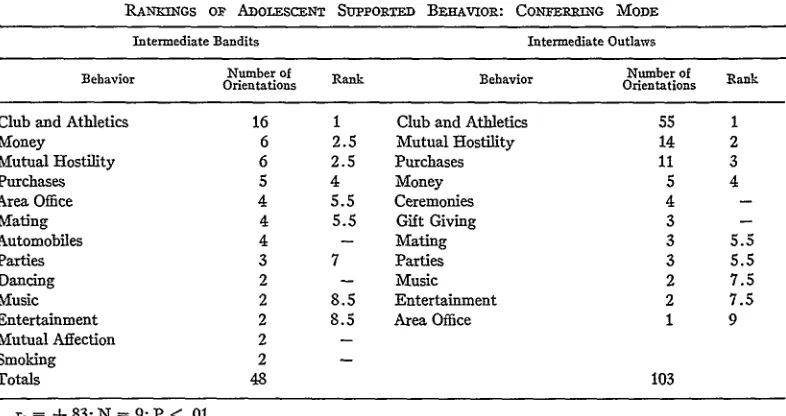
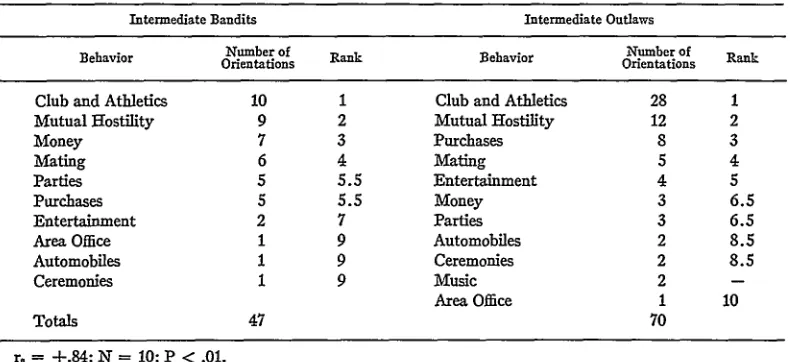
When we examine the Bandit-Outlaw activities in the adolescent sphere, we find that there is more correspondence of avenues of prestige. As Tables 8, 9, and 10 indicate, the correlations were quite high in the conferring and seeking modes but low in the denying. Since behavior relative to sports, dancing, music, club jackets, and the like is cul-turally neutral, it is not surprising that the Inter-mediates should agree for the most part in such areas. It will also be noted that both groups utilized virtually the same categories, with the exception that the Outlaws actually utilized three fewer than the Bandits (Dancing, Touring, MIu-tual Affection). However, this does not mean that the Bandits were more adolescent oriented. The Outlaws utilized these avenues much more fre-quently. They developed a well-organized club in which meetings, sports, uniforms, distinctive club jackets, and fund raising activities were very important. These became the major avenues of increasing personal prestige. Among the Ban-dits, on the other hand, there was only an abortive club. One clique of sports-minded boys attempted to channel the group into typical adolescent ac-tivities, but two leaders of the more delinquent cliques scotched these attempts. These latter two boys possessed more influence and tended to dominate the group as a whole. They counteracted the influence of both the few sports-minded boys and the social worker. The latter was also rela-tively helpless in diverting the group towards the law abiding avenues of prestige. It should be noted that he was not a particularly effective social worker in this milieu, but it is doubtful if any other social worker would have been much more effective. These boys had too well-established avenues of prestige and were reached at too late an age.
TABLE 8
RANEII'IGS op ADOLEScENT SuPPoRTED BEHAvIOR: CONFERRING MODE
Intermediate Bandits Intermediate Outlaws
Behavior Number of Rank Behavior Number of Rank
Orientations Orientations
Club and Athletics 16 1 Club and Athletics 55 1
Money 6 2.5 Mutual Hostility 14 2
Mutual Hostility 6 2.5 Purchases 11 3
Purchases 5 4 Money 5 4
Area Office 4 5.5 Ceremonies 4
-Mating 4 5.5 Gift Giving 3
-Automobiles 4 - Mating 3 5.5
Parties 3 7 Parties 3 5.5
Dancing 2 - Music 2 7.5
Music 2 8.5 Entertainment 2 7.5
Entertainment 2 8.5 Area Office 1 9
Mutual Affection 2
-Smoking 2
-Totals 48 103
r. = +.83; N = 9; P < .01.
drank quite freely, but derogated members who exceeded their known capacities.
There was also a difference in their accepted styles of mating. The Bandits were very rough with their girl friends, conceptualized them as sex objects only, and "conned" them whenever the opportunity arose. The Outlaws also rough-housed with local girls but were not as sadistic. They tended to see them more as potential mar-riage partners, although they were not averse to taking advantage of them sexually if circum-stances allowed. They also were less inclined to "'con" girls for other ulterior motives. To give an example of Bandit behavior toward girls there is the instance of one boy who, while drunk, pushed his girl down a flight of stairs, deliberately spilled ice cream down her dress, and suggested she copulate with other gang members, and even complete strangers.
Another important difference was in the orien-tation to Mutual Hostility.u The Bandits had a decided tendency to use hostility less frequently, but to explode when they did. The Outlaws reacted towards each other with more frequent but low level hostility. These differences were statistically significant at the .01 level (chi square). For
ex-27 Mutual Hostility refers to both overt and covert
expression of aggression. Overt hostility could take a verbal or actional form, while the "joking relationship" consisted of patterned, more institutionalized verbal forms of aggression, such as ribbing, joking, "ranking", "playing house", etc.
ample, the Bandits beat one boy for going swim-ming alone with the worker. Another boy broke his wrist in the process of badly beating another boy for stealing his girl. Informers were usually given severe beatings. Intragroup violence of this order was never reported among the Outlaws. The Outlaws generally invoked threats, ostracism, and other verbal sanctions, rather than physical ag-gression. Both groups used the "joking relation-ship" for similar purposes (to give the group or individual an opportunity to enjoy someone else's discomfiture), but the Outlaws employed this device at a statistically less frequent level.2
Thus, although the groups utilize virtually the same adolescent avenues of prestige, they differ greatly both in frequency and quality of use.
COMPARATIVE PATTERNS AMONG THE JUNIOR
BANDITS AND OUTLAWS: LOWER CLASS BEHAVIOR
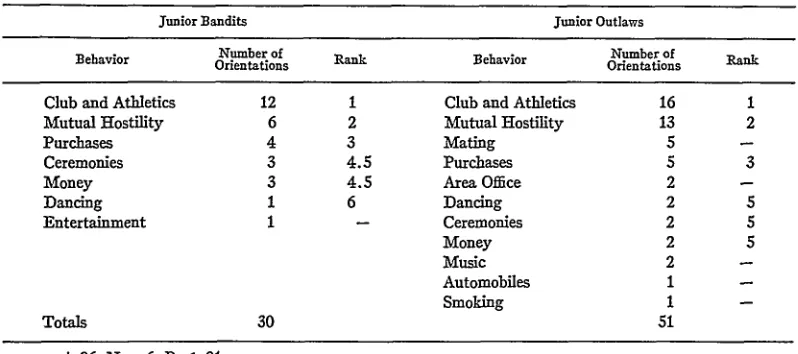
The juniors' utilization of lower class avenues of status was different in some ways from the Intermediates'. As Tables 11, 12, and 13 indicate there was a high correlation only in conferring. This contrasts with the Intermediates, where the Intermediate Outlaws conferred prestige so in-frequently in lower class terms that it was not possible to compute a correlation. In the other
[image:11.505.41.434.79.287.2]DELINQUENCY AND MIDDLE CLASS GOALS
TABLE 9
RANKINGS OF ADOLESCENT SUPPORTED BEHAVIOR: DENYING MODE Intermediate Bandits Intermediate Outlaws
Behavior Orenatonaviorhaio Number of Rank Behavior Number of Rn
Orientations Orientations
Mutual Hostility 53 1 Club and Athletics 86 1
Club and Athletics 13 2 Mutual Hostility 66 2
Automobiles 6 3 Mating 9 3
Ceremonies 4 4 Purchases 8 4
Area Office 3 6.5 Money 7 5
Money 3 6.5 Area Office 3 6
Mating 3 6.5 Music 2
-Purchases 3 6.5 Automobiles 2 7
Entertainment 2 9 Entertainment 1 9
Parties 1 - Smoking 1
-Touring 1 - Ceremonies 1 9
Gift Giving 1 10 Gift Giving 1 9
Totals 93 187
r. = +.59; N = 10; P < .05.
TABLE 10
RumINGs or ADOLEScENT SupPORTED BEHAVIOR: SEEKING MODE Intermediate Bandits Intermediate Outlaws
Number of Number of Rank
Behavior Orientations Rank Behavior Orientations
Club and Athletics 10 1 Club and Athletics 28 1
Mutual Hostility 9 2 Mutual Hostility 12 2
Money 7 3 Purchases 8 3
Mating 6 4 Mating 5 4
Parties 5 5.5 Entertainment 4 5
Purchases 5 5.5 Money 3 6.5
Entertainment 2 7 Parties 3 6.5
Area Office 1 9 Automobiles 2 8.5
Automobiles 1 9 Ceremonies 2 8.5
Ceremonies 1 9 Music 2
-Area Office 1 10
Totals 47 70
r. = +.84; N = 10; P < .01.
two modes, however, there were low correlations. Although there were somewhat higher correlations than between the Intermediates, rank order cor-relation is not discriminating enough with such a small N to warrant the conclusion that the Juniors agreed more on lower class avenues of prestige. It is apparent that a similar divergence in status avenues existed between the Juniors. The Junior Bandits chose lower class avenues more frequently than the Outlaws except in the seeking mode. However, this does not necessarily mean that the Junior Outlaws were more lower class oriented
when seeking prestige. This result was due to the aforementioned "sibling rivalry" between the Junior and Intermediate Outlaws for the services of their social worker. Despite the delinquent activities of one clique among the Junior Outlaws, the group as a whole remained essentially adoles-cent oriented.
Once again, though, it was in the qualitative aspects that the Juniors differed more dramati-cally. The Bandits were more committed to dis-approved aspects of the same lower class behavior. The Bandits actively supported and rewarded
[image:12.505.25.420.82.285.2] [image:12.505.29.424.317.498.2]TABLE 11
RANKINGS OF LOWER CLASS BEHAVIOR BY THE JUNIORS WHEN CONFERRING PRESTIGE: ALL TARGETS Junior Bandits Junior Outlaws
Behavior Number of Rank Behavior Number of Rank Orientations Orientations
Fighting 18 1 Fighting 6 1
Drinking 6 - Jobs 3 2
Vandalism 6 2.5 Theft 2 4
Jobs 6 2.5 Vandalism 2 4
Creating a Disturbance 5 4.5 Creating a Disturbance 2 4
Theft 5 4.5 Gaming 2 4
Belongingness 4 6 Profanity 2
-Trouble 4 - Absenting 1 7.5
Hanging 2 - Belongingness 1 7.5
Gaming 2 7
Absenting 1 8
Informing 1
-Totals 60 21
r. = +.81; N = 8; P < .05.
TABLE 12
RANKINGS OF LOWER CLASS BEHAVIOR BY THE JUNIORS WhEN DENYING PuEsTIGE: ALL TARGETS
Junior Bandits Junior Outlaws
Number of Number of
Behavior Orientations Rank BehaviorOrientations Bank
Fighting 23 1 Fighting 12 1
Creating a Disturbance 10 2 Trouble 8 2
Drinking 7 3 Drinking 5 3
Trouble 6 4 Belongingness 4 4
Theft 5 5 Absenting 3 6
Absenting 3 6 Profanity 3 6
Sex 2 7.5 Theft 3 6
Vandalism 2 7.5 Hanging 2 9
Gaming 1 11 Sex 2 9
Belongingness 1 11 Vandalism 2 9
Hanging 1 11 Creating a Disturbance 1 12
Jobs 1 11 Gaming 1 12
Profanity 1 11 Jobs 1 12
Totals 63 47
I. = +.45; N 13; P > .05.
participation in gang fights, vandalism, boasted of or admired theft, eagerly supported drinking bouts, etc. The Outlaws tended to engage in ver-bal support of these activities, but engaged less frequently in actional support. Where the Bandits actually participated in and fomented gang fights, the Outlaws threatened violence but seldom im-plemented their threats. They did not participate in one full scale gang fight during their worker's tenure, whereas the Bandits engaged in several.
hold-DELINQUENCY AND MIDDLE CLASS GOALS
TABLE 13
RANxINGS OF LOWER CLASS BEHAVIOR BY THE JUNIORS WBEN SEEKING PREsTIGE: ALL TARGETS
Junior Bandits Junior Outlaws
Number of Rank Behavior Number of
Behavior Orientations Orientations Rank
Fighting 8 1 Fighting 9 1
Theft 4 2.5 Jobs 8 2
Trouble 4 2.5 Drinking 5 3.5
Creating a Disturbance 3 4 Theft 5 3.5
Vandalism 2 - Belongingness 2 5.5
Absenting 1 7.5 Creating a Disturbance 2 5.5
Belongingness 1 7.5 Profanity 2
-Drinking 1 7.5 Absenting 1 8.5
Gaming 1 7.5 Gaming 1 8.5
Hanging 1 7.5 Hanging 1 8.5
Jobs 1 7.5 Informing 1
-Trespassing 1 - Trouble 1 8.5
Sex 1
-Totals 28 39
r. = +.34; N 10; P > .05.
ups. The Outlaws found less lower class behavior to criticize and generally were concerned with less serious forms of the same conceptualized behavior. Both ranked fighting first as a form of denying prestige; but the Outlaws playfully punched each other, pelted each other with wads of paper, or threatened assault, while the Bandits threw bottles or lighted matches, or threatened bodily harm with a knife. This order of difference occurred throughout the records; these examples happened to appear in the sample population.
This is not intended to deny that the Outlaws did not engage in any violative behavior. They also stole autos, drank, and damaged property, but it occurred much less frequently. They ex-erted more stringent controls and regulation of behavior which disrupted orderly group activity and continuously appealed to the worker to exert more control. They were reluctant, however, to enforce the norms regarding law-violating be-havior. Their major concern was with club and athletic activities rather than with illegal be-havior. The Bandits were much more prone to overlook minor activity-disrupting behavior as well as minor and major law-violations.
In the matter of orientation to work, the Out-laws were more likely to boast of having a job or of defending their ability to get jobs. Having a job inferred adultness, independence, and masculin-ity. It was also an easy way of gaining the ap-proval of their worker. One of the principal
functions of a job among Bandits appeared to be its tendency to keep them out of trouble. The most delinquent Junior Bandit expressed this equation several times. There was little indication that either group actively supported the voluntary unemployment pattern. There were hints, though, that the more delinquent element of Bandits would have given this support if the social worker had not been present. Considering that they were not as delinquent, nor as lower class, at the same stage of development as their brother segment, it is unlikely that they would have supported this pattern as fervently as the Intermediate Bandits. The Junior Outlaws gave no indication at all that they supported voluntary unemploy-ment; they were eager to make money and become self-sufficient.
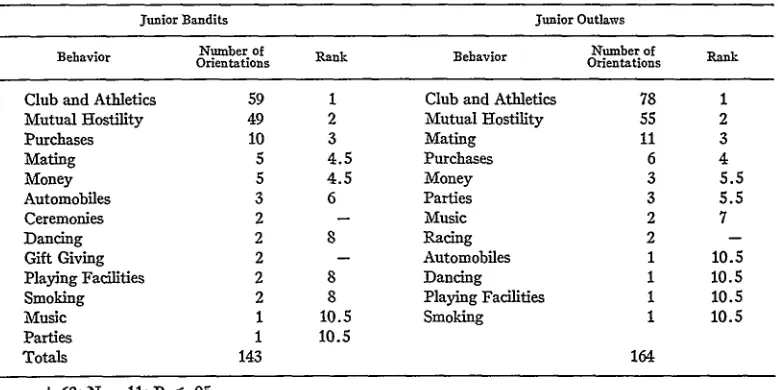
symbol of adulthood and masculinity and a major three modes indicated there were more similar-means of prestige. ities than differences. They were obviously more nearly alike than the Intermediates. Where the Adolescent Behavior latter had only two high correlations, the Juniors There were even fewer differences between the exhibited high correlations in all three modes. Juniors when orienting to adolescent supported This is consistent with their more equidistant behavior. Tables 14, 15, and 16 show that they class origins.
supported nearly the same behavior in nearly the It is obvious that both groups gave primary same rank order. The high correlations in the importance to athletics and club activities. They
TABLE 14
RANKING
or
ADoLEscENT SUPPORTED BEHAVIOR BY THE JUNIORS: CONFERRING MODEJunior Bandits Junior Outlaws
Number of Rank Behavior Number of Rank
Behavior Orientations Orientations
Club and Athletics 78 1 Club and Athletics 46 1
Purchases 15 2 Mutual Hostility 11 2
Mutual Hostility 11 3 Purchases 7 3
Money 6 4 Area Office 5 4.5
Automobiles 3 - Mating 5 4.5
Entertainment 2 5.5 Entertainment 4 6
Playing Facilities 2 5.5 Dancing 3
-Area Office 1 8 Mutual Affection 3
-Gift Giving 1 8 Money 2 7.5
Mating 1 8 Music 2
-Parties 1 - Playing Facilities 2 7.5
Touring 1 - Ceremonies 1
-Gift Giving 1 9
Totals 122 92
r. = +.62; N = 9; P < .05.
TABLE 15
RANKiNGS OF ADOLEscENT SUPPORTED BEHAVIOR BY THE JUNIORS: DENYING MODE
Junior Bandits junior Outlaws
Number of Raul Behavior Number of Rank
Behavior Orientations Orientations
Club and Athletics 59 1 Club and Athletics 78 1
Mutual Hostility 49 2 Mutual Hostility 55 2
Purchases 10 3 Mating 11 3
Mating 5 4.5 Purchases 6 4
Money 5 4.5 Money 3 5.5
Automobiles 3 6 Parties 3 5.5
Ceremonies 2 - Music 2 7
Dancing 2 8 Racing 2
-Gift Giving 2 - Automobiles 1 10.5
Playing Facilities 2 8 Dancing 1 10.5
Smoking 2 8 Playing Facilities 1 10.5
Music 1 10.5 Smoking 1 10.5
Parties 1 10.5
Totals 143 164
[image:15.505.35.434.200.396.2] [image:15.505.45.434.438.633.2]DELINQUENCY AND MIDDLE CLASS GOALS
TABLE 16
RAxKINGS Or ADOLESCENT SUPPORTED BEHAVIOR BY THE JUNIORS: SEEKING MODE
Junior Bandits Junior Outlaws Number of Raul Behavior Number of
Behavior Orientations Orientations Rank
Club and Athletics 12 1 Club and Athletics 16 1
Mutual Hostility 6 2 Mutual Hostility 13 2
Purchases 4 3 Mating 5
-Ceremonies 3 4.5 Purchases 5 3
Money 3 4.5 Area Office 2
-Dancing 1 6 Dancing 2 5
Entertainment 1 - Ceremonies 2 5
Money 2 5
Music 2
-Automobiles 1
-Smoking 1
-Totals 30 51
ra = +.96; N = 6; P < .01.
either conferred or sought prestige most frequently or criticized members for poor performance in those activities. Both groups had well-liked, effective social workers who aroused their en-thusiasm for dub-associated activities. The symbol which both groups fixed upon was the club jacket. Most of the references to Purchases refer to club jackets. Much dub activity was focused around jacket fund raising. Most other adolescent ori-ented behavior was similar. They admired skill in athletics, ridiculed physical ineptness, envied boys who had a way with the girls, rewarded group co-operation, derogated uncooperativeness, admired skill in dancing, teased awkward boys, and the like. There was remarkable uniformity in most activities labeled adolescent.
One area in which they differed, as did their older brother segments, was Mutual Hostility. The Junior Outlaws were less inclined to use the joking relationship. They were more inclined to use hostility rather than the joking relationship. This difference reached the .02 level of signifi-cance.u However, among the Intermediates it reached the .01 level. This lower significance level conforms to the generally fewer differences between the Juniors, but it also substantiates the importance of small social class differences.
Although the Outlaws used hostility more fre-quently, it was of a low level of intensity.3 0 They
19 Ibid. 153.
30 Miller, Geertz, and Cutter, Aggression in a Boys'
Street-Corner Group, PSYCHIATRY 24 (Nov., 1961). This
article discusses in great detail hostility among the Junior Outlaws.
seldom exploded or used sadistic tactics in enforc-ing norms. They were very concerned about the norms but hesitated to endanger group solidarity with highly charged reactions. There was much bickering and carping but little violence. The Bandits, on the other hand, like their older seg-ment, did not use hostile gestures so frequently, but when they did, it was often explosive but did not disrupt group solidarity. This was probably due to greater agreement on norms among the Bandits so that violent enforcement was not per-ceived as disruptive. Since they came from rela-tively homogeneous class backgrounds, there was probably greater social consensus. This seems to be reflected in their lesser use of hostility. The Outlaws derived from more heterogeneous class backgrounds and probably did not possess the same degree of values consensus. This was re-flected in their more frequent but low level bicker-ing. As Simmel noted, groups which fear to dis-rupt a tenuous social bond do not allow themselves
the luxury of violent reactions.3'
CONCLUSIONS
We have seen that Cohen, Cloward and Ohlin, and Bloch and Niederhoffer assumed the uni-versality of the internalization of middle class success goals. This hypothesis was subjected to testing and was not supported by observed inter-actional data. It was found that the more delin-quent groups were more committed to lower class values and focal concerns, while the less delinquent
[image:16.505.25.424.87.264.2]groups were more supportive of culturally neutral adolescent avenues of status. Middle class avenues of prestige were numerically unimportant. More-over, this relationship did not change significantly even when the interactional arena was middle class; all groups maintained, or even strengthened, their essential commitment to lower class or adolescent avenues. Contrary to those who main-tain the middle class values assumption, the data indicated that lower class gang boys are involved in their own little world relatively isolated from the middle classes. The general tendency of social scientists to assume that their own middle class position is the measuring rod of all classes is con-tradicted by these data. Psychoanalytically oriented people have been particularly prone to take this view, but it is also common among sociologists. It is naturally more tempting to view delinquency as a "sickness" since then one avoids examining the cultural background and concen-trates on the "deviant" aspects. What is usually overlooked is the specifying of what is being
"deviated" from, and in terms of whose definition. The tendency to be defensive about one's own value position has probably prevented many from perceiving anything but emotional sickness or social disorganization in lower class delin-quency. Miller and Sutherland are exceptions, but their viewpoints are in the minority.
The data of this study are limited in generaliz-ability because of the small sample of four groups from one city, but Hollingshead, Crawford, et al.,
and Whyte have reported behavior which is supportive.u These varied sources, as well as this study, indicate that lower class gang members are motivated more by attempts to achieve standards and measure up to qualities valued within their own subcultural milieu, than by efforts to achieve culturally distant and ill-understood values.
2 HoLLINGSHEAD, ELMTOWN'S YoUTH (1949); CRAw-FORD, MALAMUD, ANi) DutmsoN, WORKING WITH