Journal of Criminal Law and Criminology
Volume 63 | Issue 2
Article 10
1972
Polygraph Silent Answer Test, The
Frank S. Horvath
John E. Reid
Follow this and additional works at:
https://scholarlycommons.law.northwestern.edu/jclc
Part of the
Criminal Law Commons,
Criminology Commons, and the
Criminology and Criminal
Justice Commons
This Criminology is brought to you for free and open access by Northwestern University School of Law Scholarly Commons. It has been accepted for inclusion in Journal of Criminal Law and Criminology by an authorized editor of Northwestern University School of Law Scholarly Commons.
Recommended Citation
TnE JOURnAL OF CmIMIAL mLAW, CRInIOLOGY AND POLICE SCIENCE Copyright a 1972 by Northwestern University School of Law
Vol. 63, No. 2 Printed in U.S.A.
THE POLYGRAPH SILENT ANSWER TEST
FRANK S. HORVATH Aim JOHN E. REID
Frank S. Horvath received his B.S. degree in Police Administration at Michigan State University and then joined the staff of John E. Reid & Associates in 1966. Here he received training in scientific polygraph testing. In 1970 he became Chief Examiner and is a licensed polygraph examiner in the State of Illinois and a chartered member of the American Polygraph Association. He is currently pursuing graduate studies at the School of Criminal Justice, Michigan State University.
John Ei. Reid, J.D., Director of John E. Reid & Associates, is well known in the field of poly-graph examination for a number of noteworthy contributions. He is the coauthor with Fred E. Inbau of Truth and Deception, the Polygraph (Lie-Detector) Teclnique, 1966, and Criminal
Inter-rogation and Confessions (second edition 1967.) Mr. Reid has contributed several articles to this
journal.
Polygraph test results have been based tradi-tionally upon the recorded reactions to test ques-tions that are answered audibly by either a " yes" or a "no." In the past two years a new test, known as the Silent Answer Test (hereafter referred to as
SAT), has been the subject of experimentation in
over 4000 specific issue cases with considerable success. The SAT is one in which the subject is instructed by the examiner to refrain during the test from giving any audible answers to the ques-tions that are to be asked of him.'
In the SAT the subject is told to listen to each test question and to answer only to himself silently
'Some prior studies have been reported upon in which subjects were instructed not to answer. However, they were experimental using simulated laboratory
situations. See 2 PSYCHOPHYSIOLOGY, 10-13, (1956)
"The Effects of Verbal Responses on the Laboratory Detection of Deception," Gustafson, Lawrence A. and Ome, Martin T. "S's were given one of three different response tasks to perform in a detection of deception experiment using GSR. The 1st group was told to say
nothing as it heard each question, the 2nd to say "no"
to each question, and the 3rd to make a word associa-tion to each quesassocia-tion. Quesassocia-tions were presented in both a random and a known sequential order. There were overall differences among the three groups for both
con-ditions of question presentation. The 2nd group was most frequently detected, the 1st next and the 3rd least
frequently." Also see BmERumA Axm Z R, THE
AL&NiuLiox or HUMN BEHAviOR, 155 (19615. It is
possible to query S. without demanding replies from im at all, to require yes-no answers to approximately
framed questions, or to ask questions which require
explanatory statements from S. Some experimental
results (14) lead to the general proposition that if some overt response is required there are greater autonomic and muscular reactions to a stimulus. With larger re-sponses one would expect differentiation between truth and falsehood to be easier. One experiment in the Indi-ana study confirmed this expectation for lie detection. Subjects who were required to reply "yes" or "no" to questions gave more differential responses on the in-strument (GSR).
In other words, the subject is instructed that he is to "sub-vocalize" his answers, just as a person might do when he reads to himself; and, moreover, he is to think of the truthful answer and give that truthful answer to himself-silently.
THE TEST QUESTIONS
how-FRANK S. HORVATH AND JOHN E. REID
ever, is conducted before a conclusion is reached as to lying or truthtelling.2
CONCEPTION OF TrrE SAT
The SAT was conceived as the result of the "yes test"--one of the entire series that may be de-scribed as an "affirmation test." 3 In the "yes test" the subject is instructed to answer "yes" to all of the questions, including the pertinent relevant questions to which he had previously answered "no" on the prior tests. It was discovered that a large number of the lying subjects responded to the same degree when they answered "yes" to the relevant questions as on the previous tests when they answered "no" to these same questions. In other words, when the "yes" and "no" answers to the same questions in the two different tests were compared, the same type of emotional response ap-peared. The reason for this may be due to the fact that some untruthful or lying subjects view their "yes" answers as incriminating, and, therefore, it is disturbing to them even though they are telling the truth. However, a small percentage of the lying subjects show no reactions at all when answering
"yes" to the pertinent questions.
The absence of lie responses on the "yes test" is more typical of the subject who is telling the truth about the matter under investigation because he generally realizes he has nothing to fear by com-plying with the examiner's request to say "yes" to the relevant questions. He knows that he has been telling the truth and assumes that the "yes test" is just part of a routine procedure for detecting the basic liar. (Hereafter we shall apply the term "basic liar" to the person who is lying about the matter under investigation, e.g., the murder, burglary, etc.; and the term "basic truthteller" will be applied to the person who is telling the truth about the matter under investigation.)
Theoretically, a subject who is lying about the matter under investigation, the basic liar, should not respond as a liar when he answers "yes" to the relevant questions on the "yes test"; for after all, if a Polygraph is a "lie-detector" the tracing should indicate he is telling the truth when he answers "yes" to such questions. However, even though the Polygraph is reputed to be a "lie-de-tector," it is not such a device, and the typical failure of the basic truthteller to give a "lie"
re-For details regarding the standard test procedure and diagnosis, see REID, J., AND INBAU, F. E., TRUTH
AND DECEPON: THE POLYGRAPH (LIE-DETECTOR)
TECHnmQUE (1966).
'SUPRA note 1 at pp. 100-107.
sponse on the "yes test" is itself evidence of that fact. The same inference may be drawn from the basic liar's "lie" reaction even when he answers "yes" to the relevant questions. This phenomenon is what prompted the exploration into the use of the SAT. It was also thought that the SAT might minimize the occurrence of such interfering factors as a cough, a sigh, or a clearing of the throat before, during, or after an audible answer. It was theorized that during a SAT the subject does not have to anticipate audible answers to any test questions, and that this might obviate some of his anxiety and thereby render the recordings more meaningful. It was also contemplated that an overly apprehensive subject would have more freedom of thought on the test questions if he was not required to answer and, as a result, could focus attention on only those questions which are of most concern to him. Fur-ther, it seemed that the SAT might assist in the elimination of the "carryover" type of response that occasionally occurs from one question to an-other. The "carryover" response is common among highly apprehensive subjects who apparently dwell too deeply on their oral answers and cause the re-sponse from the prior questions to continue into the following questions.
WHY TiE SAT PRODUCES HELPFUL REACTIONS In our society it is courteous to answer politely asked questions, and it is an emotional hindrance not to be allowed to answer such questions. It is presumed, therefore, that the subject would be at a distinct disadvantage if told not to answer a question, especially during a Polygraph test. The basic liar may thereby become very suspicious when told not to answer any of the questions; in conse-quence, he may think much more about the ques-tions to which he will be lying. It is theorized that the SAT causes the subject to have a fear of the unknown, i.e., he is left alone with his thoughts, so to speak, and by attempting to secretly cover the real truth, a mental conflict occurs which pro-duces an emotional reaction that is reflected on the Polygraph chart.
It further appears that some subjects, when answering questions aloud are actually defending themselves against the examiner, and by talking they are allowed to relieve themselves of some of the tension that may be created by the questions stimulus. During the SAT, however, these subjects are no longer defending themselves against the ex-aminer; they are no longer competing with him; instead, they must now lie to themselves. During
THE POLYGRAPH SILENT ANSWER TEST
such silent lying to themselves they seem to try harder to conceal their deception, which efforts, in
turn, accentuate their Polygraph responses. It is very difficult for a basic liar to ignore his fear of detection; this creates a mental conflict which in turn causes a physiological reaction to ap-pear in the chart tracings. Even though he does not answer, he will have a greater mental conflict with respect to the relevant test questions, whereas the basic truthteller will concern himself only with the control questions.
INSTRUCTIONS TO THE SUBJECT
Upon initiating the use of the SAT it was discov-ered that, as in other Polygraph tests, the presenta-tion of the test instrucpresenta-tions had much to do with the final results. Two significant points were found to be necessary in order to achieve the maximum benefits from the test: first, the subject must dearly understand that in the SAT he will be asked the same questions as on his previous tests and in ex-actly the same order they were asked before; sec-ondly, it is very important for him to understand that although he is not to answer orally any test questions, he must answer all test questions silently in his own mind with only truthful answers. After some trial and error the following instructions were decided upon as being the most beneficial:
Joe, I'm going to conduct another test.
How-FIGURE 1.
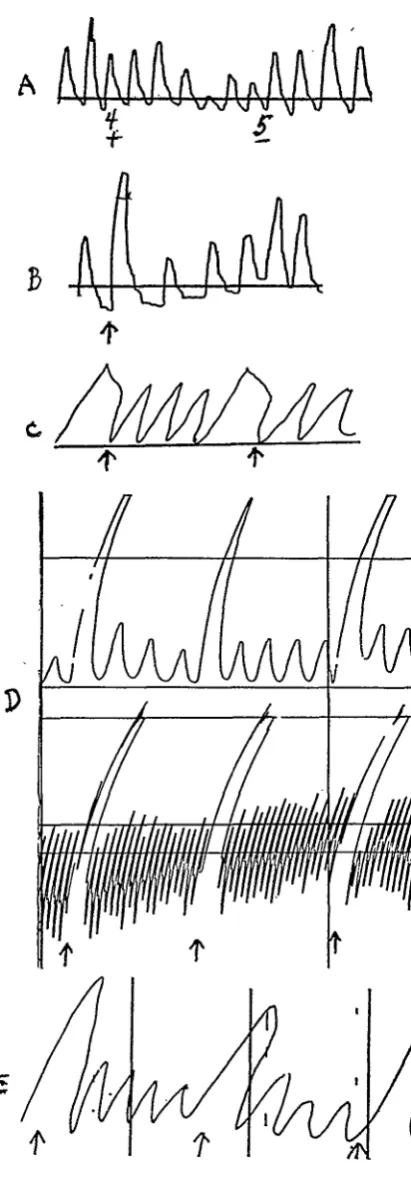
A is a portion of a "yes"-"no" Polygraph chart
con-taining the respiration tracing of a verified truthtelling subject. Question 4, answered "yes" (as indicated by the + sign), was an irrelevant question; question 5, answered "no" (as indicated by the - sign), was a relevant question. Observe the suppression midway between 4 and 5; it is an "anticipatory" response and not an indication of lying. It was caused, presumably,
by the subject's getting ready for the vocal answer of
"no" to the forthcoming relevant question.
B is a portion of a respiration tracing in which the
subject takes a deep breath at the time a question is asked, indicated by arrow, and a compensatory sup-pression thereafter. The deep breath destroys the value of the following suppression in respiration and cannot be considered as a true deception response.
C is an experimental test tracing illustrating what
happens when a subject's answer comes at the peak of an inhalation cycle.
D is an experimental polygraph chart illustrating the
type of movements that occur when an obese subject answers the test questions. Note, at the arrows, the deep breath taken by the subject and the consequent movement in the blood pressure-pulse recording (the lower tracing).
. is an experimental polygraph chart illustrating a deep respiratory sigh each time the subject answers (see arrows). If the same respiratory sighs are indicated when the subject is not required to answer the test question, it is evidence that the subject is purposely doing so to avoid detection.
/\J
[image:4.454.230.436.52.649.2]FRANK S. HORVATH AND JOHN E REID
SI j
I"
7
8
q
FiGuRE 2.
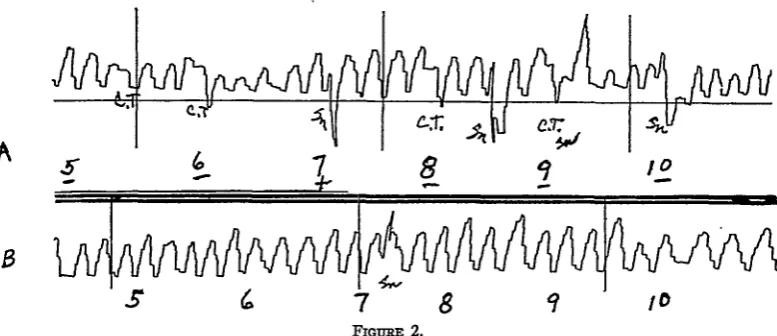
Respiration tracings of a truthful subject in the investigation of the mysterious disappearance of $5,500.00 from an armored car company. Questions 5, 8 and 9 pertain to the loss; question 7 is irrelevant; and questions 6 and 10
are control questions. The plus or minus signs under the number indicate a "yes" or "no" answer.
On test A notice the erratic respiration pattern caused by the subject's frequent clearing of his throat (indicated as C.T.) and sniffing (indicated by Sn.). On test B the subject was instructed not to verbally answer any of the test questions. Notice the lack of throat clearing or sniffing on this test.
Even though the subject cleared his throat and sniffed, he did respond on control questions 6 and 10 in test A (when he answered), and also responded slightly on question 6 (staircase suppression) and significantly (suppres-sion) on question 10 when the subject did not answer the questions aloud on test B.
Even though a significant response appears on A at control questions 6 and 10, the respiration pattern is so confusing as to render unsure what appears thereon. The indications are much clearer on SAT B--and particularly at control question 10.
ever, this test will be a little different from the prior tests. I'm going to ask the same questions as before in exactly the same order, but instead of answering my questions aloud, I want you to listen carefully and then answer each question to yourself with the truthful or correct answer but do so silently. In other words, Joe, don't answer any of the test questions out loud.
Do you understand what I want you to do when I ask you these questions (indicating the questions on the prepared sheet)?
When the subject acknowledges that he has un-derstood the test instructions, the examiner pro-ceeds with the test.
TESTING DISADVANTAGES CORRECTABLE BY
SAT
Before presenting a detailed, illustrated discus-sion of the special advantages of SAT, attention shall be given to some of the testing disadvantages inherent in the audible answer test procedure
(many of which are illustrated in Figure 1):
1. In preparing for an audible answer to a test
question a subject may indulge in:
a) a suppression in respiration (Fig. 1-A): or b) an excessive intake of air which results in a subsequent compensatory suppression re-sembling a true deception response (Fig. I-B).
2. An answer given at the height of an inhalation cycle may produce a substantial distortion in the respiratory pattern (Fig. 1-C).
3. Many obese subjects, because of the pressure of the blood pressure cuff and pneumograph tube, will be impelled to invoke various normally un-necessary muscular movements in order to audibly answer test questions. (Fig. 1-D).
4. The SAT helps to correct the respiratory pat-tern by eliminating objectionable movements caused by the following:
a) a subject who tries to physically prepare him-self with sufficient air in his lungs before answering questions aloud; (Fig. 1-E), or b) a subject who loudly bellows his answer to
emphasize his denial; or
c) a subject who feels compelled to talk in addi-tion to answering with a "yes" or "no"; or d) a subject whose throat becomes irritated each
time he is required to orally answer a test question (Fig. 2).
5. The deliberate efforts of a basic liar to "beat the machine" by respiratory distortions are more difficult to detect because of the possible similarity to unintentional distortions due to the breathing effort required for an audible answer (Fig. 3).
In addition to the SAT attribute of eliminating some of the foregoing disadvantages of the audible [Vol. 63
[image:5.454.46.435.43.211.2]THE POLYGRAPH SILENT ANSWER TEST
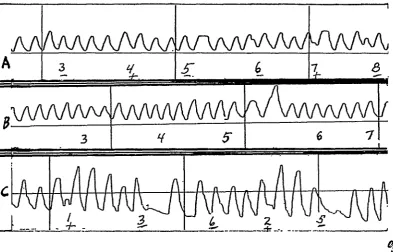
answer procedure, the tracings obtainable by the SAT are as fully revealing of truthfulness or decep-tion as the CQT (Figs. 4 and 5).
PROCEDURAL ADVANTAGES op TE SAT Experiments thus far indicate these advantages
of the SAT:
1. It is less cumbersome and easier to explain to the subject than other tests;
2. It requires less effort on the part of the sub-ject during the test, with a consequent elimi-nation of interfering factors such as coughing, sighing, and clearing of the throat.
3. It is unnecessary for the subject to mentally
Ss
4
1
8
"(
FiGtom 3.
Respiration tracings of an untruthful subject regarding the illegal disclosure of confidential information. On 'yes"-'Jno" test A, observe the respiration baseline drop after irrelevant question 4 and prior to relevant question 5. Also notice the suppression in respiration at relevant questions 5 and 8.
Notice the normal respiration baseline prior to question 4, as well as at questions 6 and 7; at other points the baseline is below normal.
On test B the subject was told the same questions would be asked but that he should not answer any of them. -Notice the more consistent respiration baseline and the more significant suppression in respiration, indicative of deception, at relevant questions 5 and 8. (The control question 6 did not contain any deception responses in either test A or B.)
FIGuE 4.
Respiration tracings of a subject suspected of an industrial sabotage. Questions 5,8 and 9 pertain to the sabotage. Question 7 is irrelevant. Question 6 is a control question: "Did you ever steal anything in your life?"
On test A the subject answered all questions audibly (indicated by a plus or minus sign under the numbers). On test B the subject was instructed not to answer at all. Note the suppression in respiration at question 6 on both tests A and B, indicating that the subject was not telling the truth on the control question. However, since he did not respond on the pertinent questions 5, 8 and 9, he was reported innocent of the sabotage, a finding later verified.
This case illustrates that the subject's oral answers to the test questions are not really necessary in order to achieve the same desired results.
FRANK S. HORVATH AND JOHN E. REID
ft~k~f3
ql
%M V f
fII
"L
F G=a, 5.
Respiration tracings of a subject who was later proven guilty of a gasoline theft. Questions 3 and 5 relate to the theft; question 4 is irrelevant; question 6 is a control question: "Besides when you were a child did you ever steal anything?"
On test A the subject answered all questions audibly (indicated by a plus or minus sign under the numbers). On test B the subject was instructed to answer silently. Note the extensive respiratory blocks on questions 3 and 5 and the lesser respiratory block on question 6, the control question, in both tests A and B. This illustrates again that it is unnecessary for the subject to orally answer test questions in order to indicate deception.
alert himself as seemingly is required during a "yes"-"no" test. In this manner the SAT assists in reducing anticipatory responses. In addition to the foregoing advantages, some other unexpected ones occurred, namely:
1. The Enhancement of the Utility of the Galvanic
Skin Reflex (GSR) Recordings. Previously the GSR recordings have been considered unreliable indica-tors of truth or deception when audible answers were required, but the GSR now provides very helpful indications when the SAT procedure is used4 (Fig. 6).
Heretofore the GSR was depended upon by the authors only in specialized Peak of Tension (POT) tests. For example, if some money had been stolen from a "desk drawer," and the suspect was not told about the exact location df the theft, POT test questions could be asked about other locations on the premises as well as the "desk drawer." When the guilty subject, the only one of the suspects who knew where the money had been, is asked ques-tions about the location of the money, no signifi-cant GSR response occurs until the question is asked about the "desk drawer." 5
Originally the POT test was described as a "peak of blood pressure tension test," but now with the SAT the GSR is also a valuable indicator.
2. An Extension of the Utility of POT Tests. When the SAT test procedure is used a helpful peak of tension is more likely to appear at the control
ques-'For a discussion of the G.S.R. see SUPRA note 1 at pp. 219-226.
5 For a discussion about the "peak of tension" test,
see SUPRA note 1 at pp. 127-140.
tion in a truthtelling person's record than when the oral answer test procedure is employed (Fig. 7). 3. Stimulation Effect of the SAT. A third innova-tion discovered in experimenting with the SAT was the stimulating effect it had on subsequently con-ducted tests. It was learned that even if the subject fails to react significantly on the SAT, it tends to induce greater responses on later tests.
FIGuin 6.
Complete recordings of portions of two tests, including the abdominal and chest respiration tracings along with
the GSR and blood pressure-pulse. (In preceding illustrations certain recordings were deleted because they were
of little or no significance.)
FRANK S. HORVATH AND JOHN E. REID
FIGURE 7.
SAT records of an innocent subject suspected of being involved in a million dollar platinum theft. Notice the gradual rise in the blood pressure-pulse tracing (lower recording) up to control question 6A and a gradual decline thereafter, indicating a peak of blood pressure tension at that point. Also notice the significant suppression in respiration at 6A. (Questions 3 and 5 are relevant regarding the theft; questions 2, 4 and 7 are irrelevant. The subject's innocence of the theft was subsequently established, and he admitted to the examiner that he had lied to the control question.)
IA
(VJk,>A
1
_____
4:
_______ ____________________________________________ II
2/,5
6
8:
I-
.-FIGUR.E 8.
!7
Respiration charts of a truthful female subject suspected of industrial espionage. Notice on test A the erratic respiration tracing. On test B, the subject's SAT, the respiration tracing seems to continue to be erratic, but the subject does show a more significant response to control question 6. Test C, a "mixed question test" (a standard section of the Reid test series) illustrates the stimulation effect of B, the SAT test. Notice the dramatic respiratory blocks to both control questions 6 and 11, and the lack of any response to the relevant questions 3 and 5 about the espionage. Control question 11, shown in "mixed question" chart, C_was also asked on tests A and B, but due to the limitation of space could not be illustrated in sections A and B. The control question responses 6 and 11 on this subject's mixed question test left no doubt as to the subject's truthfulness regarding questions 3 and 5. The results were later verified as truthful by the confession of another individual.
I
THE POLYGRAPH SILENT ANSWER TEST
FIGURE 9.
Respiration charts of a subject suspected of stealing $1,000.00 from her employer. On test A record notice the lack of any significant responses on any of the questions. It was conducted after a "card control test" which in most cases serves to stimulate a subject into responding, but in this case no significant stimulation effect was noted, and the subject's records were just as devoid of responses immediately after the card test as before it. On
SAT B record, significant responses appear on relevant questions 3 and 5, pertaining to the theft of the $1,000.00, which would lead an examiner to a tentative conclusion of the subject's guilt. Test C record, however, solidifies that diagnosis. It is a mixed question test record on which dramatic suppressions in respiration appear at relevant questions 3 and 5. The subject later confessed the theft of the $1,000.00.
the subject into reacting only to those questions which bear upon his guilt (Figs. 8 and 9).
SAT A MORE SIGmmCANT INDICATOR Or TRUM OR DECEPTION, ESPECILLY NE TE
END Or THE TEST SERIES
A subject's talking or sighing several times dur-ing the test, in addition to answerdur-ing "yes" or "no," causes respiratory disturbances as has already been illustrated. The examiner is then required to delay asking the next question until the respiration re-turns to normal. This delay may cause a pain reac-tion near the end of the test because of the addi-tional time the blood pressure cuff must remain inflated to complete the test.
R ECOGNITION or PURPOSELY DISTORTED RESPIRATORY TRACINGS
A subject who is feigning a requirement to sigh or move while answering each question does not
have that same opportunity during a test which requires no oral answers.
CONCLUSION
The current research has indicated that the SAT deserves a preferential place in future questioning techniques because it has the unique distinction of preventing defects in tests brought about in some degree by the subject's oral answers.
In addition, the SAT has produced several major innovations which have materially increased the accuracy of the Polygraph technique such as the added reliability of the GSR and the stimulating effect the SAT has on subsequent tests in the Poly-graph technique series.