Taking Control of Carbon
Emissions
Implementing Personal Action
N.F. Gray
Fellow Emeritus
Trinity Centre for the Environment Trinity College Dublin
First Published in 2018 by Tigroney Press
Avoca
Co. Wicklow
Typeset by Tigroney Press
All rights reserved ©N.F. Gray, 2018
The right of N.F. Gray to be identified as author of this work has been asserted in accordance with Section 77 of the Copyright, Designs and Patents Act 1988
This book and the material it contains may be freely distributed and reproduced subject to full acknowledgement and reference to the work.
The publisher and author are safe to assume that the advice and information in this guide are believed to be true and accurate at the date of publication. Neither the publisher or author give a
warranty, express or implied, with respect to the material contained herein or for any errors or omissions that may have been made.
A CIP record for this book is available from the British Library
1. Introduction
[image:4.595.151.407.298.459.2]Is global warming and its effect on climate actually real? Uncertainty analysis is used to establish the certainty of something being valid and is based on the level of agreement or the consensus between experts and the volume of evidence to support the theory. Everything we do is based on this type of analysis from building bridges to medical procedures. More scientists, engineers and other disciplines have been involved in the study of global warming both through the work of the Intergovernmental Panel on Climate Change (IPCC) and independently than any other issue in history. Using this approach then global warming, with a high level of consensus and a huge amount of evidence, places global warming in the top right-hand corner of Figure 1. Uncertainty assessmentreinforces that global warming is occurring and that the effects predicted are occurring at a rate closely related to atmospheric GHG concentration. Consequently, we have to accept that this is happening to us right now.
Figure 1. Using uncertainty assessment to compare the amount of evidence available on global warming and the level of agreement (shown by red cross) confirms that climate change is real and is happening now.
Even if we were to be wrong about climate change caused by global warming, then we are still in the same position, meaning that we cannot continue as we are with a high population growth rate, dwindling renewable and non-renewable resources, and increasing pollution as shown by the current plastics emergency and damaging levels of urban air pollutants. Planet Earth simply can’t support a human population much more than nine billion without ecosystem processes and services collapsing, which means that our ability to sustain all the people will not be possible. Our current path is leading to inevitable consequences that can only end in massive migration, increasing conflict, the potential death from starvation for hundreds of millions, and the possible disintegration of the global society that we enjoy today and the relative peaceful world in which we live.
simply leave this problem to sort itself out? ….well we can’t, because our lives and those of our children and in fact the survival and wellbeing of all species on planet Earth depends on us to tackling this problem now… and that’s not just you and me, that is everyone.
Now is the time to accept that global warming is real and is negatively impacting on us so that we can finally move on and engage in dealing with this major global problem in a meaningful way. Scepticism continues to stall the need to take action. Of course, we don’t want to alter our lifestyles or the way in which do business, but we are living in a fool’s paradise if we believe that we can continue as we are (i.e. business as usual). Numerous surveys have shown that the vast majority of us know that we can’t sustain this level of consumption and that global warming requires us to take action, but we just don’t want to fully admit that our own actions are part of the problem and that we have to start taking action ourselves. It is though no one wants to make the first move, although there are plenty of people who have and the number doing so is increasing every hour.
A UK Government survey published by the UK Energy Research Centre showed that those who do not believe in climate change had quadrupled from just 4% in 2005 to 19% in 2013. A IPSOS-MORI poll of 1000 people showed a similar trend with 91% accepting that the climate was changing in 2005 compared to just 72% in 2013. The level of concern has also fallen from 74% being very or fairly concerned in 2012 to 60% in 2013. So, we are seeing the general public choosing not to believe the overwhelming consensus of scientists, which has been strengthened by the recent IPCC reports and global events, but rather choosing to believe the sceptics who often have vested interests in maintaining a high-energy society. Our developed world lifestyle is not globally sustainable and has its roots in centuries of colonial exploitation which we have continued to this very day. That was the past, we now must make the large mental leap and accept that global warming and also the need to reduce our use of energy, either directly or indirectly, must take precedence in all aspects of our future economic, political and social futures. This is something we must do, if we don’t do it ourselves then Governments will have to impose it on us anyway. So, we need to put aside the doom and gloom and start to see the positive side of all this and get on with the job of tackling climate change and creating a sustainable global society.
The first task is asking ourselves honestly where we stand in all this. Each of us needs to identify what our stance on global warming and planet health really is? Below are four options. Which one do you honestly belong to and which one would you like to be in?
Total denial
➢ Just natural perturbations in climate
➢ Do nothing - business as usual
Acceptance, but will not affect me
➢ Idea that this is nothing to do with you personally
➢ Let’s see how this one pans out
➢ Scientists will find a way
➢ Governments will find a way
➢ Meanwhile do nothing - business as usual
➢ Good time to make some money of out of people’s paranoia
Acceptance, but nothing can be done
➢ What will happen will happen
➢ Deal with problems as they arise
➢ Be philosophical and prepare yourselves mentally
Acceptance and prepared to act personally
➢ Act now to slow down global warming
➢ Try and prepare yourself for a low-energy future
The answer I am hoping you will select is the last one… Acceptance and prepared to act personally. It is important that we all accept what is happening, but that global warming can be tackled and that as individuals we can do something to mitigate the problem. If we don’t then we leave no future security or hope for those who come after us and most likely for some of you actually reading this in 2018/9.
This is a golden opportunity. Never before have we been in such a position of such strength to deal with all the underlying problems of our global society. Tackling climate change will help us address: Hunger and poverty; Equality of opportunity; Water scarcity and sustainable farming; Population control and health; Maintaining biodiversity;
Controlling pollution and Wealth distribution. In fact, we are already seeing huge advances in many of these areas as a response to action to deal with climate change. We live in a networked global society, so it has never been easier to organize, share ideas, make significant changes, and to act as individuals but as part of a larger structured society. So, we are now able to act against climate change from the bottom up, rather than waiting for top down solutions. The longer we leave taking action then the increasing likelihood of those top down decisions becoming increasingly draconian is inevitable. We have gone past the tipping point where change can be prevented and are entering a new era in terms of climate. We must take action ourselves to deal and prepare ourselves for the future which will be an exciting and challenging period for everyone. Go straight to personal plan section.
Find out more about the IPCC and download their publications at http://www.ipcc.ch/
2. What are the key elements to understanding the climate crisis
Defining the problem
The global population is expanding very rapidly and for every death there are 2.4 births. We have already exceeded the carrying capacity of the planet in terms of resources and waste
Tackling climate change is a global revolution not only in how we live our lives on a daily basis, but how we interact
assimilation. Expanding population is having an increasingly irrevocable effect on all habitat types and biodiversity in general. Global warming will put more pressure on those dwindling resources and our very survival as the climate changes. The dilemma of dwindling planet health and our survival on planet earth is due to three factors that must be tackled: The underlying problem ofpopulation size; sustainability of lifestylesthat are adopted or desired which inevitably leads to inequality; and finally, the way in which we use natural resources. The magazine New Scientist listed smaller families at the top of their 10 steps to reducing greenhouse gas emissions. Each of us must see ourselves in context with the
7,664,000,000-other people all with an equal share in the biocapacity of the planet. It is important to accept the scientific evidence, as well as the evidence of our own eyes, that our climate is changing and that there is a finite global population that is sustainable.
Update global population from above figure correct in November 2018: http://www.worldometers.info/world-population/
Global warming and CO2
The greenhouse effect and global warming are real physico-chemical processes that are occurring right now. The energy balance which controls warming is complex but has been conclusively shown to be affected by man’s activities in terms of burning fossil fuel which includes domestic as well as industrial and agricultural practices. The rate of greenhouse gas emissions is continuing to rise each year and we need a significant reduction in emissions to stabilize greenhouse gas levels in the atmosphere. What you emit today in terms of CO2 will affect people for at least 100 years to come. Action to reduce emissions is urgent and the time to start is right now.
We all need to accept that greenhouse gases do actually control the surface temperature of the planet as well as the oceans and that man’s activities are releasing new GHGs, above those emitted by natural processes, at an ever-increasing rate. Action is urgent because of the longevity of the global warming potential (GWP) of the GHGs emitted, and that the targets set by the IPCC are realistic and necessary.
What is sustainability?
It is important to see ourselves as part of the natural system. We cannot exclude humanity in our vision of planet Earth nor must we see humanity in isolation. Any resolution of the environmental crisis must ensure continued economic stability, otherwise society will break down and we will enter a global dark age caused by famine and conflict. Sustainability is a complex interaction between social, economic and environmental goals. But no matter how complex and ill-defined it is, the concept of sustainability is the best mechanism that we have in achieving global stability and fairness.Nobel Laureate in Economics, Robert Solow, defined sustainability as‘an obligation to conduct ourselves so that we leave to the future
the options and the capacity to be as well off as we are, not to satisfy ourselves by impoverishing our successors.’ A major step towards living sustainably is personally agreeing to act to help achieve this.
The concept of resources
increasingly fragile environments will continue with the potential for severe environmental consequences as we have seen with oil extraction in the Gulf of Mexico and Alaska. Additional resources, such as oil sands and shales, require more complex and costly
extraction, processing and transportation, resulting in higher greenhouse gas emissions per unit of energy supplied. The list of non-renewable resources shouldn't be simply seen as materials that are limiting our development. It is more important to consider that when these resources are gone there will be no more. When the CO2 we emit today is finally dissipated in the atmosphere nearly all non-renewable resources really will be exhausted. So, avoid products that exploit and/or waste non-renewable resources, be aware of what products contain, and view these resources as your children’s inheritance.
Living sustainably is accepting that all resources are potentially finite and that we must use them sensibly and sparingly, preserving and recycling them whenever possible. We can do this by developing simple strategies to maximize our use of non-renewables by careful initial product selection, maximizing product use and making an extra effort at the end of life of products to prevent the loss of non-renewables into the waste stream.
Measuring and offsetting CO2 emissions
Every action uses energy and has a measurable carbon dioxide equivalent (CO2e) footprint. Footprint models allow us to effectively measure and manage our own emissions. I suspect that you have already used one of the numerous carbon calculators to measure your own footprint, but remember that these calculators often do not take into account embedded CO2e (i.e. they measure your direct primary footprint and not the secondary footprint which is energy used on your behalf). Such models are only of any value if you accept that an
individual’s behavior or life style is a source of global CO2e emissions.
To reduce your emissions, you first need to know what you are emitting and by which actions. So, explore which online models or calculators are best and then commit yourself to one, analyze your emissions regularly and explore ways of reducing unnecessary wastage. In Ireland, personal (primary) emissions average out at 5.7 tonnes of CO2e per person each year with the total emissions (both primary and secondary) 13.6 tonnes of CO2e per person each year. Ideally, we should all strive to reduce total our emissions to the current global average of 3.8 tonnes per person per year, although this will require a huge personal and national effort. We have until 2050 to reach the IPCC target of an 80% reduction in our emissions which would require our primary footprint to be just 1.06 tonnes of CO2e per person each year. Your choices control the energy used and CO2e emitted by you…no-one
else makes or should make that decision for you.
The real cost of carbon and offsetting
to improve their lifestyle through the more efficient use of energy, but can also drive extra growth, prosperity and so inadvertently result in increased emissions.
The impact of GHG emissions can only be reduced by using either less fossil fuels or actually removing CO2 from the atmosphere. Both alternative energy and mitigation
strategies need a long term fixed price for carbon to encourage investment, to make alternatives viable and to reduce energy use. Carbon is currently trading at €0.85 per tonne of CO2 (April 2013). The real cost of CO2 and other greenhouse gases have to be high enough to stimulate and support emissions reduction. However, to achieve this it needs to be fixed at around €100 per tonne, the actual current cost of physically removing and trapping CO2 from the atmosphere, or at least a fixed minimum trading price. We also need to ensure that carbon trading is equitable and that carbon credits are allocated in such a way as to genuinely reduce carbon emissions overall. The challenge is to allocate a realistic charge to our own personal carbon emissions and use money or time equivalent to offset carbon activities by investing in the reduction of your own or community GHG emissions.
Ecological Footprint
Whatever the reason, the longer we delay in tackling greenhouse gas emissions then the more severe climate change will be. Although not perfect, ecological footprinting (EF) gives us a far more holistic approach to tackling global warming than just using carbon or water footprint models. Governments, especially within Europe, now have the technical and management tools to start to tackle global warming seriously but they need a strong mandate! Therefore, we all need to put pressure on European, National and local politians and send a clear message that we need action.
Ecological footprinting gives us the realistic universal target of 1 planet which in 2014 was equivalent to 1.8 global hectares per capita, although this is getting less each year. This approach gives us clear goals requiring us to stabilize and increase bio-capacity, reduce the ecological footprint through reduced consumerism and greater efficiency, and to stabilize and eventually reduce population.
Find out more about ecological footprinting and the Global Footprint Network: https://www.footprintnetwork.org/
Energy - green or otherwise
Since the industrial revolution more than half of the world’s energy has been consumed in just the last two decades, despite advances in efficiency and sustainability. This means that there is an urgent need to bridge the gap between current usage and the required
Our aim should be:
➢ To do twice as much with half of the resources (Factor Four Reduction) and thereby reduce our personal ecological footprint;
➢ To stabilize and increase bio-capacity by using our space, garden and land better and by becoming involved with conserving and
reductions to be able ro meet International greenhouse gas emission targets. This can only be done by using less energy, using energy more effectively, and by replacing traditional fuels with cleaner and renewable energy alternatives. But these reductions can only be achieved by significant reductions in energy usage overall. For the individual the major uses of energy are for transportation, space heating and water heating, so it is in these areas that behavioural changes and investment can yield significant savings and emission reductions. As energy becomes increasingly expensive and pressure to reduce emissions to meet international targets becomes acute then every one of us will have to address the issues that will arise from living within a slowly reducing energy budget. Two major challenges face us, the adoption of a low energy (carbon) lifestyle and the move towards a low energy (carbon) economy. This requires replacing supply-side management (i.e. continuous growth to meet demand) to demand-side management by setting ourselves strict energy budgets or limits. This can be only be achieved through a combination of structural (e.g. smart
lighting/heating, CFC lights etc.) and behavioural actions (e.g. switching off appliances rather than leaving on standby, turning off lights when not in use etc.).
Travelling here, there, everywhere
Transportation is the largest component of the Irish personal carbon footprint (56%) and is growing. This is the same in most developed countries. Cheap flights have exacerbated aviation use with the subsequent proliferation of weekend breaks, multiple holidays, second homes etc. Aviation should be considered a luxury and should really be subject to higher carbon taxation. Transportation should be minimized and offset against other emissions within your own budget (i.e. personal trading). So, if travel is really important to you, and travelling is something that is very special, then you should try to find those carbon credits by economizing elsewhere. Alternatively, spread travel emissions over a longer period of several years to incorporate that once in a lifetime trip or studying abroad, or offset by investing your money or time in personal or community projects that really do reduce GHG emissions.
Having enough to eat
It is more than likely that if you are reading this booklet that you probably do have enough to eat. In the Western world we do tend to eat far too much protein, carbohydrates and fat which has led to rising concerns about obesity and the upsurge in diabetes in the under 40s.
Start by setting personal reduction targets for electricity used in the home, taking time to select and investment in the best energy efficient appliances, turning lights and appliances off when not required, and always selecting the most efficient energy sources. Use this ethos to influence others in your family and work.
Always ask the questions … Is this trip necessary? Is there a more efficient
However, 35% of the global population is living in food poverty and global warming will cause this figure to rise year on year.
The type of food you eat and how it's produced is the single largest component in your meal’s carbon footprint, although this is a relatively small proportion of your overall primary footprint. Although it often seems that we are obsessed with how far our food has
travelled, in general food miles associated with air travel is a very small component and are typically associated with expensive perishable items such as out of season strawberries. That is not to say that much of our staple foods do not travel long distances, but the most significant carbon footprint in terms of transport is our trip to the shop or supermarket to fetch it. We waste up to a third of our food by cooking too much or never cooking
purchased food at all, so less waste means more food to go around and less demand means lower prices globally. Less food waste at home reduces your carbon footprint. If you eat what you buy; reduce meat and dairy or not eating meat at least one day per week or simply reducing portion size; are more seasonal in your purchases and avoid out of season
hothouse grown or air freighted where possible, you will half your carbon footprint emissions for the food that you or your family eat.
Where does water fit in?
How climate change will affect society will largely focus around water availability which not only controls agricultural production but is the key cause for conflict and migration.
Increased migration increases urbanization which subsequently leads to an increased risk of water shortages often resulting in disease and poverty. Increasing scarcity of water is exacerbated by global warming with renewable resources becoming threatened by over exploitation. All products contain embedded water with our direct water use (i.e. the portion that is piped to our home) representing on average only 3% of our total water footprint. As water becomes scarcer we need to adopt the principles of water demand management, where consumers work within an adequate but fixed budget of water, with emphasis on conservation of water, use of water saving appliances, reduction in leakage and metered based charging.
Waste not want not
Recycling … does it matter? It has been shown that recycling does significantly reduce personal and business carbon emissions. Recycling also preserves and maintains
non-Reduced consumption and its careful use in the home helps to reduce carbon emissions from heating water, especially where water has come from expensive sources such as desalinization, and reduces the impact of water abstraction on ecosystems.
renewable resources and reduces environmental degradation. Overall recycling is good for the environment, for preserving resources and reducing emissions. But we must learn not to create waste in the first place and that includes waste that is recyclable. To do this we each need to develop a waste minimization strategy. Our new mantra must be to prevent and reduce waste in all areas of our life. However, we all need to buy things from food to computers, so remember the three Rs:
➢ Reduce - buy less and use less with the basic concept here to use all you buy, wear it out and reduce the amount of material discarded;
➢ Reuse -discarded items or components of the item should be used again or upcycled into more valuable items whenever possible before finally recycling; and finally,
➢ Recycle– ensure that discarded items are dismantled and sorted so that all the key resources can be recovered and reused. It is important to make sure they are clean and well separated. Over half of recyclables are discarded due to contamination, especially from glass fragments.
The Planet’s Health
The health of the planet is totally subjective as it is based on our own view of what it should be, and to a great extent it is a romantic ideal based on a manmade eighteenth century English landscape. The planet is continuing to evolve, and while we currently enjoy a period of global stability there is, in reality, no correct bioplan for planet Earth. Planet health is about sustaining us within the biocapcity available. For that we need other species of plants
and animals…we can’t survive on our own. As global temperature rises we are approaching some irreversible tipping points that will alter planet Earth for ever.
To achieve a sustainable balance between us and planet Earth we have to act now, not only on global warming, but on a large array of environmental, political and social issues. It is a very big and complex problem. However, we need to avoid whole planet engineering and global management solutions as quick fixes. Earth is so fragile that we should not interfere with its natural evolution on a global scale as we have no idea of the consequences. Such approaches should only be used as a very last result.
We all need to understand our planet, to live as closely as we can with it, be a part of it, and understand its seasons and rhythms. We must preserve and care for it, because quite simply it’s our home. So, step lightly, use only what you need, and waste nothing. We can still prevent the worse scenarios occurring if each of us chooses to act right now.
➢ Buy less and buy better quality
➢ Consume all your food
➢ Use consumables carefully
➢ Wear things out
➢ Keep electronic devices longer before replacing them
Your Health and wellbeing
Climate change can directly as well as indirectly affect human health, and if no action is taken, then problems such as malnutrition, deaths and injury due to extreme weather conditions, and change in geographical distribution of disease vectors will worsen. Set against this are significant potential benefits in both individual and community health and wellbeing from implementing carbon mitigation strategies which help offset their cost. So, for example, the reduction in city traffic density lowers air pollution levels leading to improved health.
Peoples’ quality of life is determined far more by the quality of their working life, their family life and their overall social relationships than the amount of consumption or wealth they have. So, it is important to ask yourself honestly what lifestyle you really want for yourself and your family, and plan how to achieve this sustainably. Numerous studies have shown that the de-coupling of consumption and the improvement of wellbeing is possible. Tackling climate change will require tackling those socio-political issues that currently affect human wellbeing as well as tackling unsustainable consumerism. It has become the norm to go away to find the environment and lifestyle you want, and this is reflected by the very high ownership of second homes. We are often amazed how safe it is and how relaxed it is to walk the streets at night in Italy or Greece, something we would never do in the UK or in some parts of Ireland or the US. Yet a crucial factor in sustainable living must be creating a place where you want to live, where you feel safe and unstressed. For example, many people who would like to use public transport don’t because they feel threatened and unsafe. Therefore, tackling social problems is at the core in creating a sustainable society.
The next step
Global warming is real and is happening to us all right now. This is causing our climate to change far more quickly than we have experienced before resulting for some in drought and desertification and for other in increasingly violent and unpredictable storm events leading to flooding and worse. Soglobal warming doesn’t always mean hotter, it means
unpredictability. The fact that our climate is changing means that we need to act to meet the new challenges that will face us all in the coming decades often referred to climate change resilience. Even if we are wrong about climate change, and that is extremely unlikely, then taking actions now will solve many other pressing and indeed equally damaging problems.
If we do not tackle global warming it will have an increasingly negative effect on human health through water and food scarcity, spread of diseases and increased severity of weather patterns.
It is often stated that any person on the planet can be connected to any other person through a nexus of just six relationships. Therefore, each individual, through modern media can connect and influence potentially every other human on the planet. This means that individual’s really do have the power to influence, lead by example and cause change. The cause and solution to climate change lies with the individual, that’s you and me.
3. Implementing personal action – developing a personal plan
Everyone has a different primary carbon footprint, that is emissions arising from their own direct activities (e.g. travel, household heating and lighting, food, waste etc.) but the same secondary or embedded footprint for the country in which they reside, which includes emissions arising from services (e.g. roads, education, hospital, infrastructure in general). A study by Kenny and Gray in 2009 established that the average Irish carbon footprint could be broken down into the primary personal emissions of 5.7 tonnes CO2e per year and the secondary or embedded personal emissions equivalent to 7.9 tonnes CO2e per year which gives us our total carbon footprint 13.6 tonnes CO2e per person each year. In practice it is only the primary or personal footprint you can significantly influence, while Government, both central and local, are charged with tackling the secondary footprint. The reductions in greenhouse gas emissions achieved so far has been through central, mainly Government or industrial, initiatives rather than us reducing our personal emissions which have stayed more or less the same. For example, improving the emissions per unit kWh of electricity generated by using cleaner fuels and renewables, has been pivotal in reducing overall GHG emissions. But conversely, we tend to use the same amount of electricity at the household level. The problem is that we are very passive in the way we approach reducing carbon emissions generally relying on technology to do the work for us rather than being proactive in reducing our total energy use. For example, reducing emission by replacing your light bulbs when they wear out with CFC or other energy efficient bulbs only works if you use the lights the same amount or less. The idea that if you replace a bulb with an energy saving one then you can leave it on all day doesn’t make sense. For example, single halogen
outdoor lights have been widely replaced by multiple LED lights that are then commonly left on 24/7 actually resulting in greater overall electricity use.
In order to save energy, reduce emissions and save ourselves money in the long-term we need to have a base line in terms of our individual energy usage. We can get a good idea of our primary footprint, by using an online carbon footprint calculator or model with some calculators also giving you a total footprint as well. Once you have identified what your emissions are and how you are currently using them (i.e. household heating, travel, food, consumables etc.) you can begin to take control. To do this most effectively you need to develop a personal action plan.
their actions as best as they can. However, neither of these groups will be able to achieve the required long-term goals or sustain their commitment. In contrast, a personal plan provides a focussed and staggered guide to achieving your carbon reduction goals as well as providing support and encouragement. However, the need for a personal plan really
depends on the type of person you are, the level of commitment you are making, and finally how much help you need to achieve those goals. Others simply get a thrill at setting goals and seeing if they can achieve them. To be honest with you, the level of reductions that our Governments have agreed to by the years 2020 and 2050, will really require all of us to reduce our emissions to quite a low level; So, a personal plan will help to ensure that we sustain the lifestyle that we want within those limits. The challenge is to achieve an 80% reduction in emissions without the equivalent reduction in lifestyle.
By careful planning now we can gradually, and hopefully quite effortlessly, move to a sustainable lifestyle without any dramatic changes brought about by sudden government policies. We are going to have to reduce our emissions dramatically very soon, we won’t have much of a choice about that, so rather than be caught out, plan now and be prepared for transition to a low carbon economy.
The mechanism of creating a personal plan starts with recognizing the need to change. This requires us to ask some very fundamental questions about our stance on climate change and how we are going to deal with the problems that may arise in the future as a result of global warming. The questions I would like you to consider for a few moments are:
➢ Do I want to be proactive in dealing with climate change?
➢ Do I want to be prepared for the challenges that climate change will bring?
➢ Do I have the skills that I need for a more dynamic and possibly unpredictable future?
➢ Do I want to develop the skills that will make me more prepared for the future? You can see straight away that these fundamental questions are also about personal lifestyle and career. The next step is the acceptance of change. This is always going to be the most difficult step, and that is why when you come to set personal goals it is important that they are achievable within the limits of your commitment. You can only change things that are under your own control, so it is important not waste time trying to achieve
unobtainable or unrealistic goals. Much current research into climate change resilience is unachievable, and often unhelpful, as it tries to preserve a business as usual approach, without the idea that some form of self-sacrifice or at least some active involvement from the individual is required. Also, it is not about just the wealthy nations, the whole global family must be taken into consideration.
targets, which require you to identify and detail each step to achieve your objectives. The plan is not fixed, it will evolve with time, but the key objective is a steady and continuous reduction in your emissions.
Finally, we put words into action and slowly implement our personal plan. This is not a race, and what we hope to achieve is a slow but sustainable reduction in energy use and
ecological footprint coinciding with Government targets. Then comes the rest of your life in which to slowly change to a sustainable, safer and hopefully happier lifestyle. Of course, you will need to measure your progress by rechecking your personal footprints at regular intervals to ensure that you on are target, but also as circumstances change you may need to review goals and if necessary readjust timescales or interim targets (Table 1). But by making this change you will be helping to slow global warming, to prepare yourself for the changes in our climate which are already in progress and improve your lifestyle and wellbeing, and importantly become more resilient to future socio-economic demands.
Table 1. Overview of main components of the personal plan
Recognition of the need to change
➢ Performance review by carrying out footprint analyses
➢ Identify career objectives
➢ Identify lifestyle objectives
➢ List skills
➢ Identify critical skills to acquire
Accept Change
➢ While the process is not personal in that we all need to reach common targets we do all start from different initial points in terms of our current emissions. There are no bad or good guys, only those who have decided to do something about making planet Earth sustainable.
➢ Everyone is scared of change and of the unknown. What is scarier is being aware that things are going to alter for the worse and doing nothing about it. The
challenge will seem daunting, even impossible at first, and this will make acceptance difficult. But this is an exciting opportunity to embrace the future with renewed hope, so it is really important that you accept the challenge willingly and positively.
➢ Try and imagine what change will be like, what the new lifestyle will give you and the advantages and renewed hope for the future.
➢ Instead of watching global warming slowly create havoc, you will be doing something positive to mitigate its effects and prepare yourself and your children to understand, accept and react positively to the challenges ahead.
Create personal plan
➢ Set targets/goals (i.e. carbon emissions, water usage, Earth equivalents)
➢ Break targets down into key footprint categories such as transportation, aviation, home energy, consumables, clothes, food, waste etc.
➢ Plans should have short (less the one year), medium (1 to 5 years) and long-term targets /goals (greater than 5 years) and actions that may coincide with life stages (career, house purchase, having a family, retirement etc.). Remember there will be periods in your life when you will have to use more energy than you would like, so this must be built into your plan.
➢ Identify what actions are needed to achieve each interim target/goal
➢ Set about gaining the skills you have identified that will be useful in the future
➢ Invest in both your sustainability and lifestyle which should be one of the same
➢ Use personal trading as a mechanism to learn how to manage your emissions
➢ Explore how your plan can be integrated with family, friends and the wider community (e.g. combined actions such as car sharing or carpooling)
➢ Set interim dates to assess progress
➢ Create a reward system
Implementation
➢ Once you have recognized the need to change and accepted the challenge, with your plan conceived you need to begin to implement the activities listed.
➢ Start small at first so that you can achieve your goals and targets. This will give you the confidence to continue and achieve greater things.
➢ Use skill development to meet other likeminded people who will support your efforts.
➢ Talk about what you are doing and try to show by example what can be done.
Measure progress and review
➢ A critical part of the plan is to review progress regularly and where necessary reassess targets and goals, and also the actions needed to achieve them.
Setting your target
First you need to set a target. Whether this is based on one Earth or a specific emission goal (remember we all have been set an 80% reduction of our greenhouse gas emissions by 2050), or perhaps both. However, it is important that it is whatever you feel happiest with. Your immediate short-term goal should be to get to the national average carbon footprint as soon as possible, although many of you will already be well below this.
Short term (12 months) targets should be easily achievable by carrying out simple energy saving changes, by minimizing waste and introducing more effective recycling. For example, driving sustainably can significantly reduce fuel consumption and so greenhouse gas
household heating, or investment in more advanced household insulation. Long-term
targets may require significant changes in lifestyle, so it is important that these changes are made over a significant period of ten years or more. All these changes will save you money over time which you can reinvest to create your sustainable dream, whether it’s a city flat with travel at the heart of your life, a small house and allotment, a larger house with a garden, or a small holding in the country and a commute. All five options are possible within one Earth lifestyle; it just requires careful management, imagination, innovation and commitment.
What will the plan physically look like? Well that depends on you. It can be an Excel spread sheet on your computer, a detailed plan bound in a folder, or a couple of sheets stuck to the fridge…whatever works for you. But it is important to keep a record and to ensure that you do have a long-term plan which you stick to. Remember to reward yourselves when you reach targets. Even when it’s not going exactly to plan you will still be reducing emissions.
Whatever your goals, whether they are simply to make small behavioural changes or more structured emission reductions, every little helps and more importantly will change attitudes both within your family, among your friends and work colleagues. One of the great successes in Ireland has been the green flag initiative to make schools more
sustainable. At the core of this initiative has been recycling and this has been so successful that our new generation of young people going to university and entering employment recycle as a matter of course. It was drummed into them at primary and secondary level that recycling was important and now is second nature. They have also been introduced to a wide range of life skills, which often have been lost during their parent’s generation, such as a greater understanding and appreciation of food through gardening and cooking, sewing, knitting, first aid, lifesaving, caring, and much more. By adopting a sustainable lifestyle, we will give ourselves and our children the skills, confidence and understanding to live
sustainably on planet Earth. As adults and parents, it is our role to support them in these efforts. At the heart of acting individually to address climate change is becoming a more independent and self-determining person.
What is a sustainable goal
What should be our individual target? We know from experience that as the household size increases the average individual footprint falls because you are sharing heating, food
preparation and often transport. This means that managing, and hence reducing, emissions often works best at family, shared or community level. It also allows you to trade emission allowances between family members and friends, so that emissions from holidays by one member can be absorbed by the others. The first interim target should be getting your primary footprint down to the national average which in Ireland is 5.7 tonnes per person per year. This is a very generous allowance (equivalent to 3.5 planets) and should be achieved as quickly as possible and will be quite easy by making simple behavioural changes such as switching off lights, recycling, not wasting food, etc. Look seriously at your travel footprint, especially how you drive. For many of us our average footprint will be well below this already, so what is a reasonable target?
you to offset your emissions by building biocapacity, such as growing your own food,
planting and managing woodlands etc. Alternatively, you can adopt a more direct approach that gives you far more control in how you manage your greenhouse gas emissions.
Perhaps the most sensible is to follow the IPCC reduction targets of 20 and 80% reduction by the years 2020 and 2050 respectively. Another approach is to aim for the global
average which would require us all to reduce our annual personal primary emissions to just 1.55 tonnes. This allows everyone in the planet to have the same emissions, permitting developing countries to grow and improve their lifestyles while putting a ceiling on their emissions, while at the same time allowing developed countries to use structural and behavioural strategies to significantly reduce their emissions. This is a huge reduction and cannot be realistically achieved quickly by most of us, although I know many people who have even lower emission footprints than the global average and have completely normal and certainly very happy and fulfilled lives…so this is not impossible by any means. Everyone will have a different strategy for achieving targets Some will want to achieve their final goal quickly and will perhaps make large financial investments to help them achieve them. Others, like me, I suspect will have to do this over longer timescales. The emissions
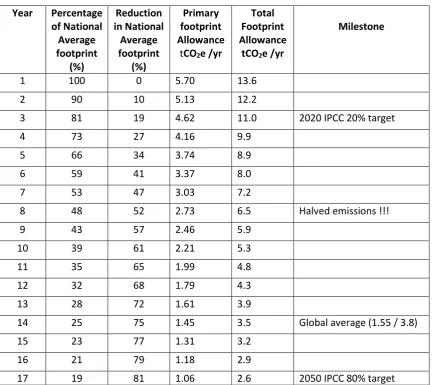
reduction system I like best is the adoption of a 10% reduction per year. This appears a very relaxed approach, but it does allow people to make changes in a more sustained way that is probably more likely to succeed. It gets tougher as time goes on to make those reductions even though actual annual reductions do get less each year. Using this method, it would take 14 years (the long-term goal) to get to achieve a global average primary footprint and would depend on a similar reduction of the secondary footprint from the current 7.9 to 2.25 tonnes per person per year. The secondary footprint is really complicated to reduce and easy to abuse. To achieve the 2050 IPCC 80% reduction target, using a 10% per annum approach, which is below the global average, it would take 17 years if you are starting at the National average footprint. It is important that you start on this process where your current emissions are. So, if your current footprint is 3.7 tonnes per annum, then you would come in at that point on Table 2 giving you just nine years to reach the ultimate target, even though the yearly reduction in actual tonnes of CO2e are relatively small (e.g. about a third of a tonne in the first year and slowly falling each year after that). We need to be able to manage our own energy use and personal emission reduction targets allows us to do just that. You can’t offset your energy use, you have to live within your own carbon budget, and what is brilliant, is that you make up your mind how you are going to use that energy.
There are going to be times when you will exceed your targets due to unforeseen
Table 2. Step reduction plan where emissions are reduced by 10% each year. Each year the actual reduction is less but becomes more difficult to achieve as the target threshold falls. Allowance for primary footprint and total (primary and secondary footprint) are given as tonnes CO2e per person
per year.
Checklist
❖ Reconnect with the living planet and be a part of it, learn to respect and love it.
❖ Be educated in practical things as global warming may throw up challenges that will require you to act more independently.
❖ Learn to be flexible in all things.
❖ Be as fit and healthy as you can that means exercise and a healthy diet. Invest in both your physical and mental health and addressing climate change helps us all in that.
❖ Plan ahead, whether it’s holidays, driving, managing your food, investing in energy efficient technology.
Year Percentage of National Average footprint
(%)
Reduction in National Average footprint
(%)
Primary footprint Allowance
tCO2e /yr
Total Footprint Allowance
tCO2e /yr
Milestone
1 100 0 5.70 13.6
2 90 10 5.13 12.2
3 81 19 4.62 11.0 2020 IPCC 20% target
4 73 27 4.16 9.9
5 66 34 3.74 8.9
6 59 41 3.37 8.0
7 53 47 3.03 7.2
8 48 52 2.73 6.5 Halved emissions !!!
9 43 57 2.46 5.9
10 39 61 2.21 5.3
11 35 65 1.99 4.8
12 32 68 1.79 4.3
13 28 72 1.61 3.9
14 25 75 1.45 3.5 Global average (1.55 / 3.8)
15 23 77 1.31 3.2
16 21 79 1.18 2.9
❖ Invest in longevity and high-quality repairable consumer goods. Think about buying second hand items, sharing and passing on unwanted items.
❖ Always incorporate climate change mitigation and impact into your long-term investments (car, housing, family)
❖ Always minimize your carbon footprint in every action you take. Ask yourself, how could I have done that better in terms of minimizing my emissions.
❖ Don’t offset emissions via a third party but do it through direct or personal action.
❖ Create a personal plan...stick to it...review it frequently…persuade others to do the same.
❖ Learn to live and enjoy a low carbon sustainable lifestyle.
4. Conclusion
Every one of us is now aware of the problems facing the planet, especially the problem of global warming and population growth. Also, we all know that we will have to act whether prompted by Government or by us taking the initiative. We have the means and the
technology to do it, so all we have to do is get on with it and stop waiting for someone else to tell us what to do and when. There are no easy solutions to tackling climate change and meeting the challenges that it will eventually present to us all. We need to find sustainable outcomes and we, as individuals, are the solution. We need you to be part of this exciting new period...to act as leaders, advocates, role models, or simply to be proactive. This is your time, your planet, and you can decide what kind of world you want to create.
Probably without realizing it you are already making a difference. The majority of us recycle, pay carbon tax on fuel, use our cars less and public transport more, replace incandescent light bulbs with long life low energy bulbs and much more. The fact that you are reading this shows your willingness to engage and take positive action. I have found that people in general are overwhelmingly positive about tackling global warming but are genuinely at a loss to know what to do. As a species we have both the intellectual
understanding and empathy that gives us all the ability to do wonderful things and to make the seemingly impossible happen. The personal plan system has been trialled on over 100 students and found to save between 0.4 and 1.4 tonnes of CO2e each within the first six months just by simple behaviour changes, so it works.
Whatever the climate has in hold for us it is possible to survive and to live full, complete and happy lives. But we must each and every one of us play our part and we need to start altering our lifestyle now by making small and considered changes. Now is the time to back off from high-energy consumerism and to live within the limits placed on the planet that needs to support 7.6 billion people just like you and me (and still growing) and countless other species. If you do it, and your friends do it, and their friends do it then suddenly things will have changed. It really does only take one person to make a difference and that person is you.
recovery is impossible. Catastrophic failures nearly always lead to cascading systems failure. Hopefully this is not going to happen in relation to climate change because politians will respond with increasingly draconian measures to deal with the consequences of global warming such as disastrous storm events, crop failures, wildfires, major migration etc. In the future some of these events could severely test our very social and economic stability. Therefore, we must pre-empt such measures by taking the lead now and not leaving it until uncontrollable events take over. Our climate is changing and we need to be able to stop the changes becoming too severe and we can only do that by all of us significantly reducing our emissions. Governments can’t tackle global warming alone and they need us to help and
we can do that by raising the issue whenever possible and ensuring that it always on the agenda no matter what other economic emergency there may be. This is done by giving the issue relevance and urgency and by giving actions validation and support; most importantly by altering our own behaviour and finally by encouraging those around us to do the same.