ScholarWorks @ Georgia State University
ScholarWorks @ Georgia State University
Counseling and Psychological Services
Dissertations Department of Counseling and Psychological Services
Summer 8-3-2010
School Mental Health Professionals' Experiences of Hurricane
School Mental Health Professionals' Experiences of Hurricane
Katrina Evacuees: A Phenomenological Approach
Katrina Evacuees: A Phenomenological Approach
Stephanie E. Eberts
Georgia State University
Follow this and additional works at: https://scholarworks.gsu.edu/cps_diss
Part of the Student Counseling and Personnel Services Commons
Recommended Citation Recommended Citation
Eberts, Stephanie E., "School Mental Health Professionals' Experiences of Hurricane Katrina Evacuees: A Phenomenological Approach." Dissertation, Georgia State University, 2010.
https://scholarworks.gsu.edu/cps_diss/52
This dissertation, SCHOOL MENTAL HEALTH PROFESSIONALS‘ EXPERIENCES OF HURRICANE KATRINA EVACUEES: A PHENOMENOLOGICAL APPROACH, by STEPHANIE ERIN EBERTS, was prepared under the direction of the candidate‘s Dissertation Advisory Committee. It is accepted by the committee members in partial fulfillment of the requirements for the degree Doctor of Philosophy in the College of Education, Georgia State University.
The Dissertation Advisory Committee and the student‘s Department Chair, as representatives of the faculty, certify that this dissertation has met all standards of excellence and scholarship as determined by the faculty. The Dean of the College of Education concurs.
______________________________ ________________________________
JoAnna F. White Ed.D. Gregory L. Brack, Ph.D.
Committee Chair Committee Member
______________________________ ________________________________
Catherine Y. Chang, Ph.D. Barbara Meyers, Ed.D.
Committee Member Committee Member
_____________________ Date
______________________________ JoAnna F. White, Ed.D
Chair, Department of Counseling and Psychological Services
______________________________ R. W. Kamphaus, Ph.D.
By preparing this dissertation as a partial fulfillment of the requirements of the advanced degree Georgia State University, I agree that the library of Georgia State University shall make it available for inspection and circulation in accordance with its regulations
governing materials of this type. I agree that permission to quote, to copy from, or to publish this dissertation may be granted by the Professor under whose direction it was written, by the College of Education‘s director of graduate studies and research, or by me. Such quoting, copying, or publishing must be solely for scholarly purposes and will not involve potential financial gain. It is understood that any copying from or publication of this dissertation which involves potential financial gain will not be allowed without my written permission.
All dissertations deposited in the Georgia State University library must be used in
accordance with the stipulations prescribed by the author in the preceding statement. The author of this dissertation is:
Stephanie Erin Eberts 1706 Cecilia Drive Atlanta, Georgia 30316
The director of this dissertation is:
Dr. JoAnna F. White
Department of Counseling and Psychological Services College of Education
ADDRESS: 1706 Cecilia Drive Atlanta, GA 30316
EDUCATION:
Ph.D. 2010 Georgia State University
Counselor Education and Practice
M.S. 2000 Loyola University
Community Counseling
B.S. 1995 University of Georgia
Foreign Language Education
PROFESSIONAL EXPERIENCE:
2008-2009 School Counselor Consultant, North Metro Psychoeducational
Program, Lawrenceville, GA
2007-present Graduate Assistant and Behavior Recovery Program Liaison, Safe
and Drug Free Schools, Lawrenceville, GA
2005 School Counselor, Saint James Episcopal Day School, Baton Rouge,
LA
2000-2006 School Counselor, Trinity Episcopal School, New Orleans
2001-2006 Spiritual and Ethical Department Chair, Challenges Summer
Program, New Orleans
2000, 2002 Counselor, Bethlehem Children‘s Home, New Orleans
1999-2000 Counselor Intern, Trinity Episcopal School, New Orleans
PROFESSIONAL SOCIETIES AND ORGANIZATIONS: American Counseling Association
Association for Counselor Education and Supervision
Southern Association for Counselor Education and Supervision
PUBLICATIONS
Levitov, J.E., Fall, K.A. & Eberts, S. (2001). Telehealth: Counseling advantages and caveats. Louisiana Counseling Association Journal. 9, 48-58.
group counseling class.. Paper presented at the meeting of The Association for Specialists in Group Work, New Orleans, LA.
Gnilka, P., Wolfe, A., Eberts, S., & Eberz, M. (2009, October) CACREP accredited master level counseling programs and prejudice levels. Poster presented at the meeting of The Association of Counselor Education and Supervision, San Diego, CA.
Flynt, M., Wynne, L., Draper, K., & Eberts, S. (2009, October). Behavior Recovery: A school based play intervention. Paper presented at the meeting of The Association for Play Therapy. Atlanta, GA.
Eberts, S. (2009, February). Voices of women survivors of hurricane Katrina. Paper presented at the meeting of The Association for Women in Psychology. Newport, RI.
SCHOOL MENTAL HEALTH PROFESSIONALS‘ EXPERIENCES WITH HURRICANE KATRINA EVACUEES:
A PHENOMENOLOGICAL APPROACH by
Stephanie E. Eberts
Abstract
The need for increased training in the area of trauma and crisis intervention has
been the subject of discussion in the literature (Mathai, 2002) and in the creation of new
training standards (Council for Accreditation of Counseling and Related Educational
Programs [CACREP], 2009). With an increasing number of challenges facing children
today, school mental health professionals are positioned to be among the first to intervene
on their behalf (Campbell & Dahir, 1997; Paisley & McMahon, 2002). In order for
interventions to be successful, school mental health professionals must be able to
recognize the signs of trauma (Canada, Heath, Money, Annadale, Fischer & Young,
2007), educate the important adults in children‘s lives (Capuzzi & Gross, 2004) , and act
in a holistic manner to accommodate the mental health needs of their students (Pederson
& Carey, 2003). When Hurricane Katrina struck the Gulf Coast of the United States,
approximately 200,000 students were forced to enroll in schools in other states
(Department of Homeland Security, 2008). This study examined 12 school mental health
professionals‘ experiences with these evacuated students. Using Creswell‘s (2007)
school mental health professionals so that they are equipped to support students in crisis.
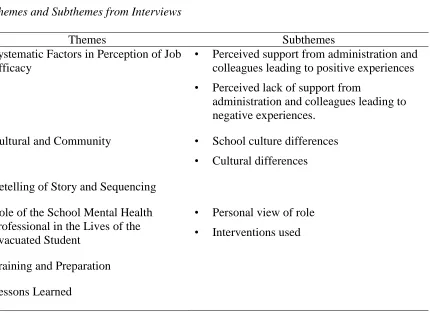
The results of this study fall under six themes: Systemic Factors in Perception of Job
Efficacy, Culture and Community, Retelling of Story and Sequence, Role of the School
Mental Health Professional in their work with Evacuated Students, Training and
A PHENOMENOLOGICAL APPROACH by
Stephanie E. Eberts
A Dissertation
Presented in Partial Fulfillment of Requirements for the Degree of
Doctor of Philosophy in
Counselor Education and Practice in
the Department of Counseling and Psychological Services in
the College of Education Georgia State University
Copyright by Stephanie E. Eberts
ii
ACKNOWLEDGMENTS
This dissertation would not have been possible without the generous personal and
academic support I received from the following people:
Thank you to my advisor, chair, and mentor, Dr. JoAnna White.
Thank you to my committee members, Dr. Greg Brack, Dr. Catharine Chang, and
Dr. Barbara Meyers.
Thank you to my colleagues and friends, especially my ―ma‘ams.‖
And thank you to my supportive family: I am forever grateful to you all for
iii
TABLE OF CONTENTS
Page
List of Tables ... iv
List of Figures ...v
Chapter 1 THE IMPORTANCE OF TRAINING SCHOOL COUNSELORS IN EFFECTIVE TRAUMA RESPONSE ...1
My Personal Journey...3
Understanding Trauma...5
Implications for Practice ...19
Suggestions for Future Research ...22
Summary ...22
References ...24
2 SCHOOL MENTAL HEALTH PROFESSIONALS‘ EXPERIENCES WITH HURRICANE KATRINA EVACUEES: A PHENOMENOLOGICAL APPROACH ...34
Methods...44
Results ...54
Discussion ...77
Significance of this Study ...85
Limitations and Need for Further Research ...86
Conclusion ...88
References ...89
iv
LIST OF TABLES
v
LIST OF FIGURES
CHAPTER 1
THE IMPORTANCE OF TRAINING SCHOOL COUNSELORS IN EFFECTIVE TRAUMA RESPONSE
New regulations for training school counselors have been added to the
require-ments for accreditation of school counselor training programs. In the most recent
accreditation documents the Council for Accreditation of Counseling and Related
Educational Programs (CACREP) standards state that ―studies provide an understanding
of the nature and needs of persons at all developmental levels and in multicultural
contexts, including all of the following: effects of crises, disasters, and other
trauma-causing events on persons of all ages‖ (CACREP, 2009, p. 11). In response to these
training standards, counselor training programs must incorporate training on the effects of
trauma from a developmental standpoint while using a culturally sensitive lens.
The American School Counseling Association‘s (ASCA) National Model (ASCA,
2003) has set its criteria for training school counselors. In the area of responsive services
this model states that in the ―traditional role of school counselors, responsive services are
activities meeting individual students' immediate needs, usually necessitated by life
events or situations and conditions in the students' lives. These needs require counseling,
consultation, referral, peer helping or information‖ (ASCA, p.9). Thus, school counselors
should be trained to respond to the needs of their students within the scope and range of
the school setting. Both the ASCA National Model (ASCA, 2003) and new 2009
CACREP Standards (CACREP, 2009) acknowledge the importance of training in the
need for this type of training, counselor educators are professionally obligated to train
school counselors so that they can be well prepared and ethically responsible school
counselors (ASCA Ethical Standards for School Counselors, Standard D, 2003).
When large scale disasters affect communities the school counselor can be a vital
resource for student and community healing (Klingman & Cohen, 2004). In the past
decade, the United States has been home to several large scale disasters: the terrorist
attacks on September 11, 2001; hurricanes Katrina, Rita, and Gustav; violent attacks
school campuses such as Virginia Tech and Columbine High School, ; and numerous
others. With violence and loss becoming a part of the lives of children and families on
such a large scale (Cougle, Resnick, & Kilpatrick, 2008), it is more important than ever
that school counselors know their roles in providing psychological support for those
affected by these events. They must understand trauma itself and the developmental
effects of it on students, parents, teachers, and the community (Capuzzi & Gross, 2004).
As the needs of students change and the demand for further expertise in detecting
trauma increases, school counselors are called upon to be mental health experts in their
institutions (Brown & Trusty, 2005). School counselors also are expected to educate their
faculty and staff about the interaction of the social and emotional needs of their students
on their performance in the academic setting. They are called upon to connect families
with outside services to support the learning needs of students. School counselors also
are expected to create developmentally-based interventions through classroom guidance,
small group work, individual interventions, and consultations (ASCA, 2003). Clearly,
environment in which they are one of the only professionals focused on the
social/emotional well being of students (ASCA).
My experiences with Hurricane Katrina have led me to learn as much as I can
about the study of trauma, and the importance of training school counselors in the area of
trauma. In this paper, I explore the study of trauma in children, the need for school
counselor training, the need for more interventions that school counselors can make use
of after a large scale disaster, and the need for school counselor self-care while working
with trauma survivors.
My Personal Journey
I was an elementary and middle school counselor in New Orleans when Hurricane
Katrina made landfall on the United States Gulf Coast on August 29, 2005. The
population of my school scattered around the United States after the storm, and my
school did not officially open until after the winter break in January, 2006. Though I
initially evacuated to Atlanta, Georgia, I relocated one week later to another city in
Louisiana where I accepted a temporary job as an elementary school counselor. The
school in the other city accepted over a hundred new students who were hurricane
Katrina evacuees, some of whom were students from my school in New Orleans. All of
the students and families were struggling to adapt to a new way of living and at the same
time struggling to learn any information that they could related to their homes.
Communication was a challenge in those first few weeks after the storm, and it was
impossible to know if everyone from my school had evacuated safely.
Personally, I was struggling with the same types of challenges as the families with
was unsure if all of my friends and family were safe. In retrospect, my memories of that
time are limited. Since I too experienced a traumatic event, I was coping with symptoms
of Acute Stress Disorder (ASD) and Post Traumatic Stress Disorder (PTSD) myself.
Even today, I cannot explain the order of events that occurred the year following the
storm. In order to write this paper, I had to consult old emails and journal entries so that I
could correctly articulate when specific events occurred. If I was facing these cognitive
challenges (and I knew that I was experiencing symptoms of PTSD), I can only imagine
how confusing it must have been for my students.
I faced a number of professional challenges during the 2005-2006 school year.
First, while working in another city in Louisiana, I sought training to better understand
trauma. I also was interested in finding interventions which were proven to work
specifically with traumatized populations. However, there were very few training
opportunities, and the one that I attended was not helpful. I also searched the literature for
interventions, and I found none that were relevant to my work with evacuated students
and families. I consulted with other school counselors, psychologists and even one
psychiatrist in the area, and they too were unable to provide me with the information that
I needed which was a specific intervention for helping students to cope with a natural
disaster. I did read literature about trauma, and I incorporated it into my practice of
counseling. But I did not know if what I was doing was actually effective. I was also
faced with personal challenges. I was an evacuee myself, and I had to cope with my own
losses as they related to the storm.
The ultimate professional challenge that I faced after the storm was during the
during my evacuation had never had a school counselor. The school counseling program
that I had created in New Orleans was designed to address the needs of my students at all
developmental levels (a traditional, balanced program), yet in this new city, I could not
rely on my traditional program to provide services to my new students. I was doing crisis
intervention without knowing exactly how to do it, and I also had to build relationships
with a new faculty, administration, and students. It was a daunting task. Many of the
faculty and administrators were unsure of the role of the school counselor, so I had to
educate them about the role of the school counselor while attending to the immediate
needs of the evacuated students.
My time in the new city led me to seek information about the study of trauma.
Ultimately, I decided to pursue a doctoral degree. As a doctoral student I have strived to
learn as much as I can about trauma and its effects, and I am also committed to
researching trauma and schools. I am pleased that the 2009 CACREP standards include
the need for trauma and crisis intervention training in master‘s and doctoral level
programs because I believe that all counselors should be prepared to work with clients
and students who have suffered from a trauma. I recognize that many masters level
training programs will not be equipped to provide this training. It is my hope that this
paper will help counselor educators to recognize the need for trauma training.
Understanding Trauma
The Diagnostic and Statistical Manual of Mental Disorders Version 4 Revised
Text (DSM-IV-TR) defines trauma as the experience of ―an event that involved serious
threat to self or others‖ (American Psychiatric Association DSM-IV-TR, 2000, p. 467).
the event itself, but in the meaning making process after the event (Herman, 2007;
Salloum & Overstreet, 2008; Seagraves, 2001). The experience proves to be
overwhelming in a way that the individual cannot make meaning or garner understanding
in the same way he or she was able prior to the event. The individual response is unique
and dependent on a number of factors such as culture, socio-economic status, exposure to
previous trauma, and ethnicity (Sar, 2008). Therefore, it is important for school
counselors to have a holistic understanding of the students who are struggling with a
traumatic experience and to keep in mind that each student reacts to the same trauma in
his/her unique way. For example, if a student is acting out in the classroom by yelling or
hiding under his/her desk, the school counselor may be asked to assist in ameliorating the
behavior. If the counselor approaches the student from a holistic perspective, the
counselor will consider all aspects of the child‘s world which could include a trauma
history. Understanding the child rather than only focusing on the behavior will help the
counselor to better assist him/her and the teacher.
Symptoms and Diagnosis
The response to a trauma can result in Acute Stress Disorder (ASD) and/or Post
Traumatic Stress Disorder (PTSD). Each diagnosis is characterized by the following
symptoms: an individual experiencing trouble in three areas including persistent
flashbacks or re-experiencing the trauma, avoidance of cues as they relate to the
traumatic experience, and symptoms of hyperarousal such as a startled response (DSM
IV-TR, 2000). The difference between these two diagnoses is the time which individuals
experience the symptoms. Individuals experiencing these symptoms for a month or less
individual is diagnosed with PTSD. There is some disagreement among researchers as to
whether these diagnoses are thorough enough to encapsulate the spectrum of symptoms
of ASD/PTSD (Herman, 1997), and there is some fear that many of the adult survivors of
childhood trauma are misdiagnosed with other personality disruptions or anxiety
disorders (Briere, 1988; Gelinas, 1983; Herman, 1997, van der Kolk, 2007). It is
therefore important to not only understand the signs of trauma early in individual‘s lives,
but also to understand the lasting effects that it can have.
It is also the belief of some researchers that there are neurological reactions to
trauma as well. The inability to make sense of the trauma may be a result of cognitive
changes that might occur after a trauma. When experiencing a trauma it is possible that
the pre-fontal lobe which regulates higher cognitive structures such as emotion and
memory are over taken by the limbic system (van der Kolk, 2007). This disconnect can
lead to loss of memory and dysfunction in affect regulation. It can also lead to more
severe posttraumatic stress disorder (PTSD) symptoms (APA, 2000; Briere & Scott,
2006; Schore, 2003, van der Kolk). It is believed the longer these neurological changes
occur the longer the PTSD symptoms persist (van der Kolk). I know that I experienced
some loss of memory, and I am sure that my students experienced these cognitive
challenges as well. I noticed that students had a harder time focusing after the storm than
they did prior to the storm. Adults reported struggling to focus as well.
Maslow’s Perspective
Maslow‘s (1954) theory of personality development focuses on a hierarchy of
needs. Often times one might find this hierarchy represented in the form of a pyramid
Self-Actualization. When conceptualizing children who have experienced a traumatic event
such as a disaster, it is easy to see that these children must be focused on these basic
needs of survival including food, water, and shelter. When a child does not have a home
to go to after the school day, it is not reasonable to assume that he or she will be able to
focus on any of life‘s tasks outside of mere survival. The next level on the hierarchy of
needs is the need for Safety. After a disaster it is possible that a child is not getting meals
and shelter at night. Without satisfying a child‘s need for survival and safety, two needs
that are often not met after a disaster, a child will not be able to focus his or her energy on
her school work. Predictability can help to create a safe environment. So if school
counselors and teachers make sure that the schedule of the day‘s events are known to the
students this could help students to better predict their environment. School counselors
should make sure that students know when and where all interventions will take place. It
is important for a child to know what is going to happen during the school day so that it is
not threatening and unknown to them. All interventions chosen by school counselors
should focus on helping the child and the family to meet these basic needs before any
therapeutic or academic intervention can be done.
Trauma in Schools
Exposure to violence and other life-threatening events affect a child‘s ability to
learn. Children who have suffered a trauma use their cognitive energy to suppress the
trauma rather than focusing on their school work (Conte & Schuerman, 1987; Shanok,
Welton, & Lapidus, 1989). Others link trauma to school problems such as limited
attention, behavioral problems, and lower cognitive functioning (Copping, Warling,
More specifically, trauma has been shown to adversely affect reading achievement for
students in elementary school (Duplechain, Reigner, & Packard, 2008). In this study, the
researchers found that of 163 urban elementary students, grades two through five, those
students who had experienced a moderate to severe trauma as measured by a sub-scale of
the Social Stress Measure (Tolan, Miller, & Thomas, 1988) had significantly lower
reading scores on the Iowa Test of Basic Skills (ITBS) and the California Achievement
Test (CAT). The researchers used a repeated measure general linear model to determine
the relationship between exposure to trauma and reading achievement. Those students
who had reported high exposure to traumatic events did not fair as poorly as the students
who reported moderate exposure. The authors suggest that the students who have
experienced moderate exposure to traumatic events may not be as easily identified and
given services in the school system. They suggest that schools must find better ways to
identify the needs of these children so that they can learn.
It is important for school counselors to understand that many school problems that
students are dealing with may be based not just in learning challenges and individual
differences, but perhaps in experiences of trauma. In understanding students from a
holistic perspective, it is important to take into account any exposure a child may have
had to violence or loss, even prior to experiencing something as large scale as a hurricane
(Ford & Cloitre, 2009).
Children who have experienced a natural disaster many be coping with previous
unresolved traumas (Ford & Cloitre, 2009). Researchers have found that many children
show symptoms of post-traumatic stress disorder (PTSD) after a natural disaster
Bingham-Alexander, & Beatley, 2002). These symptoms can include intrusive thoughts,
hyperarousal, numbness, and flashbacks (APA, 2000) all of which can interfere with
student learning. LaGreca and her colleagues surveyed 442 third through fifth grader
students three, five and ten months after Hurricane Andrew. A regression analysis was
conducted to find which if any characteristics of the children were predictive of long term
PTSD symptoms. They found that children of Hispanic and African American origin
along with children who had been exposed to other traumatic events continued to have
PTSD symptoms over time. Russoniello and her colleagues surveyed 218 fourth grade
students after Hurricane Floyd. They found that children who had been more exposed to
the traumatic event, such as loss of their home, had more PTSD symptoms than children
who had not been directly exposed. Both research teams measured PTSD symptoms in
children with the Posttraumatic Stress Disorder Reaction Index for Children (CPTS-RI;
Fredrick, Pynoos, & Nader, 1992). Large numbers of students who are experiencing these
symptoms can overwhelm an already strained school environment.
Cultural Considerations. School mental health professionals should also be
mindful of cultural differences when working with students who have experienced a
trauma. The U.S. Department of Health and Human Services (2003) provides resources
to mental health practitioners who work with disaster survivors. They suggest that mental
health professionals become aware of survivors‘ worldview by learning about how the
survivor communicates and what that person values. They discuss the importance of
respect and understanding when working with disaster survivors of different cultures. It is
important for school counselors to take the time to understand their students from a
The Role of Social Support in Trauma
Discussions with a supportive network of individuals have been shown to
ameliorate healing (Lepore, Silver, Wortman, & Wayment, 1996). Conversely,
unsupportive networks have been shown to impede healing and even to exacerbate
traumatic symptoms (Lepore et al.). Supportive networks often allow a person to tell his
or her story without judgment whereas unsupportive networks suppress the individual‘s
experiences. Informal social networks have also been shown to help with recovery from
traumatic events (Norris, Friedman, & Watson, 2002). In the case of large scale
disasters, many individuals experience the traumatic event which can deeply affect the
social support network. Each member of the social support network has to cope with the
effects of the disaster. Since school counselors have the ability to provide a supportive
network for students in groups, it is important for them to understand this element of
healing. It is also necessary for school counselors to not only work with the students in
their school setting, but to educate the adults in students‘ lives such as teachers and
family members or caregivers.
Hawkins, McIntosh, Silver, and Holman (2004) explored the social support
networks of four Columbine High School students and seven parents of Columbine High
School students during the 1999 school shootings. The researchers questioned whether
or not a ―ready-made social network‖ (p. 206) was in place for these students. All four of
the students reported that spending time with family and friends helped them to cope, yet
the students found it difficult to connect socially with anyone who was not part of the
source of negative emotions. The students reported that structured counseling
interventions were not helpful. This finding is surprising because other research has
found that talking about the traumatic event was helpful for survivors (Pennebaker &
Harber, 1993). Hawkins and her colleagues suggest that the interventions may not have
been effective or developmentally appropriate. Therefore, further research is important in
learning about how developmentally appropriate interventions could be helpful.
The importance of a support network was particularly evident to me when I was
working with families who were coping with losses related to Hurricane Katrina. I
noticed that students whose friends and family had returned to New Orleans after the
storm struggled less than those students who had fewer friends and fewer family
members in the city. I also noticed that students who shared their experiences with
friends, family or faculty seemed to have more success academically than those students
who did not share their experiences. As a school counselor after Hurricane Katrina, I
spent more time working with parents than I had in the six years prior to the storm.
Parents who had never sought consultation with me prior to the storm were asking for
help and support. They knew that their reactions and stress levels were important to their
child‘s ability to heal. I also recognized the need for social support in my own life. I often
traveled from my new location to New Orleans after it was safe to return, so that I could
be with friends and family who had experiences that were similar to my own. I found it
helpful to me to spend time socially with people who understood my struggles. I
remember how comforting it was to hear that I was not the only one who had trouble
sleeping. I imagine that the students who shared their experiences with their friends may
Interventions for Large-Scale Disasters
Schools can provide a gateway into mental health services for families. Often
students receive care exclusively through the school system due to financial or perceptual
barriers of the family (Evans & Weist, 2004). School counselors are in the unique
position to offer help to children and families who may not otherwise receive services. In
the case of trauma, these services should be both developmentally, contextually, and
multiculturally appropriate for the populations which counselors serve (Hawkins et al.,
2004; Jordan, 2006; Salloum & Overstreet, 2008). According to a mental health needs
assessment by the Federal Emergency Management Agency (FEMA) caregivers reported
that 44% of children who experienced Hurricane Katrina were showing signs of new
mental health issues (Abramason & Garfield, 2006). However there are very few
resources from which school counselors can receive information regarding effective
interventions which are specific to large scale disasters. In the current culture of schools,
school counselors are expected to use evidence-based interventions to meet the needs of
their students; however, in an extensive review of the literature, currently, the researcher
found that there were only two evidence-based interventions for school counselors to use.
Chemtob, Nakashima, and Hamada (2002) studied the effectiveness of Eye
Movement Desensitization and Reprocessing (EMDR) on children who had experienced
a hurricane. EMDR is an intervention that involves bilateral eye movements, taps or
tones to reprocess a difficult event. It is believed that by identifying a challenge and then
doing these eye movements for twenty to thirty seconds the child can reprocess the
traumatic event. The clinician must be specifically trained to administer this type of
EMDR. The children ranged in age from six to 12. There were 22 girls and 10 boys. The
students met the criteria for participations by demonstrating that they were still struggling
with symptoms of PTSD one year after the hurricane. The assessments used to measure
these symptoms were the Child Reaction Index (CRI, Pynoos, Nader, Arroyo, Steinberg,
Eth, Nunez, & Fairbanks, 1987), the Revised Child‘s Manifest Anxiety Scale (RCMAS,
Reynolds & Richmond, 1985), and The Child‘s Depression Inventory (CDI, Kovacs,
1992). The students had four sessions with trained therapists.
The focus of the intervention was to reprocess the child‘s worst fears and their
worst memories with the intention of helping the child to create a safe place in his/her
mind as it related to the event. They found that the students improved after the treatment,
and that the treatment results were maintained a year after the intervention. The evidence
of this improvement was measured by pre and post assessments. Eighteen of the thirty
two students no longer met the criteria for PTSD after the treatment. It is possible that
such interventions might be worth investigating as a part of school counselor training.
This evidence-based intervention showed an improvement in students after a trauma, and
school counselors could be well-served using effective interventions. However, it is
unrealistic to expect that school counselors can access the training that would be needed
to utilize such an intervention. This intervention was delivered in a school setting;
however, it was delivered by outside psychologists, and it is unlikely that school
counselors would use such an intervention because it is not easily understood, and it
would be a challenge to explain it to parents. It would also involve seeking training
outside of the school system which could be a challenge for school counselors both
through eye-movement or taps that someone could reprocess a traumatic event, but these
researchers have found this method to be effective.
Salloum and Overstreet (2008) created Project Loss and Survival Team (LAST)
as a specific intervention for students suffering from loss after Hurricane Katrina. The
ten-week group and individual intervention is designed for elementary aged students who
are experiencing grief and trauma due to death or disaster. The study included 56 children
who had scored in the moderate to severe range on the UCLA Posttraumatic Stress
Disorder Index (Pynoos, Rodriquez, Steinberg, Stuber, & Fredrick, 1998). Those students
participated in this program which utilizes developmentally appropriate methods to
address three phases: ―resilience and safety, restorative retelling, and reconnecting
(p.497).‖ Parents also participated in the program by attending educational meetings in
which they were taught about issues facing children who have suffered from trauma.
The children participated in both a group counseling intervention and individual
counseling sessions which focused on three goals: ―to help children (a) learn more about
grief and traumatic reactions (education), (b) express thoughts and feelings about what
happened (coherent narrative, expression of thoughts and feelings, expression the
meaning), and (c) reduce traumatic stress symptoms‖ (p. 498). The researchers found
that the students‘ symptoms of PTSD lessened throughout the intervention. Specifically,
the students‘ traumatic grief scores lowered significantly from the pre-test, as did their
global distress scores. The program was well-received by both the students and their
families. The researchers are in the process of testing this program in different settings,
date, this program is the only one which is currently in the literature which school
counselors could potentially use in the future.
Compassion Fatigue and Vicarious Trauma
Being a school counselor in the wake of Hurricane Katrina, I was experiencing
some symptoms of PTSD. Not only was I coping with personal losses related to the
storm, but I was also talking to students, parents, and faculty about their experiences. I
recognized the need for self-care, and I sought opportunities to take care of myself. I
often went to yoga classes, and I had weekly massages. But it would have been very
helpful for me to have supervision or consultation that was specifically focused on how
the stress in my students‘ and their families‘ lives were affecting me personally and
professionally.
Without specific training and access to effective interventions school counselors
risk their own well-being. The stress and challenges of school counselors can often lead
to compassion fatigue and/or secondary trauma (Sommer, 2008). It is important to note
that when a counselor is impaired by such conditions, services to the students are deeply
affected. The training of school counselors should also include information about the
potential symptoms and signs of such challenges. Training programs and supervisors are
in a unique position to extend support and information to school counselors. This support
could lead to the higher retention rates of school counselors as well as better services for
students, potentially leading to higher success in students‘ lives, both in academics and
relationships.
Several terms have been used to describe the negative effects on counselors or
Compassion Fatigue is also referred to as Secondary Traumatic Stress (STS, Figley,
1995). When helpers begin to exhibit symptoms that are closely related to PTSD, the
term that is commonly used to describe this phenomenon is compassion fatigue.
According to Figley there are three strong indicators of compassion fatigue. School
counselors will re-experience the trauma of their client, helpers may avoid stimuli that
remind helpers of the trauma, and they may experience hyper-arousal. One element that
is similar to burn out is that the school counselor will begin to feel the exhaustion of
experiencing these symptoms.
Burn out of helpers is a different from compassion fatigue. Maslach (1982) has
identified three areas under which one can categorize burn out: depersonalization,
emotional exhaustion, and reduced accomplishment in work or personal life. School
counselors experiencing burn out are less able to provide positive mental health services
to their clients. As school counselors depersonalize or distance themselves from their
clients the therapeutic alliance is compromised. Farber (1991) found that those counselors
at the greatest risk for experiencing burn out are those who have less social support
within their work setting and whose individual coping styles are less productive. For
example, a school counselor who has a larger case load with less institutional support is
far more likely to experience burn out.
Vicarious traumatization is also a term recognized throughout the literature.
Pearlman and Saavitne (1995) describe vicarious traumatization as a change in the
cognitive structures of the helper. They explain that the helper‘s worldview becomes
distorted primarily in the areas of trust, safety, control, esteem and intimacy. School
challenge. This is particularly important when a disaster affects large areas because the
helpers are experiencing the traumatic event as well. Sckoholt (2001) notes that vicarious
trauma does not manifest in the same way in all helpers, and training and education about
vicarious trauma can contribute to the prevention of it.
Regardless of whether school counselors are experiencing compassion fatigue,
burn out or vicarious traumatization, the personal well-being of counselors and the
services that they provides can be effected negatively. It is the duty of counselor
educators and supervisors to not only educate students about the possible challenges in
their future should they work with traumatized clients, but it is also important for them to
help new counselors to create strong support networks and coping strategies to help
prevent this sort of impairment from happening (Munroe, 1999).
The American Counseling Association (ACA) Code of Ethics (ACA, 2005) states
that counselors should only practice if they have had didactic training and supervision in
the area in which they work. If school counselors are working with clients who have
experienced trauma, then it is the ethical responsibility of counselor educators and
supervisors to not only be trained in this area themselves, but to train their students to be
prepared for work related to trauma. Trauma-sensitive supervision has been shown to be
helpful in the prevention of some of these work-related challenges (Trippany, 2005).
Trauma-sensitive supervision can include a number of different methods to help
counselors in training to become aware of their own experiences while working with
clients who have suffered from trauma. Sommer (2008) suggests teaching relaxation
and trauma related topics as a few ways that supervisors and educators can begin the
process of creating awareness in student counselors.
Though it is important for counselors to have training in trauma awareness and its
effects of clients and counselors alike, the material is not being taught. Kitzrow (2002)
found that over 95% practicing counselors stated that training in the area of trauma is
important, but less than 10% had received any training. There is no current research to
suggest that the percentage of trained counselors is growing, but with the introduction of
new standards, many programs will have to implement trauma sensitive training. But if
programs continue to avoid this area of training, the professionals who represent the field
of counseling will surely be at a disadvantage. Not only are they are risk for personal
problems, but they are also likely to be unable to provide the services that their clients
need.
Implications for Practice
Trauma Sensitive School Counseling Programs
Best practices for school counselors call for not only effective and
developmentally appropriate interventions, but for counselors to evaluate such practices.
According to the ASCA national model (2003) school counselors‘ delivery system is
comprised of ―school guidance curriculum, individual student planning, responsive
services, and system support" (ASCA, 2003, p. 39). School counselors can incorporate
trauma sensitive practices into all four elements of their programs. When creating
classroom guidance lessons, school counselors can incorporate didactic information about
how to cope with challenging situations which can be a preventive measure for students.
strategies when they are suffering. Individual student services can be created to address
the personal needs of students who are experiencing challenges. Responsive services
include crisis response. School counselors can play an integral role in creating crisis
response protocols for their schools. These protocols should include measures to ensure
the safety of their students, communication among staff, communication with the
community, and support networks and systems (such as group counseling or individual
counseling) to help their community to cope with the crisis. In the system support arena,
school counselors can use teacher-in-service time to educate their faculty about the signs
of trauma or abuse, so that teachers can better identify those students who may be
struggling. If school counselors can make some of these types of changes in their
programs, they will be better equipped to handle a crisis of larger proportion such as a
hurricane or other natural disaster.
When creating new interventions or educational programs, the school counselor
should also be thinking about how to evaluate the effectiveness of that program within
their school setting. The ASCA National Model (2003) suggests that school counselors
use data collection methods such as feedback surveys, on-line surveys, school records,
and demographic information to aid in the production or revamping of school counseling
programs. The results of the data collection should be shared with the school community,
and counselors should invite administration, faculty, parents, and students to give input as
to the effectiveness of their programs. Not only will this evaluation be an effective tool
for learning about which interventions and programs were most effective, but it will
year. It can also assist the counselor in learning whether he or she needs additional
training or supervision in a particular area.
The interventions listed previously in this article are specifically related to trauma
as it relates to hurricanes, but school counselors need specific training in order to
implement these types of interventions. However, school counselors receive little training
and supervision in the area of crisis and trauma response potentially leaving them feeling
ill-equipped to handle the challenges of working with traumatized children and families.
Beyond suicide prevention many school counselors report feeling inadequately prepared
to provide crisis and trauma services (Mathai, 2002) This lack of preparation is
disproportionate to the need that school counselors are reporting (Allen, Burt, Bryan,
Carter, Orsi, & Durkan, 2002; Mathai, 2002). If counselors are not trained to provide the
services that are required for their populations, they might begin to experience feelings of
professional inadequacy which could potentially lead to more serious problems such as
compassion fatigue and/or vicarious traumatization.
Common Mistakes Made by School Counselors
Well-meaning professionals might make a number of mistakes when working
with traumatized children. The first mistake is that the professional may ask a child to
talk about the traumatic event. If a counselor is not specifically trained in trauma
therapy, he or she could cause more damage than he or she intends. The child may be
retraumtized by reliving the experience, and with cognitive disruptions the child may not
be able to distinguish whether or not he or she is in eminent danger. It is not a good idea
to prompt a child to tell the counselor what happened; rather the counselor should focus
might make when working with traumatized children is to focus his or her attention on
the child‘s inability to perform school related tasks. A child who is focusing all of his
attention to cope with the traumatic event will not be able to regulate his or her own
actions in an academic setting until a sense of safety is established. The final mistake
that school counselors may make is to assume that a child who has experienced a
traumatic event will ―get over it‖ over time. Often adults will rationalize inactivity by
saying that children are resilient. Interventions and education can be helpful to children
who have experienced a trauma. It is important for school counselors to make
connections with agencies and professionals in their community who can help the family
and the school counselor to better understand what each child might specifically need.
Suggestions for Further Research
Much information is still needed to assess how much training of school
counselors is being done and what training has been effective in school counseling.
Research is needed to understand how school counselors are managing and working with
clients who have suffered from trauma. It is also important to continue to study the
effects of large scale traumatic events and how communities and schools are recovering
from them. All in all, it is important for counselor educators to create a new paradigm for
training school counselors to develop programs that will assist children in dealing with
traumatic events.
Summary
The purpose of this paper was to advocate for training school counselors to have
an understanding of trauma while also providing them with information about how their
(2008) believes that incorporating crisis intervention and trauma training in almost all
classes, that are required by CACREP standards, is possible. Historically, other areas of
interest and training have been incorporated into classes in this way. For example,
multicultural awareness and social justice issues have found their way into the day-to-day
training of master‘s level counselors. It is possible to do the same for trauma and crisis
training. This need is evidenced by new standards that are currently being implemented
into counselor preparation programs. For example, in an introduction to school
counseling class, one day can be set aside to introduce the topics of crisis intervention
and trauma. This type of training can be the foundation of school counselor‘s crisis and
trauma training.
This type of education requires that counselor educators have their own training in
crisis intervention and trauma. If programs are not currently training in this area as
research suggests (Kitzrow, 2002; Sommer & Cox, 2005), then one can wonder if
counselor educators themselves have not have appropriate training. Therefore, it is
important for counselor educators to seek training in this area so that they can provide
REFERENCES
Abramason, D., & Garfield, R. (2006). On the edge – A report of the Louisiana child and
family health study. National Center for Disaster Preparedness. New York:
Columbia University.
Allen, M., Burt, K., Bryan, E., Carter, D., Orsi, R., & Durkan, L. (2002). School
counselors‘ preparation for and participation in crisis intervention. Professional
School Counseling, 6(2), 96-102.
American Counseling Association. (2005). ACA code of ethics. Alexandria, VA: Author.
American Psychiatric Association. (2000). Diagnostic and statistical manual of mental
disorders (Rev. 4th ed.). Washington, DC: Author.
American School Counselor Association. (2003). The ASCA national model: A
framework for school counseling programs. Alexandria, VA: Author.
Bender, W. N., & Sims, R. (2007). Katrina kids! Helping kids exposed to population
wide trauma. Teaching exceptional children, 40(1), 40-47.
Briere, J. (1988). The long-term clinical correlates of childhood sexual victimization.In
R. A. Prentky & V. L. Quinsey (Eds.), Human sexual aggression: Current
perspectives (pp. 327-334). New York: New York Academy of Sciences.
Briere, J. N., & Scott, C. (2006). Principles of trauma therapy: A guide to symptoms,
evaluations, and treatment. New York: Guilford Press.
Brown, D., & Trusty, J. (2005). Designing and leading comprehensive school counseling
Cantor, P., Lewis, O., & Houser, J. (2003). Trauma, uncontrollable events and the
challenges of meeting the needs of children and families. International Journal of
Mental Health, 32, 54-66.
Cappuzzi, D., & Gross, D. R. (2004). Introduction to the counseling profession. Boston:
Allyn & Bacon.
Chemtob, C. M., Nakashima, J. P., Carlson, J. G. (2002). Brief treatment with elementary
age children with disaster related posttraumatic stress disorder: A field study.
Journal of Clinical Psychology, 58, 99-112.
Chung, M. C., Farmer, S., Werrett, J., Easthope, Y., & Chung, C. (2001). Traumatic
stress and ways of coping of community residents exposed to a train disaster.
Australian and New Zealand Journal of Psychiatry, 35, 528 – 534.
Conte, J. R., & Schuerman, J. R. (1987). Factors associated with an increased impact of
child sexual abuse. Child Abuse and Neglect, 11(2), 201-211.
Copping, V. E., Warling, D. L., Benner, D. G., & Woodside, D. W. (2001). A child
trauma treatment pilot study. Journal of Child and Family Studies, 10(4),
467-475.
Cougle, J. R., Resnick, H., & Kilpatrick, D. G. (2009). Does prior exposure to
interpersonal violence increase risk of PTSD following subsequent exposure?
Behaviour Research and Therapy, 47(12), 1012-1017.
Council for Accreditation of Counseling and Related Educational Programs. (2009). 2009
Standards. Retrieved from
Courtois, C. A. (2009). Treating complex traumatic stress disorders: An evidence-based
guide. New York: Guilford Press.
Dean, K. L., Jaycox, L. H.; Langley, A. K.; Kataoka, S. H.; Wong, M.; & Stein, B. D.
(2008). School-based disaster mental health services: Clinical, policy and
community challenges. Professional Psychology: Research and Practice, 39,
52-57.
Department of Homeland Security. (2008). The first year after hurricane Katrina: What
the government did. Retrieved from
http://www.dhs.gov/xfoia/archives/-gc_1157649340100.shtm
Duplechain, R., Reigner, R., & Packard, A. (2008). Striking differences: The impact of
moderate and high trauma on reading achievement. Reading Psychology, 29,
117-136.
Evans, S. W., & Weist, M. D. (2004). Implementing empirically supported treatments in
the schools: What are we asking? Clinical Child and Family Psychology Review,
7(4), 263-267.
Farber, B. (1991). Crisis in education: Stress and burnout in the American teacher.
New York: Wiley, John & Sons.
Figley, C. R. (1995). Compassion fatigue as secondary traumatic stress disorder: An
overview. In C. R. Figley (Ed.), Compassion fatigue: Coping with secondary
traumatic stress disorder in those who treat the traumatized (pp. 1-21).
Flannery, D. J.,Wester, K. L., & Singer, M. I. (2004). Impact ofexposure to violence in
schools on child and adolescent mental health and behavior. Journal of
Community Psychology, 32(5), 559-573.
Ford, J. D., & Cloitre, M. (2009). Best practices in psychotherapy for children and
adolescents. In C. A. Courtois & J. D. Ford (Eds.), Treating complex traumatic
stress disorders: An evidence-based guide. New York: Guilford Press.
Ford, J. D., Racusin, R., Davis, W. B., Ellis, C. G., Thomas, J., & Sengupta, A. (1999).
Trauma exposure among children with oppositional defiant disorder and attention
deficit-hyperactivity disorder. Journal of Consulting and Clinical Psychology,
67(5), 786-789.
Gaffney, D. A. (2008). Families, schools and disaster. Family & Community Health, 31,
44-53.
Gelinas, D. J. (1983). The persisting negative effects of incest. Journal for the Study of
Interpersonal Processes, 46(4), 312-332.
Getz, W. L. (1975). Fundamentals of crisis counseling. Lexington, MA: Lexington
Books.
Hawkins, N. A., McIntosh, D. N., Silver, R. C., & Holman, A. E. (2004). Early responses
to school violence: A qualitative analysis of students and parents‘ immediate
reactions to the shooting at Columbine High School. Journal of Emotional Abuse,
4(3-4), 197-223.
Herman, J. (1997). Trauma and recovery: The aftermath of violence - from domestic
Jordan, K. (2006). A case study: How a disaster mental health volunteer provided
spiritually, culturally and historically sensitive trauma training to
teacher-counselors and other mental health professionals in Sri Lanka four weeks after the
tsunami. Brief Treatment and Crisis Intervention, 6, 316-325.
Kitzrow, M. (2002). Survey of CACREP-accredited programs: Training counselors to
provide treatment for sexual abuse. Counselor Education and Practice, 42,
106-118.
Klingman, A., & Cohen, E. (2004). School-based multisystematic interventions for mass
trauma. New York: Kluwer Academic.
LaGreca, A. M., Silverman, W. K., Vernberg, E. M., & Prinstein, M. J. (1996).
Symptoms of posttraumatic stress in children after hurricane Andrew: A
prospective study. Journal of Counseling and Development, 64, 712-723.
Lepore, S. J., Silver, R. C., Wortman, C. B., & Wayment, H. A. (1996). Social
constraints, intrusive thoughts, and depressive symptoms among bereaved
mothers. Journal of Personality and Social Psychology, 70(2), 271-282.
Madrid, P. A., Grant, R., & Rosen, R. (2009). Creating mental health disability through
inadequate disaster response: Lessons from Hurricane Katrina. In C. A. Marshall,
E. Kendall, M. E. Banks, & R. M. S. Gover (Eds.), Disabilities: Insights from
across fields and around the world, Vol 2 (pp. 1-16). Santa Barbara, CA:
Praeger/ABC-CLIO.
Maslach, C. (2003). Job burnout: New directions in research and intervention. Current
Directions in Psychological Science, 12, 189-192.
Mathai, C. M. (2002). Surveying school counselors via the internet regarding their
experiences and training needs in crisis intervention. Doctoral dissertation.
Retrieved from
http://scholar.lib.vt.edu/theses/available/etd-10012002-154307/-unrestricted/MathaiDissertation.pdf
Miller, T. W. (2007). Trauma, change, and psychological health in the 21st century.
American Psychologist, 62, 889-898.
Moore, K. W., & Valera, E. R. (2010). Correlates of Long-term Posttraumatic Stress
Symptoms in Children Following Hurricane Katrina. Child Psychiatry and
Human Development, 41, 239-250.
Munroe, J. (1999) Ethical issues associated with secondary trauma in therapists. In B. H.
Stamm (Ed.), Secondary traumatic stress: Self-care issues for clinicians,
researchers, and educators (2nd ed., pp. 211-229). Lutherville, MD: Sidran Press.
Norris, F. H., Friedman, M. J., & Watson, P. J. (2002). 60,000 disaster victims speak:
Part II. Summary and implications of the disaster mental health research.
Interpersonal and Biological Process, 65(3), 240-260.
Osofsky, J. (2006). Resilience in the aftermath of disaster. SRCD-sponsored
congressional briefing. Retrieved from http://srcd.org/katrina.html. New Orleans:
Louisiana State University Health Science Center.
Pearlman, L., & Saakvitne, K. (1995). Trauma and the therapist. New York: Norton.
Pennebaker, J. W., & Harber, K. D. (1993). A social stage model of collective coping:
The Loma Prieta earthquake and the Persian Gulf War. Journal of Social Issues,
Pfefferbaum, B., North, C.S., Pollio, D.E., Wallace, N.E., Smith, R., & Jeon-Slaughter,
H. (2007). Focus groups with children after the world trade center attacks.
Journal of Loss and Trauma, 12, 349-363.
Pynoos, R. S., Goenjian, A. K., & Steinberg, A. M. (1998). A public mental health
approach to post-disaster treatment of children and adolescents. Child and
Adolescent Clinics of North America, 7, 195- 210.
Pynoos, R. S., Rodriquez, N., Steinburg, A., Stuber, M., & Frederick, C. (1998). The
UCLA Posttraumatic Stress Reaction Index for DSM-IV. Los Angeles: UCLA
Trauma Psychiatric Program.
Reynolds, C. R. & Richmond, B. O. (1985). Revised children‘s manifest anxiety scale.
3rd ed., revised. Washington D.C., Author.
Russoniello, C. V., Skalko, T. K., O‘Brien, K., McGhee, S. A., Bingham-Alexander, D.,
& Beatley, J. (2002). Childhood posttraumatic stress disorder and efforts to cope
after hurricane Floyd. Behavioral Medicine, 28(2), 61-70.
Salloum, A. & Overstreet, S. (2008). Evaluation of individual and group grief and trauma
Interventions for children post disaster. Journal of Clinical Child and Adolescent
Psychology, 37(3), 495-507.
Sar, V. (2008). Trauma and dissociation in context: Personal life, social life, and public
health. Journal of Trauma and Dissociation, 9(1), 1-8.
Schnider, K. R., Elhai, J.D., & Gray, M. J. (2007). Coping style use predicts
posttraumatic stress and complicated grief symptom severity among college
Schore, J. R. (2003). The development of attachment and affect regulation in infancy and
childhood with possible clues to psychological gender. In J. B. Sanville &
E. B. Ruderman (Eds.), Therapies with women in transition: Toward relational
perspectives with today's women. Madison, CT: International Universities Press,
Inc.
Seagraves, P. (2001). Trauma, spirituality, and their relationship: A qualitative
investigation of personal stories and process. Dissertation Abstracts International,
62 (3-B), 1597.
Shanok, R. S., Welton, S. J., Lapidus, C. (1989). Group therapy for preschool children: A
transdisciplinary school-based program. Child and Adolescent Social Work
Journal, 6(1), 72-95.
Skovholt, T. M. (2001). The resilient practitioner: Burnout prevention and self-care
strategies for counselors, therapists, teachers, and health professionals. Boston:
Allyn & Bacon.
Sommer, C. A. (2008). Vicarious traumatization, trauma sensitive supervision, and
counselor preparation. Counselor Education and Supervision, 48, 61-71.
Sommer, C. A., & Cox, J. (2005). Elements of supervision in sexual violence counselors‘
narratives: A qualitative analysis. Counselor Education and Supervision, 45,
119-134.
Stein, B. D., Jaycox, L. H., Kataoka, S. H., Wong, M. & Elliot, M. N. (2003). A mental
health intervention for school children exposed to violence: A randomized
Tedeschi, R. G., & Calhoun, L. G. (1996). The posttraumatic growth inventory:
Measuring the positive legacy of trauma. Journal of Traumatic Stress, 9, 455-471.
Tedeschi, R. G.; Park, C.L. & Calhoun, L.G. (Eds) (1998). Posttraumatic growth:
Positive changes in the aftermath of crisis. Mahwah, NJ: Lawrence Erlbaum
Associates, Inc.
Tolan, P., Miller, L., & Thomas, P. (1988). Perceptions and experiences of types of social
stress and self-image among adolescents. Journal of Youth and Adolescence, 17,
147-163.
Trippany, R. L., White Kress, V. E., & Wilcoxon, S. A. (2004). Preventing vicarious
trauma: What counselors should know when working with trauma survivors.
Journal of Counseling and Development, 19, 3-16.
United States Department of Health and Human Services. (2003) Developing Cultural
Competence in Disaster Mental Health Programs: Guiding Principles and
Recommendations. Rockville, MD: Center for Mental Health Services, Substance
Abuse and Mental Health Services Administration.
van der Kolk, B. (2007).The Developmental Impact of Childhood Trauma. In L. J.
Kirmayer, R. Lemelson, & M. Barad (Eds.), Understanding trauma: Integrating
biological, clinical, and cultural perspectives. New York: Cambridge University
Press.
Weaver, T., L., Kilpatrick, D. G., Resnick, H. S., Best, C. L., & Saunders, B. E. (1997).
An examination of physical assault and childhood victimization histories within a
Out of darkness: Contemporary perspectives on family violence. Thousand Oaks,
CHAPTER 2
SCHOOL MENTAL HEALTH PROFESSIONALS‘ EXPERIENCES OF HURRICANE KATRINA EVACUEES:
A PHENOMENOLOGICAL APPROACH
Introduction
On August 29, 2005, Hurricane Katrina made landfall on the Gulf Coast of the
United States. In New Orleans alone approximately 80% of the city was underwater due
to multiple breaches in the city‘s levee system (U.S. House of Representatives, 2006).
Many homes, schools, businesses, and city buildings were damaged or destroyed, and the
residents of this area and the Mississippi Gulf Coast were forced to seek shelter
elsewhere, many in other states. Bender and Sims (2007) refer to the overwhelming
effects and events post-Katrina as a Population-Wide Trauma. In New Orleans alone,
nearly 400,000 people were left with non-functioning homes (Department of Homeland
Security, 2008). Many of the nearly two hundred thousand children who were displaced,
relocated outside of Louisiana and Mississippi, entering school systems around the
country. This influx of new students left school mental health professionals (school
counselors, school social workers, and school psychologists) and other school personnel
to cope with not only larger school populations, but also a myriad of anxiety, mood
disorders, and other trauma related symptoms from which the students were suffering
(Madrid, Grant, & Rosen, 2008). This unique event exposed areas of growth for school
The purpose of this study was to examine the experiences of school mental health
professionals whose schools accommodated a large number of students who evacuated to
Georgia from the Gulf Coast as a result of Hurricane Katrina. With interviews one year
after hurricane Katrina, the experiences and lessons learned by these school mental health
professionals will help us to understand how they responded to the needs of the evacuated
students in their schools as well as the preparation needs of school mental health
professionals. A phenomenological approach (Creswell, 2007) of analyzing this data is
appropriate to find the essence of these experiences. The information gathered from
these participants has the potential to help counselor educators understand more fully the
need for training trauma sensitive mental health professionals as well as better informing
the practice and protocol of crisis response in schools.
As an introduction to this qualitative study, this paper provides a review of the
trauma literature especially as it relates to children. This paper also includes information
about the importance of cultural understanding when working with survivors of a
traumatic event. A description of the study including methods for data analysis, results,
and implications follow.
Trauma
The Diagnostic and Statistical Manual of Mental Disorders Version 4 Revised
Text (DSM-IV-TR) defines trauma as ―the development of characteristic symptoms
following exposure to an extreme traumatic stressor involving direct personal experience
of an event that involves actual or threatened death or serious injury, or other threat to
one's physical integrity; or witnessing an event that involves death, injury, or a threat to
serious harm, or threat of death or injury experienced by a family member or other close
associate (Criterion A1). The person's response to the event must involve intense fear,
helplessness, or horror (or in children, the response must involve disorganized or agitated
behavior) (Criterion A2)‖ (APA, 2000, p. 468). However children who have experienced
a traumatic event often meet the criteria for a number of other diagnoses, among them:
depression, oppositional defiant disorder (ODD), and attention-deficit and hyperactivity
disorder (ADHD) (Cook, Spinazzola, Ford, Lanktree…van der Kolk, 2005). The nature
of these symptoms has led Cook and co-authors to further examine how children respond
to traumatic events. They suggest that children who have been exposed to complex
trauma (multiple traumatic events) can show impairment in seven different domains:
―attachment, biology, affect regulation, dissociation, behavioral control, cognition, and
self-concept (p. 392).‖ These impairments can last well into adulthood (van der Kolk,
2006), thus it is important for mental health professionals to understand these areas of
impairment so that they can better treat children.
Trauma in children. Exposure to traumatic events affects a child‘s ability to
learn (Conte & Schuerman, 1987). Researchers who have studied trauma in children have
often studied children who have suffered from abuse. Conte and Schuerman compared
369 children who had been physically or sexually abused with 318 children who had not
been abused, and they found that the children who were abused were behaviorally
different than those children who had not been abused according to a Symptom Checklist
and Child Behavior Profile created by the authors and answered by non-offending
caregivers of the children. With cognitive disturbances among the domains discussed by