https://doi.org/10.5194/hess-22-2269-2018 © Author(s) 2018. This work is distributed under the Creative Commons Attribution 3.0 License.
Reconstruction of droughts in India using multiple
land-surface models (1951–2015)
Vimal Mishra1, Reepal Shah1, Syed Azhar1, Harsh Shah1, Parth Modi1, and Rohini Kumar2
1Civil Engineering, Indian Institute of Technology (IIT) Gandhinagar, Gujarat, 382355, India 2UFZ-Helmholtz Centre for Environmental Research, Leipzig, Germany
Correspondence:Vimal Mishra ([email protected]) Received: 21 May 2017 – Discussion started: 9 June 2017
Revised: 2 February 2018 – Accepted: 17 March 2018 – Published: 16 April 2018
Abstract.India has witnessed some of the most severe his-torical droughts in the current decade, and severity, fre-quency, and areal extent of droughts have been increas-ing. As a large part of the population of India is depen-dent on agriculture, soil moisture drought affecting agricul-tural activities (crop yields) has significant impacts on socio-economic conditions. Due to limited observations, soil mois-ture is generally simulated using land-surface hydrological models (LSMs); however, these LSM outputs have uncer-tainty due to many factors, including errors in forcing data and model parameterization. Here we reconstruct agricul-tural drought events over India during the period of 1951– 2015 based on simulated soil moisture from three LSMs, the Variable Infiltration Capacity (VIC), the Noah, and the Community Land Model (CLM). Based on simulations from the three LSMs, we find that major drought events occurred in 1987, 2002, and 2015 during the monsoon season (June through September). During the Rabi season (November through February), major soil moisture droughts occurred in 1966, 1973, 2001, and 2003. Soil moisture droughts esti-mated from the three LSMs are comparable in terms of their spatial coverage; however, differences are found in drought severity. Moreover, we find a higher uncertainty in simu-lated drought characteristics over a large part of India dur-ing the major crop-growdur-ing season (Rabi season, November to February: NDJF) compared to those of the monsoon sea-son (June to September: JJAS). Furthermore, uncertainty in drought estimates is higher for severe and localized droughts. Higher uncertainty in the soil moisture droughts is largely due to the difference in model parameterizations (especially soil depth), resulting in different persistence of soil moisture simulated by the three LSMs. Our study highlights the
impor-tance of accounting for the LSMs’ uncertainty and consider-ation of the multi-model ensemble system for the real-time monitoring and prediction of drought over India.
1 Introduction
Drought is among the top natural disasters that affect food and fresh water security. The 2014–2015 drought in India af-fected more than 3.3 million people and resulted in the loss of INR 6 50 000 crore (Indian express, 11 May 2016). Drought characteristics such as frequency, areal extent, and intensity have increased in India, which can be attributed to erratic summer monsoon as well as an increase in air temperature (Shah and Mishra, 2014). Moreover, the frequency of severe and widespread multi-year droughts has also increased dur-ing recent decades (Mishra et al., 2016). For instance, In-dia experienced 10 major droughts between 1950 and 1989, while 5 droughts occurred after 2000 (Pai et al., 2017). The drought of 2015 was among the most severe during the pe-riod of 1901–2015, which caused enormous damage to crops and affected various sectors of society (Mishra et al., 2016). Precipitation deficit during the monsoon (rainy) season not only affects water availability during that season, but also af-fects water availability in the post-monsoon (dry) season.
be amplified by positive temperature anomalies during the growing season. Due to lack of long-term observations of soil moisture, the impacts of climate variability and climate change on soil moisture drought are often studied using land-surface (hydrologic) models (LSMs, Mishra et al., 2014; Sheffield and Wood, 2008; Samaniego et al., 2013). How-ever, these LSMs have differences in model parameteriza-tion and representaparameteriza-tion of hydrological processes (Mishra et al., 2017; Wang et al., 2009), which point to uncertainty re-lated to model structural error deficits. Moreover, soil depths specified in the LSMs vary depending on an individual model configuration, which can lead to differences in soil moisture persistence (Wang et al., 2009). Soil moisture persistence is important for understanding the dynamics of soil moisture in response to meteorological forcing. For instance, LSMs with low soil moisture persistence may show higher sensitivity to temperature and/or precipitation anomalies. Differences in soil moisture persistence in LSMs can lead to uncertainty in drought monitoring and assessment.
There have been several projects on the inter-comparison of soil moisture and other hydrologic fluxes from differ-ent LSMs. For instance, the Global Land Data Assimilation System (GLDAS; Rodell et al., 2004), the earthH2Observe project (Beck et al., 2017), the Project for Intercomparison of Land Surface Parameterization Schemes (PILPS; Bowling et al., 2003), and the Global Soil Wetness Project (Dirmeyer et al., 1999, 2006) provide useful insights into the differences in soil moisture simulations from the LSMs and hydrological models. Our aim here is to understand the uncertainty in soil moisture drought characteristics simulated using three LSMs over India. We use observed gridded meteorological data to force the calibrated VIC, Noah, and CLM land-surface mod-els. We estimate drought indices based on precipitation and 60 cm depth (as a surrogate for root-zone depth) soil mois-ture from the three LSMs to reconstruct the major drought events that occurred during the period of 1951–2015. We selected the top 60 cm to analyze soil moisture drought be-cause, for many crops, effective root-zone depth falls in this region (Jalota and Arora, 2002). Also, we consider this depth for all three models in our drought assessment so as to re-duce uncertainty due to specification of different root-zone depth (based on respective vegetation parameters) and soil layer thicknesses in three LSMs. We recognize that there ex-ist different sources of uncertainty in model estimates (of soil moisture), including those arising from errors in input vari-ables (e.g., meteorological forcings, surface and sub-surface characteristics); however, here, our aim is not to quantify un-certainty due to all the sources. Rather, we limit ourselves to understanding the uncertainty in historical reconstructions of soil moisture droughts over India due to structural differ-ences among different LSMs.
2 Methodology 2.1 Data
The three LSMs (VIC, Noah, and CLM) used in this study were forced with a common meteorological dataset that com-prises daily precipitation, maximum and minimum tempera-tures, and wind speed. We used a 0.25◦ daily gridded pre-cipitation product available for the period 1901–2015 from the India Meteorological Department (hereafter IMD; Pai et al., 2015), which was developed by IMD using data from 6995 gauge stations across India and an inverse distance weighting scheme (Shepard, 1984). In the gridded precipi-tation data from IMD, orographic and topographic features of precipitation are well captured along with the spatial vari-ability associated with the Indian summer monsoon. We used 1◦ daily gridded maximum and minimum air temperatures from IMD (Srivastava et al., 2009), which were developed using the data from 395 observation stations across India. We re-gridded air temperatures from 1 to 0.25◦ using the method described in Maurer et al. (2002), which is based on a temperature lapse rate of 6.5◦C km−1rise in elevation and the SYMAP algorithm. In re-gridding of air tempera-ture, we used a 0.25◦ digital elevation model (DEM) that was resampled from the original 30 m elevation data from the Shuttle Radar Topography Mission (SRTM). The gridded precipitation and air temperature products have been used in many previous studies on drought and heat waves (Shah et al., 2017; Shah and Mishra, 2014; R. D. Shah and Mishra, 2016, 2015; Mishra et al., 2016).
2.2 Land-surface models
and Agriculture Organization (FAO) based soil maps. How-ever, since land-surface models use soil parameters from two different sources that can lead to differences in avail-able water (Fig. S2), we evaluated the difference in the sim-ulated soil moisture anomalies from the VIC model using the soil parameters based on the FAO and HWSD datasets (Fig. S3). We do not find a significant difference in the sim-ulated soil moisture anomalies based on the soil parameters from the two sources. It is worth noting that the underlying (soil-textural) dataset for the HWSD is mostly derived based on the FAO dataset. The different products may use differ-ent pedo-transfer functions to derive soil-related parameters. Nevertheless the derived (static) soil parameters do not in-duce significant differences in the temporal dynamics of sim-ulated soil moisture anomalies (Figs. S2 and S3).
Vegetation characteristics specified within LSMs were de-rived from the Advanced Very High-Resolution Radiome-ter (AVHRR) and Moderate Resolution Imaging Spectrora-diometer (MODIS) datasets. We evaluated the sensitivity of vegetation parameters derived from AVHRR and MODIS to simulated soil moisture using the Noah model (Fig. S4). In this case too we do not find any substantial differences in the dynamics of the simulated soil moisture anomalies due to differences in the underlying vegetation parameters esti-mated from the AVHRR and MODIS datasets (Fig. S4). We note that the analysis conducted here is at a 0.25◦spatial res-olution – as a result the differences among the model simula-tions due to fine-scale soil and vegetation characteristics may not be observed at a coarse scale.
All three LSMs were first spun up using 65 years (1951– 2015) of data to establish initial conditions for the mod-eled states and fluxes. All three LSMs were manually cal-ibrated to match simulated monthly streamflow with ob-served streamflow data obtained from the India-WRIS (http: //www.india-wris.gov.in) at the gauging stations (H. L. Shah and Mishra, 2016) that are least affected by human interven-tions related to water diversion and water withdrawal for irri-gation (see the Supplement, Fig. S1 and Table S2, for the ge-ographical location of these stations). We identified the cali-bration parameter for each LSM based on prior studies (Cai et al., 2014; Hogue et al., 2005; Nijssen et al., 2001) and by performing a simple (one parameter at a time) sensitivity analysis. We used soil thickness also as calibration parame-ters following the success of calibrating the VIC using soil-layer thickness (Nijssen et al., 2001; R. D. Shah and Mishra, 2016). The calibration parameters were manually adjusted so as to match observed streamflow (see Table S2). Further, we evaluated the model skill by comparing simulated soil moisture with station and satellite-based soil moisture, and also by comparing the total column soil moisture changes with terrestrial water change based on GRACE products (see Sect. 3.1 for more details).
2.2.1 The Variable Infiltration Capacity (VIC) model We used VIC v4.2.a (Liang et al., 1994), which is a semi-distributed, physically based hydrologic model in water bal-ance mode at a daily time step. The VIC model simulates water and energy fluxes in each grid cell considering soil and vegetation parameters, and meteorological forcing as input. The model estimates total evapotranspiration as a sum of the canopy and bare soil evaporation and transpiration from veg-etation mosaics. Any number of vegveg-etation types can be rep-resented within a grid cell to represent sub-grid variability in vegetation cover. Infiltration is estimated using a variable in-filtration capacity curve. The VIC model has three soil layers and the top two layers respond quickly to rainfall, and diffu-sion is allowed from the middle to top layers when the mid-dle (second) layer is wet. Baseflow from the bottom (third) layer is estimated using the Arno model formulation (Fran-chini and Pacciani, 1991). The bottom layer responds slowly to depict seasonal soil moisture behavior. We calibrated the VIC model parameters, which include depth of the soil lay-ers, infiltration curve parametlay-ers, and parameters related to baseflow, following Nijssen et al. (2001). Vegetation and soil texture used in the VIC model were developed using the 1 km Advanced Very High-Resolution Radiometer (AVHRR) and Harmonized World Soil Database (HWSD), respectively, as described in Table S1. The VIC model requires soil param-eters like field capacity and wilting point, which were de-rived by first identifying soil class based on the United States Department of Agriculture (USDA) classification and then applying the pedo-transfer functions of Cosby et al. (1984). Soil texture specified at 0.25◦ for deriving soil parameters is shown in Fig. S2a. More detailed information on the VIC model calibration can be obtained from the previous stud-ies (Mishra et al., 2010; Nijssen et al., 2001; H. L. Shah and Mishra, 2016, R. D. Shah and Mishra, 2016).
2.2.2 The Noah model
resistance, minimum and maximum values of LAI, albedo, and roughness length. The major land cover classes are For-est, Shrubs, Savannas, Tundra, Grasslands, Croplands, Wet-lands, Built-up, Ice, and Water. We used soil textures derived from a digital soil map (Fig. S2c) developed by the Food and Agriculture Organization (FAO). The forcing parame-ters required for the Noah model are daily precipitation, air temperatures (maximum and minimum), wind speed, surface pressure, relative humidity, long-wave radiation, and surface downward solar radiation. Daily meteorological forcing in the Noah model was internally disaggregated using a uni-form distribution for precipitation and the diurnal cycle for other variables. We calibrated the Noah model parameters that include the depth of four soil layers, the Zilintikevich coefficient, a surface runoff parameter, and a bare soil evap-oration component. The Zilintikevich coefficient controls the ratio of the roughness length for heat to the momentum by representing the aerodynamic resistance.
2.2.3 The Community Land Model (CLM)
The CLM is a land-surface component of the community-developed global climate system model version 3.0 (CCSM v3.0), which was developed by the National Centre for Atmospheric Research (NCAR). The CLM has 10 soil layers and, similarly to the VIC and Noah, simulates both water and energy fluxes in each grid cell. Surface runoff in the CLM is parameterized based on the TOPMODEL con-cept (Beven and Kirkby, 1979). Soil moisture storage in the CLM is modeled after removing surface runoff, infiltration, and evaporation from surface storage. The basic difference in the CLM from the VIC and Noah is that the CLM has a representation of a groundwater table which is updated dy-namically (Niu et al., 2007). The atmospheric forcings re-quired for the CLM are daily precipitation, air temperatures (maximum and minimum), wind speed, specific humidity, in-cident solar radiation, long-wave radiation, and surface pres-sure. Land cover used in the CLM is represented by 17 plant functional types (PFTs), which were derived from MODIS and are classified using the IGBP scheme similar to Bonan et al. (2002), while the soil textures (Fig. S2) used in the CLM are derived from FAO datasets. We calibrated the soil thickness parameter for the CLM model similarly to the VIC model. A detailed comparison of input parameters is pro-vided in Table S1. All three LSMs were run without consid-ering irrigation and groundwater extraction as our aim was to understand the role of atmospheric forcing in root-zone (60 cm depth) soil moisture drought uncertainty.
2.3 Drought indices
We used the Standardized Precipitation Index (hereafter SPI; McKee et al., 1993) and the Standardized Soil moisture In-dex (SSI; Hao and AghaKouchak, 2013) to represent mete-orological and soil moisture (agriculture) droughts,
respec-tively. We used 60 cm soil depth as a representative of root-zone soil moisture (Shah and Mishra, 2015). Since depths of root-zone and soil layers are different in all three LSMs (Ta-ble S1), we estimated 60 cm soil moisture for each grid cell and for each LSM, separately. A parametric (Gamma) dis-tribution was fitted to precipitation and root-zone soil mois-ture to estimate SPI and SSI, respectively. For both SPI and SSI, the cumulative distribution functions obtained by fitting the Gamma distribution were mapped onto the normal dis-tribution functions to represent a dimensionless index and to derive drought indices (see Shah and Mishra, 2015, and Appendix A for more details). We note that there are other approaches for estimating the soil moisture drought index – for example a non-parametric percentile-based drought index (Samaniego et al., 2013), but in this study we used a para-metric (Gamma) distribution for estimating SSI so as to be consistent with the precipitation-based drought index (SPI). 2.4 Intensity–areal extent–frequency curves
70˚ 75˚ 80˚ 85˚ 90˚ 95˚ 10˚
15˚ 20˚ 25˚ 30˚ 35˚
(a) VIC
Uncalibrated
70˚ 75˚ 80˚ 85˚ 90˚ 95˚ (b) NOAH
70˚ 75˚ 80˚ 85˚ 90˚ 95˚ 10˚ 15˚ 20˚ 25˚ 30˚ 35˚
(c) CLM
0.2 0.3 0.4 0.5 0.6 0.7 0.8
70˚ 75˚ 80˚ 85˚ 90˚ 95˚ 10˚
15˚ 20˚ 25˚ 30˚ 35˚
(d) VIC
Difference (calibrated−uncalibrated)
70˚ 75˚ 80˚ 85˚ 90˚ 95˚ (e) NOAH
70˚ 75˚ 80˚ 85˚ 90˚ 95˚ 10˚ 15˚ 20˚ 25˚ 30˚ 35˚
(f) CLM
[image:5.612.156.439.71.302.2]−0.15 −0.10 −0.05 0.00 0.05 0.10 0.15
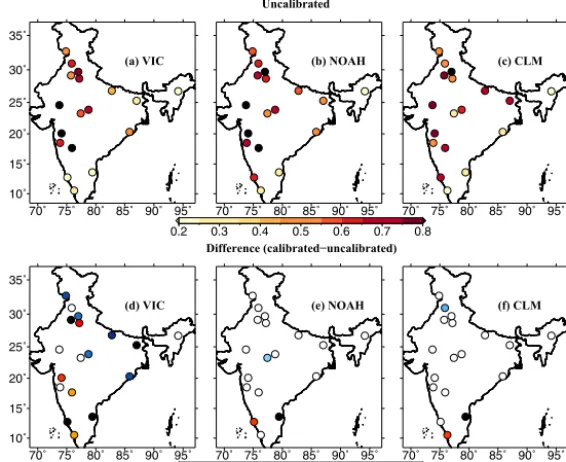
Figure 1.Correlation of weekly 60 cm simulated soil moisture with IMD gauge-based soil moisture (∼60 cm) during the monsoon season, 2009–2013.(a–c)Correlation for control (default or uncalibrated) setup for the VIC, NOAH, and CLM, respectively.(d–f)show differences (calibrated–uncalibrated) in the correlation coefficient.
3 Results
3.1 Calibration and evaluation of land-surface models (LSMs)
The three land-surface model (VIC, Noah, and CLM) param-eterizations were manually constrained (calibrated) against observed streamflow across a set of 18 major river basins covering approximately the entire landmass of India (see Fig. S1 and Table S2). The performance of the LSMs in cap-turing the temporal dynamics of monthly streamflow dur-ing calibration and validation periods is quite satisfactory for most of the river basins (Table S2). The median cor-relation r (and Nash–Sutcliffe efficiency, NS) values esti-mated across these basins during the calibration period are around 0.91 (0.78), 0.90 (0.70), and 0.90 (0.70) for the VIC, Noah, and CLM, respectively. A similar level of (median) skill is also observed during the validation period (Table S2). The skill of the multi-model averaged streamflow of the three LSMs is comparatively better than that of individual models – with an overall medianr(and NS) value estimated across all basins of 0.91 (0.80) and 0.94 (0.77) during the calibra-tion and validacalibra-tion periods, respectively. The ensemble mean of simulated streamflow from the three LSMs performed bet-ter against the observations. We also notice a relatively poor skill for all three LSMs and the ensemble mean in the coastal basins (e.g., Cauvery and eastern coast basins – Table S2), which could be attributed to a number of factors including er-rors in forcing data and model parameterizations.
Neverthe-less, considering the wide range of hydro-climatic gradients across India, the efficiency of the three LSMs for capturing the observed streamflow can be considered reasonable.
Next we evaluated the skill of each model in capturing the observed dynamics of near-surface and 60 cm soil moisture (Figs. 1 and S3–S4). We used three different sources of soil moisture observations for this comparison purpose. The first set consisted of the weekly soil moisture observations taken at 18 IMD-based stations during the monsoon (JJAS) season for the period 2009–2013 (Unnikrishnan et al., 2013). The model simulated 60 cm soil moisture dynamics were com-pared against observations, which generally revealed a good skill for all three models (Fig. 1). Model simulated soil mois-ture showed a relatively higher correlation with observations in the northern and western regions as compared to those lo-cated in the southern coastal belt. Among models, the Noah simulated soil moisture exhibited higher correlation as com-pared to other two LSMs. For this setup, we also comcom-pared the calibrated vs. uncalibrated model runs to understand what improvements (if any) could be achieved by the parameter calibration of simulation of soil moisture anomalies. We find limited benefits of the model calibration in this case – only the VIC model benefited from the model calibration, mainly in the northern region locations and a few of the southern locations.
a general bias in capturing absolute values of the observed soil moisture, their daily variability observed over the course of the year is well captured by all three models (Fig. S5). Moreover, the Noah and CLM models show improvements in terms of reducing overall bias as a result of model calibra-tion.
Finally, our third set of model evaluations considered an assessment of the model skill for capturing the remote-sensing-based soil moisture available from the ESA-CCI product (Dorigo et al., 2012). Here we used the modeled top-layer (10–30 cm) annual soil moisture over the period 1979– 2012 for the comparison; however, the ESA-CCI soil mois-ture product is more reliable after 2001 (Dorigo et al., 2017) (Fig. S6). Despite the limitation that the ESA-CCI soil mois-ture inference is for the top few centimeters of the earth’s sur-face, we find a positive correlation with modeled soil mois-ture for all three models across a large part of India. A rel-atively higher correlation (more than 0.6) can be noticed for regions in the northwestern and southern peninsular parts of India.
We also evaluated the skills of LSMs for the terrestrial water storage (TWS) anomalies from the Gravity Recovery and Climate Experiment (GRACE – release v5.0; Landerer and Swenson, 2012) derived products (1◦×1◦) for the pe-riod 2002–2015. We used the ensemble mean of three avail-able GRACE-TWS products (GeoForschungsZentrum, GFZ, Potsdam, Germany, Centre for Space Research at the Uni-versity of Texas at Austin, USA, and Jet Propulsion Labo-ratory, USA) to reduce the noise (and scatter) among differ-ent TWS products. We compared ensemble mean GRACE-TWS against the monthly anomalies of modeled total col-umn soil moisture from each of the three LSMs and their ensemble mean. The modeled total column soil moisture was aggregated to 1◦spatial resolution to match the (coarse) resolution of the GRACE-TWS product. Overall, all three LSMs are able to capture the temporal dynamics of GRACE-TWS anomalies reasonably well across a large part of In-dia (Fig. S7). The meIn-dian correlation estimated across the modeled grid cells is more than 0.6 for all three LSMs – and the ensemble mean of simulated total column soil mois-ture anomalies showed an overall best (median) skill. All three LSMs (and the ensemble mean) exhibited a system-atically lower performance in the northwestern part of In-dia (Fig. S7), which is most probably related to ground-water pumping effects that are not modeled in LSMs but are captured in GRACE datasets (Asoka et al., 2017). Each LSM shows a slightly different area (grid cells) with the best skill score that motivates the use of a multi-model ensemble mean to capture the (GRACE-based) water storage anoma-lies across a large part of India.
3.2 Multi-model ensemble droughts in India
We estimated areal extent of severe to exceptional droughts (SPI<−1.3) based on the 4-month SPI at the end of the
0 20 40
0 20 40
Areal extent (%)
0 20 40
(a) JJAS Model−SSI
Ens−SSI SPI
0 20 40
1955 1960 1965 1970 1975 1980 1985 1990 1995 2000 2005 2010 2015 0
20 40
Areal extent (%)
1955 1960 1965 1970 1975 1980 1985 1990 1995 2000 2005 2010 2015
Years
[image:6.612.309.539.65.233.2](b) NDJF
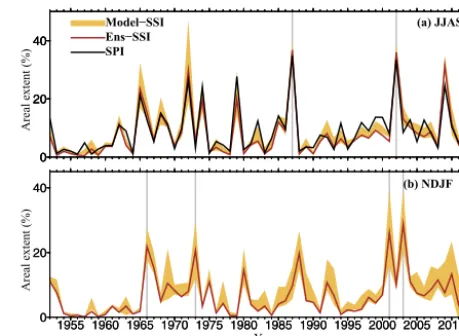
Figure 2. Uncertainty in areal extent (%) of 60 cm soil mois-ture drought simulated using the three LSMs (i.e. VIC, Noah, and CLM).(a)Multi-model ensemble (brown) mean 4-month Standard-ized Soil Moisture Index (SSI) and inter-model variation (shaded) estimated as 1 standard deviation for the monsoon season. The black line in(a)shows the 4-month Standardized Precipitation In-dex (SPI) at the end of the monsoon season (June through Septem-ber),(b) and multi-model ensemble mean and uncertainty in the 4-month SSI estimated using the three LSMs for the Rabi season (November through February). The light brown shaded area shows uncertainty in severe-to-exceptional drought based on the model simulated SSI (SSI<−1.3). The dark brown line shows areal extent estimated based on the ensemble mean SSI for the three LSMs. The grey line marks the top drought years based on area under drought.
monsoon season (representing accumulated precipitation for the June to September period) for the period of 1951–2015 (Fig. 2a). The top five monsoon season (JJAS) drought events occurred in 1987 (areal extent of severe to excep-tional droughts: 35 %), 2002 (33.5 %), 1979 (27.7 %), 1972 (26.3 %), and 2009 (24.6 %) at the all-India level. The mon-soon season droughts of 2015 (with an areal extent of 17.4 %) and 2014 (14.4 %) ranked 8th and 10th during the period of 1951–2015. Mishra et al. (2016) reported that the 2014– 2015 monsoon season drought in the Indo-Gangetic Plain was the most severe during the history of 116 years, with a return period of 542 years.
50 100 150 200 250
Precipitation (mm)
1 2 3 4 5 6 7 8 9 101112
(a)
20 25 30
Temperature (
0C)
1 2 3 4 5 6 7 8 9 101112
(b)
100 150 200
SM60 (mm)
1 2 3 4 5 6 7 8 9 101112 100
150 200
1 2 3 4 5 6 7 8 9 101112 100
150 200
1 2 3 4 5 6 7 8 9 101112
(c)
70˚ 75˚ 80˚ 85˚ 90˚ 95˚ 10˚
15˚ 20˚ 25˚ 30˚ 35˚
(d) VIC
70˚ 75˚ 80˚ 85˚ 90˚ 95˚
−0.6 −0.4 −0.2 0.0 0.2 0.4 0.6
(e) NOAH
70˚ 75˚ 80˚ 85˚ 90˚ 95˚ 10˚ 15˚ 20˚ 25˚ 30˚ 35˚
(f) CLM
0.0 0.2 0.4 0.6 0.8
Correlation
(g)
[image:7.612.128.466.65.353.2]VIC NOAH CLM
Figure 3.Uncertainty in persistence in root-zone soil moisture (60 cm). Seasonal cycle of all-India averaged(a)precipitation,(b)mean air temperature, and(c)60 cm soil moisture simulated using the VIC (blue), the Noah (green), and the CLM (red).(d–f)Autocorrelation in 60 cm soil moisture at a 4-month lag simulated using the VIC, Noah, and CLM, respectively.(g)All-India median autocorrelation (4-month lag) in the 60 cm soil moisture from the three LSMs.
1965 (23.4 %) are the top 5 drought years during the period of 1951–2015 (Fig. 2a). We notice that 1979 (areal extent: 20 %) ranked 6th on record, while 2015 (16.5 %) and 2014 (7.13 %) ranked 8th and 15th, respectively, based on ENS-SSI areal extent of the simulated 60 cm soil moisture drought during the monsoon season.
Since the Rabi season (NDJF) is the key crop-growing sea-son in India, we estimated areal extents of 60 cm soil mois-ture drought from the three LSMs for the period of 1951– 2015 (Fig. 2b). While year-to-year variability in the un-certainty of areal extent of droughts was found, the uncer-tainty in 60 cm soil moisture based on the areal extent of droughts was substantially higher (∼5 %) during the last decade of 1951–2015, which might be associated with fre-quent drought events during this period. We found a high uncertainty (∼7 %) in the areal extent of soil moisture drought in 2011 (Fig. 2b). Based on the ENS-SSI areal ex-tent of 60 cm soil moisture drought, the top 5 drought years were 2003 (areal extent 30 %, uncertainty 9.6 %), 2001 (27.6, 12.0 %), 1966 (22.6, 4.7 %), 1973 (20.7, 8.9 %), and 1988 (20.6, 6.1 %). Droughts in the Rabi season can be driven by both monsoon season precipitation deficit and positive tem-perature anomalies during this season. Uncertainty in the top five drought events in the Rabi season was substantial (5–
12 %), which underscores the need for multi-model drought assessment in the growing season.
The VIC, Noah, and CLM show an all-India median auto-correlation of 0.23, 0.37, and 0.71, respectively, at a 4-month lag (Fig. 3), indicating that the CLM has the highest persis-tence in the 60 cm soil moisture. Spatial differences in soil moisture persistence were also observed (Fig. 3). Our results are in agreement with the findings of Wang et al. (2009), who reported higher persistence for CLM modeled soil moisture, which can be attributed to its higher water holding capac-ity and thicker soil column (Fig. S2). Figure S2 shows that though there is not much difference in soil texture provided as input to three LSMs, the available water in the total col-umn is much higher for the CLM. We find that soil layer thickness is strongly related to soil moisture persistence re-gardless of model calibration (Fig. S8). The same thing can be noted even considering the first three soil layers which cover a 60 cm soil column for all three LSMs, the soil-layer thickness of the CLM dominates over another two LSMs (Fig. S9).
averaged mean monthly 60 cm soil moisture reaches the highest level in the month of August in the CLM model (Fig. 3a–c). The 1-month lag between peak precipitation and peak 60 cm soil moisture from the CLM can be due to a relatively deeper soil column (Fig. S8) and higher total col-umn water holding capacity, a higher number of soil layers, and differences in processes related to soil hydrology as dis-cussed in Wang et al. (2009) and Xia et al. (2012).
To understand the relationship between meteorological and agricultural droughts, lagged correlation analysis was performed between the 4-month SPI at the end of the mon-soon season and the 4-month SSI (at the end of JJAS, JASO, ASON, and so on). We find that the 4-month SSI at the end of the monsoon season for the VIC model showed the high-est correlation with the month SPI (JJAS), while the 4-month SSI from the Noah model showed the lowest corre-lation (Fig. S10a). These results indicate that the 60 cm soil moisture from the VIC model responds faster to the monsoon season precipitation than the other two LSMs, which can be associated with soil moisture persistence and model param-eterization (Van Loon et al., 2012; Wang et al., 2009; Xia et al., 2012). However, we notice that the correlation between the 4-month SPI at the end of the monsoon season and the 4-month SSI declines rapidly after October (ONDJ, NDJF, and so on) for the VIC and Noah models (Fig. S10a). On the other hand, the CLM shows substantially higher persistence even for the March–June 60 cm soil moisture, which can be attributed to a deeper soil column and differences in the other processes related to soil hydrology. These results also indi-cate that the anomalous precipitation during the monsoon season can last longer and have a substantial influence on agriculture drought estimated using the 60 cm soil moisture from the CLM as reflected by the strength of the relationship between the 12-month SPI and 12-month SSI in the CLM (Fig. S10b).
Areal extent and severity of agricultural droughts esti-mated using the 60 cm soil moisture show a considerable uncertainty mainly due to the differences in soil moisture persistence characteristics among three LSMs (Fig. 3). We estimated areal extent of agriculture drought from the three LSMs considering the period that showed maximum correla-tion against the monsoon season precipitacorrela-tion (Fig. S10c). For instance, 4-month SSI at the end of October (JASO) showed the highest correlation with 4-month SPI at the end of September (JJAS) for the VIC and Noah models (Fig. S10a). On the other hand, the 4-month SSI at the end of November (ASON) showed the highest correlation with the 4-month SPI at the end of September (JJAS) for the CLM. Therefore, we considered root-zone soil moisture for JASO, JASO, and ASON periods from the VIC, Noah, and CLM, re-spectively (Fig. S10c) to understand the response of the mon-soon season deficit in precipitation on agricultural drought. We find that the uncertainty in the areal extent of agricultural drought is substantially reduced considering the lagged re-sponse of the monsoon season precipitation and soil moisture
(Fig. S10c and Table S3), indicating that the major source of uncertainty in areal extent of agricultural droughts is soil moisture persistence in the LSMs.
3.3 Reconstruction of major droughts
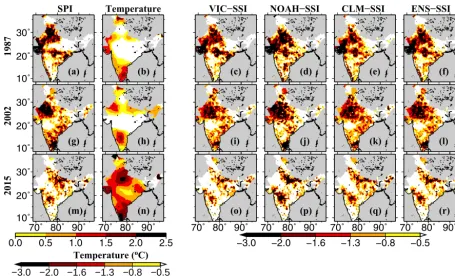
We reconstructed major monsoon season drought events over India using 60 cm soil moisture from the three LSMs for the period of 1951–2015 (Fig. 4). The meteorological and agri-cultural droughts were represented using the 4-month SPI and 4-month SSI, respectively, at the end of the monsoon season. We estimated the ensemble mean 4-month SSI from the three LSMs to understand whether the individual LSMs show a larger difference from the ensemble mean. Based on the 4-month SPI at the end of the monsoon season, we se-lected the top two most widespread drought events that oc-curred in 1987 and 2002 (Figs. 2a and 4). Moreover, we also selected a recent drought event (2015) that caused an enor-mous water crisis in the Indo-Gangetic Plain (Mishra et al., 2016). For all three major droughts (1987, 2002, and 2015) in the monsoon season, we compared areal extents of 60 cm soil moisture drought in the monsoon season estimated from the three LSMs.
Areal extents of the monsoon season droughts (meteoro-logical and agricultural) in 1987, 2002, and 2015 show that droughts were mainly caused by the monsoon season precip-itation deficits (Fig. 4). We notice positive air temperature anomalies in all 3 years (1987, 2002, and 2015); however, patterns of agricultural and meteorological droughts were largely similar (Fig. 4). Among the three drought events, the monsoon season air temperature anomaly (positive) was strongest in the 2015 monsoon season. Uncertainty in areal extent of agricultural droughts estimated using the 60 cm soil moisture is presented in supplemental Table S3. We notice large uncertainty in the areal extent of drought simulated from the three LSMs for the 2015 event (Table S3). The VIC model simulated areal extent of soil moisture drought was 14 % during the 2015 monsoon season, while the areal extent of drought simulated from Noah and the CLM was 21.2 and 18.1 %, respectively (Table S3).
10˚ 20˚ 30˚
1987
SPI
(a)
Temperature
(b)
VIC−SSI
(c)
NOAH−SSI
(d)
CLM−SSI
(e)
ENS−SSI
(f)
10˚ 20˚ 30˚
2002
(g) (h) (i) (j) (k) (l)
70˚ 80˚ 90˚ 10˚
20˚ 30˚
2015
(m)
70˚ 80˚ 90˚
(n)
Temperature (oC)
SPI
0.0 0.5 1.0 1.5 2.0 2.5
−3.0 −2.0 −1.6 −1.3 −0.8 −0.5
70˚ 80˚ 90˚
(o)
70˚ 80˚ 90˚
(p)
70˚ 80˚ 90˚
(q)
70˚ 80˚ 90˚
(r)
[image:9.612.69.525.65.341.2]−3.0 −2.0 −1.6 −1.3 −0.8 −0.5
Figure 4.Reconstruction of monsoon season drought events of(a–f)1987,(g–l)2002, and(m–r)2015, estimated based on(a, g, k)the 4-month SPI at the end of the monsoon season,(c, i, o)the 4-month SSI at the end of the monsoon season simulated using the VIC model,
(d, j, p)same as(c, i, o)but for the Noah model, and(e, k, q)same as(c, i, o)but for the CLM.(f, l, r)Ensemble mean 4-month SSI simulated using the VIC, Noah, and CLM.(b, h, n)Air temperature anomaly during the monsoon season for the selected drought years.
agricultural droughts estimated using the 60 cm soil moisture estimated from the three models is presented in supplemental Table S4. In 2001, the areal extent of droughts simulated by the VIC, Noah, CLM, and their ensemble mean were 17.2, 40.7, 24.7, and 26.1 %, respectively (Table S4). Large differ-ences in the areal extent of 60 cm soil moisture drought simu-lated from the three LSMs were also noted for the years 1966, 1973, 2001, and 2003 (Table S4).
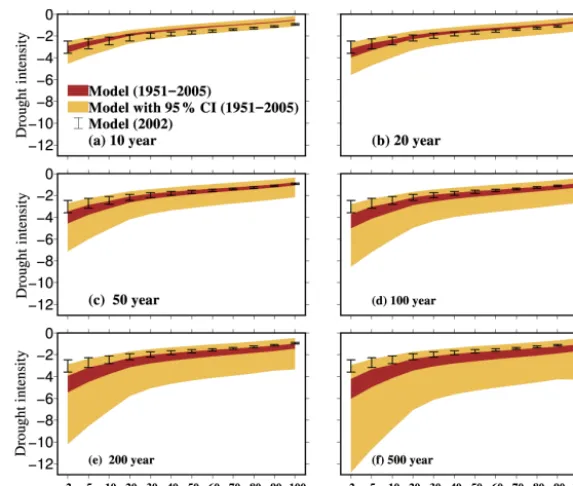
3.4 Intensity–areal extent–frequency (IAF) of droughts Uncertainty in the multi-model drought estimates was evalu-ated using IAF curves (Fig. 5). Drought intensity associevalu-ated with the selected areal extent thresholds was estimated for the return periods of 10, 20, 50, 100, 200, and 500 years (Fig. 5). We find that multi-model-based drought intensity for a se-lected areal extent has a much larger uncertainty when the 95 % confidence interval of the GEV parameters was consid-ered (Table S6). However, uncertainty in drought intensity was lower when only mean values of the GEV parameters for drought intensity and areal extents were considered. Uncer-tainty in drought intensity appeared to grow with an increase in the return period (Fig. 5). Based on the IAF curves, we find that the 2002 monsoon season drought has a return period of 50 years. Moreover, uncertainty in drought intensity from the three LSMs was larger for smaller areal extents (Fig. 5). For
instance, a drought of 50 % areal extent and 50-year return period has intensities of−1.66,−1.91, and−1.53 simulated from the VIC, Noah, and CLM, respectively (Table S5). On the other hand, a drought of 5 % areal extent and 50-year re-turn period has intensities of−2.89,−3.79, and−3.09 simu-lated from the VIC, Noah, and CLM, respectively (Table S5). Most of the return periods and areal-extent drought intensi-ties were higher for the Noah model and lower for the VIC model (Table S5), which can be associated with the differ-ences in 60 cm soil moisture persistence in the three LSMs.
A considerably higher uncertainty in IAF curves during the Rabi season was noticed (Fig. S12; Tables S7 and S8). For instance, a drought of 50 % areal extent and a 50-year re-turn period can have intensities of−1.23,−1.62, and−1.50 for 60 cm soil moisture obtained from the VIC, Noah, and CLM, respectively (Fig. S12 and Table S7). A drought of 5 % areal extent and the 50-year return period have intensities of−2.17,−3.71, and−3.25 simulated from the VIC, Noah, and CLM, respectively (Table S7). Higher uncertainty in drought intensities during the Rabi season can be attributed to the response of soil moisture in the three LSMs to meteo-rological forcing (precipitation and air temperature).
Figure 5.Uncertainty in intensity–areal extent–frequency (IAF) curves for the monsoon season 60 cm soil moisture drought estimated using the three LSMs. Dark brown color shade shows uncertainty in models without considering parameter uncertainty in the Generalized Extreme Value (GEV) distribution, while light brown color shows uncertainty considering the 95 % confidence interval of the GEV parameters for return periods(a)10,(b)20,(c)50,(d)100,(e)200, and(f)500 years. Black error bars indicate uncertainty for the 2002 monsoon season drought using three LSMs.
soil moisture from the three LSMs (Fig. S13). We used the 12-month SSI at the end of December based on the areal averaged mean annual 60 cm soil moisture over the Indo-Gangetic Plain. Similar to IAF curves for the all-India aver-aged 60 cm soil moisture, a large uncertainty was found due to differences in the GEV parameters (Fig. S13, Tables S9 and S10). Moreover, uncertainty in IAF curves of the Indo-Gangetic Plain increases with the return period and declines with an increase in areal extent of droughts. For instance, for an aerial extent of 5 % and a return period of 50 years, drought intensities were −2.59, −3.06, and −2.48 for the VIC, Noah, and CLM (Table S9). However, when areal ex-tent increases to 50 %, drought intensities are−1.42,−1.49, and−1.45 for the VIC, Noah, and CLM, respectively (Ta-ble S9, Fig. S11). Overall, uncertainty in drought intensity is higher for localized droughts that have higher return pe-riods. These results further indicate that 60 cm soil mois-ture drought characteristics can have large uncertainty arising from different LSMs, which can be reduced by considering the multi-model ensemble agricultural drought assessments. 3.5 Role of the monsoon season precipitation and Rabi
season air temperature
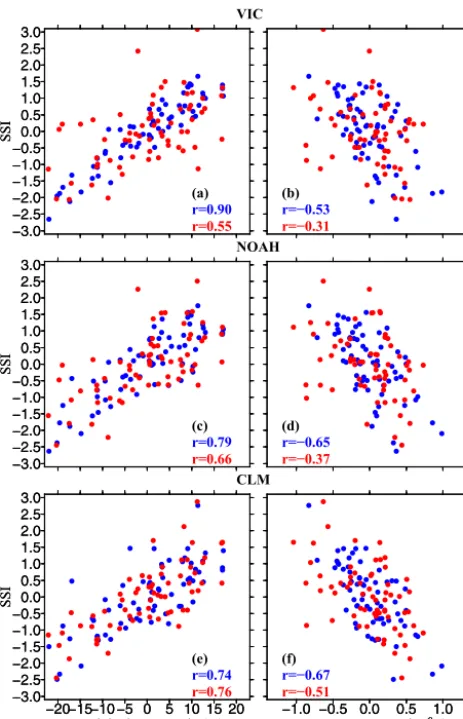
We evaluated the differences in the coupling of 60 cm soil moisture (SSI) with monsoon season precipitation and air temperature (Figs. 6 and S14). We find that a 4-month SSI
at-−3.0 −2.5 −2.0 −1.5 −1.0 −0.5 0.0 0.5 1.0 1.5 2.0 2.5 3.0 SSI VIC (a) r=0.90 −3.0 −2.5 −2.0 −1.5 −1.0 −0.5 0.0 0.5 1.0 1.5 2.0 2.5 3.0 SSI r=0.55 (b) r=−0.53 r=−0.31 −3.0 −2.5 −2.0 −1.5 −1.0 −0.5 0.0 0.5 1.0 1.5 2.0 2.5 3.0 SSI NOAH (c) r=0.79 −3.0 −2.5 −2.0 −1.5 −1.0 −0.5 0.0 0.5 1.0 1.5 2.0 2.5 3.0 SSI r=0.66 (d) r=−0.65 r=−0.37 −3.0 −2.5 −2.0 −1.5 −1.0 −0.5 0.0 0.5 1.0 1.5 2.0 2.5 3.0 SSI
−20−15−10 −5 0 5 10 15 20
Precipitation anomaly (%) CLM (e) r=0.74 −3.0 −2.5 −2.0 −1.5 −1.0 −0.5 0.0 0.5 1.0 1.5 2.0 2.5 3.0 SSI
−20−15−10 −5 0 5 10 15 20
Precipitation anomaly (%)
r=0.76
−1.0 −0.5 0.0 0.5 1.0
Temperature anomaly (0C)
(f) r=−0.67
−1.0 −0.5 0.0 0.5 1.0
Temperature anomaly (0C) r=−0.51
Figure 6. (a, c, e)Relationship between monsoon season precipita-tion anomaly (%) and 4-month SSI at the end of the monsoon sea-son, and(b, d, f)same as(a, c, e)but for the relationship between 4-month SSI and the air temperature anomaly of the monsoon sea-son. Correlation coefficients are shown for all-India SSI (blue) and 4-month SSI over the Indo-Gangetic Plain (red).
mospheric forcing, which can show a substantial variation across regions and seasons.
4 Discussion
We find that the three LSMs show major differences in agri-cultural droughts during the monsoon and Rabi seasons. Un-certainty in the intensity of droughts is higher in the Rabi season than that of the monsoon season, which can be asso-ciated with the role of air temperature in soil moisture. Also, we found differences in soil moisture drought simulated in response to precipitation and temperature deficits (Figs. 6 and S12). For instance, soil moisture from the VIC model shows a quick response to precipitation deficit, whereas Noah and the CLM show a delayed response. Moreover, local-ized droughts have more uncertainty than that of widespread
droughts over India and the Indo-Gangetic Plain. The pri-mary cause of the uncertainty in 60 cm soil moisture and droughts is related to soil moisture persistence (Fig. S16), which is associated with the soil water holding capacity as reported in Wang et al. (2009). We found that persistence in soil moisture is strongly linked with soil-layer thickness (see Fig. S8), which in turn affects the soil water holding capac-ity (available water, Fig. S16). Apart from the soil moisture persistence, there can be several other factors that can in-troduce uncertainty in 60 cm soil moisture simulations. For instance, all three LSMs have different calibration parame-ters, which do not cover the entire range of uncertainty due to manual calibration (De Lannoy et al., 2006; Samaniego et al., 2013). However, our results show that the model cal-ibration has little impact on soil moisture anomalies, which are largely driven by the climate forcing. Moreover, during drought, there is a high degree of non-linearity; therefore, calibration parameters estimated through global optimization may also not yield the best results (De Lannoy et al., 2006). The differences in vegetation parameters in the three LSMs can also be attributed to uncertainty in 60 cm soil moisture (Peters-Lidard et al., 2008). For instance, the Noah model does not account for the sub-grid variability of vegetation, unlike the CLM and VIC models, which use a mosaic-based representation of vegetation. However, since we were inter-ested in 60 cm soil moisture droughts, we assume that the major uncertainty in soil moisture simulations is due to soil hydraulic properties and different soil thickness in LSMs (Peters-Lidard et al., 2008; Teuling et al., 2009). With re-spect to the LSMs, we would like to note that the drought uncertainty assessments conducted here are limited to only three LSMs, which is comparatively a smaller size.
[image:11.612.52.284.66.426.2]pre-cipitation/air temperature. The differences in soil moisture sensitivity to atmospheric forcings can have implications for future projections of droughts from multiple LSMs. For in-stance, Prudhomme et al. (2014) reported that uncertainty in drought projections can be large, especially due to mod-els that simulate the dynamic response of plants to climate. Overall, we find that 60 cm soil moisture droughts have un-certainty associated with their areal extent and severity. The uncertainty in drought estimates is largely due to differences in the soil moisture persistence. Uncertainty in drought esti-mates during the crop-growing season can be reduced using the multi-model ensemble mean, which can assist decision makers in India.
5 Conclusions
India has witnessed some of the most severe meteorolog-ical and agricultural droughts during the period of 1951– 2015. The most wide-spread meteorological droughts during the monsoon season occurred in 1987, 2002, 1972, 1979, and 2009. During the Rabi season, the most wide-spread agricultural droughts occurred in 2003, 2001, 1966, 1973, and 1988. All three LSMs, as well as their ensemble mean, identified major 60 cm soil moisture droughts between 1951 and 2015.
The three LSMs (e.g. VIC, Noah, and CLM) showed dif-ferences in persistence of 60 cm soil moisture over India, which was largely associated with soil water holding capac-ity. The CLM showed the highest soil moisture persistence among the three LSMs. Due to differences in the soil mois-ture persistence, areal extent and intensity of droughts calcu-lated by the three LSMs showed uncertainty. Using the IAF curves, we found that the uncertainty in intensity was higher for the localized droughts (with less areal extent). Uncer-tainty increases with the return period of droughts, indicat-ing that localized and rare drought events are more different among the three LSMs.
All three LSMs showed differences in the coupling be-tween 60 cm soil moisture and precipitation/air temperature, suggesting that LSMs have disparities in soil moisture sen-sitivity to precipitation and temperature anomalies in the monsoon and Rabi seasons. Considering the differences in drought characteristics simulated by the three models, multi-model ensemble mean can be a better estimate of agricultural droughts over India as demonstrated for streamflow and ter-restrial water storage. Uncertainty in intensity and areal ex-tent can be reduced substantially for the severe and localized droughts that can affect agricultural production. Future stud-ies should consider soil moisture simulations from a large number of LSMs as well as other sources of uncertainty in the historical reconstruction of agricultural droughts over In-dia. Moreover, including the uncertainty due to choice of dif-ferent precipitation datasets and other meteorological forcing datasets can be important for regional drought impact assess-ments.
Appendix A: Estimation of the Standardized
Precipitation Index and the Standardized Soil Moisture Index
To estimate the Standardized Precipitation Index (SPI), the gamma probability density function is fitted to precipitation data accumulated to different timescales (e.g. 1-month, 4-month, 12-4-month, and 24-month) in the same way as Ed-wards and Mckee (1997) as shown in Eq. (A1):
g(x)= 1
βα0(α)x
α−1e−x/β forx >0, (A1)
whereαis a shape parameter (α >0),βis a scale parameter (β >0),x is the precipitation amount (x >0), and
0(α)=
∞ Z
0
yα−1e−ydy
where0(α)denotes the gamma function.
The shape parameter α and scale parameter β are esti-mated using maximum likelihood following Edward and Mc-kee (1997) for each grid and each timescale of interest as follows:
ˆ
α= 1
4A 1+
r
1+4A 3
!
ˆ
β=x ˆ
α
whereA=ln(x)− [P
ln(x)]/n, withnbeing the number of precipitation events andx is mean precipitation.
After fitting the probability density function and identify-ing shape and scale parameters, the cumulative density func-tion cdf(x)=
P R
0
xpdf(t)·dt is fitted.
Cumulative probability for a given rainfall amount,
H(PRE), is then estimated from the following mixed distri-bution:
H (PRE)=(m/n)+ [1−(m/n)]cdf(PRE),
wherem is the number of zeros in a dataset and n is the sample size.
SPI is then estimated by applying equi-probability trans-formation of theH(PRE) as described in Wu et al. (2007) following Abramowitz and Stegun (1965).
SPI= −
t− c0+c1t+c2t
2
1+d1t+d2t2+d3t3
for 0< H (PRE)≤0.5,
SPI= +
t− c0+c1t+c2t
2
1+d1t+d2t2+d3t3
for 0.5< H (PRE) <1,
where
t=
s
ln
1
(H (PRE))2
for 0< H (PRE)≤0.5,
t=
s
ln
1
(1−H (PRE))2
for 0.5< H (PRE) <1, c0=2.515517; c1=0.802853; c2=0.010328, d1=1.432788; d2=0.189269;d3=0.001308.
Supplement. The supplement related to this article is available online at: https://doi.org/10.5194/hess-22-2269-2018-supplement.
Competing interests. The authors declare that they have no conflict of interest.
Acknowledgements. The authors acknowledge the funding from the ITRA-Water program. Comments and suggestions from the editor and three reviewers are greatly appreciated. Authors would like to thank C. K. Unnikrishnan (NCESS) for sharing the in situ soil moisture observations.
Edited by: Harrie-Jan Hendricks Franssen Reviewed by: four anonymous referees
References
Abramowitz, M. and Stegun, I. A.: Handbook of mathematical func-tion, Editoral, Dover, p. 1046, 1965.
Asoka, A., Gleeson, T., Wada, Y., and Mishra, V.: Relative con-tribution of monsoon precipitation and pumping to groundwater storage changes in India, Nat. Geosci., 10, 109–117, 2017. Beck, H. E., van Dijk, A. I. J. M., de Roo, A., Dutra, E., Fink,
G., Orth, R., and Schellekens, J.: Global evaluation of runoff from 10 state-of-the-art hydrological models, Hydrol. Earth Syst. Sci., 21, 2881–2903, https://doi.org/10.5194/hess-21-2881-2017, 2017.
Beven, K. J. and Kirkby, M. J.: A physically based, variable contributing area model of basin hydrology/Un modèle à base physique de zone d’appel variable de l’hydrologie du bassin ver-sant, Hydrolog. Sci. J., 24, 43–69, 1979.
Bohn, T. J., Sonessa, M. Y., and Lettenmaier, D. P.: Seasonal Hydro-logic Forecasting: Do Multimodel Ensemble Averages Always Yield Improvements in Forecast Skill?, J. Hydrometeorol., 11, 1358–1372, https://doi.org/10.1175/2010JHM1267.1, 2010. Bohn, T. J., Livneh, B., Oyler, J. W., Running, S. W., Nijssen, B.,
and Lettenmaier, D. P.: Global evaluation of MTCLIM and re-lated algorithms for forcing of ecological and hydrological mod-els, Agr. Forest Meteorol., 176, 38–49, 2013.
Bonan, G. B., Levis, S., Kergoat, L., and Oleson, K. W.: Landscapes as patches of plant functional types: An integrating concept for climate and ecosystem models, Global Biogeochem. Cy., 16, 5-1–5-23, https://doi.org/10.1029/2000GB001360, 2002.
Bowling, L. C., Lettenmaier, D. P., Nijssen, B., Graham, L. P., Clark, D. B., El Maayar, M., Essery, R., Goers, S., Gusev, Y. M., Habets, F., van den Hurk, B., Jin, J., Kahan, D., Lohmann, D., Ma, X., Mahanama, S., Mocko, D., Nasonova, O., Niu, G.-Y., Samuelsson, P., Shmakin, A. B., Takata, K., Verseghy, D., Viterbo, P., Xia, Y., Xue, Y., and Yang, Z.-L.: Simula-tion of high-latitude hydrological processes in the Torne–Kalix basin: PILPS Phase 2(e), Global Planet. Change, 38, 1–30, https://doi.org/10.1016/S0921-8181(03)00003-1, 2003. Cai, X., Yang, Z.-L., David, C. H., Niu, G.-Y., and Rodell, M.:
Hy-drological evaluation of the Noah-MP land surface model for the Mississippi River Basin, J. Geophys. Res.-Atmos., 119, 23–38, https://doi.org/10.1002/2013JD020792, 2014.
Chen, F., Mitchell, K., Schaake, J., Xue, Y., Pan, H.-L., Victor, K., Duan, Q. Y., Michael, E., and Alan, B.: Modeling of land surface evaporation by four schemes and comparison with FIFE obser-vations, J. Geophys. Res., 101, 7251–7268, 1996.
Cosby, B. J., Hornberger, G. M., Clapp, R. B., and Ginn, T.: A sta-tistical exploration of the relationships of soil moisture charac-teristics to the physical properties of soils, Water Resour. Res., 20, 682–690, 1984.
De Lannoy, G. J., Houser, P. R., Pauwels, V., and Verhoest, N. E.: Assessment of model uncertainty for soil moisture through ensemble verification, J. Geophys. Res.-Atmos., 111, D10101, https://doi.org/10.1029/2005JD006367, 2006.
Dirmeyer, P. A., Dolman, A. J., and Sato, N.: The pilot phase of the global soil wetness project, B. Am. Meteorol. Soc., 80, 851–878, 1999.
Dirmeyer, P. A., Gao, X., Zhao, M., Guo, Z., Oki, T., and Hanasaki, N.: GSWP-2: Multimodel Analysis and Implications for Our Per-ception of the Land Surface, B. Am. Meteorol. Soc., 87, 1381– 1397, https://doi.org/10.1175/BAMS-87-10-1381, 2006. Dorigo, W. A., Wagner, W., Hohensinn, R., Hahn, S., Paulik, C.,
Xaver, A., Gruber, A., Drusch, M., Mecklenburg, S., van Oeve-len, P., Robock, A., and Jackson, T.: The International Soil Mois-ture Network: a data hosting facility for global in situ soil mois-ture measurements, Hydrol. Earth Syst. Sci., 15, 1675–1698, https://doi.org/10.5194/hess-15-1675-2011, 2011.
Dorigo, W., de Jeu, R., Chung, D., Parinussa, R., Liu, Y., Wagner, W., and Fernández-Prieto, D.: Evaluating global trends (1988–2010) in harmonized multi-satellite sur-face soil moisture, Geophys. Res. Lett., 39, L18405, https://doi.org/10.1029/2012GL052988, 2012.
Dorigo, W., Wagner, W., Albergel, C., Albrecht, F., Balsamo, G., Brocca, L., Chung, D., Ertl, M., Forkel, M., Gruber, A., Haas, E., Hamer, P. D., Hirschi, M., Ikonen, J., de Jeu, R., Kidd, R., La-hoz, W., Liu, Y. Y., Miralles, D., Mistelbauer, T., Nicolai-Shaw, N., Parinussa, R., Pratola, C., Reimer, C., van der Schalie, R., Seneviratne, S. I., Smolander, T., and Lecomte, P.: ESA CCI soil moisture for improved Earth system understanding: State-of-the art and future directions, Remote Sens. Environ., 203, 185–215, https://doi.org/10.1016/j.rse.2017.07.001 10.1016/j.rse.2017.07, 2017.
Edwards, D. C. and McKee, T. B.: Characteristics of 20th century drought in the United States at multiple time scales, Climatology Report No. 97-2, Colorado State Univ., Ft. Collins, CO, 1997. Franchini, M. and Pacciani, M.: Comparative analysis of several
conceptual rainfall–runoff models, J. Hydrol., 122, 161–219, 1991.
Hao, Z. and AghaKouchak, A.: Multivariate Standardized Drought Index: A parametric multi-index model, Adv. Water Resour., 57, 12–18, https://doi.org/10.1016/j.advwatres.2013.03.009, 2013. Hogue, T. S., Bastidas, L., Gupta, H., Sorooshian, S., Mitchell, K.,
and Emmerich, W.: Evaluation and transferability of the Noah land surface model in semiarid environments, J. Hydrometeorol., 6, 68–84, 2005.
Landerer, F. W. and Swenson, S. C.: Accuracy of scaled GRACE terrestrial water storage estimates, Water Resour. Res., 48, W04531, https://doi.org/10.1029/2011WR011453, 2012. Liang, X., Lettenmaier, D. P., Wood, E. F., and Burges, S.: A
sim-ple hydrologically based model of land surface water and en-ergy fluxes for general circulation models, J. Geophys. Res., 99, 14415–14428, https://doi.org/10.1029/94JD00483, 1994. Lloyd-Hughes, B. and Saunders, M. A.: A drought
cli-matology for Europe, Int. J. Climatol., 22, 1571–1592, https://doi.org/10.1002/joc.846, 2002.
Mahrt, L. and Ek, M.: The influence of atmospheric stability on po-tential evaporation, J. Clim. Appl. Meteorol., 23, 222–234, 1984. Maurer, E. P., Wood, A. W., Adam, J. C., and Letten-maier, D. P.: A long-term hydrologically based dataset of land surface fluxes and states for the conterminous United States, J. Climate, 15, 3237–3251, https://doi.org/10.1175/1520-0442(2002)015,3237:ALTHBD.2.0.CO;2, 2002.
McKee, T. B., Doesken, N. J., and Kleist, J.: The rela-tionship of drought frequency and duration to time scales, in: Proceedings of the 8th Conference on Applied Clima-tology, vol. 17, 179–183, American Meteorological Soci-ety, Boston, MA, available at: http://ccc.atmos.colostate.edu/ relationshipofdroughtfrequency.pd (last access: 22 March 2017), 1993.
Mishra, V. and Cherkauer, K. A.: Retrospective droughts in the crop growing season: Implications to corn and soybean yield in the Midwestern United States, Agr. Forest Meteorol., 150, 1030– 1045, 2010.
Mishra, V., Cherkauer, K. A., and Bowling, L. C.: Parameterization of Lakes and Wetlands for Energy and Water Balance Studies in the Great Lakes Region, J. Hydrometeorol., 11, 1057–1082, https://doi.org/10.1175/2010JHM1207.1, 2010.
Mishra, V., Shah, R., and Thrasher, B.: Soil Moisture Droughts under the Retrospective and Projected Climate in India, J. Hy-drometeorol., 15, 2267–2292, https://doi.org/10.1175/JHM-D-13-0177.1, 2014.
Mishra, V., Aadhar, S., Akarsh, A., Pai, S., and Kumar, R.: On the frequency of the 2015 monsoon season drought in the Indo-Gangetic Plain, Geophys. Res. Lett., 43, 102–112, https://doi.org/10.1002/2016GL071407, 2016.
Mishra, V., Kumar, R., Shah, H. L., Samaniego, L., Eisner, S., and Yang, T.: Multimodel assessment of sensitivity and uncertainty of evapotranspiration and a proxy for available water resources under climate change, Climatic Change, 141, 451–465, 2017. Mitchell, K. E.: The multi-institution North American Land
Data Assimilation System (NLDAS): Utilizing multiple GCIP products and partners in a continental distributed hydro-logical modeling system, J. Geophys. Res., 109, D07S90, https://doi.org/10.1029/2003JD003823, 2004.
Nijssen, B., O’donnell, G. M., Hamlet, A. F., and Lettenmaier, D. P.: Hydrologic sensitivity of global rivers to climate change, Cli-matic Change, 50, 143–175, 2001.
Niu, G.-Y., Yang, Z.-L., Dickinson, R. E., Gulden, L. E., and Su, H.: Development of a simple groundwater model for use in cli-mate models and evaluation with Gravity Recovery and Cli-mate Experiment data, J. Geophys. Res.-Atmos., 112, D07103, https://doi.org/10.1029/2006JD007522, 2007.
Pai, D. S., Sridhar, L., Badwaik, M. R., and Rajeevan, M.: Analysis of the daily rainfall events over India using a
new long period (1901–2010) high resolution (0.25◦×0.25◦) gridded rainfall data set, Clim. Dynam., 45, 755–776, https://doi.org/10.1007/s00382-014-2307-1, 2015.
Pai, D. S., Guhathakurta, P., Kulkarni, A., and Rajeevan, M. N.: Variability of Meteorological Droughts Over India, in: Observed Climate Variability and Change over the Indian Region, edited by: Rajeevan, M. N. and Nayak, S., Springer, Singapore, 73–87, 2017.
Peters-Lidard, C. D., Mocko, D. M., Garcia, M., Santanello, J. A., Tischler, M. A., Moran, M. S., and Wu, Y.: Role of precipitation uncertainty in the estimation of hydrologic soil properties using remotely sensed soil moisture in a semiarid environment, Water Resour. Res., 44, W05S18, https://doi.org/10.1029/2007WR005884, 2008.
Prudhomme, C., Giuntoli, I., Robinson, E. L., Clark, D. B., Arnell, N. W., Dankers, R., Fekete, B. M., Franssen, W., Gerten, D., Gosling, S. N., Hagemann, S., Hannah, D. M., Kim, H., Masaki, Y., Satoh, Y.,Stacke, T., Wada, Y., and Wisser, D.: Hydrologi-cal droughts in the 21st century, hotspots and uncertainties from a global multimodel ensemble experiment, P. Natl. Acad. Sci. USA, 111, 3262–3267, 2014.
Rodell, M., Houser, P. R., Jambor, U., Gottschalck, J., Mitchell, K., Meng, C.-J., Arsenault, K., Cosgrove, B., Radakovich, J., Bosilovich, M., Entin, J. K., Walker, J. P., Lohmann, D., and Toll, D.: The Global Land Data Assimilation System, B. Am. Meteo-rol. Soc., 85, 381–394, https://doi.org/10.1175/BAMS-85-3-381, 2004.
Samaniego, L., Kumar, R., and Zink, M.: Implications of Parameter Uncertainty on Soil Moisture Drought Analysis in Germany, J. Hydrometeorol., 14, 47–68, https://doi.org/10.1175/JHM-D-12-075.1, 2013.
Schaake, J., Koren, V., Duan, Q. Y., Mitchell, K., and Chen, F.: Simple iwater balance model for estimating runoff at different spatial and temporal scales, J. Geophys. Res., 101, 7461–7475, https://doi.org/10.1029/95JD02892, 1996.
Shah, H. L. and Mishra, V.: Hydrologic Changes in Indian Sub-Continental River Basins (1901–2012), J. Hydrometeorol., https://doi.org/10.1175/JHM-D-15-0231.1, 2016.
Shah, R. and Mishra, V.: Evaluation of the Reanalysis Products for the Monsoon Season Droughts in India, J. Hydrometeorol., 15, 1575–1591, https://doi.org/10.1175/JHM-D-13-0103.1, 2014. Shah, R., Sahai, A. K., and Mishra, V.: Short to sub-seasonal
hydrologic forecast to manage water and agricultural re-sources in India, Hydrol. Earth Syst. Sci., 21, 707–720, https://doi.org/10.5194/hess-21-707-2017, 2017.
Shah, R. D. and Mishra, V.: Development of an Experimental Near-Real-Time Drought Monitor for India, J. Hydrometeorol., 16, 327–345, https://doi.org/10.1175/JHM-D-14-0041.1, 2015. Shah, R. D. and Mishra, V.: Utility of Global
Ensem-ble Forecast System (GEFS) Reforecast for Medium-Range Drought Prediction in India, J. Hydrometeorol., 17, 1781–1800, https://doi.org/10.1175/JHM-D-15-0050.1, 2016.
Shepard, D. S.: Computer Mapping: The SYMAP Interpolation Al-gorithm, in: Spatial Statistics and Models, edited by: Gaile, G. L. and Willmott, C. J., Springer Netherlands, Dordrecht, 133–145, https://doi.org/10.1007/978-94-017-3048-8_7, 1984.
Shukla, S., Sheffield, J., Wood, E. F., and Lettenmaier, D. P.: On the sources of global land surface hydrologic predictability, Hydrol. Earth Syst. Sci., 17, 2781–2796, https://doi.org/10.5194/hess-17-2781-2013, 2013.
Srivastava, A. K., Rajeevan, M., and Kshirsagar, S. R.: Development of a high resolution daily gridded temperature data set (1969– 2005) for the Indian region, Atmos. Sci. Lett., 10, 249–254, https://doi.org/10.1002/asl.232, 2009.
Teuling, A. J., Uijlenhoet, R., van den Hurk, B., and Seneviratne, S. I.: Parameter sensitivity in LSMs: An analysis using stochastic soil moisture models and ELDAS soil parameters, J. Hydrome-teorol., 10, 751–765, 2009.
Unnikrishnan, C. K., Rajeevan, M., Rao, S. V. B., and Kumar, M.: Development of a high resolution land surface dataset for the South Asian monsoon region, Curr. Sci., 105, 1235–1246, 2013.
Van Loon, A. F., Van Huijgevoort, M. H. J., and Van Lanen, H. A. J.: Evaluation of drought propagation in an ensemble mean of large-scale hydrological models, Hydrol. Earth Syst. Sci., 16, 4057–4078, https://doi.org/10.5194/hess-16-4057-2012, 2012. Wang, A., Bohn, T. J., Mahanama, S. P., Koster, R. D., and
Letten-maier, D. P.: Multimodel Ensemble Reconstruction of Drought over the Continental United States, J. Climate, 22, 2694–2712, https://doi.org/10.1175/2008JCLI2586.1, 2009.
Wu, H., Svoboda, M. D., Hayes, M. J., Wilhite, D. A. and Wen, F.: Appropriate application of the Standardized Precipitation Index in arid locations and dry seasons, Int. J. Climatol., 27, 65–79, https://doi.org/10.1002/joc.1371, 2007.