Computer Information Systems Dissertations
Department of Computer Information Systems
4-29-2009
An Examination of the Deaf Effect Response to Bad
News Reporting in Information Systems Projects
Michael John Cuellar
Follow this and additional works at:
https://scholarworks.gsu.edu/cis_diss
Part of the
Management Information Systems Commons
This Dissertation is brought to you for free and open access by the Department of Computer Information Systems at ScholarWorks @ Georgia State University. It has been accepted for inclusion in Computer Information Systems Dissertations by an authorized administrator of ScholarWorks @ Georgia State University. For more information, please [email protected].
Recommended Citation
Cuellar, Michael John, "An Examination of the Deaf Effect Response to Bad News Reporting in Information Systems Projects." Dissertation, Georgia State University, 2009.
In presenting this dissertation as a partial fulfillment of the requirements for an advanced degree from Georgia State University, I agree that the Library of the University shall make it available for inspection and circulation in accordance with its regulations
governing materials of this type. I agree that permission to quote from, or to publish this dissertation may be granted by the author or, in his/her absence, the professor under whose direction it was written or, in his absence, by the Dean of the Robinson College of Business. Such quoting, copying, or publishing must be solely for scholarly purposes and does not involve potential financial gain. It is understood that any copying from or publication of this dissertation which involves potential gain will not be allowed without written permission of the author.
All dissertations deposited in the Georgia State University Library must be used only in accordance with the stipulations prescribed by the author in the preceding statement.
The author of this dissertation is:
Name Michael J. Cuellar
Address 502 Old Field Cove Woodstock, Georgia 30189
The director of this dissertation is:
His/Her Name Dr. Mark Keil
Department Computer Information Systems
Department Address 35 Broad Street 9th Floor Atlanta, Georgia 30302
Users of this dissertation not regularly enrolled as students at Georgia State University are required to attest acceptance of the preceding stipulations by signing below. Libraries borrowing this dissertation for the use of their patrons are required to see that each user records here the information requested.
Information Systems Projects
BY
Michael John Cuellar
A Dissertation Submitted in Partial Fulfillment of the Requirements for the Degree of
Doctor of Philosophy
in the Robinson College of Business of
Georgia State University
GEORGIA STATE UNIVERSITY ROBINSON COLLEGE OF BUSINESS
2008
Copyright by Michael John Cuellar
This dissertation was prepared under the direction of the candidate’s Dissertation Committee. It has been approved and accepted by all members of that committee, and it has been accepted in partial fulfillment of the requirements for the degree of Doctor in Philosophy in Business Administration in the Robinson College of Business of Georgia State University.
__H. Fenwick Huss_____________ Dean
Robinson College of Business
Dissertation Committee:
__/s/ Mark Keil________________ Chair: Dr. Mark Keil
__/s/ Detmar Straub____________ Dr. Detmar Straub
__/s/ Duane Truex_____________ Dr. Duane P. Truex
__/s/ H. Jeff Smith_____________ Dr. H. Jeff Smith
An Examination of the Deaf Effect Response to Bad News Reporting in
Information Systems Project
By
Michael John Cuellar
04/01/2009
Committee Chair: Dr. Mark Keil
Major Department: Computer Information Systems
As any researcher knows, no work is the result of only one person, it is ultimately the end result of many collaborations. So in this section, I would like to recognize the many people that have helped me conceive, construct, move forward and finish this
dissertation.
First, I would like to thank Mike Gallivan for taking my Master’s research project and showing me how to turn into a published article and thus introducing me to the world of IS research. Thank you for hauling me up Mount Everest and showing me how great the view is from the top.
Next, I would like to thank the many people at GSU who have made my time here a wonderful experience.
• The amazing faculty, who truly represent the best in academia • Libby Crawley Diaz, who guided me through the process
• My fellow PhD students and GAP fellows for their companionship, counsel and
vent sessions: Nannette Napier, Steve Du, Hiro Takeda, Yi Ding, Stacie Petter, Yide Shen, Robert Sainsbury, and Tony Vance.
Having Mark Keil as my dissertation chair has been a fantastic experience. This dissertation began as a GRA assignment in 2004. Over the years we refined it into the work that it is now. In the process, Mark taught me how to do lab research, how to conduct fieldwork, analyze the data and how to create publishable papers from both. Anything that I am as a researcher that is good, I learned from him. Anything bad is my own fault. Mark truly represents what being an academic is all about. I am proud to be his student. Mark, thank you for your hard work and patience with me in the process of getting this done. I couldn’t have done it without you.
To the members of my committee, Detmar Straub, Duane Truex and Jeff Smith for their sage wisdom and counsel as this work moved forward.
• Detmar provided another example of what a scholar could and should be and
inspired me to be diligent in ensuring that the methodology was as rigorous as possible.
• Duane was another mentor to me during the process who provided much insight
on the process and on the nature of academia. He also provided an outlet for my bomb throwing tendencies and showed me how to do in a socially acceptable manner.
• Jeff provided many constructive contributions to the interview protocols and
insightful comments during the proposal and final presentation process. My thanks go to all those who helped me with this work:
• To the instructors who allowed me to take time in their classes to administer my
surveys: Nannette Napier, Hiro Takeda, Yi Ding, and Astrid Lipp. Thanks for allowing me to work with your students.
• To my international collaborators, Roman Beck and Shan Liu, many thanks. You
• To Patrick Moore, Director of the Georgia Technology Authority (GTA), thank you
for allowing me access to your team and for making it possible to collect data from others in the state government.
• To Tom Fruman, also of GTA, thank you for being my sponsor within GTA and to
the rest of the state government.
• To all the members of the Georgia state government, past and present, that I
interviewed for the case study, I am impressed with your commitment to process improvement and desire to provide efficient and effect services to the citizens of Georgia. Thank you for your support.
• To Deepak Khazanchi and the participants of the first two International Research
Workshops on Project Management and to the facilitators of the Academy of Management OCIS and AMCIS doctoral consortiums in 2007. Thank you for the many constructive comments and suggestions regarding this work.
• To the people of Transperfect Translators who back translated the survey
instruments from Chinese and German, American Transcription Typing Service who transcribed the interviews and my daughter, Charity who proofread parts of the document. Thank you for your support.
To those who have been with me through the journey:
• To Dr. Roy Johnson for accepting me into the GAP program, for his instruction in
teaching and for his introduction into the mysterious secrets of academia. You were with Mark and I at the beginning of this work. Thank you for the wisdom, counsel and advice. Thank you for the example of an academic life exuberantly lived.
• To my parents, John and Yolanda Cuellar, who I wish could have lived to see this
day. You both started from nothing and made it possible for me to be who I am. You gave me everything. I present this achievement to you in tribute for all you did for me.
• Finally, to my beautiful wife, Joan: I can’t thank you enough for your love and
support during our lives together but especially during the writing of this
Table of Contents
TABLE OF CONTENTS ... 8
1
INTRODUCTION ... 11
1.1
MOTIVATION... 11
1.2
REVIEW OF THE ESCALATION LITERATURE... 12
1.2.1
Project Determinants ... 13
1.2.2
Psychological Determinants ... 13
1.2.3
Social Determinants... 15
1.2.4
Organizational Determinants ... 16
1.2.5
Contextual Determinants ... 16
1.3
MODELS OF ESCALATION... 17
1.4
DE-ESCALATION STUDIES... 19
1.5
COMMUNICATION ISSUES... 20
1.5.1
The Mum Effect. ... 21
1.5.2
Tourish and Robson’s Theory ... 21
1.6
THE DEAF EFFECT... 22
1.6.1
The Deaf Effect and the Escalation Literature ... 23
1.7
THIS DISSERTATION... 24
1.7.1
Chapter 2 (Laboratory Experiment 1): Construction and Test of a Model at the Individual Level 24
1.7.2
Chapter 3 (Laboratory Experiment 2): Effects of Gender, Risk and Role Prescription on the Deaf Effect ... 24
1.7.3
Chapter 4 (Laboratory Experiment 3): Effect of Societal Collectivism on the Deaf Effect.... 24
1.7.4
Chapter 5: A Case Study of the Deaf Effect... 25
1.7.5
Chapter 6: Summary ... 25
1.8
SUMMARY... 25
2
CONSTRUCTION AND TEST OF A MODEL AT THE INDIVIDUAL LEVEL ... 26
2.1
ABSTRACT... 26
2.2
INTRODUCTION... 26
2.3
LITERATURE REVIEW... 27
2.3.1
Near and Miceli’s Model of Whistle-Blowing Effectiveness and the Deaf Effect... 27
2.3.2
Cognitive Psychological Theories of Decision-making ... 28
2.4
A RESEARCH MODEL OF THE DEAF EFFECT... 29
2.5
EXPERIMENTAL DESIGN... 30
2.5.1
Experimental Model... 30
2.5.2
Scenario Description... 31
2.5.3
Operationalization of Variables... 32
2.5.4
Instrument ... 32
2.5.5
Statistical Controls... 33
2.6
EXPERIMENTAL RESULTS... 33
2.6.1
Demographics ... 33
2.6.2
Descriptive Statistics and Manipulation Checks ... 33
2.6.3
PLS Analysis ... 35
2.7
DISCUSSION... 38
2.7.1
Implications for Research ... 39
2.7.2
Implications for Practice ... 40
2.8
CONCLUSION... 40
3
EFFECTS OF GENDER, RISK AND ROLE PRESCRIPTION ON THE DEAF EFFECT... 41
3.2.2
Effects of Risk on Decision Making. ... 43
3.2.3
Effects of Credibility and Role Prescription on Risk Propensity and Risk Perception ... 43
3.2.4
Gender and Risk... 44
3.3
DESIGN AND VALIDATION OF THE LAB EXPERIMENT... 46
3.3.1
Development of the Materials and Instruments ... 46
3.3.2
Scenario ... 46
3.3.3
Procedure... 47
3.3.4
Subjects ... 47
3.3.5
Operationalization of Variables... 49
3.4
RESULTS OF THE EXPERIMENT... 50
3.4.1
Methodology... 50
3.4.2
Demographics ... 50
3.4.3
Measurement Model Assessment ... 50
3.4.4
Manipulation Checks ... 54
3.4.5
Structural Model ... 56
3.5
DISCUSSION... 60
3.6
CONCLUSION... 60
APPENDIX A: BOTH CREDIBILITY AND ROLE PRESCRIPTION MANIPULATED NEGATIVELY... 61
APPENDIX B:CREDIBILITY POSITIVELY AND ROLE PRESCRIPTION MANIPULATED NEGATIVELY... 63
APPENDIX C: CREDIBILITY MANIPULATED NEGATIVELY AND ROLE PRESCRIPTION MANIPULATED POSITIVELY... 65
APPENDIX D: BOTH CREDIBILITY AND ROLE PRESCRIPTION MANIPULATED POSITIVELY... 67
APPENDIX E: QUESTIONNAIRE... 69
APPENDIX F:DETAILS OF THE OPERATIONALIZATION OF THE VARIABLES... 72
4
EFFECTS OF SOCIETAL COLLECTIVISM ON THE DEAF EFFECT... 75
4.1
THEORETICAL FOUNDATIONS... 76
4.1.1
Definition of Culture ... 76
4.2
CULTURAL VALUES FRAMEWORK... 77
4.2.1
Selection of the Cultural Values Scale... 79
4.3
APPLYING THE GLOBE MEASURES TO THE DEAF EFFECT... 79
4.3.1
Selection of Societal Collectivism ... 79
4.3.2
The Effect of Societal Collectivism on the Deaf Effect ... 80
4.4
RESEARCH METHODOLOGY... 85
4.4.1
Subjects ... 85
4.4.2
Experimental Methodology ... 86
4.5
ANALYSIS METHODOLOGY... 93
4.5.1
Handling the Cultural Values. ... 93
4.5.2
Use of PLS... 94
4.6
RESULTS... 96
4.6.1
Cultural Response Bias... 96
4.6.2
Demographics ... 97
4.6.3
Measurement Model Assessment ... 97
4.6.4
Equivalence Checking... 105
4.7
MANIPULATION CHECKS... 115
4.7.1
Structural Analysis... 120
4.8
DISCUSSION... 131
4.9
CONCLUSIONS... 132
APPENDIX A:QUESTIONNAIRE USED IN THIS STUDY... 133
APPENDIX B: FACTOR ANALYSIS OF THE RELEVANCE AND RISK PERCEPTION CONSTRUCTS... 142
5
A CASE STUDY OF THE DEAF EFFECT OCCURRING IN AN IS PROJECT STATUS REPORTING SYSTEM... 143
5.2.2
Distortion ... 146
5.2.3
Obscuring... 146
5.3
METHODOLOGY... 147
5.3.1
Site Selection ... 147
5.3.2
Data Collection ... 148
5.3.3
Data Analysis Phases... 150
5.4
FINDINGS... 150
5.4.1
Structure of the Projects ... 151
5.4.2
The SISO Status Reporting Process ... 154
5.4.3
A History of the Projects... 159
5.5
DISCUSSION AND IMPLICATIONS... 167
5.5.1
Distortion of the Message ... 168
5.5.2
Evaluating Project Gamma using the Individual Model from this Dissertation. ... 170
5.5.3
Examining Other Escalation Factors ... 172
5.6
CONCLUSIONS... 174
6
SUMMARY OF FINDINGS ... 175
6.1
LABORATORY EXPERIMENTS... 175
6.2
CASE STUDY... 178
6.3
CONTRIBUTIONS AND FUTURE DIRECTIONS FOR RESEARCH AND PRACTICE... 179
6.3.1
Limitations ... 179
6.3.2
Implications for Research ... 179
6.3.3
Implications for Practice ... 181
1 INTRODUCTION
1.1
MOTIVATION
Information systems (IS) project management has historically been a problematic area. IS projects frequently fail and are notorious for going significantly over budget and falling behind schedule. The Standish Group, a Massachusetts-based consulting organization, reports that while software productivity has improved over the past 12 years, software “value” is still only 59 cents per dollar spent. Nineteen percent (19%) of projects still fail outright and 46% have cost or time overruns or don’t meet the customer’s needs (Rubenstein 2007). In some cases, mismanagement of software projects means that they escalate out of control, continuing to absorb valuable resources without ever delivering benefits to the organizations that undertake them (Keil 1995). A survey
sponsored by the Information Systems Audit and Control Association (ISACA) found that 30–40% of all software projects undergo some degree of project escalation (Keil and Mann 1997).
This escalation of commitment to a failing course of action is a well-known phenomenon in software project management and considerable work has been done to gain a better understanding of why executives continue to commit resources in the face of negative signals about the status of projects (Depledge 2003; Keil 1995; Keil and Flatto 1999; Keil, Tan, Wei, Saarinen, Tuunainen and Wassenaar 2000b; Ross and Staw 1993; Staw 1976; Staw 1981). While many explanations have been explored, recent work has focused on the communication failures that occur within organizations and how these may contribute to the escalation of commitment. A small, but growing number of studies have examined the so-called “Mum Effect” (Keil and Robey 1999; Keil and Robey 2001), or the reluctance to report bad news. In addition, Keil and Robey (1999, 2001) coined the term “Deaf Effect” suggesting that executives’ refusal to hear bad news might also promote escalation. That is, for reasons that are not well understood, executives may (consciously or unconsciously) ignore bad news even when those who report to them are bold enough to transmit the message. In those cases, it is important to know why senior management did not heed those who warned them that the project was in danger of failing.
Incidences of projects in which the Deaf Effect has occurred are numerous and involve serious failures. Perhaps the most notorious is that of the Challenger Disaster
Accounts committee referring to this project said, “Ignoring ample warnings, the DPW [Department for Works and Pensions], the CSA and IT contractor EDS introduced a large, complex IT system at the same time as restructuring the Agency. The new system . . . stumbled and now has enormous operational difficulties” (ZDNet.co.uk 2006). This disastrous system failure eventually resulted in the shutdown of the agency. Finally, the Denver International Airport baggage handling system is another example of where the Deaf Effect occurred. This new airport opened 16 months and $2 billion over budget due to the failure of the automated baggage handling system development effort. During the development of this system, “[the baggage handling system development contractor] told them from the beginning that they were going to need at least one more year to get the system up and running but no one wanted to hear that” (Montealegre and Keil
2000,p.433). It wasn’t until the baggage system test failed completely that it was recognized that the system would not be available as planned (Montealegre and Keil 2000).
Failures involving the Deaf Effect thus represent a serious problem. Refusal to act on reports of bad news can result not only in loss of time and money but waste of resources and even in the failure of the organization. Thus it is important that the mechanisms that cause this effect be identified and conditions that predispose this effect to occur be identified so that practitioners can take action to insure that reports of bad news are attended to. To this point, the IS and management research disciplines have not devoted much effort to the study of this phenomenon.
The contribution of this dissertation is to provide the first systematic study of the Deaf Effect by developing and empirically testing an individual level model of how the Deaf Effect might occur and investigating a project status reporting system to identify
organizational conditions that might inhibit or encourage the Deaf Effect. It is organized as follows: this chapter provides a summary of the background literature on the Deaf Effect.. Chapters 2 through 4 present the results of three laboratory experiments that develop and test the model. Chapter 5 reports the results of an exploratory case study of a state government project reporting system.
This chapter is organized as follows. First literature on project escalation and the Deaf Effect is reviewed to provide a historical and theoretical background to the study. Second, the Deaf Effect is defined and placed within that literature. It closes with descriptions of the four studies that comprise this dissertation.
1.2
REVIEW OF THE ESCALATION LITERATURE
In this section, I review the project escalation literature. Staw (1997) has provided a review of the literature up to that point in time. The discussion that follows summarizes that review and provides additional information from the literature subsequent to 1997. Escalation has been defined as
“[a situation] where losses have been suffered, where there is an opportunity to persist or withdraw, and where the consequences of these actions are uncertain” (Staw 1997).
Sometimes withdrawal occurs (McCain 1986). When there are alternatives that are clearly superior, or clear-cut financial information is available, withdrawal will occur (Bowen 1987; Northcraft and Neale 1986; Northcraft and Wolf 1984).
Escalation is not solely an IS related phenomenon. What makes it significant within the IS realm is the nature of information systems projects. Information systems are
intangible objects and information systems projects are complex undertakings. Therefore the progress of an information systems development project is often not obvious upon inspection. This leads to considerable uncertainty as to the status of a project even to the participants. Additionally the nature of information systems development as a service leads to difficulties in understanding the nature of projects. The creation of a service arrangement, such as an IT development project, is a transaction that requires an exchange of information between the customer, and the service provider in order to define the service to be performed (Chesbrough and Spohrer 2006). This knowledge is likely to be tacit and difficult to transfer and even when the transfer has occurred it would be difficult for any one person to have a comprehensive understanding of a project. Thus different participants might have different conceptions of the goal of the project and thus different views of the progress toward reaching those goals. The intangibility of the product, the complexity of the activity and the service nature of the arrangement all make IS project governance especially challenging and subject to escalation.
Staw (1997) believes that escalation is a multi-determined outcome. That is it is not the result of a single causal factor but rather is the result of multiple forces operating at multiple levels of analysis. Individuals facing escalation situations do so in the face of social and/or organizational forces that surround them.
Staw and Ross (1987; 1989) have developed a classification system for escalation causes. They divide these causes into different categories dealing with level of analysis. Keil (1995), and Newman and Sabherwal (1996), following Staw and Ross, sort causes of escalation into the same categories. The section that follows discusses the literature that falls into each category.
1.2.1 Project Determinants
These are objective features of a project that affect the financial value or utility of a course of action. These include the size of the goal or payoff (Rubin and Brockner 1975), level of costs required to achieve the goal (Brockner, Rubin and Lang 1981), the
availability of alternatives (Northcraft and Neale 1986) salvage value (Northcraft and Wolf 1984),and the presence of lock-in conditions (a high cost of withdrawal, little salvage value and high up front expenses already incurred).
An additional project determinant is the presence of real options. A project has real options when the managers have the opportunity but not the obligation to adjust the future direction of the project in response to external or internal events. Escalation may occur as a response to real options embedded in a project. Managers may opt to continue because they value the options and thus increase the value of the project over that reported by a strict financial analysis. Second, they value strategic options such as the opportunity to pursue new strategic options rather than simple operational options more highly (Tiwana, Keil and Fichman 2006).
1.2.2 Psychological Determinants
Optimism and illusion of control. These are biases that distort the evaluation of situations. Optimism leads the decision maker to overestimate the possibility of positive events occurring. For example, executives who view themselves as very competent tend to take more risks (Krueger and Dickson 1994). Illusion of control is held to underlie such optimism (Staw 1997). Illusion of control has been defined as an expectancy of a
personal success probability inappropriately higher than the objective probability would warrant (Langer 1975). This belief may be based on their perception of their own
competence or of their special skills. Langer and Roth (1975) found that success bred a belief in their skill in subjects while lack of success lead to the opposite conclusion. This illusion of control or skill leads to distortions in perception or expectations of the project. Keil, Depledge and Rai (2007) in a role playing experiment, found a significant inverse relationship between problem recognition and escalation and that selective perception and illusion of control were found to significantly affect both problem recognition and escalation.
Self-justification. Self-justification is one of the oldest explanations for escalation. The idea behind this concept is that once a decision is made the decision maker will not only distort information but change behaviors to rationalize their decision (Staw 1976). Personal responsibility is a key factor in this explanation. Without a sense of responsibility for the solution, there is no reason for self-justification (Whyte 1986)
Framing Effects. Prospect theory (Kahneman and Tversky 1982) suggests that people don’t have the same risk preferences for positive and negative outcomes. When the decision is framed as a choice between positive outcomes, decision makers become risk averse. In the opposite case, they become risk-accepting attempting to eliminate the loss by taking a gamble on a better outcome. Whyte (1986) suggested that prospect theory provided an explanation for escalation in the absence of personal responsibility. Sharp and Salter (1997) found that the same framing effects occurred in both North American and Asian subjects.
Sunk Cost Effects. In this stream of literature, it is recognized that sunk costs, those costs expended that cannot be recovered, may trigger a psychological response for decision makers to attempt to recover past expenditures through further commitment of resources. Arkes and Blumer (1985) with further studies by Garland and colleagues (1990; 1991) found that sunk costs influence decision makers over time. This applied to both project continuation and resource allocation decisions.
experiment and an archival field study of the road construction industry found results that support the Moon study. As a task approached completion, task completion is rated as increasingly important and economic motives as less important. Keil, Mann and Rai (2000a) found that the completion effect was a better classifier of projects that escalated than models constructed from self-justification, prospect theory and agency theory.
Financial and Mental budgets. Financial and mental budgets (Heath 1995; Tan and Yates 2002) have also been found to have a de-escalating effect on monetary based decisions. People tend to set budgets for projects and resist exceeding them. Escalation was only likely to occur when there was no budget or expenses were difficult to track.
Perceived Risk and Risk Propensity. Perceived risk is shaped more by perceived downside potential than the actual probability of failure. An individual’s willingness to pursue a risky project appears to be influenced more by risk perception than any innate propensity to take or avoid risks (Keil and Wallace 2000). Wong (2005) found that risk propensity had a direct effect on escalation and was only partially mediated by risk perception.
1.2.3 Social Determinants
Social elements are those elements of the environment in which the nature of social structures influence the decision process.
External Justification and Binding. Staw (1997) indicates that the social environment may affect decision makers behavior through a number of mechanisms. There may be social costs for withdrawal. By advocating the termination or redirection of the project, they may lose face or be viewed as incompetent. Similarly, the decision maker in
seeking to demonstrate competence may decide to continue on with the project. A highly politicized environment may make terminating the project infeasible given the desire to maintain their position. Accountability to others can be as important as the need to internally rationalize their decision. Managers may hesitate to recognize losing projects when their external reputations are at risk and when information about a project’s performance is not widely known. This indicates that commitment to a project is not an isolated affair (Staw 1997).
Leadership Norms. Leadership norms may influence a decision to continue a failing course of action. There may be social rewards for persistence on a project so as to turn a losing project into a winner. If being consistent and successful is strongly valued in the society or organization then persistence in the face of a losing project may be viewed as the appropriate behavior (Staw 1997).
Groupthink. Groupthink, when a group of people share opinions and assess situations in the same manner (Wissema 2002), is a social characteristic that could lead to
1.2.4 Organizational Determinants
These determinants are aspects of the organization that influence the decision making process.
Institutional inertia. Organizations have imperfect sensory systems making them impervious to changes. They are therefore slow to respond to external stimuli. Missing cues as to failing projects may result in escalation. Similarly, political resistance to the idea of terminating or redirecting a project may result in escalation. Similarly an
organization’s identification with a product or project can make withdrawal unthinkable (Staw 1997).
Agency situations. Agency theory (Eisenhardt 1989) suggests that managers (principals) have imperfect information about the activities of project managers (agents).They are subject to the risks of adverse selection (a subordinate
misrepresenting their capabilities for a position) and moral hazard (the subordinate shirking their responsibilities to the principal or acting in their own interests instead of those of the principal). Studies have shown that agency effects may cause escalation. Where adverse selection exists, managers who initiated a project and become
associated with the results of that project will tend to continue that project. Information asymmetry and an incentive to shirk must exist for this to occur. (Harrison and Harrell 1993). Under conditions for moral hazard, IS practitioners tended to implement a system with quality problems. However, this is modified by ethical considerations: moral equity (what is right) and relativism (is the behavior acceptable in this ethical context)
considerations (Tuttle, Harrell and Harrison 1997). Sharp and Salter (1997) found that agency theory had a strong explanatory capability in North American subjects, but not for Asian subjects.
Organization Structure and Values. An unclear organizational structure or weak culture could also lead to escalation (Wissema 2002). Where there is an unclear division of responsibilities, signals indicating problems in a project can be missed as managers assume that others are attending to those signals. Alternately, one manager may be overwhelmed and ignore the signal or another may simply pass it on to that manager. Similarly, where there is a weak culture, the signal may be lost in wrangling over how to respond or who is to respond to the signal.
1.2.5 Contextual Determinants
1.3
MODELS OF ESCALATION
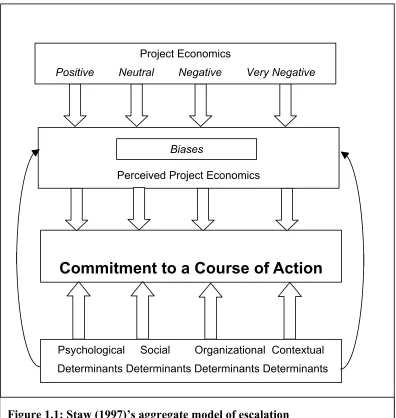
Four different attempts have been made at creating a model to describe escalation. The first, was a temporal model of escalation described in Ross and Staw (1986). It was a stage model in which there were three stages to escalation: 1) Beginning the course of action; 2) Receiving questionable or negative results and 3) Receiving highly negative results. In each phase psychological and social forces were described as holding the decision makers in place in the current course of action. This model did not receive much empirical support (Staw 1997) and Staw (1997) proposed an alternative “aggregate” model (figure 1.1).
Staw’s model portrays commitment to a course of action as the result of behavioral variables interacting with perceived project economics. The behavioral variables in addition to directly affecting the commitment to a course of action also influence how the
Project Economics
Positive Neutral Negative Very Negative
Perceived Project Economics
Commitment to a Course of Action
Psychological Social Organizational Contextual Determinants Determinants Determinants Determinants
[image:18.612.97.493.224.642.2]Biases
decision maker sees the project economics. Commitment is held to be the balancing of forces between negative economic data and the behavior variables. The key assumption is that “the behavioral forces must match or exceed the strength of any negative
economic data in order to hold [decision makers] in a failing course of action” (Staw 1997, p. 209).
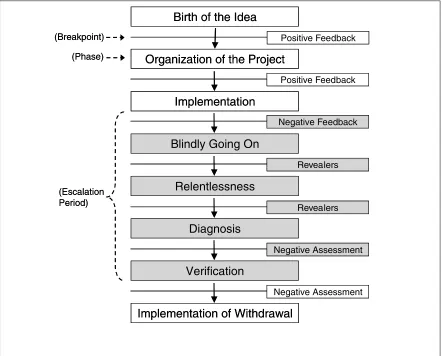
In an unpublished conference article, Royer (2002) proposed an eight phase process-oriented model of both escalation and de-escalation based on two case studies. Royer’s model includes four escalation phases: (i) blindly going on, (ii) relentlessness, (iii)
diagnosis, and (iv) verification.
Royer based her model on the concept of collective belief. Her model accounts for the rise of collective belief in a project, its persistence through bad news and then provides for the de-escalation of the project. Escalation is held to arise when the collective belief in the success of a project persists through negative feedback. Factors that account for this persistence include groupthink and cognitive biases. Only when the collective belief is broken down through the presence of revealers or entrance of actors outside the collective who don’t hold to the belief challenging the groupthink will escalation occur.
[image:19.612.95.537.196.552.2]Mahring and Keil¨ 243
Figure 2: Royer’s (2002) eight phases of escalation and deescalation.a
Birth of the Idea
Organization of the Project
Implementation
Blindly Going On
Relentlessness
Diagnosis
Verification
Implementation of Withdrawal
Positive Feedback (Breakpoint) (Phase) Positive Feedback Negative Feedback Revealers Revealers Negative Assessment Negative Assessment (Escalation Period)
Birth of the Idea
Organization of the Project
Implementation
Blindly Going On
Relentlessness
Diagnosis
Verification
Implementation of Withdrawal
Positive Feedback Positive Feedback (Breakpoint) (Phase) Positive Feedback Positive Feedback Negative Feedback Negative Feedback Revealers Revealers Revealers Revealers Negative Assessment Negative Assessment Negative Assessment Negative Assessment (Escalation Period)
aShaded parts of the model represent the escalation process according to Royer.
throughout the escalation process. In addition, current escalation research remains inconclusive on the effects of success beliefs on escalation and the idea that collec-tive project success beliefs would have a decisive impact on escalation is not well supported (Arkes, 1991; Boulding, Morgan, & Staelin, 1997; Schmidt & Calan-tone, 2002; Whyte & Fassina, 2007). Furthermore, the model blurs the distinction between escalation and deescalation as the latter two of Royer’s four escalation phases have previously been identified as part of deescalation (Montealegre & Keil, 2000). Similar to the Staw and Ross model, the cases that Royer analyzed exhibited distinct differences andfit her model to varying degrees:“the MiFi case does not include the relentlessness phase and the Phileas case includes successive identical phases”(2002, p. 6).
RESEARCH APPROACH
Research Design and Data Collection
Mahring and Keil (2008) proposed a process model of escalation (figure 1.3). In this model, they argue that an escalating project begins with the framing of the project
which they describe as being ambiguous. This allows the project to drift until conflicts concerning goal and direction arise signaling problems in the project. Solutions are attempted without a change in direction but the solutions attempted don’t match the problems resulting in increasing problem visibility. This results in a movement to the third stage in which the problems and problem continuation are rationalized. This continues until the rationalizations lose their credibility at which point de-escalation is enacted.
1.4
DE-ESCALATION STUDIES
Staw (1997) does not include de-escalation studies within his classification scheme. De-escalation studies have investigated how projects have or can be de-escalated. These studies are of interest to this dissertation since the Deaf Effect can be considered a failure to de-escalate. Knowing the conditions under which de-escalation occurs may be enlightening to the study of why de-escalation does not occur.
Simonson and Staw (1992) found that a) making negative outcomes less threatening, b) setting minimum target levels that if not reached result in change of policy and c)
evaluating decision makers on process rather than outcome were most effective in making decision makers more responsible to available evidence.
Within-phase Escalation Catalysts Ambiguity concerning project charter Within-phase Escalation Catalysts Mismatch of problems and attempted solutions Within-phase Escalation Catalysts Alternatives are equally problematic Resulting Phase Transition Trigger Imminent threat to continuation Resulting Phase Transition Trigger Increased Problem Visibility Resulting Phase Transition Trigger Problem Emergence Antecedent Condition Project Framing Outcome De-escalation Initiation
Figure 1.3: Adapted from Mahring and Keil (2008)’s escalation process model
Phase 1 Phase 2 Phase 3Unsuccessful
Montealegre and Keil (2000) found de-escalation is a gradual process vs. a sudden event. It is not random but a patterned sequence of events. De-escalation is a dynamic process that is simultaneously constricted by actions in the antecedent episode, yet capable of constructing new patterns of commitment to alternative courses of action. De-escalation is a four phase process – 1) problem recognition; 2) re-examination of
previous course of action; 3) search for alternative solutions; 4) implementing an exit strategy. Phase 1 requires a clear understanding that there is a problem. There needs to be unambiguous signs of issues or external events that trigger a general reassessment of resource allocation and allow de-escalation to occur. The Deaf Effect would prevent any of these steps from being taken.
McNamara, Moon and Bromiley (2002) found that increased monitoring of decision makers and changing decision makers attenuated escalation in commercial lending decisions. However, this had second order effects in decision makers avoiding
recognition of the problem in order to avoid increased scrutiny or loss of control of the account.
Heng, Tan and Wei (2003) found that in conditions of low sunk cost, superiors or peers who assisted in shouldering blame or providing assurance facilitated de-escalation of commitment to a course of action, However, in case of high sunk cost none of these options were effective.
Pan, Pan and Flynn (2004; Pan, Pan, Newman and Flynn 2006) investigated how a manager de-escalated commitment and turned around a government e-procurement project. In this project, the Deaf Effect occurred because the project manager was looking at the sunk cost already in the project. The project steering committee was unwilling to de-escalate the project because they feared reporting their problems to the cabinet deputy responsible for the area and additionally were unwilling to disappoint everybody involved in the project. Pan, et al. identified that the manager used the techniques of behavior disconfirmation, continuous commitment, provision of
psychological safety, development of new attitudes and behaviors, and the alignment and integration of the new attitudes and behaviors to turn around the project. They subsequently recast these findings into an evaluation model of escalation and de-escalation in IS projects based on the theories of approach-avoidance conflict and punctuated equilibrium (Pan, et al. 2006). We see in this example, that organizational aspects such as perception of their management’s expectations of their performance caused the project steering committee to continue escalation to this failing course of action.
1.5
COMMUNICATION ISSUES
Recently another stream of research has emerged subsequent to Staw (1997), to
provide another explanation for project escalation: failures of communication. This line of research finds its inspiration in social psychology theory (O'Neal, Levine and Frank 1979; Tesser, Rosen and Conlee 1972) and the management theories of whistle blowing (Miceli and Near 1992) and organizational communication (Morrison and Milliken
2000).It has developed an approach to viewing escalation as being caused by a failure in the organizational communication systems used to report bad news about the project to the decision maker.
message in project status reporting or through intrusive supervision, or confrontational regulation (Athanassiades 1973; Smith, Iacovou and Thompson 2005) or, c) the refusal of the decision maker to heed the report of bad news (the Deaf Effect) (Keil and Robey 2001)
1.5.1 The Mum Effect.
The Mum Effect term was coined by Tesser and Rosen (1972), and the effect has been investigated in a number of escalation studies (Smith and Keil 2003; Smith, et al. 2001; Tan, Smith, Keil and Montealegre 2003). The model proposed by Smith and Keil (2003) holds that perceptions of project situations create an assessment that the status ought to be reported which in conjunction with personal ethical standards creates an assessment that the individual has a responsibility to report. Given the assessment of a responsibility to report, the potential reporter assesses the alternatives to reporting including the probability of retaliation etc. This final assessment leads to a decision to report or not report.
1.5.2 Tourish and Robson’s Theory
Tourish and Robson (2006) have recently proposed a theory that describes how critical upward communication is suppressed in organizations. Their theory (figure 1.5) argues that managers by means of the systems they set up or by their reactions suppress critical upward communication. They may simply ignore critical communications, question it more severely than supportive messages or may have information systems that filter out critical message. Thus, they consciously or unconsciously reinforce ingratiating behaviors and suppress dissenting messages so that potential reporters of bad news may cease to report it. This results in a disjunction in knowledge of the status of projects between the employees and the managers so that the managers may make decisions based on inaccurate information resulting in iatrogenic interventions leading to project failure.
Perception of Project Situation
Status Should be Reported
Personal Resp. to Report
Assessment of
Alternatives
Figure 1.4: Smith and Keil (2003)’s model of the Mum Effect
1.6
THE DEAF EFFECT
The term Deaf Effect was coined by Keil and Robey (1999) and some limited evidence of the phenomenon as it relates to IT projects was reported in one subsequent study (Keil and Robey, 2001). They reported on a survey of IS auditors who were attempting to report bad news. In at least three cases their reports were ignored by decision makers. The auditors themselves on attempting to report were in some cases terminated. Another anecdotal report of the Deaf Effect comes from the report of the Challenger Disaster (Hauptman and Iwaki 1990). There, a group of engineers tried to indicate to management that the launch of the shuttle at low temperatures might result in a failure of the O-rings on the solid rocket boosters resulting in catastrophic failure. Despite
MANAGERS
STRONG FLOW OF COMMUNICATION
STRONG FLOW OF COMMUNICATION (Dissent Suppressed)
REINFORCEMENT (Ingratiation encouraged)
IATROGENIC ORGANIZATIONAL INTERVENTIONS IATROGENIC
ORGANIZATIONAL INTERVENTIONS
Weak flow of Communication
SUPPORTIVE VOICE
(INGRATIATION) Dissenting Voice --- Silence
[image:23.612.48.589.136.530.2]EMPLOYEES
repeated attempts to communicate to management that there were significant risks of failure, they were ignored and management approved the launch.
The frequency with which the Deaf Effect occurs and the range of factors that may contribute to the phenomenon remain unknown at this time. The only empirical study that addresses the Deaf Effect appears to be that of Wissema (2002), who studied 14 cases of management failure. In those cases he identified that managers often ignored warning signals of impending failure; a phenomenon that he referred to as “red light running”. He indicated that managers either did not notice, ignored, suppressed or scorned “warning signals which . . . would have contributed to preventing an incorrect decision.” (p. 522). He found nine factors that contributed to low red-light sensitivity: tension between styles of decision making, focusing on a single issue to the exclusion of all else, haste and impatience, tiredness and stress, overconfidence, groupthink, unclear structure or culture, poor information systems and ignoring intuition.
Based on anecdotal stories from Keil and Robey (2001) and those of such non-IS occurrences as those related by Wissema and that of the Challenger Disaster, I formally define the phenomenon as occurring
When a decision maker doesn’t hear, ignores or overrules a report of bad news to continue a failing course of action
In terms of bad news reporting, the Deaf Effect is distinct from the “Mum Effect” which can be defined as the failure to transmit a report of bad news (Keil and Robey 2001). Where the Mum Effect occurs, the potential bad news reporter is unwilling to report bad news whereas in the Deaf Effect, the bad news reporter transmits the message, but the intended recipient either doesn’t hear it or refuses to act upon it.
1.6.1 The Deaf Effect and the Escalation Literature
The place of the Deaf Effect in the escalation literature can be seen from how it is explained by the models summarized in the literature review. In terms of Staw (1997)’s model (figure 1.1), the Deaf Effect can be seen as the result of biases that result in improper project economics being perceived by the decision maker. These biases are created by the various escalation determinants. Thus the solution to the Deaf Effect is to prevent the creation of biases by the elimination of the escalation determinants.
Questions remain however, as to what the biases are that result in the Deaf Effect and which determinants lead to the Deaf Effect.
In Royer (2002)’s model, the Deaf Effect can be seen as blindly going in the face of negative news about the project and relentlessly continuing in the face of revealers. Royer’s model does not however provide an explanation for why the decision maker goes blindly on or continues relentlessly.
In terms of Mahring and Keil (2008)’s model (figure 1.3), the Deaf Effect can be seen as a factor that prevents correct identification of problems in phase 1. No problems may be identified or they may be minimized so as to not be considered correctly thus generating the mismatch between problems and solutions. However, their model does not provide us an explanatory mechanism as to why the Deaf Effect occurs in the first place. Finally, in Tourish and Robson (2006)’s model (figure 1.5), the Deaf Effect can be seen as a mechanism for communicating the idea that dissent or critical upward
(attenuation of the salience) or to make the news appear less bad than they really believe that it is (distortion). This describes more of an organizational level of deafness. The organization doesn’t respond to the report of bad news. It doesn’t explain why the decision maker is “deaf” in the first place.
1.7
THIS DISSERTATION
The preceding review of the escalation literature has shown that the Deaf Effect has not previously received systematic study in either the management or IS literature.
Additionally, the escalation models don’t provide good explanatory purchase for the occurrence of the Deaf Effect. A gap exists in explaining how the Deaf Effect occurs and therefore how it can be avoided in project situations. This dissertation seeks to fill that gap by contributing the first systematic study of the Deaf Effect. As such it is an exploratory investigation into the phenomenon at the individual level. The first three studies (chapters 2-4) report laboratory experiments that progressively build up the parameters of a variance model. The last study (chapter 5) is a case study in which the history of a project in which the Deaf Effect occurred is explored to determine if the model developed in laboratory experiments has explanatory power in the field. The following sections briefly describe the objectives of each study. The final chapter summarizes what has been learned in this dissertation.
1.7.1 Chapter 2 (Laboratory Experiment 1): Construction and Test of a Model
at the Individual Level
This study constructed a model of the occurrence of the Deaf Effect and tested it in a laboratory experiment. Using Evans’ Heuristic-Analytic theory of decision making and Miceli and Near’s whistle-blowing theory, it proposed hypotheses that the Deaf Effect occurs when the decision maker does not consider the report of bad news to be
sufficiently relevant. Additionally, it hypothesized that the relevance of the message is a function of the credibility of the bad news reporter. The hypotheses were confirmed, but male gender was also found to be a factor in increasing the willingness to continue the current course of action.
1.7.2 Chapter 3 (Laboratory Experiment 2): Effects of Gender, Risk and Role
Prescription on the Deaf Effect
In the previous study, gender was seen to be a significant factor on the decision to continue a course of action. Additionally, while the contours of the model were found to be true, the Deaf Effect was not technically observed in that study. In this study, the model from study 1 is expanded by consideration of the effects of risk propensity and risk perception to explain the effect of gender on the decision to continue the current course of action. Role Prescription is added to explain the lack of occurrence of the Deaf Effect in study 1. The model was tested in a laboratory experiment. Relevance of the bad news report, Risk Propensity, and Risk Perception were found to be significant in the explanation of the decision to continue a course of action. Male gender was found to increase Risk Propensity and decrease Risk Perception.
1.7.3 Chapter 4 (Laboratory Experiment 3): Effect of Societal Collectivism on
the Deaf Effect
framework of cultural variables. This experiment replicated the study of Chapter 3 in the USA, Germany and China. This study found that how the decision maker perceives the values of the culture had little effect on the occurrence of Deaf Effect but the structural model found in the previous two studies was substantially replicated in all three
geographies. However, while the structural model was replicated, the effect sizes of Risk Perception and Relevance of the bad news report were reversed in China vs. the
western cultures. This suggests that in China, individuals place more emphasis on the inherent riskiness of the project rather than the report of bad news in determining whether to continue a course of action. Additionally, in Germany, Role Prescription was found to not have a significant contribution to the relevance of the report of bad news. It is suggested that this occurs because in Germany, internal auditors (the description of the role prescribed bad news reporter) are viewed as time wasters who don’t add value to the project.
1.7.4 Chapter 5: A Case Study of the Deaf Effect
The previous studies were conducted in laboratory experiments using student subjects. In this study, I moved the examination to the study of the occurrence in the Deaf Effect in an actual project situation. This study examined the occurrence of the Deaf Effect in an Information Systems project in a state government organization over a time period from 2003 to 2006. Gathering data through interviews of project personnel and observation of project status review meetings, this study suggests that the pattern identified in the structural model of the first three experiments holds in an actual project situation among IS professionals. It also suggests that illusion of control and highly political environments are potential causes for rejection of the report of bad news. It also found that given the motivation to shirk, information asymmetries allowed the project director to distort the status of the project in reporting to the oversight committees.
1.7.5 Chapter 6: Summary
The final chapter reviews the findings from the four studies undertaken in this dissertation and summarizes them, identifies the contribution, limitations and implications for research and practice.
1.8
SUMMARY
2 CONSTRUCTION AND TEST OF A MODEL AT THE
INDIVIDUAL LEVEL
12.1
ABSTRACT
Project escalation is known to frequently occur in the context of information systems (IS) projects. The reluctance to hear bad news--a phenomenon that has been labelled the “deaf effect”--has been suggested as a possible reason for why projects are allowed to escalate for as long as they sometimes do. The deaf effect response to bad news reporting has received little research attention, yet may account for many cases of project escalation. The research reported here provides a description of conditions under which the deaf effect is likely to occur. Hypotheses regarding factors involved in causing the deaf effect are articulated based on Miceli and Near’s theory of bad news reporting effectiveness and further elaborated using insights from the cognitive psychology literature of decision making. The extended theory was then tested experimentally using a role-playing experiment. Results suggest that when a decision maker perceives a relevant message, s/he is willing to de-escalate the project. Bad news reporter credibility and the gender of the decision maker were found to be key factors in the determination of message relevance.
2.2
INTRODUCTION
Information systems project failures typically exhibit ample warning signs of impending failure, but for reasons that are not well understood, these warning signs are frequently ignored. In many cases, there are team members or even a single individual that seek to call attention to critical issues and ask for a delay or change of course in the project direction. In those cases, it is important to know why senior management did not heed the “bad news reporter” who warned them that the project was in danger of failing. This failure to heed the bad news reporter has been called the “deaf effect” (Keil and Robey 2001).
The information systems discipline is rife with this phenomenon. For example, the UK Child Support Agency recently spent 456 million GBP on a new system. During the development period, it received 70 audits of which 70% had identified serious concerns. Yet it was delivered with 52 critical defects and, three years after delivery, productivity has fallen from pre-implementation levels and the staff has to use 600 workarounds (Computer.Business.Review 2006). In the famous Providian Trust case (McFarlan and Dailey 1997), an internal auditor attempted to signal serious issues with a project and ended up getting fired for his trouble. The system went on to fail spectacularly. Failures involving the deaf effect represent a serious problem, and this is an
understudied area. Only one IS study has discussed this failure to respond. While Keil & and Robey (2001) have demonstrated that the deaf effect does occur, no study has yet investigated how or why this effect occurs. The research question that we seek to investigate is “What are some of the causal factors that that create the deaf effect?” In this research, we propose that credibility of the bad news reporter affects the decision
process behind the response to bad news reporting. This proposition is tested by means of a laboratory experiment. The next section of the paper provides a brief overview of relevant literature on whistle-blowing, bad news reporting, and decision making, along with the hypotheses to be tested. Then, we introduce the experimental design, present the results of the study, and briefly discuss its implications.
2.3
LITERATURE REVIEW
A review of the literature reveals that only one publication (Keil and Robey 2001) has dealt with the deaf effect in information systems project management. Keil and Robey (2001) described the “deaf effect” as a failure to respond to messages of impending project failure. Based on a survey of internal auditors, they demonstrated that the deaf effect exists in IS project management situations. The auditors surveyed recounted instances in which they had reported bad news about projects only to find that their concerns were ignored by senior management.
Without an existing literature or theory base that bears directly on this phenomenon, we review reference theories from management and cognitive psychology that can be used to construct hypotheses regarding factors that may promote the deaf effect. In this section, we examine the literature related to whistle-blowing effectiveness, and decision making theory, which can be used to inform a model of the deaf effect response to bad news reporting.
2.3.1 Near and Miceli’s Model of Whistle-Blowing Effectiveness and the Deaf
Effect
Whistle-blowing as used by Near and Miceli is defined as “the disclosure by organization members (former or current) of illegal, immoral or illegitimate practices under the control of their employers, to person or organization that may be able to affect action” (Miceli and Near 2002, p. 456). In the IT project context, the bad-news reporter is not
necessarily disclosing illegal, or immoral practices, but rather the fact that they believe that the present direction of the project is a failing course of action. The question then arises as to whether this literature has appropriate bearing upon consideration of the deaf effect.
We hold that the two phenomena are sufficiently similar to allow us to use the whistle blowing literature to inform our study. While in the case of the deaf effect, nothing illegal is being disclosed, the reporter is disclosing what s/he perceives to be a failing course of action that is not being addressed by the project leadership. This failing course of action is similar to illegitimate acts when sponsored by management because although
management has endorsed the project, continuing a failing course of action is
inappropriate and represents a waste of corporate resources. Reporters of bad news also face pressures similar to those of whistle-blowers. Whistle-blowers of illegal activities find that disclosure of the problem is a high risk activity and thus are reluctant to report (Miceli and Near 1992; Miceli, Near and Schwenk 1991). Reporters of bad news in projects perceive reporting similarly (Keil and Robey 2001; Smith, et al. 2001). Thus we find that bad news reporting is conceptually similar to whistle-blowing.
Near and Miceli (1995) describe a model of whistle-blowing effectiveness. They argue that the effectiveness of whistle-blowing is based on the personal characteristics (credibility and power) of the whistle-blower and the complaint recipient, moderated by the support for the whistle-blower and the wrongdoer as well as situational and
others of their correctness, trustworthiness and power as the whistle-blower’s status, position in the hierarchy, and perceived value to the organization. Thus a well-respected whistle-blower in a position of power will be more effective than one who has little standing and resides in the lower echelons of the organization.
Near and Miceli (1995) further proposed that characteristics of the wrongdoing and the organization also have an effect on the organizational response. If the organization has been dependent on the form of wrongdoing, or there is little evidence or legal basis for complaint about the wrongdoing, the organization’s willingness to change will be lower. Conversely, if the organization looks favorably on whistle blowing and is less
bureaucratic, their willingness to change will be higher. From the standpoint of the deaf effect, this seems to indicate that the deaf effect would be more likely to occur when the decision maker is dependent upon continuance of the current course of the project to maintain his/her organizational status or reputation.
2.3.2 Cognitive Psychological Theories of Decision-making
Since the deaf effect response is a failure of the decision making process, an examination of decision making theory is appropriate for building a theory of its
causation. In this section, we examine the cognitive psychology behind decision making to investigate the factors that come into play when a decision is made.
There are many different psychological theories of decision making. However, current theory in this area suggests that decision making can be regarded as a two-step process (Evans 1984; Evans 1989; Kahneman 2003; Stanovich and West 1998, pp. 309-310). These theories hold that the two-step process arose due to the vast amount of data available to a decision maker. In any non-trivial problem, finding a solution requires searching through a vast number of possible solution paths. Thus, humans are
confronted daily with more information than can possibly be processed. To handle this onslaught of data effectively, they developed heuristic processes to conserve their scarce processing power. And when one does think about these selected pieces of information, it is in the context of a mental model of the world rather than the actual world itself as the world is too large to comprehend totally (Evans 1989). Two major theories in this area are those proposed by Evans (1984; 1989) and Kahneman (2003). In both theories, the decision is held to be made in two phases. In the first phase, (intuition/heuristic), reasoning is performed in a largely automatic, unconscious, pre-attentive manner. In phase 2 (reason/analytic), reasoning is deliberate, conscious and monitored. It is generally held that information is selected as relevant or accessed during the first phase for consideration in the second phase. We adopt the Evans’ Heuristic-Analytic (HA) model for use in this paper.
2.3.2.1.
Heuristic-Analytic Theory
HA theory postulates that thinking is selectively focused on ‘relevant’ parts of problems and that prior knowledge, heuristics, and schemas are retrieved as determined
necessary by pre-attentive heuristics (Evans,1996). See figure 2.1. Evans (1989) postulates that the major cause of bias in human reasoning lies in the heuristic
processes adopted to select information for processing. If a heuristic fails to select a key piece of information or selects an irrelevant piece of information for processing, the subsequent analysis will be flawed. The analysis itself will be accurate only to the extent that the mental model of the world that one has constructed is accurate (1989).
message characteristics and the mental model of the decision maker. The message characteristics include such components as vividness/salience, comprehensibility and certain linguistic cues. Vividness/salience refers to how well the message stands out from competing messages/sensations within the decision maker’s environment.
Linguistic cues signal the decision maker on how to focus their attention (Evans 1996). The decision maker’s mental model refers to the model that the decision maker has of the real world including their conception of cause and effect relationships, expectations, beliefs and other structural factors. In the heuristic phase of decision making these structures are accessed pre-consciously to assist in filtering relevant from irrelevant information. From the decision maker’s bank of experience, additional available relevant information is also accessed.
2.4
A RESEARCH MODEL OF THE DEAF EFFECT
In this section, we use the insights from cognitive psychology and Miceli and Near’s whistle-blowing effectiveness theory to develop a research model (figure 2.2) that provides the basis for an initial experiment on the causes of the deaf effect. We adopt the basic process from Evans for the proposed model.
Heuristic
Processing
Salience
Vividness Linguistic
Factors
Bad News Reporter’s Message
Relevant Information
Prior Knowledge
Mental Model
Decision
Decision
Processing
Bad News Reporter
Credibility H3 –
H2 +
Relevance Decision
of the Message H1 -
Figure 2.2: Research model for this experiment
Evans (1989) states that decision makers pre-attentionally select the information that they believe will be relevant to making the decision using their mental model heuristics. Thus the bad news reporter’s (BNR’s) message would be evaluated for relevance using the decision maker’s mental model heuristics. Once it the message passed the
heuristics, it would be considered in the decision process. From this we see that to be effective, a BNR’s message must be considered as relevant before it can be actively evaluated. We therefore propose hypothesis 1:
H1: When the report of bad news is considered relevant, the decision maker will be more likely to discontinue the present course of action
Part of this pre-attentive processing is to determine whether the bad news report must be attended to. This is where the credibility of the whistle-blower as postulated by Near and Miceli (1995) may be processed. If the decision maker determines that the whistle-blower is not credible, then the message may be disregarded. We therefore propose the following hypothesis:
H2: Reporters of bad news that who are considered credible will tend to have their messages considered as relevant
Miceli and Near also indicate that whistle-blowers that who are credible are also more effective in terminating wrongdoing. The Heuristic Analytic Theory indicates that during relevance processing, information is selected and passed on to the analytic process for analysis. Thus the decision makers may bring their assessment of the credibility of the whistle-blower into their decision process. The effect of the BNR’s credibility may not be completely mediated by the relevance decision but may also have a direct effect on the decision. Therefore we propose hypothesis 3:
H3: Reporters of bad news that who are considered credible will be more effective in convincing the decision maker to change their course of action