THE COMPARATIVE STUDY BETWEEN TEACHER’S
DIRECT
AND INDIRECT FEEDBACK TECHNIQUES IN IMPROVING
STUDENTS’
WRITING RECOUNT TEXT
AT SMAN 1 KOTAGAJAH
(A Script)
By : Esti Kurniawati
ENGLISH EDUCATION STUDY PROGRAM
LANGUAGE AND ARTS EDUCATION DEPARTMENT
TEACHER TRAINING AND EDUCATION FACULTY
UNIVERSITY OF LAMPUNG
INDIRECT FEEDBACK TECHNIQUES IN IMPROVING
STUDENTS’ WRITING RECOUNT TEXT
AT SMAN 1 KOTAGAJAH
By Esti Kurniawati
This study was aimed to find out whether i) there was any improvement of
students’ achievement after the implementation of teacher’s direct feedback, ii)
there was any improvements of students’ achievement after the implementation of teacher’s indirect feedback, iii) there was any difference ofstudents’ achievement
between students in teacher’s direct and indirect feedback classes, and iv) what aspects of writing improved the most after the implementation of these techniques. The subjects were 30 students of X MIPA 1 and X MIPA 2 of SMAN 1 Kotagajah in 2016/2017 academic year. In collecting the data, the researcher used writing test.
The treatments were done in five meetings. In the first meeting, the researcher conducted pre test. In the second meeting, the researcher taught them about recount by providing the example of recount text, structure, and language features. After explaining, they were asked to make first draft of recount text. In the next meeting, the researcher introduced about aspects of writing and the kind of feedback given. For indirect feedback class, the teacher explained about the correction codes or symbols given in their draft. In the fourth meeting, the teacher
listed students’ common mistakes and gave the example of their correct form. Next, the students’ were asked to revise their second draft based on the feedback given. In the last meeting, the researcher conducted post test.
The results showed that there were improvements of students’ achievement after
the implementation of teacher direct and indirect feedback. For the third research question, the significant difference between students in direct and indirect feedback classes, could be seen from the gain both of classes. The gain of
teacher’s direct feedback class was 8.08 and the gain of teacher’s indirect
feedback class was 8.58 with t-value was 33.320, which the data significant based on t-table was at least 12.706 and 0.019 < 0.05. It meant that there was a significant difference of students’ achievement between students in teacher’s
THE COMPARATIVE STUDY BETWEEN TEACHER’S DIRECT
AND INDIRECT FEEDBACK TECHNIQUES IN IMPROVING
STUDENTS’ WRITING RECOUNT TEXT
AT SMAN 1 KOTAGAJAH
By : Esti Kurniawati
A Script
Submitted in a Partial Fulfillment of The Requirements for S-1 Degree
In
The Language and Arts Department of Teachers Training and Education Faculty
FACULTY OF TEACHER TRAINING AND EDUCATION
UNIVERSITY OF LAMPUNG
CURRICULUM VITAE
The writer’s full name is Esti Kurniawati. She was born in Gayabaru II, on 29th July 1994. She is the third daughter of Walyono and Nurfiati. She has two older sisters and a younger sister; they are Eka Damayanti, Dewi Kusumawati and Wahyu Indah Pratiwi. She also has 2 little nephews named Farezha Rifky Assyauqie and Aufa Abdurrahman Alfarisi.
This script is fully dedicated to:
My beloved parents, Walyono and Nurfiati
My beloved sisters, Eka, Dewi, and Wahyu Indah
My little nephews, Farezha Rifky A. and Aufa Abdurrahman A.
My Friends of English Department 2013 Lampung University
My awesome partners and my great motivator
MOTTO
“Do not pray for an easy life.
Pray for the strength to endure a difficult one”
Lee-Alhamdulillahirabbil’alamin, the writer would like to acknowledge her countless thanks to the Most Gracious and the Most Merciful, Allah SWT, who always gives her all the best of this life and there is no doubt about it to finish this research. Shalawat and Salam is addressed to the Prophet Muhammad SAW and his family.
I would like to present my thanks to everyone who has helped me, especially in completing this script. Allhamdulillah, all honors are just for Allah Azza Wajala, the almighty.
Then, I want to express my sincere thanks to:
1. The writer’s advisors, Hery Yufrizal, M.A., and Drs. Huzairin, M.Pd., for their advices, suggestions, encouragements, patience, and valuable guidence which are very helpful in finishing this script.
2. The writer’s examiner, Prof. Dr. Patuan Raja, M.Pd., for his valuable corrections and suggestions. It is hard for the writer to make this script become perfect without his contributions.
3. The Sincere appreciation goes to Dr. Ari Nurweni, M.A. as the head master of English Department study program, and Dr. Mulyanto Widodo, M.Pd. as the chairperson of Language and Art Education Department for his contribution and attention.
4. All lecturers of English Department Study program of FKIP University of Lampung, who have transferred much useful knowledge, guidance, and motivations.
ix
6. The writer’sbeloved siblings, Eka Damayanti, Dewi Kusumawati and Wahyu Indah Pratiwi, and also the little nephews, Fareza Rifky Assyauqie and Aufa Abdurrahman Alfarisi, who often encourage me to learn and also give a lot of motivations.
7. My gratitude is to the Headmaster of SMA Negeri 1 Kotagajah, Drs. H. Dasiyo Priambodo, M.Pd, who has given me permission to complete my research. Siti Rokayah, S. Pd., as an English teacher who has allowed me to conduct this research in her class. The X MIPA 1 and X MIPA 2 students who have given their nice attention and helped me during the research.
8. The writer’s friends in English EducationDepartment 2013. Thank you for all the unforgettable memories.
9. Special thanks are given to awesome Boboho’s members: Ludfia, Syarifah, and Ulfi. Thank you for always by my side in every moment and for the
support to keep the writer’s spirit alive.
10. Big thanks to Kak Ayu, Suci, Ismi, Tiwi, Tia, Bunga, Reza, Ocak, Lili, and Anggi for spending time together in our second home.
11. My wonderful friends at KKN and PPL, Azni, Batara, Diren, Fitri, Reni, Santi, Sri, Yulia, and Wahyuningrum who always support me in finishing this script.
This script is far from being perfect, but it is expected that this script will be useful not only for the researcher but also the readers. For this reason, constructive thought in suggestions and critics are welcome to make this script better.
Bandar Lampung, July 2017 The writer,
COVER ... i
ABSTRACT ... ii
APPROVAL ... iii
ADMISSION... iv
CURRICULUM VITAE... v
DEDICATION... vi
MOTTO ... vii
ACKNOWLEDGEMENT... viii
CONTENT ... x
APPENDICES ... xii
TABLE ... xiii
CHART ... xv
I. INTRODUCTION 1.1. Background ... 1
1.2. Research Questions ... 5
1.3. Objectives... 5
1.4. Uses ... 6
1.5. Scope ... 6
1.6. Definition of Terms ... 6
II. LITERATURE REVIEW 2.1. Writing ... 8
2.2. Aspects of Writing ... 9
2.3. Teaching Writing... 11
2.4. Types of Writing Text ... 14
2.5. Recount Text ... 15
2.6. Feedback... 19
2.7. Teacher’s Direct Feedback... 20
2.8. Teacher’s Indirect Feedback... 22
2.9. The Use ofTeacher’sDirect and Indirect Feedback in Teaching Learning Writing ... 24
2.11. Procedure of Teacher’s IndirectFeedback Technique in
Teaching Writing... 27
2.12.Advantages and Disadvantages of Teacher’s Direct Feedback ... 28
2.13.Advantages and Disadvantages of Teacher’s Indirect Feedback ... 29
2.14. Theoretical Assumption ... 30
2.15. Hypothesis ... 30
III. METHODS 3.1. Design... 32
3.2. Population and Sample... 33
3.3. Data Collecting Technique... 33
3.4. Instrument... 34
3.5. Scoring Criteria ... 34
3.6. Validity and Reliability ... 35
3.6.1. Validity... 35
3.6.2. Reliability ... 36
3.7. Research Procedure ... 38
3.8. Data Analysis ... 39
3.9. Hypothesis Testing ... 40
IV. RESULTS AND DISCUSSION 4.1. Results ... 42
4.1.1. The Implementation of Treatments ... 42
4.1.2. Descriptive Statistics of Students Writing ... 44
4.1.3. Hypothesis Testing... 48
4.1.4. Aspects of Writing ... 51
4.2. Discussion ... 75
V. CONCLUSION AND SUGGESTIONS 5.1. Conclusion... 78
5.2. Suggestions... 79
1. Lesson Plan ( teacher’s direct feedback class)... 84
2. Lesson Plan ( teacher’sindirect feedback class)... 90
3. Pre Test... 97
4. Post Test ... 98
5. Students’ score of Pre Test in Each Aspect of Writing (teacher’s direct feedback class) ... 99
6. Students’ score of Pre Test in Each Aspect of Writing (teacher’s indirect feedback class) ... 100
7. Students’ score of Post Test in Each Aspect of Writing (teacher’s direct feedback class)... 101
8. Students’ score of Post Test in Each Aspect of Writing (teacher’s indirect feedback class)... 102
9. Reliability of Pre Test (teacher’s direct feedback)... 103
10.Reliability of Pre Test (teacher’s indirect feedback)... 104
11. Reliability of PostTest (teacher’s direct feedback)... 105
12. Reliability ofPost Test (teacher’s indirect feedback)... 106
13.Normality of Pre Test and Post Test (teacher’s direct and indirect feedback) ... 107
14. The analysis of Hypothesis ... 108
15. Schedule of The Research... 110
16. Table of Correction Codes ... 111
STUDENTS’WRITING
STUDENTS’WORKSHEET
SURAT IJIN MELAKUKAN PENELITIAN
TABLES
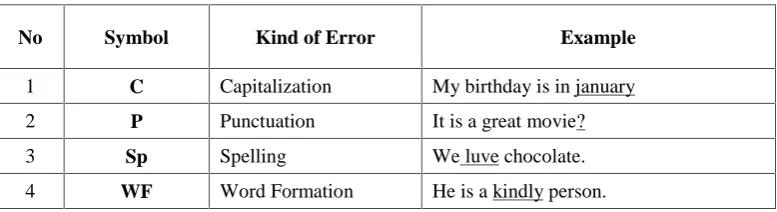
2.1. Correction Codes adapted by Olsher (1995) ... 22
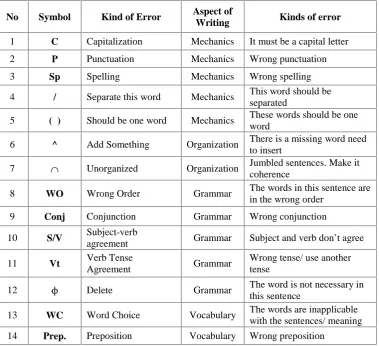
2.2. Modified Correction Codes for Students ... 23
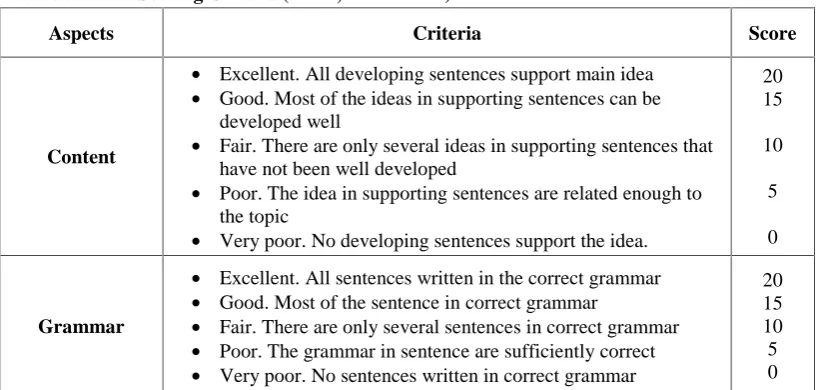
3.1. Scoring Rubric for Writing Test... 34
3.2. Reliability ofTeacher’s Direct Feedback... 37
3.3. Reliability of Teacher’s Indirect Feedback... 38
4.1. Distribution of Students’ Pre Test Score at Teacher’s Direct Feedback Class ... 45
4.2. Distribution of Students’ Pre Test Score at Teacher’s Indirect Feedback Class ... 45
4.3. Distribution of Students’ Post Test Score at Teacher’s Direct Feedback Class ... 46
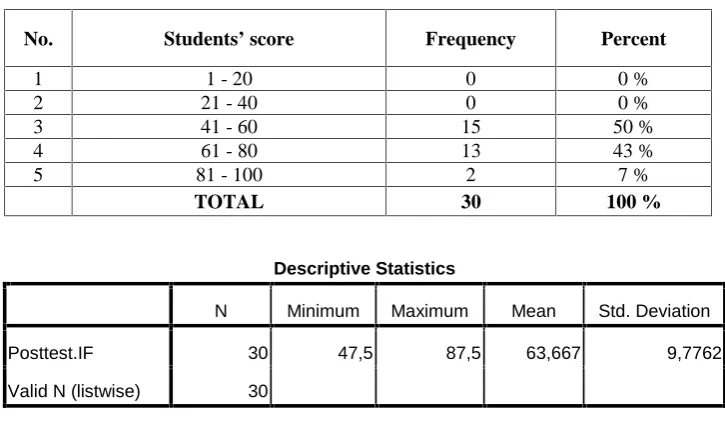
4.4. Distribution of Students’ Post Test Score at Teacher’s Indirect Feedback Class ... 47
4.5. Difference in Students’ Pre Test and Post Test at Teacher’s Direct Feedback... 48
4.6. Difference in Students’ Pre Test and Post Test at Teacher’s Indirect Feedback ... 49
4.7. Students’ Writing Improvement ... 49
4.8. Difference in Students’ Post Test at Teacher’s Direct and Indirect Feedback ... 50
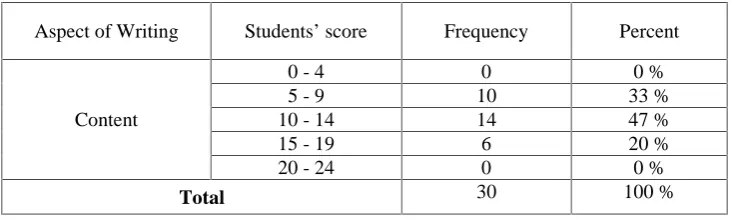
4.9. Distribution of Students’ Pre Test of Content in Teacher’s Direct Feedback... 51
4.10. Distribution of Students’ Pre Test of Content in Teacher’s Indirect Feedback ... 52
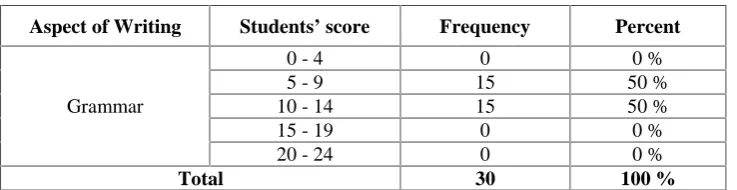
4.11. Distribution of Students’ Pre Test of Grammar in Teacher’s Direct Feedback... 53
4.12. Distribution of Students’ Pre Test of Grammar in Teacher’s Indirect Feedback ... 54
4.13. Distribution of Students’ Pre Test of Organization in Teacher’s Direct Feedback... 55
Indirect Feedback ... 58 4.17. Distribution of Students’ Pre Test of Mechanics in Teacher’s
Direct Feedback... 59 4.18. Distribution of Students’ Pre Test of Mechanics in Teacher’s
Indirect Feedback ... 60 4.19. The Increase of Students’ Writing Recount Text in Each Aspect
atTeacher’s Direct Feedback Class... 61 4.20. Distribution of Students’ Post Test of Content in Teacher’s
Direct Feedback... 62 4.21. Distribution of Students’ Post Test of Content in Teacher’s
Indirect Feedback ... 63 4.22. Distribution of Students’ Post Test of Grammar in Teacher’s
Direct Feedback... 64 4.23. Distribution of Students’ Post Test of Grammar in Teacher’s
Indirect Feedback ... 65 4.24. Distribution of Students’ Post Test of Organization in Teacher’s
Direct Feedback... 66 4.25. Distribution of Students’ Post Test of Organization in Teacher’s
Indirect Feedback ... 67 4.26. Distribution of Students’ Post Test of Vocabulary in Teacher’s
Direct Feedback... 68 4.27. Distribution of Students’ Post Test of Vocabulary in Teacher’s
Indirect Feedback ... 69 4.28. Distribution of Students’ Post Test of Mechanics in Teacher’s
Direct Feedback... 70 4.29. Distribution of Students’ Post Test of Mechanics in Teacher’s
Indirect Feedback ... 71 4.30. The Increaseof Students’ Writing Recount Text in Each Aspect
atTeacher’s Indirect Feedback Class... 72
4.31. The Difference Scores of Students’ Writing Recount Text in
Each Aspects between Teacher’s Direct and Indirect Feedback
CHART
1. Chart ofThe Difference Gain in Students’ Writing Recount Text
In order to introduce the research, this chapter will deal with the reasons for
having this research, such as background, research questions, objectives, uses,
scope, and definition of terms.
1.1. Background
As international language, English is being one of the important languages in
human communication. For its importance, it has been taught from Elementary
school until university. This is in order to make the learner be able to
communicate with the others using English both spoken and written. To achieve
the goal, the students should mastering four skills; those are listening, speaking,
reading and writing.
Writing is an action which needs a complex skill to deliver or express the writer’s
idea through written forms, so the reader can understand what the writer try to
communicate. Raimes (1983:76) stated that writing is a skill in which we express
ideas, and thought which are arranged in words, sentences, and paragraph using
eyes, brain and hands. In addition, Peim (1993) said that writing as transforming
the writer’s thought of ideas into a written text. In writing, the students are required to treat several aspects of writing, namely: content, organization,
grammar, vocabulary and mechanics. These components are related to another in
2
In the curriculum of SMA, the English material is taught based on the text, i.e.
descriptive, narrative, recount, procedure, and others. One of the English writing
texts is recount text. Recount text is the text which retell about sequences event
happened in the past, which aims to retell past events even entertain the reader or
listener. In this case, the learners must be able to write and understand recount text
based on its social function and generic structure. By using recount text, students
are expected to be able to tell their experience and express their feeling in written
form.
The situation of education today shows that the students have difficulties,
especially in applying accuracy in writing, therefore they make mistakes and
errors. Gunawan (2010:2) in his research found that the first year students of
senior high school get confused about expressing their ideas in written form,
particularly, in recount text writing. Some students find difficulties to find the best
word to representation what they are going to write. They also still confused to
transforming base form verb to be irregular or irregular verb. Concerning this
case, the English teachers should implement a good technique for teaching
students well. This is in order to make the students are able to write English in
good paragraphs. One of additional ways that can be used by teachers to improve
students’ ability in writing is implement teacher’sfeedback.
Alghazo (2009:146) states that teaching writing is an important skill and helpful
activity to students if it is done in a way to give the students error feedback to
improve their writing. It means that, feedback can be beneficial if the teacher
show the point as well. In addition, Ferris et al (2001) found that students who
were given error feedback from the teacher had greater self-correction abilities
than those who were not given error feedback. For the beginner students, it must
editing by providing correction on their work, including coded and un-coded
feedback.
There are two types of teacher’s feedback that can be given to the students to improve their writing ability, namely direct and indirect feedback. Direct feedback
is a technique of correcting students’ errors by giving explicit written feedback
(Ferris, 2002:19). It simply means, the feedback is provided when a teacher gives
the student with the correct form of their errors or mistakes. In contrast, indirect
feedback is more beneficially. It gives students the opportunity to fix the errors
themselves by providing a clue of what kind of error they do (Ferris, 2002:19). As
for this type, the teacher underlines the errors or mistakes for the students and
writes the symbol above the targeted errors. It becomes the student’s task to
diagnose and correct their sentence.
According to Rianto (2010:2) there are several reasons why indirect feedback is
so helpful for the students’ writing. Actually, direct feedback can be durable, but
it will keep only in mind of receiver and will be lost in certain time. In contrast,
indirect feedback, the thought and comment will be saved for a very long time in
the memories; and it is more helpful on student’s long term writing development
than direct feedback (Ferris, 2002).
Teacher’s feedback, including direct and indirect feedback, is a technique that can improve students writing skill. This statement was proven by Santi (2007) who
had conducted the research in Haluoleo University to investigate the effect of
teacher’s feedback on students’ writing. She focused on giving feedback to
students’ writing that would be assessed based on five aspect of composition; content, organization, vocabulary, language use, and mechanics. The result of this
4
In other research, the comparison between the effect of teacher’s direct and
indirect feedback had been done by Jamalinesari et al (2015). This study
attempted to examine the effect of two different types of feedback on the writing
performance of students regarding eight grammatical errors. The result of this
study showed that the students who received indirect corrective feedback
performed better than those who received direct feedback. The data evaluations
indicate that students improved their linguistic accuracy on new writing tasks
better when indirect feedback strategy was applied rather than direct feedback.
In other case, the research about the increasing students writing through teacher’s
direct feedback conducted by Utami (2012). She tried to investigate the
improvement of writing spoof text of students of Senior High School in Klaten
through teacher’s direct feedback. As the result, two cycles of her study showed
that the implementation of teacher’sdirect feedback was successful to improve the students’ writing skilland the improvement was on all writing aspects.
From the research finding above, it is contrary with the study has been done by
Pramana (2015). This study was intended to find out the improvement of students
descriptive writing ability of MA Al-Hikmah Bandar Lampung through teacher’s
indirect feedback and what aspect improved the most. As the result, teacher’s
indirect feedbackis successful in giving positive improvement in students’ ability
in descriptive text. He adds that this technique increases all aspects of writing,
especially in mechanics.
Considering the findings of the previous research above, it can be inferred that
teacher’s direct and indirect feedback are the effective techniques that can be used
to improve the students’ writing ability and linguistics accuracy. They also show that these techniques also successful in giving positive increase in students’
Based on the explanations above, the researcher held the research in English
writing class by using teacher’s feedback techniques, including teacher’s direct and indirect feedbacks. The differences were about the type of the text,
participants and location of this research. Therefore this research is entitled “The Comparative Study between Teacher’s Direct and Indirect Feedback Techniques in Improving Students’Writing Recount Text at SMAN 1 Kotagajah”.
1.2. Research Questions
Based on the explanation of the problem above, the research questions of this
research are formulated as follows:
1. Is there any improvement ofstudents’achievement in writing recount text after the implementation ofteacher’s directfeedback?
2. Is there any improvement ofstudents’achievement in writing recount text after the implementation ofteacher’sindirect feedback?
3. Is there any significant difference of students’ achievement in writing recount text between students in teacher’s direct and indirect feedback
classes?
4. What aspects of writing improve the most after the implementation of
teacher’s direct and indirect feedbacks?
1.3. Objectives
Based on the Research question, the objectives of this research are:
1. To find out whether there is an improvement of students’ achievementin writing recount textafter the implementation of teacher’s direct feedback.
2. To find out whether there is an improvement of students’ achievementin
writing recount text after the implementation of teacher’s indirect
6
3. To find out whether there is a significant difference of students’
achievement in writing recount text between students in teacher’s direct
and indirect feedback classes.
4. To find out the aspects of writing improved the most after the
implementation of teacher’s direct and indirect feedbacks.
1.4. Uses
The uses of this research are:
1. Theoretically, this research is expected to verify the theories related to
teacher’s direct and indirect feedback techniques in teaching writing process. The findings of this research also enrich the theory of students’
writing mastery.
2. Practically, the findings of this research are expected to become a source
of information about the alternative techniques and to give description of
how to apply these techniques.
1.5. Scope
This research was conducted at SMAN 1 Kotagajah, in the first year students of
second semester of 2016/2017 academic year. The samples of this research were
two classes, consists of 30 students for each class. In conducting the research, the
researcher tried to improve students’writing recount text after the implementation of teacher’s direct and indirect feedback. The corrections were focussed on their content, grammar, organization, vocabulary and mechanic which used correction
symbols adapted from Olsher (1995).
Definition of Terms
In this research, definitions of key terms are provided to guide the readers in
Writing
Writing is an action of delivering or expressing through written forms, which is
expressed by arranged in words, sentences, and paragraphs.
Teaching Writing
Teaching Writing is an approach to make the students being able to know how to
express the idea or imagination in written form in target language.
Recount text
Recount text is any written English which is the writer wants to recall, reconstruct
events or experiences from the past.
Feedback in writing
Feedback is the input for the writer through providing the latter with informations,
comments, questions and suggestions that the reader gives for revision.
Teacher’s feedback
Teacher’s feedback refers to feedback provided by teacher on student writing to
support students’ writing development and nurture their confidence as writers.
Teacher’sDirect Feedback
Teacher’s direct feedback is a feedback given by writing the correct form of the errors. Teacher’s direct feedback is useful technique which provides explicit
guidance for students’ mistake in compiling writing. Teacher’sIndirect Feedback
Teacher’s indirect Feedback is a feedback given by teacher to indicate the location of the error by underlining, highlighting, circling, or giving a code. It helps
students to fix their mistakes by themselves.
Those all that the researcher covers in this chapter, such as, background, research
II. LITERATURE REVIEW
This chapter discusses about the literature review use in this study, they are:
writing, aspects of writing, teaching writing, types of writing text, recount text,
feedback, teacher’s direct feedback, teacher’s indirect feedback, the use of
teacher’s direct and indirect feedback in teaching writing, procedure of teacher’s
direct feedback in teaching writing, procedure of teacher’s direct feedback in teaching writing, advantages and disadvantages of teacher’s direct feedback,
advantages and disadvantages of teacher’s indirect feedback, theoretical assumption, and hypothesis.
2.1. Writing
There are many definitions of writing that have been proposed by some experts in
language learning. Theoretically, writing skill requires the students to be able to
express their idea, feeling, and though which are arranged in words, sentences and
text using eyes, brain, and hand (Raimes, 1983:76).
Writing is one of the human’s ways to communicate. Communication is not only
achieved through speaking, but it can also be obtained through writing. This
statement is completed by Linderman (1983) that writing is naturally a process of
communication which uses conventional system to convey the meaning to the
receiver. It means that communication in form of written will deal with letters,
words, sentences, and punctuation, from those the reader can receive the
Writing included in one of four skills that should be mastered by students in
learning English. It is used to communicate the ideas, thought and feeling in
written form. The complexity of writing is one of reasons why students do many
mistakes in express their idea. It is said so because before the writer transforms
the information to the readers, they should arrange their idea into words and
arrange it into good sequences so the reader can understand easily. Barrton
(2005:5) states that writing is a complicated components and often mysterious
process although the writers may think of it as little more than arranging letters
and words on a page, a few moments‟ reflection reveal that it ismuch more than
that. It means that writing is not only to write something about what the writers
want to tell but also writing is about how the writers can deliver an information
through right words in order to express their idea about something without
missing or reducing the sense.
From the explanation above, it is considerably needed to take some points.
Writing is a skill that should be mastered by the students to express their idea,
thought or feeling on a piece of paper by using appropriate grammar and
vocabulary to make the readers understand about what they write.
2.2. Aspects of Writing
Basically, there are some fundamental components in writing. They are: content,
organization, vocabulary, mechanic and grammar.
According to Jacobs (1981: 90), there are five aspects of writing. They are:
1. Content
This aspect refers to the substance of writing, the experience of main idea
(unity). Content text is related to convey ideas rather than fluffing special
function of transition, restatement is also used in content text to state again
10
2. Organization
The aspect refers to the logical organization of the content (coherence). It is
scarily more than attempt to piece together all collections of facts and
jumbles ideas.
3. Vocabulary
This aspect refers to the selection of words those are suitable with the
content. It beings with assumption that the writer wants to express the ideas
as clearly and directly. Choosing words that express meaning is precisely
rather than skew it or blur it.
4. Grammar
This aspect deals mainly with the use of grammatical and synthetic pattern
on separating, combining and grouping ideas in words, phrases, clauses,
sentences to bring out logical relationship in texting writing. In text, word is
the smallest element that may be uttered in isolation with semantic or
pragmatic content (with literal or practical meaning). Besides, phrases may
refer to any group of words, or one word. Furthermore, clause is the
smallest grammatical unit that can express a complete proposition. Sentence
is a linguistic unit consisting of one or words that are grammatical linked.
5. Mechanics
This aspect refers to the use graphic conventional of the language. Mechanic
is the conventions of print that do not exist in oral language, including
spelling, punctuation, capitalization, and paragraphing.
Likewise, Harris (1979: 68-69) points out five components of writing, namely:
1. Content
This component is the substance of writing; the expression of the main idea
2. Organization
This component is related to the logical organization of the content
(coherence).
3. Grammar
This component is related to the usage of the correct grammatically form
and synthetic pattern.
4. Vocabulary
This component is considered in words chosen to construct their own
meaning.
5. Mechanics
This component is concerned with the use of graphic convention of the
language.
From some explanation above, it can be infered that generally the aspect of
writing are classified into five aspects namely content, organization, vocabulary,
grammar, and mechanic. By understanding those aspects of writing, the students
can improve their writing ability because those aspects are their prior knowledge
for beginning to write. In order to improve the students’ writing recount text, the researcher conducted this research by using aspects of writing by Haris (1979:
68-69), as the role of writing development.
2.3. Teaching Writing
Teaching writing is teaching the students how to express the idea or imagination
in written form. In order to be success in writing, the material should be relevant
to their needs, interest, capacities, and ages until they are able to make
composition with view or even no errors (Finnochiaro, 1964: 129). In other
words, it is clear that the teacher should guide the students how to write or how to
12
According to Brown (1987:7), teaching is showing or helping someone to learn
how to do something providing with knowledge, causing to know or to understand
while in relation of the teaching of foreign language. Teaching writing is more
difficult than teaching other skill. In teaching this skill, the teacher should teach
the language structure in each point and make sure that students understand.
In addition, Harmer (2003: 257) confirms that in the teaching of writing we can
focus on the product of that writing or on the writing process itself. Meanwhile, in
the process of writing, students need to put their attention on ideas, imagination,
information, creativity and feeling in order to make a very attractive writing;
however the things that must be really concerned are the spelling, punctuation,
and the language use such as grammar, vocabularies, linkers, etc. Therefore, good
concentration of the students is really necessary in this stage.
By seeing the important of writing, teacher should consider the way to teach
writing for students. According to Mappe (2000) in Riani (2016), there are three
steps of writing to make it more effective, that is:
1. Pre-writing
In this stage, students involve the activities, such as reading,
brainstorming, mind mapping, discussing, fast writing, questioning,
interviewing, encourage them before they write their sentences in the first
draft. A typical pre-writing activity in the process approach would be for
learners to brainstorm on the topic being provided. By this way, students
will get motivation to write because they feel that they have something
matter to say.
2. Drafting
In this stage, students will select among ideas during pre-writing and
description of topic. The content might be written without considering the
grammatical aspect first.
3. Revising
In this stage, the students review a draft to check five aspect of writing
based on the feedback which is given by the teacher or peers. Revision is a
process in which writers not only polish their style, but also develop their
ideas. In this stage, the teacher helps the students through the revision to
shape and reshape the text into final form.
4. Editing
In this stage, the students check their final text for some mistakes they
have made based on the feedback given, such as spelling, punctuation,
grammar, and all presentation.
According to Harmer (2004), there are four main elements in writing process.
They are:
1. Planning
Writers plan what they are going to write. Before starting to write or type,
they try and decide what is they are going to say. For some writers this
may involve making detailed notes. For others a few jotter words may be
enough.
2. Drafting
We can refer to the first of a piece writing as a draft. This first ‘go’ at a
text is often done on the assumption that it will be amended later. As the
writing process into editing, a number of draft may be produces on the
final to the final version.
3. Editing (reflecting and revising)
Once writers have produced a draft they then, usually, read through what
14
and revising are often helped by other readers (or editors) who comment
and make suggestions. Another reader’s reaction to a piece of writing will help the author to make appropriate revisions.
4. Final version
Once writers have edited their draft, making the changes they consider to
be necessary; they produce their final version. This may look considerably
different from both the original plan and the first draft, because things
have changed in the editing process.
From the explanation above, it is considerably needed to take some points.
Teaching writing guides students not only to write sentences in a paragraph but
also to organize idea. In this case, the researcher used Mappe process approach
step in guiding the learners in teaching writing. The process approach consisted of
pre-writing, drafting, revising and editing with teacher’s direct and indirect feedback applied in the revising stage of teaching writing process.
2.4. Types of Writing Text
In teaching writing process, there are some media can be used such as : text,
picture, movie, etc. the text as media in teaching language can be detailed into
some models that are used by the teacher as the material in teaching learning
process.
According to Hughes (2003: 140), there are five types of text based on their
function for which the text is being used:
1. Recount Text
Recount text is a text that describes sequence events that happened in the
past, it focuses on time-order and subject of the story. For example is
2. Descriptive Text
Descriptive text is kind of text that is used to describe about person, object,
appearance, scenery, or phenomenon.
3. Expository Text
Expository Text is kind of text that aims at clarifying, teaching, or
evaluating an issue.
4. Argumentative Text
Argumentative text is kind of text that aims to prove the truth or untruth of a
statement or situation.
5. Narrative Text
Narrative text is retelling a story that is told by doer or other person’s point
of view. It is more about writing a chronological story, whether true or just a
fictional.
From all the types, the researcher of this research used recount text as type of text
used in this study. This type of text is suitable for first grade students of senior
high school based on curriculum.
2.5. Recount Text
Literally, recount text tells about something especially an experience in the past
event. In recount text, the story being told is explained as clearly as possible to
make the readers or listeners able to understand the story and they can imagine it
on their own mind.
According to Siswanto (2005: 202) recount is a text that tells someone’s past
experiences in a chronological order. Through recount text, the writer can retell
and express his/her felling about his/her past experience in order to give
16
The generic structure of recount text (Derewianka, 1990: 145):
1. Orientation – scene setting opening, it given the readers the background information needed to understand the text such as who was involved,
where it happened, and when it happened.
2. Events – recount of the events as they accured, for example, I saw a book...these events may be elaborated on by adding, for example,
descriptive details.
3. Reorientation –a closing statement: When I get back, I told my mom (with elaboration in more sophisticated text).
Besides generic structures, recount text also uses particular language features
called lexico-grammatical features. Here are the language features of recount text
and their example:
1) Introducing personal participant, it is introduced by the use of pronoun I
and my.
2) Using chronological connection which is used to connect each sentence:
then, first.
3) Using linking verb which is used to show the past verb: were, saw, heard.
4) Using action verb: look, go, change.
5) Using simple past tense.
To be clearer, here is the example of recount text that reflects the generic
structure:
Going to Yogyakarta Orientation:
Events :
The first day, we visited Parangtritis Beach. The sun shone brightly and the scenery was very beautiful. We saw a lot of people in that beach. There were many birds flew in the sky. There were many sellers who sold many kinds of souvenirs. Second place was Gembira Loka Zoo. We saw many kinds of animals there, such as monkeys, tigers, crocodiles, snakes, etc. We looked around in that Zoo, and also took pictures of those animals. Then, we felt hungry, so we went to a restaurant. After finishing our lunch, we decided to back home.
Re-orientation:
That was a beautiful holiday for us although we did not visit Malioboro. We were really enjoyed it. I hope I can visit Jogja again.
Furthermore, Derewianka (1990) identified that there are five types of recount
text, they are:
1. Personal Recount
Telling about activities whereas the writer or speaker involves or do by
him or herself (i.e., oral anecdote, diary entry) use the first person
pronouns (I, we). Personal responses to the events can be included,
particularly at the end. Details are often chosen to add interest or humor.
2. Factual Recount
Record the particulars of an incident (i.e., report of a science experiment,
police report, news report, historical account). A factual recount is
concerned with recalling events accurately. It can range from everyday
tasks such as a school accident report to a formal, structured research tasks
such as historical recount. The emphasis is on using language that is
precise, factual and detailed, so that the reader gains a complete picture of
the event, experience or achievements. This type uses the third person
pronouns (he, she, it, and they). Details are usually selected to help the
reader reconstruct the activity or incident accurately. Sometimes the
18
Details of time, place and manner may need to be precisely stated, and the
passive voice may be used. It may be appropriate to include explanations
and justifications.
3. Imaginative Recount
Imaginative or literary recounts entertain the reader by recreating the
events of an imaginary world as though they are real. “ A day in my life a family pet”, for example. Emotion language, specific detail and first person narration are used to give the writing impact and appeal.
4. Procedural Recount
A procedural recount records the steps taken in completing a task or
procedure. The use of technical terms, an accurate time sequence and first
person narration (I or we), give credibility to the information provided.
Examples include a flow chart of the actions required for making bread, a
storyboard a videotaped script or advertisement, the steps taken to solve
mathematical problem.
5. Biographical Recount
A biographical recount tells the story of person’s life using a third person
narrator (he, she, and they). In this case of an autobiography, first person
narration (I, we) is used. It is usually factually accurate and records
specific names, times, places, and events, a purely factual, informative
biography, however, would lack the appeal provided by personal responses
and memorable anecdotes. There is often evaluation of the subject’s
achievements in the final section.
From five types of recount text above, the focus of the research was personal
recount, since it tells the activities whereas the writer or speaker involves or do by
her or himself. The theme used about personal recount such as about holiday and
2.6. Feedback
The term of feedback is used to describe the information that comes back from the
reader to the writer. Feedback is the input for the writer through providing the
latter with information for revision; in other words, it is the comments, questions
and suggestions that the reader gives.
The primary purpose for providing feedback on students’ written production is to
help them to improve the quality of their writing. Ur (1996: 242) says that in the
context of teaching general, feedback is information that is given to the learner
about his or her performance of the learning task, usually with the objective of
improving their performance.
Viewing feedback as an important aspect in the writing process, the issue of who
will give feedback becomes a consideration to an English teacher in writing
teaching learning process. According to Nation (2009), the feedback can come
from the teacher, from peers, and from the learners themselves in selfassessment.
1. Feedback from the teacher
In this context, the role of the teacher in the feedback is to explain and
justify a grade including also some general suggestions for the students to
consider “next time”. Moreover, Hyland (2003) adds that many students
see their teacher’s feedback as crucial to the students’ improvement as a
writer.
2. Feedback from peers
Peer feedback is done by the students to look at each other’s drafts. Each
student has to respond based on his or her ability. It can be imagined that
in the peer feedback the students will make a discussion about their writing
text to their peer. Harmer (2004) confirms that peer feedback has an
20
this, Harmer also states that the success of peer feedback may depend on
exactly who is the reviewer and whose work is being reviewed.
3. Feedback from the learners themselves
Ferris in Richards & Renandya (2002) says that when the teacher does not
have time to give response to all students’ writing, the students are
expected to self-edit their writing. However, the teacher does not then
leave the students to give feedback to their writing but the teacher has to
teach the students to self-edit.
From the types of feedback above, the focus of the research is feedback from the
teacher, sinceteacher’s feedback on students’ written production can be guidance for students to reduce their mistakes and compose a good writing.
2.7.Teacher’sDirect Feedback
Teacher feedback is a feedback provided by the teacher aimed to provide the
guidance for students’ mistakes in compiling writing. In this case, feedback is a kind of assessment that concerns on the giving information about the students’
writing performance.
There are two kinds of teacher’s feedback; they are direct and indirect feedback.
Direct feedback is a technique of correcting students’ error by giving explicit
written feedback (Ferris, 2002: 19). Direct feedback simply means that the teacher
provides the students with the correct form of their errors or mistakes. It shows
them what is wrong and how it should be written, but it does not give chance for
them to think what the errors and mistakes are. For example, if a student writes
Yesterday I goed to the store, the teacher should cross out goed and write the word
went over it.
In the development of direct feedback, the techniques of giving direct feedback
feedback proposed by Ellis are in the area on giving written feedback in the
students’ writing. The forms are crossing out unnecessary word, phrase, or morpheme; inserting a missing word or morpheme; and writing the correct from
or near to the erroneous form. The example of those forms is presented below.
Secondly, Santos et al. (2010) divide direct feedback into reformulation and error
correction. In the reformulation technique, the teacher or researcher makes a copy
of the students’ original text and reformulates each story. The example of the reformulation technique is as follows.
Meanwhile, when the teacher corrects the students’ error in a copied revision of
the students’ original text, it is called an error correction. It is likely the same as the original technique of direct feedback. The example of this error correction can
be seen in the following box.
Based on the explanation above, it can be concluded that the form of giving direct
feedback develops time by time. It is usually the combination with another
technique of feedback and also the combination with the aspect of writing itself.
In this research, the researcher as the teachers used direct feedback proposed by
Ellis (2009). The feedback given were in forms of crossing out unnecessary word,
inserting a missing word; and writing the correct from.
a a the
A dog stole ^ bone from ^ butcher. He escaped with having ^ bone. When over a a saw a
the dog was going though ^ bridge over the river he found ^ dog in the river.
Original text : He pulled out his clothes and he left them near the coastline.
Reformulated version : He took out his clothes and left them near the seaside.
Original text : It was an excited afternoon.
exciting
22
2.8.Teacher’sIndirect Feedback
Teacher’s Indirect feedback is a technique of correcting students’ error by using
general comments, and giving students the opportunity to fix errors themselves
(Ferris, 2002: 19). As for this type, the teacher underlines the errors or mistakes
for the students and then the teacher writes the symbol above the targeted error or
mistakes and the teacher gives the composition to the student to think what the
error is as this symbol helps the student to think. For example, if a student writes
Yesterday I goed to the store, the teacher should circle goed and write VT above
it.
In this type, there are two types of feedback coded indirect feedback and encoded
indirect feedback. As for the first type ‘coded indirect feedback’, the teacher the teacher writes the symbol above the targeted error or mistake and the teacher
gives the opportunity the student to think what the error is as this symbol helps the
student to think. In the second type, the encoded indirect feedback, the teacher
underlines or circles the error or the mistake without write the correct answer or
any symbols. In this research, the researcher as the teachers will use coded
indirect feedback to respond students’ errors by using symbols and codes that indicate the location and type of error.
According to Olsher (1995) in Insani Salma (2016: 34), there are symbols or
codes that can be used to indicate error in indirect feedback can be seen as
[image:39.595.115.504.646.752.2]follows:
Table 2.1. Correction codes used to indicate error types in indirect feedback
No Symbol Kind of Error Example
5 S/V Subject-verb agreement She like swimming.
6 Vt Verb Tense Agreement I have a great party yesterday. 7 ϕ Delete I’m goingto shopping now. 8 WW Wrong Word Turn write at the corner. 9 WO Wrong Order I you see will later. 10 ^ Add Something It is ^beautiful afternoon 11 Pl/Sg Plural/Singular I have three sister.
12 Conj Conjunction We studied very hard, but we passed the exam.
13 / Separate this word I go to school everyday. 14 ( ) Should be one word Every body is late today.
In this research, the symbols or codes that will be used to indicate errors in
[image:40.595.117.497.378.724.2]indirect feedback has been modified as can be seen below:
Table 2.2. Modified of correction codes used to indicate error types in indirect feedback
No Symbol Kind of Error Aspect of
Writing Kinds of error 1 C Capitalization Mechanics It must be a capital letter 2 P Punctuation Mechanics Wrong punctuation 3 Sp Spelling Mechanics Wrong spelling 4 / Separate this word Mechanics This word should be
separated
5 ( ) Should be one word Mechanics These words should be one word
6 ^ Add Something Organization There is a missing word need to insert
7 Unorganized Organization Jumbled sentences. Make it coherence
8 WO Wrong Order Grammar The words in this sentence are in the wrong order
9 Conj Conjunction Grammar Wrong conjunction 10 S/V Subject-verb
agreement Grammar Subject and verb don’t agree 11 Vt Verb Tense
Agreement Grammar
Wrong tense/ use another tense
12 ϕ Delete Grammar The word is not necessary in this sentence
24
15 ? Unclear meaning Vocabulary
I can’t understand this. The
meaning is not clear. Write in another way to make the meaning clearer.
16 DNS Does not support Content The developing sentence does not support the main idea 17 More Need more Content Need more developing
sentence
(Adapted from Osher,1995)
From those types of the correction codes, the researcher focuses on modified one,
since it has more variations in specific codes to identify specific information about
the errors. It is in order to make them easy to be understood. Therefore the
students do not find difficulties in identifying and revising their errors.
2.9. The Use ofTeacher’sDirect and Indirect Feedback in Teaching Writing
Teacher’s feedback has been applied in teaching writing as a technique to improve students’ writing ability. There are any previous research that use teacher’s direct
and indirect feedback as technique in teaching writing, and the result of the
research in various.
Dewi Santi (2007) had conducted a research in Haluoleo University to investigate
the effect of teacher’s feedback on students’ writing and found that teacher’s feedback was effective. Moreover, Dewi Santi (2007) exposed teacher’s feedback under correction and assessment (comment and grade), also suggestion and praise.
She focused on giving feedback to students’ writing that would be assessed based
on five aspect of composition; content, organization, vocabulary, language use,
and mechanics (Haris, 1979: 68-69). In the end the result showed an improvement
In other research, the comparison between the effect of teacher’s direct and
indirect feedback had been done by Jamalinesari et al (2015). This study
attempted to examine the effect of two different types of feedback on the writing
performance of students regarding eight grammatical errors. The result of this
study showed that the students who received indirect corrective feedback
performed better than those who received direct feedback. The data evaluations
indicate that students improved their linguistic accuracy on new writing tasks
better when indirect feedback strategy was applied rather than direct feedback.
In other case, the research about the increasing students writing through teacher’s
direct feedback conducted by Utami (2012). She tried to investigate the
improvement of writing spoof text of students Senior High School in Klaten
through teacher’s direct feedback. As the result, two cycles of her study showed
that the implementation of teacher’sdirect feedback was successful to improve the
students’ writing skilland the improvement was on all writing aspects.
From the research finding above, they are contrary with the study has been done
by Pramana (2015). This study was intended to find out the improvement of
students descriptive writing ability of MA Al-Hikmah Bandar Lampung through
teacher’s indirect feedback and what aspect improved the most. As the result,
teacher’s indirect feedback is successful in giving positive improvement in students’ ability in descriptive text. He adds that this technique increases all
aspects of writing, especially in mechanics.
Considering the findings of the previous research above, it can be inferred that
teacher’s direct and indirect feedback are the effective techniques that can be used to improve the students’ ability and linguistics accuracy. They also show that
these techniques also successful in giving positive increase in students’ writing
26
2.10. Procedures of Teacher’s Direct Feedback Technique in Teaching Learning Writing
In teaching recount text using teacher’s direct feedback, teacher should give attention for some steps. Those steps, states by Mappe (2000) in Riani (2016),
could be described as follows:
1. Pre- writing
a. Students were asked about their unforgettable experience, for example “Do
you have an unforgettable experience? It can be holiday, winning the
contest, even your bad day. What happened? When did it happen? Where
did it happen? Can you tell me more about that?”
b. Students were given explaination about the correlation between those
questions and the material they learned. It was about recount text.
c. Students were given an example of recount text entitled Going to
Yogyakarta
d. Students were explained about generic structure and language features of
recount text
2. Drafting
a. Students were asked to write a recount text based on their own experience.
b. Students were asked to submit their first draft to be corrected by the
teacher and given feedback (teacher’s direct feedback)
3. Revising
a. In the next meeting, students were explained about teacher’s direct
feedback and informed that their drafts had been given this feedback.
b. Students’ first draft were distributed
c. Students were asked to review their own draft to check five aspects of
4. Editing
a. Students were asked to revise their draft based on feedback given on it.
b. Students were asked to submit their second draft.
From some procedures above, the researcher made those procedures in order to
get a valid data. After the researcher explained about what recount text was and all
components of recount text, the researcher gave real example and applied the
components of recount text into example. It was useful because the researcher
used the things that students known. So in the writing process, students did not
find difficulties to arrange the text.
2.11. Procedures of Teacher’s Indirect Feedback Technique in Teaching Learning Writing
There were some procedures of teaching writing recount text using teacher’s
indirect feedback, states by Mappe (2000) in Riani (2016), could be described as
follows:
1. Pre- writing
a. Students were asked about their unforgettable experience, for example “Do
you have an unforgettable experience? It can be holiday, winning the
contest, even your bad day. What happened? When did it happen? Where
did it happen? Can you tell me more about that?”
b. Students were given explaination about the correlation between those
questions and the material they learned. It was about recount text.
c. Students were given an example of recount text entitled Going to
Yogyakarta
d. Students were explained about generic structure and language features of
recount text
28
a. Students were asked to write a recount text based on their own experience.
b. Students were asked to submit their first draft to be corrected by the
teacher and given feedback (teacher’sindirect feedback) 3. Revising
a. In the next meeting, Students were explained about teacher’s indirect feedback and informed that their draft had been given this feedback.
b. Students were introduced and given example of codes used in teacher’s indirect feedback. The codes were adapted from Olsher (1995).
c. Students’ first draftwere distributed
d. Students were asked to review their own draft to check five aspects of
writing based on the feedback given by teacher.
4. Editing
c. Students were asked to revise their draft based on feedback given on it.
d. Students were asked to submit their second draft.
Those steps are preview of procedure how to apply the teacher feedback
techniques theoretically. The procedures used by the researcher when this
technique was applied in a class.
2.12. Advantages and Disadvantages ofTeacher’sDirect Feedback
Teacher’sdirect feedback is considered as an alternative strategy to teach writing because it has many advantages. The advantages of using it can be described as
follows:
1. Direct feedback is easy to correct and takes less time for students to
rewrite their drafts.
2. Direct feedback is good for students who an English low proficiency level,
3. Direct feedback can be effective in promoting acquisition of specific
grammatical features.
Besides the advantages, direct feedback has disadvantages that should be
considered as follows:
1. Unclearteacher’s handwriting makes students confuse.
2. Include in students’ short memory, because the students just revise their work without understand their error.
3. Teacher may misinterpret student’s meaning, and students may express confusion and dissatisfaction with teacher feedback.
4. Teacher should give clear explanation about grammatical errors so
students can deepen their English knowledge.
Those are the advantages and disadvantages using teacher’s direct feedback
techniques. Although it has some disadvantages but this writing techniques should
be tried to apply in teaching writing.
2.13. Advantages and Disadvantages ofTeacher’sIndirect Feedback
In using the technique, there must be the strengths and weaknesses. The
advantages and disadvantages of usingteacher’s indirect feedbackare as follows:
The advantages of using indirect feedback can be described as follows:
1. Students are able to express their ideas more clearly in writing and to get
clarification on any comments that teachers have made.
2. Indirect feedback is more helpful on students’ long-term writing development than direct feedback.
3. Indirect feedback can guide learning and help the students solve problem
by themselves. It may be more beneficial to students than direct feedback
30
While, the disadvantages of indirect feedback can be summarized as follows:
1. The process of giving feedback to each student’s writingcan consume much time if the number of the student in the class is large.
2. Students may feel confused because of the symbol given is not familiar to
them .
3. For lower proficiency students may be unable to identify and correct errors
even when they have been marked for them.
Based on the explanations above, researcher believes that teacher’s indirect feedback has good influence in students’ writing. Although it has some
disadvantages but this writing techniques should be tried to apply in teaching
writing.
2.14. Theoretical Assumption
Based on the problem and the theories above, the researcher assumes that both of
teacher’s direct and indirect feedbacks are the appropriate techniques to increase
students’ achievement in writing recount text. Teacher’s direct feedback is a technique when the teacher gives feedback on students writing with the correct
form of their errors by giving the explicit written feedback. Meanwhile,teacher’s
indirect feedback is a technique of correcting students’ error by underlining the
errors and writing the symbol above the targeted error by the teacher. It gives the
students the opportunity to think what the error is as the symbol helps the students
to think. For the result, teacher’s direct and indirect feedback can be used to improve the students’ achievement in writing recount text. Teaching writing through these techniques not only improve the students ability in writing but also
improve the aspects of writing, including the aspect of content, organization,
vocabulary, grammar and mechanics. However, the aspect of writing improves the
most after the implementation of these techniques is mechanics. The aspect of
2.15. Hypothesis
Based on the theories and the theoretical assumption, the hypothesis can be
formulated as follows:
1. There is an improvement of students’ achievement in writing recount text
after the implementation of teacher’s direct feedback.
2. There is an improvement of students’ achievement in writing recount text
after the implementation of teacher’s indirect feedback.
3. There is a difference of students’ achievement in writing recount text between students inteacher’s direct and indirect feedbackclasses.
4. Mechanics is the aspect of writing improved the most after the
implementation ofteacher’s direct and indirect feedbacktechniques.
These are some explanations about some theories related to the research. The
III. METHODS
In this chapter, the researcher would like to discuss several sub chapters; they are
design, population and sample, data collection technique, instrument, scoring
criteria, validity and reliability, research procedures, data analysis, and hypotheses
testing. All those subchapters will be presented as follow.
3.1. Design
This research used quantitative research in order to know the improvement of
students’ writing skill after the implementation of teacher’s direct and indirect feedback. In conducting the research, the researcher applied Two Groups Pre-test
Post-test Design. This research used two classes as experimental class which
received the treatments (teacher’s direct and indirect feedback for each class). The students had pre-test, three meetings, and post-test. The design was referred
to Setiyadi (2006:135) as follow:
G1 :Group 1 (teacher’s direct feedback)
G2 :Group 2 (teacher’s indirectfeedback) T1 : Pretest
T2 : Posttest
X1 : Treatment 1using teacher’s direct feedback technique
X2 : Treatment 2using teacher’s indirect feedback technique
(Setiyadi, 2006:135) G1 = T1 X1 T2
3.2. Population and Sample
The population of this research was the first grade in SMAN 1 Kotagajah
academic year 2016/2017. The samples were class X MIPA 1 and class X MIPA 2
which consisted of 30 students for each class. The first class was given teacher’s
direct feedback as a treatment and second class was given teacher’s indirect
feedback. In conducting the research, the researcher used teacher’s direct and
indirect feedback techniques in helping the students to have better writing. This
research focused on thestudents’ writing improvement in recount text and aspects of writing.
3.3. Data Collecting Technique
The aim of this research was to gain the data on the students’ recount writing
ability score using teacher’s direct feedback and teacher’s indirect feedback
technique. Different treatments were conducted to see which treatment showed a
significant improvement on students’ score after the implementation those techniques. The data was gained from:
Pretest
Pretest was given before the treatments. This test was conducted to find out
students’ writing skill before giving treatments. In the pre-test, the researcher asked the students to make recount text in which the topic was about holiday
Post test
Post test was given to the students after the treatments. The students were given
written test. The test was the same activity as in pretest. This test was designed to