Munich Personal RePEc Archive
Applying the structural equation model
rule-based fuzzy system with genetic
algorithm for trading in currency market
Su, EnDer and Fen, Yu-Gin
National Kaohsiung First University of Science and Technology
12 December 2011
Online at
https://mpra.ub.uni-muenchen.de/35474/
1
Applying the Structural Equation Model Rule-Based Fuzzy System
with Genetic Algorithm for Trading in Currency Market
En-Der Su, Yu-Gin Fen*
College of Management, National Kaohsiung First University of Science and Technology, Kaohsiung 811, Taiwan, R.O.C
Abstract
The present study uses the structural equation model (SEM) to analyze the correlations between various economic indices pertaining to latent variables, such as the New Taiwan Dollar (NTD) value, the United States Dollar (USD) value, and USD index. In addition, a risk factor of volatility of currency returns is considered to develop a risk-controllable fuzzy inference system. The rational and linguistic knowledge-based fuzzy rules are established based on the SEM model and then optimized using the genetic algorithm. The empirical results reveal that the fuzzy logic trading system using the SEM indeed outperforms the buy-and-hold strategy. Moreover, when considering the risk factor of currency volatility, the performance appears significantly better. Remarkably, the trading strategy is apparently affected when the USD value or the volatility of currency returns shifts into either a higher or lower state.
Keywords: Knowledge-based Systems, Fuzzy Sets, Structural Equation Model (SEM), Genetic Algorithm (GA), Currency Volatility
1. Introduction
With the onset of financial liberalization, internationalization, and new financial
technology and innovation among countries, the global capitals flow more rapidly and
massively in currency markets. In this context, currency exchange rates also become
more volatile, unpredictable, and uncontrollable. In fact, the changes in the exchange
rate reflect the relative activities of the economy between countries despite brief
currency speculations. This condition implies that, to manage properly the risk and
uncertainty of exchange rates, the interactive factors of the economy that actually result
in the changes in the exchange rate should be examined. Once the trend or volatility of
the exchange rate is well managed and supervised, international traders, financial
institutes, and currency investors would find it advantageous to create effective and
correct hedges, as well as to formulate investment strategies.
However, the exchange rates are determined by the demand and supply in the
currency market, and sometimes, the central banks will intervene for the market’s own
benefit (Neely, 2005). In a liberalized market, a number of factors will reduce the
*Corresponding author address: 3F., No.63, Wenhua Rd., Xinxing Dist., Kaohsiung City 800, Taiwan, R.O.C.
2
demand for certain currencies, resulting in the depreciation of the value of such
currency. Therefore, what factors will give rise to changes in demand and supply, i.e.,
market volatility? What factors should be managed to prevent the risk for exchange
rate changes?
Economists have continuously proposed a number of exchange rate determination
models and theories from various perspectives to determine the factors affecting
exchange rates. Moffet and Karlsen (1994) found that the most important factors are
inflation, interest rate, international balance of payments, and government fiscal policy,
among others. However, a number of studies report that money supply and demand are
the most important factors determining equilibrium exchange rates (Eichengreen et al.,
2006), further arguing that monetary policy is the most influential tool in determining
exchange rates (Bilson, 1981; Frenkle, 1981). A portfolio balance model (Branson et
al., 1977; Branson and Henderson, 1985) assumes that domestic and foreign bonds are
not interchangeable and that the portfolios held by investors affect the determination of
exchange rates. Studies on foreign exchange risk began appearing in the 1970s. Among
the best known is the regression analysis by Alder and Dumas (1984). Over the last
two decades, several studies have employed Alder and Dumas as the basis for their
determination of foreign exchange risk models (e.g. Williamson, 2001; Bodnar et al.,
2002; Koedijk et al., 2002; Bodnar and Wong, 2003; Doidge et al., 2006).
However, referring to the factors or approaches found in only one or two specific
references lacks comprehensiveness. On the other hand, judging the effect of these
factors on the change in exchange rates is extremely deterministic. Thus, the current
paper combines the theories on balance of payments, purchasing power parity, and
flexible price monetary approaches to construct a knowledge-based system.
Subsequently, the studied factors comprise money supply (M2), consumer pricing
index (CPI), gross domestic production (GDP), rediscount rate, and stock price index
as the five major observable variables to construct the structural equation model (SEM).
Although the SEM includes theoretical constructs, it also handles measurement errors
using the maximum likelihood estimation (MLE) to estimate the parameters (Anderson
and Gerbing, 1988).
In the present paper, three latent (i.e. unobservable) variables are used, which are
the value of the United States Dollar (USD), the value of the New Taiwan Dollar
(NTD), and the USD index in SEM. The relationships between the three latent
3
volatilities of USD to TWD are also considered important in determining the exchange
rate changes. Therefore, four factors are used as the input variables, with the change in
exchange rates being the output variable for the fuzzy model. The knowledge-based
system created through SEM can fit well with the fuzzy logical rules because such an
approach reduces the number of observable variables and reveals the relationships
between several latent variables. More specifically, a SEM comprises a measurement
part, which represents the relationships between the latent variables and their
observable variables, and a structural part, which represents the causal relations
between the variables (Jöreskog and Sörborn, 1996).
To better train and test the non-linear fuzzy model, the fuzzy genetic algorithm
(FGA) was employed to fit the fuzzy model. The fuzzy logic enables the processing of vague information through membership functions in contrast to Boolean characteristic
mappings (Zadeh, 1965). Such an approach helps in the identification of the optimal
parameters involved in fuzzy memberships, as well as the fuzzy rules (Karr, 1991,
1993; Chan et al., 1997). The fuzzy inference system presents a state-of-the-art
framework that includes expert (explicable) knowledge in modeling nonlinear
stochastic processes and complex systems (Zimmermann, 1996). The fuzzy and
knowledge-based model provides the power behind the expert management that
supervises the changes in exchange rates not only through the more concentrated and
comprehensible factors, but also using the logical rules constructed by SEM and
operated by Mamdani-type inference (Mamdani, 1976). Therefore, the application of a
fuzzy expert system using the SEM is valuable and innovative for risk management in
currency markets.
2. Methodology
2.1 Fuzzy logic
(1) The origin of fuzzy logic
The mathematical problems encountered in our world are classified into certain,
random, and fuzzy phenomena. Although a random phenomenon is best addressed by
the probability theory and statistics, the fuzzy phenomenon contrary to the certain, i.e.,
crisp phenomenon observed by the binary logic is perceived using the fuzzy logic that
was proposed by Zadeh (1965, 1996). The fuzzy logic, which works in a similar
manner as human reasoning, has the control and inference capabilities to implement a
4
fuzzy sets are defined and characterized. For example, using some kind of
linear/non-linear membership functions, a real-valued variable X is mapped to fuzzy
numbers with a value between 0 and 1 and is denoted by μA(X). This value describes
to what degree X belongs to fuzzy set A, similar to linguist terms such as “young” or
“old” and “good” or “bad.” To date, the fuzzy arithmetic, inference, and classification,
among others, are developed and applied further to address the paradigm of system
control or modeling.
(2) Fuzzy logic and inference
Unlike the binary classical logic that assigns value 1 for true and value 0 for false,
the fuzzy logic is a mapping of membership function , which maps the universe of
true values X onto the interval [0,1], written as :x X [0,1]. The frequently used
operations of fuzzy sets are the intersection and union. Suppose that Fuzzy sets A and
B defined in the universe of discourse X have the membership functions A and B,
respectively. The intersection and union of fuzzy sets A and B can then be written as:
A B( )x min( A( ),x A( ))x A( )x A( )x
, that is one of the T-Norms
A B( )x max( A( ),x A( ))x A( )x A( )x
, that is one of the S-Norms
Moreover, fuzzy set relations, such as fuzzy Cartesian product and composition,
also exist. For example, an n-ary fuzzy relation is a mapping of R:X1×X2×…×Xn→[0,1],
which assigns membership grades to all n-tuples (x1, x2,…,xn) from the Cartesian
product X1×X2×…×Xn. Composition relations exist, such as max-min and max-product
operations. Moreover, a fuzzy proposition P can be assigned to fuzzy set A, and its true
value is given by( )P A( )x , with0A( ) 1x . Specifically, the degree of the truth
for the fuzzy proposition P is indicated by the membership incline of x in the fuzzy set
A. Logical fuzzy propositions, such as negation, disjunction, conjunction, and
implication, may exist in fuzzy inference. The reasoning scheme is simplified as
bypassing the relational calculus.
The expert knowledge has to be formulized using a set of linguist if-then fuzzy
rules for the fuzzy inference. Thus, implementing all fuzzy operations as
aforementioned is very complicated. Thus, the framework of min-max rule-based fuzzy
inference is adopted (Mamdani, 1976) for its flexibility (Mamdani and Assilian, 1975)
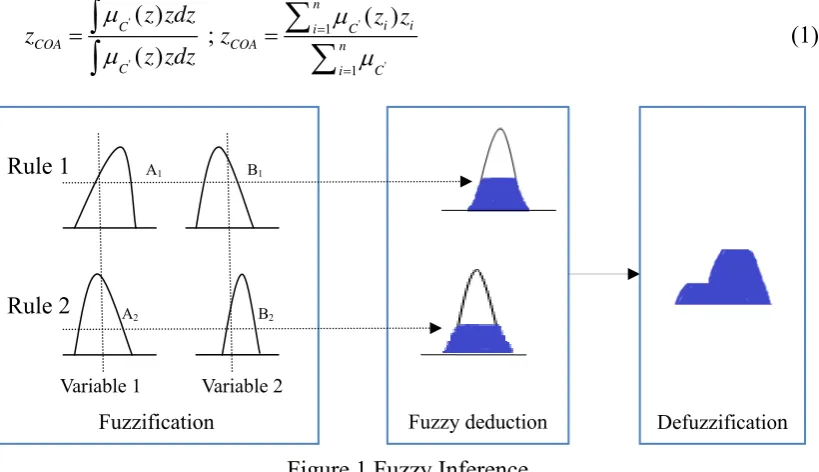
and practicality (Jager, 1995). Figure 1 depicts the min-max fuzzy inference, with two
5
Fuzzy deduction
sets with their respective bell-shaped membership function. In this case, four major
steps should be performed in this fuzzy inference, which are described as follows:
(i) In fuzzifying input variable X1 and X2, the function of antecedence is to
implement the premise part of “if.” The result of “and” or “or” operation i in the
antecedence represents the degree of fulfillment for the rule i and can be written as:
1 2 1 2
( ) ( ); ( ) ( ) for =1,2
i i i i
i A x B x i A x B x i
(ii) The “then” operation is the consequence represented by a fuzzy setCi in output
variable Z. The fuzzy implication reshapes the consequence with i given in the
antecedence. The minimum implication is written as:
'( ) ( ) for =1,2
i
i i C
C z z i
(iii) The outputs of '( )
i
C z
for i=1,2 are then aggregated to form a fuzzy setC'in
output variable Z that is written as:
' ' '
1 2
1 2 1 2
( ) [ C( )] [ C ( )]
C z C C z z
(iv) Finally, the output of aggregation is defuzzified to obtain a crisp output z.
Different methods of defuzzification may be used, such as mean of maximum,
middle of max, center of area (COA), and Center of Gravity. The current paper uses
method of COA to identify the centroid of the fuzzy set. For continuous and
discrete cases, COA is written as:
' ' ' ' 1 1 ( ) ( ) ; ( ) n i i
C i C
COA COA n
C i C
z zdz z z
z z z zdz
[image:6.595.96.506.520.756.2]
(1)Figure 1 Fuzzy Inference
A1 B1
A2 B2
Variable 1 Variable 2
Fuzzification Defuzzification
6 2.2 Genetic algorithm (GA)
A number of parameters embedded in the fuzzy inference should be determined to
estimate the output variable effectively. For instance, the parameters or shape of the
membership function, which may be Gaussian, trapezoidal, triangular, s-shaped, or
z-shaped function, is a determinant for output estimation. To preclude the excessive
non-linear property, the Gaussian membership function is applied in the present work.
Supposeθis the decision vector to be solved. The optimal problem is to minimize the
objective function of root mean squared error (RMSE) in the fuzzy inference system,
which is written as:
2
1
ˆ ( ) RMSE
n
i i i
z z Min
n
(2)where ˆzi is the estimation of output zi for sample I, and n is the sample size.
The rule-based fuzzy inference is non-linear with max-min composition, implying
that the functions in the fuzzy inference are somehow kinked and cannot be
differentiable. Hence, the fuzzy inference system cannot be optimized using the
classical method of direction search. In this complex context, GA based on the
mechanics of natural selection and natural genetics is a better robust algorithm for
implementing the fuzzy optimization. Three major types of operations exist in GA,
namely, selection, reproduction, and mutation, according to the Darwinian evolutionary
theory. For a detailed interpretation and demonstration, a number of previous studies
may be used as reference (Goldberg, 1989; Koza, 1992).
However, the fuzzy inference system has a number of limitations. Aside from its
nonlinear property and inefficiency in computing GA, one major criticism is that the
fuzzy rules are not well developed and cannot be applied to the knowledge-based
system. Thus, to embody the expert knowledge into the fuzzy rules appropriately, the
structural equation modeling, as seen in the next section, is proposed to determine the
concise and integrated structural relationships between input and output variables and
to build the more convincing fuzzy rules as well.
2. 3 Structural equation modeling
The SEM technique enables the examination of complicated phenomena using
hypothetical construct (latent) variables, measurement error, and correlative
7
between variables constructed by the linear relationship is referred to as the SEM
(Tabachnick and Fidell, 1996). The SEM is currently one of the most useful tools for
path analysis in marketing and consumer research (Gefen et al., 2000). SEM is also
frequently used in traveler behavior studies and activity analyses (Kuppam and
Pendyala, 2001).
The SEM group includes “covariance structure analysis,” “latent variable
analysis,” “confirmatory factor analysis,” and the “analysis of linear structural
relationships.” By combining multiple regression and factor analyses, the SEM is
capable of simultaneously analyzing correlations of a group of mutually dependent
variables (Hair, 1998). The SEM functions are essentially used in exploring the
causality between multivariables or univariables that are not supposed to be directly
measured. Although some presumptions have to be made over observed variables and
measurement errors, the unobservable or latent variables are constructed. In the
meantime, the structural model is established between endogenous and exogenous
constructs. Thus, the theoretical structure of SEM comprises the “structural model” and
“measurement model” (Hatcher, 1998). Specifically, the structural model is used to
define the linear relationship between the endogenous and exogenous latent variables,
whereas the measurement model defines the linear relationship between the latent
variables and the observed variables. Thus, the linear relationship developed from the
second model is typically used to extort the observation data before processing the
analysis (Lin, 1984).
3. Data Methods and Description
3.1 Study design
The present study uses the SEM to build an overall Mamdani-type fuzzy influence
system for analyzing reasonable relationships between various observed and latent
variables of the economic index. The observed variables include the USD value, NTD
value, and the USD index, plus the USD/NTD volatility of exchange rate returns that
acts as the risk factor for control. Note that USD/NTD indicates that 1 US dollar is
expressed in New Taiwan Dollars. The output and input variables are converted into
linguistic variables or fuzzy sets using various suitable membership functions. The
major fuzzy rules are then constructed by the SEM of path analysis. To optimize the
fuzzy influence system, the GA is applied to fit the parameters embedded in the
8
constructed to empirically verify the decision of trading.
3.2 Study samples
The study samples are derived from the macroeconomic database of Taiwan
Economic Journal (TEJ) and the Financial Statistics Monthly edited by the Economic
Research Department at the Central Bank of the Republic of China. The study period
covers January 1, 1996 to December 2010, yielding a total of 180 pieces of data that
are regarded as the values of observed variables. To test the robustness of the model,
the data are divided into training period samples and verification period samples. The
training period is from February 1996 to September 2007, whereas the verification
period is from July 2008 to December 2010. Using the available variables, the present
study converts the macroeconomic variables into monthly increase rates for the SEM
rule-based fuzzy model. The measurement scales for different economic indexes vary
widely. Thus, the present study also converts a variety of data into standardized scores
before analyzing or comparing the statistics so as to achieve a good fit between the
model and the data sample.
3.3 Conceptual model construction
According to the theory of SEM and the relevant literature, several variables can
affect the change in exchange rates. The data must be meaningful and informative for
the change in exchange rates. However, including all the variables in the model
construction would be costly and would also make the achievement of the goal difficult.
Thus, although the macroeconomic system widely covers the monetary, financial
securities, and labor markets, the current research followed Walras’ Law by removing
the labor market and selecting five important variables from the remaining three
markets: M2, CPI, GDP, rediscount rate, and stock price index. The present study also
adopted various economic observed values from Taiwan and the US, using these values
for the observed variables that are classified into the 1st and 2nd Groups. The observed
values taken from Taiwan (hereafter referred to as the NTD value) are the endogenous
variables (dependent variables), whereas those from the US (hereafter referred to as the
USD value) are the exogenous variables (independent variables). To better understand
the interaction of economic variables with the exchange rates of the major world
currencies, the present work selects six major international currencies, namely the Euro
(EUR), Japanese Yen (JPY), Great Britain Pound (GBP), Canadian Dollar (CAD),
Swedish Kronor (SEK), and the Swiss Franc (CHF), and attempts to compare the
9
index, the present study computes the values of USD index that are observable and can
be classified as Group 3. The USD index is considered as an endogenous or mediator
variable.
By analyzing foreign exchange related literature, the current research compiles the
data from expert knowledge and infers several hypotheses through the SEM. The
hypotheses include a positive effect of USD value on NTD value and on the USD
index, a positive effect of the USD index on the NTD value, and an indirect effect of
USD value on NTD value through the USD index. The result can be found in Sec. 4.1.
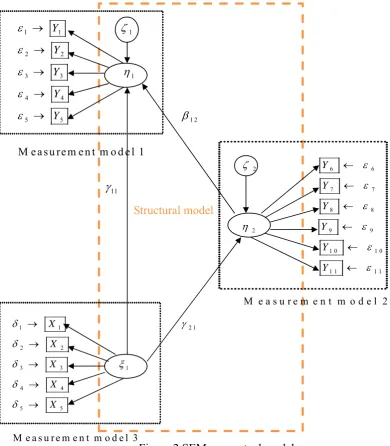
The current research uses the SEM, as shown in Figure 2, to construct the
conceptual model. The measurement and structural models are also built by estimating
the model parameters. The details are shown as follows:
1 1 1
2 2
3 3 1
4 4
5 5 1 2
[image:10.595.86.477.301.748.2]
M e a s u re m e n t m o d e l 1 Y Y Y Y Y 11 Structural model
Figure 2 SEM conceptual model
1 1 2 1
2 2
3 3 1
4 4
5 5
M e a s u r e m e n t m o d e l 3
X X X X X
2 6 6
7 7
8 8
2 9 9
1 0 1 0
1 1 1 1
M e a s u r e m e n t m o d e l 2
10 (1) Measurable equation
(a) Measurement model 1
2 1 11 1 1
2 21 1 2
3 31 1 3
M (NTD Value, measurement error)
CPI (NTD Value, measurement error)
(NTD Value, measurement error)
Re y y y f Y f Y f Y TW TW TW GDP
TW 4 41 1 4
5 51 1 5
discount rate (NTD Value, measurement error)
Stock price index (NTD Value, measurement error)
y y f Y f Y TW
(b) Measurement model 2
6 62 2 6
7 72 2 7
8 82 2 8 (US dollar index, measurement error)
(US dollar index, measurement error)
(US dollar index, measurement error)
(US dollar index, me
y y y f Y f Y f Y f USD/EUR USD/GBP USD/JPY
USD/CAD 9 92 2 9
10 102 2 10
11 112 2 11 asurement error)
(US dollar index, measurement error)
(US dollar index, measurement error)
y y y Y f Y f Y USD/CHF USD/SEK
(c) Measurement model 3
2 1 11 1 1
2 21 1 2
3 31 1 3
M (USD Value, measurement error) X
CPI (USD Value, measurement error) X
(USD Value, measurement error) X
Rediscount rate (USD Value, measurement e
x x x f f f f US US US GDP
US 4 41 1 4
5 51 1 5
rror) X
Stock price index (USD Value, measurement error) X x x f US
(2) Structural equation
11 12
1 11 1 12 2 1
21
2 21 1 2
NTD = ( USD )+ (US dollar index)+residual error
US dollar index= ( USD )+residual error
Value Value
Value
3.4 SEM structure
The SEM provides an intact comprehensive system for data analysis and
theoretical research. Using SEM, the causality in the structural model and the construct
validity in the measurement model may be simultaneously analyzed and evaluated. The
details of this approach are described below (Hu and Jen, 2008):
11
The structural model shows the causality between a host of latent variables. The
cause-and-effect relationship in the model is generally derived from other theoretical
assumptions. The “cause” assumed in the model is called the exogenous variable,
whereas the “effect” is the endogenous variable. The following shows the structural
model of SEM:
B
(3)
where is exogenous variable, is endogenous variable, stands for the
coefficient matrices of the influence effect of exogenous variables on endogenous
variables, B refers to the coefficient matrices of the influence effect of endogenous
variables on endogenous variables, and is the vector of the “residual error.”
Three basic hypotheses are given in this model: (i) The variables are represented
by deviation scores, where the average value is 0; (ii) no correlation exists between and ; and (iii) the diagonal line ofBis 0, where IB is a non-singular matrix.
(2) Measurement model
The observed variables use measureable secondary data to observe the effect of
latent variables. The measurement model is used to elaborate on the relationship
between the latent and observed variables.
Generally, the measurement model comprises two equations that define the
association between endogenous latent variables and endogenous observed
variables y and between exogenous latent variables and exogenous observed
variablesx. In fact, the measurement model can be considered a measurement and a
kind of reliability description of the observed variables as follows:
y
y (4)
where y refers to the endogenous observed variables, y stands for the coefficient
matrices of the relationship between yand, and is measurement error of y.
x
x (5)
wherex refers to the exogenous observed variables;xstands for the coefficient
matrices of the relationship between xand; is measurement error of x; and
y
and xare the approximate regression coefficients fory and x, respectively.
12
observed variables can be used to indirectly infer latent variables by assuming the following hypotheses: (i) no correlation exists between the measurement error and,
, or , but , , and can be correlated; and (ii) similarly, no correlation exists
between the residual error ( ) and the measurement error (and ).
(3) Inference of covariance matrix
Given SEM’s basic assumptions and under the hypothesis of normal data
distribution, the covariance matrix of Vector z( , )y x can be theoretically obtained.
The process is described below:
(a) Definition of variables
y
: p×m coefficient matrix describing the relationship between y and
x
: q×m coefficient matrix describing the relationship between x and
B : m×m coefficient matrix describing the influence effect ofon itself
Γ: m×n coefficient matrix describing the influence effect ofon
Φ : n×n covariance matrix of
Ψ: m×m covariance matrix of
: p×p covariance matrix of
: q×q covariance matrix of
(b) The structural equation model is shown as below:
; y x
B y x
;
The covariance matrix xx of exogenous observed variables is obtained as
follows:
( ) ( )
[( )( ) ]
( ) ( ) ( ) ( )
0 0
xx
x x
x x x x
x x
x x
Cov xx E xx E
E E E E
(6)
13 ( ) ( )
[( )( ) ]
( ) ( ) ( ) ( )
( ) 0 0 yy
y y
y y y y
y y
y y
Cov yy E yy E
E E E E
E (7)
The covariance matrix of endogenous latent variables is obtained as follows:
1 1 1 1
1 1 1 1
1 1 1 1
1 1 ( ) [( ) ( ) ][( ) ( ) ] ( ) ( ) ( ) ( ) ( )( ) ( ) ( ) ( ) ( ) ( ) [ ]( ) E
E I B I B I B I B
I B E I B I B E I B
I B I B I B I B
I B I B
(8)
Equation (8) is then substituted into (7) to derive the following:
1 1
[( ) ( )( ) ]
yy y I B I B y
(9)
The covariance matrix xyof exogenous observed variables and endogenous observed
variables is obtained as follows:
( ) ( )
[( )( ) ]
( ) ( ) ( ) ( )
( ) 0 0 0 xy
x y
x y x y
x y
x y
Cov xy E xy E
E E E E
E (10)
The covariance matrix of endogenous latent variables and exogenous latent
variables is obtained as follows:
1 1 1 1 1 1 ( ) [( ) ( ) ] ( ) ( ) ( ) ( )
( ) 0
( )
E
E I B I B
I B E I B E
I B I B (11) 1
(I B)
, and substituting this formula into Equation (10) yields the
following:
1
(1 )
xy x B y
14
Finally, the covariance matrix is written as yy yx
xy xx
. Combining Equations
(6), (9), and (12) yields the following:
1 1 1
1
[( ) ( )( ) ] (1 )
(1 )
y y y x
x y x x
I B I B B
B
(13)
3.5 Linguistic variables and linguistic terms
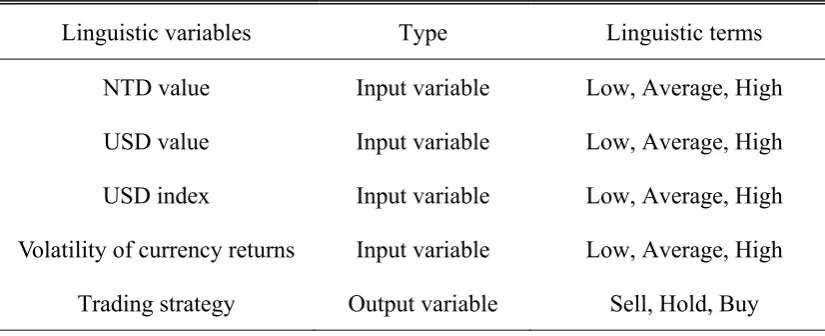
Table 1 describes the linguistic variables used in the present study, as well as their
linguistic terms. The input linguistic variables are the “NTD value,” the “USD value,”
the “USD index,” and the “Volatility of currency (USD/NTD) returns,” whereas the
output linguistic variable is termed “Trading strategy.” Each linguistic variable has
three linguistic terms, i.e., membership functions.
3.6 The membership function
The membership function describes to what degree of the truth the input variable
represents the membership of vaguely defined sets. The shape of the membership
function can dramatically affect the result of the fuzzy system. The membership
functions are generally determined in accordance with experts’' recommendations and
operation habits. Linear membership functions, including the Gaussian membership
function, are good candidates for use in the fuzzy system. The path analysis derived
through the SEM is significantly more impartial and unprejudiced in operating the
[image:15.595.91.504.547.715.2]fuzzy sets rationally.
Table 1 Names and types of variables and their linguistic terms
Linguistic variables Type Linguistic terms
NTD value Input variable Low, Average, High
USD value Input variable Low, Average, High
USD index Input variable Low, Average, High
Volatility of currency returns Input variable Low, Average, High
15 3.7 Establishment of fuzzy rules
Fuzzy rules are the most important part of the fuzzy system. Establishing rules
that comply with the status quo requires rule-of-thumb specifications. If the
goodness-of-fit of SEM is inappropriate, the logic of the rules will also be improper.
Hence, determining various rules of thumb is necessary to improve the fuzzy rules.
More reliable decisions can thus be made to achieve better investment performance.
Therefore, based on the rules of thumb inferred from the SEM and the additional rules
involved in the volatility factor, the present study analyzes the fuzzy input variables,
i.e., latent variables and creates 18 fuzzy rules, as shown in Table 2.
3.8 Fuzzy trading system
The present work primarily aims to fuzzify input variables and risks and then use
the GA for fitness so that the relationships between input and output variables could be
more precisely identified. The primary method is to properly convert the four input
variables into the output variable by operating the high, low, or average fuzzy set of
each variable. The numerical values of economic variables are thus transferred into the
linguistic variables of USD and NTD values through the Gaussian membership
functions. Therefore, the fuzzy rules derived from the SEM can be evaluated through
the sample data, and the fuzzy inference system can then be fitted to determine the
parameters embedded in fuzzy sets. A fuzzy trading system is constructed and ready
for verification using the test data.
Table 2 Fuzzy Rules
Rule No. Specification
Rule 01 IF NTD Value High and USD Value High then Strategy is Buy U/N
Rule 02 IF NTD Value low and USD Value low then Strategy is Sell U/N
Rule 03 IF NTD Value average and USD Value average then Strategy is Hold U/N
Rule 04 IF USD Value High and USDX High then Strategy is Buy U/N
Rule 05 IF USD Value low and USDX low then Strategy is Sell U/N
Rule 06 IF USD Value average and USDX average then Strategy is Hold U/N
Rule 07 IF NTD Value High then Strategy is Sell U/N
Rule 08 IF NTD Value low then Strategy is Buy U/N
Rule 09 IF USD Value High then Strategy is Buy U/N
16
Rule 11 IF USDX High then Strategy is Buy U/N
Rule 12 IF USDX low then Strategy is Sell U/N
Rule 13 IF USD Value High and VCR High then Strategy is Buy U/N
Rule 14 IF USD Value low and VCR low then Strategy is Sell U/N
Rule 15 IF USD Value average and VCR average then Strategy is Hold U/N
Rule 16 IF USDX High and VCR High then Strategy is Buy U/N
Rule 17 IF USDX low and VCR low then Strategy is Sell U/N
Rule 18 IF USDX average and VCR average then Strategy is Hold U/N
Notes: 1. “USDX” =USD index. “VCR” =Volatility of currency returns. “Strategy” =Trading strategy.
“U/N” =USD/NTD.
2. Volatility of currency returns is the volatility estimated from GARCH model.
4. Analysis of Empirical Results
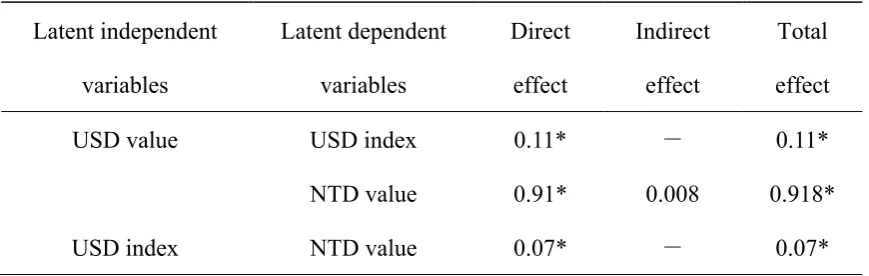
4.1 Structural model analysis
The SEM can be used for path analysis and the decomposition of influence. The
effect of one latent variable on another is called a direct effect, whereas the effect that
occurs from a third latent variable is referred to as an indirect effect. The direct effect
plus the indirect effect is called the total effect. The decomposition chart of the
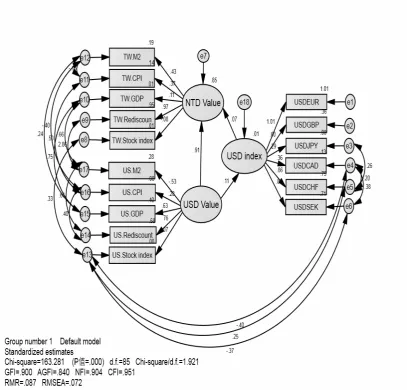
influence effects is shown in Table 3, and the present study’s overall empirical
structural model is illustrated in Figure 3.
The model reports that the USD value has a significant effect on the USD and the
NTD value, the USD index has a significant effect on the NTD value and through the
[image:17.595.84.519.593.731.2]USD index, the USD value has an indirect effect on the NTD value.
Table 3 The Decomposition of the Influence Effects
Latent independent
variables
Latent dependent
variables
Direct
effect
Indirect
effect
Total
effect
USD value USD index 0.11* - 0.11*
NTD value 0.91* 0.008 0.918*
USD index NTD value 0.07* - 0.07*
17
Figure 3 The Overall Empirical Structural Model
4.2 Model fit analysis
According to the evaluation indicators revealed in Figure 3, the Chi-square value
is 163.281, the degree of freedom is 85, and the p-value is 0.000, representing a highly
significant level. The Chi-square value ratio is 1.921 (163.281÷85), which is within the
value of criterion≤3, representing a proper overall fit between the theory model and the
overall observed data.
Moreover, the other goodness-of-fit indices were all found to reach or are
approximate close to the value of the criterion (GFI>0.9; AGFI>0.9; NFI>0.9; CFI>0.9;
RMR<0.08; RMSEA<0.08). This finding illustrates that the overall model of the
18
model based on the SEM factor analysis can appropriately interpret the actual data.
4.3 The buy/sell trading signals
The trading of USD/NTD will give rise to different returns at different times. The
buy-and-sell signals are actually determined by the output variable of the fuzzy
inference system. If the output variable is greater than a specific value, it is viewed as
the buy signal, and if it is smaller than a specific value, it is viewed as the sell signal.
These buy/sell specific points in trading strategy are determined to minimize the error
square between the output variable and the actual exchange rate of return. As a result
of the fuzzy inference trained by the sample data, the buy signal appears when the
output variable exceeds 3.3428, and the sell signal emerges when the output variable is
less than -3.9531.
4.4 Membership functions of variables
The membership functions of each variable are obtained with their respective
optimal parameters, which are then fine-tuned by a GA based on the fuzzy rules and
inference in previous section. As a result, Figure 4 exhibits all the empirical
membership functions of the input and output variables.
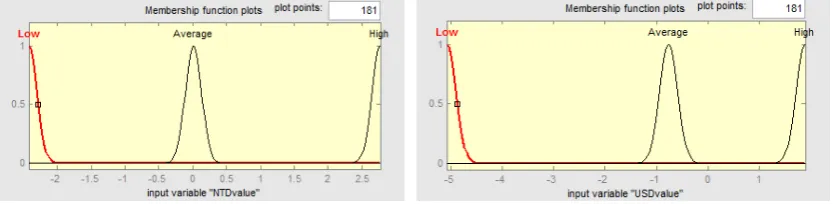
Figure 4(a) shows the membership functions of the input variable NTD value. The
optimal membership is obtained by genetically searching the parameters with
respective function types (low, average, high) to minimize the objective function of
RMSE, as shown in Equation (2). The results of the optimal membership parameters
for the NTD value are -2.4226 and 2.7706, indicating that when the NTD value is
below -2.4226, a “low value” level is achieved, and when it is above 2.7706, a “high
value” level is reached. Figure 4(b) reveals the membership function of the input
variable USD value. Similarly, the results of the optimal membership parameters for
the USD value are obtained as -5.0779 and 1.8926. A USD value below -5.0779reflects
a “low value” level, whereas a USD value above 1.8926reflects a “high value” level.
Figure 4(c) shows that the optimal membership parameters for the input variable
USDX are -1.4202 and 0.4685, implying that when the USDX is below -1.4202, a “low
index” level is achieved, and when it is above 0.4685, a “high index” level is reached.
Figure 4(d) shows that the optimal membership parameters for the input variable
volatility of currency (USD/NTD) returns are 0.1449 and 0.5461. Hence, when the
volatility of currency returns is below 0.1449, a “low volatility” level is achieved, and
19
that the optimal membership parameters for the trading strategy Sell and Buy are
-3.9531 and 3.3428. A trading strategy value below -3.9531 creates a “Sell USD/NTD”
signal, a value above 3.3428 creates a “Buy USD/NTD” signal, and a value between
-3.9531 and 3.3428generates a “Hold” signal, wherein nothing is available for trading.
The fuzzy GA (FGA) is used to fit the fuzzy model and to optimize the
parameters involved in fuzzy memberships and the fuzzy rules. Figure 5 exhibits the
objective function (fitness) converging stably and smoothly to the best value (around
1800) when the number of generations reaches approximately 40. This finding
indicates that the fuzzy inference system can effectively fit the training samples of
exchange rates through the FGA.
(a) Membership functions of NTD value (b) Membership functions of USD value
(c) Membership functions of USDX (d) Membership functions of VCR
[image:20.595.90.507.282.384.2](e) Membership functions of trading strategy
20
0 20 40 60 80 100 120 140 160 180 200
400 600 800 1000 1200 1400 1600 1800
Generations
F
it
nes
s
[image:21.595.123.454.82.249.2]Best Average Poorest
Figure 5 Convergence of GA
4.5 Changes in input and output variables
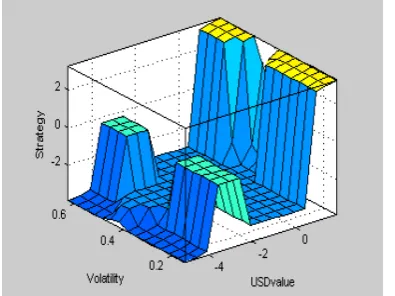
Following the training, several three-dimensional charts between the values of
trading strategy versus those of input factors are built according to the optimal fuzzy
rules and inference. The value of trading strategy is apparently noticeable against USD
value and volatility of currency returns or against USDX value and volatility of
currency returns. The results are shown in Figure 6.
[image:21.595.282.499.422.574.2]
(a) Variation in strategy vs. USD value and volatility (b) Variation in strategy vs. USDX and volatility
Figure 6 Variation in trading strategy
Figure 6(a) reveals that the weight of the trading value (importance level) rises as
the volatility or USD value becomes significantly lower or higher. Figure 6(b) shows
that the USD index dominates the volatility in affecting the value of the trading
strategy. However, a comparison of both figures shows that when the USD value or the
USD index is higher, i.e., when the USD/NTD buy point emerges, the effect of
[image:21.595.89.287.424.572.2]21
importance of volatility risk control for making trading decisions in foreign exchange
markets. Remarkably, when the USD value is lower, thus expressing the sell signal for
USD/NTD trading, the effect of USD value becomes greater.
4.6. Investigation of investment performance
The current paper compares the investment performance of the “Fuzzy trading
strategy with Volatility of currency returns,” in which risk is considered, and the
“Fuzzy trading strategy without Volatility of currency returns,” in which risk is
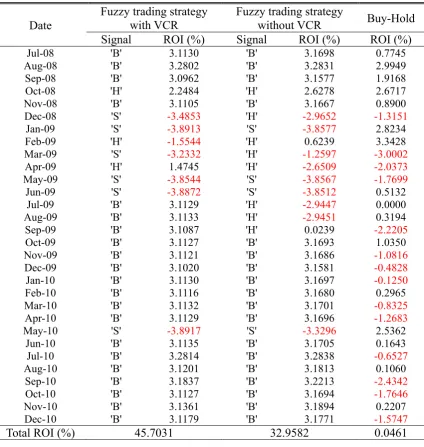
disregarded, as well as the general “Buy-Hold,” i.e., three methods. Table 4 shows the
buy/sell points and return of investment (ROI) rates generated according to the “fuzzy
trading strategy,” in which B represents the “buy signal,” H represents a “hold,” and S
represents the “sell signal.”
The rate of ROI gained from the first operation method is 45.7031%, and that
from the second operation method is 32.9582%, in contrast to merely 0.0461% using
the “Buy-Hold” method. As this comparison emphasizes, applying the “fuzzy trading
strategy” to investments can substantially improve the rate of currency return.
Furthermore, considering the volatility of currency returns can yield better profit than
disregarding such volatility.
5. Conclusion
To construct reasonable fuzzy rules, the present study employed the SEM to
determine the suitable path diagram between various economic indices of observed
variables and their respective latent variables. A risk factor of control, i.e., volatility of
currency returns, was also considered in fuzzy sets. The current research constructed
several fuzzy rules based on SEM path analysis and fitted the parameters of the
memberships of fuzzy sets to the returns of currency data using a GA. According to the
empirical results, the present work has the following conclusions:
(i) Regardless of whether or not the volatility of currency returns is considered,
investments made with the fuzzy trading strategy achieve a significantly better
rate of return than those made using the Buy-Hold method. The returns were
45.7031% and 32.9582% using the two previous methods, whereas a value of
only 0.0461% was obtained using the proposed method.
(ii)Investment using the fuzzy trading strategy, in which the volatility of currency
22 disregarded.
(iii)The trading strategy is apparently affected as the USD value or the volatility
of currency returns shifts into either a higher or lower state.
In summary, the fuzzy trading system has incorporated the SEM path and factor
analyses into fuzzy rules. Moreover, the inclusion of the volatility of currency returns
in the fuzzy trading system certainly helped in acquiring larger excess returns, thus
[image:23.595.90.515.295.743.2]outperforming the Buy-Hold strategy.
Table 4 Comparison between “Fuzzy trading strategy with Volatility of currency
returns” and “Fuzzy trading strategy without Volatility of currency returns”
and “Buy-Hold”
Date
Fuzzy trading strategy with VCR
Fuzzy trading strategy
without VCR Buy-Hold Signal ROI (%) Signal ROI (%) ROI (%)
Jul-08 'B' 3.1130 'B' 3.1698 0.7745
Aug-08 'B' 3.2802 'B' 3.2831 2.9949
Sep-08 'B' 3.0962 'B' 3.1577 1.9168
Oct-08 'H' 2.2484 'H' 2.6278 2.6717
Nov-08 'B' 3.1105 'B' 3.1667 0.8900
Dec-08 'S' -3.4853 'H' -2.9652 -1.3151
Jan-09 'S' -3.8913 'S' -3.8577 2.8234
Feb-09 'H' -1.5544 'H' 0.6239 3.3428
Mar-09 'S' -3.2332 'H' -1.2597 -3.0002
Apr-09 'H' 1.4745 'H' -2.6509 -2.0373
May-09 'S' -3.8544 'S' -3.8567 -1.7699
Jun-09 'S' -3.8872 'S' -3.8512 0.5132
Jul-09 'B' 3.1129 'H' -2.9447 0.0000
Aug-09 'B' 3.1133 'H' -2.9451 0.3194
Sep-09 'B' 3.1087 'H' 0.0239 -2.2205
Oct-09 'B' 3.1127 'B' 3.1693 1.0350
Nov-09 'B' 3.1121 'B' 3.1686 -1.0816
Dec-09 'B' 3.1020 'B' 3.1581 -0.4828
Jan-10 'B' 3.1130 'B' 3.1697 -0.1250
Feb-10 'B' 3.1116 'B' 3.1680 0.2965
Mar-10 'B' 3.1132 'B' 3.1701 -0.8325
Apr-10 'B' 3.1129 'B' 3.1696 -1.2683
May-10 'S' -3.8917 'S' -3.3296 2.5362
Jun-10 'B' 3.1135 'B' 3.1705 0.1643
Jul-10 'B' 3.2814 'B' 3.2838 -0.6527
Aug-10 'B' 3.1201 'B' 3.1813 0.1060
Sep-10 'B' 3.1837 'B' 3.2213 -2.4342
Oct-10 'B' 3.1127 'B' 3.1694 -1.7646
Nov-10 'B' 3.1361 'B' 3.1894 0.2207
Dec-10 'B' 3.1179 'B' 3.1771 -1.5747
Total ROI (%) 45.7031 32.9582 0.0461
23
References
Anderson, J.C. and D.W. Gerbing, 1988. Structural Equation Modeling in Practice: A
Review and Recommended Two-Step Approach. Psychological Bulletin, 103:3,
411-23.
Bilson, J.F.O., 1981. The Speculative Efficiency Hypothesis. Journal of Business 54,
No.3, 435-451.
Bodnar, G.M., B. Dumas, and R.C. Marston, 2002. Pass-through and exposure. Journal
of Finance 57, 199-232.
Bodnar, G.M. and M.H.F. Wong, 2003. Estimating exchange rate exposures: issues in
model structure. Financial Management 32, 35-67.
Bollen, K.A. and Long, J.S., 1993. Testing Structural Equation Models, Newbury Park
(Ca): Sage.
Branson, W., H. Halttunen, and P. Masson, 1977. Exchange rates in the short run: The
dollar-deutschemark rate. European Economic Review 10, 303-24.
Branson,W.H. and D.W. Henderson, 1985. The Specification and Influence of Asset
Markets. in, Jones, R. W. and P. B. Kenen,(ed.). Handbook of International
Economics. Volume, North Holland. Amsterdam.
Chan, K.C.C., Lee, V., Leung, H, 1997. Generating fuzzy rules for target tracking using
a steady-state genetic algorithm. IEEE Trans. Evolutionary Computation, 189-200.
Doidge, C., Griffin, J. and Williamson, R., 2006. Measuring the economic importance
of exchange rate exposure? Journal of Empirical Finance 13, 550-576.
Eichengreen, Barry, and Raul Razo-Garcia, 2006. The International Monetary System
in the Last and Next 20 Years. Economic Policy Vol. 21(47), 393–442.
Frenkel, J.A., 1981. Flexible Exchange Rates, Prices, and the Role of “News”: Lessons
from the 1970s". Journal of political Economic Vol.54, 665-703.
Gefen, D., D.W. Straub, and M-C Boudreau, 2000. Structural Equation Modeling and
Regression: Guidelines for Research Practice. Communications of the Association
for Information Systems Vol. 4, Article 7.
Goldberg, D.E., 1989. Genetic algorithms in search optimization and machine learning.
Reading. MA: Addison-Wesley Publishing Company, 412.
Hair, J.F., R.E. Anderson, R.L. Tatham, W.C. Black, 1998. Multivariate Data Analysis.
Prentice Hall.
24
Analysis and Structural Equation Modeling. SAS Institute Inc.
Hu, K.C. and Jen W., 2008. Exploring the Effects of Relational Performance and
Service Quality on Customer's Satisfaction and Loyalty in the Freight Shipping
Industry from the Viewpoint of Business-to-Business. Journal of the Chinese
Institute of Transportation 20.2, 201-228.
Jöreskog, K.G., 1973. A general method for estimating a linear structural equation
system. In Goldberger, A. S., & Duncan, O. D. (Eds). Structural Models in the
Social Science. New York: Academic Press.
Jöreskog, K.G. and D. Sörborn, 1996. LISREL 8: user’s reference guide. Scientific
Software International, Chicago.
Jager, R, 1995. Fuzzy Logic in Control. Delft TU Publisher. Delft. The Netherlands.
Karr, C.L., 1991. Genetic algorithms for fuzzy controllers. AI Expert 6(2), 27 -33.
Karr, C.L., 1993. Fuzzy control of pH using genetic algorithms. IEEE Trans Fuzzy
Syst 1, 46 –53.
Koedijk, K.G., Kool, C.J.M., Schotman, P.C., and Dijk, M.A.van, 2002. The cost of
capital in international financial markets: local or global? Journal of International
Money and Finance 21, 905-929.
Kuppam, A.R. and Pendyala, R.M., 2001. A Structural Equations Analysis of
Commuter Activity and Travel Patterns. Transportation 28(1), 33-54.
Lin, C.H., 1984. Theories and Applications of Structural Equation Models and
LISREL IV Program. Psychological Testing 31, 149-163.
Mamdani, E. and S. Assilian, 1975. An experiment in linguistic synthesis with fuzzy
logic controller. Journal of Man–Machine Studies 7(1), 1-13.
Mamdani, E., 1976. Advances in the linguistic synthesis of fuzzy controllers. Journal
of Man–Machine Studies 8, 669-678.
Moffet, M. and J. Karlsen, 1994. Managing foreign exchange rate economic exposure.
Journal of International Financial Management and Accounting 5. 2, 157-175.
Neely, C.J., 2005. An Analysis of Recent Studies of the Effect of Foreign Exchange
Intervention. Federal Reserve Bank of St. Louis Review Nov./Dec.87(6), 685-717.
Tabachnick, B.G. and L.S. Fidell, 1996. Using multivariate statistics (3rd) NY: Harper
Collins.
Williamson, R., 2001. Exchange rate exposure and competition: evidence from the
automotive industry. Journal of Financial Economics 59, 441-475.
25
Zadeh, L.A., 1996. Fuzzy sets, fuzzy logic, and fuzzy systems: selected papers:
Advances in fuzzy systems-applications and Theory.vol. 6. NJ: World Scientific.
Zimmermann, H.J., 1996. Fuzzy Sets Theory and its Applications, third ed. Kluwer