ISSN Online: 2153-1293 ISSN Print: 2153-1285
Dynamic Spectrum Access Protocol for the
Digital Dividend
Raoul Zamblé1*, Raymond Gbégbé2, Jean-Marie Kadjo1, Olivier Asseu1,2*, Pacôme Brou2
1Ecole Supérieure Africaine des Technologies de l’Information et de la Communication (ESATIC), Abidjan, Côte d’Ivoire 2Institut National Polytechnique Houphouet Boigny (INPHB), Yamoussoukro, Côte d’Ivoire
Abstract
It is not more and more, easy to satisfy the important and growing spectrum de-mands in the context of the static conventional policy spectrum allocation. There-fore, to find a suitable solution to this problem, we are to days observing the appari-tion of flexible dynamic spectrum allocaappari-tion methods. These methods that ought to improve more significantly the spectrum use have gained much interest. In fact, the digital dividend due to the change-over from the analog television to the digital ter-restrial television must be efficiently used. So the Dynamic Spectrum Access (DSA) can potentially play a key role in shaping the future digital dividend use. In the DSA, two kinds of users or networks coexist on different channels. The first one, known as the primary user, accesses to a channel with high priority; and the second one, known as secondary user has a low priority. This paper presents a dynamic spectrum access protocol based on an auction framework. Our protocol is an interesting tool that allows the networks to bid and obtain on the available spectrum, the rights to be primary and secondary users according their valuations and traffic needs. Based on certain offers, our protocol selects primary and secondary users for each idle channel in order to realize the maximum economic for the regulator or social benefits. We deal with the case in which the offers of the networks are independent one another even if they will share the same channels. We design an algorithm in accordance with our dynamic spectrum access protocol. The algorithm is used here to find an optimal solution to the access allocation problem, specifically to digital dividend. Finally, the results in the numeric section, regarding the three suggested scenarios, show that the proposed dynamic spectrum access protocol is viable. The algorithm is able to elimi-nate all non-compliant bidders for the available spectrum sharing. We notice that the revenue or social benefits of the regulator is maximized when we have on each channel, one primary user and the maximum number of secondary users.
How to cite this paper: Zamblé, R., Gbégbé, R., Kadjo, J.-M., Asseu, O. and Brou, P. (2016) Dynamic Spectrum Access Protocol for the Digital Dividend. Circuits and Sys-tems, 7, 4124-4144.
http://dx.doi.org/10.4236/cs.2016.713340
Received: May 10, 2016 Accepted: November 13, 2016 Published: November 16, 2016
Copyright © 2016 by authors and Scientific Research Publishing Inc. This work is licensed under the Creative Commons Attribution International License (CC BY 4.0).
http://creativecommons.org/licenses/by/4.0/
Keywords
Dynamic Spectrum Access Protocol, Centralized Spectrum Sharing, Spectrum Auctions, Digital Dividend
1. Introduction
The allocation and management of radio spectrum are administered by national regu-latory authorities. These authorities work together within a harmonized framework es-tablished by international policy initiatives. Radio spectrum refers to a specific range of frequencies of electromagnetic energy that is used to communicate information. Appli-cations important for society such as radio and television broadcasting, civil aviation, satellites, defense and emergency services depend on specific allocations of radio fre-quency. Recently, the demand for spectrum has increased dramatically, driven by growing quantities of data transmitted over the internet and rapidly increasing num-bers of wireless devices, including smart phones and tablets, Wi-Fi networks and eve-ryday objects connected to the internet. However, since existing wireless networks oc-cupy extensive parts of the available radio spectrum, there is insufficient spectrum available to all new wireless networks. In fact, the natural and inextensible character of the radio spectrum makes it a rare commodity that should be used sparingly. It appears that the spectral resource managed by the regulatory agencies seems to be almost com-pletely occupied and is not being utilized efficiently [1]. In addition, experts believe that spectrum use for communication will increase from 200% to 300% in the coming years [2]. Furthermore, the traditional management does not allow an actual effective use. For example, it was noted that many frequencies are unoccupied during the day when they are officially assigned [3]. This paradoxical situation obliges policy makers and regulators around the world to focus again on spectrum regulation by emphasizing more and more on the best possible balance to achieve between the certainty required to ensure the stable deployment of services and stable flexibility leading to an im-provement of costs, services and the use of innovative technologies. A new approach is then proposed to address this problem: the dynamic spectrum access which allows a secondary use of spectrum holes left by the primary users [4]. Mostly, the spectrum is available according time and geographic location. Under the lead of the FCC, the next generation wireless communication systems are being designed for the dynamic use of spectrum. This new way of spectrum use is going to emerge in order to encourage the intensive and efficient use of the spectrum. Regarding the context, we can notice that the expression dynamic spectrum access has different connotations [5]. This approach was possible with the advent of the concepts of “software defined radio” and “Cognitive Radio”. In this context, two main architecture approaches for the spectrum distribution were developed: decentralized and centralized distribution.
have a secondary detection function of the spectrum holes and the protocols of cooper-ation [6].
In centralized spectrum sharing [7], a centralized entity possesses detailed informa-tion about the network and handles with all the spectrum allocainforma-tion and access proce-dures. Hence, compared to distributed, centralized approaches simplify the design of spectrum sharing. Among centralized spectrum techniques, dynamic spectrum access protocol (DSAP) [7] is a representative one and is the focus of this paper. In fact, the dynamic spectrum access involves two kinds of users: the primary user and the second-ary user. Therefore, it is important for the regulator bodies to find the best mechanism to assign primary and secondary user rights on the spectrum under their control. A primary user has high priority access on a channel whereas a secondary user has a low priority. For instance, if we have a network which wishes to mainly transmit a real time traffic, such as video or voice, it ought to access on a channel as primary user with high priority. Otherwise, this network opts for a secondary user rights to transmit its elastic traffic like e-mail or file transfer. So we can remark that the secondary user price must be lower than the price of the primary user rights. In case of mixture traffic types, i.e. mixture of real time and elastic traffic, the network bids for a primary user rights on some channels and for a secondary user rights on others.
Indeed, we can obviously see that auctions are well indicated for assigning primary and secondary user rights. So auctions are a mechanism for the regulator to obtain higher income than that obtained from static pricing, especially the regulator is not re-quired to know in advance the prices offered by bidders [8]. It is also beneficial for the bidders to participate in auctions since in general they have opportunity to suggest prices of goods according their needs [8]. The FCC has been conducting spectrum auc-tions since 1994 to allocate licenses for radio spectrum in the static allocation context [9]. But, so far no auctions have been conducted for cognitive radio networks in the dynamic spectrum access context.
The development of digital terrestrial television (DTT) technology has given rise to a major change in spectrum use throughout the world. As well as increasing the number and quality of television services, digital television has freed up a significant part of the Ultra High Frequency (UHF) band that has been used principally for broadcasting. The spectrum available for new services as a result of this switchover is referred to as the “digital dividend”. Depending on the country, the digital dividend is located in the VHF bands (174 to 230 MHz) and UHF bands (470 to 862 MHz).
In this paper, we suggest the dynamic spectrum access protocol based on auction to use this digital dividend. As far as we are concerned, we have no knowledge to date of work done in relation to this scenario. Here, we present a particular form of auction for the allocation of idle channels in one step through the simultaneous sale of primary and secondary user rights on those channels.
available channels within the digital dividend specifically. The broker sets a guaranteed minimum price for each kind of user at each allocation period. This flexibility of our algorithm allows the regulator through its broker to determine the minimum prices based on demand. For instance, during the usual allocation period where there are lot of demands, the broker may increase the primary and the secondary minimum prices, and in the allocation periods usually supposed to receive less traffic demands, it can decrease these prices. The three scenarios present five idle channels that must be allo-cate to the different bidders and we supposed four maximum secondary users. Here the bidders are obviously any kind of wireless networks that can transmit theirs traffics through the digital dividend. And they can opt for the primary or secondary user rights according to their traffic types. When they are supposed to transmit a real time traffic, automatically they choose the primary user right and when it is to transmit traffic without time constrain, they opt to the secondary user right. The first and the third scenarios present the cases where the bidders sent offers that are all superior to the minimum prices set by the regulator. But, in the third scenario, we have less bidders compared to the number of available channels. In the second scenario, we can explore the case in which our algorithm eliminated the bidders that proposed prices inferior to the minimum prices set by the broker. In all these three scenarios, we can see that the broker maximize its revenue or the social benefits when there are one primary user and the maximum allowed secondary users.
The rest of this paper is organized as follows. Section 2 presents the different existing approaches of the spectrum trade. Section 3 talks about the proposed DSAP, while Sec-tion 4 presents the numerical outcomes. Finally, the paper ends with a conclusion and the perspectives in Section 5.
2. Approach of Spectrum Trade
tions are proposed in real time between some service providers and users. In these auc-tions, all the users try to access to the available spectrum resources at each time slot, measured in seconds or even milliseconds. The service provider is mainly the auctio-neer who is authorized to establish a guaranteed price in order to ensure a minimum benefit. Then a cognitive radio terminal dynamically calculates the offers. Different ra-dio access technologies are used at different access point by multi-standard cognitive radio nodes for their bids. Thus, a cognitive radio network will try to maximize the util-ity functions of its users by upgrading the qualutil-ity of service (QoS) at the possible lowest price. The disadvantage of this method of auction is that it cannot give any guarantee QoS to the nodes, for each time interval another cognitive radio node could place a higher offer than the active user and interrupt its communication. In [14], auctions at the inter-operators level are presented. Given that the long-term frequency planning of the operators must take into account the request of maximum traffic time during a busy hour, there will be parts of the radio resources unoccupied during the day. Thus, operators with base stations in areas of service request can lease their unused channels. As in spectrum overlay approach, known as spectrum pooling [15], article [14] consid-ers the access to spectrum based on OFDM, in which a carrier OFDM can be used as a sellable spectral unit during a time interval. Thus these auctions take advantage of the flexibility inherent in the OFDM technique in relatively the frequency and time do-mains. The reference [16], also discusses a spectrum auction in accordance with a tem-perature interference constraint assumption applied to a certain point of measurement. The system includes a central spectrum manager, but the nodes of the users do not trade their spectrum resources. Instead, they receive the interference signal and the signal to noise ratio (SINR), and their authorized transmission power.
As we can see through the various approaches of research presented above, the best way to increase the spectral efficiency, is to allow local adjustment and short-term of the current traffic volume. The traffic varies stochastically both with time and the geo-graphical area. In the case of operators operating in licensed frequency bands, during the busy hour, it may happen that an operator has its resources fully saturated and must refuse further connections, whereas another one in the same cell has his resources un-used. But few minutes after, things could change and the operator, who was facing a bottleneck, finds itself in the situation of second one and vice versa, the first in its turn is faced with a situation its resources congestion. Thus, operators facing to an impor-tant rate of traffic, could buy extra resources. Then other service providers at the same time, locally and temporarily located in a case of under-utilization of their resources, could offer some to others. So by selling and buying extra resources for a limited time, operators could benefit from this appropriate allocation.
auction is specified by asynchronous ascent of offer with regular prices updates. In the discontinuous auction, all the bids are collected once in a limited time and after that the contract may carry out.
Unlike licensed bands, the distribution of spectrum resources available in the digital dividend due to passage from the analog television to the digital terrestrial television as mentioned in introduction will not be driven in the same manner. Here, a regulator through a broker conducts a discontinuous auction to sell primary and secondary users rights to the networks for a set of idle channels.
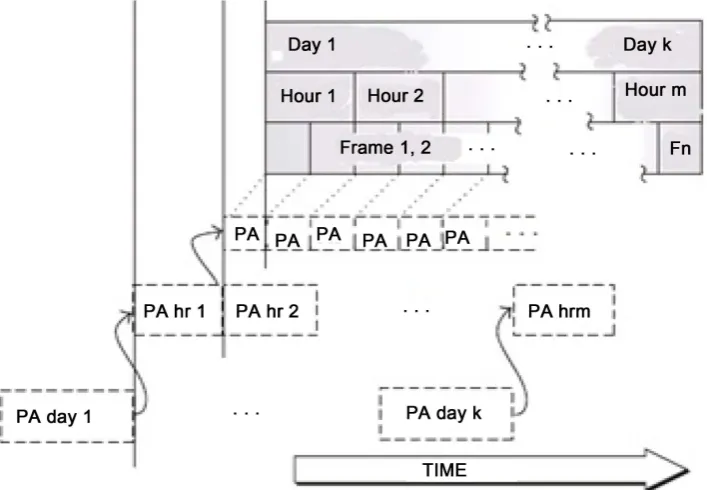
We suggest that a structural frame divided into time slots of short durations is in-troduced, about 30 minutes for instance, called allocation periods. The distribution principle of allocation periods is shown by the example in Figure 1. This figure only takes into account the temporal dimension by grouping time slots in hours and days.
During each allocation period, the regulator broker allocates the primary and sec-ondary users rights through our proposed Dynamic Spectrum Access Protocol (DSAP).
3. Dynamic Spectrum Access Protocol
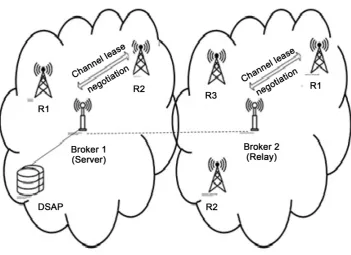
3.1. Architecture AssumptionDSAP enables dynamic spectrum access through a coordinating central entity which can be called a broker and allows efficient resource sharing and utilization in a limited geographical environment. The architecture of DSAP used in this paper is shown in Figure 2.
[image:6.595.195.549.437.682.2]DSAP consists of client, server, and relay [6]. DSAP clients are here the bidder net-works in a vicinity of a broker. They collect local needs of spectrum resources and send
Figure 2. Architecture of DSAP.
them to the broker in all the allocation period. We precise that the digital dividend is supposed to be free. It is not assigned to any technology or any service. The DSAP server is the broker directly linked to the DSAP database and based on the different in-formation from the digital dividend constructs a global view of network called Radio Map. DSAP client cannot choose a wireless communication channel arbitrarily, instead it has to request appropriate channel assignment from DSAP server. DSAP server ac-cepts communication requests from clients, and based on various optimization goals mentioned in the following section and the set of policies defined by the regulator and the Radio Map, determines an optimal radio spectrum allocation for the clients. Under different optimization goals, various algorithms and policies can be applied in the pro-cedure of obtaining the optimal distribution of radio spectrum. After deciding spec-trum assignment, DSAP server sends a feedback with a time-limited specspec-trum alloca-tion, called a lease. Once the lease is done, the DSAP server must charge the client in terms of payment for the allocation period even if the client didn’t use the allocated spectrum. We have also, at least two wireless interfaces belonging to the DSAP server. The first one is used to sense the spectrum holes. And, the other interface operates on a pre-defined Common Control Channel (CCC), which is used for exchanging control traffic between server and client. The main role of DSAP relay is to allow communica-tions between broker server and network nodes that are not inside its geographic area.
According to the spectrum sharing taxonomy, spectrum sharing of DSAP is centra-lized, cooperative, with CCC and multiple radio interfaces [6].
3.2. System Model
sharing the digital dividend: primary networks and secondary networks. In fact, the TDMA which is one of the traditional methods of statistical multiplexing can be asso-ciated to the OFDM to provide an environment of multiuser. However the intrinsic characteristics of OFDM provide a multiple users environment. Indeed, the OFDM has a multicarrier nature that gives a sole opportunity to share the spectrum at the very fine granularity level.
Therefore, to achieve the dynamic spectrum access goal for our problem, OFDM is chosen as the underlying technology. We can also mention the robustness of OFDM against multipath distortion and its easy implementation. With its different subcarriers, OFDM is more flexible in terms of channel allocation and more appropriate for a dy-namic spectrum access environment. To date orthogonal frequency division multiple access (OFDMA) is known as the only one multiuser version of OFDM. The OFDMA technique allows the allocation of single or multiple groups of subcarriers to one or several users for their traffics transmission. Further, the adaptation of modulation, coding and bandwidth are other main benefits of OFDMA that make it more flexible in terms of spectrum resource management.
Through this paper, we mainly deal with the scenario in which there are identical orthogonal OFDMA subcarriers in the cellular domain. Each OFDMA subcarrier represents a channel. So a broker associated with DSAP, drives an auction for selling primary and secondary user rights on a set of idle channels in the range of the digital dividend. Each network is bidder with several wireless nodes and participates indepen-dently in the auction. Finally, the regulator’ broker allocates the primary and secondary user rights on the channels based on the different offers of the networks. The trade of spectrum between the networks, performed here by our centralized model, allows the short-term flexibility over small geographical areas, like cell in order to satisfy current traffic demands. Once, the spectrum resources have been sold to a certain network, these resources are entirely at its disposal for the allocation period unless the broker announces a new one.
It is mandatory for this model to authorize only one primary network on a channel in order to avoid any harmful interference between two primary users. However, sever-al networks can obtain secondary user rights on a channel. The intuitive gosever-al behind the presence of multiple secondary users is to increase the spectral efficiency of the network, while, depending on the type of network, not affecting higher priority users which are primary networks. In addition, to simplify our system model, all the second-ary users are supposed to have equal rights on each channel they share together.
sec-ondary network traffic transmission to avoid harmful interference.
We denote L the set of the different possibilities to N share idle channels among P networks. In this paper, we consider that the number of channels allocation possibilities is not exponential in size. This assumption allows the system to avoid the exponential valuations of network in general, in order to facilitate the computation of our model. Then, depending on its traffic demands, i.e., the volumes of real time and elastic traffic, let x li
( )
be network’s valuation or utility from the channel allocation l∈L.There-fore, without know any information about others networks transmission patterns a network submits its offers, only based on its expected valuations x li
( )
. Theseexpecta-tions are in relation with the actual valuaexpecta-tions that it shall probably receive. For the rest,
( )
i
x l must be taken as the network i conjectured valuation or utility for the channel allocation l∈L. In the allocation l, these traffic demands may require several sub-
carriers on which network i has primary and secondary user rights. So, at the same time, the broker allocates the channel and determines the payment that each network i has to make for different allocations l∈L. Then, the following quantity defines the
net utility of the network:
(
, ,)
( )
.i i i i i
u lσ x =x l −σ (1)
i
σ is the amount of money that network i pay to the regulator broker. The social bene-fits of an allocation are defined to be the quantity 1
( )
P i i= x l
∑
. Thus, the sum of thevaluation of all networks gives the social benefits from the allocation l.
Considering the concepts of price and social benefits, our auction model could be drive by two main objectives. The first objective is to maximize the income or revenue of the regulator and the second one, is to maximize the social benefits. For this purpose, we assume that y li
( )
represents in the allocation l∈L, the offer of network i that isalso the money it will pay in the first goal context. And then, for the second goal, it represents the declared valuations of the networks. In these two cases, the channel allo-cation that maximizes the regulator income or the social benefits of the N bidders, is the allocation *
l that satisfies the following Equation (2).
( )
*( )
1 1 ; . P P i i i iy l y l l L
= =
≥ ∀ ∈
∑
∑
(2)So according the objective of the auction, the spectrum sharing problem is to find out the channel allocation that satisfies the Equation (2) within each allocation period. As said above, an allocation period may take about thirty minutes or one hour for instance. Therefore, a bidding algorithm based on the DSAP is introduced here for our auction model. In case of an exponential number of utilities, the network offers are approxi-mately expressed by the language used through our protocol.
3.3. Solution Approach
through an auction, the regulator could sell the rights to use the digital dividend in or-der to maximize its income for a given set of offers. In this case, the channel allocation
*
l satisfying Equation (2) is chosen when y li
( )
represents the offer of network i.In other hand, the regulator has the opportunity to drive the auction in order to achieve efficiency maximizing the social benefits. To reach this second possible objec-tive, each network is asked to declare its utility function, arbitrarily designated by
( )
i
y l for the network i in accordance withthe allocation. Here, again, we have the channel allocation satisfying the Equation (2) that can be chosen.
Each network i offers take the form of a vector yi
(
pi,0,pi,1,,pi n,)
. This vectorrepresents the network i offer for getting primary user rights on pi,0 channels and
getting secondary user rights on pi j, (pi j, interger, j=0,1,,p) channels shared
with other secondary users. The offer vector can be expressed as follow:
(
,0, ,1, , ,)
: 0 ,0, ,1, , , .i i i i p i i i p
y p p p ≤ p p p ≤N (3)
We consider an allocation
{
pi j, :i=1,, ;P j=0,,p}
as a feasible or anachieva-ble allocation if it is possiachieva-ble to sell the primary and secondary user rights to networks on each of the N channels. In this case, with the necessary and sufficient conditions be-low, the network i (i=1,,P), is assigned pi,0 primary parts and pi j, secondary
parts of type j ( j=1,,p):
,0
0≤ pi ≤N i, =1,, .P (4)
,0 1 . P i i p N = ≤
∑
(5),
0≤ pi j≤Nj,i=1,, ;P j=1,, .p (6)
, 1
, 1, , .
P
i j j j
i
p n N j p
=
= =
∑
(7)where Nj is an integer and represents the number of channels that can be divided in-to nj secondary parts of type j; and n1 is the minimum number of networks to obtain a feasible allocation.
Hence, the solution to the access allocation problem is definitively given by a feasible allocation
{
pi j, :i=1,, ;P j=0,,p}
maximizing the income of the broker basedon the submitted offer vectors yi
( )
. . We consider:{
i j, : 1, , ; 1, ,}
.l= p i= P j= p (8)
as a feasible allocation and L as the set of all feasible allocations.
Now, to consider the financial aspect of the offers and to simplify the implementation of an offer algorithm at each network level, let zi
( )
. = PPUi PSUi PricePUi PriceSUi becomes the network i real offers vector; where PPUi and PSUi represent the numbersof channels requested by the network i on which it would like to be respectively prima-ry and secondaprima-ry user. Then, the terms PricePUi and PriceSUi represent the channel
So, we divide the allocation process into two steps: the first allocates the primary rights and the second assigns the secondary rights. Then the revenue of regulator’ bro-kerRevBrok is given by:
,0 ,
1 1 1
Rev i i .
p
P P
Brok AP i PU i j SU
i i j
j i
p Price p Price
τ = = = ≠ = × × + ×
∑
∑∑
(9)whereτAP is the duration of an allocation period.
Finally, the amount of money that network i pay to the regulator broker for an allo-cation period is:
(
,0 i , i)
.i AP pi PricePU pi j PriceSU
σ =τ × × + × (10)
3.4. Proposed Protocol Description
This current section presents for the auction described above, a protocol (algorithm) to determine an optimal solution to the access allocation problem. Our procedure for bidders to acquire a new lease of spectrum is as follows. In each allocation period, the brokers’ network initiates communication with all bidder networks already registered in the broker’ database through the CCC. This communication is divided into 3 steps listed as follow: 1) the brokers’ network sends a Channel Offer Message; 2) all auctio-neer’ networks send their bids according to their needs of spectrum resources through a Channel Requesting Message; 3) the brokers’ network responds with a Channel Ac-knowledgments Message confirming or denying the channel lease request to all the bidders based on optimization goals, policies, and its Radio Map.
3.4.1. Protocol Structure
Channel Offer Message: Each allocation period starts with a message, called channel offer message, broadcast by the broker to all networks previously registered in his da-tabase. This message is divided in five data, consisting of the identifier of the message ChannelOffer; a real number indicating the number of available channels that can be allocated N; the minimum price for a primary use PPUmin; the minimum price for a secondary use PSUmin and an authentication data Ka. This authentication data is re-peated at each allocation period and includes the identifiers of the geographic location and the allocation period, and a random number used for the authentication of the network. The issue of authentication is not within the scope of this paper. Thus, the message is as follows:
{
ChannelOffer N P; ; PUmin;PSUmin;Ka}
.The bidders send a Channel Request Message through a triplet of data. The first data ChannelRequest, identifies the message; the second is the offer vector zi
( )
. and the third, is an authentication key Ai. The term Ai consists of the geographical location,the allocation period and a signature to authenticate the network. Hence, we have the following channel request message:
{
ChannelRequest z; i( )
. ;Ai}
.The offer vector can be formulated as indicated above
( )
. i i i ii PU SU PU SU
z = P P Price Price : and must satisfy the following conditions:
min
i
PU PU
Price ≥P and
min
i
SU SU
Price ≥P
Acknowledgments Message: upon reception of the channel request messages, the broker initiates the available spectral resources sharing process based on our optimiza-tion goals after the authenticaoptimiza-tion process. The channels sharing procedure is done into two steps: the first step is to eliminate all the bids that do not respect the minimum prices and the second step is to share the available resources between the others networks.
In order to give information about the outcome of the internal process of available resources allocation; finally the DSAP server will respond with a Channel Acknowl-edgments message confirming or denying the channel lease request to each of the au-thorized networks that have taken part in the auction. And, a network which has not been authenticated receives a notification indicating an authentication problem. The Channel Acknowledgments message is a triplet of data listed as following:
{
ChannelACK p; i,0;pi j,}
where ChannelACK identifies the ChannelAcknowledg-ments message, pi,0 and pi j, have already been defined and represent the numbers of
channels on which bidder network i is respectively primary user and secondary user along with other secondary users.
We note that the broker keeps track of all transactions in its database. This informa-tion will be used to define any royalty payable by networks based on the volume of re-sources used and their using time.
3.4.2. Algorithm
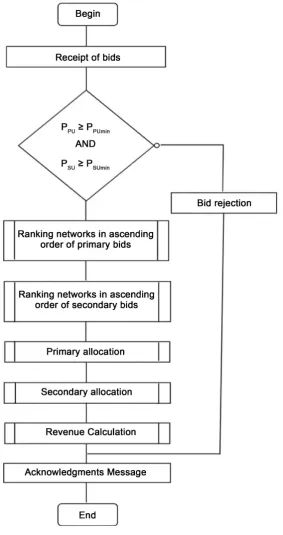
The algorithm is composed of five main functions. The first function is used to elimi-nate all the bidders with wrong prices. The second one allows us to organize networks proposals depending on the bids, starting from the highest bid to the lowest. Then, the third and fourth functions assign the right to be respectively primary or secondary user. The main goal of the last function is to estimate the broker revenue.
where ALLOC1 is a matrix of M lines and n+2 columns containing the allocation
outcome of the different channels and NPU , the number of bidders requesting the
right to be primary user on a channel.
T1 and T2 are two matrices with 2 columns and respectively NPU and NSU lines
containing the different identifiers ant the number of allocated channels. BidsPU
and BidsSU are two matrices containing respectively the primary and secondary user
[image:14.595.233.517.160.696.2]rights offers.
Figure 3 shows the flow chart of this algorithm.
4. Numerical Results
4.1. General Test Configuration
We consider a simple cell in which M =5 channels can be allocated to N =10
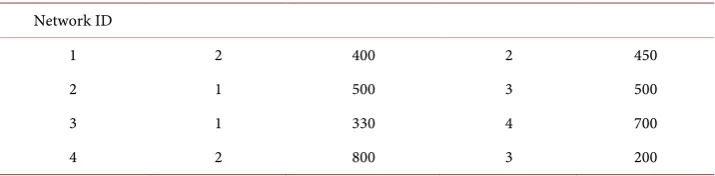
networks. The cell broker leads the available channels allocation procedure. Table 1 shows the channel needs and offers of the different networks for the scenario 1. We assume that the offers in this table are at least equal to the minimum prices given by the broker. Of course, these offers represent the proposed prices per time unit and for one channel. Then, we limit here the number of secondary user on a channel at most four.
[image:15.595.194.553.261.450.2]We can also see below, Table 2 and Table 3 respectively show the channel needs and
Table 1. Channel needs and bids of the networks for scenario 1.
Network IDa
1 2 500 2 550
2 1 600 3 600
3 1 230 4 800
4 2 900 3 100
5 4 300 1 300
6 3 500 3 240
7 1 150 3 450
8 2 710 2 500
9 2 400 1 400
10 3 900 3 840
a. Network ID represents network identity.
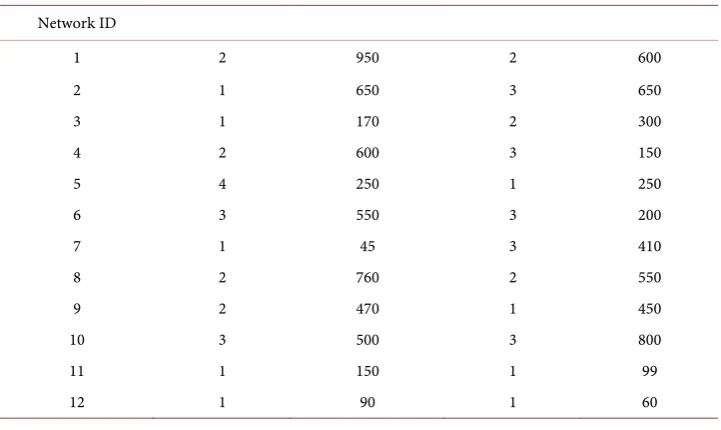
Table 2. Channel needs and bids of the networks for scenario 2.
Network ID
1 2 950 2 600
2 1 650 3 650
3 1 170 2 300
4 2 600 3 150
5 4 250 1 250
6 3 550 3 200
7 1 45 3 410
8 2 760 2 550
9 2 470 1 450
10 3 500 3 800
11 1 150 1 99
[image:15.595.193.554.494.709.2]Table 3. Channel needs and bids of the networks for scenario 3.
Network ID
1 2 400 2 450
2 1 500 3 500
3 1 330 4 700
4 2 800 3 200
offers of the different networks in the scenario 2 and scenario 3. In the scenario 2, we have N =12 networks and N=4 networks in the scenario 3.
All the information concerning the channel needs and proposed bids of all the bidder networks are loaded in external files of our programme. Therefore, we consider two different files that can be called by the computer program: one containing the bids for primary user rights and the other containing the bids for secondary user rights.
4.2. Results and Discussions
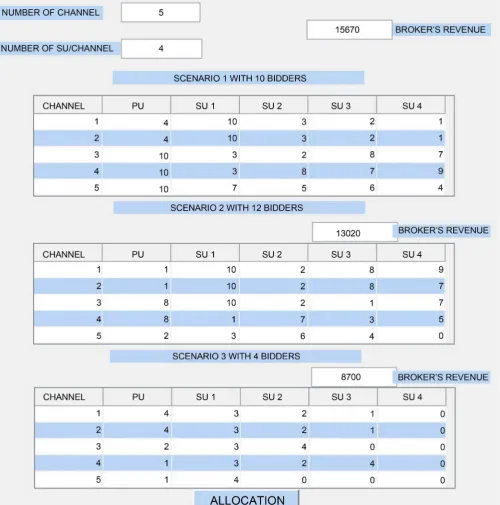
After running the computer program of our DSAP based on the input data given by the previous tables, we obtain the following window in Figure 4. For instance, in the sce-nario 1, this window gives the number of channel NUMBER OF CHANNEL =5, the
number of maximum secondary networks (SU CHANNEL/ =4) which is the
maxi-mum number of secondary users on a channel, the broker revenue
(BROKER SREVENUE′ =15670) per time unit for this allocation, and the result of the
5 channels allocation.
As it is shown on Figure 4, we have the 5 channels allocation in each of the three scenarios where the column “CHANNEL” gives the channels numbered from 1 to 5. The abbreviation “PU” represents the selected primary user according the network identities defined in the different tables mentioned above. The abbreviations “SU1”, “SU2”, “SU3”, and “SU4” defined the four different secondary networks on each chan-nel.
Figure 4.Result of the allocation procedure for the three scenarios.
chan-nels requested by network 4 and three chanchan-nels by network 10. So here, the broker has retained only the two highest proposals, we can imagine, in order to maximize its revenue. In other hand for the secondary user rights demands, networks 1, 2, 3, 5, 7, 8 and 9 are totally satisfied. But, we can observe the lack of two channels for networks 4 and 6; and one channel for network 10. Comparing this result to the Table 1 values, networks 4 and 6 proposed the lowest offers for the secondary user rights. So, it is ob-vious the reason why these networks have not been entirely satisfied.
Finally, in our test configuration, we can easily say that this channel allocation repre-sents the allocation that maximizes the income of the broker among all the allocation possibilities in which the N=5 channels may be assigned to the P=10 networks.
It is also important to precise that the allocation is only for one allocation period and in each allocation period of a day for example, the broker has the possibility to set the minimum prices for the primary and secondary use on the different channels. In this way, the algorithm is very flexible and the broker can set the minimum prices regarding the usual allocation periods with or without lot of traffic demands.
In addition to the explanation provided for the first scenario, in the second scenario, the number “0” mentioned for secondary user (US 4) on the channel 5, means that there is no fourth secondary network on this channel. This is simply because of lack of secondary user right demand. We have the same example in the scenario 3 on the five channels. On the channel 1, 2 and 4, we have three secondary networks less than the maximum allowed number of secondary networks. On the channel 3, we obtain two secondary networks and on the channel 5, only one secondary network.
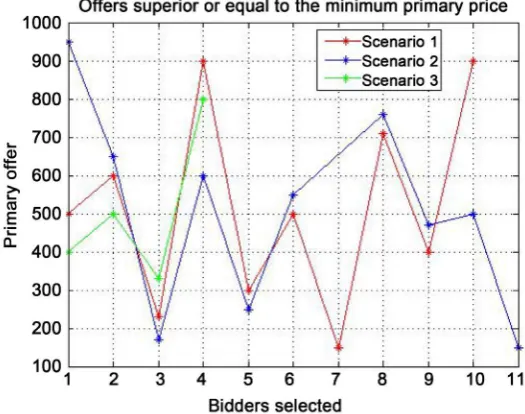
Despite Table 2 for the scenario 2 shows twelve bidders, we remark only ten selected networks; it means that two of them have been eliminated by the algorithm surely be-cause they proposed offers inferior to the minimum prices set by the broker as we can see in Figure 5 for the primary user rights offers and in Figure 6 for the secondary user rights offers. In fact Figure 5 shows the ten networks selected accordingly to their offers that are superior or equal to the minimum primary user price set by the broker. Indeed, for the scenario 2, networks 8 and 12 have not been selected and this corresponds to the lowest values proposed by these two networks for the primary user rights. In the sce-nario 3, all the four networks have been retained as selected bidders for the primary user rights. This scenario may correspond for example to an allocation period where there is no enough traffic transmission requests.
At the level of secondary user rights, in scenario 2, networks 11 and 12 have not been retained by the broker, while in the scenario 3, all the four networks have been selected. Regarding the offers’ table of the scenario 2, networks 11 and 12 suggested the lowest values. Yet, we can say it is obvious that the broker has no selected these two networks.
Figure 5. Curves of the selected primary user networks for the three scenarios.
Figure 6. Curves of the selected secondary user networks for the three scenarios.
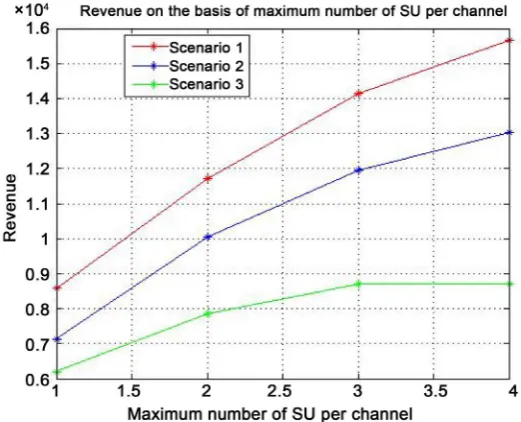
Figure 7. Broker’s revenue based on the number of secondary user net-works on a channel.
3, the number of networks for the secondary use of the channels is less than the maxi-mum allowed number of secondary networks.
Finally, we remark that the broker maximizes its revenue when the maximum al-lowed number of secondary networks on each channel is reached.
5. Conclusions and Perspectives
We describe in this paper a simple dynamic spectrum access protocol (DSAP) that can be used to find out a suitable solution to the problem of access allocation mentioned here for the use of digital dividend. The numerical results presented in Section 5 allow us to conclude that our proposed protocol is viable regarding the spectrum scarcity.
This paper opened two main problems that we can focus on for our future work. We worked with N orthogonal and identical channels, but the non-identical channels case shall be a new configuration of our problem which must be solved. Finally, we men-tioned the case of several DSAP servers in the vicinity of a network node and we re-quired that the network node picks only one of their offers. The procedure of choosing one offer also remains an open problem.
Acknowledgements
We cannot express enough thanks to the research department of ESATIC for their con-tinued support and encouragement: Dr. Francklin Kouassi and Pr. Olivier Asseu, the Chief of the department. We offer our sincere appreciation for the collaboration op-portunities provided by this department.
References
Soft Computing Techniques—A Survey. International Journal of Computational
Intelli-gence and Information Security, 3, 51-63.
[2] Reed, D.P. (2003) Bits Aren’t Bites: Constructing a “Communications Ether” That Can Grow and Adapt. International Symposium on Advanced Radio Technologies (ISART), Boulder, 4 March 2003, 39-46.
[3] OFcom (2004) A Guide to the Spectrum Framework Review.
[4] Ghosh, G., Das, P. and Chatterjee, S. (2014) Cognitive Radio and Dynamic Spectrum Access—A Study. International Journal of Next-Generation Networks, 6, 43-60.
http://dx.doi.org/10.5121/ijngn.2014.6104
[5] Zhao, Q. and Sadler, B.M. (2007) A Survey of Dynamic Spectrum Access. IEEE Signal
Processing Magazine, 24, 79-89. http://dx.doi.org/10.1109/MSP.2007.361604
[6] Ren, P., Wang, Y., Du, Q. and Xu, J. (2012) A Survey on Dynamic Spectrum Access Proto-cols for Distributed Cognitive Wireless Networks. EURASIP Journal on Wireless
Commu-nications and Networking, 2012, 60. http://dx.doi.org/10.1186/1687-1499-2012-60
[7] Liu, C. (2009) Spectrum Sharing in Dynamic Spectrum Access Networks: WPE-II Written Report. Technical Report Available at Scholarly Commons.
[8] Gandhi, S., Buragohain, C., Cao, L., Zheng, H. and Suri, S. (2008) Towards Real-Time Dy-namic Spectrum Auctions. Computer Network, 52, 879-897.
http://dx.doi.org/10.1016/j.comnet.2007.11.003
[9] FCC Auctions.http://wireless.fcc.gov/auctions
[10] Buddhikot, M.M., Kolodzy, P., Miller, S., Ryan, K. and Evans, J. (2005) DIMSUMNet: New Directions in Wireless Networking Using Coordinated Dynamic Spectrum Access. 6th IEEE International Conference on a World of Wireless Mobile and Multimedia Networks
(WoWMoM), Taormina, 16 June 2015, 78-85.
http://dx.doi.org/10.1109/WOWMOM.2005.36
[11] Office of Communications (Ofcom) (2007) A Study into Dynamic Spectrum Access—Final Report. Report No. 72/06/R/353/U, London, England.
[12] Amitay, N. and Greenstein, L.J. (1994) Resource Auction Multiple Access (RAMA) in the Cellular Environment. IEEE Transactions on Vehicular Technology, 43, 1101-1111.
http://dx.doi.org/10.1109/25.330174
[13] Kock, C., Jaekel, H. and Jondral, F. (2005) Auction Sequence as a New Resource Allocation Mechanism. 61st Vehicular Technology Conference (VTC), 1, 240-244.
[14] Grandblaise, D., Moessner, K., Vivier, G. and Tafazolli, R. (2006) Credit Token Based Ren-tal Protocol for Dynamic Channel Allocation. 1st International Conference on Cognitive
Radio Oriented Wireless Networks and Communications (CrownCom), Mykonos Island,
8-10 June 2006, 1-5.
[15] Weiss, T.A. and Jondral, F.K. (2004) Spectrum Pooling: An Innovative Strategy for the En-hancement of Spectrum Efficiency. IEEE Communications Magazine, 42, S8-S14.
http://dx.doi.org/10.1109/mcom.2004.1273768
[16] Huang, J.W., Berry, R.A. and Honig, M.L. (2006) Auction-Based Spectrum Sharing. Mobile
Submit or recommend next manuscript to SCIRP and we will provide best service for you:
Accepting pre-submission inquiries through Email, Facebook, LinkedIn, Twitter, etc. A wide selection of journals (inclusive of 9 subjects, more than 200 journals)
Providing 24-hour high-quality service User-friendly online submission system Fair and swift peer-review system
Efficient typesetting and proofreading procedure
Display of the result of downloads and visits, as well as the number of cited articles Maximum dissemination of your research work