ISSN Online: 2327-4379 ISSN Print: 2327-4352
Observing the Jumping Laser Dogs
Alberto Tufaile1*, Timm A. Vanderelli2, Adriana Pedrosa Biscaia Tufaile1
1Soft Matter Laboratory, Escola de Artes, Ciências e Humanidades, Universidade de São Paulo, São Paulo, Brazil 2Ferrocell USA, 739 Route 259, Ligonier, PA, USA
Abstract
Jumping sun dogs are rapid light flashes changing over clouds, with some of them located close to the places of halo formation in thunder storms clouds. This paper presents an outline of some aspects that are required for understanding the jumping sun dogs, using some experiments with light scattering in complex fluids. In our analogy, we have observed the jumping laser dogs, in which the ice crystals are re-placed by needlelike structures of ferrofluid, the electric field in the atmosphere is represented by an external magnetic field, and the laser beam scattered by the ferrof-luid structure has the same role of the sun as the source of light scattered by the ice crystals subjected to changing electric fields in thunderstorm clouds.
Keywords
Diffracted Rays, Sun Dogs, Laser Dogs, Geometrical Theory of Diffraction
1. Introduction
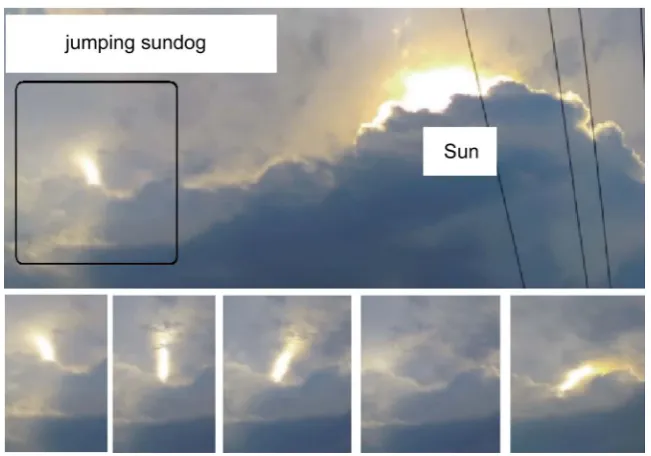
In the past few years, some people have reported the occurrence of a bizarre phenome-non: the observation of rapid light flashes changing over clouds, with some of them lo-cated close to the places of halo formation in thunderstorms clouds, as it is shown in Figure 1, like the motion of a “giant light saber”. These phenomena were observed by accident in the sky, and because of these reports, some researchers have suggested the hypothesis that these phenomena could be related with jumping sun dogs [1] [2].
It has been known for sometime that the light scattering in the ice crystals in a cloud is related to the optical effects like halos and sun pillars, and this hypothesis holds that a lightning discharge in a thundercloud can temporally change the electric field above the cloud where charged ice crystals are reflecting sunlight, and these changes in the elec-tric fields reorient the ice crystals to a new position that scatters sun light differently [3], creating a visual cloud streamer [4]. In this way, we consider that the system How to cite this paper: Tufaile, A.,
Van-derelli, T.A. and Tufaile, A.P.B. (2016) Observing the Jumping Laser Dogs. Jour-nal of Applied Mathematics and Physics, 4, 1977-1988.
http://dx.doi.org/10.4236/jamp.2016.411198
Received: September 27, 2016 Accepted: November 7, 2016 Published: November 10, 2016
Copyright © 2016 by authors and Scientific Research Publishing Inc. This work is licensed under the Creative Commons Attribution International License (CC BY 4.0).
http://creativecommons.org/licenses/by/4.0/
Figure 1. The jumping sun dog phenomenon is shown in these pictures. At the top, in the gener-al view perspective, we can see the thunderstorms clouds with the light flash at the left side of the picture. The luminous white column is swung back and forth at the frequency approximately of 1 Hz during 1 minute, combining fast and slow motions, presented in the pictures at bottom. Pic-tures obtained from Youtube user QUADME13 using the camera of a smartphone in 2015, Greenwood, Indiana, USA.
present in the atmosphere acts as a complex fluid interacting with sun light, in which a mixture of solid phase (ice crystals) and gas phase (air/water vapour) [5] shows the evidence of unusual responses to the applied electric field, creating jumping sun dogs or crown flashes. Based on our previous papers, we are suggesting that some these jump-ing sun dogs are related with the parhelic circle. Like the jumpjump-ing sun dogs, the parhelic circle is mainly white, and the absence of separated colors could indicate a different kind of light scattering, not only light refraction.
The aim of this paper is thus to explore some patterns obtained by light scattering in a complex fluid and comparing them with the jumping sun dogs. In order to accom-plish our goal, we have used a device known as Ferrocell, which consists in a Hele-Shaw cell containing a ferrofluid suspension of ferromagnetic nanoparticles that will be ex-plained in Section 2. The scattering of light in the Ferrocell can create diffracted rays, and in a recent work, we have shown that the formation of sun dogs, sun pillars, and the parhelic circle could be related to these diffracted rays, using the Geometrical Theory of Diffraction (GTD) [6] [7] [8]. In Section 3, we present some properties of light polarization in the light scattering with the Ferrocell, which plays the role of the atmosphere in our analogy. We report the simulation of the jumping sun dogs using the Ferrocell in Section 4. Finally, we present our conclusions in Section 5.
2. Experimental Apparatus
the colloidal suspension of nanoparticles inside the Ferrocell. The ferrofluid is a stable colloidal dispersion using light mineral oil.
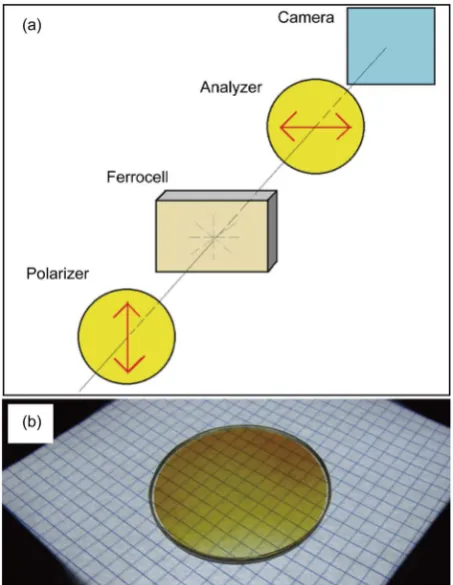
In order to explore the effects of the light scattering in the Ferrocell subjected to an external magnetic field, we have used two different types of light source configurations, the setup 1, for the observation of polarized light effects, and the setup 2, for the case of laser beam scattering obtaining the jumping laser dogs, represented in Figure 2.
In the setup 1, a white light source was generated using a LED panel light (12 W), il-luminating over the complete surface of a square Ferrocell (22 mm × 22 mm) homoge-neously, with a methacrylate diffuser and backlighting technique. Just for this case, the Ferrocell was placed between two crossed polarizers, as it is shown in Figure 2(a). The glass plates used in the Ferrocell in this case are microscope slides. The image is ob-tained directly from the system polarizers/Ferrocell.
[image:3.595.260.487.369.662.2]The setup 2 uses a circular Ferrocell made up of two 58.5 mm diameter glass plates, represented in Figure 2(b). For this case, the light source is a green diode laser (10 mW) with a wavelength of 532 nm. The beam width is around 2,00 mm. Once the beam reaches the Ferrocell, part is reflected, and part is transmitted, scattering the light. The image formed by reflection and transmission of light scattering is projected onto a screen, and a digital camera is used as a light detector of the patterns observed in the experiment.
We have used neodymium (Ne-Fe-B) magnets placed at some distance of the Ferro-cell in order to change the light patterns. For example, the value magnetic field of a cy-lindrical magnet was obtained with a Lakeshore gaussmeter model 475 DSP at room temperature of 27˚C in the plots is shown in Figure 3. Changing the position of the magnets, we can modify the magnetic field in each Ferrocell, and consequently change the structure of the magnetic nanoparticles.
3. Polarized Light and Ferrocell
[image:4.595.231.514.249.633.2]Before getting into the jumping sun dog simulation using laser dogs, let us explain some features of the optical properties of the Ferrocell in the presence of the magnetic field, in order to understand how to control the nanoparticles with an external magnetic
field. Basically, the magnetic nanoparticles arrange themselves in complex geometries in ferrofluids, such as labyrinth or needles, due to the long range dipolar interactions. One way to observe these complex geometries is using polarized light.
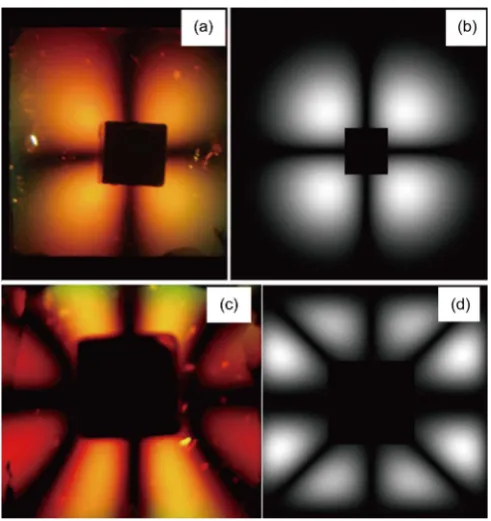
Polarization measurements show that the static magnetic field can alter the structure of the nanoparticles inside the Ferrocell, changing the light polarization, as it is shown in Figure 4. We can see the main effect of a cylindrical magnet placed at the center of the Ferrocell, with the magnetic pole facing the Ferrocell in Figure 4(a).
There are black fringes and bright regions, creating a pattern resembling a cross. The outstanding feature of this pattern is its stability. For example, in Figure 4(e), Figure 4(f) we have used a cubic magnet in the pole configuration, and we have observed a similar pattern of light polarization, like the pattern observed for the cylindrical magnet of Figure 4(a). Changing the position of the magnet, the pattern remains as a dark cross with four bright lobes, centered at the magnet. These patterns are strong evidence that the Ferrocell acts as one diffraction grating in the presence of the magnetic field.
The basic explanation for this behavior is that the ferrofluid is a complex fluid, changing its structure for different values of applied magnetic field. Other structures were observed in ferrofluids, and these structures were reported in the literature more than a decade ago [9].
In a more technical way, these patterns of light polarization represent the Faraday effect in light transmission geometry. For the same value of the magnetic field, there are different values of light intensity in different points of the Ferrocell, indicating some sort of interaction between the structures of the ferrofluid. For example, in Figure 4(b), we can observe the quantitative aspect of light amplitude of a circular stripe chosen around the magnet placed at the center of the Ferrocell1 using the pole configuration. The rotation polarization is periodic inside this circular stripe, and Figure 4(c) shows the diagram of light amplitude. The plot of Figure 4(d) represents the light amplitude for different angle values, ranging from −90˚ to 90˚, projected in y axis.
Using the information obtained from these patterns, we can explain the observed data with a phenomenological model. In order to obtain this model, we need to know the mathematical expression of the external magnetic field created by the magnet, and the equation representing needlelike structure. First, the calculation of the exact mag-netic field of the magnet at any point in space has some mathematical complexities and involves the properties of the magnetic materials. Things are simpler using direct measures of the magnetic field discussed in the previous section, such as the equation obtained for the horizontal component of the magnetic field Bhor of a magnet in the pole configuration of Figure 3(a), which is given by:
(
)
(
)
2 5 2 2 2 1 4π hor D x B x D − =+ , (1)
and for the case of dipole configuration of Figure 3(b):
(
2 2)
5 24π hor Dx B x D = −
where D is a constant featured for this magnet and x is the distance from the center of the magnet to the tip of the magnetic field sensor, based on the diagrams in the plots of Figure 3.
Second, the formation of the needlelike structures of Figure 5 is directed related with the magnetic field B around 200 G, and for the case of the circular stripe of Figure 4(a), Figure 4(b) obtained from the experiment, the direction of the polarization of the needles inside the circular region, with radius R and width a, is given by the coordinates (xi, yi) and (xi+1, yi+1) for the angle θ:
(
)
(
)
1 1
cos sin
i i
i i
x x
R R a
y y
θ θ
+
+
= +
(3)
The neddles are oriented from R to R + a direction, and we have observed from the experiment that the light intensity has the maximum intensity for θ values equal 45˚, 135˚, 225˚, and 315˚. In addition to this, the pattern is black placing a cylindrical mag-net in the pole configuration in the Ferrocell1 for θ values equal 0˚, 90˚, 180˚, and 270˚, because for these angle values the ferrofluid needles are aligned with one of the two po-larizers.
[image:7.595.251.497.377.638.2]With Equations (1)-(3), we can derive the equation for light intensity through the system formed by the first polarizer, Ferrocell, and the second polarizer. The first and last polarizers are oriented at 90˚ with respect to each other, the Ferrocell has its polarization
aligned with the angle θ, with the needles shaped by the magnetic field given by Equa-tion (1). Therefore the second polarizer is rotated an angle (π/2 − θ) from the Ferrocell. Considering the intensity after passing the first polarizer is I1, the intensity after passing the Ferrocell is I2, is given by:
(
)
(
)
2
2
2 1 5 2
2 2 1 cos 4π D r I I r D θ − =
+ . (4)
The intensity after the second polarizer for each point with coordinates (r, θ), I3, is given by:
(
)
(
)
2
2 2
3 2 1 5 2
2 2
1
π π
cos cos cos
2 4π 2
D r
I I I
r D
θ − θ θ
= − = −
+ , (5)
and rearranging the terms of Equation (5), the intensity after the second polarizer is:
( )
(
)
(
)
2
2
3 1 2 2 5 2
1
, sin
16π
D r
I r I
r D
θ = − θ
+ . (6)
where r ranges from 0 to infinity, and θ ranges from 0˚ to 360˚.
Based on this model, we can simulate the light intensity for different configurations of external magnetic fields, as it is shown in Figure 5. This analysis is a very good way to understand the role of ferrofluid needles interacting with light, and we can extrapo-late that a system with ice crystals with same size, oriented by an external electric field could have similar effect in the light scattering. To sum up, we can see that a static magnetic field placed near the Ferrocell creates a structure inside the Ferrocell, which can be mapped with polarized map. In the next section we will explore some aspects of the light scattering in this structure.
4. The Jumping Laser Dogs
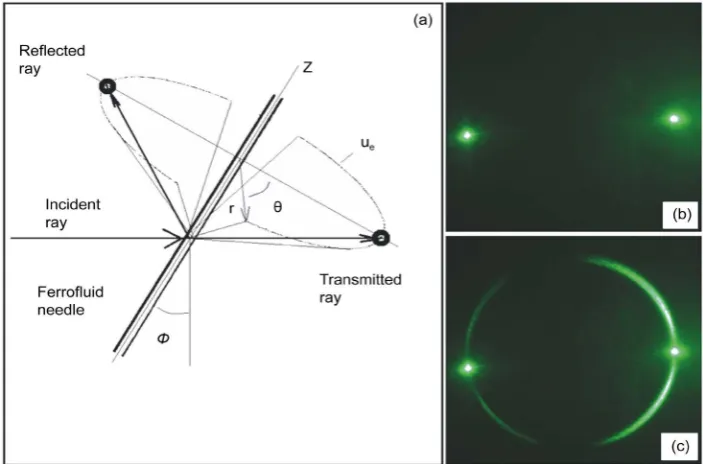
Performing some experiments [7] and obtaining similar light patterns to those ob-served in the atmospheric optics, we consider that it is important to note that the par-helic circle is an effect combining the properties of the geometric optics and wave op-tics at same time, involving the concept of diffracted ray [8]. In this way, the parhelic circle was explained in our previous papers [7] [8] as the manifestation of diffracted rays, as it is shown in Figure 6 and, according to GTD, when a light beam hits a needlelike structure of ice crystals obliquely, there is a cone of diffracted rays and the cross section of this cone is given by:
( )
1 2eikr
e i
u r =Ku r− (7)
Figure 6. The diagram of the laser scattering with the parlaseric circle with the laser dog pattern with nanoparticles forming a needle in (a). In (b), the laser spot and the laser dog with B = 0 gauss, and in (c) the parlaseric circle for B = 600 gauss.
plane θ = 0 contains the incident beam. The angle ϕ defines the tilt between the per-pendicular to the direction of the propagation of the incident beam and the needle. The light scattered emerges along the surface of the cone with apical angle 180˚ - 2ϕ and is viewed on the circle ue, sighting towards the apex of the cone.
The same effect occurs when light hits the needlelike formation in ferrofluids [11]. We can observe this type of diffracted rays for a setup without any polarizer, as it is shown in Figure 6. Part of the green laser is passing through the Ferrocell forming a laser spot at right side of this picture, and part of light is reflected forming the laser dog at left side. Applying the magnetic field in the Ferrocell used in setup 2 induces the cre-ation of diffracted rays, represented by the curved lines of Figure 6(c) for 600 gauss, because the colloidal system of ferrofluids undergoes structural changes under external field leading to linear chains [9], as it was discussed in the previous section.
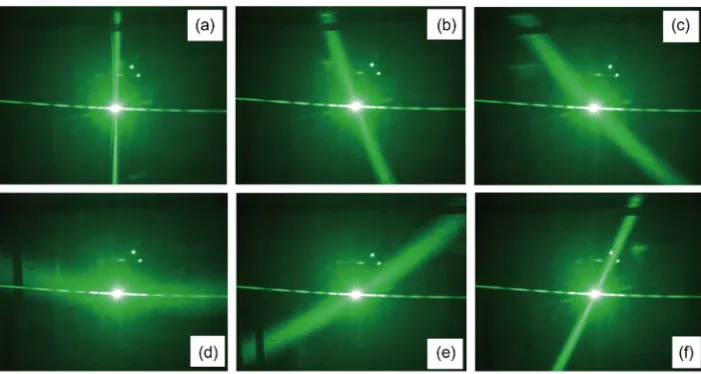
Figure 7. The jumping laser dog dynamics for different orientations of the needlelike particles, changing the external magnetic field. Using the fixed light diffraction of a soap film as the refer-ence, we have measure the following angles between the laser dog and the reference: (a) 90˚, (b) 120˚, (c) 135˚, (d) 180˚, (e) 225˚, and in (f) the laser dog is rotated 245˚.
We can observe that the light streak related to the jumping laser dog is different from that produced by the soap film. First, the laser dog can be controlled by the magnetic field, and second the absence of well defined spacing between fringes from multiple microscope particles, such as ice crystals or nanoparticles. According some authors, the absence of fringe pattern in ferrofluid is an integral sum of diffraction events from in-dividual chains, and the observed pattern can be interpreted as a result of the combina-tion of multiple diffraccombina-tion. Considering that the scale of the ice crystals present in clouds are around hundreds of micrometers, it is plausible to think that the same type of light scattering is present in the systems composed by ferrofluid or ice crystal, and some computational approaches [12] use a mix of geometric optics and Fraunhofer dif-fraction to calculate the scattering of light by ice crystals present in clouds.
5. Conclusions
range dipolar interactions.
In our analogy, the ice crystals are represented by the needlelike structures of ferrof-luid, and electric fields are represented by magnetic fields. For certain conditions of the wavelengths and sizes of these light scatterers, the angles of reflection and refraction are not defined by the angle of incidence, and part of the incoming light striking the scat-terer will give rise to a conical shell of diffracted rays, forming halos or partial halos. Using this comparison, we have inferred that the atmosphere could be associated with a complex fluid, in which a mixture of solid (ice crystals) and gas (air) exhibits unusual responses to applied electric field, creating jumping sun dogs or crown flashes.
Acknowledgements
This work was supported by Conselho Nacional de Desenvolvimento Científico e Tecnológico (CNPq), Instituto Nacional de Ciência e Tecnologia de Fluidos Complexos (INCT-FCx) and Fundação de Amparo à Pesquisa do Estado de São Paulo (FAPESP), FAPESP/CNPq #573560/2008-0.
References
[1] Plait, P. (2011) Discover Magazine Blog.
http://blogs.discovermagazine.com/badastronomy/2011/10/25/amazing-video-of-a-bizarre-twisting-dancing-cloud/#.V36ZzNIrJdh
[2] Tufaile, A.P.B., Vanderelli, T., Amorim, R. and Tufaile, A. (2016) Simulating the Jumping Sun Dogs. Proceedings of 12th Conference on Light and Color in Nature, Granada, 31 May-3 June 2016, 24-25.
https://drive.google.com/drive/folders/0BxhJRGXxaO-FUURIcnpIdEU4QjA
[3] Foster, T.C. and Hallett, J. (2008) Enhanced Alignment of Plate Ice Crystals in a Non- Uniform Electric Field. Atmospheric Research, 90, 41-53.
http://dx.doi.org/10.1016/j.atmosres.2008.02.017
[4] Vonnegut, B. (1965) Orientation of Ice Crystals in the Electric Field of a Thunderstorm.
Weather, 20, 310-312. http://dx.doi.org/10.1002/j.1477-8696.1965.tb02740.x
[5] Koop, T. (2013) Rare but Active. Nature, 498, 302. http://dx.doi.org/10.1038/nature12256
[6] Keller, J.B. (1962) Geometrical Optics Theory of Diffraction.Journal of the Optical Society of America, 52, 116-130. http://dx.doi.org/10.1364/JOSA.52.000116
[7] Tufaile, A. and Tufaile, A.P.B. (2015) Parhelic-Like Circle from Light Scattering in Plateau Borders. Physics Letters A, 379, 529-534. http://dx.doi.org/10.1016/j.physleta.2014.12.006
[8] Tufaile, A. and Tufaile, A.P.B. (2015) The Dynamics of Diffracted Rays in Foams. Physics Letters A, 379, 3059-3068. http://dx.doi.org/10.1016/j.physleta.2015.10.011
[9] Islam, M.F., Lin, K.H., Lacoste, D., Lubensky, T.C. and Yodt, A.G. (2003) Field-Induced Structures in Miscible Ferrofluids Suspensions with and without Latex Spheres. Physical Review E,67, 021402. http://dx.doi.org/10.1103/PhysRevE.67.021402
[10] Conover, E. (2015)Researchers Create “Laser Dogs” with Soap Bubbles. Science.
http://dx.doi.org/10.1126/science.aaa7816
[12] Bi, L., Yang, P., Kattawar, G.W., Hu, Y. and Baum, B.A. (2011) Scattering and Absorption of Light by Ice Crystals: Solution by a New Physical-Geometric Optics Hybrid Method.
Journal of Quantitative Spectroscopy & Radiative Transfer, 112, 1492-1508.
http://dx.doi.org/10.1016/j.jqsrt.2011.02.015
Submit or recommend next manuscript to SCIRP and we will provide best service for you:
Accepting pre-submission inquiries through Email, Facebook, LinkedIn, Twitter, etc. A wide selection of journals (inclusive of 9 subjects, more than 200 journals)
Providing 24-hour high-quality service User-friendly online submission system Fair and swift peer-review system
Efficient typesetting and proofreading procedure
Display of the result of downloads and visits, as well as the number of cited articles Maximum dissemination of your research work