http://www.scirp.org/journal/oje ISSN Online: 2162-1993 ISSN Print: 2162-1985
A New Field Protocol for Determination of
Forest Structure, Biodiversity and Heath Status
by Means of GPS Tools: A Case Study from Gaza
Forest
Yasser El-Nahhal
Department of Environmental and Earth Sciences, Faculty of Science, The Islamic University of Gaza, Gaza, Palestine
Abstract
This article describes the application of GPS, image processing analysis and statistical tools for determination of forest structure and biodiversity. The idea is based on determination of forest area using GPS tools, then taking repre-sentative plots “samples” about 5% - 10% of the forest and counting the tree species in each plot (sample). This process enables the estimation of species population in each plot. The sum of all species population enables the calcula-tion of relative density of each species. Multiplying species populacalcula-tion with plot number of the forest enables the calculations of total species population in the forest. Calculating the relative density enables the determination of dominant, co-dominant, suppressed and flour structure of the forest. To de-termine the age of the forest, we apply our method on determining the di-ameter of trees and grouping them to four groups, this enables the estimation of dominant age within single species. From these data, we can estimate the age of the forest. This field protocol is easy and applicable and provides good results in estimating structure, age and biodiversity in the forest.
Keywords
Forest, Tree Counts, Tree Age, Biodiversity, Health Status, Field Protocol
1. Introduction
Forest and urban trees are of great importance for the environmental quality. It is well known that forests, urban trees and grass lands play critical roles in providing oxygen to the population and reduce carbon dioxide accumulation, maintaining high quality of clean air. Moreover, forests play critical roles in
wa-How to cite this paper: El-Nahhal, Y. (2017) A New Field Protocol for Determi-nation of Forest Structure, Biodiversity and Heath Status by Means of GPS Tools: A Case Study from Gaza Forest. Open Journal of Ecology, 7, 69-83.
http://dx.doi.org/10.4236/oje.2017.71006
Received: December 18, 2016 Accepted: January 22, 2017 Published: January 25, 2017
Copyright © 2017 by author and Scientific Research Publishing Inc. This work is licensed under the Creative Commons Attribution International License (CC BY 4.0).
ter quality, it is documented that forest streams and groundwater is of good quality compared to water from other land uses [1]-[7]. Forest ecology is an im-ported element in the ecosystem in Palestine. The population has special inter-ests in forest and agricultural areas. Nevertheless, forest area in West Bank, Je-rusalem and Gaza Strip decreased from 320 km2 in 1970 to 100 km2 in 2008 [8].
However, Ministry of Agriculture took initiative steps to protect these vulnerable areas through developing forest protecting act. Due to this initiative, the pro-tected natural area reached to 60 Km2. Moreover, further initiative was taken for
greening the urban areas through planting forest trees in the main and sub-main roads. So far, there is a growing need for forest protection, development and management in Palestine. Moreover, residues of forest leaves and woods can friendly be converted to charcoal [9]. Urban trees and forest have critical role in reducing air or noise pollution, decreasing soil erosion and improving water quality. Moreover, they provide habitat for wildlife and become recreation areas for the local population. So far atmospheric pollution and human activi-ties exposing urban trees and forest with pests or disease infestation result in reduction of tree growth. Sustainable management of forests and urban trees maintain high environmental quality and healthy forest. So far poor manage-ment of forests and urban trees may lead to losing tree population, diversity, health status and productivity. Tree population, age and biodiversity are impor-tant elements in the forest that determine its productivity growth, and health status [10]. It is well known in the literature that forest structure is catego-rized into four groups such as canopy trees, dominant trees, co-dominant trees, intermediate trees and suppressed trees.
plots and testing the protocol in different locations.
2. Materials and Methods
2.1. Description of the Study Site
Gaza Strip is a semi-arid zone of southern part of Palestine with a total area of 365 Km2. About 2 million inhabitants live and work. Agricultural activity is the
main activity of large portion of population. Distribution of lands are 166, 126, 45 and 28 Km2 for agricultural land, urban areas, destroyed land and forest area
respectively [33], recent report (Ministry of Agriculture, [34] figured out the agricultural land as vegetables area 81.52, crop land 37.01, and fruit area 79.7 Km2. Average rain fall ranged from 280 - 480 mm/year. Temperature ranged
between 13.4˚C in January to 25.5˚C in July.
2.2. Estimation of the Total Area of the Forest
This step was based on determining four points acting as corners of the forest and determining the distances among them using GPS tools. This enables exact determination of forest area especially in the large-scale issues. To make it easy for a non-specialized reader, we propose a forest with an area of 106 m2 full of
different trees. Using GPS tools and Google Earth, we theoretically subdivided the area of the forest to 100 plots (surveying plots) having nearly the same area, then taking a representative sample of 10% - 15% of the plots for tree counts, tree diameter determination, health status of trees and biodiversity determina-tion.
2.3. Random Selection of Representative Surveying Plots
About 10 - 15 plots can be selected randomly based on complete randomized block design. After selection, using GPS tools the actual position of theses plots can be identified and marked for surveying process.
2.4. Determination of Tree Population, Relative Density, Age,
Health Status and Biodiversity
According to previous development of bioassay techniques [35] [36] and recent development [37] [38], we surveyed the trees in each of the targeted plots (sur-veying plots). This step enables determination of tree types, population of each type (P) and relative density (RD).
2.5. Determination of Average and Standard Deviation of Each
Tree Type in All Plots Using Equation (1)
(
1)
Average of tree type 1 T Tn
n + +
=
∑
(1)where T1++Tn represent tree counts of a tree type 1 in surveying plot 1 up
to plot n, respectively.
cal-culated according to the standard statistical method using Excel software.
2.6. Determination of Correction Factors
If the value of the standard deviation is too high, this indicates a not homoge-neous distribution of the trees in the surveying plots. In this case the extreme value of the tree count should be removed. This makes the values more homo-genized than before. This correction may be done for one plot. Then it is neces-sary to add minus one wherever making the final calculation.
2.7. Determination of Relative Density (RD)
Based on recent development [39] [40], the above calculations provide values of average of each tree type. Then we count the sum of average of all tree types. The produced number is used to estimate the relative density of each type using Eq-uation (2):
average of a tree type RD of a tree type
sum of all averages
= (2)
according to this calculation the sum of RD of all tree types is equal 1. This cal-culation enables the determination of biodiversity of trees in the forest. The highest RD value of a tree indicates the dominant type, co-dominant, suppressed, and forest flour.
2.8. Determination of Total Tree Population (P) in the Forest
Population of a tree type 1 can be calculated according to Equation (3)
1 average of a tree type 1*
P = Z (3)
where Z is the total number of plots in the forest, and consequently the popula-tion of all tree types are determined. In case of a correcpopula-tion factor was made to any tree type during the calculation process to get homogenized average with low value of standard deviation, Equation (4) is used instead of Equation (3) to estimate the corrected population of a tree type
(
)
1 average of a tree type 1* 1
CP = Z− . (4)
The sum of tree population in the forest equals to the sum of all tree types ac-cording to Equation (5)
1 2 3
Pn=P +P +P ++Pn (5)
in case of a correction factor was made during the calculation process, the cor-rected population of a tree type (*P1) is replacing the old value.
2.9. Determination of Forest Tree Age
Figure 1. Measuring tree diameter to characterize tree age (adapted from Ref. [41] [42] [43]).
diameter using the following equation
π A= r
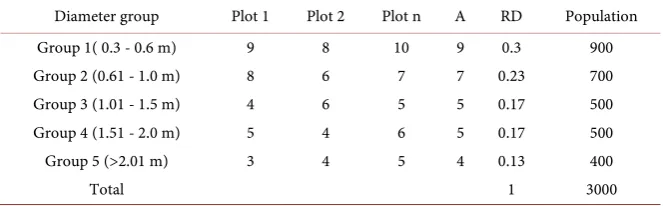
where A is the tree circle and r is the tree diameter. This step enables collections of tree population diameter as in Figure 1. Then these data needs cleaning and grouping as reported in Table 3.
This grouping may be valid and could be applied for other trees. In some case modification of the groups is necessary to be able to survey all types. Based on the calculation shown above for a tree population type, it would be possible to survey the diameters of the corresponding tree type in each surveying plot then summarizing the groups and calculate the average and standard deviation of each group. If a correction factor is necessary to be made then, it can be consi-dered during the calculation. Finding the relative density enables detecting the dominant tree diameter in the tree type consequently knowing the age. This may enable scaling the group age of the trees.
2.10. Determination of Health Status of Forest Tree
In the surveying plots we survey only the attached trees by insects or fungi. Then following the procedure described above we estimate the total attached trees. Then we calculated the relative density of the attached trees (RDAT) as on Equation (6).
sum of attected tree Total tree population
RDAT= . (6)
3. Results
The presented results in Table 1 clearly show the application of the statistical method for determination the RD and population (P) of each tree type assuming nearly homogenized distribution of each tree type in the forest.
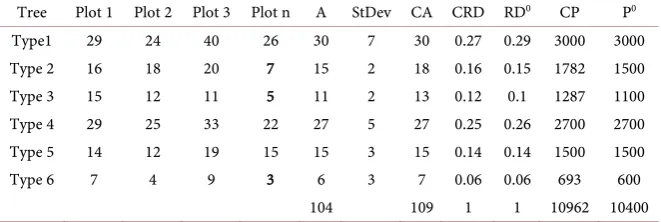
Tree type 1 had the highest RD among all followed by tree type 4, tree type 2, tree type 5. It can be concluded that tree type 1 is the dominant type in the forest followed by tree type 5, co-dominant type, type 3 is suppressed group whereas group 3 and 6 can be considered the forest floor. The data in Table 2 clearly show theoretical calculation of unhomogenized distribution of tree types (type 2, 3 and 6) as reported in bold in the table. These values were removed from calcu-lating the average and RD. Accordingly revised average and RD values were ob-tained. Consequently, the values of corrected average (CA), corrected relative density (CRD) and corrected population (CP) are higher than original ones (A, RD0 and P0). These data indicate the validation of the applied method for
deter-mination of forest structure and biodiversity. These results agree with recent
[22]-[27] and previous reports [44] [45] who used weed index to survey weed population under field conditions.
3.1. Determination of Forest Tree Age
[image:6.595.206.539.455.566.2]The data in Table 3 provide possible calculation and diameter grouping of one tree type. According to the variation of collected field results, three-five groups may be generated and applied. It may be possible to reduce them to lower or higher number of groups based on the collected field data.
Table 1. Homogenized theoretical calculation of a forest population.
Tree Plot 1 Plot 2 Plot n Average RD Population (P)
Type1 29 24 26 26 0.26 2600
Type 2 16 18 20 18 0.18 1800
Type 3 15 12 11 13 0.13 1300
Type 4 29 25 22 25 0.25 2500
Type 5 14 12 15 14 0.14 1400
Type 6 3 4 7 5 0.05 500
Total 101 1.00 10,100
Table 2. Calculation based on corrected average (CA).
Tree Plot 1 Plot 2 Plot 3 Plot n A StDev CA CRD RD0 CP P0 Type1 29 24 40 26 30 7 30 0.27 0.29 3000 3000 Type 2 16 18 20 7 15 2 18 0.16 0.15 1782 1500 Type 3 15 12 11 5 11 2 13 0.12 0.1 1287 1100 Type 4 29 25 33 22 27 5 27 0.25 0.26 2700 2700 Type 5 14 12 19 15 15 3 15 0.14 0.14 1500 1500
Type 6 7 4 9 3 6 3 7 0.06 0.06 693 600
104 109 1 1 10962 10400
[image:6.595.209.540.600.711.2]Table 3. Tree type 1 diameter grouping in the forest.
Diameter group Plot 1 Plot 2 Plot n A RD Population
Group 1( 0.3 - 0.6 m) 9 8 10 9 0.3 900
Group 2 (0.61 - 1.0 m) 8 6 7 7 0.23 700
Group 3 (1.01 - 1.5 m) 4 6 5 5 0.17 500
Group 4 (1.51 - 2.0 m) 5 4 6 5 0.17 500
Group 5 (>2.01 m) 3 4 5 4 0.13 400
Total 1 3000
A = average, RD = relative density.
3.2. Determination of Age of the Dominant Trees in the Forest
Based on the data presented in Table 3, it would be possible to collect a sample of each type of the trees and making a stem cut as in Figure 1to know the exact stem circle which indicates number of tree age in years. Moreover, it would be possible use the published data base to know the average diameter of each age group of the trees.
3.3. Determination of Health Status of the Forest
Forest trees may be attacked by insects and fungi and a serious damage may oc-cur to the trees. Application of the model mentioned above enables surveying the attacked trees. Then it would be possible to estimate the relative density of attacked trees (RDAT) from Equation (6). If the calculated value is equal or less than 0.05 the forest is healthy, if above, then the forest is not healthy. Moreover, the RDAT can be referred to as critical limit of pest attack.
Based on the data presented in Table 4, it would be possible estimate the at-tacked trees and calculate the RDAT.
4. Discussion
In this paper we provided an easy applied field protocol for estimating tree ab-undance, population, relative density, biodiversity and health status. The proto-col based on theoretical and practical field survey. The strong point of the pro-tocol is that it is flexible in determining the average and the standard deviation and make homogenization in case of high variation in the survey plots as in Ta-ble 1 and Table 2. Moreover, the protocol enabled corrections to avoid extreme values to be in the actual mode of estimation. In addition, the protocol enabled the determination of biodiversity of forest at end point and its health status (Table 4). The weak point of the protocol is that it cannot be applied for forest was exposed to disasters or ecological imbalance. Furthermore, the paper provided several possibilities of using the protocol in estimating the tree abundance, bio-diversity, total population, and health status.
Table 4. Tree type 1 diameter grouping in the forest.
Pest type Plot 1 Plot 2 Plot n Average RDAT attached trees Sum of
Insect 6 9 16 10.33 9.43 1033.33
Fungi 8 12 4 8 7.30 800
in Gaza for a small agricultural area (1 Km2) data not shown. In this test, two
weed populations (Cyperus rotundus and Setaria viridis) were estimated by the model and by manual sorting method [11] [25] [37] [40] [44]. There has been about 11% difference between the two methods of estimation. A traceable inves-tigation of errors found that Cyperus rotundus weed was counted as Setaria vi-ridis in many cases due to similarity of plant feature (see Figure 2).
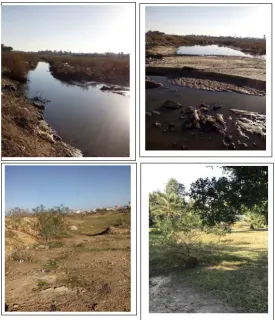
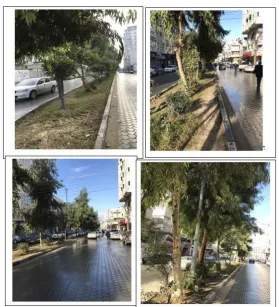
Correcting this minor mistake in the test, reduced the difference from 11% to 7% between the two method of estimation. This test validates our field protocol for estimating forest tree population and relative density. More support to our field protocol comes from estimating urban trees in two main roads in Gaza Strip (Salah Eddin Street 45 km long; Omer Al-Mukhtar Street 5 km long). The protocol found 17% difference between actual number in trees in the data base of Municipality of Gaza and those existing in the street. Traceability test of the street found about 5 km long of the street free from trees due to road construc-tion and repair. Applicaconstruc-tion of the correcconstruc-tion in our field protocol (Table 2) re-duced the difference from 17% to 6%, confirming the accuracy of our field pro-tocol. The test with Omer Al-Mukhtar street shows 7% difference which is in the acceptable range of field difference [46] [47]. Further support to our field proto-col came from testing the field protoproto-col in a protected area (Wadi Gaza) (Figure 3) and found differences less that 5% in the planted trees such as fruit trees (olive trees, grapes, palm) but we found 19% differences in weed population in the Wadi and in urban trees (Figure 4). Traceable investigation found differ-ences in soil types which was stand behind the differdiffer-ences in weed population
[48] [49]. Additional support to the protocol comes for practical testing the prod-uctivity in agricultural land cultivated with cabbage (Figure 5). So far, the pre-sented results clearly show practical application of field protocol for determining forest tree population relative density and biodiversity. These data agree with previous reports [46] [47] who used weed index to estimate the abundance of weeds in herbicides treated field plots. Further support to our method come from Ref. [48] and Ref. [49] who estimated the field phyto-toxicity of pesticides using plant biomass and heights. Moreover, several authors [50] [51] [52] [53] [54]
Figure 2. Photos of weeds used to test the field protocol (photos adopted from Wikipe-dia).
Figure 3. Testing the field protocol in estimation of trees and weed in different sections of Widi Gaza.
[image:9.595.236.512.382.703.2]Figure 4. Testing the field protocol in estimation of urban tree population and biodiver-sity (photos adopted from different locations).
Figure 5. Testing the field protocol in estimation of agricultural productivity in cabbage field.
[image:10.595.287.461.422.626.2]popula-tion of desert plants in a coastal area will not be homogenized due to growth conditions. Under these conditions, the field protocol may be validated if the area can be subdivided to a small scale and deal with each scale as a separate unit in applying the protocol.
5. Conclusion
The field protocol provides accurate results that can easily match the data ob-tained by manual investigation. The protocol can easily be applied for multi scale environment. It is also valid for large scale forests where trees are normally grown without any man-made interference and not exposed to fire or a disaster. So far, the protocol can easily be applied for estimating productivity, health status and maturity of fruits of agricultural lands. Moreover, it is a useful tool in investigating percentage of seed germination in large scale agricultural land, testing herbicidal activity and maturity of fruits in large field scale, to evaluate sugar production in citrus fruit. The weak point of protocol is that it may not provide accurate results in a small scale forest where trees are exposed to grazing of animal infestation. The method can save time and efforts and cost of evalua-tion.
Acknowledgements
Special thanks to the Alexander von Humboldt foundation for a Research Fel-lowship at Leipzig University and BAM institute Germany 2016. I would also like to thank my students at faculty of science for helping me during the field work.
Ethical Statement
This study was not funded by any organization.
Conflict of Interest
Author declares that he has no conflict of interest. The study complies with the international ethics issues.
References
[1] Callesen, I., Raulund-Rasmussen, K., Gundersen, P. and Stryhn, H. (1999) Nitrate Concentrations in Soil Solutions below Danish Forests. Forest Ecology and Man-agement, 114, 71-82. https://doi.org/10.1016/S0378-1127(98)00382-X
[2] Thornton, K.W., Holbrook, S.P., Stolte, K.L. and Landy, R.B. (2000) Effects of For-est Management Practices on Mid-Atlantic Streams. Environ. Monitoring and As-sessment, 63, 31-41. https://doi.org/10.1023/A:1006449131282
[3] El-Nahhal, Y. (2006) Contamination of Groundwater with Heavy Metals in Gaza.
Proceedings of the Tenth International Water Technology Conference, Alexandria, Egypt, 23-25 March 2006, 1139-1150.
[5] El-Nahhal, I., Al-Najar, H. and El-Nahhal, Y. (2014) Physicochemical Properties of Sewage Sludge from Gaza. International Journal of Geosciences, 5, 586-594.
https://doi.org/10.4236/ijg.2014.56053
[6] Al-Arifi, S.N., Al-Agha, R.M. and El-Nahhal, Z.Y. (2013) Environmental Impact of Landfill on Groundwater, South East of Riyadh, Saudi Arabia. Journal of Natural Science Research, 3, 222-242.
[7] Al-Arifi, S.N., Al-Agha, R.M. and El-Nahhal, Z.Y. (2013) Hydrogeology and Water Quality of Umm Alradhma Aquifer, Eastern Saudi Arabia. Journal of Environment and Earth Science, 3, 118-127.
[8] Hammad, B. (2013) Forests in Palestine Ministry of Agriculture. Proceedings of D. G. of Forests and Rangeland, Vienna, 14-18 February 2013, 1-31.
[9] Telbani, M. (2016) Environmental Production of Charcoal from Plant Leaves. M.Sc Thesis, The Islamic University-Gaza, Palestine.
[10] Chen, J.M., Zhou, W.W., Poyarkov Jr., N.A., Stuart, B.L., Brown, R.M., Lathrop, A., Wang, Y.Y., Yuan, Z.Y., Jiang, K., Hou, M., Che, H.M., Suwannapoom, C., Ngoc Nguyen, S., Van Duong, T., Papenfuss, T.J., Murphy, R.W., Zhang, Y.P. and Che, J. (2016) A Novel Multilocus Phylogenetic Estimation Reveals Unrecognized Diversity in Asian Horned Toads, Genus Megophrys sensu Lato (Anura: Megophryidae).
Molecular Phylogenetics and Evolution, 106, 28-43.
[11] El-Nahhal, Y., Safi, M., Tubail, K. and Safi, J. (2013) Effect of Treated Wastewater Irrigation on Plant Growth and Soil Properties in Gaza Strip Palestine. American Journal of Plant Science, 4, 1736-1743. https://doi.org/10.4236/ajps.2013.49213 [12] Kaschl, A., El-Nahhal, Y., Abu Mourad, T., Tubail, K., Safi, J., Hadar, Y., Chen, Y.
and Roemheld, V. (1998) Long Term Field Experiment to Examine the Agricultural Application of Municipal Solid Waste Compost in Gaza Strip. Proceedings of Verb and Deutscher Landwirtschaftlicher Untersuchungsund Forschungsanstalten, Eila-dung, 17-18 September 1998, 251-254.
[13] El-Nahhal, Y., Nir, S., Serban, S., Rabinowitz, O. and Rubin, B. (2001) Organoclay Formulation of Acetochlor for Reduced Movement in Soil. Journal of Agricultural and Food Chemistry, 49, 5464-5371. https://doi.org/10.1021/jf010561p
[14] El-Nahhal, Y., Undabeytia, T., Polubesova, T., Golda Mishael, Y., Nir, S. and Rubin, B. (2001) Organo-Clay Formulations of Pesticides: Reduced Leaching and Photode-gradation. Applied Clay Science, 18, 309-326.
https://doi.org/10.1016/S0169-1317(01)00028-X
[15] Kauffman, J.B. and Donato, D.C. (2012) Protocols for the Measurement, Monitor-ing and ReportMonitor-ing of Structure, Biomass and Carbon Stocks in Mangrove Forests. Working Paper 86, CIFOR, Bogor.
[16] ISO (2011) ISO 14051:2011. Environmental Management—Material Flow Cost Ac-counting—General Framework. ISO, Geneva.
[17] Kokubu, K. and Kitada, H. (2015) Material Flow Cost Accounting and Existing Management Perspectives. Journal of Cleaner Production, 108, 1279-1288. https://doi.org/10.1016/j.jclepro.2014.08.037
[18] Papaspyropoulos, K.G., Karamanolis, D., Sokos, C.K. and Birtsas, P.K. (2016) En-hancing Sustainability in Forestry Using Material Flow Cost Accounting. Open Journal of Forestry, 6, 324-336. https://doi.org/10.4236/ojf.2016.65026
[19] GoK (2009) Rehabilitation of the Mau Forest Ecosystem, Project Concept by the Interim Coordinating Secretariat. Office of the Prime Minister.
https://doi.org/10.1111/j.1440-1770.2008.00367.x
[21] Olson, J.M. and Maitima, J.M. (2006) Sustainable Intensification of Mixed Crop- Livestock Systems, Land Use Change Impacts and Dynamics (Lucid). International Livestock Research Institute, Nairobi.
[22] Enanga, M., Shivoga, W., Maina-Gichaba, C. and Creed, F. (2011) Observing Changes in Riparian Buffer Strip Soil Properties Related to Land Use Activities in River Njo-ro Watershed, Kenya. Water and Air Soil Pollution, 218, 587-601.
https://doi.org/10.1007/s11270-010-0670-z
[23] Njue, N., Koech, E., Hitimana, J. and Sirmah, P. (2016) Influence of Land Use Ac-tivities on Riparian Vegetation, Soil and Water Quality: An Indicator of Biodiversity Loss, South West Mau Forest, Kenya. Open Journal of Forestry, 6, 373-385. https://doi.org/10.4236/ojf.2016.65030
[24] Matano, A.S., Kanangire, C.K., Anyona, D.N., Abuom, P.O., Gelder, F.B., Dida, G.O., Owour, P.O. and Ofulla, A.V.O. (2015) Effects of Land Use Change Degrada-tion Reflected by Soil Properties along Mara River, Kenya and Tanzania. Open Journal of Soil Science, 5, 20-38. https://doi.org/10.4236/ojss.2015.51003
[25] El-Nahhal, Y. and Hamdona, N. (2016) Adsorption, Leaching and Phytotoxicity of Some Herbicides as Single and Mixtures to Some Crops. Journal of the Association of Arab Universities for Basic and Applied Science,in Press.
https://doi.org/10.1016/j.jaubas.2016.01.001
[26] Wang, Y.Y., Yuan, Z.Y., Jiang, K., Hou, M., Chen, H.M., Suwannapoom, C., Ngoc Nguyen, S., Van Duong, T., Papenfuss, T.J., Murphy, R.W., Zhang, Y.P. and Che, J. (2016) A Novel Multilocus Phylogenetic Estimation Reveals Unrecognized Diversity in Asian Horned Toads, Genus Megophrys sensu lato (Anura: Megophryidae). Mo-lecular Phylogenetics and Evolution, 106, 28-43.
[27] Khan, M.N., Hijbeek, R., Berger, U., Koedam, N., Grueters, U., Islam, S.M., Hasan, M.A. and Dahdouh-Guebas, F. (2016) An Evaluation of the Plant Density Estimator the Point-Centred Quarter Method (PCQM) Using Monte Carlo Simulation. PLoS ONE, 11, e0157985. https://doi.org/10.1371/journal.pone.0157985
[28] Duarte, G.T., Ribeiro, M.C. and Paglia, A.P. (2016) Ecosystem Services Modeling as a Tool for Defining Priority Areas for Conservation. PLoS ONE, 11, e0154573. https://doi.org/10.1371/journal.pone.0154573
[29] Kushwaha, S.P., Nandy, S. and Gupta, M. (2014) Growing Stock and Woody Bio-mass Assessment in Asola-Bhatti Wildlife Sanctuary, Delhi, India. Environmental Monitoring and Assessment, 186, 5911-5920.
https://doi.org/10.1007/s10661-014-3828-0
[30] Choi, Y.J., Klosterman, S.J., Kummer, V., Voglmayr, H., Shin, H.D. and Thines, M. (2015) Multi-Locus Tree and Species Tree Approaches toward Resolving a Complex Clade of Downy Mildews (Straminipila, Oomycota), Including Pathogens of Beet and Spinach. Molecular Phylogenetics and Evolution, 86, 24-34.
https://doi.org/10.1016/j.ympev.2015.03.003
[31] Ureta Adrianzén, M. (2015) Aboveground Biomass Input of Myristicaceae Tree Species in the Amazonian Forest in Peru. Revista de Biología Tropical, 63, 263-273. https://doi.org/10.15517/rbt.v63i1.14254
[32] Slik, J.W., Arroyo-Rodríguez, V., Aiba, S., Alvarez-Loayza, P., Alves, L.F., Ashton, P., et al. (2015) An Estimate of the Number of Tropical Tree Species. Proceedings of the National Academy of Sciences of the United States of America, 112, 7472-7477. https://doi.org/10.1073/pnas.1423147112
Development, 1-194.
[34] Ministry of Agriculture, PNA (2016) Annual Report. Gaza Strip, Palestine. [35] El-Nahhal, Y. (2003) Persistence, Mobility, Efficacy and Safety of Chloroacetanilide
Herbicide Formulation under Field Conditions. Environmental Pollution, 124, 33-
38. https://doi.org/10.1016/S0269-7491(02)00431-1
[36] El-Nahhal, Y. (2003) Adsorptive Behavior of Acetochlor on Organoclay Complexes.
Bulletin of Environmental Contamination and Toxicology, 70, 1104-1111. https://doi.org/10.1007/s00128-003-0096-z
[37] El-Nahhal, Y., Awad, Y. and Safi, J. (2013) Bioremediation of Acetochlor in Soil and Water Systems by Cyanobacterial Mat. International Journal of Geosciences, 4, 880- 890. https://doi.org/10.4236/ijg.2013.45082
[38] El-Nahhal, Y., Wheidi, B. and El-Kurdi, S. (2016) Development of Ecologically Ac-ceptable Chlorpyrifos Formulation for Effective and Safe Application. Journal of Encapsulation and Adsorption Sciences, 6, 91-108.
https://doi.org/10.4236/jeas.2016.63008
[39] El-Nahhal, Y., EL-dahdouh, N., Hamdona, N. and Alshanti, A. (2016) Toxicological Data of Some Antibiotics and Pesticides to Fish, Mosquitoes, Cyanobacterial Mats and to Plants. Data in Brief, 6, 871-880. https://doi.org/10.1016/j.dib.2016.01.051 [40] El-Nahhal, Y. and Hamdona, N. (2015) Phytotoxicity of Alachlor, Bromacil and
Diuron as Single or Mixed Herbicides Applied to Wheat, Melon, and Molokhia.
SpringerPlus, 4, 364. https://doi.org/10.1186/s40064-015-1148-7
[41] Lafortezza, R., Davies, C., Sanesi, G. and Konijnendijk, C. (2013) Green Infrastruc-ture as a Tool to Support Spatial Planning in European Urban Regions. iForest—
Biogeosciences and Foresty, 6, 102-108. https://doi.org/10.3832/ifor0723-006 [42] Millennium Ecosystem Assessment (2005) Ecosystems and Human Well Being:
Synthesis. Island Press, Washington DC.
[43] Urban Forest Monitoring (2016) Chapter 3. 188-211. http://www.emonfur.eu [44] El-Nahhal, Y., Nir, S., Polubesova, T., Margulies, L. and Rubin, B. (1997) Organo-
Clay Formulations of Alachlor: Reduced Leaching and Improved Efficacy. Weeds, 1, 21-26.
[45] El-Nahhal, Y., Lagaly, G. and Rabinovitz, O. (2005) Organo-Clay Formulations of Acetochlor: Effect of High Salt. Journal of Agricultural and Food Chemistry, 53, 1620-1624. https://doi.org/10.1021/jf040383a
[46] El-Nahhal, Y., Nir, S., Polubesova, T., Margulies, L. and Rubin, B. (1998) Leaching, Phytotoxicity and Weed Control of New Formulations of Alachlor. Journal of Agricultural & Food Chemistry, 46, 3305-3313. https://doi.org/10.1021/jf971062k [47] El-Nahhal, Y., Nir, S., Polubesova, T., Margulies, L. and Rubin, B. (1999) Movement
of Metolachlor in Soil: Effect of Organo-Clay Formulation. Pesticide Science, 55, 857-864.
https://doi.org/10.1002/(SICI)1096-9063(199908)55:8<857::AID-PS24>3.0.CO;2-P [48] El-Nahhal, Y., Nir, S., Serban, C., Rabinowitz, O. and Rubin B. (2000)
Montmoril-lonite-Phenyltrimethylammounium Yields Environmentally Improved Formula-tions of Hydrophobic Herbicides. Journal of Agricultural and Food Chemistry, 48, 4791-4801. https://doi.org/10.1021/jf000327j
[49] El-Nahhal, Y., Nir, S., Margulies, L. and Rubin, B. (1999) Reduction of Photodegra-dation and Volatilization of Herbicides in Organo-Clay Formulations. Applied Clay Science, 14, 105-119.
(1997) Dioxins, Dibenzofurans and PCBs in Human Blood, Human Milk and Food from Israel, The West Bank and Gaza. Organohalogen Compounds, 33, 457-461. [51] Schecter, A., Papke, O., Isaac, J., Hrimat, N., Neiroukh F., Safi, J. and El-Nahhal, Y.
(1997) 2,3,7,8 Chlorine Substituted Dioxins and Dibenzofuran Congeners in 2,4-D, 2,4,5-T and Pentachlorophenol. Organohalogen Compounds, 32, 51-55.
[52] Abed, M.A., Safi, M.N., Köster, J., Beer, D., El-Nahhal, Y., Rullkötter, J. and Gar-cia-Pichel, F. (2002) Microbial Diversity of a Heavily Polluted Microbial Mat and Its Community Changes Following Degradation of Petroleum Compounds. Applied Environmental Microbiology, 68, 1674-1683.
https://doi.org/10.1128/AEM.68.4.1674-1683.2002
[53] Rubin, B., El-Nahhal, Y., Nir, S. and Margulies, L. (2001) Slow Release Formulations of Pesticides. Patent No. US6,261,997 B1.
[54] Heinze, S., Chen, Y., El-Nahhal, Y., Hadar, Y., Jung, R., Safi, J., Safi, M., Tarchitzky, J. and Marschner, B. (2014) Small Scale Stratification of Microbial Activity Parame-ters in Mediterranean Soils under Freshwater and Treated Wastewater Irrigation.
Soil Biology and Biochemistry, 70, 193-204. https://doi.org/10.1016/j.soilbio.2013.12.023
[55] Bornstein, R., Safi, J., El-Nahhal, Y., Isaac, J., Rishmawi, K., Luria, M., Mahrer, Y., Ranmar, D. and Weinroth, E. (2001) Transboundary Air-Quality Effects from Ur-banization. UJSU Report to USAID-Merc.
[56] Nir, S., El-Nahhal, Y., Undabeytia, T., Rytwo, G., Polubesova, T., Mishael, Y., Rabi-novitz, O. and Rubin, B. (2006) Clays and Pesticides. Developments in Clay Science, 1, 677-691. https://doi.org/10.1016/S1572-4352(05)01021-4
[57] Nir, S., Undabeytia, T., Yaron, D., El-Nahhal, Y., Polubesova, T., Serban, S., Rytwo, G., Lagaly, G. and Rubin, B. (2000) Optimization of Adsorption of Hydrophobic Herbicides on Montmorillonite Preadsorbed by Monovalent Organic Cations: Inte-raction between Phenyl Rings. Environmental Science and Technology, 34, 1269- 1274. https://doi.org/10.1021/es9903781
[58] El-Nahhal, Y., Abadsa, M. and Affifi, S. (2013) Adsorption of Diuron and Linuron in Gaza Soils. American Journal of Analytical Chemistry, 4, 94-99.
https://doi.org/10.4236/ajac.2013.47A013
[59] Safi, J., Awad, Y. and El-Nahhal, Y. (2014) Bioremediation of Diuron in Soil and by Cyanobacterial Mat. American Journal of Plant Sciences, 5, 1081-1089.
https://doi.org/10.4236/ajps.2014.58120
[60] Safi, J., Abu Foul, N., El-Nahhal, Y. and El-Sebae, A. (2002) Monitoring of Pesticide Residues on Cucumber, Tomatoes and Strawberries in Gaza Governorates, Pales-tine. Nahrung, 46, 34-49.
Submit or recommend next manuscript to SCIRP and we will provide best service for you:
Accepting pre-submission inquiries through Email, Facebook, LinkedIn, Twitter, etc. A wide selection of journals (inclusive of 9 subjects, more than 200 journals)
Providing 24-hour high-quality service User-friendly online submission system Fair and swift peer-review system
Efficient typesetting and proofreading procedure
Display of the result of downloads and visits, as well as the number of cited articles Maximum dissemination of your research work
Submit your manuscript at: http://papersubmission.scirp.org/
![Figure 1. Measuring tree diameter to characterize tree age (adapted from Ref.[43] [41] [42] )](https://thumb-us.123doks.com/thumbv2/123dok_us/7785034.723174/5.595.211.535.71.296/figure-measuring-tree-diameter-characterize-tree-adapted-ref.webp)