Rothamsted Research willow (
Salix
spp.) breeding programme;
multi-site yield trial results 2011
By W J MACALPINE 1, I F SHIELD 1, L R E WALSH 2, A R MCCRACKEN 3,
H WILSON 4, J GILLILAND 5, A R HUGHES 6, J CUNNIFF1 and A KARP 1
1Centre for Bioenergy and Climate Change, Rothamsted Research, Harpenden, Herts, AL5 2JQ,
UK
2Applied Plant Science and Biometric Division, Agri-Food and Biosciences Institute, N.I.
Horticulture & Plant Breeding Station, Manor House, Loughgall, Armagh, BT61 8JB, Northern Ireland, UK
3Applied Plant Science and Biometric Division, Agri-Food and Biosciences Institute, Newforge
Lane, Belfast, BT9 5PX, Northern Ireland, UK
4Renewable Energy Growers Ltd, Unit 2, Market Weighton Business Centre, Becklands Park,
York Road, Market Weighton, York, YO43 3GL, UK
5Rural Generation Limited, Brook Hall Estate, 67 Culmore Road, L’Derry, BT48 8JE, Northern
Ireland, UK
6University of Bristol, Fenswood Farm, Wild Country Lane, Long Ashton, Bristol, BS41 9EB,
UK
Summary
The Rothamsted Research-based Salix spp. breeding programme has been running since 2003. This paper reports the yields of the most advanced lines in the willow breeding pipeline. The material tested was bred in January 2004 and has been through three rounds of selection within the programme. Yield trials were planted at five sites and each consisted four replicates of each variety in a randomised block design. Yield trials were planted in spring 2008, cut back in February 2009 and the first harvest in winter 2010/11. Seven yield standards drawn from commercial varieties and seven potentially new varieties produced at Rothamsted were chosen. The average yield of the commercial varieties was 12.30 t d.m. ha-1 yr-1 in wetter
western sites and 6.71 d.m. t ha-1 yr-1 in dryer eastern sites. RR04246 ‘Roth
Cotswold’ (12.97 t d.m. ha-1 yr-1 west, 5.34 t d.m. ha-1 yr-1 east) and RR04248 ‘Roth
Chiltern’ (12.49 t d.m. ha-1 yr-1 west, 5.91 t d.m. ha-1 yr-1 east) have been selected
from these trials for submission for DUS testing and registration with the CPVO for plant breeder’s rights. RR04250 (12.76 t d.m. ha-1 yr-1 west, 8.06 t d.m. ha-1 yr-1 east)
has provisionally selected for registration in 2012.
Introduction
Interest in dedicated perennial energy crops (short rotation coppice (SRC) willow and miscanthus) has grown enormously in the past 20 years. Most recently there has been a realisation that they offer greater greenhouse gas and energy efficiencies and greater flexibility to be planted on a wider range of land types than annual arable crops for energy. Rothamsted Research ran the Defra funded Biomass for Energy Genetic Improvement Network (BEGIN) from 2003 to 2010. In the seven crossing seasons between 2004 and 2010, 609 crosses were attempted. BEGIN built upon the work of the European Willow Breeding Partnership (EWBP) (Lindegaard & Barker, 1997) and, as the UK’s only active willow (Salix spp.) breeding programme, now continues as the Rothamsted Willow Breeding Programme. Breeding at Rothamsted is underpinned by one of the largest and most comprehensive willow germplasm collections in the world, the UK National Willow Collection (NWC). The NWC was initiated in the 1920s at Long Ashton Research Station (North Somerset) and moved to Rothamsted Research in 2002. It contains in excess of 1300 accessions and comprises over 100 different
Salix species (Trybush et al. 2008). Breeding at Rothamsted is also underpinned by dedicated research projects at Rothamsted that strengthen the willow breeding pipeline and improve efficiencies within it (Macalpine et al. 2010). The primary aims are to produce high yielding, pest and disease resistant elite genotypes with a growth habit that facilitates mechanical harvesting in all UK environments; arable, grassland and upland. In addition, attention is paid to temperate environments worldwide.
Material and Methods
Yield trials
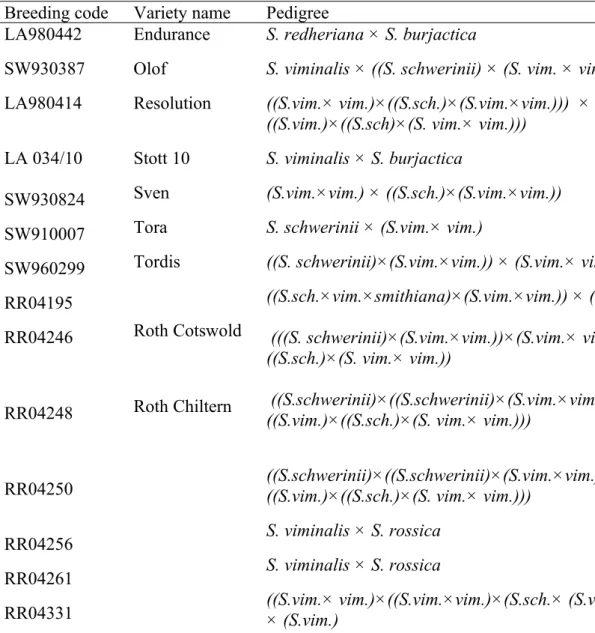
After selection from the Nursery, Observation Trial 1 and Observation Trial 2, as described in Macalpine et al. (2010) seven potential varieties from the first round crossing in 2004 were progressed to yield trials. Yield trials were planted with seven yield standards, four varieties from the Svalöf-Weibull (now Lantmännen SW seed) breeding programme in Sweden and three from the EWBP. See Table 1 for the pedigrees of the all genotypes included in the trial. Details of previous performance of these commercial varieties and more are presented elsewhere in this volume (Lindegaard et al. 2011) and in Lindegaard et al. (2001).
Trials were planted in spring 2008 using 20 cm hard wood cuttings. The first season’s growth was cut back/coppiced to circa 5 cm above ground level in February 2009 at the end of the first growing season and whilst the willows were still winter-dormant. After this cut back the willows were grown for two growing seasons before harvesting the above ground biomass for a destructive yield measurement in winter 2010/11.
Yield trial design
consisting of the yield area. All trials were planted using the conventional twin row design. Trials at Rothamsted Research and Fenswood Farm were planted with a spacing of 0.8 m within twin rows and 1.6 m between pairs of rows, cuttings were spaced at 0.5m within the rows. This planting design represents a stocking rate of 16,666 plants per ha. Trials in Lincolnshire and Loughgall were planted with a spacing of 0.75 m within twin rows and 1.5 m between pairs of rows, cuttings were spaced at 0.59m within the rows. This planting design represents a stocking rate of 15,408 plants per ha.
Table 1. Pedigree information for Yield Trial 2008 components
Breeding code Variety name Pedigree LA980442
SW930387
LA980414
LA 034/10
SW930824
SW910007
SW960299
RR04195
RR04246
RR04248
RR04250
RR04256
RR04261
RR04331
Endurance
Olof
Resolution
Stott 10
Sven
Tora
Tordis
Roth Cotswold
Roth Chiltern
S. redheriana × S. burjactica
S. viminalis × ((S. schwerinii) × (S. vim. × vim.)) ((S.vim.× vim.)×((S.sch.)×(S.vim.×vim.))) × ((S.vim.)×((S.sch)×(S. vim.× vim.)))
S. viminalis × S. burjactica
(S.vim.×vim.) × ((S.sch.)×(S.vim.×vim.)) S. schwerinii × (S.vim.× vim.)
((S. schwerinii)×(S.vim.×vim.)) × (S.vim.× vim.)
((S.sch.×vim.×smithiana)×(S.vim.×vim.)) × (S.vim.×vim.) (((S. schwerinii)×(S.vim.×vim.))×(S.vim.× vim.)) × ((S.sch.)×(S. vim.× vim.))
((S.schwerinii)×((S.schwerinii)×(S.vim.×vim.))) × ((S.vim.)×((S.sch.)×(S. vim.× vim.)))
((S.schwerinii)×((S.schwerinii)×(S.vim.×vim.))) × ((S.vim.)×((S.sch.)×(S. vim.× vim.)))
S. viminalis × S. rossica S. viminalis × S. rossica
((S.vim.× vim.)×((S.vim.×vim.)×(S.sch.× (S.vim.×vim.)))) × (S.vim.)
Yield trial sites
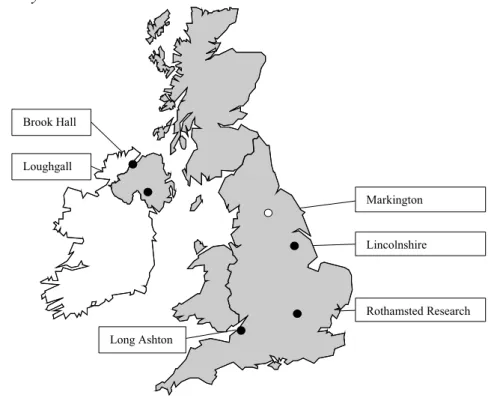
Trials were situated in six locations in England and Northern Ireland (Fig. 1). Three at research stations; Rothamsted Research (51º48’N, 0º21’W), Fenswood Farm, Long Ashton, University of Bristol (51º25’N, 2º40’W) and Loughgall, Agri-Food and Biosciences Institute (AFBI), Northern Ireland (54º24’ N, 6º35’W); and three hosted by parties involved in the SRC industry; Renewable Energy Growers Ltd (trial sited in Lincolnshire (53°23' N, 0°32' W)), Rural Generation Ltd, Londonderry, Northern Ireland and Murray Carter, Markington, Harrogate, North Yorkshire. Murray Carter’s trial was planted one year later than other trials so results from this trial are not presented here. Rural Generation Ltd’s trial results are not presented as two of the four replicates were not available for analysis. The Loughgall and Fenswood Farm sites were considered as western sites and the Rothamsted and Lincolnshire sites were considered as Eastern sites. Soils at the trial sites are as follows; Rothamsted Research, silty clay loam with flints over clay, Fenswood Farm, silty loam, Loughgall, heavy clay loams and Lincolnshire, shallow well drained brashy calcareous fine loamy soils over Jurassic limestone, with abundant fragmented limestone to the surface.
Figure 1. 2008 Multi-site yield trial locations
Trial planted 2009 Trials planted 2008
Yield Harvest
This paper will present results for the 2008 Yield Trials. The methodology used for the destructive yield harvest is detailed in Macalpine et al. (2010).
Statistical Analysis
Rothamsted Research Lincolnshire Markington
Long Ashton Brook Hall
Analysis of the yield data was carried out in Genstat for Windows, 10th Edition. GenStat 10 (Payne et al. 2007). A restricted maximum likelihood (REML) and a Wald test were performed. REML was used rather than ANOVA due to missing values being present at some sites. For the east west analysis a Wald test with a significance level of 5% was used. The same residual variation was assumed across all four sites for this test as variation was small.
Rust disease assessments
Rust assessments were conducted at the Rothamsted and Long Ashton sites in July and September or October. Pei et al. (2008) gave details of the six stage key that was used for field rust assessments.
Results
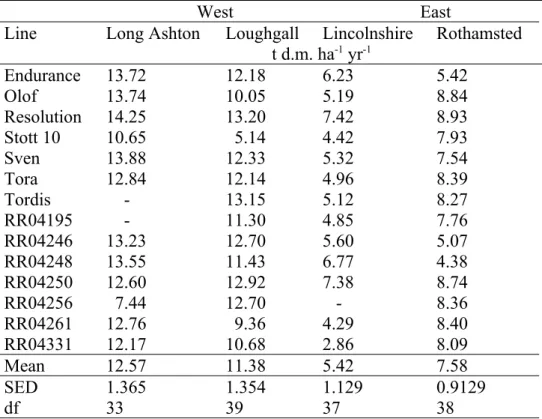
Estimated dry weight yields for 2008 Yield Trials are presented in Table 2 for all sites. All yield data represents yield taken from two year old above ground biomass in the first harvest cycle. Results have been adjusted to represent tonnes of dry matter (d.m.) ha-1 yr-1.
Table 2. Yield results for 2008 Yield Trials
West East
Line Long Ashton Loughgall Lincolnshire Rothamsted t d.m. ha-1 yr-1
Endurance Olof Resolution Stott 10 Sven Tora Tordis RR04195 RR04246 RR04248 RR04250 RR04256 RR04261 RR04331 13.72 13.74 14.25 10.65 13.88 12.84 -13.23 13.55 12.60 7.44 12.76 12.17 12.18 10.05 13.20 5.14 12.33 12.14 13.15 11.30 12.70 11.43 12.92 12.70 9.36 10.68 6.23 5.19 7.42 4.42 5.32 4.96 5.12 4.85 5.60 6.77 7.38 -4.29 2.86 5.42 8.84 8.93 7.93 7.54 8.39 8.27 7.76 5.07 4.38 8.74 8.36 8.40 8.09
Mean 12.57 11.38 5.42 7.58
SED df 1.365 33 1.354 39 1.129 37 0.9129 38
Rainfall data from sites near the trials is presented in Table 3. There are some missing values for daily rainfall from the Filton (39 days missing) and Aldergrove (42 days missing) data sets. Only the Rothamsted metrological data was collected in precise proximity to the Yield Trial site. The Aldergrove met site is approximately 25 miles away from Loughgall, the Filton met site is approximately 7 miles away from Long Ashton and Gringley-on-the-Hill is approximately 16 miles away from the Lincolnshire trial site. The growing season represents the total rainfall from 1st April to 30th September.
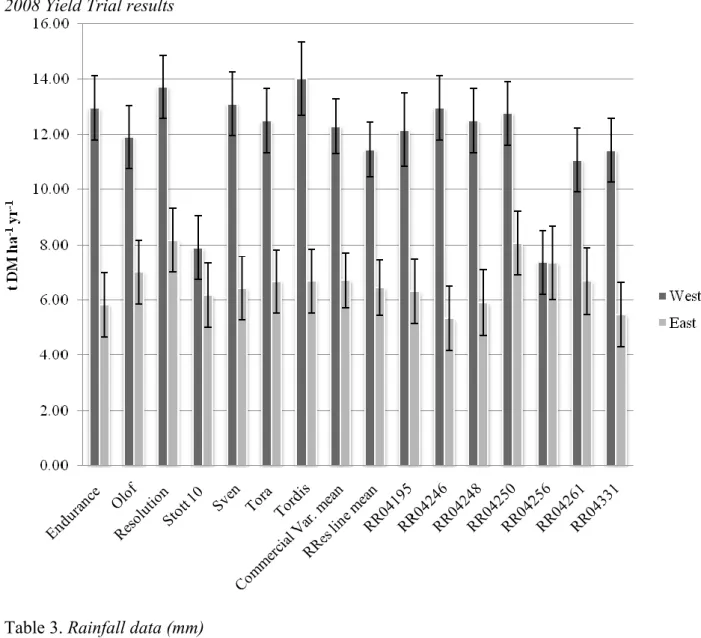
Figure 2. Pooled Long Ashton and Loughgall ‘West’ and Rothamsted and Lincolnshire ‘East’ 2008 Yield Trial results
Table 3. Rainfall data (mm)
Aldergrove, NI
Filton, Bristol
Rothamsted Research
Gringley-on-the-Hill, Lincolnshire
Growing season 2008 416.40 512.70 440.80 383.70
Growing season 2009 459.00 326.80 292.50 327.30
Annual 2009 851.40 826.40 764.50 631.30
Growing season 2010 390.60 292.40 299.50 247.30
Annual 2010 769.60 551.60 644.20 492.20
Trial Total GS 1266.00 1131.90 1032.80 958.30
Trial Total Annual 2483.20 2317.50 2290.80 1856.60
Mean GS 422.00 377.30 344.27 319.43
Mean Annual 827.73 772.50 763.60 618.87
Discussion
Yields were lower at Rothamsted and Lincolnshire sites as although productive, the soils are not as moisture retentive as those found at Long Ashton and Loughgall. The higher rainfall and lower evaporative demand of the two more western sites over the total period of the trial further compounded the difference in yields.
There was a significant vertebrate grazing pressure at the Lincolnshire and Long Ashton sites. Although the majority of test genotypes proved unpalatable, RR04256 was particularly palatable. This grazing pressure accounts for its poor performance.
The higher Melampsora spp. rust pressure at western sites accounts for ‘Stott 10’s’ (synonymous with Ashton Stott) poor performance at Loughgall and Long Ashton. Early autumn assessments at Long Ashton found that the majority of leaves had rust pustules with up to an average of 5% of the leaf area covered by uredinia and that plants showed slight defoliation due to rust. Assessments at Rothamsted revealed that the rust infection was not as severe on Stott 10. At Rothamsted, RR04331 showed some mild rust susceptibility. In addition to showing that Stott 10 is now highly susceptible to rust, assessments at Long Ashton also revealed that the following are mildly susceptible to rust, Olof, Resolution, RR04256, RR04261 and RR04331. Infection on these five genotypes was very low. It is unlikely that such mild infection will reduce yield but leaves occasionally (usually less than 5% of the total leaves in a plant) did bear a few conspicuous uredinia.
RR04248 established poorly at Rothamsted and this accounts for the poor yield in Table 2. The poor establishment could be attributed to use of inappropriate cutting material. Despite being aware of the affects of using sub optimal material (Shield et al. 2008), sometimes compromises are made when aiming to plant replicated multisite trials with limited stocks.
As seen in Fig 2, RR04250 and Resolution’s yields appear more robust across the eastern and western environments. Their potential ability to produce an excellent yield on a fertile site with adequate rainfall and to produce a serviceable yield in the sub optimal eastern conditions make them good potential choices for inclusion in a SRC plantation. This plasticity across sites is a very desirable trait.
trials to what will be obtained when grown commercially. Nevertheless by comparing and combining data from all sites it is possible to have reasonable confidence that new genotypes which are selected for commercialisation will perform consistently well in a range of circumstance.
RR04246, RR04248 and RR04250 are the most promising Rothamsted genotypes in the western sites and had yields comparable to the to the current SRC varieties. RR04246 ‘Roth Cotswold’ and RR04248 ‘Roth Chiltern’ have been selected from these trials and were submitted for DUS testing and registration with the Community Plant Variety Office (CPVO) for plant breeder’s rights in spring 2011. Multiplication beds have also been established with commercial partners and it is anticipated that these two varieties should be ready for commercial release in spring 2013. RR04250 has provisionally selected for registration in 2012 and its release date is likely to be spring 2014.
This paper has reported on the final stage in the Defra-funded BEGIN willow breeding pipeline of the most promising material from crosses in 2004. Three new promising varieties have produced yields similar to their contemporaries have been delivered to the market. Breeding continues at Rothamsted and there will be further rounds of yield trials exploiting the most promising materials from crosses made in successive years. This yield trial only represents the exploitation of 27 of the 609 crosses made at Rothamsted so far. Spring 2011 has seen seven new yield trials established with partners at sites around Europe. Material in these trials has seen more species diversity than found in the S. viminalis and S. schwerinii dominated 2004 progeny.
Acknowledgements
The authors would like to thank Peter Fruen, March Castle and Tim Barraclough as well as Rothamsted Research farm staff, Godfrey Harbard at Fenswood Farm and the team at AFBI for carrying out the destructive yield harvests. BEGIN was funded by the Department for Environment, Food and Rural Affairs project No. NF0424 (2003-2010). Rothamsted Research is an Institute of the UK Biotechnology and Biological Sciences Research Council (BBSRC).
References
Lindegaard K N, Barker J H A. 1997. Breeding willows for biomass. Aspects of Applied
Biology49:155-162.
Lindegaard K N, Parfitt R I, Donaldson G, Hunter T, Dawson W M, Forbes E.G.A, Carter
M M, Whinney C C, Whinney J E , Larsson S. 2001. Comparative trials of elite Swedish and
UK biomass willow varieties. Aspects of Applied Biology65:183-192.
Lindegaard K N, Carter M M, McCracken A, Shield I F, Macalpine W J, Hughes A,
Hinton Jones M, Valentine J and Larsson S. 2011. Comparative trials of elite Swedish and
UK biomass willow varieties 2001-2010. Aspects of Applied Biology??: ???-???
Macalpine W J, Shield I F, Karp A. 2010. Seed to near market variety; the BEGIN willow
Payne R W, Murray D A, Harding S A, Baird D B, Soutar D M. 2007.GenStat for Windows- Introduction, 10th Edn. Hemel Hempstead: VSN International.
Pei M H, Lindegaard K, Ruiz C, Bayon C. 2008. Rust resistance of some varieties and
recently bred genotypes of biomass willows. Biomass and Bioenergy32: 453-459
Shield I F, Macalpine W J, Karp A. 2008. The effect of the size of the cuttings planted on the
subsequent performance of three contrasting cultivars for short rotation coppice. Aspects of Applied Biology 90: 225-231.
Trybush S, Jahodová Š, Macalpine W J, Karp A. 2008. A Genetic Study of a Salix