http://www.scirp.org/journal/ojapps ISSN Online: 2165-3925
ISSN Print: 2165-3917
Comparison of Water Resource Management
Programs: An Algae Action Threshold Level
Approach
West M. Bishop
1,2*, Ben E. Willis
11SePRO Research and Technology Campus, 16013 Watson Seed Farm Rd. Whitakers, NC, USA 2Department of Crop and Soil Sciences, North Carolina State University, Raleigh, NC, USA
Abstract
Water resource management programs designed to control nuisance algal festations have historically been dominated by reactive approaches. With in-creased regulatory scrutiny regarding algaecide use, data regarding efficacy of integrated management approaches are needed. This research outlines an effi-cient method of comparing management programs based upon exceeding designated algae action threshold levels (AATL) in pond systems. Phosphorus mitigating technologies were specifically evaluated as phosphorus had been indicated in supporting many nuisance algal types/densities. The objectives of this research were to evaluate pond management programs in terms of action thresholds exceeded, number of reactive algaecide treatments and algaecide amount required to maintain ponds below AATL. This research compared management programs consisting of: 1) Copper sulfate; 2) SeClear Algaecide and Water Quality Enhancer; and 3) Phoslock phosphorus binding technolo-gy plus SeClear (as needed). Water and algae samples were analyzed every two weeks over two growing seasons on replicated research ponds and compared with designated AATL parameters. If an AATL was exceeded, then a reactive algaecide treatment was implemented for the corresponding water body. Ponds managed by copper sulfate alone exceeded a greater amount of AATL and required a significantly greater (P < 0.05) amount of reactive algaecide treatments to maintain control (average 6.5 annually) whereas SeClear and Phoslock plus ponds required 4.3 and 1.8 treatments, respectively. The aver-age amount of copper applied to maintain ponds below AATL was 1414 g with copper sulfate whereas copper amendments were significantly decreased with SeClear (830 g) and even further with Phoslock plus management pro-grams (342 g). Additionally, management propro-grams incorporating nutrient mi-tigation required fewer treatments and less copper in year two of the program. This research provides valuable information for water resource managers to How to cite this paper: Bishop, W.M. and
Willis, B.E. (2017) Comparison of Water Resource Management Programs: An Algae Action Threshold Level Approach. Open Journal of Applied Sciences, 7, 31-41. https://doi.org/10.4236/ojapps.2017.72003
Received: December 13, 2016 Accepted: February 7, 2017 Published: February 10, 2017
Copyright © 2017 by authors and Scientific Research Publishing Inc. This work is licensed under the Creative Commons Attribution International License (CC BY 4.0).
evaluate integrated approaches to water resource management in terms of so-cial, economic, operational and regulatory viewpoints.
Keywords
Water Resource Management, Algal Bloom, Action Threshold, Phosphorus, Copper
1. Introduction
Water resource management in pond systems is often based on promoting aes-thetic quality, although can include other critical usages such as preservation of recreational activities, fisheries production and quality/usability of water for ir-rigation [1]. As nuisance and noxious algal blooms are increasingly impacting water resources throughout the world [2] [3], a paralleled demand for efficient solutions has arisen. Furthermore, as regulatory scrutiny has intensified, more research is needed on new, integrated and holistic pond management programs [4]. Management can include both proactive techniques (e.g. nutrient mitiga-tion) and reactive strategies (e.g. algaecide applications). Since a common man-agement program includes periodic algaecide applications upon achieving nuis-ance algal biomass levels, recent regulations have mandated consideration (and implementation where appropriate) of other management approaches. Since prevention is a key component of advanced management goals, and a decrease of algaecide inputs is desired, data are needed to compare the effectiveness (cost and efficacy) of different management approaches that maintain acceptable le-vels of algae while employing both preventative and (if needed) reactive control measures.
re-growth and exceeding an action threshold). Integration of proactive man-agement may decrease the dominance of nuisance algal types (mat/scum for-mers, toxin producing cyanobacteria, etc.) and growth potential, thus, re-quiring less reactive management to maintain ponds below designated AATL. More research is needed regarding efficient comparison of pond management programs in order to allow water resource managers to make informed decisions using scientifically defensible data on predicted efficacy, economic viability, and ecological integrity.
Cyanobacteria, in particular, have garnered increased awareness in ponds due to the risks and obviation of water resource uses associated with their presence. Cyanotoxins (e.g. hepatotoxins, neurotoxins, dermatitis toxins) are more ram-pantly being studied due to the documented impacts to pets, livestock, humans and other organisms external to the water resource [5] [6] [7]. Additionally, some cyanotoxins can negatively impact fish and invertebrate health and other structural characteristics of cyanobacteria may decrease productivity of the sys-tem with less energy flow up the food chain [8] [9] [10]. Pond systems afflicted with cyanobacteria often require strategic management to create a safe and usa-ble resource. Excessive phosphorus inputs and decreased nitrogen-to-phosphor- rus ratios have, in part, significantly increased the frequency and distribution of toxin-producing cyanobacterial blooms [11] [12] [13]. Limiting phosphorus availability can be an important factor in preventing cyanobacterial presence and dominance [14]. Pond management programs that incorporate phosphorus mi-tigation can hypothetically decrease the degree of cyanobacteria infestation (e.g. density, duration) and concomitantly offset intensity of reactive management.
Copper sulfate pentahydrate has been historically used to reactively manage algae in pond systems [15]. However, recent innovations in phosphorus miti-gating technologies may provide more efficient and sustainable avenues to ma- nage ponds. Phoslock® (registered trademark of Phoslock Water Solutions, Ltd.; not a registered algaecide) consists of a patented lanthanum (5%) modified ben-tonite clay formulation that is strictly designed to remove bio-available phospho- rus from water and sediments [16] [17]. An additional product recently regis-tered consists of 4.2% copper combined with a water quality enhancer (Se- Clear® Algaecide and Water Quality Enhancer; SePRO Corporation; USEPA reg-istration No. 67690-55; patent pending) and is the only product that provides both effective algaecidal activity (i.e. reactive) and is formulated to remove pho- sphorus from the system (i.e. proactive). There are no water use restrictions fol-lowing application of Phoslock or SeClear and both are additionally approved for use in potable water sources.
techniques through time that employ both algaecidal activity as well as phos-phorus removal in order to evaluate the long-term benefits of integrated man-agement approaches, in terms of algaecide loading and operational cost. The overall objective of this research was to compare a strictly reactive algal manage- ment approach with programs incorporating proactive techniques to maintain ponds below designated AATL and ensure functionality of the water resource. The specific objectives of this research were: 1) to compare water quality para-meters and algal assemblage composition and densities between three treatment programs, and 2) to compare amount of action thresholds exceeded, number of reactive treatments required, and copper input needed to maintain ponds below AATL over a two-year period between three treatment programs.
2. Materials and Methods
2.1. Study Site Description
Replicated research ponds (0.04 hectare surface area and average depth of 1.2 meters) at the SePRO Research and Technology Campus (Whitakers, NC) were used for this experiment (36˚07'35.34''N; 77˚47'37.49''W). Ponds designated as Numbers 1, 7, 8, 9, 10 and 14 were selected for this study based on similarity in background water characteristics, water volume, water input dynamics (water- shed, evaporation and seepage) and historic algal assemblage. If pond water le-vels fell below 85% of full pool, they were filled with similar designated reservoir water.
2.2. Treatment Programs
2.3. Action Threshold Levels and Sample Analysis
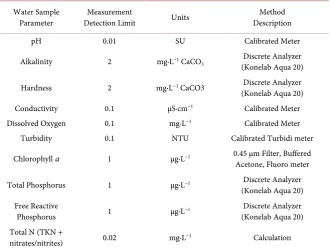
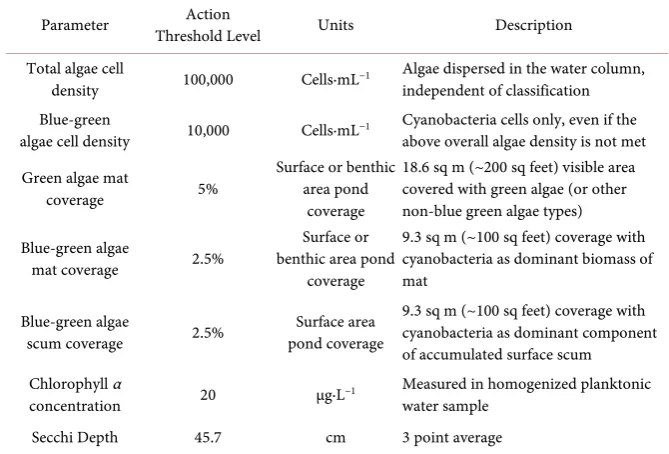
Ponds were monitored every two weeks from the beginning of June through the end of September over two growing seasons. Samples were taken randomly from four sites throughout each pond and homogenized to attain a single composite sample. Each pond was treated individually to compare variability between rep-licates. All samples were transferred to the SePRO Research and Technology Campus accredited laboratory (ISO 17025:2005; Whitakers, NC) for processing. Water quality parameters were collected and measured according to Standard Methods with documented quality assurance/quality control parameters and in-cluded: pH, dissolved oxygen, temperature, alkalinity, chlorophyll α, Secchi depth, total nitrogen, turbidity, and algal assemblage composition and densities ([19]; Table 1). Action thresholds for these pond systems were designed based on conservative levels that negatively impact typical pond uses and to proactively avoid severe algal infestations. See Table 2 for a list of parameters that each ac-count for an AATL, which, upon exceeding, trigger a reactive algaecide applica-tion.
2.4. Statistics
[image:5.595.209.541.482.732.2]A Mann-Whitney Rank Sum Test (α = 0.05) was used to discern differences be-tween ponds treated with the same program in the same year, and differences between pooled data from the same program for different years (assuming no difference between ponds treated with the same program). An ANOVA and Student Newman-Keuls Method (α = 0.05) were used to discern differences be-tween AATL exceeded, number of reactive treatments and mass of copper
Table 1. Description of water quality parameters evaluated and analytical methods used to measure.
Water Sample
Parameter Detection Limit Measurement Units Description Method
pH 0.01 SU Calibrated Meter
Alkalinity 2 mg·L−1 CaCO3 Discrete Analyzer (Konelab Aqua 20)
Hardness 2 mg·L−1 CaCO3 Discrete Analyzer (Konelab Aqua 20)
Conductivity 0.1 µS·cm−1 Calibrated Meter
Dissolved Oxygen 0.1 mg·L−1 Calibrated Meter
Turbidity 0.1 NTU Calibrated Turbidi meter
Chlorophyll α 1 µg·L−1 0.45 µm Filter, Buffered Acetone, Fluoro meter
Total Phosphorus 1 µg·L−1 Discrete Analyzer (Konelab Aqua 20) Free Reactive
Phosphorus 1 µg·L−1 (Konelab Aqua 20) Discrete Analyzer Total N (TKN +
applied between the three treatment programs (copper sulfate, SeClear, and Phos-lock plus SeClear; α = 0.05). All data were analyzed using SigmaPlot® 12.3 [20].
3. Results and Discussion
3.1. Action Threshold Levels
[image:6.595.204.539.504.731.2]The cyanobacterial cell density AATL parameter was exceeded the greatest throughout this study across all treatments. In year one, copper sulfate exceeded the cyanobacterial threshold the most (average of 56% of sampling events), whereas SeClear and Phoslock plus programs exceeded the cyanobacterial cell density parameter for 44% and 19% of sampling periods, respectively. In year two, a similar amount of sampling events for both copper sulfate and SeClear exceeded the cyanobacterial cell density AATL (i.e. 30%), whereas Phoslock plus SeClear only exceeded on 11% of sampling events. The total number of times this action threshold was exceeded (over two years) was 15 for copper sulfate, 13 for SeClear, and 5 for Phoslock plus programs, resulting in the Phoslock plus program achieving significantly less cyanobacterial AATL than the copper sul-fate or SeClear programs (P = 0.014). The overall intensity of the cyanobacterial infestations (i.e. cell density) was greater in the copper sulfate treated ponds in year one and higher for the SeClear treated ponds in year two. SeClear treat-ments provided greater control of cyanobacteria post-treatment as measured at subsequent sampling events. Copper sulfate ponds increased in cyanobacterial densities following application on four separate sampling periods (Figure 1). These data suggest SeClear is a more effective cyanobactericide than copper sul-fate based on the degree of control and decrease of cyanobacterial re-growth rates post-treatment. Reference [21] found phosphorus to be a key component
Table 2. Designation of algae action threshold levels (AATL) that when exceeded would trigger a corresponding reactive algaecide application.
Parameter Threshold Level Action Units Description
Total algae cell
density 100,000 Cells·mL−1 Algae dispersed in the water column, independent of classification Blue-green
algae cell density 10,000 Cells·mL−1 Cyanobacteria cells only, even if the above overall algae density is not met Green algae mat
coverage 5%
Surface or benthic area pond
coverage
18.6 sq m (~200 sq feet) visible area covered with green algae (or other non-blue green algae types) Blue-green algae
mat coverage 2.5%
Surface or benthic area pond
coverage
9.3 sq m (~100 sq feet) coverage with cyanobacteria as dominant biomass of mat
Blue-green algae
scum coverage 2.5% pond coverage Surface area
9.3 sq m (~100 sq feet) coverage with cyanobacteria as dominant component of accumulated surface scum Chlorophyll α
in copper detoxification by algae. Simultaneous phosphorus removal with a copper exposure may result in increased algaecidal activity as observed in this study. Furthermore, fertilized algae were less susceptible to copper exposures than without fertilization [22] [23]. Addressing nutrients can be critical in alter-ing the efficacy of a copper treatment.
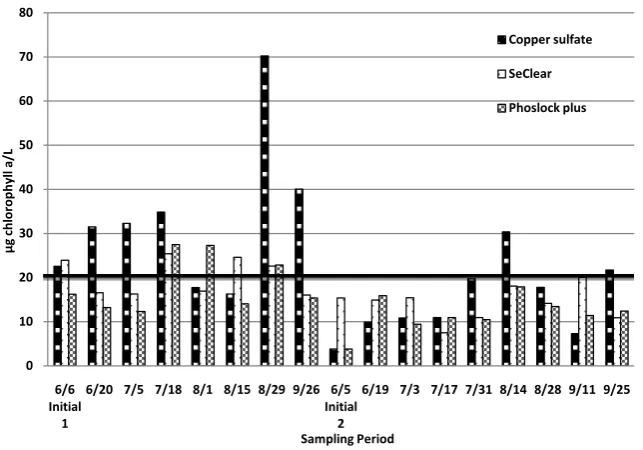
[image:7.595.208.537.239.435.2]Chlorophyll α comprised the second greatest AATL exceeded that conse-quently instigated reactive algaecide treatments. The total number of times this AATL was exceeded (over two years) was 15 for copper sulfate, 6 for SeClear, and 5 for Phoslock plus programs (Figure 2). Interestingly, there was a signifi-cant decrease in the chlorophyll α AATL achieved between the first year (5
Figure 1. Average cyanobacterial cell densities in treatment ponds over two years. Line designates the algae action threshold level.
Figure 2. Average Chlorophyll α concentrations in treatment ponds over two years. Line designates the algae action threshold level.
0 10,000 20,000 30,000 40,000 50,000 60,000 70,000 80,000 90,000 100,000 6/6 Initial 1
6/20 7/5 7/18 8/1 8/15 8/29 9/26 6/5 Initial
2
6/19 7/3 7/17 7/31 8/14 8/28 9/11 9/25
Cy an ob ac te ria (c el ls /m L) Sampling Period Copper sulfate SeClear Phoslock plus 0 10 20 30 40 50 60 70 80 6/6 Initial 1
6/20 7/5 7/18 8/1 8/15 8/29 9/26 6/5 Initial
2
6/19 7/3 7/17 7/31 8/14 8/28 9/11 9/25
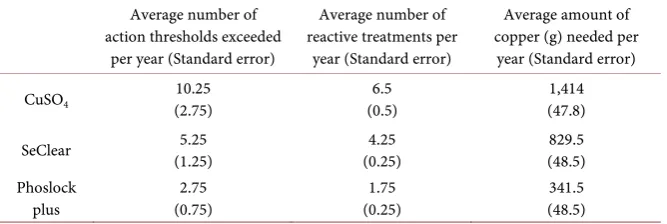
[image:7.595.211.533.481.706.2]AATL) and second year (0 AATL) with the Phoslock plus program (P = 0.026). The continued use of Phoslock reduced the number of AATL exceeded in the subsequent year. Additionally, the number of chlorophyll α instigated AATL achieved with the copper sulfate was significantly greater than with the SeClear program (P = 0.03). Total cell densities, Secchi depth and blue-green algae scum coverage were exceeded a total of 12 times across all treatment ponds with 10 coming from copper sulfate treatments and the other two from SeClear treated ponds. One Phoslock treated pond exceeded the green algal mat coverage AATL at the start of year two, although was maintained below the threshold level fol-lowing a single reactive SeClear treatment. Overall 49% and 73% fewer AATL were exceeded (both significant at α = 0.05) in SeClear and Phoslock plus treat-ments, respectively compared with copper sulfate (Table 3).
3.2. Water Quality Analyses
Water quality analyses were similar at experiment initiation between all ponds and varied slightly throughout the study primarily based on evaporation and precipitation events as well as temperature. Ranges of water chemistries for all ponds were: conductivity 80 - 250 µS·cm−1; 24 - 36˚C; 35 - 70 mg·L−1 as CaCO
[image:8.595.208.542.623.735.2]3 for alkalinity and hardness); <0.1 mg·L−1 for nitrates/nitrites. Free reactive phosphorus levels remained low (<10 µg·L−1) in all ponds throughout the treat-ment program. When phosphorus is a critical limiting nutrient, it is often assi-milated rapidly into algae/bacteria biomass [24]. Treatment program analyses suggest that proactive technologies employed decreased the concentration of free reactive phosphorus. Despite a lack of difference observed in free reactive phos-phorus levels due to low starting values, prior research has shown sediments can be a large sink/source of phosphorus in aquatic systems [25] [26] and many cyanobacteria have adaptations to allow uptake and storage of sediment asso-ciated phosphorus especially when limiting in epilimnetic waters [27] [28]. We hypothesize that the aqueous phosphorus measured was insufficient to capture the key available phosphorus sources in these systems and therefore, were unable to correlate decreases with the measured impacts on the resultant pond man-agement program.
Table 3. Summary of pond management programs in terms of average number of algae action threshold levels exceeded, number of reactive algaecide treatments and total amount of elemental copper required to maintain ponds below action threshold levels. Results are an average of treatment replicates over a two-year period.
Average number of action thresholds exceeded
per year (Standard error)
Average number of reactive treatments per
year (Standard error)
Average amount of copper (g) needed per year (Standard error)
CuSO4 (2.75) 10.25 (0.5) 6.5 (47.8) 1,414
SeClear (1.25) 5.25 (0.25) 4.25 (48.5) 829.5 Phoslock
3.3. Treatments and Copper Load
Phosphorus removal is a critical component of shifting the N:P ratio in aquatic systems to select for more beneficial algal types as opposed to nuisance cyano-bacteria [11] [12] [13]. This research sought to evaluate a standard approach to comparing pond management programs in order to discern whether integration of a preventative approach can provide operational, ecological, or economic ad-vantages. In this research, copper sulfate only treated ponds required an average of 6.5 reactive treatments annually per pond whereas ponds treated with SeClear alone and Phoslock plus required 4.3 and 1.8 average treatments, respectively. There were significantly more treatments required with copper sulfate than ei-ther the SeClear and Phoslock programs (P = 0.016). The amount of elemental copper necessary to be applied to ponds averaged 1414 g (3.12 pounds), 830 g (1.83 pounds), and 342 g (0.75 pounds) for copper sulfate, SeClear, and Phoslock plus programs, respectively. Results were additionally consistent or continually improved from year one to year two in terms of decreased amount of treatments and elemental copper required in programs incorporating proactive manage-ment. Ponds treated with SeClear required an average of 31% less number of al-gaecide applications year one and 39% less year two compared with copper sul-fate. Additionally, SeClear ponds needed 40% and 43% less elemental copper years one and two compared with copper sulfate. Pond treated with Phoslock plus SeClear required 69% and 77% less algaecide treatments than copper sulfate and 73% and 79% less elemental copper in years one and two, respectively. Ul-timately, ponds treated with the copper sulfate program required significantly more applied copper than ponds treated with the SeClear or Phoslock plus pro-grams, and the ponds treated with the Phoslock plus program required signifi-cantly less copper than the SeClear treated ponds (P = 0.031).
4. Conclusion
Overall this research outlines a specific algae action threshold level approach for assessing and implementing water resource management programs. Action thre- sholds are based on management objectives and set in accordance with levels that preserve the designated uses of the water resource. This iterative, assess-ment-prescription-implementation approach is adaptable and can be tailored to different sites and encompass management of multiple types of nuisance al-gae/cyanobacteria. This research will also assist water resource managers in making informed decisions about incorporating technologies, other than strictly reactive algaecide products, into routine management. More specifically, the re-search findings support that integration of proactive nutrient mitigating tech-nologies (e.g. Phoslock, SeClear) for addressing nuisance algal afflictions can decrease the number of reactive algaecide treatments and amount of algaecide entering aquatic systems, while maintaining the desired uses thereof.
Acknowledgements
Heilman for valuable comments on experimental design. Nick Jackson assisted with sampling, and Ben Howard, Carey Barkley and Paige Denton contributed substantially with analytical support. The authors sincerely thank SePRO Cor-poration for use of their research campus and accredited laboratory to conduct this research.
References
[1] Hoagland, P., Anderson, D.M., Kaoru, Y. and White, A.W. (2002) The Economic Effects of Harmful Algal Blooms in the United States: Estimates, Assessment Issues, and Information Needs. Estuaries, 25, 819-837. https://doi.org/10.1007/BF02804908 [2] Hallegraeff, G.M. (1993) A Review of Harmful Algal Blooms and Their Apparent
Global Increase. Phycologia, 32, 79-99. https://doi.org/10.2216/i0031-8884-32-2-79.1
[3] Paerl, H.W., Gardner, W.S., Havens, K.E., Joyner, A.R., McCarthy, M.J.J., Newell, S.E., Qin, B. and Scott, J.T. (2016) Mitigating Cyanobacterial Harmful Algal Blooms in Aquatic Ecosystems Impacted by Climate Change and Anthropogenic Nutrients.
Harmful Algae, 54, 213-222. https://doi.org/10.1016/j.hal.2015.09.009
[4] United States Environmental Protection Agency (USEPA) (2011) National Pollu-tant Discharge Elimination System (NPDES). Pesticide General Permit (PGP) for Discharges from the Application of Pesticides. Washington, DC.
[5] Falconer, I.R. (1999) An Overview of Problems Caused by Toxic Blue-Green Algae (Cyanobacteria) in Drinking and Recreational Water. Environmental Toxicology, 14, 5-12.
https://doi.org/10.1002/(SICI)1522-7278(199902)14:1<5::AID-TOX3>3.0.CO;2-0 [6] Carmichael, W.W., Azevedo, S.M.F.O., An, J.S., Molica, R.J.R., Jochimson, E.M.,
Lau, S., Rinehart, K.L., Shaw, G.R. and Eaglesham, G.K. (2001) Human Fatalities from Cyanobacteria: Chemical and Biological Evidence for Cyanotoxins. Environ-mental Health Perspectives, 109, 663-668. https://doi.org/10.1289/ehp.01109663 [7] Briand, J.F., Jacquet, S., Bernard, C. and Humbert, J.F. (2003) Health Hazards for
Terrestrial Vertebrates from Toxic Cyanobacteria in Surface Water Ecosystems. Ve- terinary Research, 34, 361-377. https://doi.org/10.1051/vetres:2003019
[8] Webster, K.E. and Peters, R.H. (1978) Some Size-Dependent Inhibitions of Larger Cladoceran Filterers in Filamentous Suspensions. Limnology and Oceanography, 23, 1238-1245. https://doi.org/10.4319/lo.1978.23.6.1238
[9] Lampert, W. (1982) Further Studies on the Inhibitory Effect of the Toxic Blue- Green Microcystis aeruginosa on the Filtering Rate of Zooplankton. Archiv fur Hy-drobiolgie, 95, 207-220.
[10] Wang, X., Qin, B., Gao, G. and Paerl, H.W. (2010) Nutrient Enrichment and Selec-tive Predation by Zooplankton Promote Microcystis (Cyanobacteria) Bloom For-mation. Journal of Plankton Research, 32, 457-470.
https://doi.org/10.1093/plankt/fbp143
[11] Smith, V.H. (1983) Low Nitrogen to Phosphorus Ratios Favor Dominance by Blue- Green Algae in Lake Phytoplankton. Science, 221, 669-671.
https://doi.org/10.1126/science.221.4611.669
[12] Seale, D.B., Boraas, M.E. and Warren, G.J. (1987) Effects of Sodium and Phosphate on Growth of Cyanobacteria. Water Research, 21, 625-631.
https://doi.org/10.1016/0043-1354(87)90072-8
Induced Cyanobacterial Blooms on Crustacean Zooplankton Communities. Fresh-water Biology, 48, 363-381. https://doi.org/10.1046/j.1365-2427.2003.01010.x [14] Downing, J.A., Watson, S.B. and McCauley, E. (2001) Predicting Cyanobacteria Do-
minance in Lakes. Canadian Journal of Fisheries and Aquatic Sciences, 58, 1905- 1908. https://doi.org/10.1139/f01-143
[15] Hrudey, S., Burch, S., Burch, M., Drikas, M. and Greorgy, R. (1999) Remedial Mea- sures. In: Chorus, I. and Bartram, J., Eds., Toxic Cyanobacteria in Water, A Guide to Their Public Health Consequences, Monitoring and Management, Routledge, London.
[16] Douglass, G.B. (2002) Remediation Material and Remediation Process for Sedi-ments. US Patent No. 6350383.
[17] Bishop, W.M., Hyde, S., McNabb, T., Cormican, I. and Willis, B.E. (2014) Opera-tional Evaluation of Phoslock Phosphorus Locking Technology in Laguna Niguel Lake, California. Water, Air, and Soil Pollution, 225, 2018.
https://doi.org/10.1007/s11270-014-2018-6
[18] Reitzel, K., Andersen, F.O., Egemose, S. and Jensen, H.S. (2013) Phosphate Adsorp-tion by Lanthanum Modified Bentonite Clay in Fresh and Brackish Water. Water Research, 47, 2787-2796. https://doi.org/10.1016/j.watres.2013.02.051
[19] American Public Health Association (APHA) (2005) Standard Methods for the Exa- mination of Water and Wastewater. 21st Edition, Washington, DC.
[20] SigmaPlot Version 12.3 (2013) Systat Software, Inc., San Jose, California.
[21] Twiss, M.R. and Nalewajko, C. (1992) Influence of Phosphorus Nutrition on Cop-per Toxicity to Three Strains of Scenedesmus acutus (Chlorophyceae). Journal of Phycology, 28, 291-298. https://doi.org/10.1111/j.0022-3646.1992.00291.x
[22] Guasch, H., Navarro, E., Serra, A. and Sabater, S. (2004) Phosphate Limitation In-fluences the Sensitivity to Copper in Periphytic Algae. Freshwater Biology, 49, 463- 473. https://doi.org/10.1111/j.1365-2427.2004.01196.x
[23] Serra, A., Guasch, H., Admiraal, W., Van der Geest, H.G. and Van Beusekom, S.A.M. (2010) Influence of Phosphorus on Copper Sensitivity of Fluvial Periphyton: The Role of Chemical, Physiological and Community-Related Factors. Ecotoxicolo- gy, 19, 770-780. https://doi.org/10.1007/s10646-009-0454-7
[24] Jacobson, L. and Halmann, M. (1982) Polyphosphate Metabolism in the Blue-Green Alga Microcystis aeruginosa. Journal of Plankton Research, 4, 481-488.
https://doi.org/10.1093/plankt/4.3.481
[25] Nürnberg, G. (1997) Coping with Water Quality Problems due to Hypolimnetic Anoxia in Central Ontario Lakes. Water Quality Research Journal of Canada, 32, 391-405.
[26] Søndergaard, M., Jensen, J.P. and Jeppesen, E. (2003) Role of Sediment and Internal Loading of Phosphorus in Shallow Lakes. Hydrobiologia, 506, 135-145.
https://doi.org/10.1023/B:HYDR.0000008611.12704.dd
[27] Ganf, G.G. and Oliver, R.L. (1982) Vertical Separation of the Light and Available Nutrients as a Factor of Causing Replacement of Green Algae by Blue-Green Algae in the Plankton of a Stratified Lake. Journal of Ecology, 70, 829-844.
https://doi.org/10.2307/2260107
Submit or recommend next manuscript to SCIRP and we will provide best service for you:
Accepting pre-submission inquiries through Email, Facebook, LinkedIn, Twitter, etc. A wide selection of journals (inclusive of 9 subjects, more than 200 journals)
Providing 24-hour high-quality service User-friendly online submission system Fair and swift peer-review system
Efficient typesetting and proofreading procedure
Display of the result of downloads and visits, as well as the number of cited articles Maximum dissemination of your research work