Group Norms and Consumer Behaviour
Pillai, Rajasekharan and Rajan, Jainey S. and
Variyamveettil, Sunitha and Mathew, Dhanu E. and Nath,
Subodh S.
Birla Institute of Technology, Kingdom of Bahrain
January 2011
Group Norms and Consumer Behaviour
K. R. Pillai,
Jainey S. Rajan,
Sunitha Variyamveetil,
Dhanu E. Mathew &
Subodh S. Nath
Birla Institute of Technology,
Kingdom of Bahrain
January 2011
Group Norms and Consumer Behaviour
K. R. Pillai, Jainey S. Rajan, Sunitha Variyamveetil, Dhanu E. Mathew & Subodh S. Nath
Birla Institute of Technology, Bahrain
Abstract
The impact of group norms on forming consumer behaviour is an important attribute of man’s social life. The market segmentation principles acknowledge the presence of this phenomenon. People belong to different age group, professional status, income levels, educational status etc. are seemed to display some specific consumer behaviour that can be attributed to a particular group. The present study attempts to find the influence of certain selected group norms on consumption pattern.
Key words: Group norms, peer influence, consumer behaviour, culture and
consumption, social norms
Introduction
It is quite natural that individual values and beliefs will be carried away by group
norms and social behaviour in the natural process of social interaction. The propensity
of human being to tend to follow the generally accepted behaviour of a particular
group, to which he/she belongs to, creates a collective behaviour. Culture and group
norms are interchangeably used in this report. As such formation of group norms or
collective practices, which have strong bearing market variables, is ascribed as culture
(Hofstede, 1980; Schiffman & Kauk, 2004). Schiffman & Kauk (2004) define culture
as the sum total of learned beliefs, values, and customs that serve to direct the
consumer behaviour of members of a particular society. Culture is what defines a
human community, its individuals and social organization. In line with this, Hofstede
(1980) defines culture as “the collective mental programming of the people in an
environment. Culture is not a characteristic of individuals; it encompasses a number of
people who were conditioned by the same education and life experience.” It is nothing
but manmade way of setting certain behavioural pattern. An accepted concept about
behaviour that are shared by a society and are transmitted from generation to
generation within that society. As an all encompassing name, culture implies
behaviour, beliefs, value, habits, tradition and heritage of a society.
Understanding the significance of culture as an initiator of buying is an important
aspect in the study of consumer behaviour. Culture cannot be separated from an
individual; it is not a system of abstract values that exist independently of individuals.
Every group or society has a culture, and culture and cultural influences on buying
behaviour may vary greatly from country to country. Hence marketers have to be
familiar with intricacies of culture scenario of target market for an effective marketing.
The success of marketing depends upon the very principle of market segmentation. In
this regard subculture is also significant in understanding the target market. Each
culture has smaller subcultures or groups of people with shared value systems based on
common life experiences and situations. Subcultures include nationalities, religions,
racial groups and geographic regions. Many subcultures make up important market
segments and marketers often design products and marketing programs tailored to their
needs (Kotler & Amstrong, 2008).
Society’s values may change continuously even though the core values are relatively
permanent. Marketers must pay special attention to values in transition because they
affect the size of market segments. Changes in a society’s values can be forecasted on
the basis of a life-cycle explanation, meaning that an individual’s grow older, their
values change. When today’s young people grow old, they will retain the values of
their youth and replace societal values of today’s older consumers Society’s values
change continuously even though the core values are relatively permanent. Marketers
must pay special attention to values in transition because they affect the size of market
segments. Changes in a society’s values can be forecasted on the basis of a life-cycle
explanation, meaning that an individual’s grow older, their perceptions may change.
The impact of culture is so natural and self-regulating that its influence on behaviour is
taken for granted. For instance, when consumer researchers ask people why they do
certain things, they frequently answer ‘because it is a right thing to do.’ This seemingly
superficial response partially reflects the deep-seated influence of culture on consumer
behaviour displaying the normative essence of culture in consumer decision making.
The present study was organised around the popular idea of Blackwell, Miniard &
cultural lens.” From this statement it is very clear that the role of culture on
households’ decision making need not be emphasised. The presented study attempted
to understand how far the group norms (culture) influence the buying decisions of
multi-cultural consumer demographies in the Middle East focussing on the UAE,
Kingdom of Bahrain and Saudi Arabia.
Methodology
The study followed a qualitative research methodology in line with survey research. A
total number of 160 respondents were contacted on judgemental basis. Fully structured
close-ended questionnaire was developed and administered to the prospective
respondents for collecting information pertaining to their demographic profile and
shopping behaviour. The demographic factors such as gender, age, nationality, level of
education, employment status and level of income are identified as the basis of
forming various groups. These six variables were considered as independent factors.
Consumer behaviour implies how consumer responds to a particular shopping situation
or market variable. The present study identified five factors such as price, brand,
usefulness of purchase, shopping convenience and discount and offers that collectively
constitute consumer behaviour. Predictive statistics was used to determine how far the
demographic factors influence the shopping behaviour with their predictive power.
The model set of multiple regression analysis is as follows:
Y= a + b1X1 + b2X2 + b3X3 +…………+ bnXn +
where;
Y= dependent variable
a = constant (intercept term)
bi =regression coefficient
Xi = independent variables
= standard error
Cronbach alpha was used to test the data sufficiency and reliability for conducting a
particular statistical test. If the Cronbach alpha is more than 0.7, the data available
deemed sufficient to do a particular statistical treatment and hence the result is reliable.
The Likert scale was used to analyse qualitative responses based on attitudinal
statements in the questionnaire. One group of questions for Likert scale analyses has
five options and they were coded as follow: Highly agree = 5, Agree = 4, Disagree = 3
and Strongly disagree= 2 and I don’t know= 1.
Review of Literature
The impact of culture is so natural and automatic that, its influence on behaviour is
usually taken for granted. Culture exists to satisfy the needs of the people within a
society. Culture is communicated to members of society through a common language
and through commonly shared symbols.
According to Swidler (1986) cultural influences action by not only providing the
ultimate values towards which action is oriented, but also by shaping and developing
habits, skills and styles. The theory of values survives due to the sensitive possibility in
our own culture of the assumption that all actions are governed by schema. It shapes
action by defining the requirements of the people. A focus on cultural values was
attractive. A settled period refers to culture independently influences action by
providing resources from which people can construct diverse lines of action and
unsettled cultural period refers to explicit ideologies which directly governs action.
Han and Shavitt (1994) state that individualism and collectivism is the most basic
dimensions of cultural variability identified in the cross cultural research. The study
conducted two experiments to examine whether the core dimensions of cultural
variability is reflected in the types of persuasive appeal by comparing two countries
United States an individualistic country and Korea a collectivistic country. The first
experiment shows that magazine advertisement in Unites States appeal to individual
benefits and preferences than the advertisements in Korea and the Korean
advertisement appeals in-group benefits, harmony and family integrity to greater extent
than US ads. In the second stage controlled experiments conducted in the two countries
discloses that advertisements emphasizing individualistic benefits are more persuasive
and advertisement emphasizing family and in-group benefits are less persuasive than
those were in Korea. The authors conclude that individualism and collectivism is
reflected in the content of advertising in different culture.
Aaker and Maheswaran (1997) point out individualism and collectivism is the most
central dimensions of cultural variability identified in cross cultural perspective,
generalizabilty of the persuasion effects predicted by dual process models. The
research supports the view that perceptual differences in cue list the systematic
differences across culture. The study conducted two experiments Elaboration
Likelihood Model and Heuristic Systematic Model to compare the two different
cultures mentioned above. These models were proved effective in predicting and
explaining persuasion effects across cultures. The findings suggest that cultural
orientation may influence how people process information and subsequent attitude
formation and change. The research points out there are several cultural differences in
forming consumer behaviour. The authors conclude the attitudes towards
differentiation and uniqueness tend to be more favourable for individualists whereas
attitudes for building relationship and maintaining connections tend to be more
favourable for collectivist.
Luna and Gupta (2001) describe culture and consumer behaviour on the basis of two
approaches: Etic and Emic approaches. Etic approach is defined as the comparison of
one culture with another whereas Emic approach to culture do not intend to directly
compare two or more differing cultures but focuses on the issues of the subjects being
studied. In a controlled experiment the authors found that both individualists and
collectivist consumers use brands for self-expressive purposes. They use brands,
however in different ways: collectivist consumers use brands to reassert their similarity
with members of their reference group, while individualist consumers use brands to
differentiate themselves from others. The study underscores that culture influences
behaviour through its manifestations such as values, rituals and symbols and with
varied manifestations of culture, the consumer psychology invariably change.
Rawwas (2001) states the primary objective of marketers is to satisfy the culturally
learned needs of the targeted customers especially in a foreign market. The article
points out the marketers must understand the customs, habits and inherent ethical
differences of their customers before marketing their products in the foreign country.
In this research the author selected eight countries that represent The author concludes
that a marketing strategy dealing with consumer ethics must be established in a manner
that satisfies the cultural expectations of the customers. Therefore marketers who
voluntarily follow the ethics and morality are more likely to maintain a loyal consumer
Triandis and Suh (2002) explain how culture influences the development of
personalities. The authors point out that behaviour is not just developed because of
culture and personality but also the interaction between the personality and situation.
Different people understand culture differently like say the events, the festivals each
individual is having differ from culture to culture. Culture is transmitted to language
which helps in communication through common language who live in some state,
country etc. The authors also bring out various dimensions of culture like tightness,
complexity, collectivism and individualism. The authors have used the Big Five
model. The researchers identified the dimensions of socialization that are related to
cultural syndromes such as the emphasis on child independence found on individualist
culture and the emphasis on dependence found in collectivist cultures.
Blackwell et al. (2001) explain how culture affects the need, search and alternative
evaluation stages how individuals makes purchase decisions. The authors state that
although marketers can influence these stages through advertising and retailing
strategic certain cultural factors are difficult to overcome. The authors view point of
how consumer consumes a product is that consumers buy products to obtain function,
forms and meaning, all of which marketers must address since they are defined by the
cultural context of consumption. Rather, the great issue about consumer culture is the
way in which it connects up central question about how one should or wants to live
and does so at the level of everyday life. Therefore we conclude that culture does
influence the behaviour of consumers.
Oyserman et al. (2002) highlight the limitations of individualism–collectivism model
of consumer behaviour. The authors explain that cultural psychology’s goal is to
identify cultural contingencies that moderate individuals thought and behaviour and
not to provide a rich description of a specific culture. They point out that individualism
and collectivism do not replace the study of culture. The authors concluded that
individualism and collectivism are often used to explain almost any culture or
cross-cultural differences and it is not useful to tie individualism and collectivism too closely
to particular, opposing or articulated value systems.
Soares, Farhangmehr & Shoham (2007) examine different approaches to
conceptualising and operationalizing culture in marketing studies. The authors
discusses the advantage of using culture dimensions and uses a three-step approach to
measuring culture at individual level. According to the authors “Culture constitutes the
broadest influence on many dimensions of human behaviour. This pervasiveness
makes defining culture difficult. This difficulty hampers research about the influence
of culture on international consumer behaviour.” The authors conclude that using a few
dimensions does not provides a complete description of cross-cultural differences
however Hofstede’s framework provides a simple and usable shortcut to the
integration of culture into studies and measuring these dimensions at the individual
level constitute an important contribution to cross-culture research.
Analysis of Data
Culture is viewed as an environmental influence on consumer behaviour. Culture is an
important component of what shapes human experience throughout life. Consumers
have different attitudes to various products of different countries. The purpose of this
study was to find out the consumers attitude about foreign products and how much
consumers are influenced with their own culture.
Demographic profile of the respondent
The demographic profile taken for the analysis comprises of gender, age, nationality,
level of education, professional status and the income level (refer appendix table 1).
The personal information of the respondents is correlated and regressed to variables for
predicting or inferring the general purchasing behaviour. More than half of the
respondents contacted, in the survey, were males (71%). Gender, being one of the
prominent variables of culture, can explain the reasons for varied preferences of men
and women.
Age has been identified as another factor constituting culture. Purchase behaviour and
consumption pattern may change with respect to different age strata. The analysis of
the age structure of the respondents shows that majority of them were in the age group
of 35 - 45 years (35%). The general observation of the data structure shows that around
55% belong to above 35 years. The average age estimated as 37.25 years with SD as
13.11. This signifies high variability of age distribution among the respondents. The
data tendency from mean and standard deviation shows that more than 68% of the
respondents are in the age group of 24 - 50 (mean ±) Since the majority of the
respondents belong to upper age category there may be possibility of sustainable
Nationality profile of the respondents shows that 51% were Indians, 21 % were Middle
East,11% were European and the rest 18% were people belonging to different
countries such as Sri Lanka, Philippines, Pakistanis etc. With respect to the level of
education majority of the respondent comes under the category of graduate were 60%
whereas those who are qualified as post graduate are about 24% followed by 15%
being higher secondary and 1 % having completed their secondary level. This show
most of respondents were highly qualified and this helped us to understand culture
better. The employment status of the respondents was also identified as an element of
culture. Knowledge regarding the professional status of the respondents will help to
identify the pattern of cultural formation through peer and colleague influence. The
data show that maximum number of respondents falls in the category of professional,
which was 56%. Next highest category is skilled workers, which constitutes 25% of
the data. Almost 6% of the respondents were unemployed and the same proportion is
identified for the respondent, who have own-business and the remaining 8 % are
covered by students.
The level of income is an important determinant for purchasing a product. As a general
perception consumers with higher income are willing to spend more and lesser income
level spends less. Among the 160 respondent, 35% of the respondent were with the
income level up to BHD 250 (BHD 1 = USD 2.65 approximate) followed by 27% were
in the category of BHD 250-500 out of the remaining 15 % and 14 % were under the
category of BHD 500-750 and BHD 750-1000 respectively. The least respondents fall
was in the category of above BHD 1000 The average income estimated was BHD
473.43 with SD as 353.93. This signifies high variability of income level among the
respondents. The data tendency from mean and standard deviation shows that more
than 68% of the respondents are in the income level of BHD 120 – 825 (mean ±).
Influence of Group norms on buying behaviour
In this section various factors influencing buying behaviour are studied and correlated
and regressed with the demographic profile of the respondent such as age, gender,
nationality, level of education, employment status and income level. This helps us to
understand how different demographic factors affect the buying the buying patterns of
Even though price is considered to be the most important determinants of demand for a
commodity, the results of the study give a moderate priority to price. It is clear from
the result that only 19% of the respondents underline price as a high priority variable.
Price may lose its significance when other factors like brand loyalty, level of income,
fashionable nature of the customers etc become prominent. When this response is
examined together with the same response against discount and offers it seems to be a
little bit strange. The proportion of the respondents who assigned top priority to
discounts and offers (24%) is higher than that of the proportion of customers (19%)
who assigned top priority to price of the products. Its quiet natural, consumers as a
group leaves no opportunity to grab discounts and offers even though they are not
much price sensitive.From the above figure, 19% of the respondents gave high priority
to the price of the product and 27% of the respondents gave high preference for brand
name which provides almost equivalent satisfaction and usefulness to them.
Respondents give least preference to the shopping convenience (48%) as they look in
for what they purchase and not for the place of shopping. The proportion of the
respondents who are on the both extremes is similar with respect to discounts/offers,
expressing top priority and least priority equi-proportionally (24%)
All the five variables discussed above (elements of consumer behaviour) were
regressed with the elements of culture discussed above. The predictors identified as
age (AGE), gender (GEN), Nationality (NAT), level of education (EDN), employment
status (PROF) and monthly household income (INC). The dependent variables together
constitutes the general consumer behaviour, are the price of the product, brand name,
usefulness of the commodity, shopping convenience and discounts and offers. The
summary of regression analysis for each factor of consumer behaviour is presented
here.
PRICE = 1.708+ -0.054 AGE+ -0.311GEN+ 0.089 NAT+0.205 EDN+ -0.004 PROF +
0.183 INC
Among the determinants of the price, the prominent variable is observed as income
(the ‘t’ value being 2.825), and the result is significant being ‘p’ value 0.005.
The second most prominent variable is identified as the level of education in
determining the price (the ‘t’ value being 1.874), and the result is not significant being
The least prominent variable among the two is identified as employment in
determining the price (the ‘t’ value being 0.072), and the test is not found significant,
being ‘p’ value 0.943.
BRAND = 2.286+ 0.078 AGE+ -0.173 GEN + -0.006 NAT+0.0192 EDN +0.0197
PROF+0.331 INC
The first most prominent variable is identified as income (the ‘t’ value being 3.791)
and the test is significant being ‘p’ value 0.000 .
The second most prominent variable is observed as employment (the ‘t’ value being
2.389) and the result is not significant being ‘p’ value 0.018 .
The least prominent variable is determined as nationality (the ‘t’ value being 0.068)
and the test is not significant being ‘p’ value 0.946 .
USEFULNESS = 1.382+ 0.098 AGE+ 0.092 GEN+ 0.006 NAT+ 0.174 EDN+ 0.167
PROF+ - 0.059 INC
The first preferred prominent variable is observed as employment (the ‘t’ value being
1.936) and the result is not significant being ‘p’ value 0.055 .
The second most prominent variable is observed as level of education (the ‘t’ value
being 1.120) and the result is not significant being ‘p’ value 0.264 .
The least prominent variable is identified as nationality (the ‘t’ value being 0.067), and
the result is proved to be insignificant being ‘p’ value 0.947 .
SHOPPING CONVENIENCE = 4.466 + - 0.017 AGE+ 0.091 GEN +0.020 NAT+
0.0153 EDN+ 0.0920 PROF+ -0.0655 INC
The first most prominent variable is observed as employment (the ‘t’ value being
1.294), and the result is not significant being ‘p’ value 0.198.
The second most prominent variable is observed as level of education (the ‘t’ value
being 1.205), and the result is not significant being ‘p’ value 0.230 .
The least prominent variable is observed as age group (the ‘t’ value being 0.205), and
the result is proved to be insignificant being ‘p’ value 0.838 .
DISCOUNTS AND OFFERS = 5.912+ -0.124 AGE+ 0.285 GEN+ -0.057 NAT+ -408
The first most preferred variable is identified as employment (the ‘t’ value being
5.810), and the result is significant being ‘p’ value 0.000 .
The second most preferred variable is identified as level of education (the ‘t’ value
being 3.177), and the result is significant being ‘p’ value 0.002 .
The least most preferred variable is identified as nationality (the ‘t’ value being 0.627),
and the result is proved to be insignificant being ‘p’ value 0.532 .
Multiple regression analysis was carried out to understand the nature and magnitude of
impact of changes in elements of culture (demographic variable) on the various factors
of consumer behaviour. It has been observed from the analysis that employment is the
most prominent factor impacting cultural attributes. Second to employment, income is
a crucial factor in configuring the cultural attributes. The prominent position of
employment, in formulating consumer behaviour, emphasis effectiveness of
peer/colleagues influence in modifying consumer behaviour.
With respect of impact of income on price, it is interesting to see that the findings of
the study are consistent to the common micro economics knowledge. The study could
also find that higher income earners are ready to pay higher price. Higher income
consumers are more brand conscious and are willing to spend more for expensive
products. It was also found that the employment status and educational level of the
respondents influences the product usefulness, shopping convenience and discounts
and offer. This shows that respondents purchase products based on their knowledge
and understanding of the product. Similarly they also look for discounts and offers for
the products.
Even though the purchase is effected by an individual consumer, the people around
him/her may have strong influence in decision making. The present study identified
four of such influences and attempted to know which, are the prominent factors
influencing consumer behaviour.
Since price is understood to be the primary factor influencing demand for a commodity
or service, the study attempted to disclose the propensity of checking the MRP on the
product. The analysis shows that, around 63% of the respondents check MRP before
buying a product. This shows us that most of the people are very price conscious and
purchase according to their budget. Around 14% of the respondent does not check the
influence on the habit of verifying maximum retail price (MRP) during the process of
purchase. Regression analysis was conducted by taking demographic factors as
independent variables (predictors) and the habit of verifying MRP as dependent
variable. The summary of analytical result is presented below.
MRP = 0.698 + - 0.084 AGE + 0.660 GEN + 0 .049 NAT + 0.147 EDU + 0.200 PROF
+ -0.076 INC
The most influential factor is observed as gender (the ‘t’ value being 3.559), and the
result is proved to be significant being ‘p’ value 0.000.
The second most prominent variable was identified as employment (the ‘t’ value being
3.113), and the test is proved to be significant being ‘p’ value 0.002.
The least prominent variable among the two is identified as nationality (the ‘t’ value
being 0.699), and the test is proved to be insignificant being ‘p’ value 0.486.
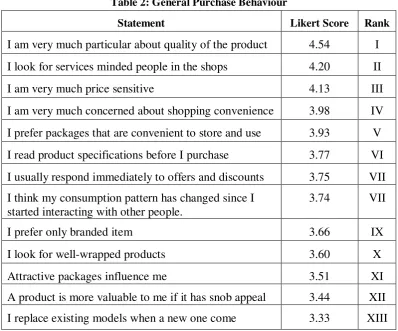
The purchase behaviour of the respondents was also explored by developing a
composite set of 13 statements. The respondents were asked to record their
agreements and disagreements on a 5 points responses scale and these responses were
coded as follows: Strongly agree= 5, Agree= 4, Disagree= 3, Strongly disagree= 2, I
don’t know= 1. The responses were analysed through Likert scale (refer appendix
table 2).
The results of the Likert scale analysis showed that the first priority among the
behavioural responses is with respect to the quality of the product. From the Likert
table is clear that the score against the quality of the product is 4.54, which is near to
the maximum score assigned. This shows that the respondents give more importance to
the quality of the product and they prefer going to shops that have good salespeople
who provides information of the product to the respondents. It is also observed from
the table respondents in general agreed to their preference to visit the shops with more
service minded people. It was also found that the most of the respondents are reluctant
to replace the existing models when a new one comes. This shows that respondents
buys product that can be used for a long time and they do not replace it as and when an
alternative available. This signifies the loyalty attributes of the customers. Some
people purchase products after reading the specifications on how to use the product.
how to use the product. Product packaging or even attractive packages also doesn’t
influence a consumer in making purchase decisions.
There are many factors which influence a person when searching for a product. These
may vary from person to person and include things like goodwill of the product or
brand, price of the product and how the product is going to satisfy his needs. But in
this case the least preferred is brand and the most preferred is price. Cronbach alpha
measure shows moderate internal consistency of the data, being 0.752 the value.
Conclusion
The present study covered the nationalities that constituted the prominent cultures in
Bahrain. The report discussed the various dimensions of culture which affect the
buying decisions of consumers. It is assumed in the present study that age group, sex,
racial subculture will affect each other. Country and society also have a great influence
towards the culture. Subculture also played an important role in deciding the culture
dimension of customer. Culture offers directions and guidance for solving human
problems by providing methods for satisfying psychological, social and personal
needs. It also analyses the trend of the consumer. The study looked in to how an
understanding of various cultures of a society helps marketers predict consumer
acceptance of their products. The study was able to bring about certain little known
facts about the role of culture on consumption. From the findings of our project we
came to the conclusion that culture/group norms has a great influence on consumer
behaviour.
It was identified that among the many factors constituting culture professional status is
consistently the prominent factor forming consumer behaviour followed by income.
Buyer characteristics include four major factors: cultural, social, personal, and
psychological. A person’s buying behaviour is the result of the complex interplay of all
these cultural, social, personal, and psychological factors. Age group also plays an
important role. In every age group varied response shows that age affects the culture to
a great extent. Life style also play an important role a life style varied with the
different age group situations. Many of these factors cannot be controlled by
marketers, but they are useful in identifying and understanding the consumers that
References
Aaker, J.L. & Maheswaran, D. (1997): The effect of cultural orientation on persuasion,
the Journal of Consumer Research, Vol. 24(3), pp 315- 328
Blackwell, R D, Miniard, P.W. and Engel, J.F. (2001): Consumer Behaviour, 9th edn, Delhi: South-Western College Publishing
Hofstede, G. (1980). Culture’s Consequences: International Differences in Work-related Values, California: Sage Publications.
Kotler,P and Amstrong,G.(2008): Principles of Marketing, New Delhi: PHI Learning Private Limited
Luna, D & Gupta,S. F. ( 2001): An integrative framework for cross- cultural consumer behavior,International Marketing Review, Vol. 18(1), pp 45- 69
Oyserman, D and Lee, S.W.S. (2008): Does Culture Influence What and How We Think? Effects of Priming Individualism and Collectivism, Psychological Bulletin,Vol. 134 (2), pp 311- 342
Rawwas, Y.A.M. (2001): culture, personality and morality: A typology of international consumer’s ethical beliefs,International Marketing Review, Vol. 18(2), pp 188- 209
Schiffman,L.G and Kanuk, L.L. (2004): Consumer behaviour, 9thedn, Delhi: Pearson
Education Inc.
Soares, A.M., Farhangmehr.M and Shoham,A. (2006): Hofstede’s dimensions of culture in international marketing studies, Journal of Business Research, Vol. 60, pp 277- 284
Swidler, A. (1986): Culture in Action: Symbols and Strategies, American SociologicalReview, Vol.51(2), pp 273- 286
Table.IV.1
Demographic Profile of the Respondents (%) N = 160
Sl.No Category Percentage
I Gender Male Female 71 29 II Age Below 25 25 – 35 35 – 45 45 – 55 Above 55 15 21 35 24 05 III Nationality Indian Middle East European Other Asian 51 21 11 18
IV Level of Education
Secondary Higher Secondary Graduate Post Graduate 01 15 60 24 V Employment Student Professional Unemployed Own Business Skilled workers 08 56 06 06 25
VI Monthly Income (in BHD)
250 35
250 – 500 27
500 – 750 15
750 – 1000 14
Table 2: General Purchase Behaviour
Statement Likert Score Rank
I am very much particular about quality of the product 4.54 I
I look for services minded people in the shops 4.20 II
I am very much price sensitive 4.13 III
I am very much concerned about shopping convenience 3.98 IV
I prefer packages that are convenient to store and use 3.93 V
I read product specifications before I purchase 3.77 VI
I usually respond immediately to offers and discounts 3.75 VII
I think my consumption pattern has changed since I started interacting with other people.
3.74 VII
I prefer only branded item 3.66 IX
I look for well-wrapped products 3.60 X
Attractive packages influence me 3.51 XI
A product is more valuable to me if it has snob appeal 3.44 XII