Munich Personal RePEc Archive
Bayesian Portfolio Selection in a Markov
Switching Gaussian Mixture Model
Qian, Hang
Iowa State University
24 December 2011
Online at
https://mpra.ub.uni-muenchen.de/35561/
Bayesian Portfolio Selection in a Markov Switching
Gaussian Mixture Model
Hang Qian1
Abstract
Departure from normality poses implementation barriers to the Markowitz
mean-variance portfolio selection. When assets are affected by common and
idiosyncratic shocks, the distribution of asset returns may exhibit Markov
switching regimes and have a Gaussian mixture distribution conditional on
each regime. The model is estimated in a Bayesian framework using the
Gibbs sampler. An application to the global portfolio diversification is also
discussed.
Keywords: Portfolio, Bayesian, Hidden Markov Model, Gaussian Mixture.
1. Introduction
Markowitz (1952) mean-variance analysis is consistent with an investor’s
utility maximization when the asset returns are normally distributed.
How-ever, it has long been recognized by practitioners and scholars that financial
asset returns often depart from normality. Investors usually feel that the
stock prices crawl upwards for months but plummet in a day, which is hard
to reconcile with the relative thin and symmetric tail of a normal
distribu-1Corresponding author: Department of Economics, Iowa State University, Ames, IA,
tion. There is abundant of empirical evidence suggesting unconditional asset
returns exhibit skewness, fat fail and extreme values (e.g., Fama, 1965;
Blat-tberg and Gonedes, 1974; Peiro, 1999; Ane and Geman, 2000, to name a few).
In that case, the mean and variance are inadequate to characterize all the
rel-evant aspects of the optimal portfolio. Higher order moments will play a role
in the portfolio selection and asset pricing. From a theoretical perspective,
Kraus and Litzenberger (1976) model the skewness preference and its effect
on risk assets valuation. Harvey and Siddique (2000) empirically test the
effect of conditional skewness on the asset pricing. Jondeau and Rockinger
(2006) use a fourth order Taylor expansion of the expected utility to quantify
the extent to which non-normality affects the optimal asset allocation.
Given the stylized fact of departure from normality, it is natural to
pro-pose some other distributions that can better accommodate skewness,
lep-tokurtosis and extreme values. Some early works use symmetric stable
dis-tribution (Fama, 1965) and Student-t disdis-tribution (Blattberg and Gonedes,
1974) to account for the fat tail but not skewness. Harvey et al. (2010)
consider the portfolio selection with a multivariate skew normal distribution,
which allows skewness and coskewness. A skew normal random variable is
essentially the sum of a normal and half normal variate. It is not easy to
pro-vide an economic interpretation of the half normal variate, since the sum of
two half normal is no longer half normal. Modeling asset returns with skew
normal distribution is largely an empirical strategy that conveniently and
effectively addresses the concern of skewed returns. Buckley et al. (2008) use
the Gaussian mixture distribution in the portfolio optimization. Gaussian
mar-ket regimes. Furthermore, Gaussian mixture can mimic many complicated
distribution. For instance, if we assign a large probability to the first regime
and a low probability to the second regime with a large mean and large
vari-ance, the mixture is similar to a positively skewed distribution. If the second
regime has a large mean and small variance, the mixture is close to a
nor-mal distribution with occasional extreme values. If we mix infinite number
of normal distributions with the same mean and inverse-gamma distributed
variances, the mixture is a Student t distribution that allows leptokurtosis.
In the Gaussian mixture, the latent regimes are random draws from a
multinomial distribution without autocorrelation. As a generalization, if the
latent regimes are allowed to have a Markov law of motion, the mixture
be-comes a hidden Markov model (HMM) initially proposed by Baum and his
colleagues (Baum and Petrie, 1966; Baum and Eagon, 1967; Baum et al.,
1970). It has been successfully applied to a variety of fields such as speech
recognition, signal process (Rabiner, 1989). This model is mostly known to
economists in another name: the Markov (regime) switching model.
Hamil-ton (1989) models the mean GNP growth rate with two Markov switching
regimes. Turner et al. (1989) consider the variance of a portfolio’s excess
returns depends on a Markov switching state variable. There are many
sub-sequent works that extend the Markov switching model to vector
autore-gression (Krolzig, 1997), endogenous regime transition (Kim et al., 2008),
etc.
In this paper, we consider a scenario that asset prices are affected by two
types of latent shocks. The first type is common shocks on all assets, which
each individual asset, which lead to a Gaussian mixture returns with different
states. The joint forces of the common and idiosyncratic shocks make asset
returns follow a Markov switching Gaussian mixture (MSGM) distribution.
It is possible to write down the likelihood function of our model in a
recursive manner, and then estimate the model by maximum likelihood or
E-M algorithm. However, when the number of regimes/states become
mod-erately large, say more than three, the model contains many parameters and
the numerical maximization can hardly perform satisfactorily in practice. 2
Roman et al. (2010) conclude that “although theoretically the HMM-based
time series modeling can tackle the multivariate case, from a practical point
of view it has limited applicability”. Our model is estimated in a Bayesian
framework. Given an appropriate estimation routine, it can reliably
esti-mate model for moderately large number of regimes/states with affordable
2There are many available estimation routines of Markov switching model. On his
web-site, Professor James Hamilton collects links to these programs. A well-received MATLAB
program by Marcelo Perlin estimates the model by direct maximization of the log
likeli-hood. In the manual, Marcelo advises against the use of the model with more than three
regimes. He mentions “the solution is probably a local maximum and you can’t really trust
the output you get”. In the MATLAB statistic toolbox there is a routine “hmmtrain.m”for
estimating discrete HMM model by the E-M algorithm. However, we test the routine with
three or four regimes using pseudo data with known data generating process, the program
cannot reliably estimate the model if the initial values are not carefully chosen. In a
tuto-rial to regime-switching models, Hamilton (2005) mentions most applications assume two
or three regimes and “there is considerable promise in models with a much larger number
of regimes, either by tightly parameterizing the relation between the regimes (Calvet and
computation costs.
Estimating our model in the Bayesian framework has another
advan-tage. The classic Markowitz portfolio selection has an implementation
bar-rier called the “estimation risk”, that is, our inability to provide the exact
inputs since the population mean and covariance matrix of asset returns are
unknown. One might resort to the sample analog as a certainty equivalent
so-lution. It is well documented that the portfolio weights under that approach
tend to be volatile, sensitive to minor inputs change and lack
diversifica-tion (Dickinson, 1974; Jobson and Korkie, 1980; Black and Litterman, 1992;
Michaud and Michaud, 2008, among others). The instability of portfolio
weights is believed to be caused by the negligence of parameter uncertainty,
especially the estimation error of the mean. Chopra and Ziemba (1993) find
that error in means is ten-fold as devastating as errors in variances.
Further-more, assets with high sample average return and low sample variance will
be assigned larger weight in the portfolio, but those asset returns are more
likely to be error-ridden (Scherer, 2002). In the Bayesian framework, the
problem of the estimation risk is resolved since our triple uncertainties over
the regimes/states, parameters and future disturbances are fully embodied
in the posterior predictive distribution.
The rest of the paper is organized as follows. Section 2 lays out a
micro-foundation that the assets prices and returns follow the MSGM distribution
when the assets are subject to common and idiosyncratic shocks. Section 3
outlines the econometric model and the Gibbs sampler to obtain posterior
draws of model parameters as well as hidden regimes and states. Section 4
asset returns. Section 5 provides an illustrative application and compares
performance our model to the classic portfolio selection model. Section 6
concludes the paper.
2. Micro Foundation
Though our asset returns model is primarily an empirical econometric
model that flexibly accommodates non-normality, it has a micro foundation.
The hidden Markov Gaussian mixture asset returns can be justified by a
Lucas asset-pricing model (Lucas, 1978), where we slightly adapt the classic
model by decomposing the exogenous productivity shocks into common and
idiosyncratic components. The former induces Markov switching regimes and
the latter leads to mixture normal returns conditional on a regime.
Consider a pure exchange economy consisting of numerous identical agents
with n varieties of fruit trees that are symbolic of assets. Normalize the
number of agents and trees of each variety to one. At the beginning of a
pe-riod, trees yield stochastic fruits, a parable of exogenous productivity shocks.
Then agents eat fruits and trade trees at market prices. Assume logarithmic
preferences, the sequential optimization problem of an agent is formulated as
max
{Ci,t,Ai,t}
E0
" ∞ X
t=0
n X
i=1
βtlnCi,t #
,
n X
i=1
(Ci,t+pi,tAi,t+1) =
n X
i=1
(pi,tAi,t+di,tAi,t) ,
wheredi,t is the yield of fruiti in periodt. At the market pricepi,t, an agent
that exogenous productivity shocks are mainly determined by the weather
dummy wt and vermin dummy vi,t in a regression style:
lndi,t =αi+γi ·wt+δi·vi,t+εi,t.
The baseline yield of fruitiis exp (αi). The period-tweather conditionwt
simultaneously affects trees of all varieties, though with varied magnitudes
on different fruits. Assumewtfollows a Markov chain with two regimes. The
weather condition is symbolic of common shocks in the macroeconomy that
affect all financial assets. As the weather can be “sun” or “rain”, the market
can be heuristically labeled as “bull” or “bear”. On the other hand, trees may
be also subject to vermin intrusion and assume each variety of fruit tree is
vulnerable to a species of worm, captured by the dummy variablevi,t for fruit
i in period t. The presence of vermin is a metaphor of major idiosyncratic
shocks to a financial asset. Lastly, the disturbance εi,t captures countless
minor common or idiosyncratic factors that may affect fruits harvest. Assume
(ε1,t, ..., εn,t|wt =s)∼N(0,Σs),s = 1,2.
The solution to the Lucas tree model is standard. By iterating forward
the Euler equation
pi,t =Et
β Ci,t Ci,t+1
(pi,t+1+di,t+1)
,i= 1, ..., n,t ≥0,
we obtain the fundamental asset price without bubbles
pi,t =Et " ∞
X
j=1
βj Ci,t
Ci,t+j
di,t+j #
.
On the other hand, the market clearing condition requires Ci,t+j = di,t+j,
∀j ≥0. So the asset pricing equation is eventually given by
pi,t =
β
or
lnpi,t = [lnβ−ln (1−β) +αi] +γiwt+δivi,t+εi,t.
The asset return from period t − 1 to t consists of capital gains and
dividend income, which can be thought as the log difference of the
dividend-adjusted price series.
ri,t ≡ln (pi,t+di,t)−lnpi,t−1
=−lnβ+γi(wt−wt−1) +δi(vi,t−vi,t−1) + (εi,t−εi,t−1)
Typically a researcher observes neither common nor idiosyncratic shocks,
therefore we marginalize lnpi,t and ri,t with respect to wt, vi,t. First
con-sider the distribution of logarithmic asset prices. (lnp1,t, ...,lnpn,t) follows
a two-regime hidden Markov chain. Conditional on each regime, there are
2n latent states determined by idiosyncratic shocks. Further conditional on
each state, it follows a multivariate normal distribution. In other words, the
distribution of logarithmic asset prices is a hidden Markov Gaussian mixture.
Next consider the distribution of asset returns. Put the weather conditions
in periodt and period t−1 as a pair, the joint returns (r1,t, ..., rn,t) follows a
four-regime hidden Markov chain. Conditional on each regime, it is a
Gaus-sian mixture with 4n latent states. Therefore, the Lucas tree model justifies
both logarithmic asset prices and returns follow the MSGM distribution.
3. Econometric Model
In this section, we build an econometric model of asset prices
Let the returns of n assets be Yt = (r1,t, ..., rn,t)′, t = 1, ..., T. Denote
YT1 ={Yt}Tt=1.Assume assets returns are driven by a hidden Markov chain
with S regimes. Let the latent regime in period t be τt ∈ {1, ..., S} and
denote τT
1 = {τt}Tt=1. The initial (period 1) distribution is π = (π1, ..., πS)′
and the transition matrix is given by
Q= Q1 ... QS =
Q1,1 ... Q1,S
...
QS,1 ... QS,S .
Conditional on τt, Yt follow a Gaussian mixture with K latent states.
Let the latent states be λt∈ {1, ..., K}, following a multinomial distribution
with probabilityηs= (ηs,1, ..., ηs,K)′ under the current regimes. Ifτt, λtwere
known, Yt would be a multivariate normal vector.
P (Yt|τt, λt) = S Y s=1 K Y k=1
[φ(Yt;µs,k,Σs,k)]
I(τt=s)·I(λt=k),
where φ(·) is the density of a multivariate normal distribution, and I(·) is
an indicator function that takes one if the expression in the parenthesis is
true and takes zero otherwise. Note that the theoretic model in Section 2
suggests the covariance matrix Σs,k does not change with the latent statek.
This restriction can greatly reduce the number of parameters in the model,
though as a general econometric model we allow the covariance matrix to
Conjugate proper priors of model parameters are specified as
µs,k ∼N(bs,k,Vs,k) ,
(Σs,k)−1 ∼W hishart(Ωs,k, νs,k) ,
Qs ∼Dirichlet(as,1, ..., as,S) ,
π ∼Dirichlet(c1, ..., cS) ,
ηs ∼Dirichlet(fs,1, ..., fs,K) ,
wheres = 1, ..., S and k = 1, ..., K.
The full posterior conditional distribution of µs,k is given by
µs,k|· ∼N(Ds,kds,k,Ds,k) ,
where
Ds,k =
Ts,k(Σs,k)−1+ (Vs,k)−1 −1
,
ds,k = (Σs,k)−1 T X
t=1
[Yt·I(τt=s, λt =k)] + (Vs,k)−1bs,k,
Ts,k = T X
t=1
I(τt =s, λt=k) .
In other words, the posterior µs,k is determined by its prior as well as
observations that fall into regimes and statek. Similarly, the posteriorΣs,k
is determined by its prior as well as observations that fall into the regime s
and the state k. It follows that
(Σs,k)−1|· ∼W hishart Ωs,k, νs,k
where
Ωs,k = (
(Ωs,k)−1+ T X
t=1
(Yt−µs,k) (Yt−µs,k)′·I(τt=s, λt =k) )−1
,
νs,k =νs,k+Ts,k.
In models where Σs,k does not vary with the state k, the posterior Σs,k
takes a similar form by replacingI(τt=s, λt =k) with I(τt =s) during the
summation. If Σs,k further does not change with regimes, the summation is
taken for the whole sample period.
The posterior of the mixture probability is given by
ηs|· ∼Dirichlet(fs,1+Ts,1, ..., fs,K +Ts,K) .
The posterior λt can take one of the K discrete states. The posterior
distribution takes the form
P (λt=k|·)∝ S Y
s=1
[ηs,kφ(Yt;µs,k,Σs,k)]
I(τt=s),
where k = 1, ...K. It follows that λt = k|· has a multinomial distribution
with probability proportional to
S Y
s=1
[ηs,kφ(Yt;µs,k,Σs,k)]I(τt=s).
The posterior of the initial distribution of the Markov chain is
π|· ∼Dirichlet[c1+I(τ1 = 1), ..., cS+I(τ1 =S)] .
The posterior of the transition matrix of the Markov chain takes the form
Qs|· ∼Dirichlet
h
as,1+Tes,1, ..., as,S +Tes,S i
,
where Tes,j = PT
The posterior latent regimesτt can take one of the S discrete regimes. A
straightforward method of sampling τt is to make use of its two neighbors
τt−1 and τt+1. However, MCMC chain may mix poorly due to excessive
nodes on the chain. A better method is to sample the entire series τT
1 by
the Baum-Welch algorithm. The algorithm outlined here is similar to Chib
(1996), who uses a backward induction. We sample the latent regimes in a
forward sequence: τ1, τ2, τ3, etc.
Letθ be all the parameters of the model (includingµs,k,Σs,k,ηs, Qs, π).
Define the forward variable
Ft,s=P τt=s,Yt1
θ,λT
1
, t= 1, ..., T, s = 1, ..., S.
The forward variable can be computed by forward induction:
Ft,s = " K
Y
k=1
φ(Yt;µs,k,Σs,k)I(λt=k) #
·
S X
r=1
Ft−1,rQr,s,
Similarly define the backward variable
Bt,s =P YTt+1
θ, λT
1, τt =s
,
which can be computed by backward induction:
Bt,s = S X
r=1
Qs,r· " K
Y
k=1
φ(Yt+1;µr,k,Σr,k)
I(λt+1=k)
#
·Bt+1,r,
Note thatP τT
1
YT1, θ, λT
1
=P τ1
Y1T, θ, λT
1 · T Y t=2
P τt
τt−1,Y1T, θ, λT1
,
so we sample τT
1 by the method of composition.
For each s, r= 1, ..., S, we have
P τ1 =s
YT1, θ ∝F1,s·B1,s,
P τt=s
τt−1 =r,YT1, θ
∝Qr,s· " K
Y
k=1
φ(Yt;µs,k,Σs,k) I(λt=k)
#
The sampler for the latent regimes can be further improved by using the
Gaussian mixture instead of normal distribution. Note that in the above
procedure, τT
1 is sampled from its full posterior conditionals, in which we
explore the realization of the latent states λt in the mixture so that the
term
K Y
k=1
φ(Yt;µs,k,Σs,k) I(λt=k)
is effectively a normal density. However, if
we put τT
1 and λT1 in a block and sample them together using the method of
composition, the nodes on the MCMC will be shortened and mixing property
can be improved. In the block sampler, we first sample τT
1 from it posterior
distribution without being conditional on λT
1, then we sample λT1 from its
full posterior conditionals. The previous procedure is modified by
Ft,s= " K
X
k=1
ηs,kφ(Yt;µs,k,Σs,k) #
·
S X
r=1
Ft−1,rQr,s,
Bt,s= S X
r=1
Qs,r· " K
X
k=1
ηr,kφ(Yt+1;µr,k,Σr,k) #
·Bt+1,r,
and
P τt=s
τt−1 =r,Y1T, θ
∝Qr,s· " K
X
k=1
ηs,kφ(Yt;µs,k,Σs,k) #
·Bt,s.
There is a note to the above Gibbs sampler. The hidden Markov models
and Gaussian mixture models have an identification problem, that is, the
likelihood function is invariant to regime/state label switching. There are
some controversies over the interpretation of the label switching problem.
Celeux et al. (2000) argue that virtually the entirety of MCMC samplers to
the mixture model fails to converge due to the computational and inferential
difficulties. Jasra et al. (2005) pessimistically believe that Gibbs sampler
battle, Fruhwirth-Schnatter (2001) addresses the problem directly by adding
a parameter random permutation step after each iteration of the
simula-tor. Geweke (2007) insightfully points out that Gibbs sampler can reliably
recover the posterior as long as the function of interest is invariant to
per-mutation. He also proposes a conceptual permutation-augmented posterior
simulator. Our function of interest is the posterior predictive asset returns
whose distribution does not depend on the regime/state label. So the labeling
phenomenon is not a problem.
4. Investor’s Problem
Once we have a probability model on the asset returns, we are ready
to solve an investor’s portfolio optimization problem. It is most natural
to assume the goal of portfolio selection is to maximize expected utility on
future portfolio returns, though there are other ways to define the goal of
portfolio optimization. For example, Buckley et al. (2008) consider
maxi-mizing the portfolio Sharpe ratio and out-performance probability of return
target. When the asset returns are normally distributed, these goals are
closed related and consistent with each other. However, different goals lead
to different portfolios when asset returns depart from normality. In this
sec-tion, we discuss an investor’s problem in the expected utility maximization
framework.
Let u(·) be a standard utility function. Assume the investor maximizes
expected returns Eu(ω′YT+1)
YT
1
subject to ω′ι = 1, where ω is the
portfolio weights and ι is a vector of ones.3
With MCMC we obtain simulated posterior sample ofnθ(j), τT,(j) 1 , λ
T,(j) 1
oJ
j=1,
where J is the number of draws in the simulation. The fact that
P YT+1, τT+1, λT+1, θ,τT YT
1
=P θ,τT
YT1 ·P(τT+1|θ,τT)·P (λT+1|τT+1, θ)·P (YT+1|λT+1, τT+1, θ)
suggests the following procedure of samplingYT+1 from its posterior
pre-dictive distribution. First, sample the period T + 1 latent regime τT(j+1) us-ing the information τT(j), θ(j). Second, sample the latent state λ(j)
T+1 using
τT(j+1) , θ(j). Third, sample the asset prices Y(j)
T+1 using λ (j)
T+1, τ (j)
T+1, θ(j). It
fol-lows that Eu(ω′Y
T+1)
YT
1
can be approximated by 1
J PJ
j=1u
ω′Y(j)
T+1
.
Note that solving an investor’s problem requires choosing a portfolio
weight ω to maximize the expected utility by some numerical optimization
method. It poses a computational challenge in that numerical optimization
is intermingled with simulation. If we want to run a large scale simulation
(largeJ) and have many assets (largen), the computation cost might not be
affordable. In that case, we may consider an approximation method that
re-places expected utility with posterior moments in the optimization problem.
I borrow one dollar from my mom and repay the principal at the end of the period. My
utility is defined on ω′RT+1. Similarly, another investor earns a salary income of w0 and
then invest his one dollar in the stock market. His utility is defined on w0+ω′RT+1. In
Define the moments of posterior predictive returns as
M1 =E YT+1
YT1 ,
M2 =E
(YT+1−M1) (YT+1−M1)′
Y1T,
M3 =E
(YT+1−M1) (YT+1−M1)′⊗(YT+1−M1)′
Y1T,
M4 =E
(YT+1−M1) (YT+1−M1)′⊗(YT+1−M1)′⊗(YT+1−M1)′
Y1T.
The Kronecker product⊗enables us to spread the high-dimension array into
a two-dimension matrix. Then the moments of the portfolio return can be
expressed as
M1p ≡E ω′YT+1
YT1 =ω′M1,
M2p ≡E h
(ω′YT+1−M1p)
2
Y1Ti =ω′M2ω,
M3p ≡E h
(ω′YT+1−M1p)
3
Y1Ti =ω′M3(ω⊗ω) ,
M4p ≡E h
(ω′YT+1−M1p)4 Y1T
i
=ω′M4(ω⊗ω⊗ω) .
Lastly, by a Taylor expansion of Eu(ω′Y
T+1)
YT
1
up to order four,
which accommodates the effects of mean, variance, skewness and kurtosis,
we have
Eu(ω′YT+1)
YT1 ≈u(M1p)+
1 2u
′′(M
1p)M2p+
1 6u
(3)
(M1p)M3p+
1 6u
(4)
(M1p)M4p.
In practice, we only have posterior draws nY(Tj+1) o
J
j=1, so the population
moments are approximated by their sample analogues. For example,
c
M1 =
1
J
J X
j=1
YT(j+1) ,
c
M3 =
1 J J X j=1
YT(j+1) −Mc1 Y(Tj+1) −Mc1
′
⊗Y(Tj+1) −Mc1
′
and Mc2, cM4 can be computed similarly. The analogue Mc1p,Mc2p,Mc3p,Mc4p
are computed fromMc1,Mc2,Mc3,Mc4, and the analogue moments of the
port-folio return are used to approximateEu(ω′R
T+1)
YT
1
. Note that it is not
a “certainty equivalent solution”. If the analogue moments are computed
from data, the magnitude of estimation risk is fixed since it is impossible to
increase the number of observations in the dataset. However, in our model
the analogue moments are computed from posterior draws of future returns,
the magnitude of estimation risk can be arbitrarily close to zero as long as
we take large enough draws in the MCMC.
Using posterior moments to approximate expected utility reduces
compu-tational cost in that simulation is disentangled from numerical optimization.
The analogue moments Mc1,Mc2,Mc3,Mc4 are computed with simulation
be-fore numerical optimization. In the stage of numerical optimization, only
c
M1p,Mc2p,Mc3p,Mc4p needs to be computed for eachω, which involves no
sim-ulation.
5. An application
To illustrate our approach, we consider a portfolio manager who diversifies
investments in six world major stock indexes: SP500 (USA), FTSE (Britain),
CAC (France), DAX (Germany), HSI (Hong Kong), NIKKEI 225 (Japan).
Daily data ranging Jan. 2000-Dec. 2011 are used to estimate the asset
returns.
Table 1 and 2 provides descriptive statistics of our dataset. Sample
mo-ments are calculated for entire sample from 2000 to 2011. The mean of index
since 2008. In hindsight, it would be better off to lock the money in the
coffer, rather than to invest any dollar in the stock market. For illustration
purposes, we exclude the possibility of refraining from investment and assume
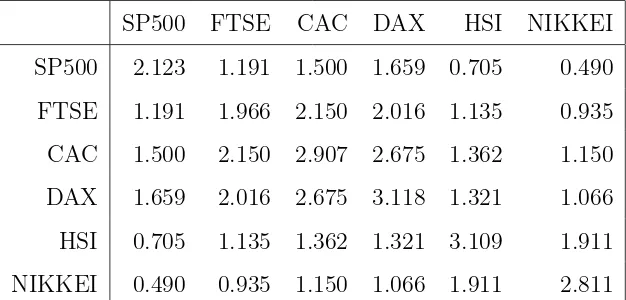
no safe assets. The covariance matrix of returns suggests stronger positive
correlations among western countries. The correlations between western and
oriental markets are less prominent, which carries significance for global
di-versifications.
As is seen in Table 1, daily returns of stock indexes exhibit substantial
skewness for most markets. The Lilliefors tests (Kolmogorov-Smirnov test
with estimated parameters) and Jarque-Bera test provides strong evidence
against normality with p value smaller than 0.001.
The departure from normality can also be seen from the Bayesian residual
test. We first fit the MSGM model with one regime and one state, which
is effectively a model of multivariate normal returns. We conduct a series
of residual tests by normalizing the historical returns using the posterior
draws of the mean and covariance matrix. If the returns are indeed normally
distributed, then the classical Kolmogorov-Smirnov test should accept the
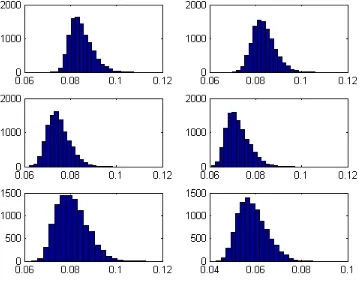
null. The histogram of the test statistics are reported in Figure 1. The six
panels correspond to the six assets in sequence. Since we have a fairly large
sample size of more than 2000 observations, the 1% significance critical value
of the test statistics can be approximated by 1.63/√T, which is about 0.03.
Figure 1 shows that test statistics are larger than the critical value in every
circumstance so that the normality can be decisively rejected.
We also go through the above tests for subsamples of the data set.
did not report the results in the text. Noted that all the normality tests
are conducted on the basis of individual asset returns. Once the normality
is rejected at individual level, the joint normality is automatically rejected
(The reverse is not true). We therefore conclude that it is necessary to adopt
more flexible distributions to model asset returns.
In this application, we fit the MSGM model with three Markov switching
regimes, each with three states in the Gaussian mixture. The covariance
matrix is assumed to be invariant across regimes and states. The posterior
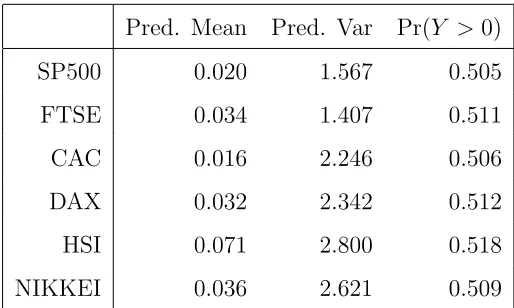
predictive distributions of asset returns are reported in Table 3. The
pre-dicted mean returns are positive, in contrast to the slightly negative mean
returns over the entire sample. The positive returns prediction might due to
the fact that at the end of our sample period, the return series tend to be
positive and thus in a high-return regime. The variances of the predictive
distributions contain triple uncertainties, namely the uncertainty over the
regimes and states, the uncertainty over the parameters and the uncertainty
over the future disturbances. However, Table 3 shows that for each asset
the predictive variance is smaller than the sample variance (which effectively
corresponds to a model with one regime and one state). That implies the
MSGM model better captures the non-normality feature of the data and
improves precision of the prediction.
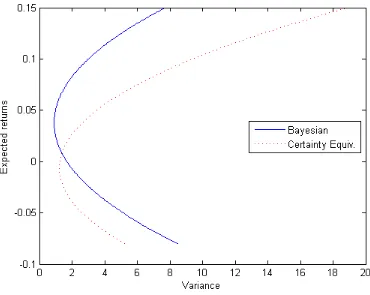
Using the draws from the posterior predictive distribution, Figure 2 plots
the Bayesian mean-variance frontier. For comparison, we also provide the
mean-variance frontier with certainty equivalent approach. The two curves
present different mean-variance trade-offs. For a given variance, the Bayesian
Mean-variance frontier may not be directly relevant to decision making
in the presence of non-normality. The next step is to estimate the optimal
portfolio weights which maximize the expected utility. We use a Tylor
ap-proximation up to the fourth order and assume that the portfolio manager
has a CARA utility. Table 4 shows the optimal weights with risk aversion
coefficients 1, 3, 5, 7, 9 and 11. The optimal weight on the third and fourth
assets are negative, which requires short selling. Table 5 provides optimal
weights when short selling is not allowed.
6. Conclusion
Departure from normality and parameter estimation risk are two major
barriers to the implementation of the Markowitz portfolio selection. This
pa-per attempts to addresses the two issues in a unified Bayesian framework, in
which deviation from normality is captured by a Markov switching Gaussian
mixture distribution and parameter uncertainty is reflected in the posterior
predictive distribution of asset returns. We develop a Gibbs sampling
proce-dure to obtain draws from the posterior distribution as well as draws from the
predictive density. Then the portfolio weights can be optimally constructed
so as to maximize the expected utility of investors.
To illustrate our approach, we considered a simplified version of global
di-versification of investing in several leading stock market indexes. The
descrip-tive statistics provide strong evidence against normality of high frequency
index returns. A model with four regimes and four states is used to predict
the future returns, and the associated optimal portfolios are also reasonably
Ane, T., Geman, H., 2000. Order flow, transaction clock, and normality of
asset returns. Journal of Finance 55 (5), 2259–2284.
Baum, L. E., Eagon, J. A., 1967. An inequality with applications to statistical
estimation for probabilistic functions of markov processes and to a model
for ecology. Bulletin of American Mathematical Society 73, 360–363.
Baum, L. E., Petrie, T., 1966. Statistical inference for probabilistic functions
of finite state markov chains. The Annals of Mathematical Statistics 37 (6),
1554–1563.
Baum, L. E., Petrie, T., Soules, G., Weiss, N., 1970. A maximization
tech-nique occurring in the statistical analysis of probabilistic functions of
markov chains. The Annals of Mathematical Statistics 41 (1), 164–171.
Black, F., Litterman, R., 1992. Global portfolio optimization. Financial
An-alysts Journal 48, 28C43.
Blattberg, R. C., Gonedes, N. J., 1974. A comparison of the stable and
student distributions as statistical models for stock prices. The Journal of
Business 47 (2), 244–80.
Buckley, I., Saunders, D., Seco, L., 2008. Portfolio optimization when
as-set returns have the gaussian mixture distribution. European Journal of
Operational Research 185 (3), 1434–1461.
Calvet, L. E., Fisher, A. J., 2004. How to forecast long-run volatility: Regime
switching and the estimation of multifractal processes. Journal of Financial
Celeux, G., Hurn, M., Robert, C. P., 2000. Computational and inferential
difficulties with mixture posterior distributions. Journal of the American
Statistical Association 95 (451), 957–970.
Chib, S., 1996. Calculating posterior distributions and modal estimates in
markov mixture models. Journal of Econometrics 75 (1), 79–97.
Chopra, V. K., Ziemba, W. T., 1993. The effect of errors in means,
vari-ances, and covariances on optimal portfolio choice. Journal of Portfolio
Management 19, 6–11.
Dickinson, J. P., 1974. The reliability of estimation procedures in portfolio
analysis. Journal of Financial and Quantitative Analysis 9 (03), 447–462.
Fama, E. F., 1965. The behavior of stock-market prices. The Journal of
Business 38 (1), pp. 34–105.
Fruhwirth-Schnatter, S., 2001. Markov chain monte carlo estimation of
clas-sical and dynamic switching and mixture models. Journal of the American
Statistical Association 96 (453), 194–209.
Geweke, J., 2007. Interpretation and inference in mixture models: Simple
mcmc works. Computational Statistics and Data Analysis 51 (7), 3529–
3550.
Hamilton, J., 2005. Regime-switching models.
dss.ucsd.edu/ jhamilto/palgrav1.pdf.
Hamilton, J. D., 1989. A new approach to the economic analysis of
Harvey, C., Liechty, J., Liechty, M., Muller, P., 2010. Portfolio selection with
higher moments. Quantitative Finance 10 (5), 469–485.
Harvey, C. R., Siddique, A., 2000. Conditional skewness in asset pricing tests.
Journal of Finance 55 (3), 1263–1295.
Jasra, A., Holmes, C. C., Stephens, D. A., 2005. Markov chain monte carlo
methods and the label switching problem in bayesian mixture modeling.
Statistical Science 20 (1), 50–67.
Jobson, J. D., Korkie, B., 1980. Estimation for markowitz efficient portfolios.
Journal of the American Statistical Association 75 (371), 544–554.
Jondeau, E., Rockinger, M., 2006. Optimal portfolio allocation under higher
moments. European Financial Management 12 (1), 29–55.
Kim, C.-J., Piger, J., Startz, R., 2008. Estimation of markov
regime-switching regression models with endogenous regime-switching. Journal of
Econo-metrics 143 (2), 263–273.
Kraus, A., Litzenberger, R. H., 1976. Skewness preference and the valuation
of risk assets. Journal of Finance 31 (4), 1085–1100.
Krolzig, H.-M., 1997. Markov-switching vector autoregressions : modelling,
statistical inference, and application to business cycle analysis. Springer.
Lucas, R. E., 1978. Asset prices in an exchange economy. Econometrica
46 (6), 1429–1445.
Michaud, R. O., Michaud, R. O., 2008. Efficient asset management: A
prac-tical guide to stock portfolio optimization and asset allocation.
Peiro, A., 1999. Skewness in financial returns. Journal of Banking and
Fi-nance 23 (6), 847 – 862.
Rabiner, L. R., 1989. A tutorial on hidden markov models and selected
appli-cations in speech recognition. In: Proceedings of the IEEE. pp. 257–286.
Roman, D., Mitra, G., Spagnolo, N., 2010. Hidden markov models for
fi-nancial optimization problems. IMA Journal of Management Mathematics
21 (2), 111–129.
Scherer, B., 2002. Portfolio resampling: Review and critique. Financial
An-alysts Journal 58 (6), 98–109.
Sims, C. A., Zha, T., 2006. Were there regime switches in u.s. monetary
policy? American Economic Review 96 (1), 54–81.
Turner, C. M., Startz, R., Nelson, C. R., 1989. A markov model of
het-eroskedasticity, risk, and learning in the stock market. Journal of Financial
SP500 FTSE CAC DAX HSI NIKKEI
Mean -0.005 -0.008 -0.024 -0.005 0.003 -0.031
Skewness -0.193 0.013 0.117 0.010 -0.216 -0.408
Kurtosis 9.180 9.818 8.667 8.585 12.586 9.528
Lilliefors 0.080 0.079 0.071 0.068 0.080 0.058
p-val 0.001 0.001 0.001 0.001 0.001 0.001
Jarque-Bera 4258.0 5162.4 3572.5 3463.4 10225.5 4806.2
[image:26.612.130.485.157.376.2]p-val 0.001 0.001 0.001 0.001 0.001 0.001
Table 1: Descriptive statistics of daily percentage asset returns
SP500 FTSE CAC DAX HSI NIKKEI
SP500 2.123 1.191 1.500 1.659 0.705 0.490
FTSE 1.191 1.966 2.150 2.016 1.135 0.935
CAC 1.500 2.150 2.907 2.675 1.362 1.150
DAX 1.659 2.016 2.675 3.118 1.321 1.066
HSI 0.705 1.135 1.362 1.321 3.109 1.911
[image:26.612.149.462.468.618.2]NIKKEI 0.490 0.935 1.150 1.066 1.911 2.811
Pred. Mean Pred. Var Pr(Y >0)
SP500 0.020 1.567 0.505
FTSE 0.034 1.407 0.511
CAC 0.016 2.246 0.506
DAX 0.032 2.342 0.512
HSI 0.071 2.800 0.518
[image:27.612.176.433.159.313.2]NIKKEI 0.036 2.621 0.509
Table 3: Summary of the posterior predictive asset returns with a three-regime, three-state
MSGM model
1 3 5 7 9 11
SP500 40.5 39.5 38.3 37.1 35.9 34.7
FTSE 83.3 87.8 90.2 92.4 94.7 97.0
CAC -33.5 -30.0 -31.5 -33.5 -35.5 -37.7
DAX -17.0 -22.5 -22.4 -21.9 -21.3 -20.6
HSI 6.9 1.2 0.8 1.3 2.0 2.9
[image:27.612.167.444.429.580.2]NIKKEI 19.7 24.1 24.7 24.6 24.2 23.8
Table 4: Optimal portfolio weights (in percentage) under different risk aversion coefficients
while short selling is allowed. The expected utility is approximated by the Taylor expansion
1 3 5 7 9 11
SP500 33.4 29.3 26.6 26.3 25.6 24.5
FTSE 44.9 52.7 54.8 55.7 56.2 55.9
CAC 0.0 0.0 0.0 0.0 0.0 0.0
DAX 0.0 0.0 0.9 0.0 0.1 1.1
HSI 4.6 2.2 0.6 0.2 0.0 1.2
[image:28.612.178.431.293.446.2]NIKKEI 17.1 15.8 17.1 17.8 18.2 17.3
Table 5: Optimal portfolio weights (in percentage) under different risk aversion coefficients
while short selling is not allowed. The expected utility is approximated by the Taylor
Figure 1: Bayesian residual Kolmogorov-Smirnov test statistics. The six panels correspond
to SP500, FTSE, CAC, DAX, HSI, NIKKEI respectively. Under the null of normality, the
Figure 2: A comparison of the classic mean variance frontier (certainty equivalence
solu-tion) with the mean variance frontier using the posterior predictive distribution of asset