
Procedural Puzzle Generation: A Survey
Barbara De Kegel, and Mads Haahr,
Member, IEEE
Abstract—Procedural Content Generation (PCG) for games has existed since the 1980s and is becoming increasingly impor-tant for creating gameworlds, backstory and characters across many genres, in particular open-world games such as Minecraft (2011) andNo Man’s Sky (2016). A particular challenge faced by such games is that the content and/or gameplay may become repetitive. Puzzles constitute an effective technique for improving gameplay by offering players interesting problems to solve, but the use of PCG for generating puzzles has been limited compared with its use for other game elements, and efforts have focused mainly on games that are strictly puzzle games, rather than creating puzzles to be incorporated into other genres. Nevertheless, a significant body of work exists, which allows puzzles of different types to be generated algorithmically, and there is scope for much more research into this area. This paper presents a detailed survey of existing work in PCG for puzzles, reviewing 32 methods within eleven categories of puzzles. For the purpose of analysis, the paper identifies a total of seven salient characteristics related to the methods, which are used to show commonalities and differences between techniques and to chart promising areas for future research.
Index Terms—Puzzle games, procedural content
I. INTRODUCTION
P
ROCEDURAL Content Generation (PCG) has been popular in digital games for decades; from dungeons and levels in Rogue (1980) to terrain and resources inCivilization (1991–) andMinecraft (2011) and most recently entire planets and solar systems in No Man’s Sky (2016), it has often been used in the creation of game worlds across genres. Besides world-building, PCG has also been used in the creation of narrative elements. For example, Dwarf Fortress (2006), a predecessor and influence on Minecraft
[1] procedurally generates a detailed backstory including a dwarven lineage at the start of each game. AI-driven characters have also been the subject of PCG, such as Crusader Kings II (2012), which procedurally generates character traits that alter the NPCs’ decision-making, leading to interesting family dramas, while Shadow of Mordor (2014)makes players feel like they are fighting specific enemies by generating each enemy’s personality independently and retaining it throughout the game.
The benefits of PCG are obvious—by replacing the problem of creating gameworlds, backstory and characters with the metaproblem of creating systems that in turn create those things, content production costs can be reduced. At the same
Manuscript received January 12, 2017; revised October 31, 2017 and September 20, 2018; accepted May 9, 2019.
B. De Kegel was with the School of Computer Science and Statistics, Trinity College Dublin when she did the work presented in this paper and is now with Systems Biology Ireland, University College Dublin.
M. Haahr is with the School of Computer Science and Statistics, Trinity College Dublin.
time, there is potential that the content can be scaled in a near-unlimited fashion. A particular challenge in the construction of gameworlds, backstory and characters in this fashion is of course that the content generated with PCG may become repetitive and uninteresting. Filling large open worlds with engaging content is challenging, and this is particularly true for games with procedurally generated worlds, such asMinecraft
andNo Man’s Sky. While Minecrafthas successfully profiled itself as a crafting sandbox,No Man’s Sky has been criticised by players for being boring in the moment-to-moment game-play, leading many to ask for refunds [2].
A. Why Procedurally Generate Puzzles?
While PCG is popular for generating many types of game content, including gameworlds, entity behaviours and charac-ters [3], its use in the creation of puzzles has been limited. Efforts have focused mainly on puzzles for games that are strictly puzzle games, rather than creating puzzles to be incorporated into other genres, such as a role-playing games (RPGs), where they can improve gameplay by offering players interesting problems to solve.
We define puzzles as problems to which the player can find a solution based on previous knowledge (from in or outside the game) and/or by exploring the solution space [4]. It is clearly interesting to generate puzzles algorithmically for the simple reason that they are popular with players but that the replay value of individual puzzles is low.
In digital games, puzzles are a feature of many game genres and come in a myriad of forms. Sometimes they are integrated into game environments, such as the physics puzzles in Half-Life 2 (2004), and other times they are present as mini-games that serve as intermissions from the main gameplay, such as the hacking puzzles inBioshock (2007). Puzzles in digital games are popular when they offer players interesting problems to solve, and they work particularly well when they integrate with the core gameplay.
Procedural generation of puzzles comes with similar chal-lenges as procedural generation of other game elements. A barrier for mainstream adoption of generated puzzles, com-pared to other types of content, may be the strict solvability constraint. As noted previously, large procedurally generated game worlds often suffer from repetitive content, and for puzzles, this repetition can manifest as a single type of interaction or puzzle appearing in many different places, e.g., the bypass puzzles in Mass Effect 2 (2010). The outcome of applying PCG is usually unpredictable, which can be a deterent, but also a benefit, especially insofar that it can aid designer creativity.
common complaint for these types of games is that they can only really be played once. Changing the puzzles integrated into the game’s story could provide variety in experience without the need for designers to write branching story lines.
B. Review Methodology
Previous surveys of PCG for games, covered in [3] and [5], look at generation techniques used for a wide range of game content—covering everything from 3D objects to game systems. Puzzles are one type of game content addressed in that range, but, given the broadness of those surveys, only a limited view is provided. Our survey aims to focus specifically on research in PCG for puzzles.
Work on procedural puzzle generation has mostly focused on specific puzzles, because creating a generator requires at least some knowledge of specific puzzle rules. Our approach in this paper is to review research in puzzle generation by puzzle types; we divide the space of all puzzles that have been subject to PCG into categories that reflect common puzzle genres. The categories are not based on a formal survey of puzzles and are not intended as a taxonomy of puzzles. Instead, they are based on our informed reading of how the different puzzle genres are discussed in the literature and as an approximate grouping of related puzzles that will allow us to review a considerable body of work in a methodical manner. Effectively, we divide a wide domain and look for relationships between PCG techniques and puzzle types. Puzzles’ characteristics often carry implications for the possibilities and challenges of PCG. To that end, we place the category boundaries where we determined the puzzle characteristics were different enough to influence PCG.
Because the categories are approximations, it is not always clear-cut which category a given puzzle belongs to, and we will give examples of this later in the paper. Furthermore, the puzzle categories are not intended to be exclusive, i.e., there are puzzles that fall in the intersection of two (or more) categories. The categories are also not intended to be all-encompassing; in particular, we do not include categories for puzzles with little associated PCG work, such as time-based puzzles, like those found inBraid (2008)andThe Talos Principle (2014) or programming puzzles, like those found in
Lightbot (2008).
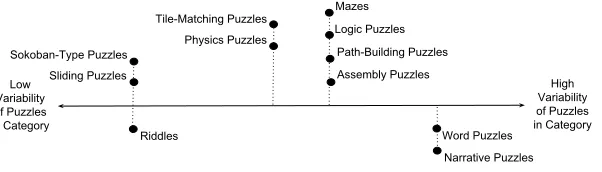
For the same reason, the categories also differ in granularity. Some categories primarily contain puzzles that are very simi-lar, while others contain puzzles that differ significantly, even if their core idea is the same. We have tried to show this in Fig. 1 where the eleven puzzle categories are arranged broadly according to the variability of the puzzles in that category. Our estimate as captured in the figure should not be considered a formal metric, but rather an informed assessment based on our reading of the field. We leave the exhaustive mapping of the domain of puzzles themselves as future work and instead focus this paper on PCG techniques.
Not every puzzle type is weighted equally in this survey because generation is trivial for some types of puzzles, and not feasible for others. We determined it worthwhile to include categories with little work in them as they help provide a more complete picture of the map as a whole.
For our literature search, we searched for works that were both frequently referenced and those that were somewhat obscure in order to cover what was influential as well as what has been attempted outside of the mainstream research. We generally focused on academic and experimental works as opposed to published games.
For each puzzle type, we give a brief introduction to the puzzle characteristics, list some prominent examples of games that include or consist of puzzles that we deem belong in that category, and then we review the work that addresses the procedural generation of these puzzles. This approach is intended to group research that has similar objectives and at the same time allows us to make observations across the puzzle types. A further intention is that this approach will allow us to identify ‘gaps on the map’ of research into puzzle generation, i.e., areas that are under-developed and therefore promising candidates for future research.
We define eight salient characteristics of PCG methods based on the taxonomy devised by Togelius et al. in their survey of search-based PCG [6], which was later revised by Shaker et al. in their book on procedural content generation in games [5].
Our selection of characteristics is tailored to puzzle gener-ation so we have left out some dimensions and added others. Specifically, we do not include the “necessary vs. optional” dimension, because all the work surveyed generates puzzles that constitute an entire game, i.e., the puzzles generated are always necessary; and “stochastic vs. deterministic”, because deterministic methods are not very interesting for puzzles. The dimensions we have added are “direct vs. simulation-based evaluation” (section I-B2) and “quality considerations” (section I-B7).
The purpose of these characteristics is primarily to provide a basis for analysis of PCG methods currently used for puzzle generation. Similarily to the dimensions listed by Shakeret al.
in their book, the items on the list below should be seen more as a spectrum than a dichotomy. It should also be noted that the list does not provide an exhaustive means of comparison, and we expect it to change as the field evolves.
1) Constructive vs. Generate-and-Test: Constructive algo-rithms generate the content once and are done, usually per-forming validity checks at different stages of construction. The Markov chain is a typical example of a constructive algorithm. Generate-and-test techniques construct and test in a loop until a satisfactory candidate is found; here evaluation occurs each time a complete candidate has been constructed. Some search-based algorithms, including answer set programming solvers, used by various generators in our survey, fall somewhere be-tween constructive and generate-and-test algorithms. A search often creates, tests and rejects partial or potential candidates before they are fully generated [7].
Fig. 1. Map of Puzzle Categories. Categories towards the left are fine-grained, containing highly similar puzzles, while categories toward the right are coarse-grained, containing more dissimilar puzzles. Vertical positioning is not significant.
where a human implicitly or explicitly scores candidates [8]. Evaluation functions are necessary for any algorithm that has some form of generate-and-test loop and are often not relevant for constructive algorithms, such as constraint-based methods, because those formulate the suitability of puzzles as a property of the allowed solutions.
3) Online vs. Offline: Online generation takes places while the game is running, allowing the player to see a lot of content variation, whereas offline generation occurs during game development, or at the start of the game. An algorithm must be both sufficiently fast and reliably accurate to be suitable for online generation.
4) Degree and Dimension of Control: Designers can con-trol which content is generated by a PCG technique in different ways. Shaker et. al. mention the random seed and a vector of content features as examples. In some cases, this control is in the form of optional tweaking of the generator but it can also refer to the amount of input a game designer has to feed into the puzzle generator. For generators that require a lot of input, the quality of the resulting puzzles tends to be heavily dependent on the quality of the input. While an input requirement allows for creative control, it also means that the generator will not work out-of-the-box. Examples of input are templates of level layout pieces, or databases of game item specifications.
5) Automatic Generation vs. Mixed Authorship: Mixed authorship is closely linked to the previous characteristic; it refers to content that is generated as the result of cooperation between the game designer and the generation algorithm. However, while the dimension of control is always about input that the designer feeds to the algorithm, mixed authorship may also refer to designers continuing the work of the generator, i.e., completing the design of a partially generated puzzle. Mixed authorship necessarily implies the algorithm running offline.
6) Generic vs. Adaptive: The output of generic algorithms is independent of the individual player, and this is the category most generators fall under. However, there is some investiga-tion into adaptive PCG, which uses the player’s acinvestiga-tions as inputs to the generator. While the use of PCG is often cited as useful for creating replayability, PCG can also be used to introduce adaptiveness [9].
7) Quality Considerations: Puzzle generators that include quality constraints/specifications attempt to generate puzzles that are also interesting and appealing, in addition to
be-ing simply solvable. Different methods may devote varybe-ing amounts of resources towards puzzle quality. One aspect of quality is difficulty; i.e., whether the puzzle generation algo-rithm allows for the creation of puzzles of different, specified levels of difficulty.
C. Traditional vs. Digital Puzzles
Some puzzle types covered in this survey originated on paper or in other tangible formats, while others, such as physics-based puzzles can only really exist in digital games, due to their interactive and dynamic nature. Dynamic puzzles present unique challenges for generation, as will be discussed further in the paper. Traditional puzzles are often digitalized as is, i.e., they are adapted to a digital platform without changes to the core puzzle mechanics. Popular examples of such puzzles areSudokuand crossword puzzles. Digitalization can make traditional puzzles more available, e.g., on smart phones, and accessible, by providing ways to easily undo and check partial solutions.
One notable difference between traditional and digital puz-zles is that the latter can employ brute force as a game mechanic. For example, for each set of maze puzzles inThe Witness (2016)the puzzler has to figure out the rules by using brute force to solve several small puzzles. Although the digital context makes brute force possible as a game mechanic, there are also computer-based puzzles that do not lend themselves to this, such as the path-building puzzles inThe Talos Principle. Another difference between paper-based and digital puzzles is the existence of temporal aspects; digital puzzles more frequently use time as a mechanism or constraint than tradi-tional puzzles, where it is only common in competitions. Time pressure can be used to increase the difficulty of a puzzle; e.g.,
Tetris (1984), an interactive puzzle, would not be challenging without its temporal component.
Distinctly from games with a time dimension, there are games that use time as a puzzle mechanic. The solutions of these puzzles require player-directed manipulation of time, e.g., the puzzles inBraid.
description applies to both 2D and 3D path-building puzzles, e.g., Refraction (2010)[10].
II. SURVEY OFPROCEDURALPUZZLEGENERATION
A. Sokoban-Type Puzzles
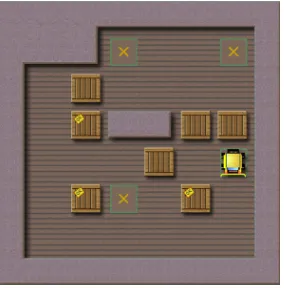
[image:4.612.105.247.277.421.2]This category of puzzles is named after the 1982 Japanese video game in which a player character pushes crates around a constrained grid-based area to get them to goal posi-tions. A defining factor of this type of puzzles is that no items/characters are ever lost or added to the board; the solution exists as a rearrangement of the original configuration. Many variations and offshoots of Sokoban (1982)now exist, a level from one version, JSoko, is shown in Fig. 2. Game developer Stephen Lavelle, creator of Stephen’s Sausage Roll (2016), a popular take onSokoban, has even created a scripting language for this type of game, calledPuzzleScript[11], which has been used as a tool for automatic generation and evaluation of Sokoban-style puzzles [12], [13].
Fig. 2. Screenshot from JSoko, an open source version ofSokoban.
The constraints imposed by limited space and possible actions, e.g., crates can be only be pushed, not pulled, are a key characteristic of Sokoban puzzles. The player has to think a few moves ahead, as some sequences of moves may lead to a state from which the solution is unreachable. In practice, Sokoban puzzles often have an undo functionality that allows for avoiding that scenario. This facilitates the puzzler’s problem-solving, as it allows exploration of solution sequences, and means the use of brute force is technically possible. However, all but elementary Sokoban puzzles tend to have several open lines of play at any given time, making brute force unfeasible.
Well-designed Sokoban puzzles must strike the balance between trivially easy and outright impossible, a difficult task for all but experienced Sokoban level designers [14]. Proce-dural generation can function as an aid to puzzle designers. GenerallySokobanlevels do not have many, if any, alternative solutions. The problem-solving process involves using spatial thinking to pursue promising sequences, and discarding those that are futile.
Despite the simplicity of the rules, Sokoban puzzles can be challenging to solve [15], for both human and machine players. Past research has determined that solving generalized
Sokobanpuzzles, i.e., on ann×nboard, is PSPACE-complete [16]. Automatic puzzle solvers are not the focus of this paper,
but are relevant insofar that they are often used to test the solvability of a generated puzzle.
Sokoban-type puzzles are relatively popular in the domain of procedural puzzle generation, possible due to the fact that Sokoban exhibits compelling challenges in this field, including a large space of possible configurations, which hinders exhaustive search algorithms and may make it difficult to guarantee solvability [15]. Additionally there is no good method to evaluate if an initial state will lead to a non-trivial or interesting solution sequence.
One of the earliest forays into puzzle generation was by Murase et al. who developed a program to create Sokoban
problems in three stages; generation, checking and evaluation [17]. This is a generate-and-test approach: a level layout is generated through a random combination of level templates and random placement of game items, and then a Breadth First Search (BFS) solver is used to check for a solution. However, BFS will only manage to solve puzzles with short solution sequences, so those with long sequences were incor-rectly discarded [17]. After testing for solvability, trivial and uninteresting, albeit legal, levels are discarded at the hand of an evaluator that checks solution length, number of direction changes and number of detours. One of the main issues with this generation program is that the restriction on solution length prevents the creation of complex problems. This method can be controlled through the use of the level templates, and is not suitable for online generation because the BFS results are unpredictable.
Taylor and Parberry generated Sokoban levels that are guaranteed to be solvable on the basis of working backwards from the goal positions [14]. As in the approach by Muraseet al., empty rooms are generated with templates, but here invalid or low quality rooms are immediately discarded. A brute force algorithm is used to evaluate all possible combinations of goal positions. While this can lead to the discovery of compelling levels, it is an expensive process; the runtime of the algorithm is exponential. For each goal placement, the system finds the furthest possible starting position, i.e., the shortest longest path according to the box line metric, by moving in reverse [14].
Taylor and Parberry claim their technique produces interest-ing levels, but it is only suitable for offline generation because it runs in exponential time and cannot handle levels with more than six boxes. The authors mention that their methodology could be applied for generation of other puzzles, but there would be quite some effort involved in reducing the amount of game-specific information; as mentioned, a major issue in puzzle generation efforts.
Tayloret al.performed an auditory Stroop test that indicated that players are as engaged with the generated puzzles by Taylor and Parberry [14] as they are with hand crafted puzzles by experienced designers [18]. The experiment exploits the fact that attention is a finite resource; focusing on Sokoban
will decrease participants’ attention on the Stroop test and vice versa. That players found generated puzzles equally interesting demonstrates value in procedurally generated puzzles.
apply MCTS by defining the puzzle generation as an MCTS optimization problem. This approach has been successful for other problems with high branching factors, the search tree structure guarantees solvability, and it has the anytime property, meaning the algorithm will return a valid solution regardless of when it is interrupted. The best puzzles found af-ter different rollouts can be stored; the search could optionally be terminated at a certain quality threshold. The authors state that their method is able to generate puzzles quickly enough for them to be used in procedurally generated mini games.
The puzzle generation method by Kartal et al. splits up the creation of the initial room layout and the placement of the goal locations. Initially the board is composed entirely of obstacles except for one empty tile with an agent, and the possible actions that can be undertaken at each node in the search tree are: “delete obstacles,” “place boxes,” or “freeze level” [15]. Once the ”freeze level” action is chosen, saving a start configuration, the action set is replaced by the “move agent” and ”evaluate level” actions. The “move agent” action simulatesSokobangame play; the boxes are pushed around to determine the goal positions. Like Taylor and Parberry, Kartal
et al. exploit the fact that generating a puzzle through game play guarantees solvability, but they execute game moves in the forwards direction, while Taylor and Parberry went backwards. MCTS requires an evaluation function to guide the search. Kartal et al. have published two different approaches for this function; both are direct but one is theory-driven while the other is data-driven. The theory-driven approach uses a combination of two metrics based on the level layout: terrain, the number of neighboring obstacles, and congestion, the number of obstacles and items between each box and its corresponding goal [15]. While this method eliminates the need for human input, the evaluation function did not capture all aspects of difficult Sokoban puzzles, and has no formal validation.
For the data-driven approach, Kartal et al. performed a user study to annotate a set of existing Sokobanpuzzles with perceived difficulty. Statistical analysis was performed on the results to discover which features correlate most strongly with difficulty, and these were then used in the evaluation function. Features were restricted to those that are efficient to compute, in order to maintain the efficiency of this method. Each given run of the MCTS algorithm will generate several levels of increasing difficulty. A second user study was performed for validation; there was a high correlation between the score assigned by the MCTS and the perceived difficulty [19].
There is still future work to be done on generating large
Sokoban puzzles of high difficulty; for all described methods, generation time increases exponentially for linear increases in the number of boxes and tiles.
Fling! (2013), shown in Fig. 3, is an example of a puzzle that falls in the overlap of Sokoban-type and tile-matching puzzles, though more towards the former. In this game the puzzler flings balls into each other to sequentially remove all but one ball from an empty grid. The balls act in turn as the player character, an obstacle or a crate, when compared with
Sokoban.
[image:5.612.340.536.58.205.2]Sturtevant looked at using large-scale breadth-first search—
Fig. 3. Sample moves on aFling! (2013)board, from [20].
a complete and uninformed search approach—for analysis and content generation for Fling! [20]. This is unusual as PCG methods generally favor selective search techniques due to the large state space. Sturtevant attempts to answer a question posed in [6]; namely whether search-based PCG can be combined with a top-down approach.
The focus of his research is the development of a tool for designers that can analyze and explore Fling! puzzles, rather than generating them from scratch, although it can be used for this also. The tool uses an endgame database, generated by solving all Fling! boards of sizes 1-10 using a retrograde search. For any given board the tool can determine the following metrics: the number of states legally reachable, using forward BFS; the legal moves which lead to a goal state, using DFS with endgame data; and how adding/removing pieces from the board changes the solvability. As such, the tool could be used in a generate-and-test puzzle generation approach.
The difficulty of a given Fling! board is most intuitively measured by the number of reachable states from an initial configuration. Experiments showed a strong correlation be-tween levels (difficulty) and number of states in the state space. Like for Sokoban, more domain-specific metrics may be useful, e.g., counting the number of times the player has to switch which ball is being flung.
B. Sliding Puzzles
Sliding puzzles are closely related toSokoban-style puzzles because they also involve moving items, or tiles, towards goal positions in a constrained grid-based space. There are, however, some differentiating characteristics that qualify this as a different puzzle type: there is no player character and items can be moved in any free direction. Often, the grid is square-shaped without obstacles and there are only a few open spaces to slide a tile onto. Like forSokobanpuzzles, the player must look a few moves ahead to determine possible winning sequences.
Fig. 4. Screenshot fromRush Hour (1996).
possibly using brute force. Unlike in Sokoban-type puzzles, sliding puzzles may have one-to-one pairings between items and goal positions, in which case figuring out the best mapping is not part of the solving process. In Rush Hour and similar puzzles, there is one item that must reach one defined goal position—inRush Hour, shown in Fig. 4, it is the red car that must reach the exit. LikeSokoban, theRush Hour puzzle has been shown to be PSPACE-complete [21], and exhibits similar challenges in determining the difficulty of a given puzzle.
Block-sliding puzzles can conceivably be generated by starting from the end configuration and working backwards, in a similar fashion to some of the generation methods described in section II-A. However, the number of moves used to play backwards to a start layout could be greater than the shortest path, so it is not necessarily a good metric for difficulty.
Some work has been done on the generation of hard configurations of the Rush Hour puzzle game [22], [23]. They define a hard puzzle as one requiring a large number of moves to solve, noting that a puzzle with many moves will still be easy if there are always only a few possible moves. The researchers used symbolic methods to iteratively compute reachable configurations from a set of solvable initial configurations for Rush Hour. This implies a constructive method. Symbolic methods are a way to bypass combinatorial explosion in many typical applications: sets are represented symbolically, in this case through use of binary decision diagrams (BDDs), instead of element-wise. This allowed for studying the huge graph of all possible initial configurations of the 6x6 Rush Hourpuzzle. A dual encoding of the board, i.e., one that works on a line and column level, is used to limit the size of the BDDs. The hardest initial configuration, found by Colletteet al. takes 93 steps to solve. Additionally, there are 24132 configurations that can be reached from it. As part of discovering the hardest configuration, the researchers classified every solvable configuration according to minimal solution length.
C. Tile-Matching Puzzles
The player’s objective in tile-matching games is to manip-ulate tiles on a grid in order to make matches [24]. When a match is made, the corresponding set of tiles disappears, and the player scores points. Common matching criteria include
shapes, colors and symbols. Puzzles of this category are relatively simple—they have very few rules—and are often categorized as casual games. Unlike other types of puzzles, tile-matching puzzles are almost exclusively randomly gener-ated, and generally do not have one specific solution.
This history of tile-matching puzzles could be traced back to
Tetris, which falls in the overlap between the tile-matching and packing puzzle categories. Like inTetris, each player action in a tile-matching puzzle permanently changes the level layout.
The most popular subcategory of tile-matching game is match-three games, e.g.,Bejeweled (2001), in which players swap the positions of tiles to make a row or column of at least three matching tiles. Juul observes that this category of puzzles has a ”low status,” perhaps due to their low barrier to entry, or the large number of similar games that now exist [24]. Most tile-matching puzzles have an element of time pressure which introduces a fail state; without a timer the puzzles would be too easy and the puzzlers would not feel a sense of achievement. The initial layout of tiles on the grid, and/or the choice of tiles/pieces that appear during the game are likely always procedurally generated using random number generators. The generation of these simple tile-matching puzzles is a rather trivial task, but for hybrid games more interesting approaches exist.
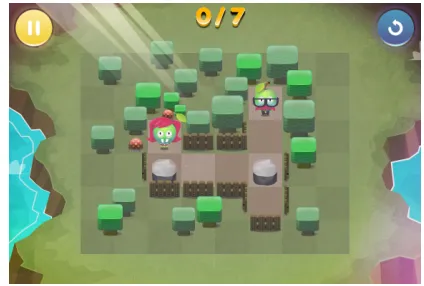
Fig. 5. Screenshot fromFruit Dating.
Rychnovsky procedurally generated all the levels for his gameFruit Dating (2014)[25], a more complex tile-matching puzzle that draws elements fromSokobanand sliding puzzles, and has similar mechanics to the popular mobile puzzle game
Threes (2014). Fruit Dating, shown in Fig. 5 consists of moving items on a grid-based board with walls and obstacles, with the goal of getting matching characters onto adjacent tiles. Unlike Sokoban, it lacks a player character, and each action can affect between zero and all items on the board. Items are moved by swiping in one of the four cardinal directions; each swipe will move all objects in the chosen direction, while they are not blocked by obstacles.
As is characteristic for theSokobanand sliding puzzle types,
[image:6.612.330.542.349.492.2]moves; this game has well-defined solutions whereas typical tile-matching games tend to be more open-ended.
Rychnovsky developed a level editor tool that can generate new levels and evaluate the solvability of any given level. The automatic solver uses a BFS approach with pruning and returns the shortest path. The level editor interface means that the designer can tweak a generated level, and then re-test it to make sure it is still solvable.
The process of generating a Fruit Dating level is divided into two steps; generating the level structure and placing the on-board items [25]. The level structure is created by first randomly placing the external wall tiles, and then the internal ones. The game objects, including the pair(s) of fruits that must be matched, are placed randomly according to predefined weights assigned to empty tiles. Rychnovsky took aesthetic qualities into account when creating the layout in order to facilitate the creation of interesting-looking levels.
All levels are checked for solvability after generation, and those that are not solvable are simply discarded. The main issue with this generation approach is that there is no way to control difficulty, other than by simply adding more items to the board. Overall the output is not of high quality, and the approach functions more to aid rather than to replace the designer.
D. Assembly Puzzles
In an assembly puzzle, a number of shapes must be assem-bled into a larger shape without overlap or gaps. Generally all the provided shapes must be used to achieve this. The process of fitting the pieces into the larger shape may be entirely based on shape-matching, or it could involve creating a picture out of the images printed on the pieces, as is the case for jigsaw puzzles. Puzzles of this type could exist in either a 2D or 3D format, and may or may not be digital, though the 3D versions tend to tangible. A famous 3D assembly puzzle, also called an interlocking puzzle, is the Soma cube, invented by Piet Hein in 1936, which consists of seven irregular pieces made up of unit cubes that must be assembled into a cube with side length three.
InThe Talos Principleunlocking new areas requires solving an assembly puzzle with tetromino pieces. As mentioned, we consider Tetristo be a combination of an assembly and tile-matching puzzle; the goal there is to assemble pieces into rectangles without overlap, and matching tiles into a line shape will cause them to disappear. Tetris is set apart from other assembly puzzles by its time pressure element, and the inability of the player to move pieces once they have been placed. Time pressure is a label that can be applied across puzzle types, rather than being a type on its own.
A famous example of an assembly puzzle is the Eternity
puzzle created by Christopher Monckton in 1999. Composed of assembling 209 irregular polygons of the same color into a dodecagon, this puzzle is extremely difficult and came with a £1 million prize for whoever could solve it in the first four years. The prize was awarded to two Cambridge mathematicians in October 2000.
There is no formal research into the generation of 2D assem-bly puzzles, likely because they are relatively uncomplicated
to create. Conceivably, such a puzzle could be generated by an algorithm that splits a region into areas; e.g., a Voronoi diagram.
[image:7.612.348.528.234.360.2]Songet al.developed a constructive approach for generating interlocking puzzles; such puzzles are made up of a number of pieces that can be assembled into an structure that can be locked by a single key piece [26]. They are challenging to solve and compute as the pieces have no orientation and can be combined in an extremely large number of ways. In a standard interlocking puzzle, all pieces are immobilized until the key piece is removed, at which point they all become mobilized. However in a recursive interlocking puzzle, which was the specific focus of the research, pieces are also locked in intermediate states.
Fig. 6. An example interlocking puzzle with LEGO bricks, from [26].
A model for generating new interlocking geometric struc-tures, given a general voxelized shape as input, was derived from the analysis of interlocking mechanics. Songet al.prove that the whole model can be interlocking if every three consecutive pieces are interlocking. A puzzle is created by iteratively extracting pieces from the given shape, in such a way that validity is guaranteed [26]. This technique provides a designer with a lot of control as it can create puzzles from any voxelized shape, enabling the creation of, for example, custom puzzles that use LEGO bricks, as shown in Fig. 6.
E. Mazes
Sturtevant and Ota have worked on an algorithm for generating a version of the tetronimo maze puzzle from The Witness
[image:8.612.95.252.150.240.2]where multiple puzzle panels must be solved jointly. They use a branch and bound (semi-exhaustive) search to enumerate possibilities and then select subsets where there is only one solution that works for all puzzles in the subset; Fig. 8 shows one such subset [28].
[image:8.612.68.278.282.349.2]Fig. 7. Screenshot of two maze puzzles fromThe Witness.
Fig. 8. Puzzles based on those fromThe Witnessthat were generated by
Sturtevant and Ota. The correct solution is the one that works for all three puzzles.
Obstacle course navigation can be classified as a type of maze; the player must navigate an area along a correct path to reach an endpoint without taking too much damage. Many obstacle courses are a cross between a maze and a path-building puzzle, where a player must utilize a number of items to create the desired path between entry and exit.
Loderunner (1983) and Lemmings (1991) also fall into that overlap of puzzle types; they both include dynamic mazes that the player must navigate by making decisions in real-time. As such, they can also be viewed as early RTS games, and do not always have a clearcut solution.
Fig. 9. Example of a chess maze for a rook from [27]; E represents the entry tile, X the exit tile, and the K tiles have knights on them. The left image is what appears to the player, the right image has the obstructed squares marked in blue.
Constructive maze generation is an old topic in computer science, mainly popularized in the context of dungeon and/or level generation. A practical approach to random maze gener-ation, which could be used for a number of applications and
which covers classic algorithms such as the binary tree algo-rithm and Kruskal’s algoalgo-rithm, is given in Buck’s bookMazes for Programmers: Code Your Own Twisty Little Passages[29] Shaker et al. describe four main categories of constructive maze generation: space partitioning, which performs (usually binary) spatial subdivisions in a hierarchical fashion; agent-based algorithms; cellular automata; and algorithms agent-based on generative grammars [30]. The last two categories are also delineated by van der Linden et al. in their survey on pro-cedural generation of dungeons, which additionally includes sections on evolutionary and constraint-based algorithms [31]. Nelson and Smith cover this last category in their application of answer set programming to mazes (ASP is described later in this section); they represent mazes as grid-embedded trees and impose constraints on reachability and path length [32]. Recently, Brewer conducted a general audience survey on the history of dungeon generation, ranging fromRogue (1980)to
Minecraft (2011) [33]. We will not go into more depth on these algorithms, because most of the literature is about gen-erating level structures as opposed to stand-alone puzzles, and thus not within the scope of this survey. However, some work in this domain, particularly under grammar-based algorithms, focuses on the gameplay, i.e., narrative progression, aspect of dungeons, and we will look at this work in the narrative puzzles section.
Ashlock uses an evolutionary algorithm to generate chess-based and chromatic mazes of varying levels of difficulty [27]. Evolutionary algorithms are well-suited to creating a large collection of unique puzzles because they can quickly locate many diverse optima in a complex function. The fitness func-tion, which returns a measure of the quality and/or difficulty of puzzles in a generation, uses dynamic programming to calculate the minimum number of steps required to traverse the maze. Dynamic programming is a method for solving a complex problem by decomposing it into simpler sub-problems, and storing the solutions to those problems.
Both the chess and chromatic mazes are grid-based and have implicit barriers; players must figure out which tiles are safe according to the puzzle rules. Entry and exit squares are marked on the grids. In the chess maze, shown in Fig. 9, the player must move across the board according to their assigned chess piece, and without traversing any squares covered by the other pieces. In the chromatic puzzle, a safe move consists of continuing onto a tile whose color is adjacent in the color wheel to the color of the current tile. In digital format, some form of repercussion can be used to prevent the use of brute force.
To determine the fitness of a maze, dynamic programming is used to traverse a network and record the cost of arriving at each node, computing the shortest path to traverse the maze. During evolution, the aim is to maximize the length of this shortest path, theoretically increasing the difficulty of the maze. The evolutionary algorithm is straightforward; each generation, seven population members are randomly selected, and the two most fit out of those are picked for reproduction, which includes crossover and mutation operations [27].
[image:8.612.72.275.543.643.2]algorithm. The size of the sample space aids in this, but for smaller sample spaces diversity-promoting measures could easily be introduced. By adjusting the dynamic programming code, the technique described could be used for other types of puzzles. However, the authors warn that dynamic program-ming is not a very human way of solving a maze, so it may not provide the best estimation of what a puzzler would find difficult [27].
Fig. 10. Example of a chromatic maze from [7], with a shortest solution path.
Smith and Mateas re-implemented Ashlock’s chromatic and chess maze generators using answer set programming [7]. ASP is a form of declarative logic programming where constraints and logical relations are declared in a Prolog-like language; specifically, common answer set solvers use AnsProlog [34]. Answer set programs contain two structures—facts and rules— which capture the design space model. Facts are statements that describe configurations and properties; rules control the production of new facts. There are three types of rules: choice rules, deductive rules and integrity constraints. An answer set solver often works by performing a heursitic, back-tracking search that applies one choice at a time and eliminates large sub-spaces of potential solutions when it can deduce a forbidden property, as specified by the constraints, in these solutions [34].
For the application of chromatic maze generation, the facts correspond to which color is assigned to each grid cell, and which cells are the start and end. The choice rules ensure exactly one fact is produced per grid position. This simple formulation can already create mazes, albeit ones where the end is possibly not reachable from the start. Desirable solu-tions can be assured by adding a constraint on reachability. One of the generated mazes is depicted in Fig. 10.
Compared to Ashlock’s method, where the fitness function is essentially a black box, the ASP approach for maze gener-ation is a “white box model” [7]. While the space of possible outputs is smaller than for a black box model, a designer can control it directly through constraints. For example, while the longest shortest path length is used to evaluate fitness in Ashlock’s generator, the desired path length can be declared as a constraint in the ASP generator. Additionally, constraints provide a way to improve the quality of generated mazes, e.g., a designer can add constraints on which colors are traversed on all shortest paths [7].
Williams-King et al. used a genetic algorithm combined with agent simulation to generate levels for a variety of
Loderunner[35]. The game can be considered a maze because the puzzler must discover a path through the level to collect all pieces of gold without encountering an enemy. The presence of moving enemies makes this maze dynamic, and the ability of the puzzler to dig, indicates a path-building element.
This generation process has two phases that each employ a method of evaluation. The fitness function that steers the GA comprises of direct static analysis, which alone cannot guarantee solvability but does allow for consideration of other interesting properties. Levels with high fitness are passed forward to the next phase where they are simulated with an AI player, to test the dynamic aspect, using 20 different paths. Difficulty is measured by the number of valid solution paths found in this process.
Williams-King et al. state that their system can generate interesting levels in an online scenario. This two-part tech-nique has potential to be applied to other puzzle games with dynamic elements. The scope for future work is mainly in the improvement of the evaluation function—an observation that can be made for several types of puzzles.
F. Path-Building Puzzles
[image:9.612.332.542.437.555.2]This type of puzzle requires the player to build a path from a point A to a point B using a number of provided items. The path could be built for an entity in the world to traverse, like an enemy AI; tubes, like the BioShock mini-game, shown in Fig. 11; a laser, like in somePortal (2007) levels; or for the player character themself. This survey discusses gameplay paths, such as those undertaken by a player traversing a dungeon, in the narrative puzzle category, though one can also construe this as path-building.
Fig. 11. Screenshot fromBioShock (2007).
Path-building is somewhat related to mazes but is differen-tiated by the nature of the game environment; in a maze, the player cannot change the environment, only find the best path through it, while in a path-building puzzle, the objective is to create a new path by altering the environment at the hand of tools or items. For some of these puzzles the challenge stems from figuring out the correct placement of a limited number of items while in others there are more items than needed, i.e., decoy items, and the player must determine which ones are most suitable, in addition to placing them. The latter usually lends itself to multiple possible solutions.
Refraction[10]. Many generators have not incorporated a way to guarantee that certain constraints, including aesthetic or difficulty concerns, are satisfied in their output. In other words, the constraints require the puzzle not only to be solvable, but solvable under certain prescribed conditions.
Fig. 12. Screenshot fromRefraction.
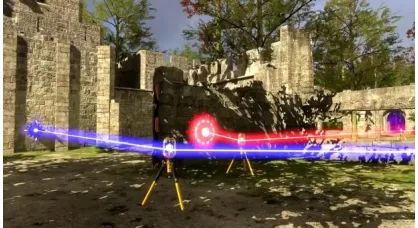
Refraction, shown in Fig. 12 is an educational game that aims to teach proportional reasoning (fractions) through a puzzle about re-directing laser beams towards a spaceships. The beams can be bent, split, etc. using different components, the placement of which also trains spatial problem-solving abilities. The game is set in a constrained space formed by walls of asteroids.
Smith et al. present implementations of three constraint-based generation tools—mission generation, grid embedding, and puzzle solving—that each solve part of the problem of procedural puzzle generation [10]. The first is responsible for creating a general outline with possible level solutions; it transforms a set of math expressions and a target number of pieces into a directed acyclic graph (DAG). Grid embedding translates a mission, specifically the DAG, to a geometric layout. Finally, puzzle solving aims to construct alternative reference solutions.
The overall level generator uses the structure defined by Dorman and Bakkes which distinguishes between missions and spaces; missions are the logical order of goals the player must accomplish, while spaces are the physical layouts of the levels [36]. This distinction is valid for many puzzle games, and may be especially useful for approaching puzzles set in 3D space, such as those in The Talos Principle. Part of a path-building from The Talos Principle is shown in Fig. 13; the mechanic of re-directing lasers to solve the puzzle is similar to that found in somePortal levels. WhileRefraction
is a 2D grid-based video game, the high-level formulation of the different components could lend themselves to a 3D adaptation—mission generation would not need to change.
Smithet al.made two implementations of each of the three tools. The initial implementation of mission generation uses a constructive feed-forward approach where pieces are inserted one by one, and the generated mission DAGs all represent feasible solutions, by construction. The first grid-embedding and puzzle solving implementations both used DFS. The main bottleneck in a system comprised of these tools was the grid-embedding step, which the authors identified as a constrained
Fig. 13. Screenshot fromThe Talos Principle (2014), showing path-building with lasers.
search problem that could not be fruitfully addressed with a generate-and-test approach.
The second implementation of the tools is based on ASP, and Smith et al. found that these performed better than the original tools, both in terms of speed and output quality [10]. The quality is better because the ASP approach allows for the specification of style constraints. They also found that declarative languages can be a powerful expressive tool for reliable, controlled puzzle generators. Constraint-focused generator design can allow aesthetic failures to be treated the same as absence of solvability. Few other generators reviewed in this paper have reached the stage of taking aesthetics into account.
In a later study, motivated by the sequel Refraction 2, Smith et al. looked at constraining undesirable solutions, which they also refer to as shortcut solutions [34]. In path-building puzzles the unforseen combination of pieces, either those from the primary solution, or those added as distractions, can introduce alternative solutions that were not intended by the designers. Since Refraction is an educational game, the designers require tight control over the puzzle progression, though this tends to also be a concern for game designers in general. Easier and/or alternative solutions, which could occur in Refraction as mathematical or spatial shortcuts, are potentially unacceptable, if they demonstrate a pattern that the designer did not anticipate.
Smith et al. formalize the generation of solvable puzzles with no undesirable solutions as an NPNP complete search problem. To address this problem they added two design-oriented extensions to their previous ASP approach [10] that allows the space of desirable, i.e. shortcut-free, solutions to be declaratively posed. This improved generation technique resulted in a reliable qualitative leap in the produced puzzles. Butleret al.used the ASP-based puzzle generator by Smith
et al. as part of their tool for designing level progressions through mixed-authorship [37]. The tool uses constraints, which are specified by designers and are incorporated into the original generator, to address the generation of a logical progression of levels. Combining a high level view with the creation of individual puzzles is interesting for e.g. the incremental introduction of concepts.
Encouraged by Smith and Mateas’ work on using ASP for the generation of mazes, as covered in section II-E, Compton
[image:10.612.84.268.128.264.2]Fig. 14. Representation ofAnza Island, showing two possible solutions for the constraints “Dark Obelisk cannot be cannoted to Monumental Stone Head. Monumental Stone head cannot be connected to Hidden Grotto. Bubbling Pool must be connected to Hidden Grotto” [9].
puzzle game called Anza Island [9]. In this game, a human plays against an AI, Anza. The human must visit a number of landmarks in different zones to win, while Anza attempts to thwart this by controlling, i.e. activating and deactivating the bridges between zones. The human player must create a number of constraints, based on collected logic cards, that force Anza to create the bridges they require (this is the path-building element). Two possible solutions for three given constraints are shown in Fig. 14. This novel approach to PCG directly incorporates the generation into the game— the constraints specified by the player modify the answer set program at runtime. The declarative nature of ASP makes it possible to ensure all generated content would be valid.
G. Narrative Puzzles
Narrative puzzles can be defined as puzzles that form part of the progression of a narrative, whose solutions involve exploration and logical as well as creative thinking. They are a key component of adventure and story-driven games, and often feature in large open world games, including RPGs. Narrative puzzles can be viewed as temporary obstacles to the narrative’s advancement, though they do not always have to be solved in a precise order.
Adventure games have many sub-genres, including text adventures, point and click adventures and escape the room games, such asThe Room (2012)series. Not all of the puzzles in this range belong in the narrative puzzle class; adventure games could choose to include any of the puzzle types mentioned in this classification. However, narrative puzzles is one of the broader puzzle classes; it incorporates many logical thinking and pattern matching type puzzles, such as those in
Myst (1993).
A good narrative puzzle should have a satisfying solution, i.e., one that ultimately makes sense to the puzzler. Puzzlers find solutions by exploring the environment and investigating ways in which objects can be manipulated and combined. Some examples of narrative puzzle patterns, as outlined in [38], are:
• Figuring out which item a character desires, usually leading to a reward in exchange.
• Logically combining two objects to change their proper-ties, or to create a new object.
• Disassembling an object into useful components.
• Saying the right thing to convince a character to provide aid.
• Acquiring a key to open a new area.
Unexplored (2017) is a published procedurally generated roguelike that integrates varied, generated lock and key and code based puzzles [39].
The use of the label ‘narrative puzzle’ could be debated because it is possible to switch out the specific puzzles without affecting the overall narrative—the focus of the research in [40]. However, the label has been used in past research and fits when viewing story progression as centered on player action. A different take on a narrative puzzle is Framed (2014), a puzzle game set up like a noir comic in which the player must rearrange the order of events to prevent the protagonist from getting caught or shot by the police. As some of the re-arrangements are focused on creating physically feasible path, rather than a narrative one, this game is considered a blend of a narrative and path-building puzzle.
Fig. 15. Screenshot fromStranded in Singapore[38].
The Puzzle-Dice system was developed by MIT Media Lab Singapore for the purpose of generating narrative puzzles [38]. Their motivation was to add re-playability to adventure games, which frequently only have one linear path. The use and de-velopment of the Puzzle-Dice system is demonstrated through two proof-of-concept games: Symon (2010) and Stranded in Singapore (2011).
Symon was an early prototype with a dream-like setting that allowed for fantastical logic, i.e., using something cold to change an object’s color to blue. It was small in scope but succeeded at demonstrating the generation of a short, re-playable game. The initial system for Symon used a puzzle map that concatenates narrative puzzle patterns into the struc-ture of a game. Both this map and the possible puzzle patterns need to be specified by a designer; the generation process then inserts characters and objects into patterns, and patterns into the map, using a brute force approach. This grammar-based method of generation ensures that all puzzles will be solvable because the generation is constructive.
[image:11.612.333.538.299.452.2]adventure game in which the puzzler must fulfill the demands of a number of characters, often through logical combination of items found in the world. The full system is based on puzzle building blocks that can be customized by designers; a modular approach that aims to allow for expansions. This system’s puzzle map is a map structure resulting from the combination of building blocks and defines the chronology of actions the players must undertake, in terms of dependencies. Puzzle maps are paired with a database of designer-defined game items that have attributes and relationships to other items. The relationships are used to determine which items can fit into certain puzzle building blocks. For example, each item has a “madeby” property that links it to two other items that can be combined to create that item. Building blocks perform generation of narrative puzzles independently given a desired output. The generation process is composed of three steps: generating the output item with the desired properties, generating inputs, and finally creating a relationship between the input and outputs. The possible relationships include: combine, property change, insertion, request and area connection.
The motivation behind the development of the Puzzle-Dice System [38] is threefold; the researchers wanted to create a tool that guarantees solvability in its output, is accessible to designers, and is general enough to allow for a range of narrative-type puzzles. The tool is more like a framework than an out of the box puzzle generator as both the item database and puzzle map must be constructed by the designer. Narrative puzzles, by nature, require a large amount of designer input compared to other puzzle classes.
Dart and Nelson worked on adventure-game puzzle gener-ation using smart terrain causality chains [40]. They focused on creating a drop-in solution for the issue of re-playability: generating variations on puzzles that fit in the same place in an existing story line. In other words, this technique introduces re-playability without high-level narrative variation, and stands in contrast to the common branching story lines approach. The puzzles do change the low-level narrative significantly, and thus fit this puzzle class.
The puzzle generation relies on a database of smart terrain items to create causality chains that form puzzle solutions. Smart terrain items, introduced by Will Wright, developer of The Sims (2000), have a set of associated actions and properties that determine how they behave, and how the environment can affect them. In contrast to the Puzzle-Dice system, items are not aware of their specific relationships to other items. Interactions between objects are executed through use of physics simulations, such as phase transitions, collisions or indirect energy [40].
A smart terrain causality chain (STCC) is a directed graph that defines dependencies between all the objects in the scene, and the objective of the puzzle [40]. The sequence of items represented by the STCC corresponds to the sequences of ac-tions that the puzzler must perform to solve a puzzle. A list of possible actions for an item, along with the causes and effects, allows the creation of an STCC using a backwards chaining algorithm. The generation starts from a set of scene objectives and runs till it reaches primitive smart-terrain objects, which
are then placed in the scene. This is a constructive process that guarantees at least one solution, and that each item in the scene is relevant for at least one solution.
Dart and Nelson tested their generation method in the adventure game Space Dust (2014). Players have to replay this game several times to acquire all the information needed to win, and on each playthrough, have to solve different puzzles to progress. They discovered that 70 percent of players found the puzzle scenarios easier when there were more possible, parallel solutions, and most players said that longer causality chains corresponded to more difficult puzzles [40]. Their experiments also showed that players found the game engaging, despite the repetition in overall story.
Object placement in the physical game world is currently not automated, but could be added in by also storing semantic information about the environment. Another area of future work is actions/effects inference; similar to in the Puzzle-Dice system, all cause and effect information has to be manually specified by a designer, but it would be desirable to automate this process.
Generally, procedural generation for dungeons has focused on the level layout, but van der Linden et al. also looked at generating sequences of player actions for a gamed called
Dwarf Quest (2013) [31]. These actions include fighting enemies as well as basic narrative puzzle constructs such as key-and-lock challenges.
An action graph, is generated from a gameplay grammar in which player actions are defined as a verb and a target, which is typically a game item. Additionally, actions may have sequences of sub-actions, which may represent disjoint alternatives. For example, a sub-action of unlocking a door with a key might be fighting an enemy from whom the key can be looted. Designers can control generation through the authoring of the grammar, and through the intial actions, since those steer the recursive substitution of compound actions with sub-actions (or sub-graphs). The produced action graphs are converted to physical dungeon levels, but that aspect falls outside the scope of this survey.
Another category of PCG that can fall under narrative puz-zles is quest generation. Quests are commonly used in RPGs as plot advancement devices but tend to represent higher-level narrative elements than the narrative puzzles previously discussed in this section.
Doran and Parberry analysed the structure of almost 30,000 quests from four popular MMORPGs—Eve Online (2003),
World of Warcraft (2004), EverQuest (1999) and Vanguard: Saga of Heroes (2007)—to develop a quest generator [41]. They determined that the structure of a quest, which a player obtains from an NPC, can be described by: the NPC’s moti-vation, the strategy, as assigned by the NPC, for completing the quest, and the individual sequence actions that lead to the implementation of these strategies. From the surveyed games, the top NPC motivations appear to be conquest, equipment, protection and knowledge. Some example strategies are “spy,” “attack enemies,” and “treat or repair,” and some possible actions are “go to” and “give.”
of this grammar correspond to the atomic actions that can be undertaken by a player. As such, quests can be expressed as trees, where the root represents the entire quest, and the leaf nodes, visited in pre-order traversal of the tree, detail the sequence of player actions necessary to complete the quest.
The quest generator starts by randomly picking a motivation and selecting an associated strategy. This becomes the root of the tree, and from there nodes are recursively replaced according to the grammar rules to generate sub-strategies (sub-quests) and actions. The choice of rule to use for a replacement is dependent on the state of the game at that point to, for example, prevent creating a quest for obtaining an item that player already has.
Many RPGs use recurring quest structures in which the details are just replaced to generate “different” quests; Doran and Parberry propose that their generator can also change the structure, to provide a wider range of useful content. However, in the cited paper they had not evaluated whether the quests created by their generator were equal in quality to hand-crafted quests [41].
H. Physics Puzzles
Puzzlers have to use game physics to complete the puzzles belonging to this class. Physics in games is (most often) modeled after real-life physics, and so finding a solution requires players to predict the physical outcomes of possible actions. These puzzles naturally only exist in digital games. Physics puzzles have an element of unpredictability, as the game environment changes in real-time according to the laws of physics.
In contrast to many other puzzle classes, the solutions to these puzzles may require precise timing and/or execution of actions on the player’s part; for example, shooting a new portal while falling in a Portalpuzzle room. This is dexterity difficulty, modeled by Isaksenet al.as one of two orthogonal components of perceived difficulty—the other being strategy [42]. Dexterity difficulty is an element of interactive puzzle games and speaks to the execution of a solution. In compar-ison, strategic difficulty refers to the derivation of a solution and is influenced by the size of the search space and the required application of logic. The dexterity component poses a challenge for generating physics puzzles because a generator must ensure solutions are feasible, i.e., they have a margin of error that accomodates human reaction time. Diversely, viewing the dimensions independently may allow a generator to create puzzles that are tuned for a certain skill.
Shakeret al.focused on the generation of levels for physics-based puzzle games, using a clone of the mobile game Cut The Rope (2010) as a test ground [43]. The goal in Cut The Rope, shown in Fig. 16, is to make the candy drop in such a way that it reaches a frog monster placed at a fixed position. There are different game objects that can be used to change the movement direction of the candy, including ropes, air cushions, bubbles, bumpers, and rockets. All these objects obey the laws of Newtonian physics.
[image:13.612.336.542.56.185.2]The game generator by Shaker et al. [43] evolves levels based on a context-free grammar, which is a set of recur-sive rewriting rules. Design grammars offer a concise way
Fig. 16. Screenshot fromCut The Rope[43].
of describing a huge variety of possible level structures. Grammatical Evolution (GE) is a technique that combines an evolutionary algorithm with a grammatical representation. Shaker et al. constructed the grammar by analyzing original levels for design patterns.
Levels, which are the phenotypes, are represented by lists of objects that can be placed anywhere in the map and may have some properties. As mentioned, the structure of a level is described by a design grammar, which is what is used to evolve levels. The GE process includes a genotype-to-phenotype mapping using production rules from the design grammar. This results in phenotypic programs that are syntactically correct— these programs are then evaluated for fitness.
A fitness function based on direct heuristic measures, which are theory-driven, is used to rate and consequently evolve lev-els. However, high fitness is only an indication of playability, not a guarantee. Consequently, Shakeret al.experimented with a simulation-based fitness function that works by randomly selecting actions based on game state until the game is won, lost, or times out.
To estimate the expressiveness of their generation, which corresponds to the range of all levels, the researchers de-fined three measures: frequency, orientation and density of game items. They saw promising results in terms of efficient exploration of the content space, and also reflections of the constraints imposed by their grammar and fitness functions.
In later research, Shaker et al. developed a deliberative Prolog-base agent to improve the simulation-based evaluation component of their original generator [44]. The agent uses inference to determine a set of sensible actions and a depth-first search is then performed on this (reduced) search space. Two different rule sets were used for the agents; the first focused on the all game objects’ properties and their placement in the level while the second contains only objects the candy can reach while in a given position, direction and velocity. The use of the notion of reachable components in the second ruleset greatly improved the processing speed, because it disregarded more branches. Overall the evaluation technique is effective at detecting playable levels, but it does not address difficulty.
components: timeline generation, where GE is used to evolve a timeline of in-game events, and timeline simulation, where the timelines are simulated using an intelligent agent. The agent maps the timeline to a possible level layout in a constructive manner and assigns it a fitness based on level design, playability and aesthetic.
The progressive approach provides a one-to-many mapping between genotypes and phenotypes; each timeline (genotype), which described the rhythmic feel of the game, could be mapped to several different level layouts (phenotypes). The timeline simulation component combines the generation of the complete design with a playability check, and guarantees that all placed components are needed in the completion of the puzzle.
Compared to their previous approaches, Shakeret al.found that the progressive approach was much faster and resulted in a greater variety of generated puzzles. They state that this technique could be applied to many games to induce a significant decrease in generation time. Future work includes providing a way to control difficulty as part of the timeline generation.
Ferreira and Toleda used a genetic algorithm to generate levels for another popular 2D physics puzzle game: Angry Birds (2009) [46]. Briefly, the objective in Angry Birds is to crush all the pigs, in the alloted time, by using a slingshot to throw birds against a structure of blocks and pigs. The player must use physics knowledge to estimate how hard and at what angle to fling the bird to trigger an optimal collapse of the structure. Since the source code of Angry Birdsis not available, the researchers created a clone using theUnitygame engine.
The game clone is used as part of their genetic algorithm to perform simulation-based evaluation. The structure of can-didate levels is encoded as an array of columns with elements (block, pig or composed block), but at the evaluation stage all the individuals in the current population are transcribed to an XML file that can be used to build the level for simulation. The results of each simulation—specifically the average velocity and number of collisions for the blocks and pigs, plus end rotation for the blocks—are recorded for use in determining the stability of structures in a level. The genetic algorithm considers the most fit levels to be those that are the most stable and performs crossover and mutation by manipulating the associated arrays of columns [46].
An important parameter in these simulations, which the researchers determined experimentally, is the time limit: if the simulation time is too short, game items may not have started to fall when the timer runs out; if it is too long all elements will end up at rest. The algorithm initializes the population according to some probabilities that prevent randomly creating start individuals with extremely unstable structures.
Ferreira and Toleda, like Shaker et al., defined metrics for evaluating the expressivity of their level generator, specifically frequency, linearity and density, which refer to the blocks’ types and orientations. These metrics showed that there was variation in the generated levels, e.g., structures with varying heights.
[image:14.612.349.526.58.204.2]Stephenson and Renz came up with an algorithm for
Fig. 17. An example of a generated structure for anAngry Birdslevel, from [47].
generating Angry Birds levels that is dependent on a self-contained structure generator [47]. The structure generator creates independent structures, using a variety of different blocks, for different randomly sized sub-sections of the level. This generator works top down: it starts by picking a block for the peak of a structure, and then recursively determines blocks to place underneath. Block choices are made at the hand of a probability table and a validity check, for the stability of the structure, is used to determine the layout of the blocks. An example of a fully generated structure is shown in Fig. 17.
After the structures have been placed, they are analyzed to determine possible pig placement locations. This is followed by a structural analysis to determine weak points that should be protected from the player, by the introduction of extra blocks, so that the level is not too easy. Finally, a number of birds is added, which also effects difficulty in that it determines the number of “shots” the player gets.
This generator is highly controllable by a designer as there are many inputs, such as the block selection probabilities and number of structures that can be customised. Stephenson and Renz also used a number of metrics to evaluate their generator: frequency of block types, structural height variety, density, difficulty, which is depdendent on the input parameters, and playability. The researchers concluded that their generator is flexible enough to be applied to other games, and that it can come up with a broad range of levels [47].
I. Logic Puzzles
Logic puzzles are solved through deductive reasoning; the player arrives at a solution through a series of deductions made from some given premises. The first logic puzzles appeared in Lewis Carroll’s bookThe Game Of Logic[48] and were akin to syllogisms. Popular puzzles in this category are Sudoku, in which the player makes deductions about placements of numbers, and logic grid puzzles. The latter is so named because the puzzler is provided with a grid on which to fill in information obtained from clues.
![Fig. 3. Sample moves on a Fling! (2013) board, from [20].](https://thumb-us.123doks.com/thumbv2/123dok_us/1497319.690289/5.612.340.536.58.205/fig-sample-moves-on-a-fling-board-from.webp)
![Fig. 6. An example interlocking puzzle with LEGO bricks, from [26].](https://thumb-us.123doks.com/thumbv2/123dok_us/1497319.690289/7.612.348.528.234.360/fig-example-interlocking-puzzle-lego-bricks.webp)
![Fig. 9. Example of a chess maze for a rook from [27]; E represents the entrytile, X the exit tile, and the K tiles have knights on them](https://thumb-us.123doks.com/thumbv2/123dok_us/1497319.690289/8.612.95.252.150.240/fig-example-chess-maze-represents-entrytile-tiles-knights.webp)
![Fig. 10. Example of a chromatic maze from [7], with a shortest solution path.](https://thumb-us.123doks.com/thumbv2/123dok_us/1497319.690289/9.612.113.237.164.290/fig-example-chromatic-maze-shortest-solution-path.webp)
![Fig. 15. Screenshot from Stranded in Singapore [38].](https://thumb-us.123doks.com/thumbv2/123dok_us/1497319.690289/11.612.60.290.56.169/fig-screenshot-from-stranded-in-singapore.webp)
![Fig. 16. Screenshot from Cut The Rope [43].](https://thumb-us.123doks.com/thumbv2/123dok_us/1497319.690289/13.612.336.542.56.185/fig-screenshot-from-cut-the-rope.webp)
