Technology (IJRASET)
A Non-cooperative Approach For Resource
Allocation in Heterogeneous Distributed
Computing Platform
Sameeksha Chauhan1, Rama Shankar Sharma1
1
M.Tech. Scholar, 2Associate Professor,Computer Science & Engg Department University College of Engineering,Rajasthan Technical University,Kota, Rajasthan, India
Abstract— HDCS(Heterogeneous Distributed Computing System) is a set of interconnected computing nodes so as to offers sharing of computational power, applications or network resources vigorously In this paper, our distributed system consists of diverse resources with numerous selfish customers that receive computationally rigorous tasks from users and settle on conveying them to resources. The consumers in the system work in parallel, of which attempts to allocate the inward tasks to resources with the purpose of optimizing the expected completion time of it`s tasks. In order to have a balanced system there should be equilibrium between these selfish consumers. Here we devise s decentralized dynamic resource allocation scheme in distributed computing systems has been modelled as a non-cooperative game among the computing nodes and nash equilibrium gives the optimal solution of this non-cooperative game .In the preceding accessible schemes allot tasks to the computing nodes which are having more processing capability but in dynamic environment its not sufficient to schedule tasks based on the processing powers. Think about resource availability along with the processing powers of computational resources is great connotation with regard to performance issue. In the proposed scheme resource allocation is based upon the processing powers of the computing nodes, communication delay and the resource availability(waiting time) of tasks at different computing nodes.
This scheme improves the fairness of the HDCS and minimizes make span of the tasks
Keywords— Heterogeneity of tasks, Distributed Computing System, Resource Allocation, Nash Equilibrium, Non-cooperative
Game
I. INTRODUCTION
One of the aims of the load balancing has been to diminish the total execution time of tasks given to accessible resources in a distributed computing atmosphere The load balancing decisions depend on either a static study of the behaviour of system resources[3][10] or dynamic changes and current state of system behaviour. Schedulers or consumers use Static or dynamic information of system circumstances. There are two approaches: centralized [9][12][10] with Single decision maker and decentralized(distributed) ,with multiple ones on basis of the number of decision makers,. For a large number of computers, the operating cost of centralized become unaffordable and the central decision computer hold up. In distributed load balancing, Load balancing could be achieved by either Cooperative approach in which several decision makers work together in making the decisions such that each of them will handle at its optimum or Non-cooperative approach where decision makers that are not allowable to cooperate and each of them selfishly optimizes its own rejoinder time independently of the others and they all eventually reach an equilibrium.
II. RELATEDWORK
In history works on load balancing considered optimization of the entire system expected response time [5][3][8][10] .In current years, there is evaluation of game theoretic approaches and market oriented models for the propose and examination of distributed systems and load balancing.
Technology (IJRASET)
is formulated here by Shailendra S.Aote and M.U.Karat, they have measured accessible processing powers of computers and task arrival rate as a parameters for pronouncement the suitable computers for allocation of tasks.Daniel Grosu and Anthony chronopoulos estimated the self-interested load balancing in a heterogeneous distributed systems as a non-cooperative game [14] to get better response time of tasks submitted at any computer. This is a static approach which uses the processing power and task arrival rate for finding proper computers for task assignment.
A load balancing problem in computational grids is proposed by R .Subrata and Y.Zomaya as a non-cooperative game by making an allowance for the processing powers of computers and transfer time of the tasks to the other computers [15] with an objective of minimizing the average completion time of the tasks.
The queue theory is relevant to model in which waiting tasks should be processed at resources. Under the postulation of exponential service times and Poisson arrival, a small number of job allotment games for distributed systems were obtainable, though, no communication delays were taken into account[1][2][10]
III.STRATEGICAPPROACH
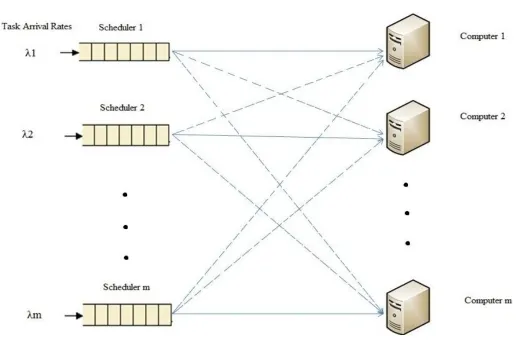
[image:3.612.42.562.328.685.2]The purpose of this paper is to invent the load balancing problem in distributed systems as a non-cooperative game among clients whereas considering the multiple communication channels which bond each pairs of customer and resource. Here give a categorization of the Nash for computing the most favourable point for this game. At the Nash equilibrium a user cannot obtain any further improvement by changing its own decision equilibrium.
Fig -1: Allocation of Resources
Technology (IJRASET)
customer i contain the tasks at the same average rate λi sent by users and dispatches tasks to theresources. The decisions are taken
by client which resource will process the task and assigns tasks to that resource and finally collects outcome such that the total expected execution time of its tasks is reduced.
The decision making of task scheduling has been modelled as the cooperative game and the optimality concept of this non-cooperative game is represented by the nash equilibrium.
In this dynamic non-cooperative approach communication delay between any two computing nodes is taken as hop count. On the basis of current waiting times, processing powers of computing nodes, communication delay and processing times of the tasks at different computing nodes, this approach focuses on allocating tasks to the computing nodes.
If there are n computing nodes then instead of assigning tasks to each computer, this approach schedules tasks to the selected computing nodes who available earlier. The performance of this non-cooperative scheme is analyzed under the performance parameters make span, fairness and communication delay.
The communication delay is integrated in the model. There is a single communication link between each consumer and all of the system resources independent of others.
We devise this dilemma as a non-cooperative game among customers under the hypothesis that clients are selfish. Meaning of that they minimize the expected response time of their own tasks by conveying the designated fraction of them to each resource. Every resource has a queue that holds tasks to be executed; each task is then executed as first-come-first-serve. Depending on the
computational power provided by the resources, each resource j executes tasks at an averagerate μj (tasks per second) .
IV.SIMULATIONRESULTS
To evaluate the performance of the system under distinct performance metrics make span, fairness and the outcome of communication delay on make span of the system considered two heuristics Overall optimal scheme, Non-cooperative approach . Objective is to minimize the make span of tasks, get better the fairness of the distributed computing system and evaluate the consequence of communication delay on make span.
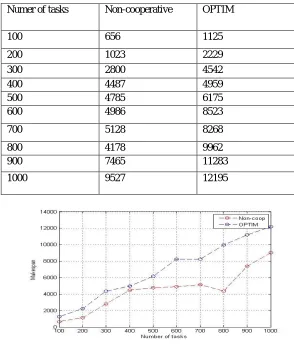
Graphs in the figure depicts consequence of workload on make span and here comparison of the make span of proposed non-cooperative with the OPTIM [15] scheme at dissimilar loads. From the figure 3 proposed non-non-cooperative scheme gives better make span as compared with the OPTIM [15] scheme. Here OPTIM scheme considers processing power of the computing nodes and tasks arrival rate but it does not focus on the current waiting times at diverse computing nodes i.e., based on the processing powers, it always assigns same number of tasks to each computing node, while in the anticipated non-cooperative scheme scheduling will be through based on the waiting times at diverse computing nodes i.e., more tasks will be migrated to computing nodes having less waiting times.
A. Proportional Scheme (PROP)
According to the proportional scheme allotment of tasks from one computing node to other computing nodes based on the proportion to their processing power i.e., computing node having high processing power will get more number of tasks than the computing node having low processing power.
∑mi=1p
To calculate the fairness index of system under both of schemes, use following formula
I(Fi)= (∑mi=1 Mi)2/ ∑mi=1 Mi2
Technology (IJRASET)
TABLE 1:MAKE SPAN OF NON-COOP VS OPTIM
Figure 1: Make Span of Non-coop vs OPTIM
If all computers have same expected completion times then I=1, means system is 100% fair to all the computers and wholly load
balanced i.e., here I gives percentage of computers having irregular completion times. If dissimilarity between Mj of different
computers increases then load balancing scheme will nepotism only for some computers.
[image:5.612.158.452.89.433.2]Figure 2 shows the fairness index of the system. Here comparisons of fairness of the proposed non-cooperative scheme with respect of waiting times only and the ratio of processing power to the waiting time .
Figure 3 depicts the consequence of communication delay on make span of the tasks inwards in the system.
Figure 2: Fairness vs Number of Computers
Numer of tasks Non-cooperative OPTIM
100 656 1125
200 1023 2229
300 2800 4542
400 4487 4959
500 4785 6175
600 4986 8523
700 5128 8268
800 4178 9962
900 7465 11283
[image:5.612.45.521.557.693.2]Technology (IJRASET)
Figure 3: Fairness of non-cooperative scheme
V. CONCLUSIONS
This paper presents some basic concepts of game theory and implementation of proposed non-cooperative resource allocation in distributed computing systems. The performance of this approach is analyzed by the performance parameters fairness and communication delay. From the above results we can conclude that the proposed non-cooperative scheme is giving better fairness of this proposed non-cooperative scheme is 90% i.e. ,utilization of all the computing nodes in the system is almost same. 30% of the make span is due to the communication delay in the network and the communication delay highly depends on the network topology.
VI. ACKNOWLEDGMENT
I am grateful to numerous local and global peers who have contributed towards shaping this thesis. At the outset, I would like to express my sincere thanks to Asst Prof. R.S. Sharma overall direction of the research and to move forward with investigation in
depth. He has helped me greatly and been a source of knowledge
.
My sincere thanks to everyone who has provided me with kind words, a welcome ear, new ideas, useful criticism, or their invaluable time, I am truly indebted. I must acknowledge the academic resources that I have got from RTU Kota. I would like to thank administrative and technical staff members of the Department who have been kind enough to advise and help in their respective
roles
.
REFERENCES
[1] X. Tang and S. T. Chanson. Optimizing static job scheduling in a network of heterogeneous computers. In Proc. of the Intl. Conf. on Parallel Processing, pages 373-382, August 2000.
[2] T. Roughgarden. Stackelberg scheduling strategies. In Proc. of the 33rd Annual ACM Symp. on Theory of Computing, pages 104-113, July 2001.
[3] D.L. Eager, E.D. Lazowska, and J. Zahorjan, “Adaptive Load Sharing in Homogeneous Distributed Systems,” IEEE Trans. Software Eng., vol. 12, no. 5, pp. 662-675, May 1986.
[4] J. Nash, Non-cooperative games, Ann. Math. 54 (2) (September 1951) 286–295.
[5] Issam Al-Azzoni and Douglas G Down. Decentralized load balancing for heterogeneous grids. In Future Computing, Service Computation, Cognitive, Adaptive, Content, Patterns, 2009 COMPUTATIONWORLD'09.Computation World:, pages 545{550. IEEE, 2009.
[6] Rahul Savani and Bernhard Von Stengel “Game Theory Explorer-Software for the Applied Game Theorist” pages 29,March 16,2014 [7] Martin J Osborne. An Introduction to Game Theory, volume 2. Oxford University Press, 2004.
[8] Satish Penmatsa and Anthony T. Chronopoulos. Game-theoretic static load balancing for distributed systems. Journal of Parallel and Distributed Computing, 71(4):537 { 555, 2011.
[9] John Von Neumann and Oskar Morgenstern. The theory of games and economic behavior. 1947 [10] A. Silberschatz and P. Galvin, “Operating System Concepts, 5th ed ”, Addison-Wesl [11] http://en.wikipedia.org/wiki/Game_theory
[12] S.S. Aote and MU Kharat. A game-theoretic model for dynamic load balancing in distributed systems. In Proceedings of the International Conference on Advances in Computing, Communication and Control, pages 235{238. ACM, 2009.
[13] Daniel Grosu and Anthony T. Chronopoulos. Non-cooperative load balancing in distributed systems. Journal of Parallel and Distributed Computing, 65(9):1022 { 1034, 2005.
[14] Yuan-Chieh Chow and Walter H. Kohler. Models for dynamic load balancing in a heterogeneous multiple processor system. Computers, IEEE Transactions on, C-28(5):354{361, May 1979.