Technology (IJRASET)
Two Level Security System Using Matlab
Sunil Kumar Sharma1, Sharad Chouhan2, Kamal Kumar Sharma3
1
Student, M. Tech, ESSEAR, Ambala
2
Assistanr Professor, 3Professor, Dept. of CSE, E-Max group of Institutions, Ambala
Abstract---Two levels security system include Face Recognition and Password based entry control. Two level security(Face recognition and PIN) can provide hi-tech security at public place including International Airport, Metro-Station, Shopping Mall, banking ATM control and home etc. It increase human computer interaction which is fast and secure. This paper addresses first level i.e. the building of face recognition system by using Principal Component Analysis (PCA) method and second level Edsim51Di simulator for keypad entry and finally controlling the motor. A PCA algorithm is written on MATLAB. PCA [31], [33], [37] is a statistical approach used for reducing the number of variables in face recognition. As extracting the most information (feature) contained in the images (face). In PCA, every image in the training set can be represented as a linear combination of weighted eigenvectors called as “Eigen faces”. These eigenvectors are obtained from covariance matrix of a training image set called as basis function. Recognition is performed by projecting a new image (test image) onto the subspace spanned by the Eigen faces and then classification is done by distance measure methods such as Euclidean distance. Finally, when the face is matched, MATLAB program generate the 8bit hex code which is received at the port of 8051, further this project is simulated with the help of Edsim51di, first matches face code from database and secondly password entered by keypad which is interface with 8051 to match with the stored database and motor is rotated to allow the entry. If any one condition not satisfies it display “No Entry” at LCD.
Keywords— Principal Component Analysis (PCA), , Eigen faces, Euclidean distance.
I.INTRODUCTION
Today’s world is seeing new technological advancement in electronic industries day by day. The face recognition is ideal for high traffic areas which are open to the general public for e.g. airports and railway stations, ATM’s, public transportationThese days’ numbers of terrorism and thefts cases are increasing day by day all over the nation and world. Securityat the public places like Metro station, car parking, ATM machine, markets homes have become the prime concern. In given scenario it becomes the need of the time to use such type of security device which are automated, fast and secure. On the basis of existing studies as discussed in previous sections most of the people have worked either on biometrics, “Face Recognition” [11], [12], [13] or numerically controlled personal identification number (PIN) based security systems [38]. There are only few studies which have considered the hybridized aspects of security systems. This was the prime motivation to design a hybrid security system combining biometric and numeric password based approach for security purpose. There are many algorithms to detect the unknown face from the data base. These algorithms are Principal Component Analysis, Discrete Cosine Transform and 3D recognition methods etc.
These algorithms are further categorized on the basis of image mode face recognition characteristics. A detail of this categorization has been shown imageThere are many characteristics to be considered for choosing a face recognition method.
Out of all the above face recognition algorithms and characteristics, Principle Component Analysis (PCA) [30-35] is effective feature extraction method based on face as a global feature. It reduces the dimension of image effectively and holds the primary information at the same time.With these in mind the PCA method of face recognition was selected for this project because:Simplest and easiest method to implement – due to project deadlines this method seemed the most practical. And Very fast computation time. Here two levels security system implies that biological prints in the form of face recognition and password based security system. This project has been implemented in two parts i.e. face recognition and password based security system. In the first part principal component analysis (PCA) based face recognition algorithm has been implemented using MATLAB digital signal processing tool box and for the second part a password protected security system for operating the opening and closing the door has been simulated using 8051 Microcontroller.
Technology (IJRASET)
II.RESULTANDANALYSIS
The simulation and result based on the Two Level Security System using MATLABIn the first part, A Face Recognition System based on Principal Component Analysis (PCA) using Eigen face approach has to be implemented with MATLAB digital signal processing tool box.In the second part, the second level of security is implemented in the form of numerically controlled personal identification number (PIN) verification system. The second level security system has to be realized in the form of a simulation using Edsim51di public domain simulator. Using EdSim51the simulation of an interface system will be implemented to capture the face recognized code through port2 of 8051. Based on the captured code the secondary level password entered through an interfaced keyboard will be check with an existing code database, once the code is verified by the system the final door opening sequence will be executed by rotation the motor
A. TESTING PARAMETERS
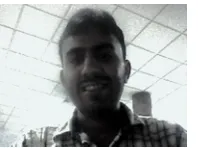
MATLAB R2009b is used for coding of PCA algorithm. A colored face image is converted to grey scale image as grey scale images are easier for applying computational techniques in image processing.As discussed above in MATLAB Overview color image is converted into gray scale by the command. Colored image is shown in image
Fig 1: A colored face image (RGB)
A grey scale face image is scaled for a particular pixel size as 112 X 92 because many input images can be of different size. Whenever we take an input face for recognition, size of image remain constant. Gray color image shown image
Fig 2: A gray color face image (I)
B. TESTING CONDITIONS
Testing Condition are necessary terms that define the rate of recognition. Better illuminating condition make rate of recognition faster. There are some testing conditions are described in paragraph below:
1) Expression: When an expression of a person is changed the orientation of face organs are changed according to it thus changing
[image:3.612.269.368.401.475.2]the feature vectors accordingly. Therefore changed expressions alter the recognition procedure. Fig 3.5 below shows the image in reduced light intensity.
Fig 3: Image in reduced light intensity
2) Illumination: Different intensity of light on face may change the recognition just as bright light causes image saturation.
Technology (IJRASET)
C. FACE IMAGE TESTING
Fig 4: 112 x 92 Image as input
D. TRAINING SET
Training Set consists of image of different persons with their individuals five different facial expression. 5 different expressions for
5 different people thus creating a 5x5 that is equal to 25 different set of face images. Total image are represented by the symbol M. Rotated images in left and right direction and different moods like happiness and sadnessand different illumination conditions are also considered while making the training set.A single face image for five different expressions is shown
E. RESULT OF FACE RECOGNITION
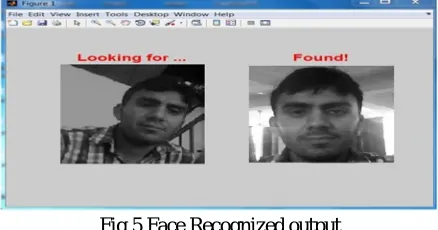
On comparing the test image with training data set images, the minimum distance or difference give Euclidean distance. If this distance is less than threshold value (either predetermined or to be determined), then face is categorized as known face images. It is briefly explain in section 2.3 (step6) of chapter 2.When a PCA algorithm is executed in MATLAB, if face is matched its output is shown as inFig.3.11 and a sound signal “Face is match “is generated along with the matched face. If face does not match, than computer generate a sound of “Face is not in database”. As each user has been coded in their unique 8 bit code which is stored in computer memory. On matching the particular face, its 8 bit code is sent out. This unique code is handed over to the next stage of the system for the verification of PIN
[image:4.612.201.420.407.522.2]The next stage is implemented in next chapter as the out code by computer is captured using Port2 of 8051 controller and matched with the existing data base of codes in controller memory. Further PIN is entered, in case the (PIN) code matches with existing PIN code, the sequence for opening the door would execute using microcontroller. This implementation is simulated using open source simulator Edsim51di which is Java based simulator.
Fig 5 Face Recognized output
In case if the face code does not exists in database a message “Face not Match” is generated by microcontroller. THIS PART IS ABOUT SCANNING THE FACE CODE
If face code is match, than show the LCD output is “ENTER PASSWORD” RESULT: - After the execution of above program, LCD output is shown in image
Fig 6 LCD output enter password
Otherwise face not match jump next step and show the LCD output is “FACE NOT MATCH”
Fig 7 LCD output face not match
F. MOTOR OUTPUT
Technology (IJRASET)
every user have only one personal key. Keypad is shown in image.Fig 8 keypad 4*3 Motor initial stage is shown in image
Fig 9 Motor display
After execution of above instruction Motor gets rotation of clockwise Shown in image.
Fig 10 Motor Display
After execution of above instruction Motor gets rotation of anticlockwise shown in image
Fig 11 Motor Display
Implementation of Personal Identification Number verification system with keypad for the Second level of Security is done successfully on the Edsim51di simulator. All the output is shown along the program execution on LCD module.
G. RESULTS AND ANALYSIS
A face is classified as belonging to class i (i=1…M) when the minimum Euclidean Distance Ed (here b=Ed, in PCA program) is
below some chosen threshold Th(Th=check, in PCA Program), otherwise the face is classified as unknown.Six different images for
[image:5.612.148.471.582.708.2]each mentioned condition were taken to test for fivedifferent people. Light intensity is tried to keep low. Size variation of a test image is not altered too much extent. We can observe that normal expressions are recognized as face efficiently because facial features are not changed much in that case and in other cases where facial features are changed efficiency is reduced in recognition.
Technology (IJRASET)
H. EFFICIENCY
(9 + 8.5 + 7.5 + 8 + 6 + 6.5)/6 = 7.583 Therefore 7.583 x 10 = 75.83%
However this efficiency cannot be generalized as it is performed on less numberof tests of images and conditions under which tested may be changed on other time
III. CONCLUSION
PCA based face recognition and increase the number of Eigen value will increase the recognition rate However, the recognition rate saturates after a certain amount of increase in the Eigen value.. Simultaneously 8 bit password based system make working at edsim51 simple and fast. Increase in the no. of bit or digits make little complex and time consuming. At last hybrid combination first face recognition and second password based security able to work properly and are efficient and economy to person. [37]
REFERENCES
[1] Craw, D. Tock, and A. Bennett, “Finding face features,” Proc. of 2nd European Conf. Computer Vision. pp. 92-96, 1992.
[2] A. Lanitis, C. J. Taylor, and T. F. Cootes, “An automatic face identification system using flexible appearance models,” Image and Vision Computing, vol.13, no.5, pp.393-401, 1995.
[3] T. K. Leung, M. C. Burl, and P. Perona, “Finding faces in cluttered scenes using random labeled graph matching,” Proc. 5th IEEE int’l Conf. Computer Vision, pp. 637-644, 1995.
[4] B. Moghaddam and A. Pentland, “Probabilistic visuallearning for object recognition,” IEEE Trans. Pattern Analysis and Machine Intelligence, vol. 19, no.7. pp. 696-710, July, 1997.
[5] M. Turk and A. Pentland, “Eigenfaces for recognition,” J. of Cognitive Neuroscience, vol.3, no. 1, pp. 71-86, 1991.
[6] M. Kirby and L. Sirovich, “Application of the Karhunen-Loeve procedure for the characterization of human faces,”IEEE Trans. Pattern Analysis and Machine Intelligence, vol.12, no.1, pp. 103-108, Jan. 1990.
[7] I. T. Jolliffe, Principal component analysis, New York: Springer-Verlag,1986.
[8] T, Agui, Y. Kokubo, H. Nagashi, and T. Nagao,“Extraction of face recognition from monochromatic photographs using neural networks,” Proc. 2nd Int’l Conf. Automation, Robotics, and Computer Vision, vol.1, pp. 18.81-18.8.5, 1992.
[9] Krestinin, I.A., Seredin, O.S.: “Excluding cascading classifier for face detection.” Proc. of the 19th Int. Conf. on Computer Graphics and Vision, 380–381 (2009).
[10] R. Chellappa., C. L. Wilson., S. Sirohey: “Human and machine recognition of faces: a survey”. Proc. IEEE, 83(5), pp. 705—740, 1995. [11] S. Z. Li., A. K. Jain.: “Handbook of Face Recognition”, Springer, New York, 2005.
[12] J. R. Solar, P. Navarreto, " Eigen space-based face recognition: a comparative study of different approaches, IEEE Tran., Systems man And Cybernetics- part c: Applications, Vol. 35,No. 3, 2005.
[13] Sahoolizadeh, H.; Ghassabeh, Y.A.;” Face recognition using eigen-faces, fisher-faces and neural networks, Cybernetic Intelligent Systems, 2008. CIS 2008.7th IEEE International Conference on 9-10 Sept. 2008
[14] M.Turk., A. Pentland.: “Eigenfces for recognition”. Journal of Cognitive Neuroscience, 3(1), pp.71--86, 1991
[15] A. A. Thomas and M. Wilscy, “Face Recognition Using Simplified Fuzzy ARTMAP”,J.Signal and Image Processing, Vol.1, No.2, pp 134-136, December 2010.
[16] M.S. Bartlett, J.R. Movellan, T.J. Sejnowski, Face Recognition by Independent Component Analysis, IEEE Trans. on Neural Networks, Vol. 13, No. 6, November 2002, pp. 1450-1464 .
[17] C. Liu, H. Wechsler, Evolutionary Pursuit and Its Application to Face Recognition, IEEE Trans. on Pattern Analysis and Machine Intelligence, Vol. 22, No. 6, June 2000, pp. 570-582.