Technology (IJRASET)
An Effective Deadlock Detective Mechanism For
Multithreaded Programs
T.Ramar1, N.Narayanan Prasanth2
1
PG Scholar, 2Assistant Professor, National College of Engineering Maruthakulam, Tirunelveli, Tamilnadu
Abstract—In a Multithreaded environment, deadlock bugs may occur at any stage of the process. These bugs are reported to the users in the form of warnings and all the warnings are not real deadlocks. Existing techniques probability ratio to find deadlocks from warnings are very low. In this paper we proposed an effective NSA algorithm to identify the occurrence of deadlocks under various situations. Result shows proposed algorithm’s deadlock detection ratio from warning is high compared to existing techniques.
Keywords—Deadlock, Thread, Multithreaded Environment,Bugs
I. INTRODUCTION
Deadlocks are severe concurrency bugs in a multithreaded environment[3]. They stop their program executions, it must be identified and rectified is important one. Different kinds of deadlock avoidance techniques are available there. But those techniques are cannot prevent all the deadlock bugs. Still it is a very big challenge in a real world. In this paper we study the real deadlock probability ratio will be very high. Deadlock is when two threads are executing at a same time, each one request others resources. Existing scenario reports real deadlock probability will be very low from the warnings. In that scenario thread will get suspended easily it is called as thrashing. It is proven that some warnings are real deadlock. In existing technique thread involved in a deadlock warning gets suspended. Another approach observes that all the threads involving in a deadlock should synchronize their execution steps not only at their deadlocking sites. All the threads will be suspended, only a necessary condition to triggering a deadlock
Existing techniques[5] (deadlock fuzzer, magic scheduler) report deadlock confirmation probability will be low. Once a deadlock is triggered, if all threads involving in a deadlock circularly wait for one another to release a certain locks. In Predictive deadlock detection technique, real deadlocks are could not be isolated.JPF is used to detect the concurrency bug but it suffers from severe scalability problems. Gadara is used to avoiding a deadlock in offline. But it fails with online. Replay techniques report that how concurrency bugs can happen.iGoodlock [1] is used to detect potential deadlocks.
Technology (IJRASET)
were implemented. It is used to reduce the deadlock and improving our system performance. Noises are injected during their program execution. Deadlock occurrence checking time will be minimized by using NSA algorithm.NSA is able to scale up to confirm deadlocks in programs with many threads[3].
II. SYSTEM ARCHITECTURE
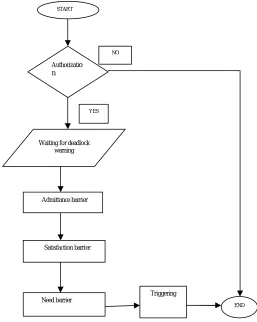
[image:3.612.175.432.273.595.2]Access the rights to control the executions in the network session. The deadlocks may occur in the database also, user needs the rights to control the threads in that particular field. Service provider accesses the rights from the authority holder. System waiting for a dead lock warning, our proposed system going to check the warning is real deadlock warning or some other execution problem. More than one threads runs simultaneously [3] and there is more chance for deadlocks. The normal thread function is acquires the program and release it before the next program get in to the thread. If the function/program is too large, then it takes some time to execute it. The algorithm first monitors the confirmation run against the Admittance barrier ABr(c) followed by the Satisfaction barrier SBr(c) and finally the Need barrier NBr(c). Refer to the site corresponding to a thread t in three barriers ABr(c), SBr(c), and NBr(c) as ABr(c, t), SBr(c, t), and NBr(c, t), respectively. NSA schedules a program to traverse each barrier in cohort and one after another. Finally real deadlock will be triggered.
Fig. 1 System Architecture diagram
There are two types of event related to deadlock confirmation:
Acquire (t, m) and release (t, m), meaning that a thread t acquires a lock m and releases a lock m.The thread t1 firstly acquires the lock k at site s01, and then releases it at site s02. Then, t1 acquires the lock s at site s03. Before releasing s, t1 holds the lock n for a brief period at sites s04 and s05 followed by acquiring three more locks p, m, and n at sites s06, s07, and s08, respectively. Finally, t1 releases all its locks from site s09 to site s12.The thread t2 acquires the lock s at site s13 and then Releases it at site s14. Then, t2 acquires the locks n and p at sites s15 and s16 and releases them at sites s17 and s18.
START
Authorizatio n
Triggering
END NO
YES
Waiting for deadlock warning
Admittance barrier
Satisfaction barrier
Technology (IJRASET)
A. Deadlock Example
Schedule 1 triggers the deadlock: Suppose that thread t2 is locating at site S15 before acquiring the lock n,and t1 executes all the operations from site s01 to site s07.Thus, t1 is holding the lockset {s, p,m}. Now, t2 acquires the lock n at site s15. However, t2 cannot further acquire the lock p at site s16 because t1 is holding p. Schedule 1 then switches to guide t1 to acquire n at site s08, but it fails as t2 is holding the lock n. As such, a real deadlock occurs. If the confirmation run is scheduled as schedule 1, the n Randomized scheduler successfully triggers the deadlock. Otherwise RS may miss to trigger the deadlock.
Schedule 2, right after t2 has released the lock s at site s14; t1 acquires the lock k and then releases it. Before t1 proceeds further, t2 completes its execution. Following Schedule 2 does not trigger the deadlock firstly suspends t2 once t2 is locating at site s16 (i.e., after t2 has acquired the lock n at site s15). However, when t1 is locating at s04, the thread t1 has to wait for t2 to release the lock n. Now, RS is suspending t2, and t2 is blocking t1: thrashing occurs. To resolve thrashing, RS has to resume t2. After t2 has acquired the lock p, there is no way to trigger the deadlock indicated by c0 anymore. Systematic Scheduler (These scheduler aim is to detect concurrency bugs. But their ability to expose deadlocks is very low.
III. PROPOSED ALGORITHM
In this section we describe an NSA Algorithm. The algorithm first monitors the confirmation run against the admittance barrier ABr(c) followed by the satisfaction barrier SBr(c) and finally need barrier NBr(c).we refer to the site corresponding to a thread t in three barriers ABr(c), SBr(c),and NBr(c) as ABr(c,t),SBr(c,t) and NBr(c,t),respectively. Algorithm 1 summarizes the main NSA algorithm. It takes a program p and a deadlock warning c as inputs. At lines 1-3, it initializes the execution state of the confirmation run. For each thread t in the warning c, it assigns ABr(c,t) to the variable CurBr, and initializes two maps Request and Lockset as empty sets. The set Enable (lines 4 and 22) models the set of active threads in the confirmation run. If Enable is non-empty (line 5), the algorithm fetches the next statement (denoted by stmt). It handles stmt by distinguishing three cases:
A. Case 1
If stmt is neither a lock acquisition/release event nor a statement executed by any thread involving in c, Algorithm 1 simply executes stmt. For instance, all memory accesses fall into this case.
B. Case 2
Technology (IJRASET)
Lock k.
C. Case 3
If stmt is a release(t,m) event, the algorithm removes the lock m from the set Lockset for the thread t,and executes stme. For instance,if the stmt is the release(t1,k) event occuring at site s02,NSA executes it and removes the lock k from Lockset(t1).
Next if the set Enable becomes empty, the algorithm either resolves thrashing or reports an unexpected but real deadlock. Otherwise it iterates the above procedure the next statement.The function checkbarrier is core part of the Algorithm.It takes a lock acquistion event as an input.It checks whether the given site s is the site for the thread t at the barrier under monitoring. If so the algorithm suspends t.Next itchecks whether all the threads involving in c have been suspended at their corresponding sites indicated by the same barrier. If this is also the case and the barrier is need barrier,the algorithm checks whether the given warning is manifested into a real deadlock via the function checkfordeadlocks.
At line 39, the algorithm advances to monitor the barrier following the current barrier via the function Next (CurBr(c,t)).that is for each thread t in c,the variable CurBr(t) is updated from ABr(c,t) or from SBr(c,t) to NBr(c,t).Finally function check Barrier returns a Boolean value, indicating whether the site(e) is a site in the barrier under monitoring.
For instance, when check Barrier is called from the example in Case 2 (check barrier (acquire (t1, s)@s03)),ASN finds that the site s03 equals to CurBar (t1) whose value is ABr(c0,t1). It then suspends t1 (line 33). Suppose that the thread t2 is also locating at site s13 (ABr (c0, t2)). Hence, both threads are locating at their ABr sites, which are not their NBr sites. NSA does not invoke checkforDeadlockðcÞ (lines 35-37). Next, NSA updates CurBr(t1) to SBr(c0,t1) and CurBr(c0,t2) to SBr(c0,t2) (line 39).As the site ABr(c0,t1) is not the site SBr(c0,t1) and the site ABr(c0,t2) is not the site SBr(c0,t2), NSA resumes both threads at line 41.
Technology (IJRASET)
NSA Algorithm
For each thread t in threads(c) do
CurBr (t):=ABr(c, t), Request (t):=ø, Lockset (t):= ø, end for
Enable: =Threads (p) while Enable≠ ø do
(t, stmt):=the next stmt from a random thread t if t € Threads(c) ˅ (stmt ≠ acquire ˄ stmt ≠release) then execute (stmt)
else if stmt = acquire (t, m)@s then Request (t):=m@s
if Check Barrier (stmt) =true then push back stmt
Enable: = Enable \ {t} else execute (stmt)
Lockset (t):=Lockset (t)U{m@s} end if
else if stmt=release (t, m)@s then Lockset (t):=Lockset (t)\ {m@s’} execute (stmt)
end if
if Enable=then
if some threads are suspended then else Print “A deadlock is triggered” end if end if
end while
Function check Barrier (Event e)//where e=acquire (t,m) @s
bar: =CurBr (t) if site (e) = bar then suspend (t)
if each thread x in thread(c) at site CurBr(x) then if the monitoring barrier is the need barrier then call Checkfordeadlock(c)
end if
for each t’€ threads© do
CurBr (t’):=Next (Cur (Br (t’)) // advance do the next barrier
if site (e) ≠CurBr (t) then resume (t)
Enable: =Enable U {t’} end if end for
return false end if return true end if return false end function
Function checkforDeadlock (cycle c)
If c’=<d1, d2, dk>where di=<ti, Request (ti), Lockset (ti)> Such that c’ is a cycle then
if c’=c then
Print “The given warning is confirmed into a real deadlock!” halt!
Technology (IJRASET)
IV. RESULT ANALYSIS
[image:7.612.193.420.144.410.2]Proposed algorithm is implemented using NS2 simulator. It shows how the deadlock occurs & how they are detected. Fig. 2 shows the list of nodes involved in a process at the current situation.
Fig. 2 Node creation
Fig.3 Node initialization
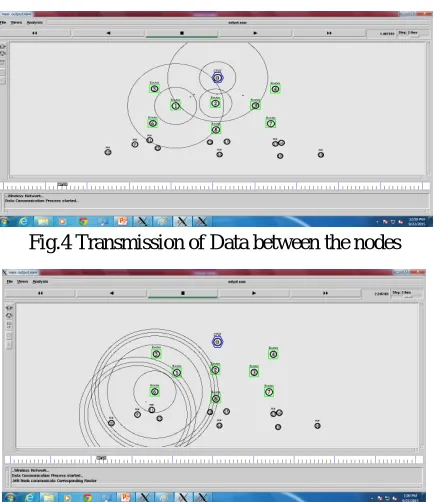
[image:7.612.199.416.448.699.2]In fig.3 denoted as how their nodes will be initialized, In this block colour round circles denoted as mobile users whereas green colour circles are routers, and blue colour circles denoted as gateway. In fig.4 Data will be transmitted between their mobile users and their gateway through routers.
Fig.4 Transmission of Data between the nodes
Technology (IJRASET)
In fig.5 Admittance barrier will be started when two mobile users are changing their place from one to another, if their id will be synchronized. Deadlock affected nodes are moved to some other place to confirm the Deadlock which is shown in fig. 6. In fig.7 after completion of Admittance barrier if a thread moves to the next thread, before reaching the next, thrashing may occur. Thrashing leads to suspend the thread easily. If the thread moves successfully, then it is not a real deadlock.
Fig.6 Deadlock affected nodes are moving to some other place to confirm the Deadlock
Fig.7 Need Barrier start to confirm the real deadlock
V. CONCLUSION
NSA algorithm is used to find the occurrence of deadlock under various situations. NSA’s probability ratio of detecting the deadlock is very high compared to existing algorithms. NSA is able to scale up to confirm deadlocks in programs with many threads therefore the system performance is much improved under multithreaded environment.
REFERENCES
[1] R. Agarwal, L. Wang, and S.D. Stoller, “Detecting Potential Deadlocks with Static Analysis and Run-Time Monitoring,” Proc. IBM Verification Conf., 2005. [2] G. Altekar and I. Stoica, “ODR: Output-Deterministic Replay for Multicore Debugging,” Proc. 22nd Symp. Operating Systems Principles(SOSP ’09), pp.
193-206, 2009.
[3] S. Bensalem and K. Havelund, “Scalable Dynamic Deadlock Analysis of Multi-Threaded Programs,” Proc. First Haifa Int’l Conf. Hardware and Software Verification and Testing (PADTAD ’05), 2005.
[4] S. Burckhardt, P. Kothari, M. Musuvathi, and S. Nagarakatte, “A Randomized Scheduler with Probabilistic Guarantees of Finding Bugs,” Proc. Architectural Support for Programming Languages and Operating Systems (ASPLOS XV), pp. 167-178, 2010.
[5] Y. Cai and W.K. Chan, “Magiclock: Scalable Detection of Potential Deadlocks in Large-Scale Multithreaded Programs,” IEEE Trans.Software Eng., vol. 43, no. 3, pp. 266–281, Mar. 2014.
[6] Y. Cai and W.K. Chan, “MagicFuzzer: Scalable Deadlock Detection for Large-Scale Applications,” Proc. Int’l Conf. Software Eng. (ICSE ’12), pp. 606-616, 2012.
[7] Z.D. Luo, R. Das, and Y. Qi, “MulticoreSDK: A Practical and Efficient Deadlock Detector for Real-World Applications,” Proc. IEEE Int’l Conf. Software Testing, Verification and Validation (ICST),pp. 309-318, 2011.
[8] C. Flanagan and S.N. Freund, “FastTrack: Efficient and Precise Dynamic Race Detection,” Proc. SIGPLAN Conf. Programming Language Design and Implementation (PLDI ’09), pp. 121-133, 2009.
[9] M. Grechanik, B.M.M. Hossain, and U. Buy, “Testing Database- Centric Applications for Causes of Database Deadlocks,” Proc. Sixth Int’l Conf. Software Testing, Verification and Validation (ICST),pp. 174-183, 2013.