5
IV
April 2017
Technology (IJRASET)
A Hybrid Approach for Emotion Extraction
Mr. Ahefaz Pothiyawala1, Mrs. Kavita R. Singh2
1
M.Tech Student , 2Associate Professor, Department of Computer Science and Engineering Yeshwantrao Chavan College of Engineering Nagpur, Nagpur, India
Abstract: With the growth of internet the amount of content that gets produced everyday has increased significantly. Many different types of textual/image documents are produced on varying types of platforms such as social media, news, blogs etc. This paper presents a hybrid approach for emotion extraction from the text documents. With such large amounts of textual content being produced every day, one cannot ignore the importance of mining and extracting opinions, sentiments and also emotions that are embedded in the text. The task of opinion mining, extraction and sentiment analysis has been extensively used in many fields. This is because emotions form an important part of any communication and opinion and have profound effect on the sentiments that the text represents. This makes emotion recognition or extraction from text as well as other media of communication such as speech images videos a crucial task. Emotion analysis is the task of making the computers makes sense of emotions. Emotion extraction is focused on delivery of the exact emotional state of a user at the time when the document was being prepared. In this paper, the main focus of the proposed work is to improve emotion extraction and the study of different approaches and methods that have already been developed and deployed for use. A number of approaches have been developed for emotion extraction and each of them has some strengths and weaknesses. Many machine learning techniques have been used such as Support Vector Machines, Naive Bayes classifier, Vector Space Model and others. Many others combine machine learning techniques with other rule-based techniques or keyword-based techniques. Our approach combines the SVM with k-NN algorithm while still employing the rule based technique to take the advantage of all while avoiding their weaknesses. Our algorithm will be implemented and evaluated using a standard benchmark GRIMM’s data set. The new approach will be evaluated on the basis of accuracy of the emotions that are assigned to the sentences in a document
Keywords: Opinion Mining, Sentiment Analysis, Emotion Extraction, SVM, k-NN
I. INTRODUCTION
Emotions are an intrinsic part of any communication that occurs. Many day to day decisions made by a person are based on the type of emotions that a person feels in the moment. Emotions also play an important role in influencing ones behavior towards other entities or objects. Emotions go deep into a person’s state of mind. Therefore, in order to understand why a person engaged in an activity we need to be able to extract and analyse the type of emotion the person felt prior to his/her engagement in the activity. Also the rapid increase in the emotion rich content available on the internet has caught the attention of researchers regarding emotion extraction, sentiment analysis and opinion mining. Due to the growing use of internet, more and more emotional information is gathered at one place from which emotions are required to be extracted and analysed. Emotion extraction is a method of finding emotions of an author about particular entity. As a result emotion analysis has received considerable attention in recent years. Emotion analysis is also closely related to the tasks of opinion mining and sentiment analysis, however it is a fine grained task as it attempts to assign a single exact emotion value from a pool of emotion values or labels that exist in real life as opposed to the basic orientation values of positive, negative and neutral that are often used in opinion mining.
Different approaches for emotion analysis [8], text classification and opinion mining have been developed. First is the keyword-based approach used in [1] [2] [4] [6] [13] [14] [11] that depend on the presence of opinion and emotion conveying words. Next, is the learning-based approach used in [3] [5] [9] [10] [12] [13] that utilizes a trained classifier to perform the task and third is hybrid approach [8] [12] that combine keyword-based approach and learning-based approach. The use of any particular approach depends on the application. The applications for emotion analysis generally include different domains. Some of these applications include applications in government [1] [7] [15], applications in shopping and in marketing [4] [6] [11] [10] [13] [14] [16] and applications for entertainment [2] [3] [4] and other purposes [17].
The work presented in this paper is focused on the development of a hybrid method which will accept a text document in english and evaluate the emotion for every sentence in the document. The main focus is to design a approach that would efficiently and accurately extract the emotions from a given text.
Technology (IJRASET)
problem a rule-based engine and an SVM model is used for each category of the emotion. The sentences which are not assigned any emotion by the SVM are further classified using the k-NN classifier. A set of syntactic and semantic features are selected for each sentence to build the rules and train the classifiers. The rules are generated manually based on a set of lexical and emotional clues. In the following section we have provided a brief introduction to the different systems that have been developed for emotion extraction.
II. RELATED WORK
Technology (IJRASET)
combined with keyword-based approach in [11] by authors Xiaojun li et al.,. The authors have constructed an emotional lexicon and a feature lexicon for the system. The authors have used the emotion words and assigned intensities to each and computed an orientation value by taking into account impact of the adverbs on them. The advantage of the system is that the opinion is classified using both the emotion role and the feature role contained in it. To improve text classification the authors Yun Li et al,. in [12] have proposed the combination of SVM and k-NN algorithm. The combined approach for classification clearly outperforms either SVM or k-NN for the classification task of 10000 webpages used for experimentation by the authors. The system provides improved results because SVM fails to classify the web pages that fall between the margins of the maximum margin hyperplane and these web-pages in turn are then classified using k-NN classifier. In [13] the authors Jibran Mir et al., have proposed keyword-based approach to a conceptual model for aspect based opinion mining .In [14]the authors Vijay B. Raut et al., have used three different machine learning algorithms namely SVM, Naive Bayes and decision tree for performing classification of hotel reviews and compared the outputs of all.
III. METHODOLOGY
The idea is to extract the emotions using a technique which combines different fairy tales from standard GRIMM’s dataset of fairy tales to identify nine artistic emotions as described as: pleasure, mirth, anger, energy, fear, disgust, astonish, serenity, sorrow. The
architecture of the proposed work is shown in the figure 1.The input to the system is a single text document in English Natural
Language and the output is the emotion label for each sentence. The proposed approach undergoes three phase’s viz., Pre-processing Phase, Feature Extraction Phase,
Polarity Measurement Phase and Emotion Extraction Phase. The Pre-processing Phase consists of sentence segmentation, tokenization stop word removal and stemming. The Feature Extraction Phase consists of parsing the sentences in the document, Part-of-Speech tagging of the sentences and Name Entity Recognition for the sentences in the document.The Polarity Measurement Phase consists of the calculation of the sentiment polarity as negative and positive for each sentence in the document. The Emotion extraction phase uses the Rule-Engine and the combination of the SVM and k-NN algorithms to extract and label the emotions for each sentence present in the document.
Fig.1. Architecture of Proposed approach
A. Algorithm
Input: Accept a document in pure English (.txt)
Output: Emotion label (pleasure, mirth, sorrow, anger, energy, fear, disgust, astonishment, serenity) Accept a text document in Pure English as input
Technology (IJRASET)
1) Sentence Segmentation
2) Tokenization
3) Calculate the term frequency
4) Perform Name Entity Recognition (NER)
5) Parsing and POS Tagging
6) Calculate Sentiment Polarity
7) For each sentence perform Emotion Detection by using rule base engine, SVM algorithm
8) If sentence undetected then for each sentence perform Emotion Detection by using rule base engine, KNN and SVM algorithm
B. Sample Input Document
Cinderella thanked him, went to her mother's grave, and planted the branch on it, and she wept so much that her tears fell upon it and watered it. It grew and became a beautiful tree.
C. Output: Emotion Labels
D. The Proposed Approach Consists of Four Phases
1) Pre-Processing Phase: A computer, as we know, is not capable of thinking or taking decision on its own. Rather it is impossible for a computer to independently analyze the data provided as an input and give the solution. So there is a need of a program to perform all these functions for the computer, where given a text in English, it needs to be pre-processed. Initially, the entire document is considered to be an input.
a) Sentence Segmentation: Sentence Segmentation is a process of breaking the string text into sentences. This is done by searching for punctuation mark, particularly full stop in English Language. Once it is found the string of text is split into component sentences. These sentences are then saved in a separate file in order to provide it as an input to the next module of tokenization.
Algorithm for Sentence Detection
Step 1: Accept the filtered document as an input.
Step 2: Compare each character of the filtered document with the special character “.”. If match found split the sentence and display it.
Step 3: Repeat the step till every character from the filtered document gets processed.
InputCinderella thanked him, went to her mother's grave, and planted the branch on it, and she wept so much that her tears fell upon
it and watered it. It grew and became a beautiful tree.
Output:Cinderella thanked him, went to her mother’s grave, and planted the branch on it, and she wept so much that her tears fell
upon it and waters it. It grew and became a beautiful tree.
b) Tokenization: Tokenization is a task of breaking sentences into tokens. This is done by searching a space after each word. All the generated tokens are saved in a separate file for further processing. The list of tokens becomes input for further processing such as part-of-speech tagging and named entity recognition. It locates word boundaries.
Technology (IJRASET)
Step 1: Accept the input documentStep 2: From beginning scan the input document and identify the white space
Step 3: If space is found then word before the space/ word between two spaces are identified as a token Step 4: Repeat the process until all the text is considered.
Input:It grew and became a beautiful tree.
Output (tokens)
It grew and became a beautiful tree
c) Term Frequency: Term frequency is defined as the number of times a word occurs in the document. Term frequency generally depends on the length of the document, i.e., a term may occur more frequently in a large document as compared to a small document.
Algorithm for calculating Term Frequency
Step 1: Accept the tokens from tokenization module Step 2: Initialize count to 0
Step 3: For each token increment the count and store it in separate file. Repeat step until all the tokens are completed.
InputCinderella thanked him, went to her mother's grave, and planted the branch on it, and she wept so much that her tears fell upon
it and watered it. It grew and became a beautiful tree.
Output Cinderella <0> thanked <0> him <0>, went <0> to<0> her<1> mother's<0> grave<0>, and<3> planted<0> the<0> branch<0> on<0> it<3>, and<3> she <0> wept<0> so<0> much<0> that<0> her<1> tears<0> fell<0> upon<0> it<3> and<3> watered<0> it<3>. It<3> grew<0> and<3> became<0> a<0> beautiful<0> tree<0>.
2) Feature Extraction phase: This module takes the input from previous phase and generates parsing and POS and NER for Feature extraction. In this step feature are getting calculated for each sentences on the basis of different factors which checks for linguistics as well as statistics for every sentences.
a) Name-Entity Recognition (NER): Named Entity Recognition (NER) labels sequences of words in a text which are the names of things, such as person and company names, or gene. It comes with well-engineered feature extractors for Named Entity Recognition, and many options for defining feature extractors. Good named entity recognizers for English, particularly for the 3 classes (PERSON, ORGANIZATION, and LOCATION) are available. Stanford NER tool and Open NLP tool are available for doing the tasks.
Input Cinderella thanked him, went to her mother's grave, and planted the branch on it, and she wept so much that her tears fell upon it and watered it.
Output Cinderella -> Person
b) Parsing and Part-of-Speech Tagging (POS): A Part-Of-Speech Tagger (POS Tagger) is a piece of software that reads text in some language and assigns parts of speech to each word, such as noun, verb, adjective, etc. It is an extremely powerful and accurate tool. It can be used in any application that deals with natural language text to analyze words/tokens and classify them into categories. Stanford POS tagging tool is available and can be used as a plug in our project. The Stanford POS Tagger uses a probability model to predict the correct pos tag out of the tag set. To limit the possible tags for a token a tag dictionary can be used which increases the tagging and runtime performance of the tagger.
InputCinderella thanked him, went to her mother's grave, and planted the branch on it, and she wept so much that her tears fell upon
it and watered it.
Output(ROOT (S (S (NP (NNP Cinderella)) (VP (VBD thanked) (SBAR (S (NP (PRP him)) (VP (VP (VBD went) (PP (TO to) (NP
(NP (PRP$ her) (NN mother) (POS 's)) (NN grave)))) (CC and) (VP (VBD planted) (NP (DT the) (NN branch)) (PP (IN on) (NP (PRP it))))))))) (CC and) (S (NP (PRP she)) (VP (VBD wept) (ADVP (RB so) (RB much)) (SBAR (IN that) (S (NP (PRP$ her) (NNS tears)) (VP (VP (VBD fell) (PP (IN upon) (NP (PRP it)))) (CC and) (VP (VBD watered) (NP (PRP it)))))))) (. .)))#(ROOT (S (NP (PRP It)) (VP (VP (VBD grew)) (CC and) (VP (VBD became) (NP (DT a) (JJ beautiful) (NN tree)))) (. .)))#
Technology (IJRASET)
Sentiment Polarity = 1 – (Pos Score + Neg Score).Algorithm for Sentiment Polarity calculation Step 1: Accept the input text document
Step 2: For each sentence in the document ObjScore = 1- (PosScore + NegScore) Step 3: Repeat the step until all the sentences in the document are scanned.
Input Cinderella thanked him, went to her mother's grave, and planted the branch on it, and she wept so much that her tears fell upon it and watered it.
Output (Polarity) -0.301025
4) Emotion Extraction Phase: This is the main phase of the system wherein the emotion labels are extracted using rule-based engine, SVM and KNN. In this phase set of rules are applied to the input text document.
Here we have two different flow for analysis of the sentence processing by rule_based combines with SVM and Rule_based combines with k-NN and then it will relate to SVM for final output.
a) Rule Based +SVM Approach: Rules are always help us to judge the proper emotions that covers by the system. In this section, we covers around nine rules to find correct emotions by specifying rules.
Rules covered in proposed approach: Pleasure
For eg.: I am so happy.
Rule 2: IF the person describes him/herself afraid from someone and the sentence is negative then
Fear
For eg.: Daddy will scold me.
Rule 3: IF the person describes him/herself being angry on someone and the sentence is negative then
Anger
Rule 4: IF the person is in shock or in a state of confusion then
Astonish
For eg.: The surprise attack was devastating
Rule 5: IF the person express dislike or hate towards someone or something and the sentence is negative. then
Disgust
For eg.: Due to her aversion to the outdoors she complained throughout the entire camping trip. Rule 6: IF the person feels endurance or forcefulness and the sentence may be positive or negative. then
Energy
For eg.: 1) The outbreak of World War II in 1939 gave a new impetus to receiver development. 2) He recited the story with great animation.
Rule 7: IF the person feels glad or cheerful then
Mirth
For eg.: 1) The decoration added greatly to the gaiety of the room. 2) His presentation pleased the executives
Rule 8: If the person feels peace of mind or calm then
Serenity
For eg.: 1) She looked at her students with joviality and serene mentality. 2) Her soul rested in harmony.
Technology (IJRASET)
SorrowFor eg.: She was worn out from so much grief.
Some of the developed rules for emotion extraction are implemented as below
If is_first_person(subj) and verb_aux is member of[do,shall,have..] and verb polarity >0 and verb_tense== present and verb is a member of [happy,good..] and sentence polarity is positive then assign emotion label as pleasure
if is_first_person(subj) and verb_aux is member of[will,shall,..] and verb polarity >0 and verb_tense== future/present and verb is a member of [calm ,serene,rest..] and sentence polarity is positive then assign emotion label as serene
if is_first_person(subj) and verb_aux is member of[might,been, may..] and verb polarity <0 or is_negated(verb) and verb is a member of [miserable,break,..] and sentence polarity is negative then assign emotion label as sorrow
if is_first_person(subj) and verb_aux is a member of [can,could,will..] and is_negated(verb) or verb polarity >0 and verb_aux is a member of [not ,can't..] and verb_tense== past and verb is a member of[run,kill,..] and sentence polarity is negative then assign emotion label as anger
if is_first_person(subj) and verb_aux is member of[was,has,did..] and is_negated(verb) or verb polarity <0 and verb_tense== past and verb is a member of[shock,confuse,..] then assign emotion label astonishment
if is_first_person(subj) and verb_aux is member of[could,would,should..] and verb polarity <0 or is_negated(verb) and verb is a member of [hate,like,dislike..] and sentence polarity is negative then assign emotion label as disgust
if is_first_person(subj) and verb_aux is member of[do,shall,have..] and verb polarity >0 and verb_tense== present and verb is a member of [endurance,force,..] then assign emotion label as energy
if is_first_person(subj) and verb_aux is member of[could,was,will..] and verb polarity <0 and verb_tense== past/future and verb is a member of [scold,afraid,..] and sentence polarity is negative then assign emotion label as fear
if is_first_person(subj) and verb_aux is member of[do,shall,have,..] and verb polarity >0 and verb is a member of [glad,cheer,great,..] and sentence polarity is positive then assign emotion label as mirth
If the rule-based engine does not extract the emotional label then such sentences are forwarded to the SVM. SVM builds a hyper-plane based on the polarity calculated. Here the positive values are on one side of the hyper-hyper-plane while the negative values are on the other side.
While implementing this system on the Grimm’s dataset it was observed that there are some polarity values that lie on the hyper-plane and close to hyper hyper-plane boundary and the emotion labels for such valued sentences are not extracted. In order to overcome this problem, k-NN algorithm is used.
b) Rule Based + k-NN + SVM Approach: Rule engine is not able to cover all the emotions efficiently so we need classifier to extract the emotions, to do this we have used a trained SVM classifier. The SVM classifier is trained using a corpus of 500 emotion conveying words which are manually collected by carefully studying the GRIMM’s dataset of fairy tales. SVM basically covers all the data which falls in dense regions but does not cover data on the hyper-plane. The sentences whose polarity value belong to the hyper-plane thereafter are covered by k-NN algorithm which considers an optimal value of k(2 in our case) and finds all the nearest neighbors. This reduces the work of SVM and SVM finally provides the emotion label. Different standard distance metrics were evaluated and studied namely the manhattan distance ,the euclidean distance and the minowski distance. The euclidean distance measure is chosen and used for computation of the nearest neighbors for each of the input sentence in the text. By experimenting with different values of k(1,2,3,4) for the k-NN ,it was observed that for k=1 the recall of the system increases significantly and that for k=3 and k>3 the accuracy gets reduced. Therefore the optimal value of k=2 has been chosen for the k-NN classifier. A data-set of 1000 sentences annotated with different emotion class labels has been developed by carefully examining and studying the standard GRIMMS data-set of stories.
IV. EXPERIMENTAL RESULTS
The system is evaluated to check whether the output generated by the current system is efficient than that of the existing system or not. Various performance measures such as accuracy, precision, recall and f-measure score has been used to check the same. To check the accuracy and efficiency of the system number of sentence in the document are used as unit for evaluation. In order to perform these evaluations, some notations are used.
They are as follows:
DS1, DS2, DS3,……. – Represents input documents from Grimm’s test dataset used for testing.
Technology (IJRASET)
Sorrow respectively, in which the sentences are classified.PC1, PC2, …….., PC9 – Represents the predicted class of emotions such as Anger, Astonish, Disgust, Energy, Fear, Mirth, Pleasure, Serenity and Sorrow respectively, in which the sentences are classified.
Sample Input Cinderella thanked him, went to her mother's grave, and planted the branch on it, and she wept so much that her tears fell upon it and watered it. It grew and became a beautiful tree.
Cinderella went to this tree three times every day, and beneath it she wept and prayed. A white bird came to the tree every time, and whenever she expressed a wish, the bird would throw down to her what she had wished for.
Now it happened that the king proclaimed a festival that was to last three days. All the beautiful young girls in the land were invited, so that his son could select a bride for himself.
When the two stepsisters heard that they too had been invited, they were in high spirits. They called Cinderella, saying, "Comb our hair for us. Brush our shoes and fasten our buckles. We are going to the festival at the king's castle."
[image:9.612.42.576.275.732.2]Cinderella obeyed, but wept, because she too would have liked to go to the dance with them. She begged her stepmother to allow her to go.
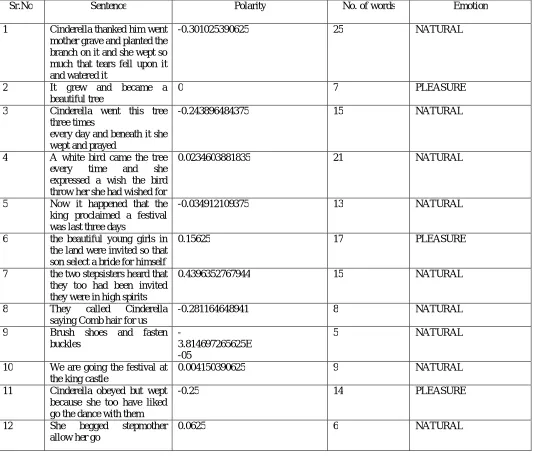
Table 1: Output given by existing system
Sr.No Sentence Polarity No. of words Emotion
1 Cinderella thanked him went
mother grave and planted the branch on it and she wept so much that tears fell upon it and watered it
-0.301025390625 25 NATURAL
2 It grew and became a
beautiful tree
0 7 PLEASURE
3 Cinderella went this tree
three times
every day and beneath it she wept and prayed
-0.243896484375 15 NATURAL
4 A white bird came the tree
every time and she
expressed a wish the bird throw her she had wished for
0.0234603881835 21 NATURAL
5 Now it happened that the
king proclaimed a festival was last three days
-0.034912109375 13 NATURAL
6 the beautiful young girls in
the land were invited so that son select a bride for himself
0.15625 17 PLEASURE
7 the two stepsisters heard that
they too had been invited they were in high spirits
0.4396352767944 15 NATURAL
8 They called Cinderella
saying Comb hair for us
-0.281164648941 8 NATURAL
9 Brush shoes and fasten
buckles
-
3.814697265625E -05
5 NATURAL
10 We are going the festival at
the king castle
0.004150390625 9 NATURAL
11 Cinderella obeyed but wept
because she too have liked go the dance with them
-0.25 14 PLEASURE
12 She begged stepmother
allow her go
Technology (IJRASET)
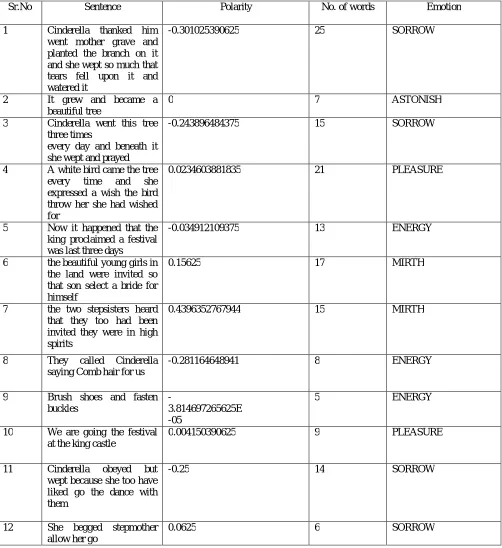
Table 2: Output given by our systemSr.No Sentence Polarity No. of words Emotion
1 Cinderella thanked him
went mother grave and planted the branch on it and she wept so much that tears fell upon it and watered it
-0.301025390625 25 SORROW
2 It grew and became a
beautiful tree
0 7 ASTONISH
3 Cinderella went this tree
three times
every day and beneath it she wept and prayed
-0.243896484375 15 SORROW
4 A white bird came the tree
every time and she
expressed a wish the bird throw her she had wished for
0.0234603881835 21 PLEASURE
5 Now it happened that the
king proclaimed a festival was last three days
-0.034912109375 13 ENERGY
6 the beautiful young girls in
the land were invited so that son select a bride for himself
0.15625 17 MIRTH
7 the two stepsisters heard
that they too had been invited they were in high spirits
0.4396352767944 15 MIRTH
8 They called Cinderella
saying Comb hair for us
-0.281164648941 8 ENERGY
9 Brush shoes and fasten
buckles
-
3.814697265625E -05
5 ENERGY
10 We are going the festival
at the king castle
0.004150390625 9 PLEASURE
11 Cinderella obeyed but
wept because she too have liked go the dance with them
-0.25 14 SORROW
12 She begged stepmother
allow her go
0.0625 6 SORROW
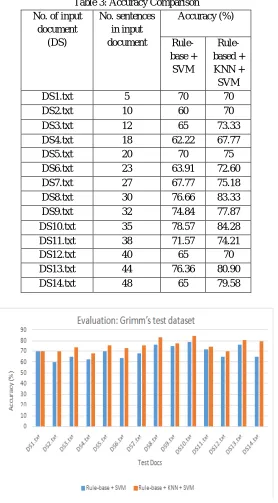
A. Accuracy
Accuracy is defined as the ratio of number of sentences for emotion labels are extracted correctly to the total number of sentences in the document.
Technology (IJRASET)
Table 3: Accuracy Comparison No. of inputdocument (DS)
No. sentences in input document
Accuracy (%)
Rule-base +
SVM
Rule-based + KNN + SVM
DS1.txt 5 70 70
DS2.txt 10 60 70
DS3.txt 12 65 73.33
DS4.txt 18 62.22 67.77
DS5.txt 20 70 75
DS6.txt 23 63.91 72.60
DS7.txt 27 67.77 75.18
DS8.txt 30 76.66 83.33
DS9.txt 32 74.84 77.87
DS10.txt 35 78.57 84.28
DS11.txt 38 71.57 74.21
DS12.txt 40 65 70
DS13.txt 44 76.36 80.90
[image:11.612.170.448.80.583.2]DS14.txt 48 65 79.58
Fig 2. Accuracy comparison graph
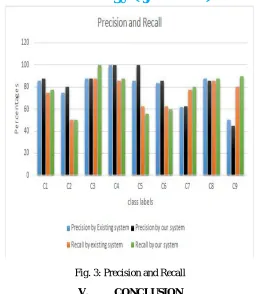
B. Precision and Recall
As the system deals with multi class classification problem, the only way to evaluate the performance of the system is to compute the precision and recall for each class label and analyze the individual performance on class labels or average on class labels or average the values to get the overall precision and recall. For evaluating precision and recall for the system. 10 sample sentences are considered for each class of emotion
Technology (IJRASET)
2) Recall: Recall is defined as the ratio of the number of relevant records retrieved to the total number of relevant records in the database. It is usually expressed as a percentage.
Precision recall table for existing system
C1 C2 C3 C4 C5 C6 C7 C8 C9
PC1 6 0 0 0 1 0 0 0 0
PC2 0 3 0 0 0 1 0 0 0
PC3 0 0 7 0 0 0 0 0 1
PC4 0 0 0 6 0 0 0 0 0
PC5 0 0 0 0 5 0 0 0 0
PC6 0 1 0 0 0 5 0 0 0
PC7 0 1 0 1 0 2 7 0 0
PC8 0 0 1 0 0 0 0 6 0
PC9 2 1 0 0 2 0 2 1 8
Precision recall table for our system:
C1 C2 C3 C4 C5 C6 C7 C8 C9
PC1 7 0 0 0 1 0 0 0 0
PC2 0 4 0 0 0 1 0 0 0
PC3 0 0 7 0 0 0 0 0 1
PC4 0 0 0 7 0 0 0 0 0
PC5 0 0 0 0 5 0 0 0 0
PC6 0 1 0 0 0 6 0 0 0
PC7 0 1 0 1 0 3 8 0 0
PC8 0 0 0 0 0 0 0 7 0
PC9 2 2 0 0 3 0 2 1 9
Class Labels Precision by
existing system
Precision by our system
Recall by existing system
Recall by our system
C1 85.71 87.5 75 77.77
C2 75 80 50 50
C3 87.5 87.5 87.5 100
C4 100 100 85.71 87.5
C5 85.71 100 62.5 55.55
C6 83.33 85.71 62.5 60
C7 61.53 62.5 77.77 80
C8 87.5 85.71 85.71 87.5
Technology (IJRASET)
Fig. 3: Precision and Recall
V. CONCLUSION
The system has performed extremely well in terms of accuracy while showing the signs that it can be further scaled to much bigger and different dataset with better performance. In this research, the main focus was on analyzing emotions at sentence level which can further explored to paragraph level and topic level. The work can also be expanded in future by introducing methods that increase the accuracy by handling problems like change of emotions when the personal pronoun changes which still needs to be evolved properly.
REFERENCES
[1] Wingyan Chung, Saike He, Daniel Dajun Zeng, Victor Benjamin, “Emotion extraction and entrainment in social media: The case of U.S. immigration and border security”, Proceedings of 2015 IEEE International Conference on Intelligence and Security Informatics (ISI), pp. 55-60, 2015.
[2] Akshi Kumar, Prakhar Dogra, Vikrant Dabas, “Emotion analysis of Twitter using opinion mining”, Proceedings of the Eighth IEEE International Conference on Contemporary Computing (IC3), pp.285-290, Noida, 2015.
[3] Lily Dey; Mahim-Ul Asad; Nadia Afroz; Rudra Pratap Deb Nath, “Emotion extraction from real time chat messenger”, Proceedings of 2014 International Conference on Informatics, Electronics & Vision (ICIEV),pp. 1-5, 2014.
[4] Cheng-Yu Lu, William W. Y. Hsu, Hsing-Tsung Peng, Jen-Ming Chung, Jan-Ming Ho, “Emotion Sensing for Internet Chatting: A Web Mining Approach for Affective Categorization of Events”, Proceedings of 2010 13th IEEE International Conference on Computational Science and Engineering, pp. 295 – 301, 2010.
[5] Mansur Alp Tocoglu; Adil Alpkocak, “Emotion Extraction from Turkish Text”, Proceedings of 2014 European Network Intelligence Conference, pp. 130 – 133, 2014.
[6] Luwen Huangfu; Wenji Mao; Daniel Zeng; Lei Wang, “OCC model-based emotion extraction from online reviews”, Proceedings of 2013 IEEE International Conference on Intelligence and Security Informatics, pp. 116-121, 2013
[7] Azadeh Nikfarjam, Ehsan Emadzadeh, “A Hybrid System for Emotion Extraction from Suicide Notes”, Biomedical Informatics Insight, pp. 165-174, 2012. [8] Nilesh M. Shelke and Shriniwas Deshpande and Vilas Thakre, “Approaches towards Emotion Extraction from TEXT”, IJCA Proceedings on National
Conference on Innovative Paradigms in Engineering & Technology , pp. 10-14, 2013.
[9] J. S. Raikwal Kanak Saxena, “Performance Evaluation of SVM and K-Nearest Neighbor Algorithm over Medical Data set”, International Journal of Computer Applications (0975 – 8887), vol. 50 , no.14, July 2012.
[10] Taysir Hassan A. Soliman; Mostafa A. Elmasry; Abdel Rahman Hedar; M. M. Doss, “Utilizing support vector machines in mining online customer reviews”, Proceedings of 22nd International Conference on Computer Theory and Applications (ICCTA), pp. 192-197, 2012.
[11] Xiaojun li, Lin Dai, Hanxiao Shi, “Opinion mining of camera reviews basedon Semantic Role Labeling”, Proceedings of the Seventh IEEE International Conference on Fuzzy Systems and Knowledge Discovery (FSKD), pp. 2372-2375, 2015.
[12] Yun Li, Jie Wang, “Research on Text Classification Based on SVM-KNN”, Proceedings of 5th IEEE International Conference on Software Engineering and Service Science (ICSESS), pp. 7-29, 2014.
Technology (IJRASET)
Conference on Digital Information Management (ICDIM), pp.49-56, 2015.[14] Vijay B. Raut, D.D. Londhe, “Opinion Mining and Summarization of Hotel Reviews”, Proceedings of the IEEE International Conference on Computational Intelligence and Communication Networks (CICN), pp.556-559,Bhopal, 2014.
[15] E. Aramaki, T. Imai, K. Miyo, and K. Ohe, “Patient status classification by using rule based sentence extraction and bm25-knn based classifier,” In Workshop on Challenges in Natural Language Processing for Clinical Data, 2006.
[16] Tomomi Nomura; Yasue Mitsukura, “Extraction of unconscious emotions while watching TV commercials”, Proceedings of 41st Annual Conference of the IEEE Industrial Electronics Society, pp. 368-373, 2015.