
Technology (IJRASET)
©IJRASET : All Rights are Reserved
661
A Novel Approach for Face Detection and
Recognization with Multi Scale Color
Restoration Technique Using Combination of
Knowledge
Based and Feature Segmentation
Suyash Bahadur Singh1, S. R. Tandan21
M.Tech. Scholar, Department of Computer Science and Engineering
2
Assistant Professor, Department of Computer Science and Engineering
Abstract—Pattern recognition is the fastest growing area in digital world. Face Detection and recognization technique help
this area make it more powerful. In this paper we have introduce an algorithm in which we have combined the two existing techniques that is knowledge based and feature based segmentation. This algorithm works on low level resolution camera from which an uncompressed image can be taken. We capture those images and check whether it is uncompressed then apply our algorithm for detection and recogniazation which result the accuracy far better than prior work.
Keywords— Face Detection, Pattern Recognization, Binary Image, Knowledge Base, Data Base.
I. INTRODUCTION
Being a human every face are having some difference with each other. The basic idea of using biometric devices is being used is this uniqueness of human face. Face recognition has basically two parts; first is face detection and second one is recognition. Skin area is major component to detect face online as well as offline. This paper proposes a combination of knowledge based and feature based segmentation algorithm for face detection in uncompressed images with detection of many faces and skin regions. In Face Detection, we check in given input image whether it contains human face or not, if so, then returning the location of the human face. Basically due to lots of research, wide variety of applications (like in computers, communication, image database management, law enforcement, security, smart home application and automatic control systems etc) and difficulties in face detection has become interesting topics of research for the researchers in past decade [1]. Actually Face Detection is first essential step in Face Recognition system for extracting the features of given image. Since faces have lot of variation in feature based approach, face detection is not a simple or straightforward, it consists of a long list of these factors, such as pose variation, occlusion, image orientation, illuminating conditions, facial expression, structural components, facial size found in the image, the scene and complexity of images background and others [1, 2].
II. TYPES OF FACE DETECTION TECHNIQUES
Face detection methods have various approaches for detection which are generally classified into four categories [6]:
1.1.1 Feature based methods.
1.1.2 Knowledge based methods.
[image:2.612.32.553.621.708.2]1.1.3 Machine learning methods or Appearance based methods.
©IJRASET : All Rights are Reserved
662
Face detection is an interdisciplinary field which integrates different techniques such as (i) image processing, (ii) pattern recognition, (iii) computer vision, (iv) computer graphics, (v) physiology, and (vi) evaluation approaches. In general, the computerized face recognition/face detection includes four steps.
i. Face image is acquired, enhanced and segmented. ii. Face boundary and facial features are detected.
iii. The extracted facial features are matched against the features stored in the database. The classification of the face image into one or more persons is achieved
Figure 2: Block diagram of face detection/face recognition system The pre-processing process may involve number of steps is given below—
Image size Normalization Histogram Equalization Enhancement
Median Filtering High pass filtering Background removal
Translational and rotational normalization Feature Based
Technology (IJRASET)
[image:4.612.216.439.539.645.2]©IJRASET : All Rights are Reserved
663
Figure 3: Face Detection Algorithm on Feature-based methods
IV. FEATURE-BASED METHODS
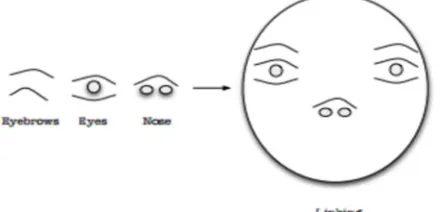
Feature-based methods are those that take a bottom-up approach by locating facial features initially and then collecting their respective enclosing entities such as edges, blobs, streaks and graphs as a detected face. Typically, edge detectors are used to identify particular shapes such as eyebrows, eyes, noses etc. and statistical models estimate distances between these shapes. A linking stage follows that collects them into groups and subsequently detects a face. Figure 2.2 illustrates this approach: edge
filtering and grouping to detect faces
Figure 4: Edge detection followed by linking and grouping to detect faces.
Sirohey [18] reasons that since the shape of a face is roughly elliptical, facial features can be combined in an ellipse fitting probe.
Essentially, he uses a Canny Edge Detector to identify all the edges. Heuristics are used to create an edge map, i.e. unconnected edges (the output of the edge detector) are linked to verify if ellipses formed thus conform to that of a face contour. The final result
©IJRASET : All Rights are Reserved
664
The name MATLAB stands for MATrix Laboratory. MATLAB was written originally to provide easy access to matrix software developed by the LINPACK (linear system package) and EISPACK (Eigen system package) projects. MATLAB is a high-performance language for technical computing. It integrates computation, visualization, and programming environment. Furthermore, MATLAB is a modern programming language environment: it has sophisticated data structures, contains built-in editing and debugging tools, and supports object-oriented programming
In this proposed diagram we used low resolution camera by which we can take picture of low resolution. By capturing and converting these pictures into uncompressed pictures. To start our algorithm we need an inbuilt web cam. Captured pictures need to be enhanced before processing, this is called preprocessing, and this also includes cropping of pictures. MSCR technique is used for enhancing a lightining the picture. This pictures needs to save in database if it is new and needs to update if it is existing. Now we are apply our proposed algorithm to detect and recognize
Figure 5: Proposed Flow Diagram
VI. RESULT ANALYSIS
Sr. No Face Images
(Total Unit as input) Face Recognization Feature Base (in numbers) Face Recognization Knowledge Base (in
numbers)
Face Recognization using Combination
(in numbers)
1 10 8 7 9
2 20 16 17 17
3 30 23 26 27
4 40 37 35 38
5 50 46 44 46
Technology (IJRASET)
©IJRASET : All Rights are Reserved
665
The above table illustrates about the accuracy of proposed algorithm with reference to edge base, color base, and text base face recognition methods. Here, we have checked accuracy of our proposed method of genetic algorithm with number of images taken as input. From the results, we found that our method provides better accuracy as compared to others.
VII. CONCLUSION
The face recognition and detection algorithms were thoroughly studied taking a number of test images and varying the conditions and variables. All the work mentioned above involved real time data. The success rate was different for different images depending on the external factors. This entire algorithm for face segmentation, detection and tracking is implemented in MATLAB. This paper proposes an algorithm with better accuracy for face detection. In case of Face recognition, we compared the parameters of face recognition with existing one like color base, edge base, and text based techniques and the matching rate as well as matching time of our proposed algorithm is good with respect to existing one and achieved better results.
REFRENCES
[1] Tanvi Chauhan and Vineet Richhariya “Real Time Face Detection with Skin and Feature based Approach and Reorganization using Genetic Algorithm” CiiT International Journal of digital Image Processing Issue: January 2013
[2] H.C. Vijay Lakshmi and S. Patil Kulakarni, “Segmentation Algorithm for Multiple Face Detection in Color Images with Skin Tone Regions using Color Spaces and Edge Detection Techniques,” International Journal of Computer Theory and Engineering, vol. 2, no. 4, Aug. 2010.
[3] Iyad Aldasouqi, and Mahmoud Hassan, “Smart Human Face Detection System,” International Journal of Computers, vol. 5, 2011.
[4] Ming-Hsuan Yang, David J. Kriegman, and N Ahuja, “Detecting faces in images: A survey,” IEEE Transactions on Pattern Analysis and Machine Intelligence, vol. 24, pp. 34–58, Jan. 2002.
[5] Diedrick Marius, Sumita Pennathur, and Klint Rose, “Face Detection Using Color Thresholding, and Eigen image Template Matching,”
[6] Arti Khaparde, Sowmya Reddy. Y, Swetha Ravipudi, “Face Detection Using Color Based Segmentation and Morphological Processing: A Case Study,” Int. Symposium on Computer Egg. & Tech., 20 March, 2010.
[7] Amol Dabholkar and Kin Choong Yow, “Automatic Human Face Detection and Tracking,” IEEE T-PAMI pp.780–785 1997.
[8] T. Sakai, M. Nagao, and T. Kanade, “Computer analysis and classification of photographs of human faces.” Proc. First USA-Japan Computer Conference. pp. 2–7, 1972.
[9] M. Kirby, And L. Sirovich, “Application of the Karhunen-Loeve Procedure For The Characterization Of Human Faces,” IEEE Trans. Pattern Analysis and Machine Intelligence, vol. 12, pp. 103-108, Jan. 1990.
[10] M. Turk and A. Pentland, “Eigen-faces for recognition” J. of Cognitive Neuroscience, vol.3, no.1, pp. 71-86, 1991.] [11] http://vision.ucsd.edu/~leekc/ExtYaleDatabase
[12] Wang and T. Tan, “A new face detection method based on shape information.” Pattern Recog. Lett, pp. 463–471, 2000.
[13] M. Pham and T. Cham, “Fast training and selection of haar features using statistics in boosting-based face detection,” IEEE 11th International Conference on Computer Vision, pp. 1–7, 2007.
[14] P. Viola and M. Jones, “Rapid object detection using a boosted cascade of simple features,” in CVPR01, pp. 511–518, 2001.
[15] C. Kotropoulos and I. Pitas, “Rule based face detection in frontal views,” Proc. Of IEEE Int. Conf. on Acoustics, Speech and Signal Processing, April 1997.
0
5
10
15
20
25
30
35
40
Face Images (Total Unit as input
Face Recognization Feature Base (in numbers)
Face Recognization Knowledge Base (in numbers)
Face Recognization using Combination (in
©IJRASET : All Rights are Reserved
666
[17] M.-H. Yang, D. J. Kriegman, and N. Ahuja, “Detecting faces in images: A survey,” IEEE Trans. Pattern Anal. Mach. Intell., vol. 24, no. 1, pp. 34–58, 2002. [18] S. A. Sirohey, “Human face segmentation and identification,” Master’s thesis, University of Maryland, 1993.
[19] B. Scassellati, “Eye finding via face detection for a foveated, active vision system,” in AAAI ’98/IAAI ’98: Proceedings of the fifteenth national/tenth conference on Artificial intelligence/Innovative applications of artificial intelligence, (Menlo Park, CA, USA), pp. 969–976, American Association for Artificial Intelligence, 1998.

![Poly[[di μ aqua (μ 4 formyl 2 methoxyphenolato)disodium] 4 formyl 2 methoxyphenolate]](data:image/gif;base64,R0lGODlhAQABAIAAAP///wAAACH5BAEAAAAALAAAAAABAAEAAAICRAEAOw==)