R E S E A R C H
Open Access
Comparisons between intragastric and small
intestinal delivery of enteral nutrition in the
critically ill: a systematic review and meta-analysis
M Deane Adam
1,2*, Dhaliwal Rupinder
3, G Day Andrew
3, J Ridley Emma
4, R Davies Andrew
4and
K Heyland Daren
3Abstract
Introduction:The largest cohort of critically ill patients evaluating intragastric and small intestinal delivery of nutrients was recently reported. This systematic review included recent data to compare the effects of small bowel and intragastric delivery of enteral nutrients in adult critically ill patients.
Methods:This is a systematic review of all randomised controlled studies published between 1990 and March 2013 that reported the effects of the route of enteral feeding in the critically ill on clinically important outcomes.
Results:Data from 15 level-2 studies were included. Small bowel feeding was associated with a reduced risk of pneumonia (Relative Risk, RR, small intestinal vs. intragastric: 0.75 (95% confidence interval 0.60 to 0.93);P= 0.01; I2 = 11%). The point estimate was similar when only studies using microbiological data were included. Duration of ventilation (weighted mean difference: -0.36 days (-2.02 to 1.30);P= 0.65; I2= 42%), length of ICU stay (WMD: 0.49 days, (-1.36 to 2.33);P= 0.60; I2= 81%) and mortality (RR 1.01 (0.83 to 1.24);P= 0.92; I2= 0%) were unaffected by the route of feeding. While data were limited, and there was substantial statistical heterogeneity, there was significantly improved nutrient intake via the small intestinal route (% goal rate received: 11% (5 to 16%);P= 0.0004; I2= 88%).
Conclusions:Use of small intestinal feeding may improve nutritional intake and reduce the incidence of ICU-acquired pneumonia. In unselected critically ill patients other clinically important outcomes were unaffected by the site of the feeding tube.
Introduction
In the critically ill, nutritional therapy is a component of standard care. Delivery into the gastrointestinal tract is the preferred route of nutrient administration, via a tube into either the stomach or small intestine [1]. However, whether these feeding tubes should be preferentially placed into the stomach or small intestine remains con-tentious. Several clinical practice guidelines have recom-mended that enteral nutrition should be commenced using an intragastric tube [1,2], whereas other guidelines advise that when small bowel feeding is feasible that this route is preferable [3].
The advantages of commencing with intragastric feeding include that naso- or oro-gastric tubes are relatively easy to insert, so that once a decision is made to feed, delivery of nutrient can promptly commence. However, disadvan-tages of the intragastric approach include delayed gastric emptying, which occurs frequently in the critically ill [4,5], and predisposes to inadequate nutrient administration. Indeed, observational studies, in which most patients receive intragastric feeding, have shown that the propor-tion of calories and protein delivered to critically ill patients are about 50 to 70% of targeted calorie and protein loads [6-8].
Small intestinal feeding tubes are more difficult to insert, often requiring specific expertise and equipment. Their potential advantages include bypassing the stomach, which
* Correspondence: [email protected]
1Intensive Care Unit, Royal Adelaide Hospital, Adelaide, SA, Australia
Full list of author information is available at the end of the article Deane Adamet al.Critical Care2013,17:R125
http://ccforum.com/content/17/3/R125
should theoretically‘guarantee’delivery of nutrients, as the major gastrointestinal motility disorders in the critically ill appear to occur in the antral-pyloro region of the stomach [9]. Not only does increasing administration of nutrients have the potential to reduce mortality and length of stay, particularly in those patients at risk of critical illness malnutrition and its consequences [10], but delivery of nutrients into the small intestine has been reported to reduce the incidence of hospital-acquired pneumonia, possibly because episodes of gastro-oesophageal regurgita-tion occur less frequently [11,12]. Intuitively, a reducregurgita-tion in pneumonia should shorten intensive care unit (ICU) and hospital length of stay and may reduce mortality [13].
Systematic reviews and meta-analysis have been pub-lished that evaluated small bowel and gastric feeding in the critically ill [14-17]. An update incorporating impor-tant recent studies [18-20] was published by Jiyong and colleagues [17]. However, a limitation of the latter review is that the authors included a study in which patients received care on the general hospital ward rather than a critical care environment. In addition, Jiyong and collea-gues included studies of both adult and paediatric subjects. Finally, data from the ENTERIC study were not included, and we believe that this study is the pivotal study in the area [21]. For these reasons we sought to update previous reviews to determine whether small bowel, when compared to intragastric delivery of nutrition, is associated with improved outcomes in the critically ill.
The objectives of this study were to determine the effects of small bowel and gastric tube delivery of liquid nutrients on hospital-acquired pneumonia, duration of mechanical ventilation, length of ICU and hospital stay, mortality and nutritional intake in adult critically ill patients.
Methods
The meta-analysis was performed in line with the recommendations from the Preferred Reporting Items for Systematic Reviews and Meta-Analyses (PRISMA) statement [22].
Study identification
We conducted a systematic review of the published litera-ture to identify all relevant randomised clinical trials. Using text word or MeSH headings containing:“ rando-mized";“blind";“clinical trial";“nutrition";“enteral";“small bowel";“gastric";“nasojejunal";“nasoduodenal"; and“ naso-gastric”computerised searches for relevant articles on MEDLINE, EMBASE, BIIOSIS, CINAHL electronic databases Cochrane Controlled Trials Register from 1990 to March 2013 were performed. Reference lists of review articles and original studies were hand searched and rele-vant articles extracted.
Study eligibility criteria
All primary studies were retrieved and reviewed. Primary studies were eligible for inclusion if they: (1) studied adult patients with critical illness; (2) compared small bowel (delivered into the jejunum or duodenum) to gastric deliv-ery; (3) included clinically important outcomes, such as mortality, infectious complications (including hospital-acquired pneumonia), length of stay or major nutritional endpoints; and (4) were randomised clinical trials (RCTs).
We defined patients with critical illness as those who were cared for in a critical care environment. Utilizing a scoring system that has been previously reported [23], RCTs were rated for methodological quality. Using pre-viously piloted forms [23], two reviewers independently, and in duplicate, then abstracted data from these studies. Agreement was reached by consensus. We attempted to contact the authors of included studies and requested further information not contained in published articles.
Data synthesis
The primary outcome was the incidence of ICU-acquired pneumonia. Secondary outcomes were duration of mechanical ventilation, duration of ICU stay, duration of hospital stay, mortality, and nutritional intake. We used definitions of ICU-acquired pneumonia as defined by the original study investigators.
To quantify nutritional intake we included only studies that reported the mean (SD) percentage of calories or volume delivered when compared to the patients’energy expenditure or prescribed volume as estimated by weight-based or complex calculation. Data from all studies were combined to estimate the common risk ratio (RR) and associated 95% confidence intervals (CI) for mortality and hospital-acquired pneumonia. In the meta-analysis, we used maximum likelihood methods of combining risk ratios across all trials and examined the data for evidence of heterogeneity within groups. The Mantel-Haenszel method was used to test the significance of treatment effect. We used a random effects model to estimate the overall relative risk. Heterogeneity was determined using the Chi squared test and interclass correlation I2. We also analysed the effect of small bowel delivery on duration of mechanical ventilation, ICU stay and hospital stay; the weighted mean difference (WMD) was used to describe the standardised difference between mean duration of stay from small bowel and intragastric delivery, respectively.
P-values < 0.05 were considered significant. Subgroup and sensitivity analyses
There were substantial limitations when interpreting data from two of the included studies. Taylor and colleagues reported the effect of‘enhanced’enteral nutrition, that ideally was administered via a small intestinal feeding tube [24]. However, only 34% of the patients actually achieved
Deane Adamet al.Critical Care2013,17:R125 http://ccforum.com/content/17/3/R125
feeding via the small bowel, which is markedly inferior to rates of successful small intestinal tube placement reported by other groups [25]. Minard and colleagues compared patients who received early immune-enhanced enteral nutrition via the small bowel to those receiving delayed immune-enhanced enteral nutrition via the stomach [26]. Accordingly, when indicated, meta-analyses of outcome data were performed with, and without, these two studies.
It should also be recognised that the diagnosis of ICU-acquired pneumonia can be subjective. For this reason, when evaluating the effect of small intestinal feeding on the incidence of pneumonia we also report the subgroup of studies that used microbiological data in association with clinical data [27].
Results
The literature search resulted in 22 RCTs. After review-ing these studies, four were excluded because they were systematic reviews [14-17], one had < 50% of enrolled patients admitted to an ICU [28], one did not report clinical outcomes [11] and one [29] was an analysis of data already included.
Studies
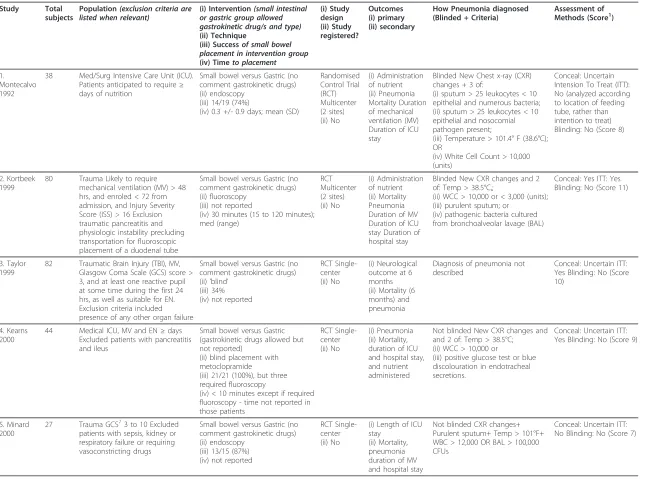
Results from these 15 level-2 RCTs were aggregated. None of the studies were able to blind treating health care provi-ders to the route of delivery once patients were rando-mised, and only three studies included patients from more than one ICU (Kortbeek,n= 2; Montejo,n= 11; Davies, 2012,n= 17). Only two groups reported registration of their study [18,21]. The characteristics of the studies are summarised in Table 1.
Placement of small intestinal feeding catheters
Various techniques were used to insert small intestinal tubes (Table 1).
Success - and time to successful placement - of small intestinal feeding tubes were not reported in all studies. When reported (n= 11), success rates varied between 34 and 100%, with the median time to placement ranging from 5 hours to 1.5 days (Table 1). Repeated testing to confirm that the feeding tube remained in either the stomach or small intestine throughout the patient’s admis-sion was not reported in any study.
Standardisation in the intragastrically-fed group
While the ‘control’ group in all studies was, at least initially, intragastric delivery, the use of gastrokinetic drugs was inconsistently reported (Table 1).
Outcomes
Pneumonia
Twelve studies reported the incidence of ICU-acquired pneumonia. The reported incidence of pneumonia ranged
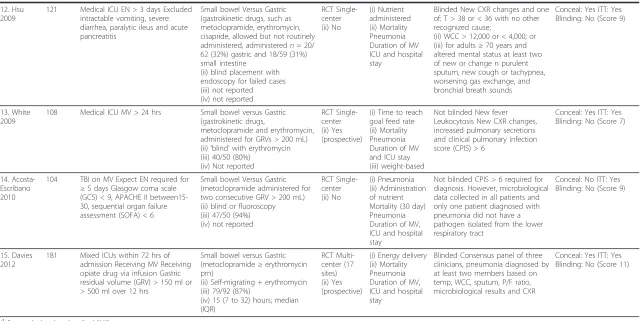
from 9% to 46% of patients studied. Pneumonia was diag-nosed according to a variety of techniques (Table 1), with six studies incorporating microbiological and clinical data [20,21,30-33], four studies used clinical signs and radiolo-gical changes [18,19,34,35] and two studies did not describe the technique used to make the diagnosis of pneumonia [24,36]. In only four studies were the investiga-tors blinded to treatment allocation when making the diagnosis of pneumonia [19,21,30,31].
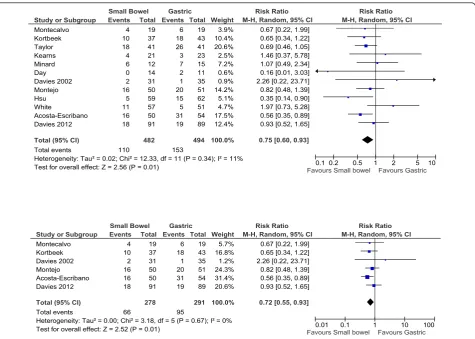
Small bowel feeding was associated with a reduced risk of ICU-acquired pneumonia when compared to gastric (relative risk (RR): small intestine vs. intragastric: 0.75 (0.60 to 0.93)P= 0.01; test for heterogeneity I2= 11%; Figure 1A). The point estimate was unaffected when the studies by Taylor and Minard were removed (RR: 0.75 (0.56 to 1.00);P= 0.05; I2= 21%). When analysing only studies that included microbiological diagnosis, these results remained similar (RR: 0.72 (0.55 to 0.93);P= 0.01; I2= 0%; Figure 1B).
Length of stay
Nine studies reported on ICU length of stay. Although heterogeneity was present, length of stay appeared unaf-fected regardless of whether small intestine or intragastric tubes were used (weighted mean difference (WMD): 0.49 days (-1.36 to 2.33);P= 0.60; I2= 81%; Figure 2A). Results were unchanged when the study by Minard was excluded (WMD: 0.04 days (-1.85 to 1.93); P= 0.97; I2 = 82%). Hospital length of stay was also unaffected by small bowel or intragastric administration of nutrients in the five studies that reported this outcome (WMD: 0.56 days (-3.60 to 4.73)P= 0.79; I2= 24%; Figure 2B).
Duration of mechanical ventilation
Administration of nutrients directly into the small intes-tine did not appear to influence duration of mechanical ventilation (WMD: -0.36 (-2.02 to 1.30); P= 0.67; I2= 42%; Figure 2C).
Mortality
Thirteen studies reported mortality data. Feeding via small intestinal or intragastric tube did not affect mortality (RR: 1.01 (95% CI: 0.83 to 1.24);P= 0.92; I2 = 0%; Figure 3). When the studies by Taylor and Minard were excluded, data were unchanged (RR: 1.03 (0.84 to 1.27);P= 0.78; I2 = 0%).
Nutritional administration
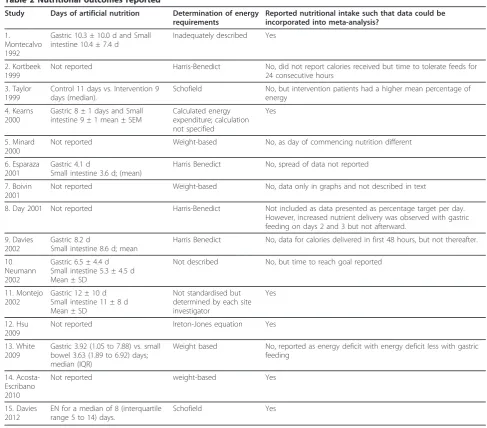
Targets for nutritional delivery were based on formulae (n = 7) or weight-based calculations (n= 4), with a few studies either not, or inadequately, reporting how the nutrition target was derived (n= 4) (Table 2). Only eight studies reported the number of days of enteral nutrition provided, which varied from less than 4 days to more than 11 days (Table 2).
Nine studies reported the amount of nutrients adminis-tered to patients (calories ± protein). Of these studies, one reported small intestinal feeding reduced the amount of
Deane Adamet al.Critical Care2013,17:R125 http://ccforum.com/content/17/3/R125
Table 1 Characteristics of included studies
Study Total subjects
Population(exclusion criteria are listed when relevant)
(i) Intervention(small intestinal or gastric group allowed gastrokinetic drug/s and type)
(ii) Technique
(iii) Successof small bowel placement in intervention group
(iv) Timeto placement
(i) Study design (ii) Study registered?
Outcomes (i) primary (ii) secondary
How Pneumonia diagnosed (Blinded + Criteria)
Assessment of Methods (Score1)
1. Montecalvo 1992
38 Med/Surg Intensive Care Unit (ICU). Patients anticipated to require≥ days of nutrition
Small bowel versus Gastric (no comment gastrokinetic drugs) (ii) endoscopy
(iii) 14/19 (74%)
(iv) 0.3 +/- 0.9 days; mean (SD)
Randomised Control Trial (RCT) Multicenter (2 sites) (ii) No
(i) Administration of nutrient (ii) Pneumonia Mortality Duration of mechanical ventilation (MV) Duration of ICU stay
Blinded New Chest x-ray (CXR) changes + 3 of:
(i) sputum > 25 leukocytes < 10 epithelial and numerous bacteria; (ii) sputum > 25 leukocytes < 10 epithelial and nosocomial pathogen present;
(iii) Temperature > 101.4° F (38.6°C); OR
(iv) White Cell Count > 10,000 (units)
Conceal: Uncertain Intension To Treat (ITT): No (analyzed according to location of feeding tube, rather than intention to treat) Blinding: No (Score 8)
2. Kortbeek 1999
80 Trauma Likely to require mechanical ventilation (MV) > 48 hrs, and enroled < 72 from admission, and Injury Severity Score (ISS) > 16 Exclusion traumatic pancreatitis and physiologic instability precluding transportation for fluoroscopic placement of a duodenal tube
Small bowel versus Gastric (no comment gastrokinetic drugs) (ii) fluoroscopy
(iii) not reported
(iv) 30 minutes (15 to 120 minutes); med (range)
RCT Multicenter (2 sites) (ii) No
(i) Administration of nutrient (ii) Mortality Pneumonia Duration of MV Duration of ICU stay Duration of hospital stay
Blinded New CXR changes and 2 of: Temp > 38.5°C,;
(ii) WCC > 10,000 or < 3,000 (units); (iii) purulent sputum; or
(iv) pathogenic bacteria cultured from bronchoalveolar lavage (BAL)
Conceal: Yes ITT: Yes Blinding: No (Score 11)
3. Taylor 1999
82 Traumatic Brain Injury (TBI), MV, Glasgow Coma Scale (GCS) score > 3, and at least one reactive pupil at some time during the first 24 hrs, as well as suitable for EN. Exclusion criteria included presence of any other organ failure
Small bowel versus Gastric (no comment gastrokinetic drugs) (ii)‘blind’
(iii) 34% (iv) not reported
RCT Single-center (ii) No
(i) Neurological outcome at 6 months (ii) Mortality (6 months) and pneumonia
Diagnosis of pneumonia not described
Conceal: Uncertain ITT: Yes Blinding: No (Score 10)
4. Kearns 2000
44 Medical ICU, MV and EN≥days Excluded patients with pancreatitis and ileus
Small bowel versus Gastric (gastrokinetic drugs allowed but not reported)
(ii) blind placement with metoclopramide
(iii) 21/21 (100%), but three required fluoroscopy
(iv) < 10 minutes except if required fluoroscopy - time not reported in those patients
RCT Single-center (ii) No
(i) Pneumonia (ii) Mortality, duration of ICU and hospital stay, and nutrient administered
Not blinded New CXR changes and and 2 of: Temp > 38.5°C;
(ii) WCC > 10,000 or
(iii) positive glucose test or blue discolouration in endotracheal secretions.
Conceal: Uncertain ITT: Yes Blinding: No (Score 9)
5. Minard 2000
27 Trauma GCS73 to 10 Excluded patients with sepsis, kidney or respiratory failure or requiring vasoconstricting drugs
Small bowel versus Gastric (no comment gastrokinetic drugs) (ii) endoscopy
(iii) 13/15 (87%) (iv) not reported
RCT Single-center (ii) No
(i) Length of ICU stay
(ii) Mortality, pneumonia duration of MV and hospital stay
Not blinded CXR changes+ Purulent sputum+ Temp > 101°F+ WBC > 12,000 OR BAL > 100,000 CFUs
Conceal: Uncertain ITT: No Blinding: No (Score 7)
Deane
Adam
et
al
.
Critical
Care
2013,
17
:R125
http://ccfo
rum.com/con
tent/17/3/R1
25
Page
4
of
Table 1 Characteristics of included studies(Continued)
6. Esparaza 2001
54 Medical ICU Inclusion criteria not reported
Small bowel versus Gastric (gastrokinetic drugs, erythromycin or metoclopramide- allowed in both groups. Reported as administration per patient-fed days) (ii) electromyographic guided with erythromycin, metoclopramide and/or fluoroscopy
(iii) 21/27 (78%) (iv) not reported
RCT Single-center (ii) No
(i) Aspiration events based on radiolabelled ‘meal’and gamma camera) (ii) Mortality, administration of nutrient
Pneumonia not reported Conceal: Uncertain ITT: Yes Blinding: No (Score 8)
7. Boivin 2001
80 Med/Surg ICU, MV in 98% Enteral Nutrition (EN)≥72 hrs Excluded: pancreatitis, burns, severe head injury
Small bowel versus Gastric (all patients in both groups received erythromycin)
(ii) blind placement with erythromycin, with fluoroscopy for failed attempts
(iii) 28/40 (71%) (iv) 304 minutes
RCT Single-center (ii) No
(i) Administration of nutrient (ii) Mortality
Pneumonia not reported Conceal: Uncertain ITT: No Blinding: No (Score 6)
8. Day 2001 25 Primary neurological diagnosis and expected to receive EN for≥3 days Patients were excluded who had gastroparesis
Small bowel versus Gastric (No comment regarding gastrokinetic drugs)
(ii) blind placement (iii) not reported (iv) not reported
RCT Single-center (ii) No
(i) Administration of nutrient (ii) Pneumonia
Did not report how pneumonia was diagnosed
Conceal: Uncertain ITT: Yes Blinding: No (Score 5)
9. Davies 2002
73 Med/Surg ICU Expected to receive EN≥days
Small bowel versus Gastric (gastrokinetic drugs excluded) (ii) endoscopy
(iii) 33/34 (97%)
(iv) time to placement not reported. However, time to commencing nutrition was delayed in patients receiving small intestinal feeds (81 vs. 55)
RCT Single-center (ii) No
(i) Intolerance to enteral nutrition (ii) Mortality Pneumonia Duration of ICU stay
Not blinded Clinical criteria, CXR changes and microbiological data
Conceal: Uncertain ITT: No Blinding: No (Score 8)
10. Neumann 2002
60 Medical ICU In need of enteral nutrition excluded gastroparesis, ileus and pancreatitis
Small bowel versus Gastric (no comment gastrokinetic drugs) (ii) blind placement, fluoroscopy as second line - required in 7/20 attempts.
(iii) not reported (iv) not reported
RCT Single-center (ii) No
(i) Efficacy of nutrition (ii) Aspiration events
Pneumonia not reported Conceal: Uncertain ITT: Yes Blinding: No (Score 6)
11. Montejo 2002
101 Mixed ICUs EN > 5 days Patients with gastroparesis allowed to enter
Small bowel versus Gastric (no comment gastrokinetic drugs) (ii) technique depending on local expertise but included endoscopy (n= 18), fluoroscopic guidance (n
= 12), blind technique (n= 15), or by echography (n= 5).
(iii) 100%
(iv) time to small intestine 21.0 ± 9.8 vs. gastric 5.3 ± 7.9 hrs
RCT Multi-center (14 ICUs) (ii) No
(i) Pneumonia (ii) Mortality Duration of ICU stay
Not blinded Diagnosed according to criteria described by the Centre for Disease Control
Conceal: Not sure ITT: Yes Blinding: No (Score 6)
Deane
Adam
et
al
.
Critical
Care
2013,
17
:R125
http://ccfo
rum.com/con
tent/17/3/R1
25
Page
5
of
Table 1 Characteristics of included studies(Continued)
12. Hsu 2009
121 Medical ICU EN > 3 days Excluded intractable vomiting, severe diarrhea, paralytic ileus and acute pancreatitis
Small bowel Versus Gastric (gastrokinetic drugs, such as metoclopramide, erythromycin, cisapride, allowed but not routinely administered, administeredn= 20/ 62 (32%) gastric and 18/59 (31%) small intestine
(ii) blind placement with endoscopy for failed cases (iii) not reported (iv) not reported
RCT Single-center (ii) No
(i) Nutrient administered (ii) Mortality Pneumonia Duration of MV ICU and hospital stay
Blinded New CXR changes and one of: T > 38 or < 36 with no other recognized cause;
(ii) WCC > 12,000 or < 4,000; or (iii) for adults≥70 years and altered mental status at least two of new or change n purulent sputum, new cough or tachypnea, worsening gas exchange, and bronchial breath sounds
Conceal: Yes ITT: Yes Blinding: No (Score 9)
13. White 2009
108 Medical ICU MV > 24 hrs Small bowel versus Gastric (gastrokinetic drugs,
metoclopramide and erythromycin, administered for GRVs > 200 mL) (ii)‘blind’with erythromycin (iii) 40/50 (80%)
(iv) Not reported
RCT Single-center (ii) Yes (prospective)
(i) Time to reach goal feed rate (ii) Mortality Pneumonia Duration of MV and ICU stay (iii) weight-based
Not blinded New fever Leukocytosis New CXR changes, increased pulmonary secretions and clinical pulmonary infection score (CPIS) > 6
Conceal: Yes ITT: Yes Blinding: No (Score 7)
14. Acosta-Escribano 2010
104 TBI on MV Expect EN required for
≥5 days Glasgow coma scale (GCS) < 9, APACHE II between15-30, sequential organ failure assessment (SOFA) < 6
Small bowel Versus Gastric (metoclopramide administered for two consecutive GRV > 200 mL) (ii) blind or fluoroscopy (iii) 47/50 (94%) (iv) not reported
RCT Single-center (ii) No
(i) Pneumonia (ii) Administration of nutrient Mortality (30 day) Pneumonia Duration of MV, ICU and hospital stay
Not blinded CPIS > 6 required for diagnosis. However, microbiological data collected in all patients and only one patient diagnosed with pneumonia did not have a pathogen isolated from the lower respiratory tract
Conceal: No ITT: Yes Blinding: No (Score 9)
15. Davies 2012
181 Mixed ICUs within 72 hrs of admission Receiving MV Receiving opiate drug via infusion Gastric residual volume (GRV) > 150 ml or > 500 ml over 12 hrs
Small bowel versus Gastric (metoclopramide≥erythromycin prn)
(ii) Self-migrating + erythromycin (iii) 79/92 (87%)
(iv) 15 (7 to 32) hours; median (IQR)
RCT Multi-center (17 sites) (ii) Yes (prospective)
(i) Energy delivery (ii) Mortality Pneumonia Duration of MV, ICU and hospital stay
Blinded Consensus panel of three clinicians, pneumonia diagnosed by at least two members based on temp, WCC, sputum, P/F ratio, microbiological results and CXR
Conceal: Yes ITT: Yes Blinding: No (Score 11)
(1
Score calculated as described [23]).
Deane
Adam
et
al
.
Critical
Care
2013,
17
:R125
http://ccfo
rum.com/con
tent/17/3/R1
25
Page
6
of
nutrients administered [18], four reported that it increased nutrient delivery [19,20,30,34] and four reported that energy and protein delivered was unaffected by route of feeding [32,33,37] (Table 2).
Data from six studies that reported nutritional intake as mean ± SD could be aggregated. In these studies there was slight variation in the description of nutrient intake: it was specified as percentage of daily caloric intake, per-centage of estimated energy requirements received, and
‘mean efficacious volume of diet’. When these data were grouped, small bowel feeding compared to gastric feeding was associated with a significantly greater percentage of nutritional intake (WMD 11% of intake/amount prescribed [5,16];P= 0.0004, I2= 88%; Figure 4A). Data from studies that reported the time to reach nutritional goal rate were aggregated (n= 4), and there was no effect detected (WMD -3.4 hours (-13.5 to 6.6);P= 0.51; I2= 87%; Figure 4B).
Discussion
We conducted a systematic review and meta-analysis of all RCTs of gastric vs. small bowel feeding in the ICU
setting, including the recently published ENTERIC study [21]. The main observations are that delivery of nutri-ents directly into the small intestine may be associated with a reduction in the incidence of ICU-acquired pneu-monia when compared to intragastric delivery, but despite this, days of ventilation, ICU and hospital length of stay and mortality appear unaffected. In addition, while there were relatively few, and substantial heteroge-neity between, studies that evaluated nutritional effi-ciency, there was a signal that feeding into the small intestine increased nutrient intake.
It is possible that our meta-analysis over-estimated any reduction in pneumonia caused by small intestinal feeding. In several studies the diagnosis of pneumonia was made while investigators were aware of treatment allocation. Moreover, nearly all studies were conducted at a single ICU and the number of subjects was relatively small. Biases, including publication and selec-tion biases, are well known to occur in studies involving fewer subjects, thereby affecting point estimates calcu-lated in meta-analyses [38]. To limit bias we also ana-lysed studies that used quantitative microbiological Study or Subgroup
Montecalvo Kortbeek Taylor Kearns Minard Day Davies 2002 Montejo Hsu White
Acosta-Escribano Davies 2012
Total (95% CI) Total events
Heterogeneity: Tau² = 0.02; Chi² = 12.33, df = 11 (P = 0.34); I² = 11% Test for overall effect: Z = 2.56 (P = 0.01)
Events 4 10 18 4 6 0 2 16 5 11 16 18
110 Total
19 37 41 21 12 14 31 50 59 57 50 91
482 Events
6 18 26 3 7 2 1 20 15 5 31 19
153 Total
19 43 41 23 15 11 35 51 62 51 54 89
494 Weight
3.9% 10.4% 20.6% 2.5% 7.2% 0.6% 0.9% 14.2% 5.1% 4.7% 17.5% 12.4%
100.0%
M-H, Random, 95% CI 0.67 [0.22, 1.99] 0.65 [0.34, 1.22] 0.69 [0.46, 1.05] 1.46 [0.37, 5.78] 1.07 [0.49, 2.34] 0.16 [0.01, 3.03] 2.26 [0.22, 23.71] 0.82 [0.48, 1.39] 0.35 [0.14, 0.90] 1.97 [0.73, 5.28] 0.56 [0.35, 0.89] 0.93 [0.52, 1.65]
0.75 [0.60, 0.93]
Small Bowel Gastric Risk Ratio Risk Ratio
M-H, Random, 95% CI
0.1 0.2 0.5 1 2 5 10
Favours Small bowel Favours Gastric
Study or Subgroup Montecalvo Kortbeek Davies 2002 Montejo Acosta-Escribano Davies 2012
Total (95% CI) Total events
Heterogeneity: Tau² = 0.00; Chi² = 3.18, df = 5 (P = 0.67); I² = 0% Test for overall effect: Z = 2.52 (P = 0.01)
Events 4 10 2 16 16 18
66 Total
19 37 31 50 50 91
278 Events
6 18 1 20 31 19
95 Total
19 43 35 51 54 89
291 Weight
5.7% 16.8% 1.2% 24.3% 31.4% 20.6%
100.0%
M-H, Random, 95% CI 0.67 [0.22, 1.99] 0.65 [0.34, 1.22] 2.26 [0.22, 23.71] 0.82 [0.48, 1.39] 0.56 [0.35, 0.89] 0.93 [0.52, 1.65]
0.72 [0.55, 0.93]
Small Bowel Gastric Risk Ratio Risk Ratio
M-H, Random, 95% CI
0.01 0.1 1 10 100
[image:7.595.62.538.87.426.2]Favours Small bowel Favours Gastric
Figure 1Small intestinal feeding and pneumonia. Twelve studies reported the: (A) incidence of pneumonia with (B) six studies incorporating both microbiological data with clinical data when making the diagnosis.
Deane Adamet al.Critical Care2013,17:R125 http://ccforum.com/content/17/3/R125
assessment. When this was performed, the interpreta-tion remained similar supporting the original observa-tion. Nevertheless, a reduction in pneumonia was not apparent in the largest cohort studied (ENTERIC). Given that discrepancies between meta-analyses and the‘truth’occur frequently [39,40], circumspect inter-pretation of these aggregate data related to the incidence of pneumonia is recommended.
While we report a reduction in ICU-acquired pneumo-nia, the number of days of ventilation, length of ICU and hospital stay, as well as mortality, were unaffected by the route of feeding. While the lack of effect on the latter out-comes may reflect an inadequate sample size or, as described, that our meta-analysis overestimated the effect of route of feeding on the risk of pneumonia, there are plausible mechanisms that may explain these seemingly discrepant findings. In several of the studies artificial nutri-tion was administered for only a short period and so-called
‘early-onset’ventilator-associated pneumonia is often
caused by susceptible organisms and responds rapidly to antibiotic therapy [41]. Accordingly, attributed outcomes, such as length of ventilation and mortality, may actually be unaffected by‘early-onset’hospital-acquired pneumo-nia. Indeed, other factors, such as depth of sedation [42], may be greater determinants of length of ventilation and ICU stay than development of pneumonia.
There was a signal for increased nutritional intake when using small intestinal feeding tubes. There was, however, substantial statistical heterogeneity indicating that this observation should be interpreted with caution. The heterogeneity may reflect that placement of small intestinal tube can be technically difficult, requiring expertise and sophisticated methodologies [25]. Some-what surprisingly, time-to-placement and placement success was not consistently reported. We suggest that the improvement in nutritional intake will only be gen-eralisable to institutions that have the capacity to rapidly insert feeding tubes into the small intestine.
Study or Subgroup Montecalvo Kearns Minard Davies 2002 Montejo Hsu White Acosta-Escribano Davies 2012
Total (95% CI)
Heterogeneity: Tau² = 4.93; Chi² = 41.62, df = 8 (P < 0.00001); I² = 81% Test for overall effect: Z = 0.52 (P = 0.60)
Mean 11.7 17 18.5 13.9 15 18.2 7.12 16 12.5 SD 8.2 2 8.8 1.8 10 11.8 6 9 8.6 Total 19 21 12 34 50 59 51 50 91 387 Mean 12.3 16 11.3 10.4 18 18.2 9.1 18 12.7 SD 10.8 2 6.1 1.2 16 11.2 10.55 7 9.8 Total 19 23 15 39 51 62 55 54 89 407 Weight 6.1% 16.7% 6.4% 17.5% 7.4% 9.5% 11.6% 11.9% 13.0% 100.0%
IV, Random, 95% CI -0.60 [-6.70, 5.50]
1.00 [-0.18, 2.18] 7.20 [1.34, 13.06] 3.50 [2.79, 4.21] -3.00 [-8.19, 2.19] 0.00 [-4.10, 4.10] -1.98 [-5.22, 1.26] -2.00 [-5.12, 1.12] -0.20 [-2.90, 2.50]
0.49 [-1.36, 2.33]
Small Bowel Gastric Mean Difference Mean Difference
IV, Random, 95% CI
-10 -5 0 5 10
Favours Small Bowel Favours Gastric
Study or Subgroup
Kearns Minard Hsu
Acosta-Escribano Davies 2012
Total (95% CI)
Heterogeneity: Tau² = 5.40; Chi² = 5.25, df = 4 (P = 0.26); I² = 24% Test for overall effect: Z = 0.27 (P = 0.79)
Mean 39 30 36 38 28.8 SD 10 14.7 24.2 24 26.1 Total 21 12 59 50 91 233 Mean 43 21.3 31.7 41 27.4 SD 11 14.7 21.1 28 21.1 Total 23 12 62 54 89 240 Weight 29.3% 10.9% 20.1% 14.4% 25.3% 100.0%
IV, Random, 95% CI
-4.00 [-10.21, 2.21] 8.70 [-3.06, 20.46] 4.30 [-3.81, 12.41] -3.00 [-13.00, 7.00] 1.40 [-5.53, 8.33]
0.56 [-3.60, 4.73] Year 2000 2000 2009 2010 2012
Small Bowel Gastric Mean Difference Mean Difference
IV, Random, 95% CI
-10 -5 0 5 10
Favours Small Bowel Favours Gastric
Study or Subgroup Montecalvo Minard Hsu White Acosta-Escribano Davies 2012
Total (95% CI)
Heterogeneity: Tau² = 1.57; Chi² = 8.67, df = 5 (P = 0.12); I² = 42% Test for overall effect: Z = 0.43 (P = 0.67)
Mean 10.2 15.1 28.5 5.73 7.3 9.8 SD 7.1 7.5 24.9 5.29 4 6.2 Total 19 12 59 51 50 91 282 Mean 11.4 10.4 23.8 7.68 8.9 9.7 SD 10.8 6.1 18.2 9.81 4 6.3 Total 19 15 62 55 54 89 294 Weight 6.9% 8.2% 4.1% 18.5% 32.8% 29.4% 100.0%
IV, Random, 95% CI -1.20 [-7.01, 4.61]
4.70 [-0.55, 9.95] 4.70 [-3.10, 12.50] -1.95 [-4.92, 1.02] -1.60 [-3.14, -0.06] 0.10 [-1.73, 1.93]
-0.36 [-2.02, 1.30]
Small Bowel Gastric Mean Difference Mean Difference
IV, Random, 95% CI
-10 -5 0 5 10
[image:8.595.58.538.88.444.2]Favours Small Bowel Favours Gastric
Figure 2Small intestinal feeding and duration of ICU- and hospital admission and mechanical ventilation. (A) Nine studies reported the duration of admission into the Intensive Care Unit (ICU), (B) five studies reported hospital admission length-of-stay, and (C) six reported length of mechanical ventilation.
Deane Adamet al.Critical Care2013,17:R125 http://ccforum.com/content/17/3/R125
Study or Subgroup Montecalvo Kortbeek Taylor Kearns Minard Esparaza Boivin Davies 2002 Montejo Hsu White
Acosta-Escribano Davies 2012
Total (95% CI) Total events
Heterogeneity: Tau² = 0.00; Chi² = 6.11, df = 12 (P = 0.91); I² = 0% Test for overall effect: Z = 0.10 (P = 0.92)
Events 5 4 5 5 1 10 18 4 19 26 11 6 13
127 Total
19 37 41 21 12 27 39 34 50 59 51 50 91
531 Events
5 3 6 6 4 11 18 5 22 24 5 9 12
130 Total
19 43 41 23 15 27 39 39 51 62 57 54 89
559 Weight
3.6% 2.0% 3.3% 3.8% 1.0% 9.1% 17.7% 2.7% 18.1% 22.5% 4.2% 4.4% 7.7%
100.0%
M-H, Random, 95% CI 1.00 [0.35, 2.90] 1.55 [0.37, 6.48] 0.83 [0.28, 2.52] 0.91 [0.33, 2.55] 0.31 [0.04, 2.44] 0.91 [0.47, 1.78] 1.00 [0.62, 1.62] 0.92 [0.27, 3.14] 0.88 [0.55, 1.42] 1.14 [0.74, 1.74] 2.46 [0.92, 6.60] 0.72 [0.28, 1.88] 1.06 [0.51, 2.19]
1.01 [0.83, 1.24]
Small Bowel Gastric Risk Ratio Risk Ratio
M-H, Random, 95% CI
0.1 0.2 0.5 1 2 5 10
[image:9.595.56.539.88.273.2]Favours small bowel Favours gastric
Figure 3Small intestinal feeding and mortality.Thirteen studies reported mortality data.
Table 2 Nutritional outcomes reported
Study Days of artificial nutrition Determination of energy
requirements
Reported nutritional intake such that data could be incorporated into meta-analysis?
1. Montecalvo 1992
Gastric 10.3 ± 10.0 d and Small intestine 10.4 ± 7.4 d
Inadequately described Yes
2. Kortbeek 1999
Not reported Harris-Benedict No, did not report calories received but time to tolerate feeds for 24 consecutive hours
3. Taylor 1999
Control 11 days vs. Intervention 9 days (median).
Schofield No, but intervention patients had a higher mean percentage of energy
4. Kearns 2000
Gastric 8 ± 1 days and Small intestine 9 ± 1 mean ± SEM
Calculated energy expenditure; calculation not specified
Yes
5. Minard 2000
Not reported Weight-based No, as day of commencing nutrition different
6. Esparaza 2001
Gastric 4.1 d
Small intestine 3.6 d; (mean)
Harris Benedict No, spread of data not reported
7. Boivin 2001
Not reported Weight-based No, data only in graphs and not described in text
8. Day 2001 Not reported Harris-Benedict Not included as data presented as percentage target per day. However, increased nutrient delivery was observed with gastric feeding on days 2 and 3 but not afterward.
9. Davies 2002
Gastric 8.2 d
Small intestine 8.6 d; mean
Harris Benedict No, data for calories delivered in first 48 hours, but not thereafter.
10. Neumann 2002
Gastric 6.5 ± 4.4 d Small intestine 5.3 ± 4.5 d Mean ± SD
Not described No, but time to reach goal reported
11. Montejo 2002
Gastric 12 ± 10 d Small intestine 11 ± 8 d Mean ± SD
Not standardised but determined by each site investigator
Yes
12. Hsu 2009
Not reported Ireton-Jones equation Yes
13. White 2009
Gastric 3.92 (1.05 to 7.88) vs. small bowel 3.63 (1.89 to 6.92) days; median (IQR)
Weight based No, reported as energy deficit with energy deficit less with gastric feeding
14. Acosta-Escribano 2010
Not reported weight-based Yes
15. Davies 2012
EN for a median of 8 (interquartile range 5 to 14) days.
Schofield Yes
Deane Adamet al.Critical Care2013,17:R125 http://ccforum.com/content/17/3/R125
[image:9.595.52.540.316.744.2]There were also inconsistencies between studies as to reporting concurrent gastrokinetic drug administration. This is likely to be important when trying to interpret the nutritional data, as gastrokinetic drugs can have potent effects on gastric emptying, but the response varies mark-edly between drug classes and regimens [4,43,44]. It should, therefore, be emphasised that data relating to nutritional intake do not extend to a comparison between small intestinal feeding and intragastric feeding with con-current gastrokinetic drug administration.
While nutrient intake may have been‘improved’, as dis-cussed, mortality was unaffected. However, the optimal amount of calories and protein that should be adminis-tered to the critically ill is uncertain. Moreover, the bene-fits of nutrient administration may vary according to a number of factors specific to the individual patients. Those likely to benefit more from artificial nutrition com-pared to other ICU patients are those with a body mass index at either extreme [6], increased NUTRIC score [45], and anticipated prolonged length of stay in the ICU [10]. It should be emphasised that in some studies the period of nutrition required was relatively brief [18]. Hence, the power to detect any benefit from improved nutritional efficiency is markedly diminished [45]. It should also be noted that administration of more nutrient might have effects that are important to patients, but are not mea-sured using data such as length of stay and mortality. Rice and colleagues reported that patients who received fewer calories were less likely to return to independent living on discharge [46]. Unfortunately, only one study reported longer-term function (neurological outcomes in this case) [24] and none measured muscle strength after ICU discharge. These functional outcomes may be very
important to patients, and future studies of nutritional interventions would benefit from measuring such outcomes.
A further consideration is that the delivery of nutrients into the small intestine does not guarantee absorption, and it is absorption, rather than delivery of nutrients, which will improve patient outcomes, as undigested nutri-ents entering into the large intestine will lead to gas formation and abdominal distension, as well as diarrhoea [47]. Whether nutrients are administered proximal or distal to the pylorus does not, however, appear to affect absorption [48].
Although our search strategy was relatively compre-hensive, and our methodology robust, there are several limitations to our findings. Statistical heterogeneity was modest and clinical heterogeneity was substantial. Some studies attempted to identify a cohort that was likely to have delayed gastric emptying [21], whereas others eval-uated all patients requiring enteral nutrition at the beginning of their ICU stay [18]. There are no studies that include only patients with persistent feed-intoler-ance and/or those at the greatest risk of ICU-acquired pneumonia. This is important because while delayed gastric emptying occurs frequently in the critically ill [4,5], the prevalence is probably no greater than 30% of all ICU patients that receive enteral nutrition. We suggest that patients with relatively ‘normal’ gastric emptying and oesophago-gastric motility are unlikely to benefit from small intestinal feeding. For this reason, we recommend against extrapolating this systematic review to patients with documented enteral feed-intolerance (as a marker of delayed gastric emptying) [49], particularly when feed-intolerance occurs during gastrokinetic drug Study or Subgroup
Montecalvo Kearns Montejo Hsu
Acosta-Escribano Davies 2012
Total (95% CI)
Heterogeneity: Tau² = 40.41; Chi² = 40.66, df = 5 (P < 0.00001); I² = 88% Test for overall effect: Z = 3.56 (P = 0.0004)
Mean
61 69 80 95 92 72
SD
17 7 28 5 7 21
Total
19 21 50 59 50 91
290 Mean
46.9 47 75 83 84 71
SD
25.9 7 30 6 15 19
Total
19 23 51 62 54 89
298 Weight
9.7% 19.7% 12.0% 21.3% 19.4% 17.9%
100.0%
IV, Random, 95% CI
14.10 [0.17, 28.03] 22.00 [17.86, 26.14] 5.00 [-6.31, 16.31] 12.00 [10.04, 13.96] 8.00 [3.55, 12.45] 1.00 [-4.85, 6.85]
10.59 [4.76, 16.41] Year
1992 2000 2002 2009 2010 2012
Small Bowel Gastric Mean Difference Mean Difference
IV, Random, 95% CI
-50 -25 0 25 50
Favours Gastric Favours Small Bowel
Study or Subgroup
Kortbeek Neumann Davies 2002 Hsu
Total (95% CI)
Heterogeneity: Tau² = 84.16; Chi² = 23.32, df = 3 (P < 0.0001); I² = 87% Test for overall effect: Z = 0.67 (P = 0.51)
Mean
34 43 23.2 32.4
SD
7.1 24.1 3.9 27.1
Total
37 30 31 59
157 Mean
43.8 28.8 23 54.5
SD
22.6 15.9 3.4 51.4
Total
43 30 35 62
170 Weight
26.9% 23.4% 30.8% 18.8%
100.0%
IV, Random, 95% CI
-9.80 [-16.93, -2.67] 14.20 [3.87, 24.53] 0.20 [-1.58, 1.98] -22.10 [-36.64, -7.56]
-3.41 [-13.45, 6.62] Year
1999 2002 2002 2009
Small Bowel Gastric Mean Difference Mean Difference
IV, Random, 95% CI
-50 -25 0 25 50
[image:10.595.56.541.88.292.2]Favours small bowel Favours gastric
Figure 4Small intestinal feeding and nutritional outcomes. (A) Six studies reported nutrient intake, and (B) four reported the time taken to reach goal feeding.
Deane Adamet al.Critical Care2013,17:R125 http://ccforum.com/content/17/3/R125
use, and/or those at the greatest risk of ICU-acquired pneumonia - as these groups of patients may well bene-fit from small intestinal feeding.
Future studies should therefore target patients who develop feed-intolerance while receiving gastrokinetic drugs. In particular, targeting patients who are most likely to benefit from augmented nutritional delivery and who will require nutritional support for a substan-tial period of time will be a priority. In addition, these studies would also benefit from using a technique that affords rapidly and repeatedly successful placement of small intestinal feeding tubes as well as measuring longer-term functional outcomes.
Conclusions
Small bowel feeding may be associated with a reduction in ICU-acquired pneumonia and increases in nutrient delivery, but days of ventilation, ICU and hospital stay, and mortality were unaffected. Until further data are available, decisions as to whether to preferentially feed patients into the small intestine will need to be at an institutional level, incorporating the feasibility, safety and delays in obtaining access, while identifying patients most likely to benefit from this route of feeding.
Key messages
• In the critically ill, small intestinal feeding when compared to intragastric may reduce the incidence of ICU-acquired pneumonia.
• In the critically ill, small intestinal feeding when compared to intragastric may increase nutritional intake.
•The route of enteral nutrient administration (intra-gastric or small intestinal) does not appear to be a major determinant of mortality or length of stay in unselected critically ill patients.
Abbreviations
CI: Confidence interval; ICU: Intensive care Unit; PRISMA: Preferred Reporting Items for Systematic Reviews and Meta-Analyses; RCT: Randomised control trial; RR: Relative risk; SD: Standard deviation; WMD: Weighted mean difference.
Competing interests
The authors declare that they have no competing interests.
Authors’contributions
AD contributed to acquisition, analysis and interpretation of data, and was responsible for drafting, editing and submission of the manuscript. RD contributed to study conception and design. She was responsible for acquisition, analysis and interpretation of data and contributed to revision of the manuscript for important intellectual content. ADay contributed to study conception and design, as well as acquisition, analysis and interpretation of data. ER contributed to study conception and design, as well as acquisition, analysis and interpretation of data. ADavies contributed to study conception and design, acquisition, analysis and interpretation of data, and revision of the manuscript for important intellectual content. DH was responsible for conception and design, acquisition, and revising the manuscript for
important intellectual content. All authors have read and approved the final manuscript.
Acknowledgements
Prof Daren Heyland was awarded the 2012 Royal Adelaide Hospital Nimmo Professorship. The Nimmo Professorship facilitated collaboration required for this study.
Authors’details
1Intensive Care Unit, Royal Adelaide Hospital, Adelaide, SA, Australia. 2Discipline of Acute Care Medicine, University of Adelaide, Adelaide, SA,
Australia.3Clinical Evaluation Research Unit, Kingston General Hospital, Kingston, ON, Canada.4Department of Epidemiology and Preventive Medicine, Monash University, Melbourne, VIC, Australia.
Received: 15 March 2013 Revised: 30 April 2013 Accepted: 21 June 2013 Published: 21 June 2013
References
1. Martindale RG, McClave SA, Vanek VW, McCarthy M, Roberts P, Taylor B, Ochoa JB, Napolitano L, Cresci G:Guidelines for the provision and assessment of nutrition support therapy in the adult critically ill patient: Society of Critical Care Medicine and American Society for Parenteral and Enteral Nutrition: Executive Summary.Crit Care Med2009, 37:1757-1761.
2. Kreymann KG, Berger MM, Deutz NE, Hiesmayr M, Jolliet P, Kazandjiev G, Nitenberg G, van den Berghe G, Wernerman J, Ebner C, Heymann C, Spies C:ESPEN Guidelines on Enteral Nutrition: Intensive care.Clin Nutr
2006,25:210-223.
3. Heyland DK, Dhaliwal R, Drover JW, Gramlich L, Dodek P:Canadian clinical practice guidelines for nutrition support in mechanically ventilated, critically ill adult patients.JPEN J Parenter Enteral Nutr2003, 27:355-373.
4. Spapen HD, Duinslaeger L, Diltoer M, Gillet R, Bossuyt A, Huyghens LP: Gastric emptying in critically ill patients is accelerated by adding cisapride to a standard enteral feeding protocol: results of a prospective controlled trial.Crit Care Med1995,23:481-485.
5. Chapman MJ, Fraser RJ, Matthews G, Russo A, Bellon M, Besanko LK, Jones KL, Butler R, Chatterton B, Horowitz M:Glucose absorption and gastric emptying in critical illness.Crit Care2009,13:R140. 6. Alberda C, Gramlich L, Jones N, Jeejeebhoy K, Day AG, Dhaliwal R,
Heyland DK:The relationship between nutritional intake and clinical outcomes in critically ill patients: results of an international multicenter observational study.Intensive Care Med2009,35:1728-1737.
7. Hiesmayr M, Schindler K, Pernicka E, Schuh C, Schoeniger-Hekele A, Bauer P, Laviano A, Lovell AD, Mouhieddine M, Schuetz T, Schneider SM, Singer P, Pichard C, Howard P, Jonkers C, Grecu I, Ljunggvist O, NutritionDay Audit Team:Decreased food intake is a risk factor for mortality in hospitalised patients: the NutritionDay survey 2006.Clin Nutr2009,28:484-491.
8. Allingstrup MJ, Esmailzadeh N, Wilkens Knudsen A, Espersen K, Hartvig Jensen T, Wiis J, Perner A, Kondrup J:Provision of protein and energy in relation to measured requirements in intensive care patients.Clin Nutr
2012,31:462-468.
9. Deane A, Chapman MJ, Fraser RJ, Bryant LK, Burgstad C, Nguyen NQ: Mechanisms underlying feed intolerance in the critically ill: implications for treatment.World J Gastroenterol2007,13:3909-3917.
10. Heyland DK, Cahill N, Day AG:Optimal amount of calories for critically ill patients: depends on how you slice the cake!Crit Care Med2011, 39:2619-2626.
11. Heyland DK, Drover JW, MacDonald S, Novak F, Lam M:Effect of postpyloric feeding on gastroesophageal regurgitation and pulmonary microaspiration: results of a randomized controlled trial.Crit Care Med
2001,29:1495-1501.
12. Metheny NA, Stewart BJ, McClave SA:Relationship between feeding tube site and respiratory outcomes.JPEN J Parenter Enteral Nutr2011, 35:346-355.
13. Metheny NA, Clouse RE, Chang YH, Stewart BJ, Oliver DA, Kollef MH: Tracheobronchial aspiration of gastric contents in critically ill tube-fed patients: frequency, outcomes, and risk factors.Crit Care Med2006, 34:1007-1015.
Deane Adamet al.Critical Care2013,17:R125 http://ccforum.com/content/17/3/R125
14. Heyland DK, Drover JW, Dhaliwal R, Greenwood J:Optimizing the benefits and minimizing the risks of enteral nutrition in the critically ill: role of small bowel feeding.JPEN J Parenter Enteral Nutr2002,26(6 Suppl):S51-55, discussion S56-57.
15. Marik PE, Zaloga GP:Gastric versus post-pyloric feeding: a systematic review.Crit Care2003,7:R46-51.
16. Ho KM, Dobb GJ, Webb SA:A comparison of early gastric and post-pyloric feeding in critically ill patients: a meta-analysis.Intensive Care Med
2006,32:639-649.
17. Jiyong J, Tiancha H, Huiqin W, Jingfen J:Effect of gastric versus post-pyloric feeding on the incidence of pneumonia in critically ill patients: observations from traditional and Bayesian random-effects meta-analysis.Clin Nutr2013,32:8-15.
18. White H, Sosnowski K, Tran K, Reeves A, Jones M:A randomised controlled comparison of early post-pyloric versus early gastric feeding to meet nutritional targets in ventilated intensive care patients.Crit Care2009,13: R187.
19. Hsu CW, Sun SF, Lin SL, Kang SP, Chu KA, Lin CH, Huang HH:Duodenal versus gastric feeding in medical intensive care unit patients: a prospective, randomized, clinical study.Crit Care Med2009, 37:1866-1872.
20. Acosta-Escribano J, Fernandez-Vivas M, Grau Carmona T, Caturla-Such J, Garcia-Martinez M, Menendez-Mainer A, Solera-Suarez M, Sanchez-Paya J:Gastric versus transpyloric feeding in severe traumatic brain injury: a prospective, randomized trial.Intensive Care Med2010, 36:1532-1539.
21. Davies AR, Morrison SS, Bailey MJ, Bellomo R, Cooper DJ, Doig GS, Finfer SR, Heyland DK:A multicenter, randomized controlled trial comparing early nasojejunal with nasogastric nutrition in critical illness.Crit Care Med
2012,40:2342-2348.
22. Moher D, Liberati A, Tetzlaff J, Altman DG:Preferred reporting items for systematic reviews and meta-analyses: the PRISMA statement.PLoS Med
2009,6:e1000097.
23. Heyland DK, MacDonald S, Keefe L, Drover JW:Total parenteral nutrition in the critically ill patient: a meta-analysis.JAMA1998, 280:2013-2019.
24. Taylor SJ, Fettes SB, Jewkes C, Nelson RJ:Prospective, randomized, controlled trial to determine the effect of early enhanced enteral nutrition on clinical outcome in mechanically ventilated patients suffering head injury.Crit Care Med1999,27:2525-2531.
25. Deane AM, Fraser RJ, Young RJ, Foreman B, O’Conner SN, Chapman MJ: Evaluation of a bedside technique for postpyloric placement of feeding catheters.Crit Care Resusc2009,11:180-183.
26. Minard G, Kudsk KA, Melton S, Patton JH, Tolley EA:Early versus delayed feeding with an immune-enhancing diet in patients with severe head injuries.JPEN J Parenter Enteral Nutr2000,24:145-149.
27. Lisboa T, Rello J:Diagnosis of ventilator-associated pneumonia: is there a gold standard and a simple approach?Curr Opin Infect Dis2008, 21:174-178.
28. Eatock FC, Chong P, Menezes N, Murray L, McKay CJ, Carter CR, Imrie CW: A randomized study of early nasogastric versus nasojejunal feeding in severe acute pancreatitis.Am J Gastroenterol2005,100:432-439. 29. Huang HH, Chang SJ, Hsu CW, Chang TM, Kang SP, Liu MY:Severity of
illness influences the efficacy of enteral feeding route on clinical outcomes in patients with critical illness.J Acad Nutr Diet2012, 112:1138-1146.
30. Montecalvo MA, Steger KA, Farber HW, Smith BF, Dennis RC, Fitzpatrick GF, Pollack SD, Korsberg TZ, Birkett DH, Hirsch EF, Craven DE:Nutritional outcome and pneumonia in critical care patients randomized to gastric versus jejunal tube feedings. The Critical Care Research Team.Crit Care Med1992,20:1377-1387.
31. Kortbeek JB, Haigh PI, Doig C:Duodenal versus gastric feeding in ventilated blunt trauma patients: a randomized controlled trial.J Trauma
1999,46:992-996, discussion 996-998.
32. Davies AR, Froomes PR, French CJ, Bellomo R, Gutteridge GA, Nyulasi I, Walker R, Sewell RB:Randomized comparison of nasojejunal and nasogastric feeding in critically ill patients.Crit Care Med2002, 30:586-590.
33. Montejo JC, Grau T, Acosta J, Ruiz-Santana S, Planas M, García-De-Lorenzo A, Mesejo A, Cervera M, Sánchez-Alvarez C, Núñez-Ruiz R, López-Martínez J, Nutritional and Metabolic Working Group of the Spanish Society
of Intensive Care Medicine and Coronary Units:Multicenter, prospective, randomized, single-blind study comparing the efficacy and
gastrointestinal complications of early jejunal feeding with early gastric feeding in critically ill patients.Crit Care Med2002,30:796-800. 34. Kearns PJ, Chin D, Mueller L, Wallace K, Jensen WA, Kirsch CM:The
incidence of ventilator-associated pneumonia and success in nutrient delivery with gastric versus small intestinal feeding: a randomized clinical trial.Crit Care Med2000,28:1742-1746.
35. Minard G, Kudsk KA:Effect of route of feeding on the incidence of septic complications in critically ill patients.Semin Respir Infect1994,9:228-231. 36. Day L, Stotts NA, Frankfurt A, Stralovich-Romani A, Volz M, Muwaswes M,
Fukuoka Y, O’Leary-Kelley C:Gastric versus duodenal feeding in patients with neurological disease: a pilot study.J Neurosci Nurs2001,33:148-149, 155-159.
37. Esparza J, Boivin MA, Hartshorne MF, Levy H:Equal aspiration rates in gastrically and transpylorically fed critically ill patients.Intensive Care Med
2001,27:660-664.
38. Sterne JA, Gavaghan D, Egger M:Publication and related bias in meta-analysis: power of statistical tests and prevalence in the literature.J Clin Epidemiol2000,53:1119-1129.
39. Cook DJ, Guyatt GH, Laupacis A, Sackett DL, Goldberg RJ:Clinical recommendations using levels of evidence for antithrombotic agents.
Chest1995,108(4 Suppl):227S-230S.
40. LeLorier J, Gregoire G, Benhaddad A, Lapierre J, Derderian F:Discrepancies between meta-analyses and subsequent large randomized, controlled trials.N Engl J Med1997,337:536-542.
41. Valles J, Pobo A, Garcia-Esquirol O, Mariscal D, Real J, Fernandez R:Excess ICU mortality attributable to ventilator-associated pneumonia: the role of early vs late onset.Intensive Care Med2007,33:1363-1368.
42. Kress JP, Pohlman AS, O’Connor MF, Hall JB:Daily interruption of sedative infusions in critically ill patients undergoing mechanical ventilation.N Engl J Med2000,342:1471-1477.
43. Nguyen NQ, Chapman MJ, Fraser RJ, Bryant LK, Holloway RH:Erythromycin is more effective than metoclopramide in the treatment of feed intolerance in critical illness.Crit Care Med2007,35:483-489. 44. MacLaren R, Kiser TH, Fish DN, Wischmeyer PE:Erythromycin vs
metoclopramide for facilitating gastric emptying and tolerance to intragastric nutrition in critically ill patients.JPEN J Parenter Enteral Nutr
2008,32:412-419.
45. Heyland DK, Dhaliwal R, Jiang X, Day AG:Identifying critically ill patients who benefit the most from nutrition therapy: the development and initial validation of a novel risk assessment tool.Crit Care2011,15:R268. 46. Rice TW, Mogan S, Hays MA, Bernard GR, Jensen GL, Wheeler AP:
Randomized trial of initial trophic versus full-energy enteral nutrition in mechanically ventilated patients with acute respiratory failure.Crit Care Med2011,39:967-974.
47. Deane AM, Wong GL, Horowitz M, Zaknic AV, Summers MJ, Di Bartolomeo AE, Sim JA, Maddox AF, Bellon MS, Rayner CK, Chapman MJ, Fraser RJ:Randomized double-blind crossover study to determine the effects of erythromycin on small intestinal nutrient absorption and transit in the critically ill.Am J Clin Nutr2012,95:1396-1402. 48. Di Bartolomeo AE, Chapman MJ, VZaknic A, Summers MJ, Jones KL,
Nguyen NQ, Rayner CK, Horowitz M, Deane AM:Comparative effects on glucose absorption of intragastric and post-pyloric nutrient delivery in the critically ill.Crit Care2012,16:R167.
49. Chapman MJ, Besanko LK, Burgstad CM, Fraser RJ, Bellon M, O’Connor S, Russo A, Jones KL, Lange K, Nguyen NQ, Bartholomeusz F, Chatterton B, Horowitz M:Gastric emptying of a liquid nutrient meal in the critically ill: relationship between scintigraphic and carbon breath test
measurement.Gut2011,60:1336-1343.
doi:10.1186/cc12800
Cite this article as:Deane Adamet al.:Comparisons between intragastric and small intestinal delivery of enteral nutrition in the critically ill: a systematic review and meta-analysis.Critical Care201317: R125.
Deane Adamet al.Critical Care2013,17:R125 http://ccforum.com/content/17/3/R125